Programming with Python › Files, Errors, and Object-Oriented Python › Day 70
Day 70: Modeling a Domain with Objects
After this lesson you will be able to turn a page of plain-English rules into a working domain model: extract the nouns and verbs, separate entities from value objects, name every invariant and the exact line that enforces it, draw the boundary between a pure core and its adapters, model relationships with composition and use inheritance only where it earns its keep, hide storage behind a repository, express refusals as a domain exception hierarchy, and recognise the five anti-patterns that ruin small models.
Hands-on lab for this lesson
Lab files on GitHub: https://github.com/ai-roadmap-365/ai-roadmap-365.github.io/tree/main/labs/sections/programming-with-python/day-070-modeling-a-domain-with-objects
- Get the hands-on files. Clone the labs repository once (you can reuse this clone for every lesson). This works on macOS, Linux, and Windows (PowerShell or WSL):
git clone https://github.com/ai-roadmap-365/ai-roadmap-365.github.io.git cd ai-roadmap-365.github.io - Open this lesson's lab. Move into the directory for this specific day. Every lab lives at the same predictable path — section / subsection / week / day:
cd labs/sections/programming-with-python/day-070-modeling-a-domain-with-objects - Read the lab guide. Open `README.md` in that directory. It lists the exact commands, what each does, the expected output, and how to check your work — read it before running anything.
- Run it and check your work. Follow the README's "How to run" section: run the example first to see the finished result, then complete the numbered exercises in `starter/`, then run the tests. The tests pass (exit 0) only when your work is correct.
bash tests/run_tests.sh # or the test command named in the lab README
You can also open the lab as a local page (works offline, shows the file tree and expected output).
Learning objectives
By the end of this lesson you will be able to:
- Explain what a domain model is and why using the domain expert's vocabulary (ubiquitous language) makes code readable by the person who stated the rules
- Distinguish entities (identity and a life cycle) from value objects (defined entirely by their values, immutable, compared by value) and implement each correctly in Python with dataclasses
- Name every invariant of a domain in one sentence and choose its enforcement point — an initializer, __post_init__, or a service method on the owning object
- Draw the boundary between a pure domain core with no input or output and the adapters around it, and explain why that split makes the core testable with no files present
- Model relationships with composition and collections, identify the one place inheritance genuinely earns its keep, and use enum.Enum for every closed set instead of bare strings
- Hide persistence behind a repository object and express refusals as a domain-specific exception hierarchy that the outermost adapter translates into human messages
- Recognise and fix the god object, the anemic model, primitive obsession, premature inheritance and stringly-typed code, and judge a model by three questions about its rules, its changes, and its tests
Prerequisites
- Days 64-69 of this course: reading and writing files, CSV and JSON in the real world, exceptions and error-handling strategy, classes and objects, inheritance versus composition and the dunder protocols, and dataclasses with type hints
- Day 63: designing a small program well — the pure functional core and the thin imperative shell, which this lesson promotes from functions to types
- Comfort running a Python script from the terminal and editing a text file
Why this matters
For six days you have been collecting parts. You learned to read and write files, to survive real-world CSV and JSON, to raise and catch exceptions on purpose, to define classes with state and behaviour, to choose composition over inheritance and to implement the dunder protocols, and to write compact record types with dataclasses and type hints. Every one of those is a technique. Today you learn the judgment that decides which of them to use, in what shape, for a particular problem — how to look at a messy human activity like “keeping track of what I spend” and turn it into a small set of objects whose rules the computer will not let you break.
The stakes are practical and immediate. A program built from loose dicts and floats and strings has its rules scattered everywhere and enforced nowhere: the check that an amount is positive lives in the import script, and also in the report, and also — forgotten — in the correction path, which is the one that lets a negative rent through at midnight. A program built from a domain model has each rule written once, in the object that owns it, and cannot be bypassed, because there is no way to construct an invalid object in the first place. The difference shows up as money. Represent an amount as a float and you will eventually ship a report whose per-category totals do not add up to the total, and spend an afternoon proving it is not your arithmetic. Represent a category as a plain string and a single misspelling silently creates a fifth category that no report ever shows.
This is also the day Week 10 becomes one thing instead of seven. The Expense Tracker you build as this week’s project is exactly the model developed in this lesson, at one size larger. And the same discipline is what separates a maintainable AI application from a script that dies in a notebook — which is where this lesson ends.
The idea in plain language
A domain is the slice of the real world your program is about: gym memberships, expenses, patient appointments, a document search index. A domain model is a set of objects and rules that mirror that slice closely enough that the code reads like the problem. When the model is good, you can hand a printout of your class definitions to the person who described the problem to you, and they can read it.
That last sentence is the whole test, and it has a name: ubiquitous language. You use the domain expert’s words, spelled the way they spell them. If the gym owner says member, plan, tier, and check in, your code says Member, Plan, PlanTier, and check_in — not UserRecord, type_string, and process_event. Every translation you introduce between their words and yours is a place where a misunderstanding can hide, and a tax you pay at every conversation for as long as the program lives.
A domain model has three ingredients:
- Types that mean something. Not
float,str, anddict, butMoney,Category, andExpense. A type is a place to put a rule. - Rules that live with the data they constrain. “An expense amount is positive” belongs inside the thing that holds the amount, not in whatever code happens to build one.
- A boundary. The model itself touches no files, no screen, no clock. Everything that does is pushed to the outside, where it can be swapped without disturbing the rules.
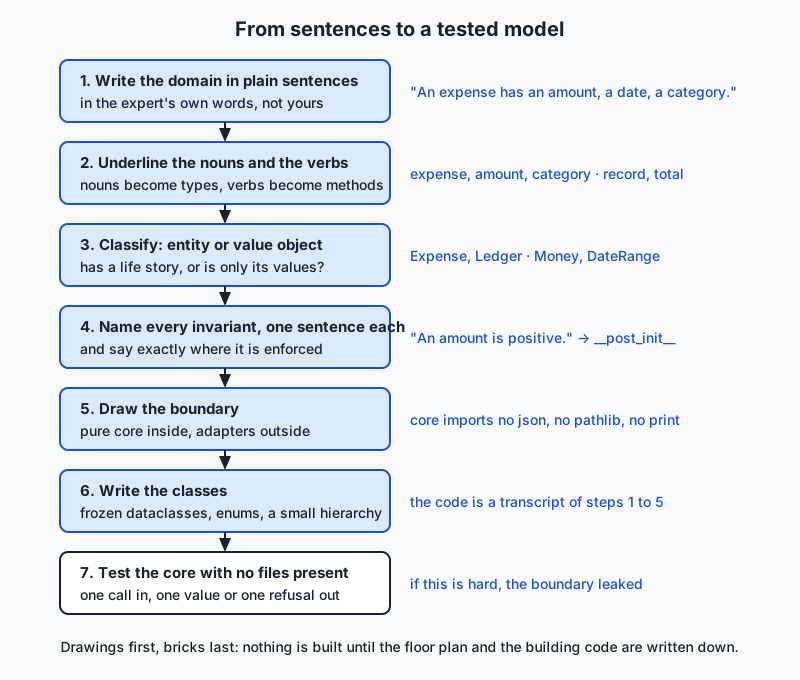
Today’s method turns those three ingredients into eight repeatable steps, demonstrated end to end on one running example.
Historical background
Objects were invented to model the world. Simula 67, designed by Ole-Johan Dahl and Kristen Nygaard at the Norwegian Computing Center in Oslo, introduced classes and objects for the specific purpose of writing simulations — of ships in a harbour, of customers in a queue. The point of an object was never encapsulation for its own sake; it was that a thing in the program could stand for a thing in the world. Dahl and Nygaard received the Turing Award in 2001 for that idea. Alan Kay, whose Smalltalk work at Xerox PARC in the 1970s carried the idea further, made the same argument in a different vocabulary: objects as independent entities that model something and communicate by messages.
The vocabulary this lesson uses was assembled by Eric Evans in Domain-Driven Design: Tackling Complexity in the Heart of Software (Addison-Wesley, 2003). That book named the patterns practitioners had been circling for years: ubiquitous language, the shared vocabulary between developers and domain experts; entities, objects with identity and a life cycle; value objects, objects defined entirely by their attributes; and repositories, objects that hide how a model is stored. Also in 2003, Martin Fowler published a short piece named “AnemicDomainModel”, warning about the very common failure mode where classes hold data and nothing else while all the behaviour drifts into a separate layer of procedures — an object-oriented design, he argued, with the object-orientation removed. Alistair Cockburn described the complementary structural idea in 2005 as hexagonal architecture, or ports and adapters: an application core surrounded by interchangeable adapters, with all dependencies pointing inward.
Python gained purpose-built tools for this style relatively late. Enumerations arrived in Python 3.4 through PEP 435, giving closed sets a first-class representation. Type hints arrived in Python 3.5 through PEP 484. Dataclasses arrived in Python 3.7 through PEP 557, and it is dataclass(frozen=True) that makes a proper value object a three-line affair rather than a page of boilerplate. Everything in this lesson is an old idea meeting a modern, concise expression of it.
What it is — and what it is not
Modelling a domain with objects is the practice of turning stated rules into types that cannot represent an invalid state, arranging those types so the rules live with the data they constrain, and drawing a boundary so the rules can be exercised without touching the outside world.
It is not “using classes.” You can write a hundred classes and have no model — that is what the god object and the anemic model both are. It is not an architecture ceremony: the whole model in this lesson is about a hundred and eighty lines. It is not a database schema. A schema describes how bytes are stored; a model describes what is true. They often disagree, and a repository exists precisely to translate between them. And it is not a promise of completeness: a model deliberately leaves out everything the stated rules do not mention. Modelling lockers, trainers, and refunds when nobody asked for them is the fastest way to make a small model unmaintainable.
| Common misconception | The reality |
|---|---|
| ”A domain model is what you do on big enterprise systems.” | The payoff arrives at about a hundred lines. A single script with money in it already benefits from a Money type. |
| ”Classes are just dicts with dots.” | A dict cannot refuse to be wrong. A class with a validating initializer can, which is the entire point. |
| ”Getters and setters make it object-oriented.” | Behaviour makes it object-oriented. A class with fields and no rules is an anemic model with extra typing. |
| ”Model the database tables and you have a model.” | Storage shape and rule shape differ. Model the rules; let a repository translate to whatever the tables need. |
| ”More inheritance means better design.” | Inheritance earns its keep roughly once per small model. Composition and plain functions carry the rest. |
Why it was created and what problems it solves
Each element of the method defeats a specific failure.
Without meaningful types you get primitive obsession: money as a float, a date as a string, a category as a string. Then 0.1 + 0.2 is 0.30000000000000004, "2026-13-01" parses fine as text and blows up three functions later, and "grocerys" becomes a silently valid category. Nothing is validated because there is nowhere to put the validation. Real types solve this by giving each rule a home.
Without rules living inside the objects you get the anemic model: data classes plus a sprawl of loose functions, each of which must remember to re-check what the others check. Every new caller is a new chance to forget. Behaviour on the object solves this, because the only way to obtain an Expense is through the code that validates one.
Without a boundary you get a model you cannot test. If computing a monthly total requires a file on disk, then every test needs fixtures, tests get slow, slow tests get skipped, and untested rules quietly rot. A pure core solves this: a test is one call in and one value — or one refusal — out.
Without a repository, storage decisions leak everywhere. Change from CSV to SQLite and you edit forty places. One class that owns persistence solves this: you edit one.
And without domain errors you get a program that reports its problems in the language of the machinery — a KeyError from a dict three layers down — instead of the language of the problem. A small exception hierarchy solves this: the outer layer catches one base class and says something a human can act on.
How it works
Here is the shape you are building toward. Read the arrows: they all point the same way, and that is the design.
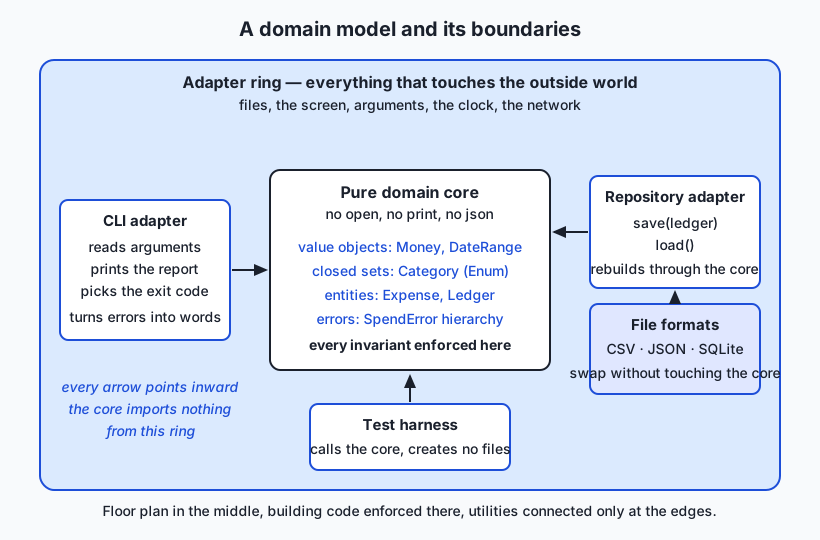
The method that gets you there has eight steps. The running example throughout is a small spending tracker, because that is what the Week 10 project asks you to build.
1. Write the domain in plain sentences
Before any code, write down what is true, in the words of whoever knows. For the tracker:
- A tracker records what you spent, when, and on what.
- An expense has a reference, a date, an amount, a category, and a note.
- An amount is money: whole cents in one currency, never negative, and you never add euros to dollars.
- A category is one of a fixed set: groceries, transport, rent, fun.
- A ledger holds many expenses, in one currency, and can total them, total them per category, and report a period.
- A period is a start date and an end date; it never ends before it starts.
- Anything the rules forbid is refused with a clear error.
2. Underline the nouns and the verbs
Nouns are candidate types; verbs are candidate methods, and the noun nearest a verb usually owns it.
- Nouns: tracker, expense, reference, date, amount, money, cents, currency, category, note, ledger, period, error.
- Verbs: record, total, total per category, report a period, refuse.
record is something a ledger does. total is something a ledger does. Adding is something money does. Already the methods have homes.
3. Separate entities from value objects
This is the decision that shapes everything else, and two questions settle it every time. Would I still call it the same thing after every one of its values changed? If yes, it has identity — it is an entity. Would two of them with identical values be interchangeable? If yes, it is a value object.
| Entity | Value object | |
|---|---|---|
| Identified by | an identity field that never changes | all of its values together |
| Equality | same identity means same thing | same values means same thing |
| Mutability | changes over a life cycle | immutable — frozen |
| Hashing | hash the identity | hash the values |
| In this model | Expense, Ledger | Money, DateRange, Category |
| Python spelling | @dataclass(eq=False) plus explicit equality | @dataclass(frozen=True) |
Money is the archetype. It is frozen, it compares by value, it stores whole cents as an integer, and it refuses to add two currencies:
@dataclass(frozen=True)
class Money:
    cents: int
    currency: str

    def __post_init__(self):
        if not isinstance(self.cents, int) or isinstance(self.cents, bool):
            raise InvalidMoney(f"money is whole cents, got {self.cents!r}")
        if self.cents < 0:
            raise InvalidMoney(f"money cannot be negative, got {self.cents}")
        if len(self.currency) != 3 or not self.currency.isupper():
            raise InvalidMoney(f"currency must be a code like EUR, got {self.currency!r}")

    def __add__(self, other):
        if not isinstance(other, Money):
            return NotImplemented
        if other.currency != self.currency:
            raise CurrencyMismatch(f"cannot add {other.currency} to {self.currency}")
        return Money(self.cents + other.cents, self.currency)
Two behaviours worth seeing directly, both from a real run:
Money(4215,'EUR') == Money(4215,'EUR') -> True
Money(4215,'EUR') == Money(4215,'USD') -> False
assigning to a frozen value object -> FrozenInstanceError: cannot assign to field 'cents'
Why integer cents rather than a float? Not because every float sum drifts — sum(0.10 for _ in range(10)) really is exactly 1.0. The problem is that you cannot predict which sums drift. In the same interpreter, 0.1 + 0.2 is 0.30000000000000004. A representation whose correctness depends on which particular numbers a user happens to enter is not a representation you can defend in a report. Integers always add exactly, so the question never arises.
Expense, by contrast, is an entity. Its reference identifies it; everything else can change:
same reference, all values changed -> True 1That is a == b being True and a set containing both landing on one element, even though the amount, the category, and the note all differ.
4. Name the invariants and choose where each is enforced
An invariant is a sentence that must be true of a valid model at all times. Write each one in one sentence, then name the exact place that refuses to let it break. If you cannot name the place, the rule is not enforced — it is a hope.
| Invariant | Enforced where | Error raised |
|---|---|---|
| An amount is whole cents, never negative | Money.__post_init__ | InvalidMoney |
| Two currencies are never added | Money.__add__ | CurrencyMismatch |
| An expense amount is strictly positive | Expense.__post_init__ | InvalidMoney |
| A category is one of the four | Expense.__post_init__, and Category itself | UnknownCategory, ValueError |
| A period never ends before it starts | DateRange.__post_init__ | InvalidPeriod |
| Every expense in a ledger shares its currency | Ledger.record | CurrencyMismatch |
| A period’s total equals the sum of its expenses | Ledger.total, by construction | — |
Notice the three enforcement points. __post_init__ is where a dataclass validates values that are already assembled. A plain initializer is where a non-dataclass does the same. And a service method on the object that owns the collection — Ledger.record — is where a rule that spans more than one object lives, because no single value object can see enough to check it. The last row is a different kind of rule: it is not checked, it is made unbreakable by only ever computing the total one way.
5. Draw the boundary
Split the code in two. The core holds the types and the rules and imports nothing that touches the world: no json, no pathlib, no open, no print, no input, no os. The adapters hold everything else — the command-line front end, the repository, the report printing. Dependencies point inward only: adapters import the core; the core imports no adapter.
This is Day 63’s functional core and imperative shell, promoted from functions to types. The payoff is the same and larger: the entire rulebook can be exercised from an empty directory, with no fixtures, in milliseconds. If a test of a rule needs a file, the boundary has leaked.
6. Model relationships with composition — and use inheritance once
A Ledger has many expenses. That is composition, and it is the right answer for nearly every relationship in a small model. Give the container the dunder protocols so it behaves like the collection it is:
@dataclass
class Ledger:
    currency: str
    expenses: list = field(default_factory=list)

    def record(self, expense):
        if expense.amount.currency != self.currency:
            raise CurrencyMismatch(
                f"ledger is in {self.currency}, expense is in {expense.amount.currency}"
            )
        self.expenses.append(expense)
        return expense

    def __len__(self):
        return len(self.expenses)

    def __iter__(self):
        return iter(self.expenses)
There is exactly one place in this model where inheritance genuinely earns its keep: reports. Several reports share a rendering procedure and differ only in a title and a list of lines. That is the classic template-method shape, and a base class expresses it without repetition:
class Report:
    def title(self):
        raise NotImplementedError

    def lines(self):
        raise NotImplementedError

    def render(self):
        return "\n".join([self.title()] + [f"  {line}" for line in self.lines()])
MonthlyReport and LargestReport each supply a title and lines and inherit render. The honest alternative is a plain function, render(title, lines), called by two independent classes or even two functions — and for two reports that is entirely defensible. The base class starts paying only when the shared procedure grows (widths, totals, a footer) or when a fourth and fifth report arrive. Write the function first; promote it to a base class when the third subclass shows up, not before.
7. Persistence is a boundary concern
Storage belongs in one class — a repository — with two public operations, save and load, plus private translators between domain shape and file shape. Everything the file format knows lives there.
The crucial detail is on the way back in: load rebuilds every value through the domain constructors, so a hand-edited file is refused rather than silently poisoning the model. Here is a real round trip through a CSV repository, then the same file with one amount edited to a negative number:
reference,spent_on,cents,currency,category,note
E-001,2026-04-02,4215,EUR,groceries,weekly shop
E-003,2026-04-05,95000,EUR,rent,April rent
reloaded total: 992.15 EUR | same as original: True
hand-edited bad file -> InvalidMoney: money cannot be negative, got -95000
Swapping CSV for JSON or SQLite now means writing a second repository class with the same two methods. The core never learns that anything changed.
8. Errors are part of the model
Give the domain its own exception hierarchy with one base class, as you learned on Day 66:
class SpendError(Exception):
    """Any rule of the spending domain that was refused."""

class InvalidMoney(SpendError): ...
class CurrencyMismatch(SpendError): ...
class InvalidPeriod(SpendError): ...
class UnknownCategory(SpendError): ...
Now the outermost adapter catches one thing and translates it. except SpendError means “a rule was broken” — a message and exit code 1. except OSError means “the disk or the path is wrong” — a different message and a different exit code. Anything else is a bug, and should be allowed to crash loudly.
An everyday analogy
An architect does not start with bricks. She starts with drawings, and the drawings come in three kinds, which map exactly onto the three things you have just built.
The floor plan is your entities and their relationships: these rooms exist, this one contains those, the corridor connects them. It says what the building is before anyone argues about paint. Your Ledger containing many Expense objects, each holding a Money and a Category, is a floor plan.
The building code is your invariants: a stair riser is at most this high, a bedroom has a window of at least this area, a beam over this span is at least this deep. Nobody negotiates with the building code on site at four in the afternoon — it is checked before the pour, at the one place where it can still be enforced cheaply. Your __post_init__ methods are the inspection, and they happen at construction, before anything is built on top.
The utilities connections — water, power, drains — enter at the edges of the plan, at marked points. The rooms do not each drill their own hole to the street. Your adapters are those connections: the repository at one edge, the command line at another. Change from a septic tank to mains drainage and you re-plumb the connection, not the bedrooms.
The analogy carries one more way, and it is the one people miss. You can draw a floor plan for a building that has not been built, and show it to the client, and they can tell you it is wrong — cheaply, on paper. That is what step 1 to step 4 of the method buys you: the chance to be wrong on a worksheet instead of in three hundred lines of code.
Examples in practice
Here is the finished core driven end to end. The output below is a real run, not a sketch.
ledger = Ledger("EUR")
rows = [
    ("E-001", date(2026, 4, 2), 4215, Category.GROCERIES, "weekly shop"),
    ("E-002", date(2026, 4, 3), 275, Category.TRANSPORT, "bus"),
    ("E-003", date(2026, 4, 5), 95000, Category.RENT, "April rent"),
    ("E-004", date(2026, 4, 11), 1850, Category.FUN, "cinema"),
    ("E-005", date(2026, 4, 18), 3790, Category.GROCERIES, "market"),
    ("E-006", date(2026, 5, 2), 4400, Category.GROCERIES, "weekly shop"),
]
for ref, day, cents, cat, note in rows:
    ledger.record(Expense(ref, day, Money(cents, "EUR"), cat, note))

april = DateRange(date(2026, 4, 1), date(2026, 4, 30))
print(MonthlyReport(ledger, april).render())
print(LargestReport(ledger, 3).render())
Spending 2026-04-01 .. 2026-04-30
fun 18.50 EUR
groceries 80.05 EUR
rent 950.00 EUR
transport 2.75 EUR
total 1051.30 EUR
Largest 3 expenses
2026-04-05 950.00 EUR rent — April rent
2026-05-02 44.00 EUR groceries — weekly shop
2026-04-02 42.15 EUR groceries — weekly shop
expenses recorded: 6
whole-ledger total: 1095.30 EURCheck the arithmetic yourself: April’s groceries are 42.15 plus 37.90, which is 80.05; the April total is 80.05 plus 2.75 plus 950.00 plus 18.50, which is 1051.30; and the whole ledger adds May’s 44.00 to reach 1095.30. Every one of those sums is integer addition on cents, so it is exact by construction, not by luck.
Now the more interesting half — the model refusing to be wrong. Each line below is a real exception message produced by breaking one rule on purpose:
Rules the model refuses to break
  a negative amount: InvalidMoney: money cannot be negative, got -500
  an amount as a float: InvalidMoney: money is whole cents, got 42.15
  a zero-value expense: InvalidMoney: an expense must be positive, got 0.00 EUR
  adding dollars to euros: CurrencyMismatch: cannot add USD to EUR
  a backwards period: InvalidPeriod: period 2026-04-30..2026-04-01 ends before it starts
  a dollar expense in a euro ledger: CurrencyMismatch: ledger is in EUR, expense is in USD
  a misspelled category: ValueError: 'groserys' is not a valid Category
That last line is the argument for enum.Enum in a single frame. A closed set — the categories, the plan tiers, the order states, the message roles — must be a type. With a plain string, "groserys" is accepted, stored, written to the file, and shows up months later as a category no report displays and no total includes. With an enum, the typo raises at the moment it is written, and the legal values are listed in exactly one place.
Which brings us to the failure catalogue. Every one of these is common, and every one of them is easy to spot once it has a name.
| Anti-pattern | What it looks like | Why it hurts | The fix |
|---|---|---|---|
| God object | One class — Tracker — that parses CSV, validates, totals, formats, and prints | Cannot be named in one sentence, cannot be tested in parts, every change touches it | Split by responsibility; give the core the rules and the adapters the world |
| Anemic model | Field-only classes plus loose functions holding every rule | Each new caller can forget a check; rules drift out of sync | Move the rule to the object that owns the data — validate at construction |
| Primitive obsession | float for money, str for dates and categories | Nowhere to put validation; silent wrong values | Money, date, Category — a type per concept |
| Premature inheritance | An abstract base with exactly one subclass | Indirection with no payoff; harder to read than the function it replaced | Write the function; promote it when the third case appears |
| Stringly typed | Status, tier, role, and category all plain strings | A typo travels far from where it was made | enum.Enum for every closed set |
| Leaky boundary | import json or a print inside the core | Rules can no longer be tested without files or captured output | Move it to an adapter; assert the core’s import list in a test |
One honest qualification on the anemic model, because Python is not Java. A module of plain frozen dataclasses plus a handful of pure functions that operate on them is a perfectly good design — it is close to how functional languages model domains, and it is often clearer than methods for pure calculations over data you do not own. The failure is not “functions exist.” The failure is when nothing enforces the invariants at construction, so an invalid object can exist at all. Keep validation in the type; put calculation wherever it reads best.
Finally, three questions that tell you whether a model is good. Can you state each rule in one sentence, and point at the line that enforces it? Does a change to one rule touch exactly one place? Can the whole core be tested with no files anywhere? Three yeses is a good model. A no is a precise instruction about what to fix.
Implications: security, privacy, performance, scalability, and cost
Security. Validation at construction is a security control, not just a tidiness habit. When the only way to obtain an Expense is through code that checks the amount, the category, and the currency, a hostile CSV cannot inject a negative rent or a category that no report displays. The boundary helps twice over: a core that imports nothing capable of I/O physically cannot delete a file, open a socket, or spend money, whatever input it is handed. Every dangerous capability is confined to a few readable lines in the adapter ring, which is the part you audit.
Privacy. A model makes data flow legible. Personal data enters through one adapter, is transformed by a pure core that cannot log or transmit anything, and leaves through another adapter. That is what lets you answer “where does this person’s spending history go?” by reading two small files instead of grepping a codebase. It also makes redaction implementable: a __repr__ on a value object is the single place to mask an account number.
Performance. Objects cost more than tuples — every Money is an allocation, and Ledger.total builds one new Money per expense. For thousands of records this is irrelevant; for millions in a hot loop it is measurable, and the standard remedies are to compute over the raw cents inside one method and wrap the result once, or to use slots=True on the dataclass to cut per-instance memory. Do that when a measurement says so, never before. The far larger performance fact is that a pure core is testable in milliseconds, so its tests actually run.
Scalability. Scalability here means of change, and that is what the repository buys. Moving from a CSV file to SQLite to a service is one new class implementing save and load. Adding a report is one subclass. Adding a category is one enum member and one line in whatever maps file values to it. A model scales in team size too: two people can work on the core and the adapters simultaneously because the seam between them is explicit.
Cost. The dominant cost of software is change, and a model concentrates change. The counter-cost is real and worth naming: modelling something with three fields and no rules is over-engineering, and every unnecessary type is a thing to read, name, and maintain forever. The sweet spot is the smallest set of types that gives every stated rule a home — no more.
Alternatives: free, open source, and commercial
There are five mainstream ways to hold and persist a domain model in Python. All five are free to use; the split that matters is between what ships with Python and what you install with pip.
| Approach | What it is | When to choose it | Cost |
|---|---|---|---|
| Dataclasses plus a repository | Frozen and mutable dataclasses for the model, one class owning CSV or JSON storage | The default for a small program with a few hundred to a few thousand records; what this lesson and the Week 10 project use | Free, in the standard library |
sqlite3 | Python’s built-in bindings to an embedded SQL database, one file on disk | When you need queries, indexes, transactions, or concurrent readers, but no server | Free, in the standard library |
| An object-relational mapper such as SQLAlchemy | A library that maps classes to database tables and generates SQL | Real database schemas, migrations, relationships across many tables, several backends | Free and open source, installed with pip; commercial hosting of the database is separate |
| pydantic | A library that validates and coerces data against typed models at a boundary | Validating untrusted input — request bodies, config files, model responses — where you want structured errors | Free and open source, installed with pip |
enum and NamedTuple | Standard-library types for closed sets and tiny immutable records | Closed sets always; NamedTuple for a small value with no rules to enforce | Free, in the standard library |
Dataclasses plus a repository — how, with an example. Model with @dataclass(frozen=True) for values and @dataclass for entities, validate in __post_init__, and put all file knowledge in one class. The worked example is the CSV round trip shown earlier: save writes six columns, load rebuilds every field through the domain constructors, and a hand-edited negative amount is refused with InvalidMoney rather than loaded.
sqlite3 — how, with an example. Connect, create a table, and use parameter placeholders — never string formatting — so the values stay data. This is a real run against an in-memory database:
import sqlite3
con = sqlite3.connect(":memory:")
con.execute("CREATE TABLE expense (reference TEXT PRIMARY KEY, spent_on TEXT, "
            "cents INTEGER, currency TEXT, category TEXT)")
con.execute("INSERT INTO expense VALUES (?,?,?,?,?)",
            ("E-001", "2026-04-02", 4215, "EUR", "groceries"))
print(con.execute("SELECT reference, cents, category FROM expense").fetchall())
[('E-001', 4215, 'groceries')]The shape of the swap is the point: this becomes a SqliteLedgerRepository with the same save and load, and the core is untouched.
An ORM such as SQLAlchemy — how, with an example. You declare mapped classes and let the library generate the SQL, then work in objects and sessions rather than rows. Sketched, the declaration reads like this (not run here, since the library is not part of the standard library):
class ExpenseRow(Base):
    __tablename__ = "expense"
    reference: Mapped[str] = mapped_column(primary_key=True)
    cents: Mapped[int]
    currency: Mapped[str]
Choose it when the schema is real and relational. The trap to avoid is letting the mapped classes become your domain model: keep them as the storage shape and translate, or your rules start depending on your tables.
pydantic — how, with an example. Define a model with type annotations and validators; it parses untrusted data and raises structured errors listing every bad field at once. Choose it at a boundary — an API request, a config file, a model’s JSON response — and keep it out of the core, so the core stays dependency-free:
class ExpenseIn(BaseModel):
    reference: str
    cents: int = Field(gt=0)
    currency: str
enum and NamedTuple — how, with an example. Use an enum for every closed set, always. Use NamedTuple when you want an immutable, tuple-compatible record with no validation to perform:
class Point(NamedTuple):
    cents: int
    currency: str
Point(cents=4215, currency='EUR') True 4215That real run shows value equality and attribute access. The reason this lesson still reaches for a frozen dataclass is __post_init__: a NamedTuple has nowhere clean to enforce a rule.
Comparison with related concepts
| Concept A | Concept B | Key difference |
|---|---|---|
| Entity | Value object | An entity has an identity that survives every value changing; a value object is its values and is frozen |
| Domain model | Database schema | The model says what is true; the schema says how bytes are stored. A repository translates between them |
| Repository | Data access scattered in place | A repository puts every storage decision in one class; scattered access spreads them through the program |
| Domain exception | Built-in exception | A domain exception names a broken rule; a KeyError names a broken mechanism. Adapters translate the first into human sentences |
| Composition | Inheritance | Composition says “has a” and is almost always right; inheritance says “is a” and earns its place when several classes share a real procedure |
| Enum | String constant | An enum makes an illegal value impossible at the moment it is written; a string makes it possible forever |
| Domain model | Anemic model | Both have classes. In a model the rules live with the data; in an anemic model the classes are field bags and the rules float free |
When to use it — and when not to
Reach for a domain model whenever the problem has rules. Money, dates, quantities, statuses, quotas, limits, states with legal transitions — the moment a sentence in the requirements starts with “must”, “never”, or “at most”, you have an invariant that needs a home. Reach for it when a program will outlive the afternoon, when more than one person will touch it, or when getting a value wrong costs something real. The Week 10 project is precisely this case, which is why the modelling worksheet is its first step rather than an afterthought.
Do not reach for it when the data has no rules. A script that reads a CSV, sums one column, and prints the answer should read the CSV, sum the column, and print the answer. Wrapping three values in two classes to do that is over-engineering — the same failure as the god object, approached from the other side. Nor should you model the whole world: build only the types the stated rules mention, and add the seventh type when the seventh rule arrives.
There is a middle case worth naming, because you will meet it constantly: a program with one rule. Almost always the right move is one value object — usually Money — and plain functions around it. That is the entire method, correctly scaled down.
This is the last day of Week 10, and the week now connects. Day 64 gave you files, Day 65 gave you CSV and JSON, and today those became the repository at one edge. Day 66 gave you exceptions, which became the domain error hierarchy. Day 67 gave you classes, Day 68 gave you composition and the dunder protocols, which became the Ledger that has many expenses and answers len and iteration. Day 69 gave you dataclasses and type hints, which became the frozen value objects. And Day 63, from the week before, gave you the pure core and the thin shell, which today grew from functions into types. The Expense Tracker project takes this exact model and adds the CSV import, the atomic save, and the command-line front end.
And here is where it points. Every serious AI application is a domain with rules, and the ones that survive are the ones that were modelled. You will work with documents and the chunks split from them; embeddings that must match their model and dimension or the comparison is meaningless; conversations made of messages with a role from a closed set; tools with names and typed arguments; eval runs with a dataset, a metric, and a score. Every one of those is an entity or a value object with invariants — a chunk belongs to exactly one document, an embedding’s dimension never changes, a message’s role is one of a fixed few, a token count is a non-negative integer, a cost is money. Model them, and a change to the chunking strategy touches one class. Skip the modelling, and you get the script everyone recognises: prompts, model calls, parsing, retries, and storage tangled into one function that nobody can test without spending money. The pure-core-and-adapters split is exactly how you keep prompt construction and scoring — pure, testable, free to run — apart from the model calls and the database, which are the slow, costly, mockable edges. The discipline you practise today on a gym and a spending tracker is the same discipline, unchanged, at the scale of the systems you are heading toward.
Knowledge check
Try these from memory before looking back:
- State the two questions that decide whether a noun is an entity or a value object, and answer them for
Moneyand forExpense. - Name three places an invariant can be enforced, and give an example rule for each.
- Why is a category an
enum.Enumrather than a string? Give the concrete failure the string version allows. - What does a repository buy you, and what would you have to change to move from JSON to SQLite?
- Explain the anemic model in one sentence, then say when field classes plus plain functions are nonetheless a fine design in Python.
- Why must the domain core import no module that performs input or output?
Hands-on exercise
Time to model a domain from nothing but a page of sentences. In the Day 70 lab you build the membership model for Northside Gym — deliberately a different domain from the lesson’s spending tracker, so the Week 10 project stays a fresh exercise. The lab gives you eleven plain-English rules from the gym’s owner, a worksheet to model on, and a starter with six exercises. Work in the lab directory; every command below is run from there.
First read the rules, then fill in the worksheet before writing code — the nouns and verbs, the entity-versus-value-object classification, the invariants and their enforcement points, and the boundary table:
cat examples/domain-rules.md
open starter/domain-worksheet.md   # or your editor of choice
Now drive the finished reference so you know the target — the roster, the monthly revenue, a save-and-reload round trip, and every rule being refused in turn:
python3 examples/demo.py club.jsonCall the pure core directly, with no files and no adapter, to see why the boundary matters:
PYTHONPATH=examples python3 -c "import gym_core as g; print(g.Money(2900, 'EUR') + g.Money(4900, 'EUR'))"Then open starter/gym_core.py and complete its six numbered exercises — the MembershipNumber and Money value objects, DateRange, Plan, the Member entity with identity-based equality and its check-in limit, and the Club that refuses duplicates and unknown members — followed by the repository exercise in starter/gym_repository.py. Finally, run the suite:
bash tests/run_tests.shExpected output
The reference run produces exactly this (a real captured session):
Northside Gym — roster
  GYM-0001  Ada    joined 2026-01-15  plan basic (29.00 EUR)  April check-ins: 4
  GYM-0002  Grace  joined 2026-02-01  plan plus (49.00 EUR)  April check-ins: 15
  GYM-0003  Ada    joined 2026-03-09  plan basic (29.00 EUR)  April check-ins: 0
  monthly revenue: 107.00 EUR

Saved to club.json and reloaded — round trip intact: True

Rules the model refuses to break
  a membership number that is not GYM-####: InvalidMembershipNumber: membership number must look like GYM-0001, got '0007'
  a negative price: InvalidMoney: money cannot be negative, got -100 cents
  adding dollars to euros: CurrencyMismatch: cannot add USD to EUR
  enrolling a number twice: DuplicateMember: GYM-0001 is already a member of Northside Gym
  a member the club never met: UnknownMember: GYM-9999 is not a member of Northside Gym
  a 13th basic check-in in one month: CheckInLimitExceeded: GYM-0003 is on the basic plan and already used all 12 check-ins in 2026-04
The test suite prints one line per check and ends with 33 checks, 0 failure(s). while the starter is still unfinished.
Validate your work
python3 examples/demo.py club.jsonexits 0 and reportsround trip intact: True.- The two members both named Ada have different membership numbers and are treated as different people, while the roster is ordered by number.
- The monthly revenue is
107.00 EUR— check it by hand: 29.00 plus 49.00 plus 29.00. - Grace, on the plus plan, records fifteen April check-ins without complaint; the third member’s thirteenth basic check-in is refused.
bash tests/run_tests.shends with33 checks, 0 failure(s).and exits 0.- Searching your own
starter/gym_core.pyforjson,open,print,Path, andinputfinds nothing — the test suite checks this too. - Every row of the worksheet is filled in, including the anti-pattern checklist, in sentences rather than single words.
Troubleshooting
The lab’s troubleshooting.md covers the full list. The four you are most likely to meet: NotImplementedError from the starter, which is expected until you finish an exercise; FrozenInstanceError when you try to assign to a field of a frozen dataclass, which means the value object is working exactly as designed and you should build a new one instead; TypeError: unhashable type when you put an entity in a set after defining __eq__ without __hash__; and a ModuleNotFoundError for gym_core, which means you ran a file from the wrong directory or forgot PYTHONPATH=examples.
Common mistakes
- Writing the classes before the worksheet. The worksheet is the design; the classes are the transcript. Skipping it produces a model shaped like your first guess.
- Making an entity frozen, or a value object mutable. A member has to change; a price must not.
- Defining
__eq__on an entity and forgetting__hash__. Python then sets the hash toNone, and the object cannot go in a set or be a dict key. - Letting a
printor animport jsoninto the core. It works, and it destroys the property that made the core testable. - Storing the price as a float. It looks fine on three examples and then produces a revenue total ending in a long tail of digits.
- Using a string for the plan tier. The typo will not surface until a report quietly omits a member.
Practice assignment
Take a domain you actually know — a book club, a bus timetable, a chore rota, a five-a-side league — and write it up the way the gym owner did: numbered plain-English sentences, ten to twelve of them, including at least three that say “must”, “never”, or “at most”, and a short vocabulary list. Then run the full method on it. Fill in a worksheet: nouns and verbs; each noun classified as an entity or a value object with a one-sentence justification; every invariant in one sentence with its enforcement point named; and a boundary table saying which module owns which responsibility. Finally, implement the core in a single file — frozen dataclasses for the values, an enum for every closed set, a domain exception hierarchy — and write a small test script that exercises every invariant from an empty directory, with no files present. Your deliverable is three files: the rules, the worksheet, and the core with its tests, plus the captured output of the test run.
Extension challenge
Extend the gym model in the lab three ways, each of which forces a genuine modelling decision rather than more typing.
Add a third tier. Introduce a STUDENT tier at a lower price with a monthly check-in limit of its own. Count how many files you had to change; if it was more than the enum, the limits table, and the plan construction, the closed set had leaked somewhere and you have just found where.
Add a second repository. Write a CsvClubRepository with the same save and load methods as the JSON one, storing one row per member with the check-ins in a separate file or a single quoted field. Then prove the swap is free: run the demo against each repository in turn and confirm the roster, the revenue, and the round-trip check are identical. If the core needed even one edit, the boundary was not where you thought.
Model billing. Add a BillingPeriod report using the existing DateRange, producing the amount due for one member over one period, and decide deliberately — writing your reasoning down — whether it belongs on Member, on Club, or in a separate report class inheriting from a small Report base. Then state the invariant your answer implies, in one sentence, and name the line that enforces it. That final sentence is the skill this whole day exists to build.
Quiz
Q1. Which question best decides that a noun should be modelled as an entity rather than a value object?
- Does it have more than three fields?
- Will it ever be written to a file?
- Would I still call it the same thing after every one of its values changed?
- Does it appear more than once in the requirements?
Show answer
Answer: C. Would I still call it the same thing after every one of its values changed?
Identity is the test. If a member keeps their name changed, their plan switched and fifty check-ins added and is still the same member, the thing has a life cycle and an identity — an entity. Field count, storage and frequency have nothing to do with it. The mirror question settles value objects: two of them with identical values would be interchangeable, so they are defined entirely by their values.
Q2. Why does a value object such as Money get written as a frozen dataclass?
- Because it must be compared by value and can never drift after it has been validated
- Because frozen dataclasses are faster to construct than mutable ones
- Because only frozen dataclasses can define __post_init__
- Because freezing is required before an object can be written to JSON
Show answer
Answer: A. Because it must be compared by value and can never drift after it has been validated
A value object IS its values, so it needs value equality — which a dataclass generates — and it must not change after construction, or the validation done in __post_init__ would no longer be true. Freezing gives both. It is not a speed feature, __post_init__ works on any dataclass, and JSON serialisation is entirely unrelated.
Q3. A rule says "every expense in a ledger must be in the ledger's currency." Where does that invariant belong?
- In Money.__post_init__, because the rule mentions currency
- In the command-line adapter, just before the expense is created
- In the CSV importer, because that is where most expenses come from
- In Ledger.record, because it is the only place that can see both the ledger and the expense
Show answer
Answer: D. In Ledger.record, because it is the only place that can see both the ledger and the expense
The rule spans two objects, so it must be enforced where both are visible — the service method on the object that owns the collection. Money cannot see the ledger. Enforcing it in an adapter or an importer means every other path into the ledger can bypass it, which is exactly how invariants quietly stop holding.
Q4. What is the practical argument for storing money as whole integer cents rather than as a float?
- Summing floats always accumulates error, so float totals are always wrong
- You cannot predict which float sums will drift — 0.1 + 0.2 gives 0.30000000000000004 — while integer addition is always exact
- Floats cannot represent values above about one million, so large totals overflow
- The dataclasses module refuses to store a float in a frozen field
Show answer
Answer: B. You cannot predict which float sums will drift — 0.1 + 0.2 gives 0.30000000000000004 — while integer addition is always exact
The honest version matters. Some float sums are exact: sum(0.10 for _ in range(10)) really is 1.0. But 0.1 + 0.2 is 0.30000000000000004, and you cannot tell in advance which of your users' numbers will land badly. A representation whose correctness depends on which values arrive is indefensible in a financial report; integers add exactly, every time, so the question never comes up.
Q5. What is an "anemic domain model"?
- A model with too few classes to express the problem
- A model whose classes all inherit from one abstract base
- A model that keeps its data in a database rather than in memory
- Classes that hold data only, while all the rules live in loose functions elsewhere
Show answer
Answer: D. Classes that hold data only, while all the rules live in loose functions elsewhere
Martin Fowler named this in 2003: it looks object-oriented — there are classes with fields — but the objects hold no behaviour, so every rule sits in separate procedures and every new caller can forget one. Note the Python qualification: frozen dataclasses plus pure functions are a fine design, provided the invariants are still enforced at construction so an invalid object cannot exist at all.
Q6. What does a repository object buy you?
- Every storage decision lives in one class, so swapping CSV for JSON or SQLite touches only that class
- It makes the domain objects serialise themselves automatically
- It removes the need to validate data that is read back from disk
- It guarantees that saving is faster than writing the file directly
Show answer
Answer: A. Every storage decision lives in one class, so swapping CSV for JSON or SQLite touches only that class
A repository is the single place that knows how the model is stored, with save and load as its whole public surface. Change the format and you rewrite one class. It does not remove the need for validation — quite the opposite: load rebuilds every value through the domain constructors, which is what makes a hand-edited file fail loudly instead of poisoning the model.
Q7. Why should a closed set such as a plan tier or an expense category be an enum.Enum rather than a string?
- Enums use less memory than strings
- Only enums can be used as dictionary keys
- A typo raises immediately, and the legal values are written down in exactly one place
- Enums serialise to JSON automatically while strings do not
Show answer
Answer: C. A typo raises immediately, and the legal values are written down in exactly one place
With a string, "groserys" is accepted, stored, written to the file, and surfaces months later as a category no report shows. With an enum, Category("groserys") raises ValueError at the moment the typo is written, and the set of legal values exists once instead of being scattered through comparisons. Strings are perfectly usable as dict keys, and enums need explicit conversion for JSON.
Q8. Which of these is the clearest sign that the boundary between the domain core and its adapters has leaked?
- The core module is longer than the adapter modules
- A test of a domain rule cannot run without creating a file
- Two different classes both raise the same exception type
- A value object defines both __eq__ and __hash__
Show answer
Answer: B. A test of a domain rule cannot run without creating a file
The whole point of a pure core is that a rule can be exercised with one call in and one value or refusal out, from an empty directory. The moment a rule test needs a fixture on disk, some part of the core is touching the world — an import of json or pathlib, an open, or a print. Core length, shared exception types and value-object hashing are all normal and say nothing about the boundary.
Glossary
- Domain
- The slice of the real world a program is about — gym memberships, spending, appointments, a document index. The domain is what the rules describe, before any decision about code.
- Domain model
- A set of objects and rules that mirror a domain closely enough that the code reads like the problem: meaningful types, rules living with the data they constrain, and a boundary separating them from files and screens.
- Ubiquitous language
- The shared vocabulary of the domain expert and the code. If the owner says member, plan, tier and check in, the code says Member, Plan, PlanTier and check_in — every translation between the two vocabularies is a place a misunderstanding can hide.
- Entity
- An object with an identity and a life cycle: it stays the same thing even after every one of its values changes. Identified by an identity field, compared on that field, and usually mutable — a Member, a Ledger.
- Value object
- An object defined entirely by its values, so two with identical values are interchangeable. Immutable (a frozen dataclass in Python), compared and hashed by value — Money, DateRange, a membership number.
- Invariant
- A sentence that must be true of a valid model at all times, such as "an expense amount is positive". Every invariant needs a named enforcement point; a rule with no enforcement point is a hope, not a rule.
- __post_init__
- The method a dataclass calls after its generated initializer has assigned the fields. It is the standard place to validate a value object, raising a domain exception before any invalid instance can escape.
- Pure domain core
- The module holding the types and rules, importing nothing that performs input or output — no json, pathlib, open, print or input. Because it cannot touch the world, its rules can be tested from an empty directory.
- Adapter
- Code at the edge that connects the pure core to the outside world: a command-line front end, a repository, a report printer. Adapters import the core; the core imports no adapter, so every dependency points inward.
- Repository
- The one object that knows how a model is stored, with save and load as its public surface plus private translators between domain shape and file shape. Swapping CSV for JSON or SQLite means writing one new repository class.
- Domain exception hierarchy
- A family of exceptions with a single base class — for example SpendError — raised whenever a domain rule is refused, so an adapter can catch one type, know it is holding a broken rule rather than a bug, and translate it into a human message.
- Anemic domain model
- A design in which classes hold data only while every rule lives in loose functions elsewhere. Named by Martin Fowler in 2003; the harm is that each new caller can forget a check. Field classes plus pure functions are fine in Python provided invariants are still enforced at construction.
- Primitive obsession
- Representing domain concepts with built-in types — a float for money, a string for a date or a category — so there is nowhere to put validation and wrong values pass silently. The fix is one meaningful type per concept.
- Stringly typed
- Using plain strings for values that belong to a closed set, such as a status, a role or a tier, so a typo is accepted where it is written and fails somewhere far away. enum.Enum makes the typo impossible.
- God object
- A single class that parses, validates, calculates, formats and prints. It cannot be described in one sentence, cannot be tested in parts, and every change touches it. The remedy is to split by responsibility and push the world to the adapters.
Sources and further reading
- dataclasses — Data Classes — Python Software Foundation (accessed 2026-07-19)
- enum — Support for enumerations — Python Software Foundation (accessed 2026-07-19)
- Classes — Python Software Foundation (accessed 2026-07-19)
- Domain-driven design — Wikipedia (accessed 2026-07-19)
- AnemicDomainModel — martinfowler.com (accessed 2026-07-19)
Kept in this browser, no account needed. Your progress page turns the whole record into one link you can bookmark or open on another device.