210 of 365 lessons written · 210 labs released

One year. Nine courses. Every day.

A complete, self-paced path from how a computer actually works to shipping production AI systems — one substantial lesson and one hands-on lab every single day. No prerequisites beyond curiosity, and every lab runs on free and open-source tools.

365days
52weeks
9courses
210lessons written
210labs released

The whole year, end to end

where this takes you

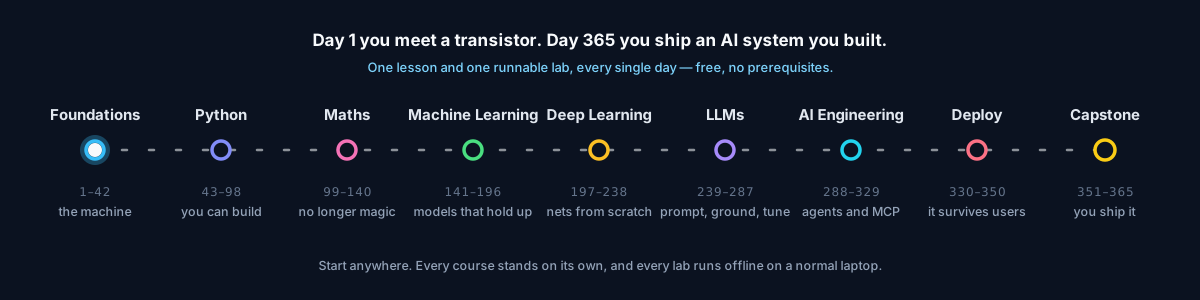
The 365-day journey: nine courses on one path, from Computing Foundations on Day 1 through Python, maths, machine learning, deep learning, large language models, AI engineering and deployment, to shipping your own capstone on Day 365

The nine courses

foundations → production

Course01 · 42/42 written

Computing Foundations

How computers, operating systems, the command line, networks, and developer tooling actually work — the bedrock every AI practitioner builds on.

Course02 · 56/56 written

Programming with Python

From first program to tested, packaged, database-backed applications — the working programming skill AI work demands.

Course03 · 42/42 written

Math, Statistics, and Data

The linear algebra, calculus, probability, and data-analysis skills that make machine learning understandable rather than magical.

Course04 · 56/56 written

Machine Learning

Classical machine learning done properly: models, evaluation, feature work, and the discipline that separates working systems from leaderboard tricks.

Course05 · 14/42 written

Deep Learning

Neural networks from first principles to transformers: build them, train them, debug them, and understand the hardware they run on.

Course06 · 0/49 written

LLMs and Generative AI

Large language models as a working material: how they are made, how to prompt and call them, how to ground them with retrieval, customize them, and go multimodal.

Course09 · 0/15 written

Capstone

Two weeks to design, build, evaluate, secure, deploy, and present a complete AI application of your own.

How this works

what you get each day

A lesson you can read in one sitting

Written prose, not slides — with worked examples, a quiz to check yourself, and a glossary of every term it introduces.

A lab you actually run

Starter files with numbered exercises, a reference implementation, automated tests that exit zero when you are done, and genuinely captured expected output.

Honest progress

Days that are titled but not yet written are marked planned, never dressed up as finished. The counters above are computed from what is actually on disk.

The full curriculum

every day, in order

Computing Foundations 42/42
Programming with Python 56/56
Math, Statistics, and Data 42/42
Machine Learning 56/56
Deep Learning 14/42

Sequence Models and Transformers

218 Text Preprocessing and Tokenization 219 Word Embeddings 220 Recurrent Neural Networks 221 LSTMs and GRUs 222 Sequence-to-Sequence and Early Attention 223 Text Classification with Embeddings 224 A Sentiment Analysis Project 225 “Attention Is All You Need” 226 Self-Attention, Step by Step 227 The Transformer Architecture 228 Encoder Models: BERT and Friends 229 Decoder Models: The GPT Family 230 Hugging Face Transformers in Practice 231 Fine-Tuning a Small Transformer 232 GPUs and AI Hardware 233 Mixed Precision and Performance 234 Distributed Training Concepts 235 Experiment Tracking 236 Quantization and Distillation 237 Scaling Laws and What They Bought Us 238 Section Project: Reproducing a Paper
LLMs and Generative AI 0/49

Working with LLMs

239 How Large Language Models Are Trained 240 Pretraining, Fine-Tuning, and RLHF 241 The Model Landscape: Claude, GPT, Gemini, Llama 242 Open Weights versus Closed APIs 243 Tokens, Context Windows, and Sampling 244 Capabilities, Limits, and Hallucination 245 Benchmarking Models Yourself 246 Prompting Fundamentals 247 System Prompts and Role Design 248 Few-Shot Examples and Chain of Thought 249 Structured Output: Getting Reliable JSON 250 Prompt Patterns and Templates 251 Prompt Injection and Safe Prompting 252 A Tested Prompt Library 253 First Calls to the Claude API 254 The OpenAI-Compatible Ecosystem 255 Streaming Responses 256 Tool Use and Function Calling 257 Working with Images and Documents 258 Cost, Caching, and Rate Limits 259 Building a CLI Assistant

Retrieval and Customization

260 What Embeddings Are 261 Semantic Similarity Search 262 Vector Databases 263 Chunking Strategies 264 Hybrid Search and Rerankers 265 Evaluating Retrieval Quality 266 Semantic Search over Your Own Notes 267 The RAG Architecture 268 A Minimal RAG System from Scratch 269 RAG over PDFs and Messy Documents 270 Citations and Grounded Answers 271 Advanced RAG Patterns 272 Evaluating RAG Systems 273 A Documentation Assistant 274 Prompting versus RAG versus Fine-Tuning 275 Fine-Tuning with LoRA 276 Building Fine-Tuning Datasets 277 Running Local Models with Ollama 278 Quantized Inference and llama.cpp 279 Serving Open Models 280 Fine-Tune and Serve Your Own Model

Multimodal and Frontier

281 How Diffusion Models Generate Images 282 Image Generation in Practice 283 Speech: Recognition and Synthesis 284 Video and Music Generation 285 Multimodal Models 286 Generative AI Ethics and Copyright 287 Section Project: A Multimodal Application
AI Engineering: Agents and Applications 0/42

Agents and Tools

288 What an AI Agent Is 289 The Agent Loop: Reason, Act, Observe 290 Designing Tools for Agents 291 An Agent from Scratch 292 Agent Frameworks and When to Use Them 293 Multi-Agent Systems 294 Building a Research Agent 295 What MCP Is and Why It Exists 296 Using MCP Servers 297 Building an MCP Server 298 MCP Resources and Prompts 299 Building an MCP Client 300 MCP Security 301 Your Personal MCP Server 302 The AI Coding Landscape 303 Working with a Coding Agent 304 Effective Agentic Coding Workflows 305 Configuring Agents: Memory, Skills, and Rules 306 Reviewing and Trusting AI-Written Code 307 Coding Agents in CI and Automation 308 Shipping a Feature with an Agent

Production AI Systems

309 Why Evals Are the Real Moat 310 Building Evaluation Datasets 311 LLM-as-Judge 312 Regression Testing for Prompts and Models 313 Guardrails and Content Moderation 314 Observability and Tracing for AI 315 An Evaluation Harness 316 Architecture of an AI Product 317 Backend Patterns for LLM Apps 318 Chat UX and Streaming Frontends 319 Auth, Quotas, and Billing 320 Latency and Caching 321 Vendor Abstraction and Fallbacks 322 A Full-Stack AI Application 323 Data Ingestion Pipelines 324 Document Processing at Scale 325 Keeping Indexes Fresh 326 Scaling Retrieval 327 Cost Engineering for AI Systems 328 Privacy in AI Systems 329 Section Project: A Production Assistant
Deployment, MLOps, and Security 0/21

Deploying AI Systems

330 Docker Fundamentals 331 Dockerizing an AI Application 332 Docker Compose for Multi-Service Apps 333 Kubernetes Concepts 334 Cloud Options and Free Tiers 335 CI/CD with GitHub Actions 336 A Containerized AI Deployment 337 Deploying to a Cloud Service 338 GPU Serving and Inference Infrastructure 339 Monitoring and Alerting 340 Logging and Analytics for AI Features 341 Rollouts, A/B Tests, and Feature Flags 342 Incidents and Rollbacks 343 A Monitored Production Deployment

Securing AI Systems

344 Threat Modeling AI Systems 345 Defending Against Prompt Injection 346 Data Privacy and PII Handling 347 Model and Supply Chain Security 348 AI Governance and Regulation 349 Red Teaming Your Own Systems 350 Section Project: A Security Review
Capstone 0/15

Capstone Project

351 Choosing and Scoping Your Capstone 352 Architecture and Design Document 353 Data and Retrieval Layer 354 Core AI Features 355 Agent and Tool Integration 356 Tests and Evals for Your Capstone 357 Milestone Review and Course Correction 358 Frontend and User Experience 359 Deploying Your Capstone 360 Monitoring and Cost Controls 361 Security Review of Your Capstone 362 Documentation and Demo 363 Portfolio, Resume, and Sharing Your Work 364 Capstone Retrospective 365 Graduation: Your AI Roadmap Going Forward