Programming with Python › Testing and Code Quality › Day 75
Day 75: Static Typing with mypy
After this lesson you will be able to run a real type checker over your own code and act on what it says: you will explain the two-worlds model that Day 69 set up — annotations are inert at runtime, and a separate program reads them before anything runs — install and run mypy, read an error by its file, line, message and bracketed error code, recognise and fix the missing-None bug that a green test suite routinely misses, use Optional, Union, TypeVar, Protocol, Literal, TypedDict, Final, NewType and cast at the depth real code needs them, narrow a union with a guard so the checker follows your reasoning, demonstrate for yourself that Any silently switches checking off, configure mypy in a pyproject.toml with strict mode and per-module overrides, use type: ignore responsibly with its error code, adopt the checker incrementally in an existing codebase, and state precisely which bug classes it cannot catch and why your tests are therefore not optional.
Hands-on lab for this lesson
Lab files on GitHub: https://github.com/ai-roadmap-365/ai-roadmap-365.github.io/tree/main/labs/sections/programming-with-python/day-075-static-typing-with-mypy
- Get the hands-on files. Clone the labs repository once (you can reuse this clone for every lesson). This works on macOS, Linux, and Windows (PowerShell or WSL):
git clone https://github.com/ai-roadmap-365/ai-roadmap-365.github.io.git cd ai-roadmap-365.github.io - Open this lesson's lab. Move into the directory for this specific day. Every lab lives at the same predictable path — section / subsection / week / day:
cd labs/sections/programming-with-python/day-075-static-typing-with-mypy - Read the lab guide. Open `README.md` in that directory. It lists the exact commands, what each does, the expected output, and how to check your work — read it before running anything.
- Run it and check your work. Follow the README's "How to run" section: run the example first to see the finished result, then complete the numbered exercises in `starter/`, then run the tests. The tests pass (exit 0) only when your work is correct.
bash tests/run_tests.sh # or the test command named in the lab README
You can also open the lab as a local page (works offline, shows the file tree and expected output).
Learning objectives
By the end of this lesson you will be able to:
- Explain the two-worlds model — that the interpreter evaluates annotations once and never compares a value against one, while a separate checker reads the same annotations before anything runs — and close the loop Day 69 deliberately left open
- Install mypy, run it over a file, and read an error correctly as file, line, message and bracketed error code, giving two reasons the code matters more than the prose
- Name and diagnose the five error codes that dominate real work — [union-attr], [arg-type], [return-value], [assignment] and [no-untyped-def] — from real captured output
- Recognise the Optional bug that a green test suite misses, and fix it by narrowing with a guard rather than by silencing the message
- Demonstrate that Any disables checking rather than describing a type, and explain why the hole spreads to every value that flows out of it
- Use builtin generics, unions, TypeVar generics, Protocol for structural typing of an injected dependency, Literal, TypedDict, Final, NewType and cast, each with a worked example
- Configure mypy in a [tool.mypy] table with strict, disallow_untyped_defs, warn_return_any and warn_unused_ignores, and use per-module overrides as a visible, shrinking adoption queue
- Use # type: ignore[code] responsibly, always with its error code, and explain what warn_unused_ignores protects a codebase from
- Explain how mypy gets type information for third-party code — typeshed, py.typed, stub packages — and why --ignore-missing-imports is a decision rather than a fix
- State the honest limits: mypy does not run your code, cannot catch a wrong algorithm, cannot verify values, and does not replace the tests of Days 071-074 — because types and tests catch different bug classes
Prerequisites
- Day 69: type annotations, X | None, builtin generics, and the proof that Python stores annotations without enforcing them
- Days 071-074: pytest, writing and running a test suite, fixtures and parametrization, and injecting dependencies to test at a boundary
- Day 70: modelling a domain with objects, including the value objects and repository shape this lab reuses
- Day 66: raising exceptions deliberately; Day 65: reading JSON with json.load
- Day 43: python3 -m venv and installing packages with pip
Why this matters
Six days ago, on Day 69, this course made you a promise and then had to admit it could not keep it yet. That lesson taught you type annotations — score: float, def find(name: str) -> Model | None, list[int], dict[str, float] — and then proved, with a real run, that Python stores every one of them in __annotations__ and never once compares a value against them. A function annotated to return an integer returned the string 'abab' and nothing anywhere objected. The lesson said plainly that the point of an annotation is that a separate program reads it, and then it had to stop, because no such program was installed on the machine that lesson was written on. It refused to quote output it had not produced.
Today that program is installed. mypy 2.3.0 (compiled: yes), verified on this machine on 19 July 2026 alongside Python 3.14.0. Every line of checker output in this lesson is a real capture from a real run, and today is the payoff to Day 69: you wrote the labels, and now you hire someone to read them.
Here is why that is worth a day of your life rather than a paragraph. You have just spent four days — Days 71 to 74 — learning to write tests. You can write a green suite. What no one has told you yet is the shape of the hole in a green suite, and it is a specific, measurable shape: a test only exercises the paths it walks. Today’s lab hands you a module with eight passing tests and two real bugs. The tests are not lazy or fake; they are perfectly reasonable tests. They simply never call the function with the argument that breaks it. mypy reads every path in the file, in about a second, and finds both:
$ python3 -m mypy starter/catalog.py
starter/catalog.py:63: error: Item "None" of "Model | None" has no attribute "name"  [union-attr]
starter/catalog.py:63: error: Item "None" of "Model | None" has no attribute "context_tokens"  [union-attr]
starter/catalog.py:85: error: Argument 2 to "estimate_cost" has incompatible type "float"; expected "int"  [arg-type]
Found 3 errors in 1 file (checked 1 source file)
The first two are the same bug: a lookup that can return None, used as though it never could. That single bug class — the missing None check — is the most valuable thing a type checker catches, and it is precisely the bug tests miss most often, because the None case is the case nobody thought to write a test for. If they had thought of it, they would have handled it.
The concrete stakes for your AI work are these. Model pipelines are made of lookups that can fail: a model name that is not in your registry, a key absent from a JSON response, a cache miss, an optional field a provider stopped sending. Every one of those is an X | None flowing through code that assumes it is an X. In a batch job over ten thousand records, the one record that trips it fails at record 8,417, forty minutes in, and you rerun the whole thing. The checker costs a second and no money at all — mypy is free and open source — and it tells you before you press run. That trade is the entire argument, and it is not close.
The idea in plain language
Think about a building — and hold this image, because the whole lesson runs on it.
Before anyone breaks ground, the drawings go to a plan check. A person who will never lift a brick sits with the architect’s drawings and reads them against a code of practice. They check that the beam carrying the second floor is specified for the load written above it. They check that the corridor is wide enough for the doors that open onto it. They check that every component named in the drawing exists and has published dimensions. They find contradictions on paper — a joist labelled to span four metres that the manufacturer’s data sheet says spans three — and they hand the drawing back before a single piece of timber is cut.
Then, separately, the builders turn up and build what is drawn. The builders do not read the code of practice. They do not check the joist against its data sheet. If the drawing says four metres, they cut four metres, and the floor sags in year three.
That is the two-worlds model, and it is the single idea of today. Your annotated Python file is the drawing. mypy is the plan check: it reads the drawing, never runs it, and reports contradictions between what you wrote down and what your code actually does. The Python interpreter is the builders: it executes what is written, evaluates each annotation once into a dictionary nobody consults, and builds whatever you drew. The two never talk to each other. Running mypy changes nothing about how your program behaves. Not running mypy changes nothing either. The entire value of the check is that a human reads the report and edits the drawing.
Everything else today is detail on that picture. Typeshed is the catalogue of published data sheets for every standard component. A stub file is the data sheet for a component whose insides you cannot see. Any is a region of the drawing stamped “by others” — the plan checker skips it, and skips everything that connects to it. Narrowing is a note on the drawing that says “if this door is absent, stop here”, which lets the checker prove that the rooms beyond it are reachable. And the honest limits are the ones any plan check has: it will not tell you the client wanted three bedrooms, that the soil is bad, or that the building is ugly. For that you need the site — which is what your tests are.
Historical background
Python was born dynamically typed and its designers spent two decades declining to change that. What eventually shifted the argument was not elegance but scale: by the late 2000s there were Python codebases of millions of lines, and navigating them meant reading function bodies to learn what a parameter was supposed to be. Several teams had independently invented comment conventions to record types, and none of them were machine-checkable.
The first serious answer came before the standard did. Jukka Lehtosalo began mypy as doctoral work at the University of Cambridge, initially as a separate language with Python-like syntax, and then re-aimed it at Python itself. The decision to write types in Python’s own annotation syntax rather than in comments or a new dialect is the reason the whole ecosystem looks the way it does today.
PEP 484 — Type Hints made it official. Authored by Guido van Rossum, Jukka Lehtosalo and Łukasz Langa, it was created in 2014 and shipped with Python 3.5. Two of its decisions matter more than everything else in it:
- The annotations are for offline tools, and Python will not enforce them at runtime. This was not a compromise or a first step toward enforcement. It is stated in the PEP as the design. That single sentence is why Day 69’s runtime demonstration worked, and why today needs a separate program at all.
- Typing is gradual. You may annotate as much or as little as you like. An unannotated function is simply not checked, and annotated and unannotated code interoperate freely. Without this, no existing codebase could ever have adopted types, because the only migration available would have been to annotate every line before anything worked.
PEP 484 essentially standardised what mypy had already proven workable, which is why mypy is called the reference implementation: the tool came first and the specification described it.
The years since have been steady accretion rather than upheaval. PEP 526 (Python 3.6) added variable annotations — the score: float = 0.0 form that @dataclass later read. PEP 544 (Python 3.8) added Protocol, giving structural typing a written form. PEP 585 (Python 3.9) let you write list[int] instead of importing List. PEP 604 (Python 3.10) added the X | None spelling for what used to be Optional[X]. PEP 561 defined how a third-party package declares that it ships type information, via a marker file named py.typed. And typeshed, the community repository of type stubs for the standard library and for packages that do not ship their own, grew into the shared asset that makes any of this useful — every checker reads it.
The version this lesson was verified against is mypy 2.3.0, which reports itself as mypy 2.3.0 (compiled: yes). That parenthetical means the binary was compiled with mypyc — mypy compiled by itself — which is why it is fast enough to run on every save.
What it is — and what it is not
mypy is a program that reads Python source files and reports where an expression contradicts the annotations around it. That is the whole job description. The misconceptions are expensive enough to list, and several of them are the reason people bounce off type checking and never come back.
| Common misconception | The reality |
|---|---|
| ”mypy runs my code to check it.” | It never executes a line. It parses your files into syntax trees and reasons about them. This is why checking a file is safe even if running it would not be, and why it cannot know anything about the data that will actually arrive. |
”mypy passing means my code is correct.” | It means values flow where their annotations allow. A function that computes the wrong answer with perfectly consistent types passes cleanly. |
| ”A clean run means mypy checked everything.” | On unannotated code, a clean run means mypy checked nothing. The lab’s untyped_first_run.py is entirely unannotated and reports Success: no issues found in 1 source file. Under --strict the same unchanged file reports six errors. |
| ”Adding types will slow my program down.” | Annotations are evaluated once at definition time and then ignored. mypy is a separate command that runs on your machine and never ships with your program. |
| ”I have tests, so I do not need a checker.” | They catch different bug classes. The lab’s suite is green over a module with a crash-on-None bug, because no test passes an unknown name. |
| ”I have a checker, so I do not need tests.” | mypy cannot tell you that total() adds when it should multiply. Types constrain shape; tests constrain behaviour. |
”# type: ignore fixes the error.” | It hides the message. Which is occasionally right and usually a decision you should have to justify in a comment. |
”Any means ‘any type is fine here’.” | It means “stop checking here”, and the hole spreads to everything the value flows into. |
| ”mypy only helps in huge codebases.” | Its best return is per boundary, not per line — anywhere a value can be absent, or arrives from a file or a network. Small programs have those too. |
| ”The error message text is the important part.” | The bracketed error code is. Messages get reworded between releases; codes are the stable, searchable, configurable identity of the check. |
Why it was created and what problems it solves
It exists because PEP 484 deliberately left the enforcement out. Given a language that records your claims and never checks them, the claims are worth exactly as much as the tool that reads them. mypy is that tool, and the fact that annotations were designed for it rather than the other way round is why the fit is so clean.
It solves the None problem, which is the big one. Tony Hoare, who introduced the null reference to ALGOL W in 1965, later called it his billion-dollar mistake. Python’s version is None, and the way it bites is always the same: a function that can return nothing, used by a caller who did not think about that case. Look at the lab’s bug, which is four lines long:
def find_model(name: str) -> Model | None:
    return CATALOG.get(name)


def describe(name: str) -> str:
    model = find_model(name)
    return f"{model.name}: {model.context_tokens:,} token context"
find_model is honest — dict.get returns None for a missing key, and the annotation says so. describe reads two attributes off the result without asking. Eight tests pass, because every test uses a name that exists. mypy reports it twice, once per attribute, both on line 63, both [union-attr]. The annotation was already correct. What was missing was the reader.
It solves the “what does this function actually want?” problem. Before annotations, learning that a function took a list of records rather than one record meant reading its body or trusting a docstring. A docstring rots silently; an annotation cannot, because a tool compares it against the code.
It makes silent type drift loud. Day 69’s demonstration — a function annotated -> int returning 'abab' — is the small version. The large version is a value that is a str in one module, gets float()-ed somewhere in the middle, and arrives as a number in a comparison that used to be a string comparison. Nothing raises. The result is just quietly different.
It gives you a gate you can automate. mypy exits non-zero when it finds errors, which means it can be a step in a build the same way a test run is. That is what Day 77 assembles, and it is the difference between a check you sometimes remember and a check that cannot be skipped.
And it makes generated code reviewable. This is the modern reason, and it is honest to name it. When a lot of code in a project was not written keystroke by keystroke by the person reviewing it, the reviewer’s leverage is not reading every line — it is the gates. A typed signature is a machine-checked statement of what a function accepts and returns, and it holds whether the body was typed by a person or produced some other way.
How it works
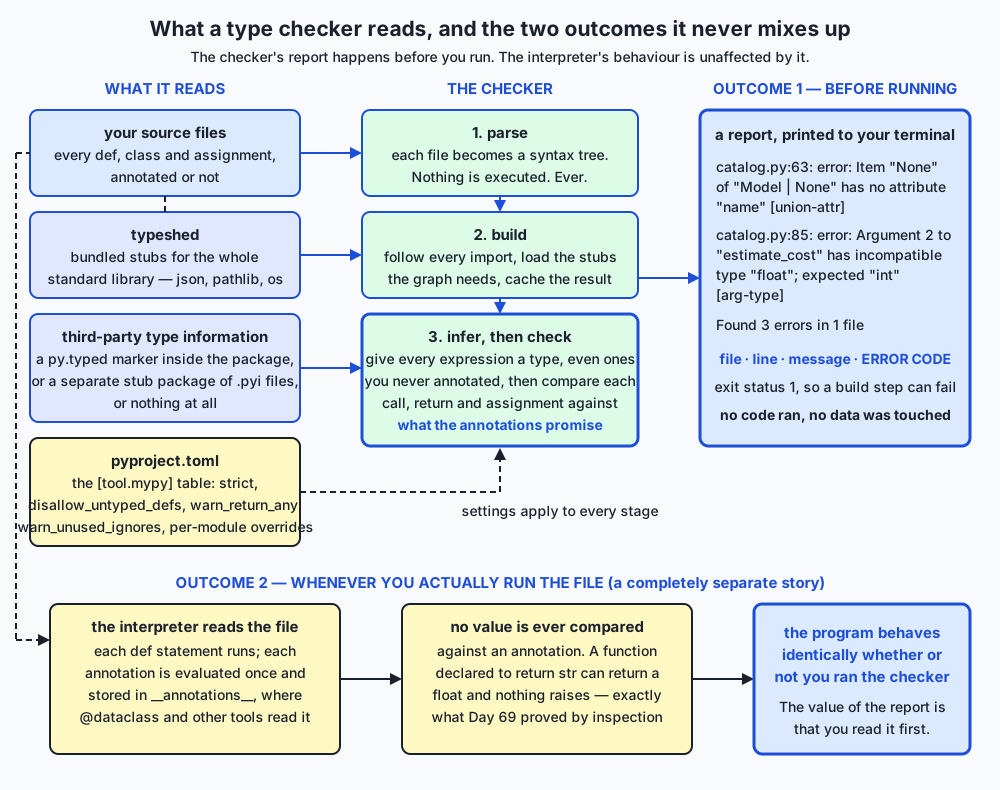
The three stages
Parse. Every file mypy is asked about is read as text and turned into a syntax tree. Nothing is imported in the runtime sense, nothing is executed, no module-level code runs. A file that would delete your home directory on import is perfectly safe to type-check.
Build. mypy follows the imports. For each imported module it needs type information from somewhere: your own annotated source, a bundled typeshed stub for anything in the standard library, a py.typed marker inside a third-party package that ships its own annotations, or a separate stub-only package. If it can find none of these, it says so — a real capture:
$ python3 -m mypy missing_import.py
missing_import.py:1: error: Cannot find implementation or library stub for module named "definitely_not_a_real_package_xyz"  [import-not-found]
missing_import.py:1: note: See https://mypy.readthedocs.io/en/stable/running_mypy.html#missing-imports
Found 1 error in 1 file (checked 1 source file)
This stage is why mypy writes a .mypy_cache/ directory. Re-checking a large project from scratch every time would be slow, so it caches the built representation of each module and rebuilds only what changed.
Infer and check. This is the part people underestimate. mypy does not only compare your annotations against each other — it works out a type for every expression, including hundreds you never annotated. Write total = 0 and mypy knows total is an int. Write names = [m.name for m in models] where models is list[Model] and Model.name is a str, and it knows names is list[str] without you saying a word. Then it checks: does every call pass arguments the parameters accept, does every return produce what the signature promised, does every assignment put a compatible value in the name, does every attribute access exist on the thing you are accessing it on.
The output is a report and an exit status. Non-zero on errors, zero on success. That is the entire interface.
Reading an error properly
Every mypy error has four parts, and beginners read them in exactly the wrong order.
starter/catalog.py:85: error: Argument 2 to "estimate_cost" has incompatible type "float"; expected "int" [arg-type]starter/catalog.py— the file.85— the line. Note carefully: this is the line where the contradiction appears, which is usually the call site, not the definition. The definition ofestimate_costis fine. Line 85 is where something wrong was handed to it.Argument 2 to "estimate_cost" has incompatible type "float"; expected "int"— the prose. Genuinely helpful, and genuinely unstable: message wording changes between mypy releases.[arg-type]— the error code, and the part that matters most.
The code matters more than the prose for four concrete reasons. It is searchable — pasting a whole message into a search engine finds your specific variable names; searching mypy arg-type finds the concept. It is stable, so a test suite or a script that greps for [arg-type] keeps working across releases, which is exactly why the lab’s test suite asserts on codes and never on message text. It is configurable: you can enable, disable or escalate an individual code by name in your settings. And it is what a # type: ignore comment refers to — # type: ignore[arg-type] suppresses that code and nothing else.
Here are the five codes worth learning by name today, each with output captured from a real run of mypy 2.3.0 over a short file:
# error_codes.py
from typing import Any


def label(score: float) -> str:
    return score


def setup() -> None:
    retries: int = 3
    retries = "three"


def caller() -> None:
    print(label("not a number"))


def loose(value: Any) -> str:
    return value.anything_at_all()
$ python3 -m mypy error_codes.py
error_codes.py:7: error: Incompatible return value type (got "float", expected "str") [return-value]
error_codes.py:12: error: Incompatible types in assignment (expression has type "str", variable has type "int") [assignment]
error_codes.py:16: error: Argument 1 to "label" has incompatible type "str"; expected "float" [arg-type]
Found 3 errors in 1 file (checked 1 source file)Three errors from a five-function file — and read the fourth function again, because it is the most important thing on this page. loose takes an Any, calls a method on it that certainly does not exist, and declares it returns a str. mypy said nothing about it. We will come back to that.
| Error code | What it means | The typical cause |
|---|---|---|
[arg-type] | An argument does not match the parameter it was passed to | The wrong value reached a call, often after arithmetic changed its type |
[return-value] | The value returned does not match the declared return type | The signature was updated and the body was not, or vice versa |
[assignment] | A value was assigned to a name whose type does not allow it | A variable reused for a second purpose halfway down a function |
[union-attr] | An attribute was accessed on a union where at least one member lacks it | The missing None check — the single most valuable catch |
[no-untyped-def] | A function has no annotations (strict mode, or disallow_untyped_defs) | Code written before the module was typed |
The type system, at the depth you need today
Builtin generics. list[int], dict[str, float], tuple[int, int], tuple[int, ...], set[str]. The container and what it contains. Older code imports capitalised List and Dict from typing; they mean the same thing and you should write the lowercase form in new code.
Optional[X], spelled X | None. This is the centrepiece, so give it a paragraph rather than a line. X | None says the value is either an X or nothing. That is not a weakness in a signature — it is the signature being honest. dict.get returns None for a missing key; a database lookup returns nothing when the row is absent; a regular-expression match returns None when it does not match; a configuration option is present or it is not. The value of writing X | None down is that the checker then refuses to let you forget the second case, at every single use, forever. There is no other tool in your kit that does that. Tests cannot, because a test for the None case only exists if someone thought of the None case, and if they had thought of it they would have handled it. This is the asymmetry that makes type checking worth the trouble even in small programs.
Union. str | list[str] means either. X | None is just the most common union. Anything you do with a union has to be valid for every member, unless you narrow first.
Narrowing. Which is how you make unions usable, and gets its own section below.
Any. Not “some type” — “stop checking here”. This is the cautionary demonstration of the day and it deserves to be run, not just read. Two functions with the identical bug, differing only in a return annotation:
# any_hole.py
from typing import Any


def strict_lookup(key: str) -> dict[str, int]:
    return {"a": 1}


def loose_lookup(key: str) -> Any:
    return {"a": 1}


def use_strict() -> None:
    print(strict_lookup("a").total_count)


def use_loose() -> None:
    print(loose_lookup("a").total_count)
$ python3 -m mypy any_hole.py
any_hole.py:13: error: "dict[str, int]" has no attribute "total_count" [attr-defined]
Found 1 error in 1 file (checked 1 source file)One error, not two. Line 13 is caught; line 17 is the same bug and is not mentioned. Both will raise AttributeError the moment they run. Any did not make line 17 correct — it made it invisible. And the hole is not local: anything you get out of an Any is itself Any, so it propagates through every variable it touches until something re-annotates it. The lab makes you prove this yourself with starter/any_demo.py, where changing one return annotation to Any takes a genuine [union-attr] error to Success: no issues found in 1 source file while the code still raises AttributeError: 'NoneType' object has no attribute 'upper' at runtime.
TypeVar and generic functions. Any forgets; a TypeVar remembers. A type variable is a placeholder meaning “whatever type came in, that same type goes out”:
T = TypeVar("T")


def first_or(items: list[T], fallback: T) -> T:
    return items[0] if items else fallback
Call it with list[int] and an int and mypy knows the result is an int. Call it with list[str] and a str and it knows the result is a str. Annotate the same function with Any and you get a function that accepts anything and tells you nothing.
Protocol and structural typing. A Protocol describes a shape, and anything with a matching shape satisfies it — no inheritance, no registration, no import relationship at all. This is the typed form of duck typing, and it pairs directly with what you built yesterday. Day 74 made code testable by injecting its dependencies: pass in the clock, pass in the repository, so a test can pass a fake. The obvious question that raises is how you annotate the parameter. Making both the real clock and the fake clock inherit from a shared base class works, but it forces the test double to know about a hierarchy. A Protocol does it without any of that:
class Clock(Protocol):
    def now(self) -> float: ...


class FrozenClock:          # inherits from nothing, mentions Clock nowhere
    def __init__(self, value: float) -> None:
        self.value = value

    def now(self) -> float:
        return self.value


def stamp(clock: Clock, message: str) -> str:
    return f"[{clock.now():.1f}] {message}"
FrozenClock satisfies Clock by having the right method. And when it does not, mypy explains exactly which member is wrong — a real capture, from a BrokenClock whose now returns a string:
tour_errors.py:44: error: Argument 1 to "stamp" has incompatible type "BrokenClock"; expected "Clock"  [arg-type]
tour_errors.py:44: note: Following member(s) of "BrokenClock" have conflicts:
tour_errors.py:44: note:     Expected:
tour_errors.py:44: note:         def now(self) -> float
tour_errors.py:44: note:     Got:
tour_errors.py:44: note: def now(self) -> strLiteral. Pins a value to a fixed set of constants. A typo becomes an error rather than a shrug:
tour_errors.py:10: error: Argument 1 to "search" has incompatible type "Literal['sematic']"; expected "Literal['semantic', 'keyword']" [arg-type]TypedDict. For JSON-shaped data you need to keep as a dict, it says which keys exist and what each holds. Misspell one and you get both halves of the story at once:
tour_errors.py:18: error: Missing key "passed" for TypedDict "RunRecord"  [typeddict-item]
tour_errors.py:18: error: Extra key "passsed" for TypedDict "RunRecord" [typeddict-unknown-key]Final. Says a name is never rebound. MAX_RETRIES: Final = 3, and then:
narrowing.py:4: error: Cannot assign to final name "MAX_RETRIES" [misc]NewType. Makes a distinct type out of an existing one, so two things that are both strings stop being interchangeable. UserId = NewType("UserId", str) and SessionId = NewType("SessionId", str) are both str at runtime and different types to mypy, which is how you catch an argument-order mistake a (str, str) signature could never see:
tour_errors.py:28: error: Argument 1 to "audit" has incompatible type "SessionId"; expected "UserId"  [arg-type]
tour_errors.py:28: error: Argument 2 to "audit" has incompatible type "UserId"; expected "SessionId" [arg-type]cast, with a warning. cast(str, value) asserts a type to the checker and does nothing at runtime — no check, no conversion, no cost, no safety. It is you telling the checker to believe you. Sometimes you genuinely know something it cannot, and then a cast plus a comment explaining what you know is the right call. But reach for isinstance first every time, because isinstance narrows and checks, and a cast that turns out to be wrong fails somewhere else entirely, far from the lie.
Narrowing: how a guard teaches the checker
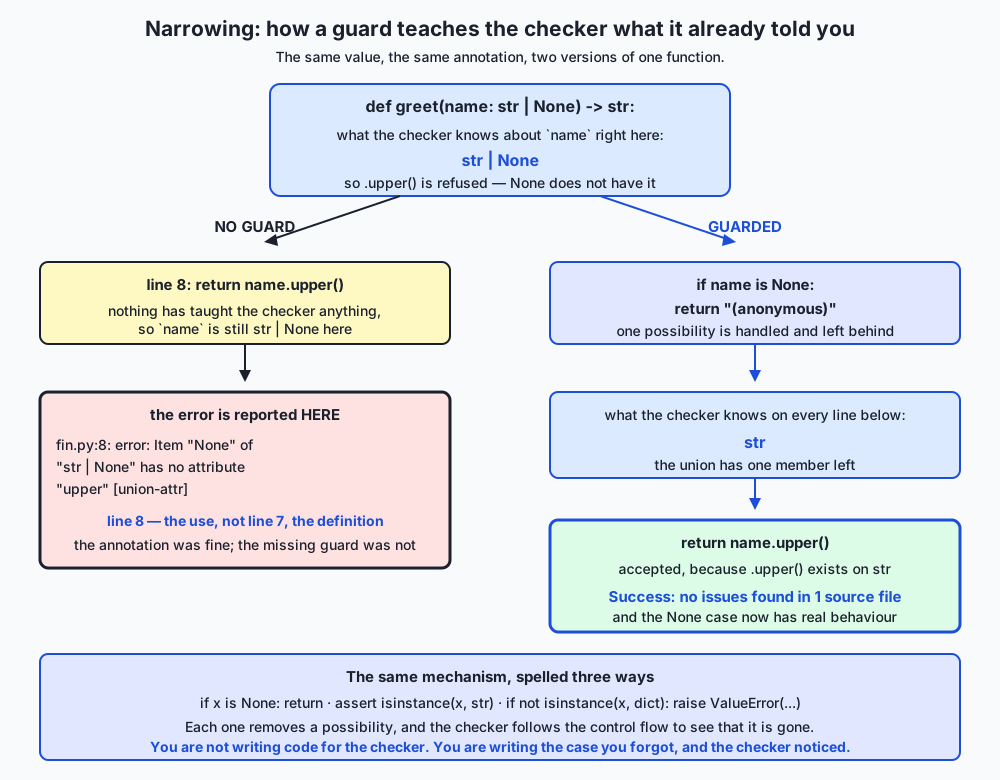
If X | None is the most valuable annotation, narrowing is the technique that makes it liveable. mypy follows the control flow of your function and updates what it knows about each name as it goes. Consider these two functions in one file:
def greet(name: str | None) -> str:
    return name.upper()


def greet_guarded(name: str | None) -> str:
    if name is None:
        return "(anonymous)"
    return name.upper()
The real output names only the first:
narrowing.py:8: error: Item "None" of "str | None" has no attribute "upper" [union-attr]greet_guarded is silent. Nothing about the annotation changed. What changed is that the if name is None: return ... removed a possibility, and from the line after it there is only one member of the union left, so .upper() is fine. That is narrowing, and it is worth being precise about what just happened: you did not write anything for the checker’s benefit. You wrote the case you had forgotten. The checker’s contribution was noticing it was missing.
The forms you will use constantly:
if x is None: return— the early return. Handles the case and narrows everything below it.if x is None: raise ValueError(...)— same narrowing, when absence is genuinely an error.if not isinstance(raw, dict): raise ...— the boundary check. This is how you turn parsed JSON into something the checker will let you use, and it is the fix the lab’sload_settingsapplies.assert isinstance(x, str)— narrows in one line. Use it where you can genuinely justify the assumption; remember thatassertstatements are removed when Python runs with-O, so an assert is a checker aid and a development check, never a validation of untrusted input.if x is not None and x.startswith("m")—andnarrows within a single expression, left to right.
The lab’s fix to bug A is one if, three lines, and it makes two [union-attr] errors disappear and gives the unknown-model case real behaviour instead of a crash. That is the pattern to internalise: the fix a checker asks for is almost always a fix a user would have wanted.
Configuration in pyproject.toml
Command-line flags are how you experiment. A configuration file is how a project actually works, because it makes the settings the same for you, your colleagues, your editor and your build. mypy reads a [tool.mypy] table from pyproject.toml:
[tool.mypy]
python_version = "3.10"
strict = true
disallow_untyped_defs = true
warn_return_any = true
warn_unused_ignores = true
warn_unreachable = true
show_error_codes = true

[[tool.mypy.overrides]]
module = "legacy_importer.*"
disallow_untyped_defs = false
warn_return_any = false

[[tool.mypy.overrides]]
module = "some_untyped_dependency.*"
ignore_missing_imports = true| Setting | What it does | Why you want it |
|---|---|---|
python_version | Which version’s rules to check against | Stops you using syntax your deployment target does not have |
strict | A bundle switching on roughly a dozen individual flags | The setting to aim at; get there module by module |
disallow_untyped_defs | Every function must be annotated | Without it, an unannotated function’s body is not checked at all, so a codebase can drift back to unchecked while the run stays green |
warn_return_any | Returning Any from a function that promises a real type is an error | Catches json.load() flowing straight out of a loader — a very common real bug |
warn_unused_ignores | An ignore comment that no longer suppresses anything is an error | The only thing that stops ignores accumulating for years |
warn_unreachable | Reports code the checker can prove never runs | Usually means a narrowing guard is wrong |
Per-module [[tool.mypy.overrides]] | Different settings for named modules | The adoption mechanism: strict everywhere, with a shrinking list of named exceptions |
That last row is the important one and it is easy to skim past. A per-module override list checked into your repository is a work queue that cannot be forgotten, because it is visible in a file everyone reads. An override with a comment saying who will remove it and roughly when is honest engineering. An override with no comment is a place where checking quietly stopped.
# type: ignore, used responsibly
Sometimes mypy is wrong, or right about something you cannot fix today. The escape hatch is a comment, and there is one rule: always carry the code.
Write # type: ignore[arg-type], never a bare # type: ignore. A bare ignore suppresses every error on that line forever, including the completely different error that appears there next year. A coded ignore suppresses exactly one thing, and mypy will tell you when you got the code wrong rather than silently obeying:
$ python3 -m mypy ignores.py
ignores.py:2: error: Incompatible return value type (got "float", expected "str")  [return-value]
ignores.py:2: note: Error code "return-value" not covered by "type: ignore[arg-type]" comment
Found 1 error in 1 file (checked 1 source file)
That note is mypy being an excellent colleague: it noticed you were trying to silence something and told you that you silenced the wrong thing.
Then there is rot. An ignore written for a real problem outlives the problem. The code gets fixed, the library ships stubs, the signature changes — and the comment stays, quietly suppressing nothing, and nobody dares delete it because nobody knows whether it still does something. warn_unused_ignores is the cure, and it is not subtle about it:
$ python3 -m mypy --warn-unused-ignores ignores.py
ignores.py:2: error: Unused "type: ignore" comment  [unused-ignore]
ignores.py:2: error: Incompatible return value type (got "float", expected "str")  [return-value]
ignores.py:2: note: Error code "return-value" not covered by "type: ignore[arg-type]" comment
ignores.py:10: error: Unused "type: ignore" comment  [unused-ignore]
Found 3 errors in 1 file (checked 1 source file)
Line 10’s ignore was suppressing nothing at all, and now you know.
Typing third-party code
Your code is not the only code mypy reads. When you import something, it needs type information for it, from one of four places:
- typeshed — the community-maintained collection of stub files bundled with mypy, covering the entire standard library. This is why
json.loadis known to returnAnyandpathlib.Path.read_textis known to returnstrwithout you doing anything. - The package itself. A package that ships annotations and includes a
py.typedmarker file (the convention from PEP 561) is used directly. - A stub-only package. Some libraries publish their annotations separately as
.pyifiles in a companion package, usually namedtypes-something. A stub file is a header: signatures and no bodies, exactly like a manufacturer’s data sheet for a component you cannot open. - Nothing. Then you get
[import-not-found]or[import-untyped], and you have a decision to make.
The lazy answer to (4) is --ignore-missing-imports, and it does work:
$ python3 -m mypy --ignore-missing-imports missing_import.py
Success: no issues found in 1 source file
Be careful with that Success. Silencing the import does not give mypy types for the package — everything from it becomes Any, so every value flowing out of that library is unchecked, along with everything downstream. Use it per module in your overrides table, after checking that no stub package exists, with a comment saying what you checked. Applying it globally is how a project ends up with a green checker and no checking.
An everyday analogy
Hold the building plan check all the way through.
The drawings are your source with its annotations. Dimensions written on a drawing are exactly annotations: a claim, in a standard notation, about what a thing is. They are useful to every reader and they do not, by themselves, cut anything to length.
The plan checker is mypy. A separate person, hired separately, who reads the drawing and never visits the site. They work through it against a code of practice and hand back a list: sheet 4, grid line C, this joist is specified to span further than its data sheet allows. Sheet, grid line, description, and — this is the error code — the clause number of the rule that was broken. Experienced people cite the clause, because the clause is the same next year when the wording of the description has changed.
The builders are the Python interpreter. They build what is drawn. They do not read the code of practice, they do not check joists against data sheets, and they will build a floor that sags because the drawing said so. This is the two-worlds model, and it is why running your program tells you nothing about whether the plan check would pass, and vice versa.
Typeshed is the catalogue of published data sheets for every standard component — every steel section, every fastener, everything in the standard library. py.typed is a manufacturer saying “our published dimensions are trustworthy, use them”. A stub-only package is somebody else measuring a manufacturer’s component and publishing the data sheet the manufacturer never wrote.
Gradual typing is a partially dimensioned drawing. You are allowed to submit one. The plan checker checks the parts you dimensioned and skips the rest — which is exactly why a clean report on an undimensioned drawing means nothing at all, and exactly why disallow_untyped_defs exists.
Any is a region stamped “by others”. The plan checker’s eye slides straight over it, and over everything that connects to it. The stamp is sometimes correct and honest — a specialist subcontractor really is designing that part. It is much more often a way of making a difficult question go away.
Narrowing is a note on the drawing. “If the survey shows rock at this level, stop and revise.” Once that note is there, the checker can follow the logic and confirm the beam beyond it is only ever built in the case where it works.
The configuration file is which edition of the code of practice applies, plus the schedule of legacy wings that are exempt. Written down, visible, and shrinking — or not written down, and then nobody knows what was checked.
And the limits are a plan check’s limits. It will not tell you the client wanted three bedrooms and you drew two. It will not tell you the soil is bad. It will not tell you the building is ugly. For those you need the site, the survey and the client — which, in your project, are your tests, your data, and the person who asked for the thing. Where the analogy needs care: a plan checker can occasionally spot that a room labelled “bedroom” is too small to be one. mypy cannot. A str that must be an email address is, to mypy, exactly as good as any other str.
Examples in practice
A registry lookup that can miss. The canonical shape, and the one you will write hundreds of times:
def load_model_config(name: str) -> ModelConfig:
    config = REGISTRY.get(name)
    if config is None:
        raise KeyError(f"unknown model: {name!r}")
    return config
The guard does three jobs at once: it gives the caller a good error message, it narrows the type for everything below, and it satisfies the checker. Three jobs, one if.
A parsing boundary, checked rather than merely annotated. This is the fix the lab applies to load_settings, and it is the pattern for every piece of data that comes from outside your program:
def load_settings(path: str) -> dict[str, float]:
    with open(path, encoding="utf-8") as handle:
        raw: object = json.load(handle)
    if not isinstance(raw, dict):
        raise ValueError(f"{path}: expected a JSON object at the top level")
    settings: dict[str, float] = {}
    for key, value in raw.items():
        if not isinstance(value, (int, float)) or isinstance(value, bool):
            raise ValueError(f"{path}: setting {key!r} is not a number")
        settings[str(key)] = float(value)
    return settings
Three things are happening. Binding to raw: object throws away the Any that json.load returns, so the checker starts caring again. The isinstance checks narrow, so the loop is allowed. And the float(value) conversion is the value check that no type system can do for you. Without the middle two lines, mypy under warn_return_any says Returning Any from function declared to return "dict[str, float]" [no-any-return] — a promise you had not kept.
A Protocol for an injected dependency, straight from Day 74. Yesterday you injected a clock so tests could freeze time. Today you can type the parameter without making the fake inherit anything:
class Repository(Protocol):
    def get(self, key: str) -> Record | None: ...
    def save(self, record: Record) -> None: ...


def sync(source: Repository, target: Repository, key: str) -> bool:
    record = source.get(key)
    if record is None:
        return False
    target.save(record)
    return True
Both your real repository and your in-memory test double satisfy Repository by having those methods. Note the Record | None return, and note that the if record is None: return False is what makes target.save(record) legal — the same narrowing again.
A typed function is most of a tool definition. Look at this signature:
def search_documents(query: str, top_k: int = 5, mode: Literal["semantic", "keyword"] = "semantic") -> list[str]:
    ...
Read what is already written down: three parameters, their names, their types, which are required, which have defaults, and one of them restricted to two exact strings. That is a machine-readable description of what this function accepts. Later in this course, when a model is allowed to call your functions, the interface it is given is a schema of precisely this information — parameter names, types, requiredness, allowed values. A well-typed signature is not analogous to a tool definition; it is most of one, already written, and the libraries that do this job read your annotations to build it. Literal in particular earns its keep here, because “one of these two strings” is a constraint a plain str cannot express to anybody, human or otherwise.
A TypeVar in a real helper:
def batched(items: list[T], size: int) -> list[list[T]]:
    return [items[i:i + size] for i in range(0, len(items), size)]
batched(prompts, 8) gives list[list[str]]; batched(records, 8) gives list[list[Record]]. The checker tracks it through; Any would have thrown it away.
Implications: security, privacy, performance, scalability, and cost
Security — the honest version, in two halves. The first half is that type checking is a safe operation. mypy reads your source and never executes it, so checking an unfamiliar file cannot run its module-level code. The second half is more important and is the one people get wrong: a type is a claim about your source, never about your data. def send(to: str) -> None is satisfied by send("not an email"), by send("'; DROP TABLE users; --"), and by a filename with ../../ in it. mypy will not blink at any of them. Types constrain shape; only a runtime check constrains value. Two settings are worth naming as security-relevant because they turn checking off silently: Any, which un-checks everything downstream of it, and --ignore-missing-imports, which makes an entire third-party package unchecked. Both deserve a comment saying why. And nothing about running mypy sends your code anywhere: it runs locally, needs no account, no key, and no network after installation.
Privacy. The one thing worth knowing is that mypy writes a .mypy_cache/ directory containing a processed representation of your source. Exclude it from version control — the lab’s cleanup step removes it — and be aware that it exists on disk next to your project.
Performance. Nothing about your program’s runtime changes; annotations are evaluated once at definition time and never consulted. The cost is the checker’s own runtime, on your machine, and it is small: a lab-sized file checks in well under a second, and the (compiled: yes) in mypy 2.3.0 (compiled: yes) means the tool itself was compiled with mypyc, which is what makes it fast enough for a save hook. Large projects use the incremental cache; the first run is the slow one.
Scalability. This is where checking earns its keep disproportionately. A test verifies the paths it walks; a checker verifies every call site of a changed function at once. Rename a parameter or change a return type in a project with four hundred call sites and the checker enumerates every one that no longer fits, in seconds, exhaustively. There is no manual process that competes with that, and there is no test suite that does it either unless every one of those call sites happens to be covered.
Cost. Free. mypy is open source under the MIT licence, per the project’s own documentation, and costs nothing personally or commercially. The real cost is a habit and a small amount of friction while you adopt it — and the thing you buy is the specific bug class that is most expensive to find later, because a None crash or a silently wrong type does not fail at the line that caused it.
Alternatives: free, open source, and commercial
| Tool | What it is | Choose it when | Cost |
|---|---|---|---|
| mypy | The reference type checker, from the project PEP 484 grew out of | You want one authoritative answer for the whole codebase, and a build step that fails | Free, open source (MIT licence, per the project’s documentation) |
| Pyright | A separate checker implementation from Microsoft, written in TypeScript | You want fast checking with strong inference, in an editor or on the command line | Free and open source |
| Pylance | The Visual Studio Code extension that runs Pyright for you as you type | You work in VS Code and want feedback on every keystroke | The extension is proprietary, but free to use |
| ty | A newer Python type checker from Astral, the makers of Ruff | You want to evaluate a newer entrant; check its own documentation for its current maturity before depending on it | Free, open source |
| pyrefly | A newer Python type checker from Meta | Same: worth evaluating, and worth reading its own documentation on readiness before adopting | Free, open source |
| pydantic | Runtime value validation built from the same annotations | Data arrives from outside your program and must be checked when it arrives | Free, open source |
mypy — how, and when. Install it, point it at a path, read the codes.
python3 -m pip install mypy
python3 -m mypy src/
python3 -m mypy --strict src/
Choose it as your project’s authoritative checker and as a build gate, because it exits non-zero on errors and because its error codes are the ones the ecosystem’s documentation and configuration are written around. It is the checker this course uses, and the one this lab pins at 2.3.0 so its captured output is exact.
Pyright — how, and when. Pyright is free and open source. It runs from the command line, and it is also the engine inside Pylance. Choose it when you want checking while you type — for most people that is where the habit actually sticks, because the feedback arrives before you have moved on. A common and entirely reasonable arrangement is Pyright in your editor and mypy in your build; they read the same annotations, so agreement is the normal case and disagreement is usually about a setting rather than about your code.
npx pyright src/The precise licensing point, because it is often muddled: Pyright itself is free and open source. The Pylance extension is proprietary software that is free to use. Those are two different statements and both are true.
ty and pyrefly — how, and when. These are newer entrants, and the honest thing to do is describe them carefully rather than rank them. ty is a Python type checker from Astral, the team behind Ruff (which is tomorrow’s lesson). pyrefly is a Python type checker from Meta. Both are free and open source, both aim at speed, and both are moving quickly. This lesson deliberately quotes no version numbers, no benchmarks, and no readiness claims for either, because those would be out of date by the time you read this and because no run of either was performed on this machine. If you want to evaluate one, read its own documentation for its current state, run it beside mypy on a project you know, and compare what each reports. What transfers regardless of which you pick is everything in this lesson: the annotations are the same, X | None is the same, narrowing is the same, and the two-worlds model is the same.
pydantic — how, and when, and the distinction that matters. Day 70 already mentioned pydantic, and it is worth drawing the line sharply now, because “types” is doing two completely different jobs in these two tools.
mypy does static type checking: before you run, it reads your source and asks whether values flow where their annotations allow. It never sees a value. pydantic does runtime value validation: while you run, it takes actual data and checks it against a model, converting or raising as configured.
from pydantic import BaseModel


class EvalRecord(BaseModel):
    prompt: str
    score: float


EvalRecord(prompt="2+2?", score="not a number")   # raises a validation error, at runtime
Two things follow. First, they are not alternatives — they are complements that happen to read similar declarations. mypy catches the missing None check in code you wrote; pydantic catches the malformed record in data you received. A serious project uses both, at different moments. Second, only pydantic can address the limit this lesson keeps returning to: a str that must be an email address. mypy cannot express that, ever, at any strictness setting. pydantic can, because it has the actual string in its hand.
Comparison with related concepts
| Concept A | Concept B | Key difference |
|---|---|---|
| Static type checking | Unit testing | The checker reads every path without running any; a test runs one path and checks the answer. Types constrain shape, tests constrain behaviour |
| mypy | The Python interpreter | mypy reads and never executes; the interpreter executes and never checks an annotation |
X | None | X | The union forces every use site to handle absence; the plain type quietly assumes it cannot happen |
Any | object | Any disables checking — you may do anything with it. object stays checked — you may do almost nothing with it until you narrow |
Any | TypeVar | Any forgets what came in; a TypeVar remembers it and carries it to the return type |
Protocol | Base-class inheritance | Structural: satisfied by having the right methods. Nominal: satisfied by declaring the relationship |
isinstance narrowing | cast | isinstance narrows and checks at runtime; cast narrows and does nothing at all at runtime |
| Error code | Error message | The code is stable, searchable and configurable; the message is prose that gets reworded between releases |
# type: ignore[code] | bare # type: ignore | The coded form suppresses one thing and mypy tells you if you named the wrong one; the bare form suppresses everything on that line, forever |
| Default mode | --strict | Default mode skips unannotated functions entirely; strict makes missing annotations themselves an error |
| mypy | pydantic | Static checking of source before running, versus runtime validation of values while running |
| mypy | Ruff (tomorrow) | The checker asks whether types are consistent; a linter asks whether the code follows rules about style, imports and common errors |
| typeshed | py.typed | A community collection of stubs for code that ships none, versus a package declaring that its own annotations are usable |
| Type annotation | Docstring | Both document; only the annotation is machine-checked, so only the annotation cannot rot silently |
When to use it — and when not to
Use mypy on anything you will still be running in three months. The specific places it pays best: any function that can return nothing, any code that parses external data, any module with more than a handful of callers, any library other people import, and any project where more than one person edits the code.
Adopt it incrementally, because that is what gradual typing is for. The migration that works looks like this. Install mypy and run it with default settings over your whole project; fix whatever it finds, which on unannotated code will be almost nothing. Add a [tool.mypy] table with strict = true and then add per-module overrides turning strictness off for every module that fails, so the run is green on day one. That override list is now your work queue, checked into the repository where nobody can forget it. Delete entries one module at a time, annotating as you go, starting with the modules that have the most callers because those are where a wrong signature does the most damage. Put mypy in your build the moment the run is green, so the list can only shrink. What does not work is switching strict = true on globally in a large untyped codebase, staring at four thousand errors, and concluding that type checking is not for you.
Do not use it as a substitute for tests, and do not let anyone tell you it is one. State this plainly because it is the sentence to carry out of today: types and tests catch different bug classes. The lab is built to prove it in both directions. Eight tests pass over a module with a None crash waiting in it, because no test walks that path — tests missed it, mypy caught it. And mypy reports Success on a function that computes a total by subtracting when it should add, because subtraction is perfectly type-correct — mypy misses it, a test catches it. A good project has both, and Day 77 is where you assemble them into a single gate that runs on every change.
Skip it, or keep it light, on genuinely throwaway code: a ten-line script you will run once, an exploratory notebook cell, a spike you intend to delete. Annotating those is real work for no return.
Be honest about the limits, all of them. mypy does not run your code, so it knows nothing about the data that will arrive. It cannot catch a wrong algorithm — a correct-looking function with the wrong formula passes cleanly. It cannot verify values: a str that must be an email, a float that must be a probability between zero and one, an int that must be positive. It cannot see anything behind an Any, and it cannot see anything at all inside a function you did not annotate unless you turn strictness on. And it is not a substitute for the four days of tests you just wrote.
And here is the AI thread, which is more direct than it looks. Two connections, both concrete. The first is about review. When a project contains a lot of code that a reviewer did not write line by line — and increasingly that describes ordinary work — the reviewer’s leverage is not reading every character. It is the gates: does it type-check, does it lint, do the tests pass. A typed signature is a machine-verified statement of what a function accepts and returns, and it holds regardless of how the body came to exist. That is why the “types and tests catch different bugs” point is not academic: they are two of the three gates that make unfamiliar code reviewable at all.
The second is about tool calling, and it is almost literal. Later in this course a model will be given a set of functions it is allowed to call, and the way it is told what each function accepts is a schema: parameter names, types, which are required, which have defaults, and which are restricted to a fixed set of values. Look at that list and then look back at def search_documents(query: str, top_k: int = 5, mode: Literal["semantic", "keyword"] = "semantic") -> list[str]. Every item on the list is already there. A well-typed function is most of a tool definition, and the libraries that build those schemas do it by reading exactly the annotations you have been writing since Day 69. The habit you build today is not preparation for that work; it is the first half of it.
Tomorrow, Day 76, adds the third gate: Ruff, which mechanizes the readability judgements you made by hand on Day 61.
Knowledge check
Answer from memory before looking back.
- Day 69 proved that Python stores annotations and ignores them. Given that, explain in one sentence what mypy actually does, and what changes about your program’s behaviour when you run it.
- A file with no annotations at all reports
Success: no issues found in 1 source file. Why is that the most misleading result mypy can give you, and which single setting fixes it? - In
catalog.py:63: error: Item "None" of "Model | None" has no attribute "name" [union-attr], name the four parts of the error, and give two reasons the code matters more than the prose. - Why is the missing
Nonecheck the bug class where a checker most clearly beats a test suite? Your answer must explain why a test for that case usually does not exist. - Two functions contain the identical bug; one is annotated
-> dict[str, int]and the other-> Any. mypy reports one error. Explain whatAnydid, and why the effect is not confined to that one function. - What does
if x is None: returndo for the checker, and why is it wrong to describe writing it as “adding code to please mypy”? - What is the difference between
# type: ignoreand# type: ignore[union-attr], and what doeswarn_unused_ignoresprotect you from? - Name three bugs mypy cannot catch, and say which tool catches each.
Hands-on exercise
Today’s lab, “Catch the Bug the Tests Missed”, is the whole lesson in executable form. starter/catalog.py is fully annotated, ships with eight passing tests, and contains two real bugs that the suite never reaches. You run both tools over the same file, read the errors by their codes, fix the code, turn strictness up, and finish by proving mechanically that adding Any to one signature makes a caught error vanish while the code stays exactly as broken.
Install once, from the lab directory:
cd labs/sections/programming-with-python/day-075-static-typing-with-mypy
python3 -m venv .venv
.venv/bin/pip install -r requirements/requirements.txt
.venv/bin/mypy --version
.venv/bin/pytest --version
Then work the exercises in order:
# 0. What does a checker say about code with no annotations at all?
.venv/bin/mypy starter/untyped_first_run.py
.venv/bin/mypy --strict starter/untyped_first_run.py

# 1. Eight tests, all green, on the buggy module.
PYTHONPATH=starter .venv/bin/pytest -q starter/test_catalog.py

# 2. The same file, the other tool.
.venv/bin/mypy starter/catalog.py

# 3. Write down each error's file, line, message and code.
# 4-5. Fix bug A and bug B, re-running step 2 until it prints Success.
# 6. Turn strictness up and handle what it adds.
.venv/bin/mypy --strict starter/catalog.py

# 7. Prove the Any point yourself.
.venv/bin/mypy starter/any_demo.py

# The finished reference, at any point.
PYTHONPATH=examples python3 examples/demo.py
PYTHONPATH=examples python3 examples/typing_tour.py
.venv/bin/mypy --strict examples/catalog.py examples/typing_tour.py
.venv/bin/mypy --config-file examples/pyproject.toml examples/catalog.py

bash tests/run_tests.sh
Expected output
Captured from a real run on the authoring machine — mypy 2.3.0 (compiled: yes), pytest 9.1.1, Python 3.14.0 — and fully deterministic apart from pytest’s timing line.
The contrast the whole lab exists for, the same file through two tools:
$ python3 -m pytest starter/test_catalog.py
........                                                                 [100%]
8 passed in 0.00s
(exit 0)

$ python3 -m mypy starter/catalog.py
starter/catalog.py:63: error: Item "None" of "Model | None" has no attribute "name"  [union-attr]
starter/catalog.py:63: error: Item "None" of "Model | None" has no attribute "context_tokens"  [union-attr]
starter/catalog.py:85: error: Argument 2 to "estimate_cost" has incompatible type "float"; expected "int"  [arg-type]
Found 3 errors in 1 file (checked 1 source file)
(exit 1)
What strict mode adds to that same unchanged file:
$ python3 -m mypy --strict starter/catalog.py
starter/catalog.py:63: error: Item "None" of "Model | None" has no attribute "name"  [union-attr]
starter/catalog.py:63: error: Item "None" of "Model | None" has no attribute "context_tokens"  [union-attr]
starter/catalog.py:85: error: Argument 2 to "estimate_cost" has incompatible type "float"; expected "int"  [arg-type]
starter/catalog.py:88: error: Function is missing a type annotation  [no-untyped-def]
starter/catalog.py:103: error: Call to untyped function "format_price" in typed context  [no-untyped-call]
starter/catalog.py:117: error: Returning Any from function declared to return "dict[str, float]"  [no-any-return]
Found 6 errors in 1 file (checked 1 source file)
(exit 1)
And the result that surprises people most — a completely unannotated module under default settings, then the same file under --strict:
$ python3 -m mypy starter/untyped_first_run.py
Success: no issues found in 1 source file
(exit 0)

$ python3 -m mypy --strict starter/untyped_first_run.py
starter/untyped_first_run.py:25: error: Function is missing a type annotation  [no-untyped-def]
starter/untyped_first_run.py:33: error: Function is missing a type annotation  [no-untyped-def]
starter/untyped_first_run.py:37: error: Function is missing a return type annotation  [no-untyped-def]
starter/untyped_first_run.py:37: note: Use "-> None" if function does not return a value
starter/untyped_first_run.py:38: error: Call to untyped function "load_prices" in typed context  [no-untyped-call]
starter/untyped_first_run.py:39: error: Call to untyped function "total" in typed context  [no-untyped-call]
starter/untyped_first_run.py:43: error: Call to untyped function "main" in typed context  [no-untyped-call]
Found 6 errors in 1 file (checked 1 source file)
(exit 1)
The fixed reference, clean under strict, with the suite still green:
$ python3 -m mypy --strict examples/catalog.py examples/typing_tour.py
Success: no issues found in 2 source files
(exit 0)

$ python3 -m pytest examples/test_catalog.py
.........                                                                [100%]
9 passed in 0.00s
(exit 0)
Validate your work
-
.venv/bin/mypy --versionprintsmypy 2.3.0 (compiled: yes)and.venv/bin/pytest --versionprintspytest 9.1.1. - Before you change anything: the eight starter tests pass and exit 0, and
mypy starter/catalog.pyreports exactly three errors and exits 1. - You can state, for each of those three errors, the file, the line and the code — without reading the message text. Two are
[union-attr]and one is[arg-type]. - After fixing bug A the
[union-attr]errors are gone and the tests still report8 passed— proof that the fix touched nothing on any tested path. - After fixing bug B,
mypy starter/catalog.pyprintsSuccess: no issues found in 1 source file. -
mypy --strict starter/catalog.pyadds[no-untyped-def],[no-untyped-call]and[no-any-return]; after you annotateformat_priceand check the loaded object inload_settings, strict mode printsSuccesstoo. -
mypy starter/any_demo.pyreports[union-attr]; after changinglookup’s return annotation toAnyit printsSuccess, and the code still raisesAttributeErrorwhen run. Nothing got safer. -
mypy --config-file examples/pyproject.toml examples/catalog.pypasses, so you have run the checker from a real configuration file and not only from flags. -
bash tests/run_tests.shends with33 checks, 0 failure(s).and exits 0.
Troubleshooting
mypy: command not found. The tool is installed inside the lab’s virtual environment, not on your PATH. Use .venv/bin/mypy, or activate the environment first. The test suite finds it either way, and accepts MYPY=/path/to/mypy if you want to be explicit.
Cannot find implementation or library stub for module named ... — code [import-not-found]. mypy cannot locate type information for something you imported. Check the spelling first. If it is a real third-party package, look for a stub package before reaching for --ignore-missing-imports, and if you do silence it, do it per-module in your overrides table with a comment.
ModuleNotFoundError: No module named 'catalog' when running pytest. The tests import catalog directly, so the directory containing it must be on the import path: PYTHONPATH=starter .venv/bin/pytest -q starter/test_catalog.py.
mypy reports nothing on a file you know is broken. Almost always one of two things: the file has no annotations, so there is nothing to check against — run --strict and watch six errors appear on untyped_first_run.py — or the value involved is Any, which switched checking off. Both are the lesson, not a malfunction.
X | None raises a TypeError when you run the file. That syntax needs Python 3.10 or newer at runtime. Either upgrade, or add from __future__ import annotations at the top of the module, which is what the lab’s files do.
A # type: ignore did not suppress what you expected. Read the note mypy prints: Error code "return-value" not covered by "type: ignore[arg-type]" comment. You named the wrong code. Fix the code in the brackets, and never write a bare ignore.
New [unused-ignore] errors appeared after you fixed something. That is warn_unused_ignores doing its job — the ignore is now suppressing nothing. Delete it.
Results look stale. Delete the incremental cache: rm -rf .mypy_cache. The only cost is a slower next run.
Your editor and the command line disagree. They are almost certainly using different settings, different Python versions, or different checkers — many editors run Pyright rather than mypy. Make the command line with your [tool.mypy] table authoritative, and configure the editor to match it.
Common mistakes
- Reading the message and ignoring the code. The code is the stable, searchable, configurable identity of the check. Learn
[union-attr],[arg-type],[return-value],[assignment]and[no-untyped-def]by name. - Looking for the bug at the line of the definition. mypy reports the line of the contradiction, which is usually the call site.
- Silencing
[union-attr]with an ignore comment. That error is a real missing case. The fix is three lines of narrowing that also gives theNonepath real behaviour. - Reaching for
Anyto make a message go away. You did not fix anything; you switched checking off for that value and everything downstream of it. - Writing a bare
# type: ignore. Always carry the code. - Reading
Successon unannotated code as good news. It means mypy did not look. - Turning on
strict = trueglobally in a large untyped project and giving up at the error count. Use per-module overrides as a shrinking work queue. - Assuming a checked codebase does not need tests. A wrong formula is perfectly type-correct.
- Assuming
name: strmeans the string is safe, valid, or well-formed. It means it is a string. Nothing more.
Practice assignment
Build catalog_service.py, a small module in the Day 63 shape — a pure, testable core with a thin shell around it — that manages a catalogue of model records loaded from JSON. Every function must carry full annotations, and the finished module must pass mypy --strict with no ignore comments anywhere.
Your spec. Define a frozen dataclass Model with fields name: str, context_tokens: int and price_per_million: float. Define a Protocol named Catalog with two methods, get(self, name: str) -> Model | None and names(self) -> list[str], and write two classes satisfying it without inheriting from it: DictCatalog, backed by a dictionary, and EmptyCatalog, which always returns None. Write load_catalog(path: str) -> DictCatalog that reads a JSON file and validates every record at the boundary — narrow with isinstance, raise ValueError naming the offending key, and make sure a str where a number belongs is rejected rather than annotated away. Write cheapest(catalog: Catalog, names: list[str]) -> Model | None returning the lowest-priced model among those names, or None when none of them exist; every caller of it must then narrow the result. Write describe(catalog: Catalog, name: str) -> str that handles the missing case with a real message rather than a crash. Add Mode = Literal["input", "output"] and estimate(catalog: Catalog, name: str, tokens: int, mode: Mode) -> float. Add MAX_BATCH: Final = 64.
Requirements to check yourself against: no Any anywhere; no bare # type: ignore; mypy --strict catalog_service.py prints Success; a [tool.mypy] table in a pyproject.toml beside it reproduces that result via --config-file; and — the part that matters most — a pytest suite covering cheapest and describe including the case where the name is absent. When you are done, write two sentences in a comment at the top of the file: one bug your tests caught that mypy could not, and one bug mypy caught that your tests did not.
Extension challenge
One: measure the adoption cost honestly. Take the largest Python program you have written since Day 43. Run mypy on it with default settings and record the error count. Run mypy --strict and record that count. Now classify every strict-mode error into one of two buckets: missing annotation and real bug or real ambiguity. Write down both totals and the ratio. That ratio is the honest answer to “is strict mode worth it on this code”, and it will differ enormously between a script and a library — which is the point.
Two: build the incremental adoption queue. Add a pyproject.toml with [tool.mypy] and strict = true, then add one [[tool.mypy.overrides]] block per module that fails, turning off exactly the flags it needs to go green. Get the whole project passing. Then delete one override, fix that module properly, and commit. Do it three times. You have now performed, in miniature, the only migration strategy that works on a real codebase — and you have a file that tells anyone reading your repository exactly how much is left.
Three: make an ignore rot, then catch it. Add # type: ignore[arg-type] to a line where nothing is wrong. Run mypy --strict and watch [unused-ignore] appear. Now remove warn_unused_ignores from your config and run again with --config-file. Silence. Write one paragraph on how a codebase accumulates hundreds of ignores that nobody can safely remove, and what the one setting that prevents it is worth.
Four: find the boundary between the two tools. Write a function def send_report(to: str, score: float) -> None. Call it with send_report("not an email", 4.2) — an invalid address and a score outside any sane range. Confirm mypy is perfectly happy. Now write the runtime validation that catches both, first by hand with explicit checks, then with a pydantic model. Finish with one paragraph explaining, precisely, why no static type system was ever going to catch either of those, and where in a real program that validation belongs.
Quiz
Q1. Day 69 proved Python stores annotations and never enforces them. Given that, what does running mypy change about how your program behaves?
- Nothing at all — mypy reads your source without executing it and only produces a report and an exit status
- It installs runtime checks that raise a TypeError when an annotation is violated
- It rewrites your source to insert isinstance checks at each annotated boundary
- It changes behaviour only for functions annotated with strict types
Show answer
Answer: A. Nothing at all — mypy reads your source without executing it and only produces a report and an exit status
This is the two-worlds model and it is the single idea of the day. mypy parses your files into syntax trees, reasons about them, prints a report of file, line, message and error code, and exits non-zero on errors. The interpreter, separately and later, evaluates each annotation once into __annotations__ and never compares a value against one. Running the checker changes nothing about the program; not running it changes nothing either. The entire value is that a human reads the report and edits the code first.
Q2. A module with no annotations anywhere reports `Success: no issues found in 1 source file`. What does that actually tell you?
- That every function in the module is type-correct
- That the module is too small for mypy to find anything wrong
- That mypy checked nothing, because an unannotated function is one it declines to check
- That mypy inferred all the types itself and they were consistent
Show answer
Answer: C. That mypy checked nothing, because an unannotated function is one it declines to check
This is gradual typing working exactly as PEP 484 designed it, and it is the single most misleading result a newcomer can get: "mypy passes" on unannotated code means "mypy did not look". The lab proves it — `starter/untyped_first_run.py` is entirely unannotated and reports Success, and the same unchanged file under --strict reports six errors, four of them [no-untyped-def] or [no-untyped-call]. The setting that fixes it is `disallow_untyped_defs`, which `strict` includes.
Q3. In `catalog.py:85: error: Argument 2 to "estimate_cost" has incompatible type "float"; expected "int" [arg-type]`, why does the bracketed code matter more than the message?
- Because the message is only shown when show_error_codes is disabled
- Because the code names the line number, whereas the message does not
- Because the code indicates severity while the message is informational
- Because the code is stable across releases, searchable, individually configurable, and is what a type: ignore comment refers to
Show answer
Answer: D. Because the code is stable across releases, searchable, individually configurable, and is what a type: ignore comment refers to
Message wording is prose and gets reworded between mypy releases; the code is the check's stable identity. Searching for the concept beats searching for your own variable names, a script or test suite can grep for `[arg-type]` and keep working across upgrades — which is exactly why the lab's suite asserts on codes and never on message text — you can enable or disable an individual code by name in your settings, and `# type: ignore[arg-type]` suppresses that one code and nothing else.
Q4. Why is the missing `None` check the bug class where a checker most clearly beats a test suite?
- Because None comparisons are unusually slow to test at runtime
- Because a test for the None case only exists if someone thought of it — and if they had, they would have handled it
- Because pytest cannot assert that a function returns None
- Because None is the only value mypy is able to track through a program
Show answer
Answer: B. Because a test for the None case only exists if someone thought of it — and if they had, they would have handled it
The asymmetry is the whole argument. A test exercises the paths it walks; the None path is precisely the path nobody thought about, which is why the bug exists in the first place. The lab makes this concrete: eight perfectly reasonable tests pass over a module where `describe()` reads attributes off a `Model | None` without a guard, because every test uses a name that is in the catalogue. mypy reports it twice on line 63 with the code [union-attr], in under a second, having walked every path in the file.
Q5. Two functions contain the identical bug — a call to a method that does not exist. One returns `dict[str, int]`, the other returns `Any`. mypy reports one error. What happened?
- Any made the second function correct by widening its return type
- mypy reports only the first error it finds in each file
- The Any version is checked more leniently but still reported as a warning
- Any means "stop checking here", so the second bug is invisible — and the hole spreads to every value that flows out of it
Show answer
Answer: D. Any means "stop checking here", so the second bug is invisible — and the hole spreads to every value that flows out of it
This is the day's cautionary demonstration and it is worth running rather than reading. In the captured output only line 13 is reported, `"dict[str, int]" has no attribute "total_count" [attr-defined]`; line 17 is the same bug and goes unmentioned. Both raise AttributeError the moment they run. Any is not "some type" — it is an instruction to stop looking, and anything you get out of an Any is itself Any, so the hole propagates until something re-annotates it.
Q6. What does the guard `if name is None: return "(anonymous)"` do for the checker?
- It narrows the union, so on every line below it the only remaining possibility is str
- It converts None into an empty string so string methods become valid
- It suppresses the [union-attr] error code for the rest of the function
- It tells mypy to treat the parameter as Any from that point on
Show answer
Answer: A. It narrows the union, so on every line below it the only remaining possibility is str
mypy follows the control flow of your function and updates what it knows about each name. Once one member of the union has been handled and returned, only `str` is left, so `.upper()` is accepted. The important framing: this is not code written to please the checker. It is the case you forgot, and the checker noticed it was missing — the guard gives the None path real behaviour, gives the reader a clear answer, and satisfies the checker, all at once. `assert isinstance(...)` and an early `raise` narrow in exactly the same way.
Q7. What is the practical difference between a bare `# type: ignore` and `# type: ignore[union-attr]`?
- There is none; the bracketed form is a stylistic preference
- The bare form is checked at runtime, the coded form only by mypy
- The bare form suppresses every error on that line forever; the coded form suppresses one code, and mypy tells you when you named the wrong one
- The coded form is deprecated in favour of the bare form
Show answer
Answer: C. The bare form suppresses every error on that line forever; the coded form suppresses one code, and mypy tells you when you named the wrong one
A bare ignore silences the completely different error that turns up on that line next year. A coded ignore is precise, and mypy will not silently obey a wrong one — the captured output shows the note `Error code "return-value" not covered by "type: ignore[arg-type]" comment`, which is the checker telling you that you silenced the wrong thing. Pair coded ignores with `warn_unused_ignores`, which reports an ignore that no longer suppresses anything as [unused-ignore] — the only thing that stops ignores accumulating for years until nobody dares remove one.
Q8. Which statement correctly distinguishes mypy from pydantic?
- mypy validates values at runtime; pydantic checks annotations before you run
- They are competing implementations of the same static checking, and you should pick one
- mypy checks source before running and never sees a value; pydantic validates actual data at runtime and can reject it
- pydantic replaces mypy once a codebase is fully annotated
Show answer
Answer: C. mypy checks source before running and never sees a value; pydantic validates actual data at runtime and can reject it
They read similar declarations and do completely different jobs at completely different moments, which is why a serious project uses both. mypy catches the missing None check in code you wrote, before anything runs, without ever seeing data. pydantic catches the malformed record in data you received, while running, by holding the actual value. Only pydantic can address the limit this lesson keeps returning to: a `str` that must be an email address is, to mypy, exactly as good as any other `str`, at any strictness setting. Both are free and open source.
Glossary
- static typing
- Checking that values flow where their declared types allow, before the program runs, by reading the source rather than executing it. "Static" is the whole point: the analysis happens on the text, so it reaches every path in the file, including the ones no test walks and the one that would have crashed in production.
- gradual typing
- PEP 484's design principle that a codebase may be annotated as much or as little as you like, with annotated and unannotated code interoperating freely and unannotated functions simply going unchecked. It is what makes adopting types in an existing project possible at all — you type one module at a time — and it is also why a clean run on unannotated code means the checker did not look.
- type checker
- A separate program that reads your annotated source without executing it and reports where an expression contradicts the annotations around it. mypy is the reference implementation; Pyright, ty and pyrefly are others. It produces a report and an exit status, and changes nothing about how your program behaves.
- annotation
- A recorded claim about what a name is supposed to hold, written as `score: float` or `def find(name: str) -> Model | None`. Python evaluates it once at definition time, stores it in `__annotations__`, and never compares a value against it — which is exactly why a separate checker is needed for it to mean anything.
- type inference
- The checker working out the type of an expression you never annotated. Write `total = 0` and mypy knows it is an `int`; write a comprehension over a `list[Model]` and it knows what comes out. Inference is why annotating function signatures buys checking of hundreds of lines you did not annotate.
- Optional
- The type of a value that is either an `X` or nothing, written `Optional[X]` in older code and `X | None` in modern code — the same type, two spellings. Writing it down is what forces every use site to handle absence, and the missing check is the single most valuable thing a checker catches, because tests routinely miss it.
- union type
- A type meaning "one of these", written `str | list[str]` or `Model | None`. Anything you do with a union must be valid for every member unless you narrow first, which is why unions and narrowing are always learned together.
- Any
- The typing escape hatch that means "stop checking here" rather than "some type". A value typed `Any` may be passed anywhere and have anything called on it, and anything derived from it is itself `Any`, so the hole spreads downstream until something re-annotates it. Deliberate at a genuinely dynamic boundary; a way of hiding a real bug everywhere else.
- narrowing
- The checker's tracking of what a name can be as control flow proceeds. `if x is None: return`, `if not isinstance(x, dict): raise`, and `assert isinstance(x, str)` each remove a possibility, so on the lines below only the remaining members of the union are considered. The guard is not written for the checker — it is the case you forgot, and the checker noticed.
- Protocol
- A declaration of a required shape — a set of methods and their signatures — that any object satisfies by having them, with no inheritance and no registration. It is how you type an injected dependency such as a clock or a repository, so a test double satisfies the same annotation as the real thing without sharing a base class.
- structural typing
- Deciding type compatibility by shape: if it has the right methods with the right signatures, it fits. This is duck typing with the expectation written down, and `Protocol` is its form in Python. When it fails, mypy names the specific member that conflicts and shows both signatures.
- nominal typing
- Deciding type compatibility by declared identity: a value fits because its class inherits from, or is, the named type. Ordinary Python class annotations are nominal; `Protocol` is the structural alternative, and the choice between them is really a choice about whether the two sides must know about each other.
- TypedDict
- An annotation describing a dictionary with known keys and a type for each key — how you type JSON-shaped data that must stay a dict rather than becoming a class. Misspell a key and the checker reports both halves of the story: the required key that is missing and the unexpected key that appeared.
- TypeVar
- A placeholder type variable meaning "whatever type came in, that same type goes out". It is what `Any` cannot express, because `Any` forgets: a function annotated with a TypeVar returns a known type that depends on its arguments, so the checker keeps tracking values through it.
- generic
- A type or function parameterised by other types. `list[int]` and `dict[str, float]` are generic containers; a function written with a TypeVar is a generic function. The modern builtin spelling replaced the capitalised `List` and `Dict` imports from `typing`, which mean the same thing.
- stub file
- A `.pyi` file containing signatures and no bodies — a header, or a data sheet for a component you cannot open. Stubs describe the types of code the checker cannot otherwise read, and are distributed either inside a package or as a separate stub-only package.
- typeshed
- The community-maintained collection of stub files for the Python standard library and for third-party packages that ship none. It is bundled with mypy and read by every checker, and it is why `json.load` is known to return `Any` and `Path.read_text` is known to return `str` without you writing anything.
- py.typed
- A marker file a third-party package includes, per PEP 561, to declare that its own inline annotations are complete enough to be used by type checkers. Its presence is the difference between a dependency you get checking for and one that arrives as `Any`.
- strict mode
- mypy's `--strict` flag, or `strict = true` in configuration — a bundle switching on roughly a dozen individual settings, including `disallow_untyped_defs` and `warn_return_any`. It is what turns "mypy found nothing" from a statement about your annotations into a statement about your code.
- error code
- The bracketed identifier at the end of every mypy message — `[union-attr]`, `[arg-type]`, `[return-value]`, `[assignment]`, `[no-untyped-def]`. It is the stable, searchable, individually configurable identity of a check, it is what a `# type: ignore[code]` comment refers to, and it is what a test suite should assert on, because message wording changes between releases.
- type: ignore
- A comment suppressing a mypy error on one line. Always write it with its error code — `# type: ignore[union-attr]` — because a bare ignore silences every error on that line forever, including the different one that appears next year. mypy reports when the code you named does not cover the error found.
- warn_unused_ignores
- The setting that reports an ignore comment which no longer suppresses anything, with the code `[unused-ignore]`. Without it, ignores written for real problems outlive those problems and accumulate for years until nobody dares remove one, because nobody can tell which still do something.
- per-module override
- A `[[tool.mypy.overrides]]` block applying different settings to named modules. It is the mechanism for incremental adoption: strict everywhere, with a checked-in list of named exceptions that is visible to everyone and shrinks over time — a work queue that cannot be forgotten.
- cast
- A function that asserts a type to the checker and does nothing whatsoever at runtime — no check, no conversion, no safety. Prefer `isinstance`, which narrows and checks; reach for `cast` only where you genuinely know something the checker cannot, and write a comment saying what.
- Literal
- An annotation restricting a value to a fixed set of constants, such as `Literal["semantic", "keyword"]`. It turns a misspelled mode string from a shrug at runtime into an error before you run, and it expresses a constraint a plain `str` cannot communicate to anybody.
- Final
- An annotation declaring that a name is never rebound after its first assignment. Assigning to it again is reported as an error, which makes a module-level constant genuinely constant as far as any reader or tool is concerned.
- NewType
- A way of making a distinct type out of an existing one, so that two values which are both strings at runtime stop being interchangeable to the checker. It catches the argument-order mistake that a plain `(str, str)` signature can never see.
- mypy cache
- The `.mypy_cache/` directory holding a processed representation of each module, so repeated runs rebuild only what changed. It appears wherever you ran mypy, belongs outside version control, and can be deleted at any time at the cost of one slower run.
Sources and further reading
- mypy documentation — mypy project (accessed 2026-07-19)
- PEP 484 — Type Hints — Python Software Foundation (accessed 2026-07-19)
- typing — Support for type hints — Python Software Foundation (accessed 2026-07-19)
- pytest documentation — pytest project (accessed 2026-07-19)
- Ruff documentation — Astral (accessed 2026-07-19)
Kept in this browser, no account needed. Your progress page turns the whole record into one link you can bookmark or open on another device.