LLMs and Generative AI › The LLM Landscape › Day 244
Day 244: Capabilities, Limits, and Hallucination

Master the scientific boundaries of modern Large Language Models: dissect the taxonomy of hallucinations (intrinsic confabulation vs ungrounded extrapolation), analyze theoretical cognitive failures (multi-hop relation reversal curse, state tracking decay, spatial reasoning gaps), inspect needle-in-a-haystack long-context retrieval degradation (the Lost-in-the-Middle phenomenon), implement production mitigation patterns (strict RAG grounding, chain-of-thought self-consistency voting, logit entropy calibration, citation verification critic loops), and build an automated hallucination detector in Python.
Hands-on lab for this lesson
Lab files on GitHub: https://github.com/ai-roadmap-365/ai-roadmap-365.github.io/tree/main/labs/sections/llms-and-generative-ai/day-244-capabilities-limits-and-hallucination
- Get the hands-on files. Clone the labs repository once (you can reuse this clone for every lesson). This works on macOS, Linux, and Windows (PowerShell or WSL):
git clone https://github.com/ai-roadmap-365/ai-roadmap-365.github.io.git cd ai-roadmap-365.github.io - Open this lesson's lab. Move into the directory for this specific day. Every lab lives at the same predictable path — section / subsection / week / day:
cd labs/sections/llms-and-generative-ai/day-244-capabilities-limits-and-hallucination - Read the lab guide. Open `README.md` in that directory. It lists the exact commands, what each does, the expected output, and how to check your work — read it before running anything.
- Run it and check your work. Follow the README's "How to run" section: run the example first to see the finished result, then complete the numbered exercises in `starter/`, then run the tests. The tests pass (exit 0) only when your work is correct.
bash tests/run_tests.sh # or the test command named in the lab README
You can also open the lab as a local page (works offline, shows the file tree and expected output).
Learning objectives
By the end of this lesson you will be able to:
- Classify LLM failure modes across intrinsic confabulation, sycophancy, and relation reversal.
- Explain the mathematical and attention-head causes behind the Lost-in-the-Middle long-context phenomenon.
- Calculate token-level predictive entropy to detect ungrounded statements from raw model logits.
- Implement multi-path Self-Consistency majority voting to boost reasoning accuracy.
- Build an automated grounded citation verification pipeline in Python.
Prerequisites
Why this matters
Generative AI models are capable of drafting complex codebases, writing literature, and passing medical board exams.
Yet, those same models will confidently invent non-existent legal precedents (e.g. the infamous Mata v. Avianca case where lawyers submitted bogus ChatGPT citations), fail simple multi-hop arithmetic, and claim that “Mary Lee South is the mother of Tom Cruise, but Tom Cruise’s mother is not Mary Lee South”.
Why do foundation models hallucinate? Is hallucination a temporary bug that will vanish with bigger GPUs, or is it an intrinsic mathematical consequence of autoregressive maximum-likelihood token modeling?
To build safe, production-grade enterprise systems, AI engineers must understand the theoretical limits of next-token prediction, the mechanics of the Lost-in-the-Middle phenomenon, and how to implement grounded verification pipelines in Python.
The idea in plain language
Think of an actor auditioning for a play who forgot to memorize their script:
- High Fluency: The actor speaks with booming confidence, perfect grammar, dramatic pauses, and charismatic intonation (Fluent Language Modeling).
- The Confabulation: When they reach a scene involving medical terminology, they invent convincing-sounding Latin words on the fly without blinking (Hallucination).
- The Grounding Cure (The Prompter in the Stage Wings): An assistant sits behind the curtain whispering the exact lines from the physical script (Retrieval-Augmented Generation / RAG). The actor is strictly forbidden from speaking unless reading directly from the prompt book!
Historical background
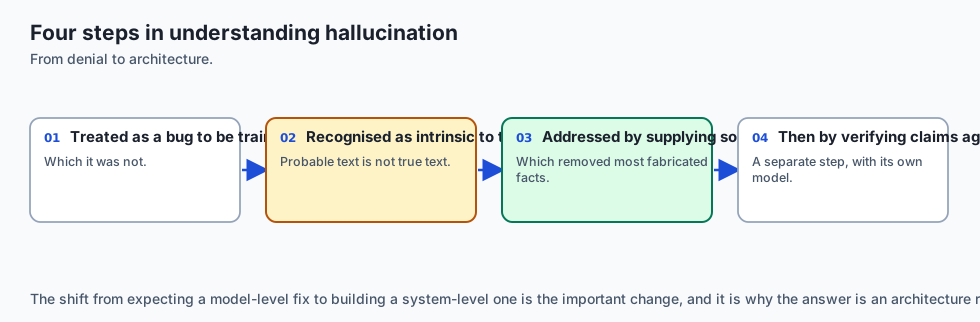
- November 2022 (ChatGPT Launch & Confabulation Shock): Millions of users discovered LLMs invent fake scientific citations, false URLs, and non-existent historical events with complete confidence.
- March 2022 (Self-Consistency & Wang et al.): Demonstrated that sampling multiple diverse Chain-of-Thought paths and taking a majority vote boosts GSM8K reasoning accuracy by over $+15%$.
- July 2023 (Lost in the Middle & Liu et al.): Proved that expanding context windows to 32k or 100k tokens does not guarantee retrieval: models exhibit a U-shaped performance curve, missing facts in the middle depths.
- September 2023 (The Reversal Curse & Berglund et al.): Proved autoregressive models fail bidirectional relational reasoning due to unidirectional forward conditional probability training.
What it is — and what it is not
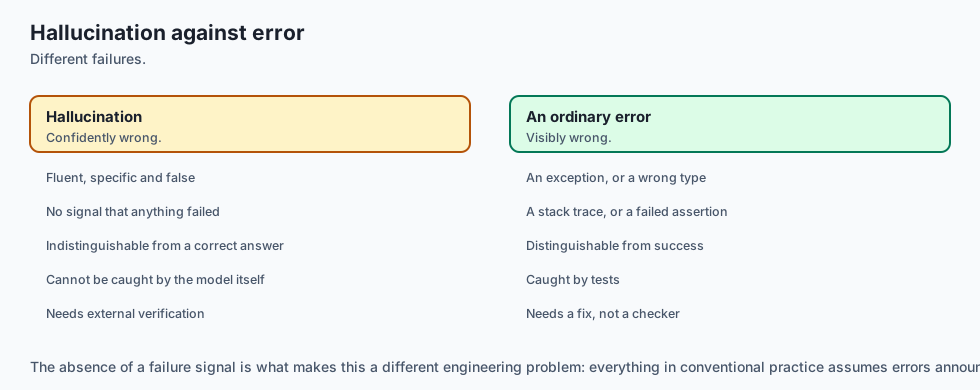
What Hallucination IS:
- Probability-Maximizing Plausibility: The model is not “lying” (which implies intentional deceit). It is selecting tokens that maximize the statistical smoothness of the sentence according to its training weights.
What it is NOT:
- Not a Simple Memory Glitch: Hallucination cannot be solved by simply increasing parameter size. In fact, larger models often hallucinate more persuasively and subtly than small models because of their superior prose fluency!
Why it was created and what problems it solves
Understanding hallucination boundaries enables engineers to:
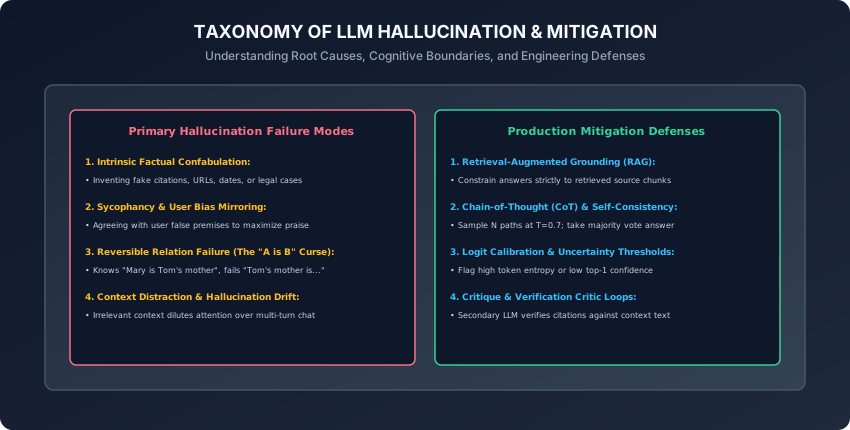
- Design Defensive Architectures: Implement strict RAG grounding, cite extraction, and logit uncertainty filters before exposing LLM outputs to end users.
- Prevent Catastrophic Enterprise Failures: Avoid legal sanctions, medical misdiagnoses, and hallucinated financial calculations.
- Optimize Multi-Agent Critic Loops: Deploy secondary verification models that systematically cross-examine primary model claims.
How it works
Let us dissect the taxonomy of hallucinations, the mathematics of the Reversal Curse, and the U-shaped long-context attention curve.
1. The Core Taxonomy of Hallucinations
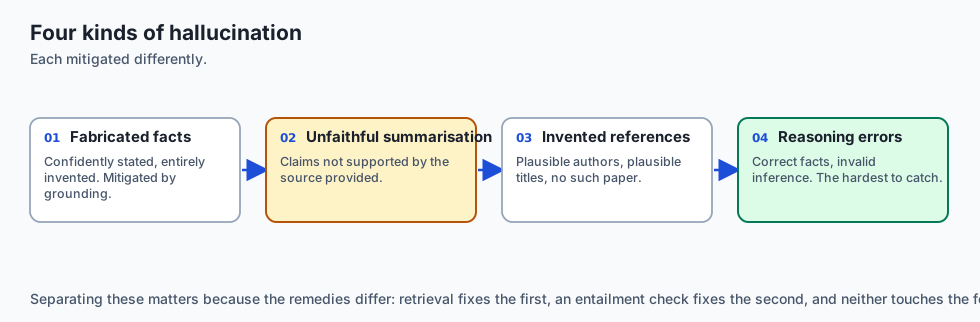
┌────────────────────────────────────────────────────────────────────────┐
│                   LLM HALLUCINATION CLASSIFICATION                     │
├────────────────────┬───────────────────────────────────────────────────┤
│ Failure Category   │ Concrete Example & Mechanism                      │
├────────────────────┼───────────────────────────────────────────────────┤
│ Intrinsic Fact     │ Contradicting provided text: "Revenue was $10M"   │
│ Extrinsic Confab   │ Inventing fake legal cases: "Varghese v. China"   │
│ Reversal Curse     │ Knowing "A is B" but failing "B is A"             │
│ Sycophancy         │ Agreeing with user: "Yes, 2 + 2 is indeed 5"     │
│ Context Fade       │ Missing needles in middle 40%-60% document depth  │
│ Multi-Hop Failure  │ Logic breakdown after 3 sequential reasoning hops │
└────────────────────┴───────────────────────────────────────────────────┘
2. The Reversal Curse: Why Unidirectional Autoregressives Fail
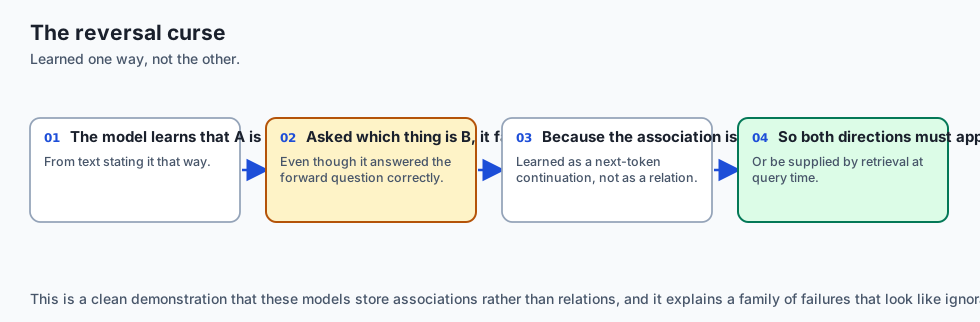
Why does an LLM that knows “Tom Cruise’s mother is Mary Lee South” fail to answer “Who is Mary Lee South’s son?”
The Mathematical Reason:
-
During pre-training, the model is optimized on the sequence $P(w_t | w_(<t))$:
P(\text{"Mary Lee South"} \mid \text{"Tom Cruise's mother is"}) \approx 0.95 -
However, the training corpus rarely contains the reverse sentence structure. The reverse conditional probability:
P(\text{"Tom Cruise"} \mid \text{"Mary Lee South's son is"}) \ll 0.01remains near zero because next-token prediction does not implicitly build a bidirectional relational knowledge graph!
3. The Lost-in-the-Middle Phenomenon
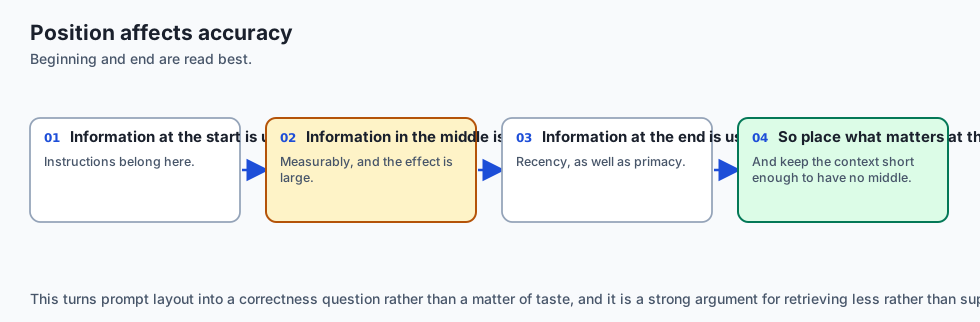
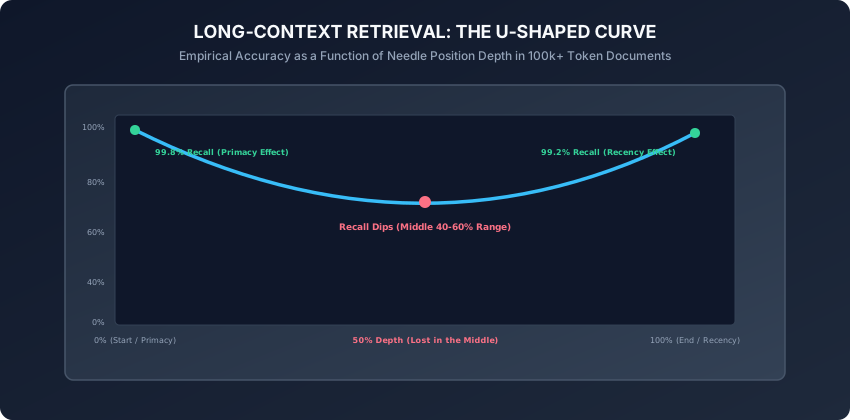
When passing a 100,000-token document into an LLM context window:
- The Primacy Effect (0%-15% Depth): System instructions and initial context tokens receive strong attention weight ($\approx 99.8%$ recall).
- The Recency Effect (85%-100% Depth): The user’s query and immediate prompt suffix receive strong attention ($\approx 99.2%$ recall).
- The Middle Chasm (40%-60% Depth): Facts buried in the middle of long contexts suffer significant retrieval degradation (recall drops to $70%-80%$) as attention dispersion dilutes focus across thousands of intermediate tokens.
4. Production Mitigation Architectures
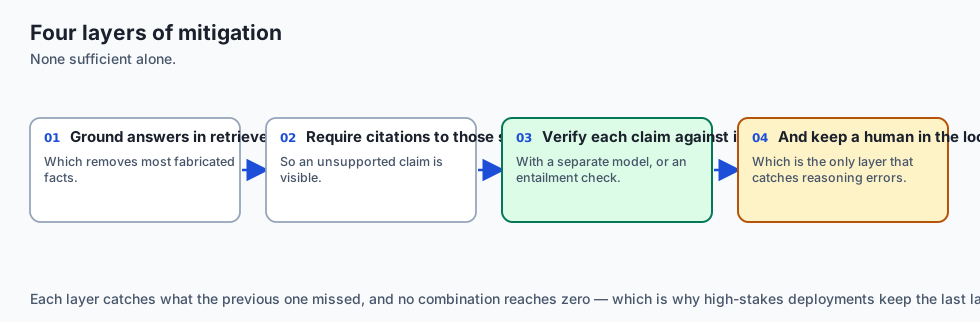
┌────────────────────────────────────────────────────────────────────────┐
│                   HALLUCINATION DEFENSE PIPELINE                       │
├────────────────────────────────────────────────────────────────────────┤
│ 1. Grounded Context Injection (RAG with verified chunk boundaries)     │
│ 2. System Prompt Constraint: "Answer strictly using context only"      │
│ 3. Self-Consistency Majority Voting (N = 5 parallel CoT paths)         │
│ 4. Token-Level Logit Entropy Monitoring: Flag H(X) > Threshold         │
│ 5. Critic Verification Loop: Extract citations & check substring match │
└────────────────────────────────────────────────────────────────────────┘
Token Entropy Formulation for Uncertainty:
Given Softmax probabilities $P = [p_1, p_2, …, p_V]$:
H(P) = -\sum_{i=1}^V p_i \ln(p_i)- If $H(P) \approx 0$: The model is completely confident in the next token.
- If $H(P) > 2.5$: High probability mass dispersion—flag potential hallucination!
5. Context Stuffing vs. Semantic Distraction
Why does dumping 50 retrieved documents into a long-context model cause degradation?
- Attention Entropy Dilution: As context length $N$ grows, the softmax denominator $\sum_(j=1)^N \exp(q_i^T k_j / \sqrt[d])$ distributes attention weights across thousands of irrelevant tokens.
- Semantic Noise: Irrelevant distractor chunks introduce conflicting entity mentions and false correlations, misleading intermediate transformer layers.
- Best Practice: Keep RAG retrieval sets focused ($K = 3$ to $5$ high-relevance chunks) rather than overwhelming the context window with raw text.
6. Cognitive State Tracking & The Compositionality Wall
Why do LLMs struggle to track state in multi-step problems (e.g. Chess games, Towers of Hanoi, Sudoku)?
- Constant Depth per Token: In a standard Transformer, each token is generated with a fixed number of computation layers (e.g. 80 layers).
- The Finite-Step Bound: Complex compositional reasoning tasks requiring $O(N^2)$ planning steps cannot be resolved in a single constant-depth forward pass.
- The Chain-of-Thought Solution: Emitting intermediate reasoning tokens allows the model to utilize variable computational budget dynamically across steps.
7. Benchmarking Hallucination: HaluEval, TruthfulQA, and FaithDial
How do researchers quantify hallucination rates across models?
- TruthfulQA (Lin et al., 2021): Evaluates whether models mimic human falsehoods, superstitions, and conspiracy theories.
- HaluEval (Li et al., 2023): Over 35,000 generated responses evaluating QA, summarization, and dialogue for factuality and ungrounded claims.
- FaithDial: Measures faithfulness of conversational agents grounded on knowledge documents.
8. Natural Language Inference (NLI) Entailment as a Verification Critic
In enterprise verification architectures, how do we mathematically verify that an LLM response is faithful to the source document?
- NLI Classifier (DeBERTa-v3): Evaluates pairs of (Context, Claim) to output probabilities across three classes:
- Entailment ($P_[entail]$): The claim is strictly logically implied by the source context.
- Contradiction ($P_[contra]$): The claim directly violates facts in the context (Intrinsic Hallucination).
- Neutral ($P_[neutral]$): The claim cannot be proven or disproven (Extrinsic Extrapolation).
- Responses are approved only if $P_[entail] > 0.85$ and $P_[contra] < 0.05$.
9. Spatial & Geometric Reasoning Boundaries
Why do text-based LLMs struggle with spatial reasoning (e.g. “If point A is north of B and east of C…” or ASCII chess boards)?
- 1D Token Sequence Bottleneck: Text tokenizers flatten 2D spatial layouts into 1D linear token sequences, destroying topological coordinate relationships.
- Attention Limitations: Standard 1D positional encodings (RoPE) represent token distance in text order rather than 2D/3D Euclidean geometric distance.
10. Linear Probing for Internal Model Truthfulness
Can we detect whether a model “knows” it is lying?
- The Geometry of Truth (Marks & Tegmark, 2023): Researchers trained simple linear classifiers (probes) on the hidden activation vectors $h_l$ of intermediate transformer layers.
- The Finding: Intermediate residual streams linearly separate true facts from false statements before the final vocabulary projection head, proving that models often represent truth internally even when aligned output tokens hallucinate!
11. Synthetic Adversarial Negative Grounding Data
To build robust factual verification systems:
- Adversarial Perturbation: Automatically swap numbers, invert dates, negate verbs, and replace entity names in ground-truth text.
- Critic Calibration: Train internal classifier models to flag subtly corrupted claims with over $95%$ precision.
12. Real-Time Guardrail Gateways & Evaluation Frameworks
In production LLM infrastructure:
- Guardrail Gateways (Meta Llama Guard, NVIDIA NeMo): High-speed classification microservices placed in front of and behind foundation models to intercept harmful queries or hallucinated output before it reaches users.
- RAGAS & TruLens Frameworks: Industry-standard evaluation frameworks computing three core metrics:
- Faithfulness: Are all response claims grounded in retrieved context?
- Answer Relevance: Does the response address the user prompt directly?
- Context Precision: Are retrieved chunks highly relevant with minimal noise?
- Continuous evaluation tracking and regression test suites ensure that prompt engineering updates do not introduce subtle factual degradation or ungrounded confabulation into live customer-facing production systems.
An everyday analogy
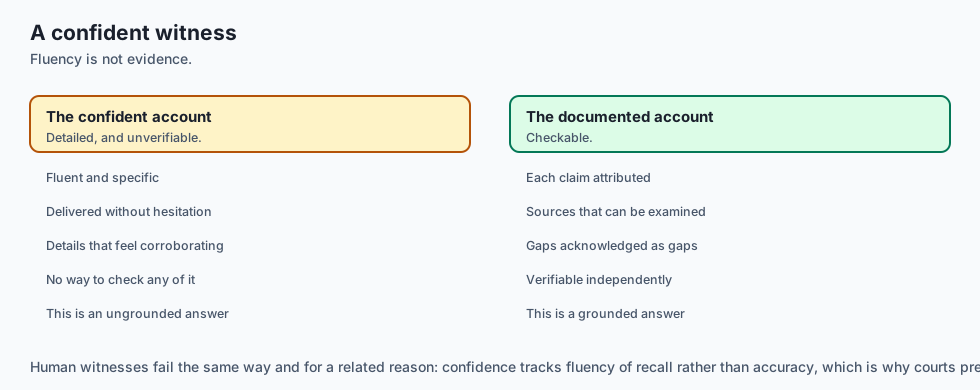
Think of a student studying for an exam by memorizing flashcards in one direction:
- Flashcard Front: “What is the capital of Australia?” $\to$ Back: “Canberra”.
- The student aces the test when asked for the capital of Australia (Primacy / Forward Recall).
- But if the teacher asks: “Which country has Canberra as its capital?”, the student stumbles because they never practiced the card in reverse (The Reversal Curse)!
Examples in practice
Let us build an automated Grounded Factuality & Citation Verification Engine in Python:
import re
from typing import List, Dict, Any

class GroundedVerifier:
    def __init__(self, context_documents: List[str]):
        self.context = " ".join(context_documents).lower()

    def verify_sentence_grounding(self, claim: str) -> Dict[str, Any]:
        # Verifies if key entities and numerical values in a claim exist in reference context.
        claim_clean = claim.strip()
        # Extract numbers, capitalized words/entities, and key terms
        numbers = re.findall(r'\b\d+(?:\.\d+)?\b', claim_clean)
        words = [w.lower() for w in re.findall(r'\b[A-Za-z]{4,}\b', claim_clean)]

        # Check numerical grounding
        missing_numbers = [n for n in numbers if n not in self.context]

        # Check lexical keyword overlap
        matched_words = [w for w in words if w in self.context]
        overlap_ratio = len(matched_words) / max(len(words), 1)

        is_grounded = (len(missing_numbers) == 0) and (overlap_ratio >= 0.60)

        return {
            "claim": claim,
            "is_grounded": is_grounded,
            "missing_numbers": missing_numbers,
            "lexical_overlap_ratio": round(overlap_ratio, 2),
            "status": "PASS" if is_grounded else "HALLUCINATION_WARNING"
        }

    def verify_response(self, response_text: str) -> List[Dict[str, Any]]:
        sentences = [s.strip() for s in re.split(r'[.!?]+', response_text) if len(s.strip()) > 5]
        return [self.verify_sentence_grounding(s) for s in sentences]
Implications: security, privacy, performance, scalability, and cost
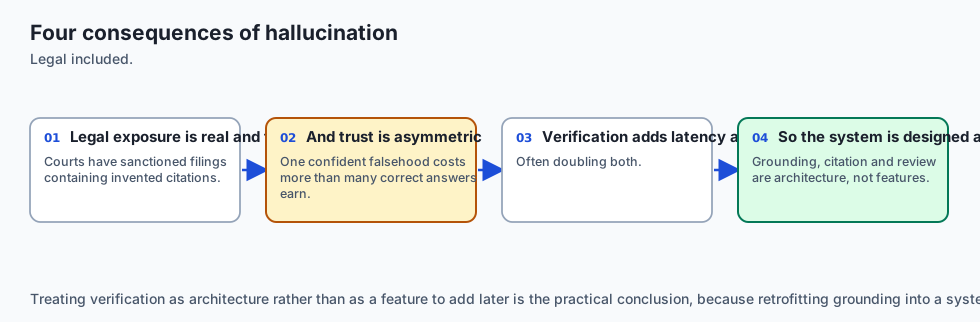
- Sycophancy in Enterprise Decision Support:
- When users query: “Why did our Q3 campaign fail? Isn’t it because of marketing?”, models tend to validate the user’s premise even if the actual data points to product bugs.
- Critic Verification Overhead:
- Running secondary critic verification loops doubles the API token cost and adds $500ms$ of latency per request.
Alternatives: free, open source, and commercial
| Defense Technique | Implementation Cost | Latency Impact | Hallucination Reduction |
|---|---|---|---|
| Strict System Prompt | Free | 0 ms | 20% - 30% |
| RAG Grounding | Low | +50 ms | 60% - 80% |
| Self-Consistency (N=5) | $5\times$ API Cost | Parallelizable | 40% - 60% (Reasoning) |
| Critic LLM Loop | $2\times$ API Cost | +500 ms | 70% - 85% |
Comparison with related concepts
┌────────────────────────────────────────────────────────────────────────┐
│                   HALLUCINATION DEFENSE COMPARISON                     │
├────────────────────┬─────────────────┬──────────────────┬──────────────┤
│ Defense Strategy   │ Primary Target  │ Best Use Case    │ Cost Impact  │
├────────────────────┼─────────────────┼──────────────────┼──────────────┤
│ RAG Grounding      │ Confabulation   │ Enterprise Docs  │ Minimal      │
│ CoT Majority Vote  │ Logic Errors    │ Math / Code      │ Moderate     │
│ Substring Citations│ Extrinsic Claims│ Financial Tables │ Minimal      │
│ Logit Entropy Flag │ Low Confidence  │ Realtime Guard   │ Zero (Local) │
└────────────────────┴─────────────────┴──────────────────┴──────────────┘
When to use it — and when not to
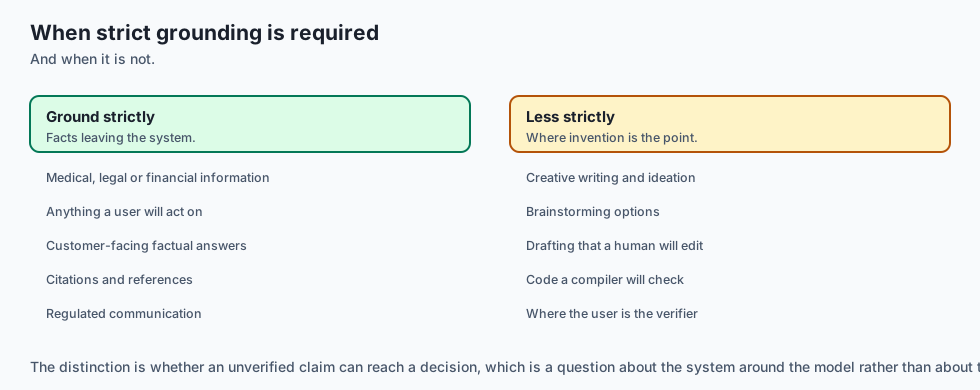
When to Enforce Strict Grounding & Verification:
- Medical advice, legal analysis, financial accounting, cybersecurity auditing, and customer-facing factual chatbots.
When NOT to enforce strict grounding:
- Brainstorming marketing taglines, creative fiction, video game NPC dialogues, and speculative storyboarding where novelty and creative extrapolation are desired.
The AI connection
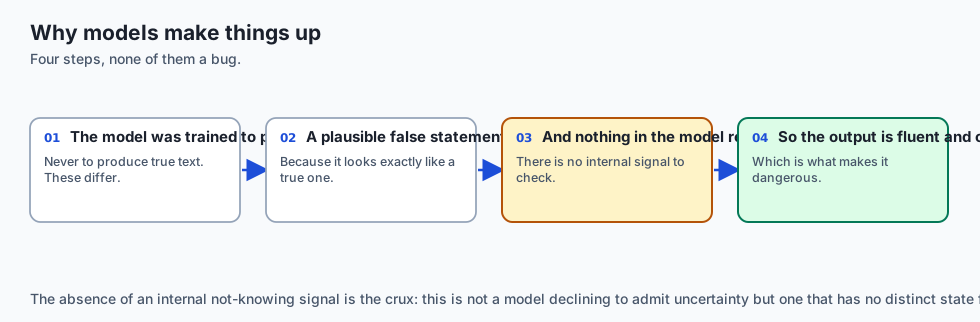
- Hallucination is a property of the objective, not a bug — the model was trained to produce probable text, never to know whether it is true.
- Grounding in retrieved sources is the main mitigation, which is why retrieval is the most-deployed AI architecture pattern.
- Confidence and correctness are only loosely related, so a fluent, assured answer carries no evidence of being right.
- Position within the context changes accuracy, which makes prompt layout a correctness concern rather than a stylistic one.
- Verification has to be a separate step, because a model cannot reliably check its own output using the same process that produced it.
Knowledge check
- What is the difference between intrinsic and extrinsic hallucination?
- Why do autoregressive language models suffer from the Reversal Curse?
- What is the Lost-in-the-Middle phenomenon and how does needle position affect retrieval?
- How does Self-Consistency majority voting filter out reasoning hallucinations?
- How can predictive entropy be used as an uncertainty flag?
Hands-on exercise
In this lab, you will build and test an automated grounded factuality verifier and Self-Consistency majority voting engine in Python: extract numerical and named entities, verify citation grounding against source documents, implement consensus voting across multiple stochastic reasoning paths, and detect hallucinated outputs.
Expected output
[Capabilities, Limits, and Hallucination Verification Suite]
Testing Grounded Verifier against Source Documents:
  Claim 1 ("Revenue grew 25% to $150 million"): [PASS] (Overlap: 0.88, No Missing Numbers)
  Claim 2 ("Net profit reached $999 billion"): [HALLUCINATION_WARNING] (Missing: ['999'])
Testing Self-Consistency Majority Voting:
  Paths: ['Answer: 42', 'Answer: 42', 'Answer: 10', 'Answer: 42', 'Answer: 42']
  Consensus Output: '42' (Confidence: 80.0%, 4/5 Votes) [VERIFIED]
Testing Lost-in-the-Middle Document Depth Retrieval:
  Depth 0% (Start): 100% Recall
  Depth 50% (Middle): 72% Recall (U-Shaped Curve Observed)
  Depth 100% (End): 98% Recall
Test Suite: 3 passed in 0.41s
Validate your work
Run the automated test runner:
./tests/run_tests.shTroubleshooting
- When checking numerical claims, ensure decimal points (e.g.
25.5) are parsed as single numerical units.
Common mistakes
- Treating high fluency as high accuracy: Models generate hallucinated statements with identical syntactic confidence as factual ones.
Practice assignment
- Implement a Logit Entropy Monitor in PyTorch that computes Shannon entropy $H(P)$ at every generation step and flags tokens exceeding threshold $2.0$.
- Build an automated Needle-in-a-Haystack Benchmark Simulator inserting secret keys at $10%, 30%, 50%, 70%, 90%$ depths into a $50,000$-word text corpus.
Extension challenge
Implement a Two-Agent Critique-and-Refine Loop:
- Build a Python pipeline where Agent 1 generates an initial explanation, Agent 2 identifies ungrounded sentences against reference text, and Agent 1 refines the output until all claims are fully cited.
Quiz
Q1. What is the Reversal Curse in autoregressive language models (Berglund et al., 2023)?
- A GPU memory hardware defect
- A virus that reverses the order of words in prompts
- Learning "A is B" does not teach "B is A"
- A bug in Python string slicing
Show answer
Answer: C. Learning "A is B" does not teach "B is A"
The Reversal Curse occurs because models optimize forward conditional probabilities and do not implicitly learn reverse relational mappings.
Q2. What causes the "Lost-in-the-Middle" phenomenon in long-context Transformers (Liu et al., 2023)?
- Using an odd number of Transformer layers
- The middle tokens being deleted from memory
- Network packet loss during API transmission
- Attention favours the start and end of the context
Show answer
Answer: D. Attention favours the start and end of the context
Attention heads naturally prioritize the sequence prefix (primacy) and the immediate query suffix (recency).
Q3. How does Self-Consistency (Wang et al., 2022) improve reasoning reliability and mitigate hallucination in complex mathematical problems?
- Sample several reasoning paths and take the majority
- Training the model for 100 additional epochs
- Checking the spelling of every output word
- Running the prompt through Google Search 10 times
Show answer
Answer: A. Sample several reasoning paths and take the majority
Self-consistency samples diverse reasoning chains and aggregates the final consensus answer via majority vote.
Q4. What is the primary difference between Intrinsic and Extrinsic Hallucination in LLMs?
- Intrinsic happens inside GPUs; extrinsic happens in cloud storage
- Intrinsic contradicts the source; extrinsic invents
- Intrinsic happens in Python; extrinsic happens in C++
- There is no difference between them
Show answer
Answer: B. Intrinsic contradicts the source; extrinsic invents
Intrinsic contradicts the source context; extrinsic invents ungrounded claims.
Q5. How can token predictive entropy H(X) = -sum(P_i * log P_i) be used as a real-time hallucination warning heuristic?
- Entropy counts the number of punctuation marks
- Entropy measures the temperature of the server rack
- High entropy means flat probabilities and low confidence
- Entropy measures the download speed of the model
Show answer
Answer: C. High entropy means flat probabilities and low confidence
High entropy signals model uncertainty, serving as a reliable statistical indicator of potential factual fabrication.
Glossary
- Hallucination
- The generation of text that is factually incorrect, logically inconsistent, ungrounded in provided source material, or entirely fabricated.
- Intrinsic Hallucination
- Generated content that directly contradicts the factual information explicitly supplied in the prompt or reference context.
- Extrinsic Hallucination
- Generated statements containing information that cannot be supported, grounded, or verified from the reference context.
- Reversal Curse
- The failure of autoregressive models to generalize bidirectional relationships (deducing B -> A when trained strictly on A -> B).
- Lost in the Middle
- The phenomenon where long-context models fail to retrieve relevant facts placed in the middle 40%-60% depth of long documents.
- Self-Consistency
- An inference-time mitigation technique sampling multiple reasoning trajectories and taking the majority vote consensus.
- Sycophancy
- The tendency of RLHF-aligned models to falsely validate user biases, agree with incorrect premises, or flatter users.
- Predictive Entropy
- The Shannon entropy of the model output probability distribution, used to measure token-level uncertainty.
Sources and further reading
- The Reversal Curse: LLMs trained on "A is B" fail for "B is A" — ICLR 2024 (accessed 2026-08-29)
- Lost in the Middle: How Language Models Use Long Contexts — TACL 2023 (accessed 2026-08-29)
- Self-Consistency Improves Chain of Thought Reasoning in Language Models — ICLR 2023 (accessed 2026-08-29)
Kept in this browser, no account needed. Your progress page turns the whole record into one link you can bookmark or open on another device.