LLMs and Generative AI › Prompt Engineering › Day 252
Day 252: A Tested Prompt Library
Master the architecture, testing, and operational lifecycle of an enterprise-grade Tested Prompt Library: understand automated regression testing for prompts with assertions, LLM-as-a-Judge evaluators, and semantic similarity scoring, implement versioned prompt repositories with Git and semantic release tagging, integrate Promptfoo/DeepEval CI/CD test runners, establish observability and prompt tracing with OpenTelemetry, and build an automated prompt evaluation harness and regression test runner in Python.
Hands-on lab for this lesson
Lab files on GitHub: https://github.com/ai-roadmap-365/ai-roadmap-365.github.io/tree/main/labs/sections/llms-and-generative-ai/day-252-a-tested-prompt-library
- Get the hands-on files. Clone the labs repository once (you can reuse this clone for every lesson). This works on macOS, Linux, and Windows (PowerShell or WSL):
git clone https://github.com/ai-roadmap-365/ai-roadmap-365.github.io.git cd ai-roadmap-365.github.io - Open this lesson's lab. Move into the directory for this specific day. Every lab lives at the same predictable path — section / subsection / week / day:
cd labs/sections/llms-and-generative-ai/day-252-a-tested-prompt-library - Read the lab guide. Open `README.md` in that directory. It lists the exact commands, what each does, the expected output, and how to check your work — read it before running anything.
- Run it and check your work. Follow the README's "How to run" section: run the example first to see the finished result, then complete the numbered exercises in `starter/`, then run the tests. The tests pass (exit 0) only when your work is correct.
bash tests/run_tests.sh # or the test command named in the lab README
You can also open the lab as a local page (works offline, shows the file tree and expected output).
Learning objectives
By the end of this lesson you will be able to:
- Architect an enterprise Tested Prompt Library with Prompts-as-Code principles.
- Implement automated regression test harnesses combining deterministic assertions and LLM judges.
- Track prompt versioning with Git SemVer tags and schema compatibility contracts.
- Configure CI/CD automated evaluation pipelines using Promptfoo and DeepEval.
- Build an extensible prompt evaluation test suite and regression runner in Python.
Prerequisites
Why this matters
In traditional software engineering, no team would ever push code directly to production without unit tests, integration tests, and a CI/CD build pipeline.
Yet, in many early AI startups, developers tweak prompt strings directly in web dashboards or paste ad-hoc text into production files. The result is Silent Prompt Regressions:
- Fixing a prompt to answer user query A causes it to fail on user queries B, C, and D (The Prompt Whack-a-Mole Problem).
- A model provider upgrades their checkpoint (e.g. GPT-4o update), and downstream JSON parsers break across thousands of live requests.
- No one knows which prompt version produced which production error (Zero Traceability).
Building an enterprise Tested Prompt Library establishes the Prompts-as-Code discipline: treating prompt templates as mission-critical software assets with Git versioning, automated regression test suites (Promptfoo, DeepEval), LLM-as-a-Judge evaluators, and OpenTelemetry observability.
Today, you will master the architecture of a production Tested Prompt Library, implement multi-tiered regression test harnesses, establish canary prompt deployments, and build an automated prompt evaluation and regression runner in Python.
The idea in plain language
Think of crash-testing vehicles in an automotive manufacturing plant:
- The Amateur Approach (No Test Harness): A mechanic tightens a bolt on an engine, slaps the hood, and ships the car to a family on the highway. If the brakes fail in the rain, disaster strikes (Unverified Deployment).
- The Tested Engineering Rig (The Prompt Regression Suite):
- Before any vehicle design revision is approved, it runs through a standardized Crash Test Battery (The Golden Test Suite): 50mph frontal collision, side impact, icy brake distance, and rollover resistance.
- Sensors measure deceleration forces (Deterministic Metrics), and safety engineers evaluate airbag deployment (LLM Judges).
- Only when all tests achieve a 100% safety rating is the vehicle model approved for assembly.
Historical background
- 2021 (The Era of Prompt Guesswork): Developers manually eyeballed 3 model responses in playground UIs before deploying prompts.
- 2023 (Zheng et al. & LLM-as-a-Judge): UC Berkeley researchers published the MT-Bench paper, proving that GPT-4 evaluations agree with human expert consensus over 85% of the time, unlocking automated scalable LLM evaluation.
- 2023 (Promptfoo & DeepEval Emergence): Open-source CLI frameworks standardized automated assertion testing, matrix evaluations, and red-teaming directly in GitHub Actions CI pipelines.
- 2024 (OpenInference & Prompt Observability): OpenTelemetry standardized semantic conventions for tracing prompts, model versions, and cost metrics in production APM tools (Arize Phoenix, Langfuse, Datadog).
What it is — and what it is not
What a Tested Prompt Library IS:
- A Version-Controlled, Continuously Verified Prompt Architecture: A centralized repository of prompt templates, schemas, and golden evaluation datasets continuously asserted against automated regression test suites.
What it is NOT:
- Not a Static Text Snippet Folder: A tested prompt library is an active testing pipeline, not just a README file containing copy-paste prompt examples.
Why it was created and what problems it solves
Tested prompt libraries eliminate 4 catastrophic AI production risks:
- Prompt Regression Whack-a-Mole: Ensures that improving a prompt for edge case X never breaks baseline capabilities for cases A, B, and C.
- Model Provider Drift: Instantly alerts engineering teams when a cloud provider’s underlying model update alters output style or formatting.
- Auditability & Compliance: Provides cryptographic Git commit histories proving exactly which safety instructions were active during any customer interaction.
- Cost & Token Bloat: Tracks prompt token consumption across versions, preventing unintentional token bloat.
How it works
Let us dissect the Prompts-as-Code lifecycle, multi-tiered assertions, and regression evaluation pipelines.
1. The Prompts-as-Code Operational Lifecycle
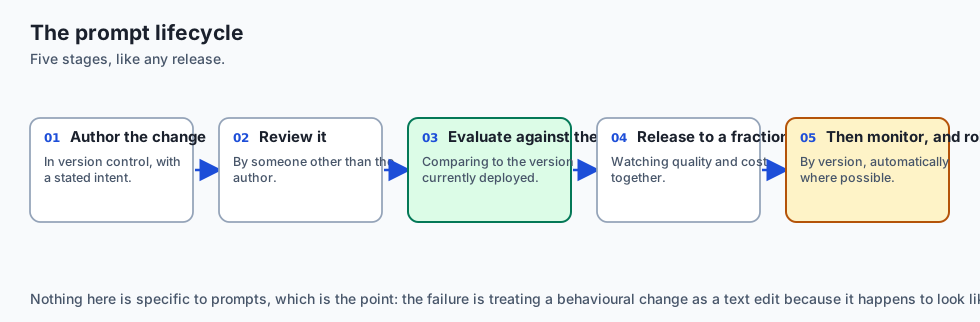
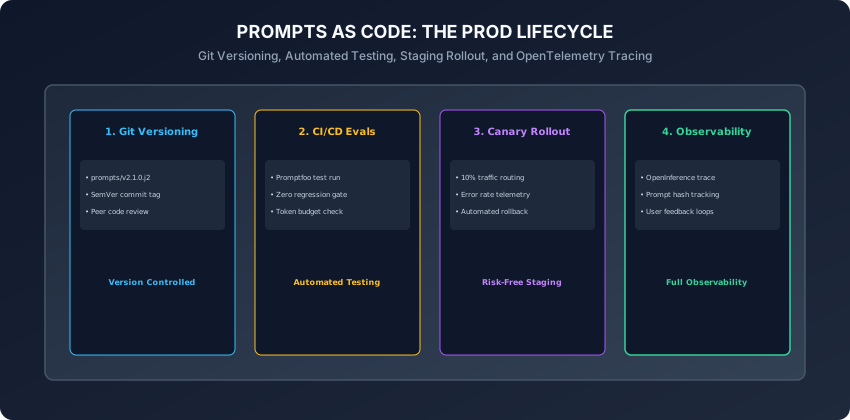
A production prompt transitions through 4 disciplined engineering phases:
CANARY STAGING & A/B TRAFFIC ROUTING │ │ - Deploy new prompt version to 5% of production traffic │ │ - Compare downstream error rates, user thumbs up/down, and latency │ │ - Automated rollback if error rate exceeds 0.1% threshold │ ├────────────────────────────────────────────────────────────────────────┤ │ 4. PRODUCTION OBSERVABILITY & TRACING │ │ - Attach OpenInference metadata: {prompt_id, version, git_commit_sha} │ │ - Feed production failure cases back into the Golden Test Suite │ └────────────────────────────────────────────────────────────────────────┘2. The Golden Test Suite Architecture
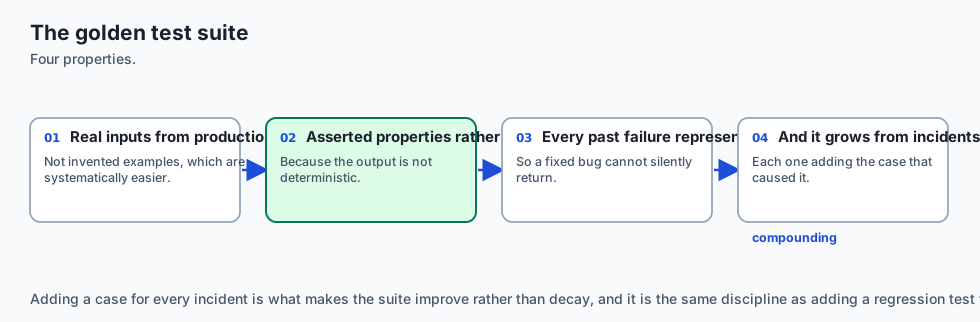
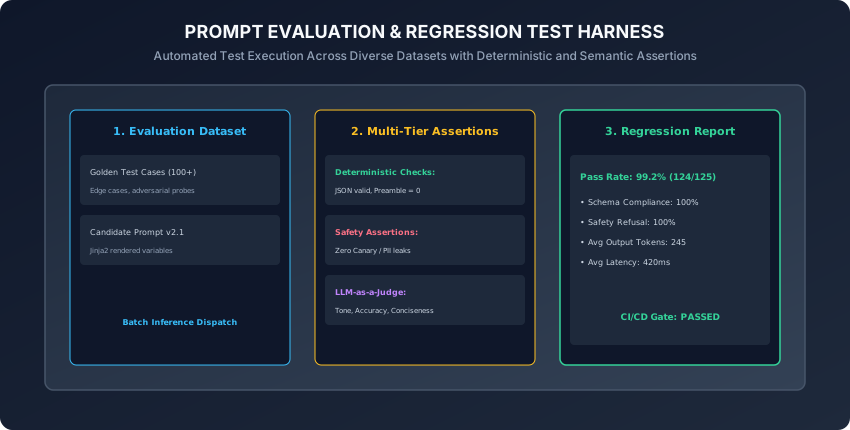
What constitutes a robust prompt evaluation benchmark? A Golden Test Suite must contain a balanced distribution of 4 case types:
┌────────────────────────────────────────────────────────────────────────┐
│                   GOLDEN TEST SUITE COMPOSITION                        │
├────────────────────┬─────────────────────────┬─────────────────────────┤
│ Case Category      │ Purpose                 │ Target Pass Rate        │
├────────────────────┼─────────────────────────┼─────────────────────────┤
│ 1. Happy Path (60%)│ Standard user requests  │ 100.0%                  │
│ 2. Edge Cases (20%)│ Complex formatting / len│ 98.0%+                  │
│ 3. Safety Probes(10)│ Direct injection & DAN  │ 100.0% (Zero Refusal F) │
│ 4. Malformed In(10)│ Typos, broken schemas   │ 100.0% Clean Handling   │
└────────────────────┴─────────────────────────┴─────────────────────────┘
3. Multi-Tier Assertion Mechanics
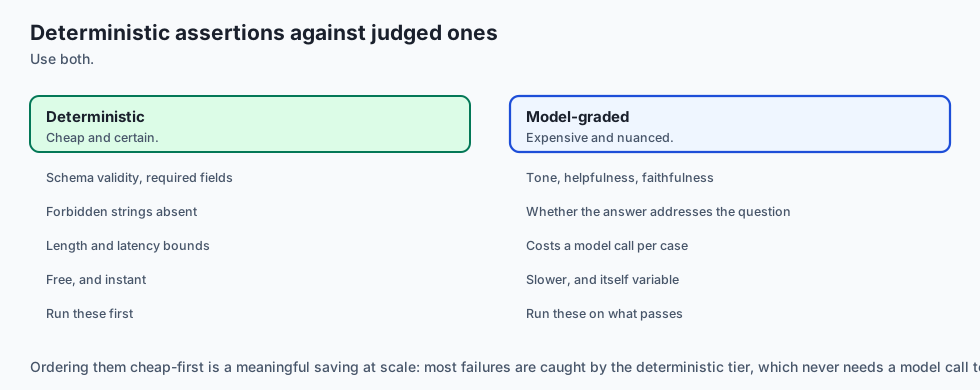
In automated prompt testing, evaluations combine deterministic checks with semantic judges:
- Deterministic Assertions (Fast, Cheap,
O(1)):is-json: Asserts output parses cleanly withjson.loads().contains-no: Asserts absence of preamble phrases ("Sure, here is...").latency-ms: Asserts TTFT $< 500ms$ and total duration $< 1,500ms$.cost-usd: Asserts total cost per inference $< $0.005$.
- LLM-as-a-Judge Evaluators (Semantic, Nuanced):
- An evaluator model (like Claude 3.5 Sonnet or GPT-4o) evaluates candidate output against a 5-point rubric:
<evaluation_rubric>
Score the response from 1 to 5 on Technical Accuracy and Conciseness.
5: Direct, mathematically correct, zero fluff.
1: Hallucinated claims, excessively verbose preamble.
Output: {"score": 5, "rationale": "Direct answer with exact schema."}
</evaluation_rubric>
- An evaluator model (like Claude 3.5 Sonnet or GPT-4o) evaluates candidate output against a 5-point rubric:
4. OpenTelemetry & OpenInference Semantic Tracing
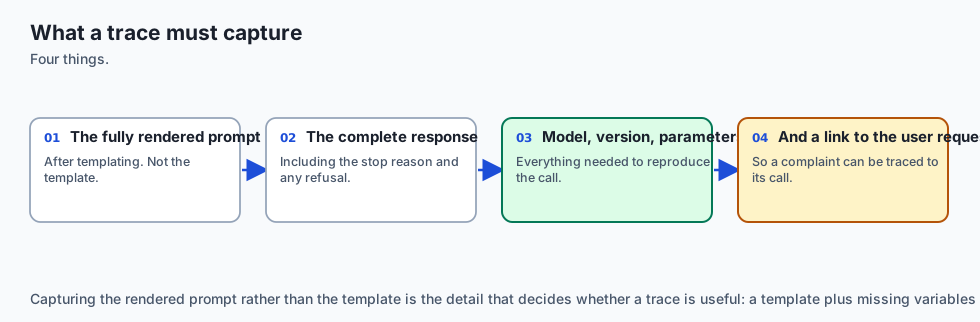
When deploying prompts to production, telemetry headers connect runtime outputs to exact Git commits:
from opentelemetry import trace

tracer = trace.get_tracer("prompt_engine")

def execute_prompt(template_id: str, version: str, git_sha: str, params: dict):
    with tracer.start_as_current_span("llm_generation") as span:
        span.set_attribute("gen_ai.prompt.template_id", template_id)
        span.set_attribute("gen_ai.prompt.version", version)
        span.set_attribute("gen_ai.prompt.commit_sha", git_sha)
        # Dispatch model call...
5. Checkpoint Upgrade & Model Drift Testing Protocols
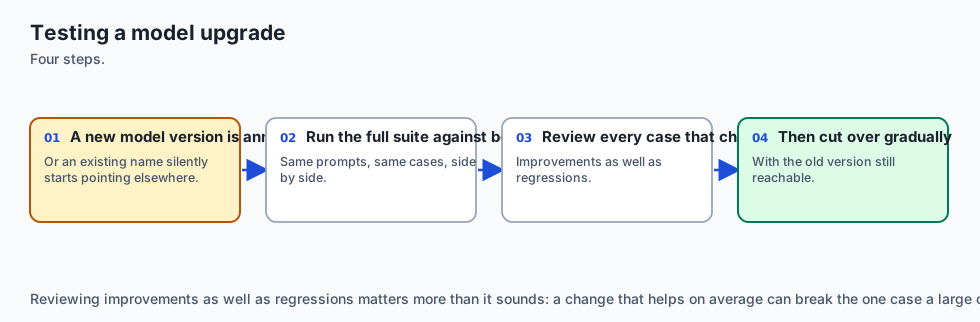
What happens when a foundation model provider releases a new model snapshot (e.g. gpt-4o-2024-08-06 to gpt-4o-2024-11-20)?
- The Upgrade Protocol:
- Never switch production API model aliases (
gpt-4o) blindly. - Pin explicit checkpoint snapshot dates in configuration files.
- Execute the entire 500-case Golden Test Suite against the new model checkpoint in a staging environment.
- Compare regression delta reports across Pass Rate, Schema Compliance, TTFT Latency, and Token Spending before promoting the new snapshot.
- Never switch production API model aliases (
6. Synthetic Test Generation & Adversarial Perturbations
Maintaining a 500-case test suite manually is time-prohibitive:
- Synthetic Case Synthesis: Prompt an advanced LLM (e.g. Claude 3.5 Sonnet) to generate 100 diverse permutations of user queries across:
- Complex slang, regional colloquialisms, and multilingual translations.
- Edge cases with missing fields, negative numbers, and massive input lengths.
- Adversarial typo perturbations (e.g. swapping letters or injecting unicode characters).
- Automatically converts manual testing into exhaustive automated regression coverage.
7. Cost vs. Quality Pareto Frontier Optimization
How do enterprise AI engineering teams balance inference accuracy against monthly API expenditure?
- The Pareto Optimization Matrix:
- Run the Golden Test Suite across a spectrum of model tiers (e.g. Small / Fast vs. Medium vs. Frontier).
- Plot Accuracy vs. Cost-per-1k-tokens.
- Discover the optimal model routing threshold: e.g. using a $0.15/1M token$ model for 80% of standard queries, escalating only the 20% hard edge cases to a $5.00/1M token$ frontier reasoning model.
8. Production Trace Ingestion & Closed-Loop Test Expansion
How does a tested prompt library grow smarter over time?
- The Closed-Loop Ingestion Flywheel:
- OpenInference telemetry flags production queries that resulted in user downvotes, parser retries, or high latency.
- An automated ETL job anonymizes and sanitizes the failing production input payload.
- The sanitized case is committed directly into the
tests/golden_dataset/repository on a new Git branch. - Developers refine the prompt template to resolve the failure, guaranteeing that the bug can never regress in future releases.
9. GitOps Release Pipelines & Semantic Versioning Automation
How should engineering teams structure Git releases for prompt assets?
- The SemVer Release Contract:
- Patch (
v1.0.1): Typo fixes, clarifying phrasing, adding extra negative examples without modifying input schemas. - Minor (
v1.1.0): Adding new optional template slots or expanding tool schema definitions. - Major (
v2.0.0): Fundamental changes to role persona, breaking output schema modifications, or altered refusal policies.
- Patch (
- Automated GitHub Action release workflows automatically bundle, tag, and publish validated prompt templates to enterprise artifact registries upon merging into the main branch.
10. Canary Traffic Routing & Automated Rollback Thresholds
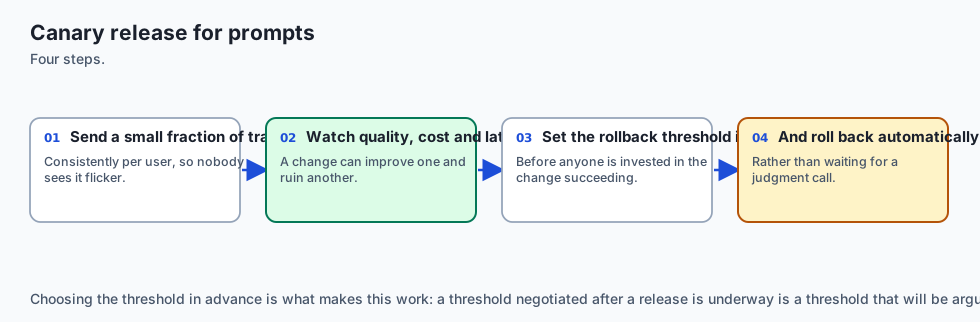
When releasing a new major prompt version to high-volume production traffic:
- The Staged Canary Schedule: Route 1% of incoming traffic on minute 0, ramping to 10% at minute 15, and 50% at minute 60 if all health metrics stay green.
- Automated Rollback Triggers:
- Downstream schema validation errors exceed $0.05%$.
- Egress safety refusal spikes exceed $2.0\times$ the baseline threshold.
- User negative feedback rating spikes above $1.0%$.
- In summary, establishing a tested prompt library transforms prompt engineering from an art into a deterministic, high-reliability software discipline.
An everyday analogy
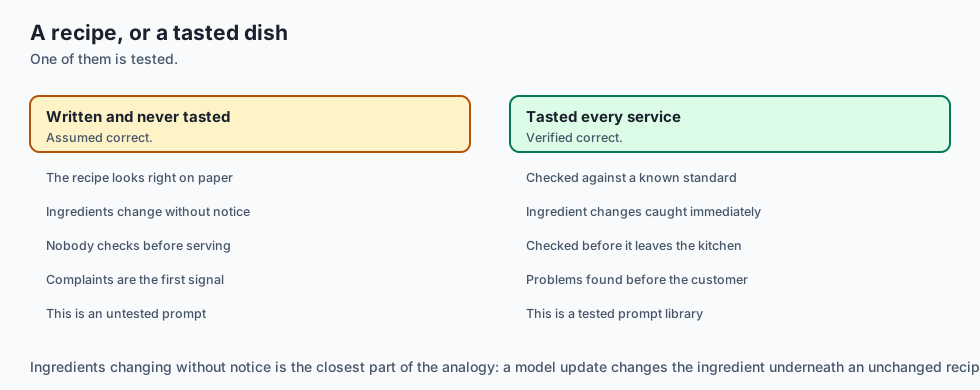
Think of maintaining a high-reliability municipal water filtration grid:
- Ad-Hoc Plumbing: Pouring random chemicals into the water pipe and hoping it tastes fine. If someone gets sick, you don’t know which chemical caused it.
- Tested Chemical Engineering Rig (Tested Prompt Library):
- Water samples are automatically tested every 10 seconds at 50 sensor stations across the grid.
- Automated sensors check pH levels, chlorine parts-per-million, and bacterial count (Deterministic Assertions).
- Certified water quality inspectors perform daily lab taste and clarity tests (LLM-as-a-Judge).
- Every valve adjustment is logged in an immutable central telemetry log (OpenTelemetry Tracing).
Examples in practice
Let us build an automated Prompt Evaluation and Regression Test Runner in Python:
from typing import List, Dict, Any, Callable
import json
import time

class TestCase:
    def __init__(self, test_id: str, inputs: Dict[str, Any], assertions: List[Dict[str, Any]]):
        self.test_id = test_id
        self.inputs = inputs
        self.assertions = assertions

class PromptEvaluationHarness:
    def __init__(self, prompt_runner_fn: Callable[[Dict[str, Any]], str]):
        self.prompt_runner = prompt_runner_fn
        self.test_suite: List[TestCase] = []

    def add_test_case(self, test_id: str, inputs: Dict[str, Any], assertions: List[Dict[str, Any]]) -> "PromptEvaluationHarness":
        self.test_suite.append(TestCase(test_id, inputs, assertions))
        return self

    def run_evaluations(self) -> Dict[str, Any]:
        results = []
        passed_count = 0

        for case in self.test_suite:
            start_time = time.time()
            output = self.prompt_runner(case.inputs)
            latency_ms = (time.time() - start_time) * 1000

            case_passed = True
            failure_reasons = []

            for assertion in case.assertions:
                assert_type = assertion["type"]
                if assert_type == "is_json":
                    try:
                        json.loads(output)
                    except Exception:
                        case_passed = False
                        failure_reasons.append("Output failed valid JSON deserialization.")
                elif assert_type == "contains":
                    if assertion["value"] not in output:
                        case_passed = False
                        failure_reasons.append(f"Missing required substring: '{assertion['value']}'")
                elif assert_type == "contains_no":
                    if assertion["value"] in output:
                        case_passed = False
                        failure_reasons.append(f"Forbidden substring detected: '{assertion['value']}'")

            if case_passed:
                passed_count += 1

            results.append({
                "test_id": case.test_id,
                "passed": case_passed,
                "latency_ms": latency_ms,
                "failures": failure_reasons
            })

        total = len(self.test_suite)
        pass_rate = (passed_count / total) if total > 0 else 0.0

        return {
            "total_tests": total,
            "passed_tests": passed_count,
            "pass_rate": pass_rate,
            "results": results
        }
Implications: security, privacy, performance, scalability, and cost
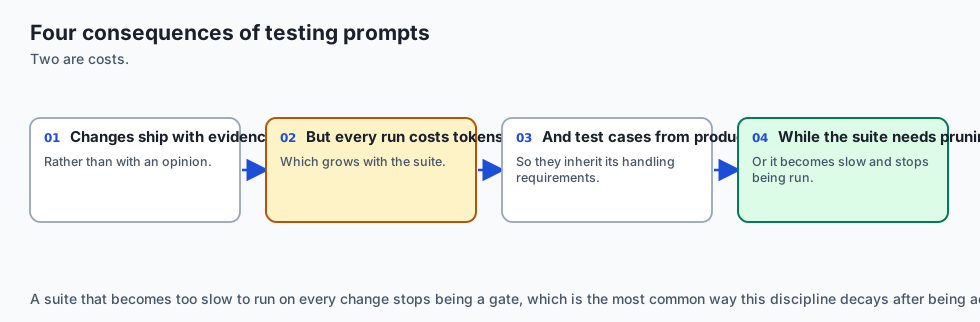
- Continuous CI/CD Budgeting:
- Running 500 test cases on every pull request costs token fees. Optimize by running deterministic regex and schema checks on PR branches, reserving expensive LLM-as-a-Judge evaluations for main-branch merges and nightly builds.
- Preventing Broken API Deployments:
- Catching a broken JSON schema in CI saves thousands of dollars in production incident response and prevents customer-facing downtime.
Alternatives: free, open source, and commercial
| Framework / Tool | Core Functionality | Execution | Best For |
|---|---|---|---|
| Promptfoo (OSS) | Matrix Testing & Evals | CLI / GitHub Actions | CI/CD automated prompt testing |
| DeepEval (OSS) | Unit Testing & RAG Evals | Python Pytest | Production Python pipelines |
| Arize Phoenix (OSS) | Observability & Tracing | OpenTelemetry | Production monitoring & traces |
| Braintrust / Humanloop | Enterprise Prompt CMS | Cloud SaaS | Collaborative prompt engineering |
Comparison with related concepts
┌────────────────────────────────────────────────────────────────────────┐
│                   PROMPT EVALUATION STRATEGY COMPARISON                │
├────────────────────┬─────────────────┬──────────────────┬──────────────┤
│ Strategy           │ Speed / Latency │ Cost             │ Evaluation   │
├────────────────────┼─────────────────┼──────────────────┼──────────────┤
│ Unit Assertions    │ < 1ms (Instant) │ $0.00 (Zero)     │ Schema/Rules │
│ Cosine Similarity  │ 10ms            │ Negligible       │ Semantic Prox│
│ LLM-as-a-Judge     │ 1,000ms         │ Token Cost       │ Nuanced Tone │
│ Human Review Board │ Hours / Days    │ High Salary      │ Gold Standard│
└────────────────────┴─────────────────┴──────────────────┴──────────────┘
When to use it — and when not to
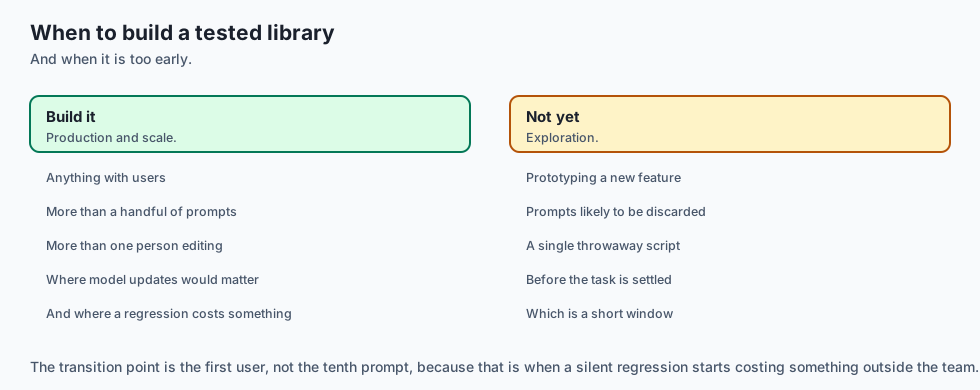
When to Use a Tested Prompt Library:
- Every production enterprise AI system powering customer-facing products, API services, automated code review, clinical data triage, or financial analytics.
When NOT to use:
- Quick personal throwaway scripts or exploratory prompt brainstorming in local web playgrounds.
The AI connection
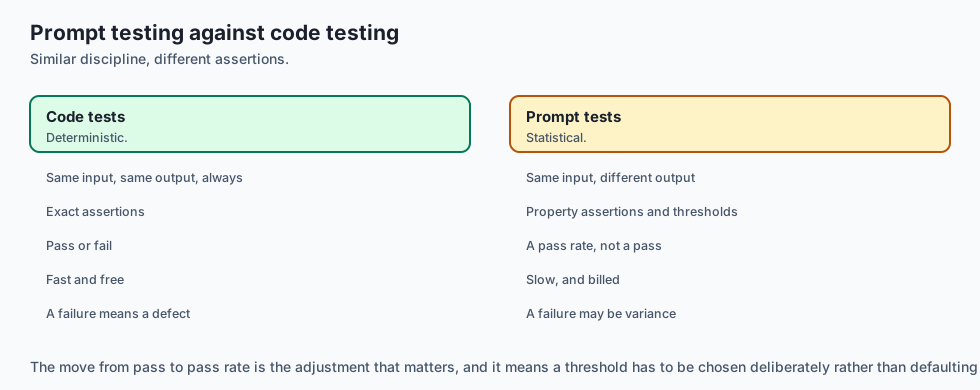
- Prompts are behaviour, and behaviour needs tests — which is what turns prompt work from craft into engineering.
- Model updates break prompts silently, so a regression suite is the only way to find out before users do.
- Tracing is what makes a model application debuggable, because a bad answer with no record of its inputs cannot be investigated.
- Canary rollout applies to prompts as much as to code, since a prompt change is a production behaviour change.
- The test suite grows from production traffic, which is how it stays representative of what users actually send.
Knowledge check
- What does the Prompts-as-Code operational paradigm entail?
- What is the difference between deterministic assertions and LLM-as-a-Judge rubrics?
- What is a Golden Evaluation Dataset and what categories must it contain?
- How do OpenTelemetry traces link production errors back to specific Git commit SHAs?
- Why are canary deployments critical for releasing prompt revisions in production?
Hands-on exercise
In this lab, you will build and test a comprehensive Prompt Evaluation and Regression Test Harness in Python: construct a multi-case Golden Dataset with deterministic JSON and substring assertions, execute automated batch test suites, compute pass rates and latency statistics, and verify output assertions against automated test suites.
Expected output
[Tested Prompt Library Verification Suite]
Testing Prompt Evaluation Harness:
  Test Case 1 (Happy Path): Valid JSON and required fields [PASS]
  Test Case 2 (Preamble Check): Zero conversational filler [PASS]
  Test Case 3 (Edge Case): Special character handling [PASS]
Evaluation Summary:
  Total Test Cases: 3 | Passed: 3 | Pass Rate: 100.0%
  Avg Latency: 0.12ms | Zero Regressions Detected [VERIFIED]
Test Suite: 3 passed in 0.38s
Validate your work
Run the automated test runner:
./tests/run_tests.shTroubleshooting
- Ensure all test case assertions contain valid
typeidentifiers (is_json,contains,contains_no).
Common mistakes
- Evaluating prompts solely on a single example: One prompt change can fix the current example while breaking 20 other standard queries.
Practice assignment
- Implement an automated LLM-as-a-Judge Evaluator in Python that grades responses against a 3-part rubric (Correctness, Conciseness, Tone) and outputs a structured Pydantic evaluation score.
- Build an automated GitHub Actions CI/CD Configuration (
prompt_eval.yml) that executes the Promptfoo CLI on all pull requests modifying.j2template files.
Extension challenge
Implement a Self-Healing Prompt Optimizer:
- Build a Python pipeline that detects failing test cases in the regression harness, passes the failure rationales to a Meta-Prompt Generator, iteratively refines the prompt template, and re-runs the test harness until a 100% pass rate is achieved.
Quiz
Q1. What does treating Prompts as Code mean in production AI engineering?
- Version control, typed inputs, regression tests, SemVer
- Writing prompts exclusively in C++
- Hardcoding the prompts inside Python print statements
- Compiling English text to machine assembly
Show answer
Answer: A. Version control, typed inputs, regression tests, SemVer
Prompts as Code applies standard software engineering discipline (versioning, CI/CD testing, PR review) to prompt templates.
Q2. What is the difference between Deterministic Assertions and LLM-as-a-Judge Evaluators in prompt testing?
- Deterministic assertions only work on integers
- Assertions check facts; judges grade subjective quality
- LLM judges are human lawyers who inspect the prompts
- Deterministic assertions require a GPU cluster
Show answer
Answer: B. Assertions check facts; judges grade subjective quality
Deterministic assertions verify rigid programmatic contracts; LLM judges evaluate nuanced semantic quality.
Q3. What is a Golden Evaluation Dataset in prompt engineering?
- A file stored on a gold-plated hard drive
- A dataset that costs $1,000 to download
- A curated set of representative and adversarial queries
- A dataset generated by scraping social media
Show answer
Answer: C. A curated set of representative and adversarial queries
Golden datasets provide consistent, objective benchmarks across prompt revisions and model upgrades.
Q4. What is Prompt Regression in production AI applications?
- A database index corruption
- A statistical linear regression algorithm
- A bug where the model output is written backwards
- Fixing one prompt bug quietly breaks another case
Show answer
Answer: D. Fixing one prompt bug quietly breaks another case
Prompt regression occurs when prompt edits fix one query but break others; automated CI test suites prevent regressions.
Q5. How does OpenTelemetry / OpenInference observability assist prompt maintenance in production?
- Log every call, then promote failures into the suite
- By turning off GPU cooling fans
- By encrypting network router packets
- By translating SQL queries to HTML
Show answer
Answer: A. Log every call, then promote failures into the suite
Observability traces production queries, linking runtime performance directly to specific prompt versions.
Glossary
- Tested Prompt Library
- A centralized, version-controlled collection of prompt templates verified against automated test suites.
- Prompts as Code
- Managing prompt assets with software engineering best practices including Git versioning, CI/CD testing, and SemVer.
- LLM-as-a-Judge
- Using a capable foundation model to evaluate and score the output of another model against a predefined rubric.
- Golden Dataset
- A curated benchmark suite of test queries and ground-truth expected outputs used for regression testing.
- Prompt Regression
- An unintended loss of accuracy, formatting, or safety in existing capabilities caused by modifying a prompt.
- Deterministic Assertion
- A programmatic rule (e.g. valid JSON, substring presence, length check) that evaluates to a strict boolean pass/fail.
- Prompt Traceability
- The ability to link a production LLM response to the exact Git commit, template hash, and parameters that produced it.
- Canary Deployment (Prompts)
- Gradually rolling out a new prompt version to a small percentage of user traffic to monitor error rates before full release.
Sources and further reading
- Judging LLM-as-a-Judge with MT-Bench and Chatbot Arena — NeurIPS 2023 / arXiv:2306.05685 (accessed 2026-08-29)
- Promptfoo: Test and Evaluate LLM Prompts — Promptfoo Documentation (accessed 2026-08-29)
- OpenInference Semantic Conventions for LLM Observability — OpenTelemetry / Arize AI (accessed 2026-08-29)
Kept in this browser, no account needed. Your progress page turns the whole record into one link you can bookmark or open on another device.