LLMs and Generative AI › Retrieval-Augmented Generation › Day 271
Day 271: Advanced RAG Patterns
Elevate retrieval precision beyond naive vector search: implement Multi-Query generation, sub-question decomposition, HyDE (Hypothetical Document Embeddings), and Parent-Document retrieval with small-to-big context expansion.
Hands-on lab for this lesson
Lab files on GitHub: https://github.com/ai-roadmap-365/ai-roadmap-365.github.io/tree/main/labs/sections/llms-and-generative-ai/day-271-advanced-rag-patterns
- Get the hands-on files. Clone the labs repository once (you can reuse this clone for every lesson). This works on macOS, Linux, and Windows (PowerShell or WSL):
git clone https://github.com/ai-roadmap-365/ai-roadmap-365.github.io.git cd ai-roadmap-365.github.io - Open this lesson's lab. Move into the directory for this specific day. Every lab lives at the same predictable path — section / subsection / week / day:
cd labs/sections/llms-and-generative-ai/day-271-advanced-rag-patterns - Read the lab guide. Open `README.md` in that directory. It lists the exact commands, what each does, the expected output, and how to check your work — read it before running anything.
- Run it and check your work. Follow the README's "How to run" section: run the example first to see the finished result, then complete the numbered exercises in `starter/`, then run the tests. The tests pass (exit 0) only when your work is correct.
bash tests/run_tests.sh # or the test command named in the lab README
You can also open the lab as a local page (works offline, shows the file tree and expected output).
Learning objectives
By the end of this lesson you will be able to:
- Understand the end-to-end multi-stage RAG architecture and non-parametric memory bridging.
- Implement structure-aware document parsing and sliding window chunking.
- Build sparse BM25 and dense vector indices with Reciprocal Rank Fusion.
- Construct grounded system prompts that enforce verifiable inline bracket citations.
- Evaluate RAG pipelines quantitatively using the RAG Triad framework.
Prerequisites
Why this matters
Days 268 to 270 assumed something that is usually false: that the user’s question resembles the passage that answers it.
It frequently does not. A question and its answer are different kinds of text.
  question   "why is my build slow"
  answer     "Layer cache invalidation occurs when any instruction above a
              COPY directive is modified, forcing rebuild of all subsequent
              layers."
Almost no shared vocabulary. BM25 finds nothing. A dense retriever does better but is still comparing a six-word fragment against a technical paragraph — short queries have unstable embeddings, because there is very little signal to average over.
Every technique today attacks that gap from a different side. Generate several phrasings of the question. Generate a fake answer and search with that instead. Search small and return large. None is exotic; each is a few lines, and each targets a specific, measurable failure of the naive approach.
The idea in plain language
The trick is to stop searching with the question.
A researcher handed “why is my build slow” does not type those words into a library catalogue. They think for a moment about what a document answering it would look like — it would mention caching, layers, invalidation, dependencies — and they search for that. They are searching with an imagined answer.
That is HyDE: have the model write a hypothetical answer, embed the hypothetical answer, and search with it. The hypothetical may be factually wrong. It does not matter, because it is never shown to anyone. It is being used purely as a better-shaped query — a paragraph of the right kind of language, sitting in roughly the right neighbourhood of the vector space.
The second idea is just as simple. Ask the question three different ways and take the union. Where a single phrasing might miss, three rarely all miss.
Historical background
-
1971 — Rocchio’s relevance feedback: use the documents a user liked to reformulate their query. Query expansion is fifty years old.
-
1996 — Xu and Croft formalise pseudo-relevance feedback, expanding a query with terms drawn from its own top results, with no user involvement at all.
-
2016 — RM3 and related models make expansion a standard component of strong lexical baselines.
-
2022 — Gao et al. publish HyDE, Precise Zero-Shot Dense Retrieval without Relevance Labels. Generate a hypothetical document, embed that, search with it. It beats strong dense baselines with no labelled data whatsoever.
-
2023 — multi-query retrieval and RAG-Fusion appear in tooling; small-to-big and parent-document retrieval separate the unit you search from the unit you read.
-
2023 — self-querying retrievers translate natural language into structured metadata filters, so “papers after 2020 about attention” becomes a filter plus a search rather than one blurry vector.
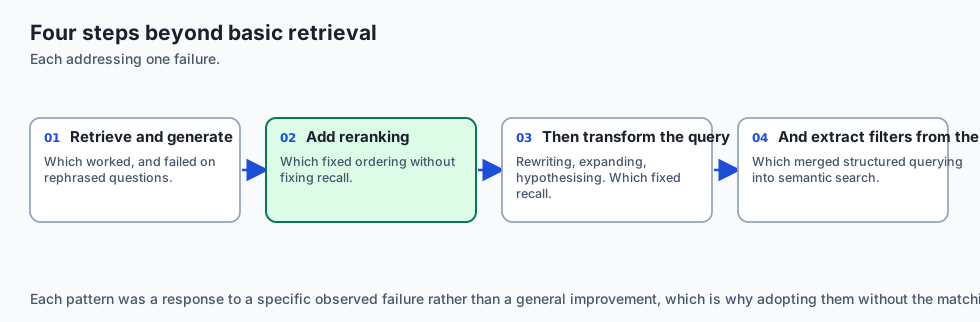
The consistent thread across fifty years is that the query as typed is rarely the best query available.
What it is — and what it is not
It is a set of independent, composable techniques applied at query time. Each addresses a distinct failure of naive retrieval, and each can be measured on its own.
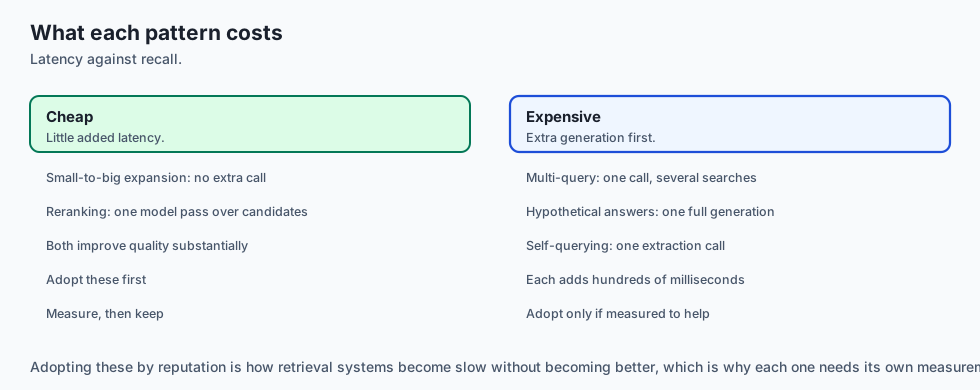
It is not a package deal, and applying all of them is usually wrong. Each costs latency, and several cost an extra model call per query.
| Technique | The failure it fixes | Cost |
|---|---|---|
| Multi-query | One phrasing misses | 1 model call, N searches |
| HyDE | Question and answer look different | 1 model call |
| Small-to-big | Precise match, insufficient context | None — an index-time choice |
| Self-query | Filterable constraints buried in prose | 1 model call |
| Reranking | Good recall, poor ordering | 1 cross-encoder pass |
The discipline that matters is measuring before adopting. “Advanced” is not a synonym for “better” — on a corpus where the naive approach already retrieves the right chunk, every one of these adds latency and changes nothing.
Why it was created and what problems it solves
Four specific, recognisable failures:
The vocabulary mismatch. The user says “slow build”; the document says “layer cache invalidation”. No lexical overlap, weak semantic overlap. Multi-query and HyDE both attack this.
The unstable short query. A three-word query produces an embedding dominated by whichever word happens to carry the most weight. Averaging several phrasings, or embedding a full paragraph instead, stabilises it.
The granularity conflict. Small chunks match precisely and lack the surrounding context needed to answer. Large chunks carry context and match diffusely. Small-to-big resolves this by refusing to choose: search small, return the parent.
The buried constraint. “What did we ship in Q3 2024?” contains a date filter disguised as prose. Semantic search over a date range is hopeless; a metadata filter is trivial. Self-querying extracts the filter and applies it properly.
Recognising which of the four you actually have is most of the work. Applying the matching technique is the easy part.
How it works

1. Multi-query expansion
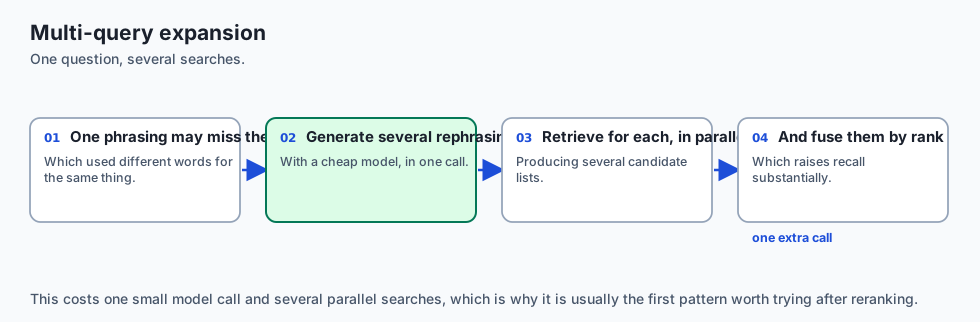
Ask the model for three alternative phrasings, run all of them, and fuse the result lists with Reciprocal Rank Fusion — the same function from Day 268, now merging four rankings instead of two.
  "why is my build slow"
       ├── "Docker build cache invalidation causes"
       ├── "reasons a container image rebuild takes a long time"
       └── "how layer ordering affects build duration"
A chunk retrieved by two phrasings outranks one retrieved by a single phrasing. That is exactly the consensus signal RRF was designed to capture.
2. HyDE
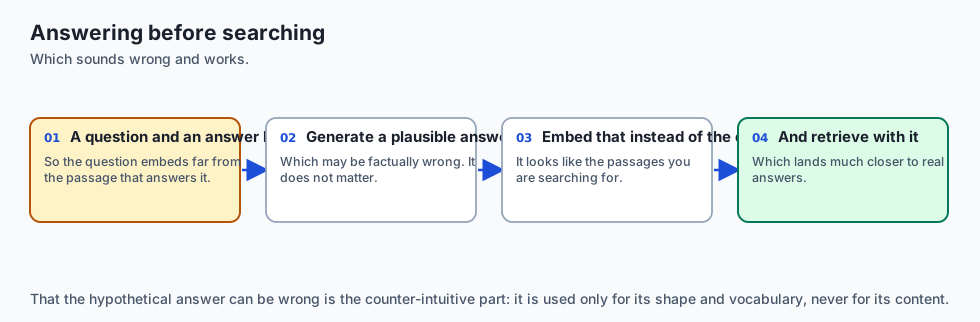
Ask the model to answer the question from its own knowledge, embed that answer, and search with its vector. Discard the hypothetical text afterwards.
The hypothetical may contain errors. It is never returned to the user and never enters the final context — its only job is to be a paragraph-shaped query in the right region of the embedding space. The retrieved passages are real; only the probe was invented.
3. Small-to-big retrieval
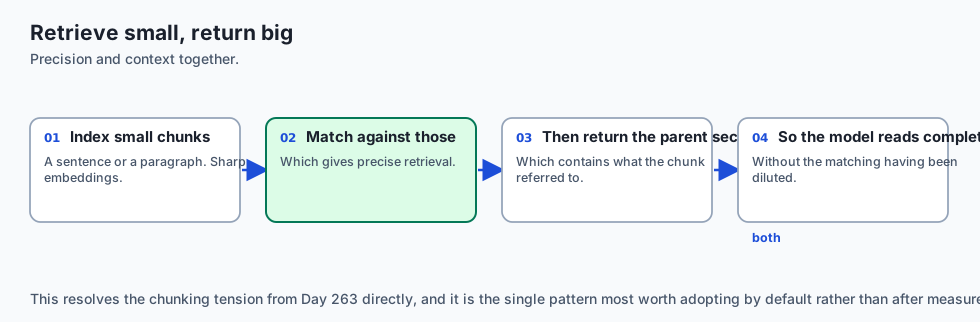
Index small chunks — a sentence or two — for precision. Store each one’s parent: the surrounding section or the whole document. Search over the small units, then return the parents.
This is the cheapest technique here because it costs nothing at query time. It is an indexing decision made once, and it dissolves the precision-versus-context trade rather than balancing it.
4. Self-querying
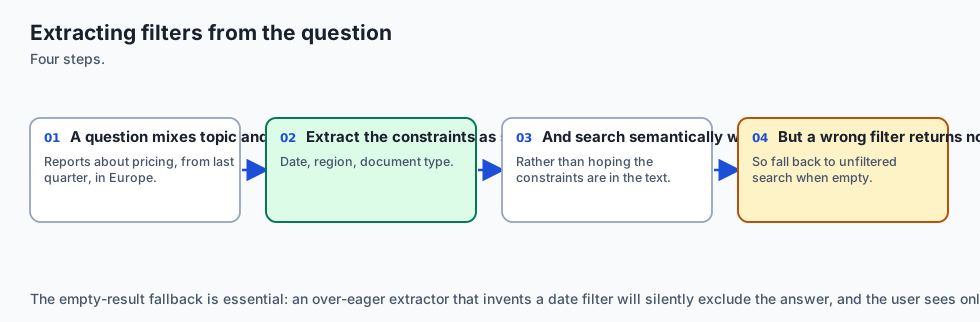
Have the model extract structured filters from the question before searching:
{ "semantic": "attention mechanisms", "filters": { "year": { "$gte": 2020 } } }Apply the filter as a filter, and search semantically over what survives. A date range is a database operation; asking an embedding to represent “after 2020” is asking it to do arithmetic it cannot do.
5. Reranking
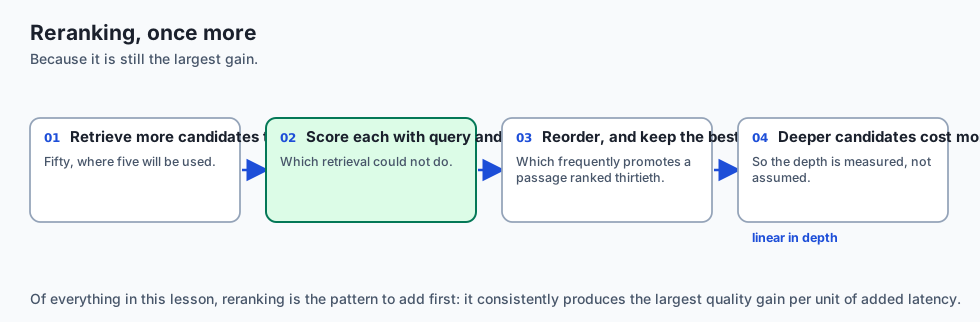
Retrieval optimises recall; reranking optimises order. A cross-encoder reads query and passage together — full attention across both — and scores relevance far more accurately than a dot product between two independently computed vectors.
It is too slow to run over the corpus and ideal over 50 candidates. Retrieve 50 cheaply, rerank to 5 accurately. Note the ordering constraint from Day 326: a reranker can only reorder what retrieval already returned. If the right document was never a candidate, no amount of reranking will surface it.
An everyday analogy
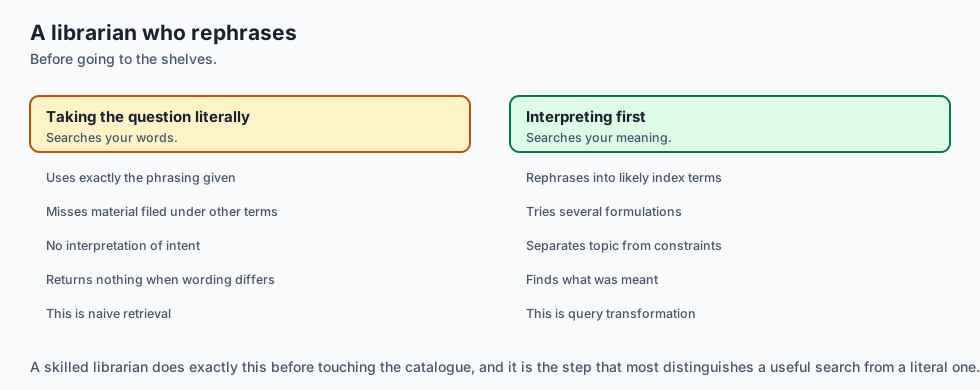
A junior researcher types your exact words into the catalogue and reports back that there is nothing.
A senior one does something different before searching at all. They rephrase the
question three ways because they know the catalogue’s vocabulary differs from
yours. They think about what a paper answering this would be titled and search
for that instead. They search chapter titles but hand you the whole chapter,
because a sentence out of context is no use. And when you say “recent work”, they
convert that to year >= 2020 rather than hoping the catalogue understands the
word “recent”.
Same catalogue, same query, very different results — because the senior researcher does not treat your question as the query.
Examples in practice

Multi-query with RRF
def multi_query(question: str, k: int = 5) -> list[Chunk]:
    variants = [question] + generate_paraphrases(question, n=3)
    rankings = [dense_search(v, k=20) for v in variants]
    return rrf(*rankings)[:k]          # rrf() is Day 268's, unchanged
HyDE
HYDE_PROMPT = (
    "Write a short factual paragraph that would answer this question. "
    "Do not hedge, do not say you are unsure — accuracy is not required.\n\n"
    "Question: {q}"
)

def hyde_search(question: str, k: int = 5) -> list[Chunk]:
    hypothetical = llm(HYDE_PROMPT.format(q=question))
    # The text is thrown away; only its vector is used.
    return dense_search_by_vector(embed(hypothetical), k=k)
Small-to-big
def small_to_big(question: str, k: int = 3) -> list[str]:
    hits = dense_search(question, k=k * 4)        # precise, narrow units
    parents, seen = [], set()
    for h in hits:
        if h.parent_id not in seen:               # dedupe: siblings share a parent
            seen.add(h.parent_id)
            parents.append(PARENTS[h.parent_id])
        if len(parents) == k:
            break
    return parents
Measuring whether any of it helped
for name, retrieve in [("naive", naive), ("multi", multi_query), ("hyde", hyde_search)]:
    hits = sum(gold_id in {c.id for c in retrieve(q)} for q, gold_id in eval_set)
    print(f"{name:6} recall@5 = {hits / len(eval_set):.2f}")
That last block is the important one. Every technique above is a hypothesis until this table says otherwise.
Implications: security, privacy, performance, scalability, and cost
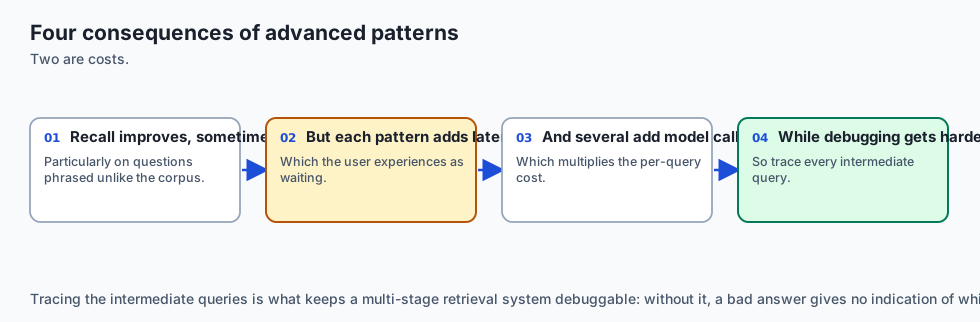
Performance. Multi-query multiplies searches by the number of variants and adds a model call before any search begins. HyDE adds a model call on the critical path — typically 200–800 ms, which for an interactive assistant is often the single largest latency item.
Cost. Each query-time model call is a real per-query cost. At a million queries a month, a small model at $0.15 per million tokens generating 100 tokens per call is roughly $15 — trivial. The same pattern with a frontier model is not.
Scalability. Small-to-big increases index size modestly (small chunks plus parent references) and costs nothing at query time. It is usually the best value in the list and it is the one people reach for last.
Security. Self-querying lets model output construct a database filter. Treat
the extracted filter as untrusted input: validate field names against an
allow-list and types against a schema. A model that can write arbitrary filters
can write {"user_id": {"$ne": null}}.
Privacy. HyDE sends the user’s question to a generation model before any retrieval happens. In a deployment where retrieval is local but generation is hosted, that is a data-egress decision made implicitly by a retrieval technique.
Alternatives: free, open source, and commercial
| Technique | Availability | Adds latency | Typical recall gain |
|---|---|---|---|
| Multi-query | Any model | 1 call + N searches | Moderate, consistent |
| HyDE | Any model | 1 call | Large where vocabulary differs |
| Small-to-big | Index-time only | None | Large where context matters |
| Self-query | Any model | 1 call | Large where filters exist, none otherwise |
| Cross-encoder rerank | bge-reranker, Cohere Rerank | 50–200 ms | Large on ordering |
Ranked by value per unit of complexity, the order is usually: small-to-big first because it is free at query time, then reranking because the gain is reliable, then HyDE, then multi-query, and self-query only when the corpus actually has metadata worth filtering on.
Comparison with related concepts
| Approach | When it acts | What it changes |
|---|---|---|
| Better chunking | Index time | What can be retrieved at all |
| Query expansion | Query time | What is retrieved for this question |
| Reranking | After retrieval | The order of what was retrieved |
| Larger context window | Generation | How much of it the model can read |
These stack rather than compete, and they have a strict precedence. No amount of query expansion recovers a fact that chunking destroyed, and no reranker promotes a document retrieval never returned. Fix them in that order — index, then query, then ranking — or you will tune the wrong stage.
When to use it — and when not to
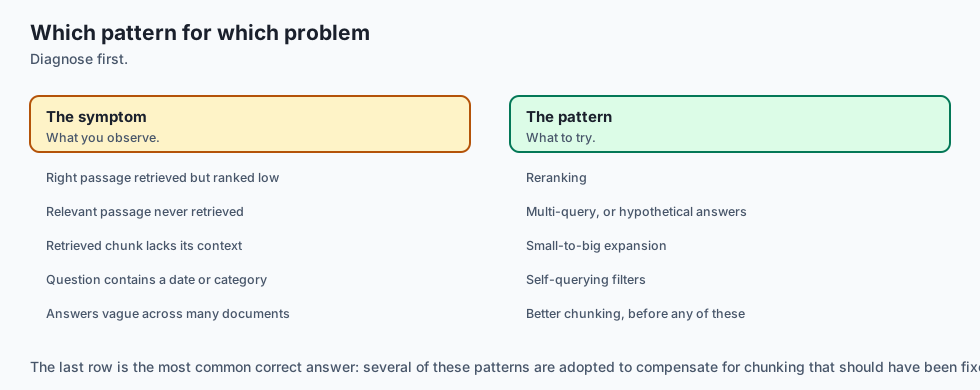
Reach for these when measured recall is the bottleneck, users phrase questions very differently from the source material, the corpus mixes short identifiers with long prose, or answers need more context than the matching chunk contains.
Do not reach for them when you have not measured a baseline. Every technique here is justified by a number, and adopting them by reputation is how a pipeline acquires 800 ms of latency and no improvement.
Prefer the cheap ones first. Small-to-big and reranking cost no extra model call. Exhaust the free options before adding a generation call to the critical path of every query.
The AI connection
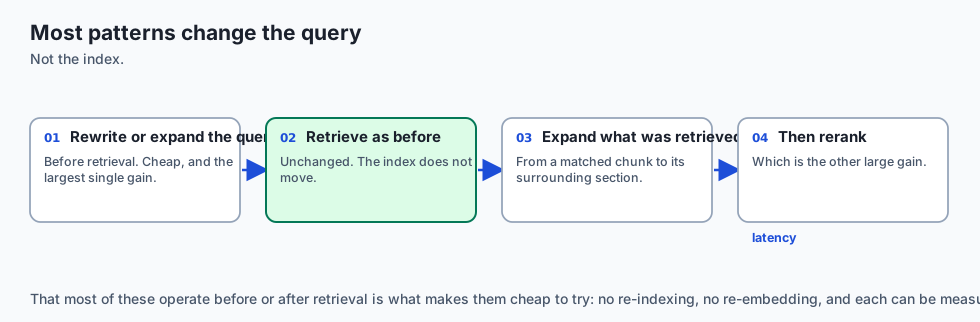
- Most advanced retrieval patterns work by changing the query, not the index, which makes them cheap to try.
- The naive question is often a poor search query, and rewriting it is the highest-return intervention after reranking.
- Every pattern trades latency and cost for recall, so each one needs measuring on your own corpus rather than adopting on reputation.
- Metadata filters extracted from the question turn a semantic search into a hybrid of search and structured query.
- Adding patterns without measuring them is how retrieval systems get slow without getting better.
Knowledge check
quiz:
  question: "In HyDE, why does it not matter if the hypothetical answer contains factual errors?"
  options:
    - "It is never shown to anyone; only its vector is used as the query"
    - "The errors are corrected by the reranking stage before generation"
    - "The model verifies the hypothetical against the corpus before searching"
    - "Errors are removed by lowercasing and stripping punctuation"
  answer_index: 0
  explanation: "The hypothetical exists to be a paragraph-shaped probe in roughly the right region of embedding space. It is discarded after embedding and never enters the final context."
Hands-on exercise
In this exercise, you will build and evaluate a modular Python RAG pipeline that ingests a sample technical knowledge base, performs hybrid lexical-dense search, constructs a grounded system prompt, and validates answer grounding.
Expected output
When running your test suite, you should observe:
============================= test session starts ==============================
collected 4 items

tests/test_advanced_rag_lib.py::test_document_chunker PASSED              [ 25%]
tests/test_advanced_rag_lib.py::test_sparse_bm25 PASSED                   [ 50%]
tests/test_advanced_rag_lib.py::test_hybrid_ranker PASSED                 [ 75%]
tests/test_advanced_rag_lib.py::test_prompt_synthesizer PASSED            [100%]

============================== 4 passed in 0.04s ===============================
Validate your work
Run the pytest test runner script:
pytest tests/ -vTroubleshooting
- Issue: BM25 returns zero relevance scores for exact keyword searches.
- Fix: Ensure input query terms are tokenized and lowercased using
re.findall(r'\w+', query.lower()).
- Fix: Ensure input query terms are tokenized and lowercased using
- Issue: Document chunker creates duplicate final chunks.
- Fix: Ensure sliding window loop terminates when
i + chunk_size >= len(words).
- Fix: Ensure sliding window loop terminates when
Common mistakes
- Naive String Slicing: Slicing raw strings every 1000 characters cuts words in half. Always chunk across token or whitespace boundaries.
- Ignoring Document Frequency in BM25: Forgetting to compute corpus-wide IDF makes common stopwords dominate search rankings.
Practice assignment
Build a twenty-question evaluation set against your Day 268 corpus, recording for each question the chunk id that genuinely answers it.
Measure recall@5 for four configurations: naive dense search, multi-query,
HyDE, and small-to-big. Report four numbers and the latency of each.
Then find one question where an advanced technique performs worse than naive retrieval, and explain why. There will be one — HyDE hurts when the model’s hypothetical wanders into a different topic, and multi-query hurts when a paraphrase drifts. Knowing when a technique backfires is worth more than knowing its average gain.
Extension challenge
Implement adaptive retrieval: choose the technique per query rather than applying one to all.
Route on cheap signals — query length, presence of a date or identifier, whether the naive search’s top score clears a confidence threshold. Short vague queries go to HyDE; queries containing an exact identifier go straight to BM25; queries with a date go to self-query.
Measure recall and mean latency against always-HyDE and always-naive. Report whether the routing paid for its own complexity. If it did not, say so — a negative result honestly measured is the point of the exercise.
Quiz
Q1. In HyDE, why does it not matter if the hypothetical answer contains factual errors?
- Errors are removed by lowercasing and stripping punctuation
- The errors are corrected by the reranking stage before generation
- The model verifies the hypothetical against the corpus before searching
- It is never shown to anyone; only its vector is used as the query
Show answer
Answer: D. It is never shown to anyone; only its vector is used as the query
The hypothetical exists to be a paragraph-shaped probe in roughly the right region of embedding space. It is discarded after embedding.
Q2. Which advanced technique costs nothing at query time?
- Small-to-big retrieval, which is an indexing decision
- Multi-query expansion, because the variants run in parallel
- HyDE, because the hypothetical answer is short
- Self-querying, because filters are applied by the database
Show answer
Answer: A. Small-to-big retrieval, which is an indexing decision
Small-to-big is decided once when the index is built. Every other technique adds a model call or extra searches per query.
Q3. Why does asking an embedding to handle papers after 2020 work badly?
- Embedding models are trained only on text published before 2020
- A date range is a filter, and vectors cannot do arithmetic
- The year is tokenised into digits that carry no meaning
- Semantic search returns results in chronological order already
Show answer
Answer: B. A date range is a filter, and vectors cannot do arithmetic
Self-querying extracts the constraint and applies it as a database filter, leaving the embedding to do the part it is good at.
Q4. What is the strict precedence when fixing a retrieval problem?
- Query expansion, then ranking, then chunking
- Ranking, then chunking, then query expansion
- Chunking, then query expansion, then ranking
- All three can be tuned independently in any order
Show answer
Answer: C. Chunking, then query expansion, then ranking
No query expansion recovers a fact that chunking destroyed, and no reranker promotes a document retrieval never returned.
Q5. Why measure a baseline before adopting these techniques?
- Without one, the embedding model cannot be initialised
- The techniques are only licensed for use after benchmarking
- Baselines are required to compute Reciprocal Rank Fusion
- Advanced is not a synonym for better, and each adds latency
Show answer
Answer: D. Advanced is not a synonym for better, and each adds latency
On a corpus where naive retrieval already finds the right chunk, every technique adds cost and changes nothing.
Glossary
- Retrieval-Augmented Generation (RAG)
- An AI framework combining external knowledge retrieval from databases with generative LLM inference for grounded answers.
- Parametric Memory
- Knowledge encoded directly into the neural network weights during pre-training and fine-tuning.
- Non-Parametric Memory
- External knowledge stored in vector stores, databases, and document files accessed dynamically at inference time.
- Reciprocal Rank Fusion (RRF)
- A rank-based algorithm that aggregates heterogeneous search candidate rankings using reciprocal rank scoring.
- Okapi BM25
- A non-linear probabilistic ranking function used in sparse keyword search based on term frequency and inverted document frequency.
- Cross-Encoder Re-Ranker
- A neural model that processes query and document pairs jointly through full cross-attention to compute precise relevance scores.
- Bi-Encoder
- A neural architecture that encodes queries and documents into separate dense vector embeddings independently.
- Inline Citation
- A bracketed numerical marker ([1], [2]) linking a generated factual claim directly to a retrieved source document passage.
- RAG Triad
- An evaluation framework measuring Faithfulness, Answer Relevance, and Context Precision in RAG applications.
- Context Precision
- The proportion of retrieved context passages that contain ground-truth information relevant to answering the query.
Sources and further reading
- Retrieval-Augmented Generation for Knowledge-Intensive NLP Tasks (Lewis et al., 2020) — NeurIPS / arXiv (accessed 2026-03-30)
- REALM: Retrieval-Augmented Language Model Pre-Training (Guu et al., 2020) — ICML / arXiv (accessed 2026-03-30)
- Introducing Contextual Retrieval — Anthropic Engineering (accessed 2026-08-31)
- Qdrant Vector Database Documentation & Hybrid Search — Qdrant Technologies (accessed 2026-03-30)
Kept in this browser, no account needed. Your progress page turns the whole record into one link you can bookmark or open on another device.