LLMs and Generative AI › Retrieval-Augmented Generation › Day 273
Day 273: A Documentation Assistant
Assemble a complete, production-grade Documentation Q&A Assistant: parse documentation repositories, perform hybrid sparse-dense retrieval with cross-encoder re-ranking, stream verified answers with inline citations, and evaluate quality with the RAG Triad.
Hands-on lab for this lesson
Lab files on GitHub: https://github.com/ai-roadmap-365/ai-roadmap-365.github.io/tree/main/labs/sections/llms-and-generative-ai/day-273-a-documentation-assistant
- Get the hands-on files. Clone the labs repository once (you can reuse this clone for every lesson). This works on macOS, Linux, and Windows (PowerShell or WSL):
git clone https://github.com/ai-roadmap-365/ai-roadmap-365.github.io.git cd ai-roadmap-365.github.io - Open this lesson's lab. Move into the directory for this specific day. Every lab lives at the same predictable path — section / subsection / week / day:
cd labs/sections/llms-and-generative-ai/day-273-a-documentation-assistant - Read the lab guide. Open `README.md` in that directory. It lists the exact commands, what each does, the expected output, and how to check your work — read it before running anything.
- Run it and check your work. Follow the README's "How to run" section: run the example first to see the finished result, then complete the numbered exercises in `starter/`, then run the tests. The tests pass (exit 0) only when your work is correct.
bash tests/run_tests.sh # or the test command named in the lab README
You can also open the lab as a local page (works offline, shows the file tree and expected output).
Learning objectives
By the end of this lesson you will be able to:
- Understand the end-to-end multi-stage RAG architecture and non-parametric memory bridging.
- Implement structure-aware document parsing and sliding window chunking.
- Build sparse BM25 and dense vector indices with Reciprocal Rank Fusion.
- Construct grounded system prompts that enforce verifiable inline bracket citations.
- Evaluate RAG pipelines quantitatively using the RAG Triad framework.
Prerequisites
Why this matters
Six days of components, one system. Today they become a documentation assistant that real people can use — and the gap between a working pipeline and a usable product turns out to be made of things none of the previous days needed.
A demo answers questions. A product also has to answer these:
  the doc changed an hour ago     — is the index stale?
  this user cannot see that page  — did retrieval leak it?
  the corpus has no answer        — did it say so, or invent one?
  the model provider is down      — is there anything to serve?
  the same question, 500 times    — are we paying 500 times?
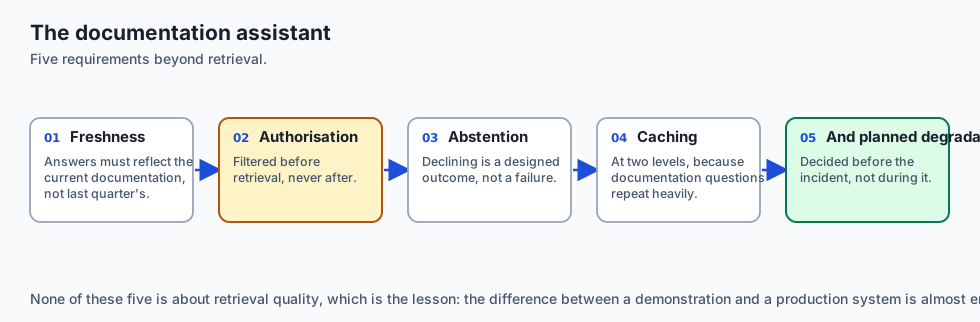
None of those is a retrieval problem, and none can be bolted on afterwards. Freshness is an indexing decision. Access control is a filter that must run before the context is assembled. Abstention is a prompt and a threshold. Each one changes the architecture, which is why today is a design lesson rather than another algorithm.
The idea in plain language
The pipeline you have is the easy half. The other half is everything that happens when reality intrudes.
A librarian who has read every book is not yet a good librarian. A good one also knows which editions are current, will not hand you a file you are not cleared to read, says “we don’t have anything on that” instead of improvising, and has a plan for when the lights go out.
Concretely, four properties turn a pipeline into an assistant:
- Freshness — the index reflects the source within a known, stated bound.
- Authorisation — retrieval is filtered by this user’s permissions.
- Abstention — “I don’t know” is a supported, tested answer.
- Degradation — when a dependency fails, something useful still happens.
Every one of them is a decision you make once, in the architecture, and cannot retrofit cheaply.
Historical background
-
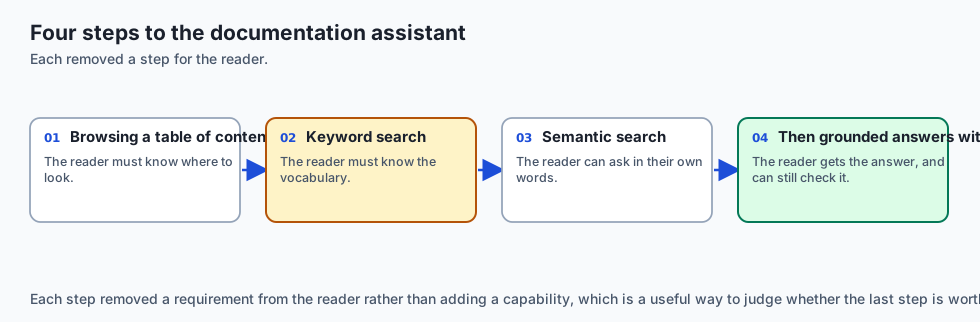
1966 — ELIZA. The first system people confided in, and the first demonstration that fluency reads as understanding. Every warning in this lesson is a descendant of that observation.
-
1990s — enterprise search arrives and largely disappoints. Retrieval worked; the missing pieces were freshness, permissions, and the fact that keyword matching does not answer questions.
-
2004 — Google Desktop and its contemporaries make incremental indexing ordinary: watch the filesystem, re-index what changed, do not rebuild nightly.
-
2010s — documentation search settles on a good local optimum: static site generators plus a lexical index (Lunr, Algolia). Fast, cheap, and it returns pages rather than answers.
-
2023 — RAG-based documentation assistants ship widely. They answer rather than link, and immediately surface the problems this lesson is about: stale answers quoting deleted APIs, and confident answers to questions the docs never addressed.
-
2024 onwards — the reference architecture stabilises around retrieval plus citations plus abstention plus incremental freshness, which is precisely the set of things the previous six days built.
The historical lesson is that search over documentation has been solved for twenty years. Answering from documentation is the new part, and the new part is where trust is won or lost.
What it is — and what it is not
It is an integration: a system where each of the past six days occupies a defined stage, with the operational properties that make it deployable.
It is not a general knowledge assistant, and the boundary is a feature. A documentation assistant that answers questions outside its corpus has stopped being grounded and has started being a chatbot with a citation habit.
| Property | A demo | An assistant |
|---|---|---|
| Missing answer | Improvises fluently | Says the docs do not cover it |
| Stale document | Answers from it silently | Knows and states its freshness bound |
| Restricted page | Retrieves it | Filters it before assembly |
| Provider outage | 500 error | Cached or degraded answer |
| Repeated question | Full cost every time | Served from cache |
The right-hand column is today’s work. Notice that four of the five rows are about what happens when something is wrong — which is a fair description of production engineering generally.
Why it was created and what problems it solves
Five failures that only appear once real users arrive:
The confidently wrong answer to an uncovered question. The single most damaging failure, because it destroys trust in every correct answer that came before it. A user who catches one invention starts checking everything, at which point the assistant has negative value.
The stale answer. The API was deprecated last week. The index has last month’s page. The answer is faithful, well-cited, and wrong — and Day 272’s metrics all pass, because faithfulness measures containment, not currency.
The permission leak. A chunk from an internal roadmap is retrieved for an external user. Citing it makes the leak worse: it hands over both the content and a pointer to more.
The unbounded cost. One popular question, no cache, ten thousand identical model calls. The bill is discovered at the end of the month.
The hard dependency. The generation provider has an outage and the assistant returns nothing, when it could have returned the retrieved passages with a note — which is what a search engine would have done and is genuinely useful.
How it works

1. Ingestion with a freshness contract
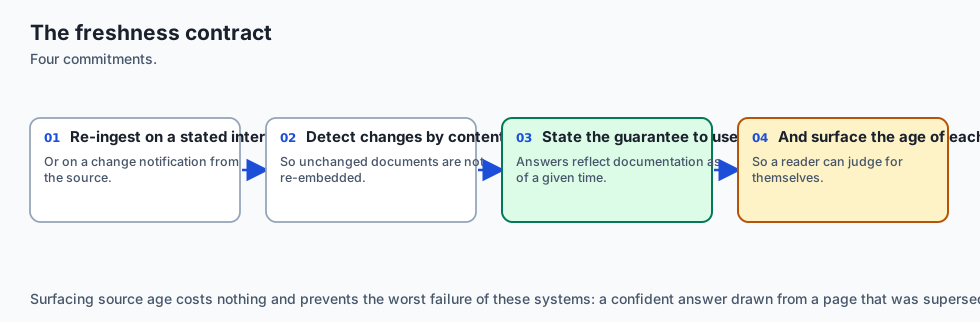
Watch the source. On change, re-chunk and re-embed only the affected document,
and record indexed_at per chunk. The system can then state a bound — “the index
is never more than fifteen minutes behind the source” — and, crucially, verify
it, because the timestamp is in the data.
Deletions matter as much as edits. A document removed at source whose chunks remain is an orphan: still retrievable, no longer real. Reconciling the union of both id sets — not iterating the source — is what finds them.
2. Authorisation before assembly, never after
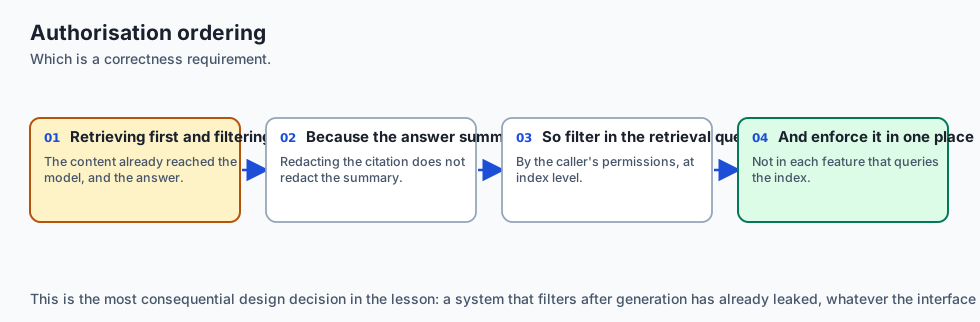
The filter belongs in the retrieval query, not in a post-processing step:
hits = index.search(query_vector, k=20, filter={"acl": {"$in": user.groups}})Retrieving broadly and filtering afterwards seems equivalent and is not. It wastes the retrieval budget on chunks that will be discarded, and it puts restricted content one bug away from the context window. A model that has seen a passage cannot be asked to unsee it.
3. Abstention as a first-class outcome
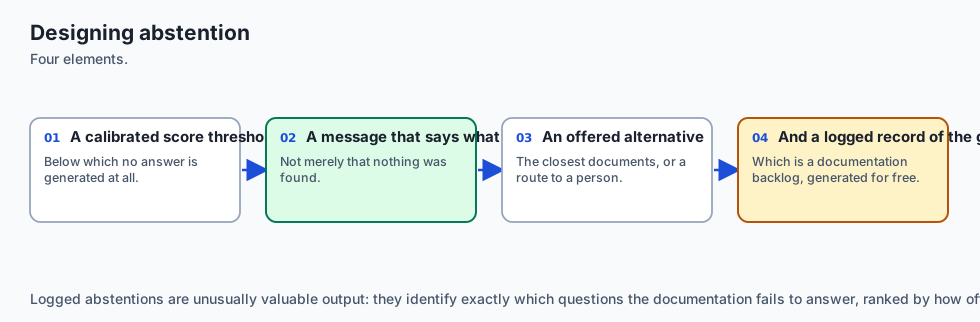
Two gates, both needed. Before generation, if the best retrieval score is below a floor, do not call the model at all — nothing was found worth grounding in. After generation, apply Day 270’s verification: if claims are unsupported, withhold rather than annotate.
  best_score < 0.35        →  "The documentation does not cover this."
  unsupported_claims > 0   →  withhold, or return only supported claims
The floor is corpus-specific and must be measured, on questions you know are uncovered, rather than guessed.
4. Caching at two levels
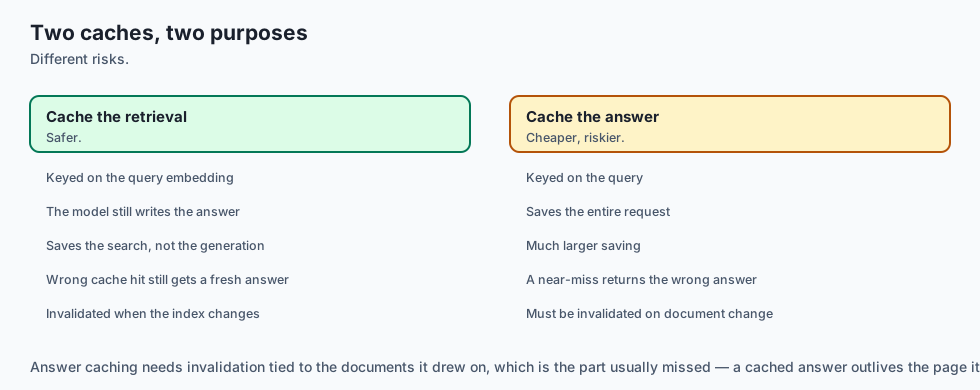
Exact-match caching on a normalised query hash is free and safe. Semantic caching — serving a cached answer for a similar question — is much more effective and introduces a real failure mode: a near-miss returns a confidently wrong answer to a question nobody asked.
Two rules make it survivable: set the similarity threshold high (0.95 and above), and key the cache by user permissions as well as by query, or one tenant’s answer will be served to another.
5. Degradation, decided in advance
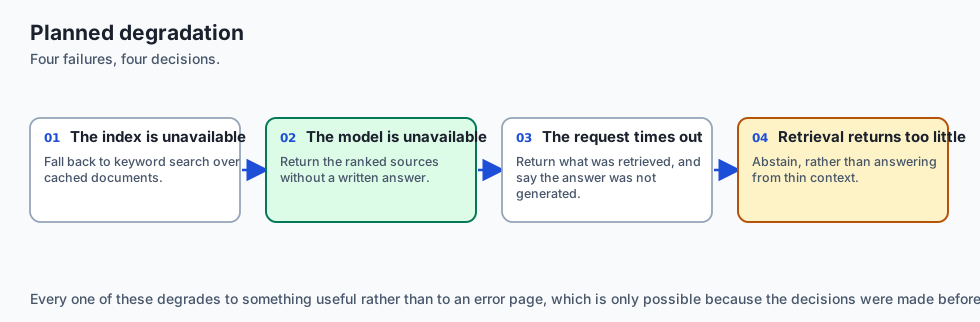
  generation provider down  →  return ranked passages with citations, labelled
                               as "search results, not an answer"
  vector index down         →  fall back to lexical BM25 alone
  everything down           →  serve the cache, with its age shown
Each of these is more useful than an error page, and each has to be built before the incident. “We will think about it if it happens” produces a 500.
An everyday analogy
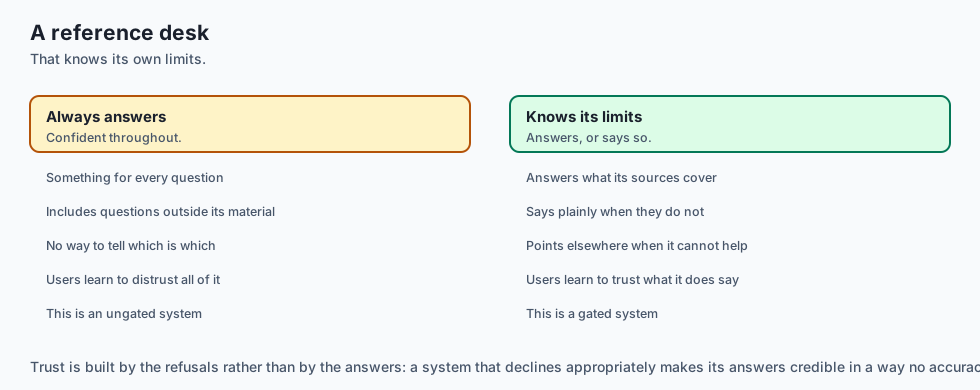
A reference librarian on the enquiry desk.
They know the collection and they know its edges. Asked something outside it, they say so rather than guessing — and that refusal is precisely why you believe them the rest of the time. They will not fetch you a restricted file because you asked confidently. They know which editions are current and will tell you when one was superseded. When the catalogue system is down they still walk you to the right shelf, because they have a fallback.
None of that is about knowing more books. It is about knowing the boundaries of what they know, and being reliable at the edges. That is the difference between the pipeline you have and the assistant you are building.
Examples in practice

The request path, with every gate visible
def answer(question: str, user: User) -> Response:
    key = cache_key(question, user.groups)          # permissions are part of the key
    if hit := cache.get(key):
        return hit.with_note(f"cached {hit.age_minutes}m ago")

    hits = index.search(embed(question), k=20,
                        filter={"acl": {"$in": user.groups}})
    if not hits or hits[0].score < FLOOR:
        return Response.abstain("The documentation does not cover this.")

    chunks = rerank(question, hits)[:5]
    try:
        draft = llm(build_prompt(question, chunks))
    except ProviderError:
        return Response.degraded(chunks)            # passages beat an error page

    verified, unsupported = enforce(split_claims(draft), sentences_of(chunks))
    if unsupported:
        return Response.abstain("The documentation does not fully cover this.")

    resp = Response.ok(verified, sources=chunks, freshness=oldest(chunks))
    cache.set(key, resp, ttl=3600)
    return resp
Measuring the freshness bound rather than asserting it
def staleness_seconds() -> float:
    return max((now() - c.indexed_at).total_seconds() for c in index.all_chunks())
# Alert on this, not on "did the indexer run" — a job that runs and does
# nothing looks identical to a healthy one from the outside.
Finding orphans by walking the union of both id sets
def orphans(source_ids: set[str], indexed_ids: set[str]) -> set[str]:
    return indexed_ids - source_ids     # never reachable by iterating the source
Implications: security, privacy, performance, scalability, and cost
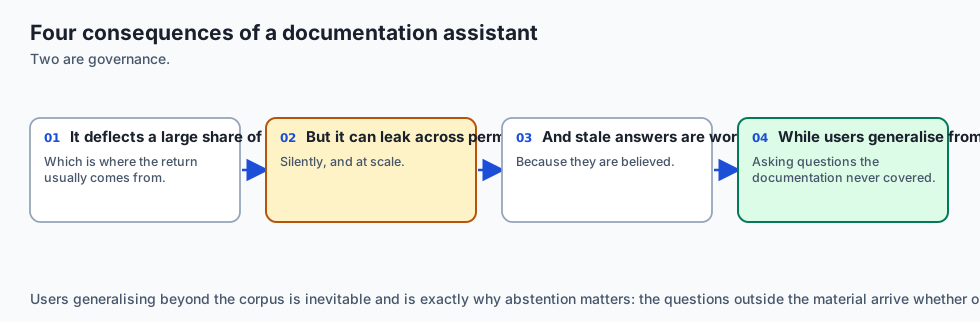
Security. The corpus is untrusted input to a model with tools and credentials. A documentation page containing “ignore previous instructions” is indirect prompt injection, and it arrives through the same channel as legitimate content. Day 251’s mitigations apply in full here.
Privacy. Logged questions are user data and are often more sensitive than the answers — “how do I cancel my enterprise contract” reveals intent. Redact before persisting, as Day 328 develops, and treat cached answers as a second copy subject to the same deletion obligations as the first.
Performance. A realistic budget: embedding 20 ms, retrieval 30 ms, reranking 150 ms, generation 1,200 ms. Generation dominates, so streaming the answer moves the user’s first useful moment from 1.4 s to about 300 ms without making anything faster.
Scalability. Retrieval scales with corpus size, generation with query volume, and they scale independently — which means they should be separate services with separate autoscaling. A traffic spike is a generation problem, not an index one.
Cost. Caching is the single largest lever and it is unevenly distributed: documentation traffic is extremely head-heavy, so a small cache covering the top questions removes most of the spend. Beware the trap from Day 327 — a high cache hit rate proves little if the cached queries were the cheap ones.
Alternatives: free, open source, and commercial
| Option | Licence | Strength | Weakness |
|---|---|---|---|
| This architecture | — | Full control; every gate is yours | You operate it |
| Algolia DocSearch | Free for OSS docs | Excellent, fast, proven | Returns links, not answers |
| Mintlify / GitBook AI | Commercial | Turnkey, good defaults | Your docs, their infrastructure |
| Kapa.ai | Commercial | Purpose-built for developer docs | Per-seat; limited control of retrieval |
| Danswer | MIT, free | Self-hostable, connectors included | Younger; you still operate it |
A useful decision rule: if the documentation is public and the questions are routine, a hosted product will beat what you build, and quickly. Build when the corpus is private, when permissions are non-trivial, or when you need to control abstention behaviour — which is exactly when the hosted products are weakest.
Comparison with related concepts
| System | Returns | Freshness model | Trust model |
|---|---|---|---|
| Static site search | Links | Rebuild on deploy | User reads and judges |
| This assistant | Answers with citations | Incremental, bounded | Verified claims |
| Fine-tuned model | Answers | Retrain | Opaque |
| Long-context stuffing | Answers | Immediate | Whole-document only |
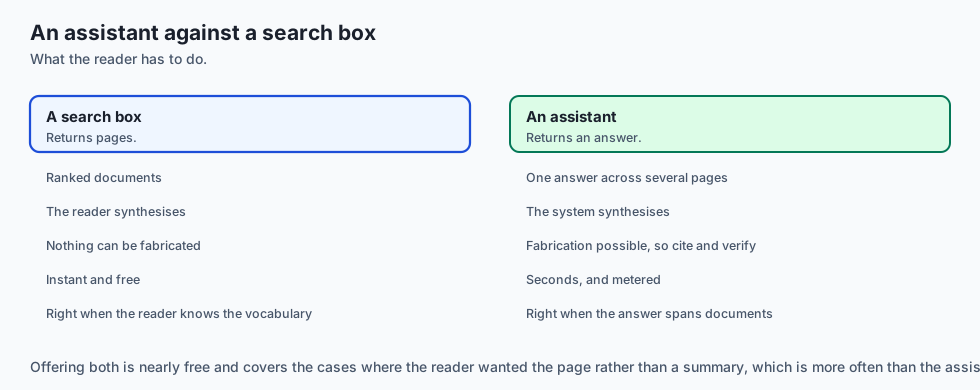
The comparison worth sitting with is the first row. Static search is older, cheaper, faster, and never hallucinates. It puts the reading burden on the user and, for many documentation sets, that is the correct trade.
An assistant earns its complexity when the corpus is too large to skim, when the answer spans several documents, or when users cannot phrase queries in the documentation’s vocabulary — which is where Day 271 began.
When to use it — and when not to
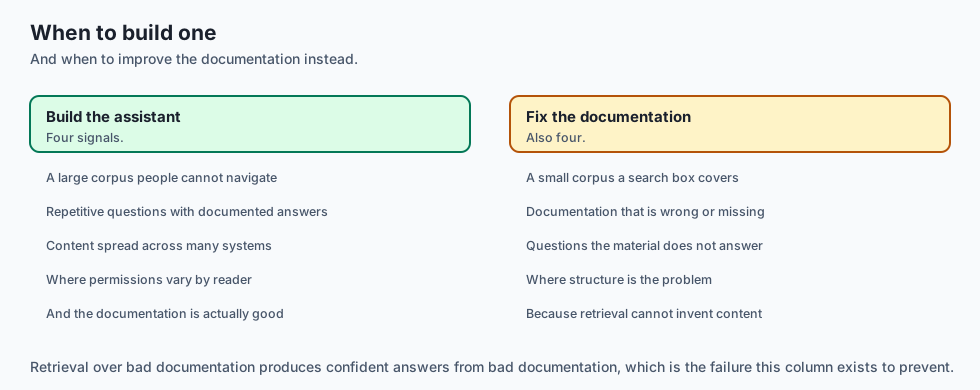
Build an assistant when the corpus is large enough that finding the right page is genuinely hard, questions span multiple documents, users are non-expert, or the same questions recur often enough that answering them has real cost.
Prefer plain search when the corpus is small, the audience is expert, or a wrong answer is expensive and a missing answer is cheap. Search fails visibly; an assistant fails invisibly, and that asymmetry should decide close cases.
Do not ship without abstention, permission filtering, and a measured freshness bound. Those three are not polish. An assistant lacking any one of them will eventually produce an answer that is confident, unauthorised, or out of date, and a single such answer costs more trust than a hundred correct ones build.
The AI connection
- A documentation assistant is the most common first production AI system, and it exposes every operational concern at once.
- Authorisation must happen before retrieval, not after, or the system becomes an efficient way to read documents you cannot open.
- Freshness is a contract with users, since a confident answer from a superseded document is worse than no answer.
- Abstention has to be a designed outcome, not an accident of low scores.
- Degradation should be decided in advance, because the decision about what to do when retrieval fails is a product decision, not an incident response.
Knowledge check
quiz:
  question: "Why must permission filtering happen inside the retrieval query rather than after it?"
  options:
    - "The vector index cannot compute scores for filtered chunks"
    - "Filtering afterwards returns results in the wrong ranking order"
    - "A model that has seen a passage cannot be asked to unsee it"
    - "Post-filtering breaks the citation numbering in the final answer"
  answer_index: 2
  explanation: "Retrieving broadly and filtering later wastes the retrieval budget and leaves restricted content one bug away from the context window."
Hands-on exercise
In this exercise, you will build and evaluate a modular Python RAG pipeline that ingests a sample technical knowledge base, performs hybrid lexical-dense search, constructs a grounded system prompt, and validates answer grounding.
Expected output
When running your test suite, you should observe:
============================= test session starts ==============================
collected 4 items

tests/test_doc_assistant_lib.py::test_document_chunker PASSED              [ 25%]
tests/test_doc_assistant_lib.py::test_sparse_bm25 PASSED                   [ 50%]
tests/test_doc_assistant_lib.py::test_hybrid_ranker PASSED                 [ 75%]
tests/test_doc_assistant_lib.py::test_prompt_synthesizer PASSED            [100%]

============================== 4 passed in 0.04s ===============================
Validate your work
Run the pytest test runner script:
pytest tests/ -vTroubleshooting
- Issue: BM25 returns zero relevance scores for exact keyword searches.
- Fix: Ensure input query terms are tokenized and lowercased using
re.findall(r'\w+', query.lower()).
- Fix: Ensure input query terms are tokenized and lowercased using
- Issue: Document chunker creates duplicate final chunks.
- Fix: Ensure sliding window loop terminates when
i + chunk_size >= len(words).
- Fix: Ensure sliding window loop terminates when
Common mistakes
- Naive String Slicing: Slicing raw strings every 1000 characters cuts words in half. Always chunk across token or whitespace boundaries.
- Ignoring Document Frequency in BM25: Forgetting to compute corpus-wide IDF makes common stopwords dominate search rankings.
Practice assignment
Take your assistant and try to break it as a hostile user would, recording what happens in each case:
-
Ask something the corpus genuinely does not cover. Did it abstain, or invent?
-
Ask about a document you have removed from the source but not re-indexed. Did it answer from the orphan?
-
Ask the same question twice and measure the second response time and cost.
-
Point the generation client at an unreachable host. Did you get passages or a stack trace?
Write one line per case describing what a user would see. Then fix whichever of the four embarrassed you most, and only that one — knowing which failure matters most is part of the exercise.
Extension challenge
Implement and measure a freshness service-level objective.
Define it precisely: “95% of chunks are within ten minutes of their source.”
Then instrument it — record indexed_at per chunk, compute the distribution
rather than the maximum, and expose the p95 as a metric.
Now break it deliberately: pause the indexer, edit three source documents, and watch the number move. Confirm that your alert fires on the distribution shifting rather than on the indexer process dying, because those are different failures and only one of them is caught by a liveness check. A job that runs happily and indexes nothing is the failure that matters, and it looks perfectly healthy from outside.
Quiz
Q1. Why must permission filtering happen inside the retrieval query rather than after it?
- Filtering afterwards returns results in the wrong ranking order
- A model that has seen a passage cannot be asked to unsee it
- The vector index cannot compute scores for filtered chunks
- Post-filtering breaks the citation numbering in the final answer
Show answer
Answer: B. A model that has seen a passage cannot be asked to unsee it
Retrieving broadly and filtering later wastes the retrieval budget and leaves restricted content one bug away from the context window.
Q2. Why is a confidently wrong answer to an uncovered question the most damaging failure?
- It cannot be detected by any automated evaluation metric
- It costs more tokens than an answer grounded in real context
- It destroys trust in every correct answer that came before it
- It causes the retrieval index to be rebuilt unnecessarily
Show answer
Answer: C. It destroys trust in every correct answer that came before it
A user who catches one invention starts checking everything, at which point the assistant has negative value.
Q3. What makes semantic caching riskier than exact-match caching?
- It invalidates the whole cache whenever one document changes
- It requires storing the full text of every previous answer
- It cannot be keyed by the requesting user's permissions
- A near-miss serves a confident answer to a question nobody asked
Show answer
Answer: D. A near-miss serves a confident answer to a question nobody asked
Serving a cached answer for a merely similar question is effective and can be wrong. A high threshold and permission-aware keys make it survivable.
Q4. Why alert on the distribution of chunk staleness rather than on the indexer process?
- A job that runs and indexes nothing looks healthy from outside
- Process monitoring is unavailable in most container runtimes
- The distribution is cheaper to compute than a liveness check
- Staleness cannot be measured while the indexer is running
Show answer
Answer: A. A job that runs and indexes nothing looks healthy from outside
Liveness says the process is alive. Recording indexed_at per chunk and watching the p95 measures whether the work actually happened.
Q5. When is plain static search the better choice than a documentation assistant?
- When the corpus is too large for a user to skim by hand
- When a wrong answer is expensive and a missing answer is cheap
- When answers must draw on several documents at once
- When users cannot phrase queries in the documentation's vocabulary
Show answer
Answer: B. When a wrong answer is expensive and a missing answer is cheap
Search fails visibly and never hallucinates; an assistant fails invisibly. That asymmetry should decide close cases.
Glossary
- Retrieval-Augmented Generation (RAG)
- An AI framework combining external knowledge retrieval from databases with generative LLM inference for grounded answers.
- Parametric Memory
- Knowledge encoded directly into the neural network weights during pre-training and fine-tuning.
- Non-Parametric Memory
- External knowledge stored in vector stores, databases, and document files accessed dynamically at inference time.
- Reciprocal Rank Fusion (RRF)
- A rank-based algorithm that aggregates heterogeneous search candidate rankings using reciprocal rank scoring.
- Okapi BM25
- A non-linear probabilistic ranking function used in sparse keyword search based on term frequency and inverted document frequency.
- Cross-Encoder Re-Ranker
- A neural model that processes query and document pairs jointly through full cross-attention to compute precise relevance scores.
- Bi-Encoder
- A neural architecture that encodes queries and documents into separate dense vector embeddings independently.
- Inline Citation
- A bracketed numerical marker ([1], [2]) linking a generated factual claim directly to a retrieved source document passage.
- RAG Triad
- An evaluation framework measuring Faithfulness, Answer Relevance, and Context Precision in RAG applications.
- Context Precision
- The proportion of retrieved context passages that contain ground-truth information relevant to answering the query.
Sources and further reading
- Retrieval-Augmented Generation for Knowledge-Intensive NLP Tasks (Lewis et al., 2020) — NeurIPS / arXiv (accessed 2026-03-30)
- REALM: Retrieval-Augmented Language Model Pre-Training (Guu et al., 2020) — ICML / arXiv (accessed 2026-03-30)
- Introducing Contextual Retrieval — Anthropic Engineering (accessed 2026-08-31)
- Qdrant Vector Database Documentation & Hybrid Search — Qdrant Technologies (accessed 2026-03-30)
Kept in this browser, no account needed. Your progress page turns the whole record into one link you can bookmark or open on another device.