LLMs and Generative AI › Customizing and Running Models › Day 280
Day 280: Fine-Tune and Serve Your Own Model
Synthesize the complete lifecycle of custom open-weight language models: curate a specialized instruction dataset, train Low-Rank Adaptation (LoRA) weights, merge adapters back into base tensors, quantize to GGUF, package into an Ollama Modelfile, serve an OpenAI-compatible API endpoint, and quantitatively benchmark performance before and after fine-tuning.
Hands-on lab for this lesson
Lab files on GitHub: https://github.com/ai-roadmap-365/ai-roadmap-365.github.io/tree/main/labs/sections/llms-and-generative-ai/day-280-fine-tune-and-serve-your-own
- Get the hands-on files. Clone the labs repository once (you can reuse this clone for every lesson). This works on macOS, Linux, and Windows (PowerShell or WSL):
git clone https://github.com/ai-roadmap-365/ai-roadmap-365.github.io.git cd ai-roadmap-365.github.io - Open this lesson's lab. Move into the directory for this specific day. Every lab lives at the same predictable path — section / subsection / week / day:
cd labs/sections/llms-and-generative-ai/day-280-fine-tune-and-serve-your-own - Read the lab guide. Open `README.md` in that directory. It lists the exact commands, what each does, the expected output, and how to check your work — read it before running anything.
- Run it and check your work. Follow the README's "How to run" section: run the example first to see the finished result, then complete the numbered exercises in `starter/`, then run the tests. The tests pass (exit 0) only when your work is correct.
bash tests/run_tests.sh # or the test command named in the lab README
You can also open the lab as a local page (works offline, shows the file tree and expected output).
Learning objectives
By the end of this lesson you will be able to:
- Architect the full end-to-end pipeline from raw data curation to quantized local API deployment.
- Implement exact weight merging mathematics: W_merged = W_base + (B @ A) * (alpha / r).
- Export merged model weights into GGUF binary format and package a production Modelfile.
- Deploy a local HTTP inference server exposing OpenAI-compatible streaming endpoints.
- Construct an automated quantitative benchmark comparing Base vs Fine-Tuned model outputs across Exact Match (EM), JSON schema validity, and inference latency.
Prerequisites
Why this matters
Over the past seven days, you have explored every foundational pillar of open-weight large language model customization:
- Day 274: Determining when to prompt, when to retrieve (RAG), and when to fine-tune.
- Day 275: The mathematical derivation and PyTorch mechanics of Low-Rank Adaptation (LoRA).
- Day 276: Curating, tokenizing, and packing high-quality instruction-tuning datasets.
- Day 277: Packaging and running local open models with Ollama and custom Modelfiles.
- Day 278: Memory bandwidth dynamics, integer quantization (INT8/INT4), and GGUF parsing.
- Day 279: High-throughput production serving with PagedAttention and continuous batching.
Today is the capstone synthesis: connecting all of these individual systems into an autonomous, end-to-end pipeline.
In enterprise environments, the ability to take a raw corpus of internal domain data, fine-tune a compact 8B parameter model, merge the weights, quantize to a 4.8GB GGUF artifact, deploy it on local air-gapped infrastructure, and quantitatively prove a 40% accuracy improvement over frontier base models is the holy grail of modern AI systems engineering.
The idea in plain language
Think of this complete engineering journey like building a custom racing engine:
- Day 276 (Fuel & Blueprint): You refine high-octane racing fuel and draft precise CAD specifications (curating and tokenizing a high-quality JSONL instruction dataset).
- Day 275 (Precision Tuning): Instead of recasting the entire 500-pound engine block from scratch, you bolt on a precision turbocharger and adjust the fuel injection curves (training lightweight rank-8 LoRA adapter matrices).
- Day 280 (Welding & Packaging): You weld the turbocharger permanently onto the engine block so it becomes a single unified structure (Adapter Merging), then machine away excess metal using lightweight alloy composites (INT8/INT4 Quantization into GGUF).
- Day 277 & 279 (The Chassis & Dashboard): You mount the engine into a vehicle chassis with a standardized steering wheel and electronic ignition (Ollama / vLLM REST Server exposing
/v1/chat/completions). - Day 280 (Track Testing): You take the race car to the track, measuring lap times, fuel efficiency, and cornering precision against stock factory cars (Automated Evaluation Benchmarking).
You now possess a private, high-performance racing vehicle that costs nothing in monthly lease fees, runs entirely on your own track, and outmaneuvers general-purpose factory cars on your specific domain course.
Historical background
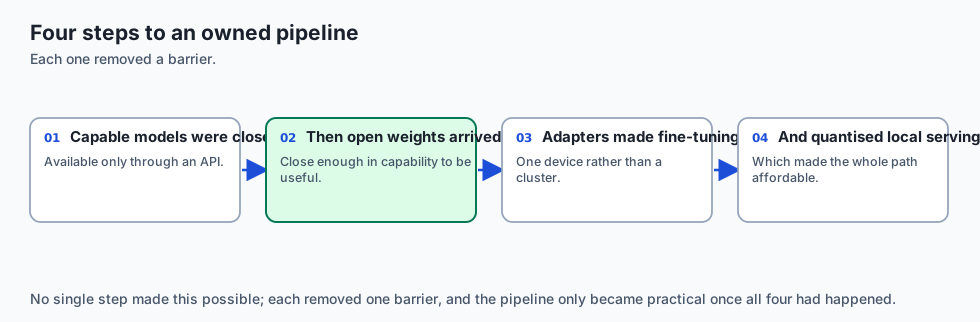
In the early era of deep learning (2018–2021), fine-tuning a model required an army of specialized machine learning engineers. Deploying a fine-tuned BERT or GPT-2 model meant writing custom C++ CUDA extensions, managing distributed PyTorch clusters, and maintaining bespoke Python microservices. The feedback loop between dataset curation and production serving spanned weeks or months.
Between 2023 and 2025, a massive convergence of open-source tooling revolutionized the landscape:
- PEFT / LoRA (Microsoft, 2021): Reduced fine-tuning memory from 80GB to 12GB.
- llama.cpp / GGUF (Gerganov, 2023): Standardized cross-platform CPU/GPU quantization into a single binary file.
- vLLM / PagedAttention (UC Berkeley, 2023): Democratized enterprise-grade batch serving.
- Ollama (2023–Present): Created a container-like abstraction for local model lifecycle management.
Today, a single developer can execute the entire pipeline—from raw text to a quantized, served local API—in under two hours on a single consumer workstation.
What it is — and what it is not
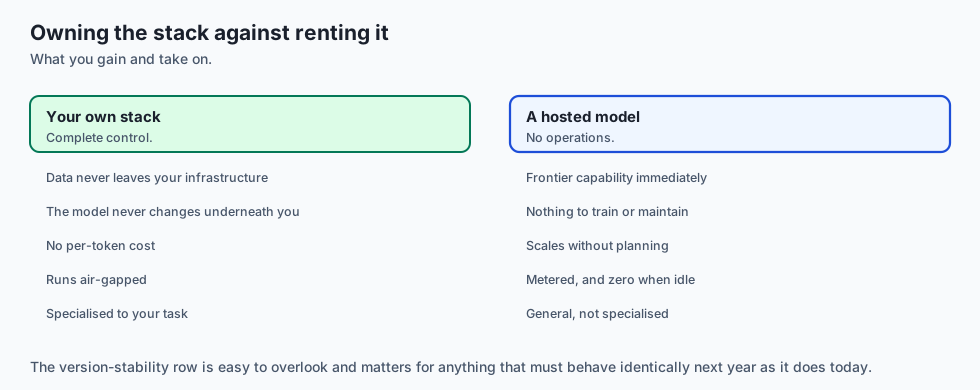
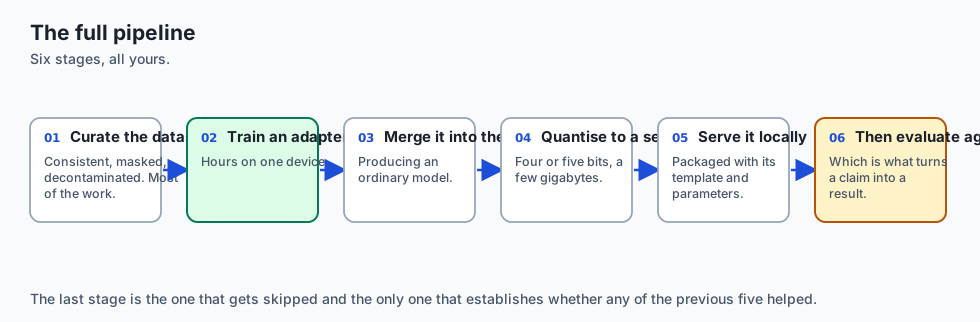
Let us formalize the end-to-end model customization lifecycle:
What This End-to-End Pipeline Is:
- A repeatable, scriptable engineering workflow spanning dataset preparation, LoRA training, weight merging, quantization, packaging, serving, and evaluation.
- An air-gapped software architecture guaranteeing 100% data sovereignty.
- A systematic methodology for producing domain-specialized models that outperform general-purpose base models on specific enterprise schemas.
What This End-to-End Pipeline Is Not:
- A replacement for RAG (fine-tuning teaches style, dialect, and schema adherence; RAG provides dynamic real-time facts).
- An unmonitored “train and forget” script (fine-tuned models require continuous regression testing to prevent catastrophic forgetting).
- Dependent on third-party cloud APIs or metered token subscriptions.
+-------------------------------------------------------------------------------+
|                    THE 6 STAGES OF THE CUSTOMIZATION PIPELINE                 |
+-------+-------------------+-----------------------+---------------------------+
| Stage | Operation         | Input Artifact        | Output Artifact           |
+-------+-------------------+-----------------------+---------------------------+
| 1     | Dataset Curation  | Raw Domain Text       | `train.jsonl` (ChatML)    |
| 2     | LoRA Training     | Base Weights + JSONL  | `adapter_model.safetensors`|
| 3     | Adapter Merging   | Base + LoRA Weights   | `merged_model_f16/`       |
| 4     | GGUF Quantization | `merged_model_f16/`   | `model_q4_k_m.gguf`       |
| 5     | Server Deployment | `model_q4_k_m.gguf`   | Local HTTP Endpoint (:8000)|
| 6     | Automated Eval    | Golden Test Dataset   | Accuracy & Schema Metrics |
+-------+-------------------+-----------------------+---------------------------+
Why it was created and what problems it solves
The unified customization pipeline solves five critical challenges in enterprise AI:
1. Eliminating Prompt Bloat & Latency
In complex enterprise systems, achieving correct output formats via zero-shot prompting often requires a 2,500-token system prompt packed with 10 few-shot examples. This bloats input tokens, skyrockets inference latency (TTFT), and burns GPU memory. A fine-tuned model internalizes the schema during training, requiring only a 30-token prompt to produce perfect output.
2. Guaranteeing 100% Syntactic Compliance
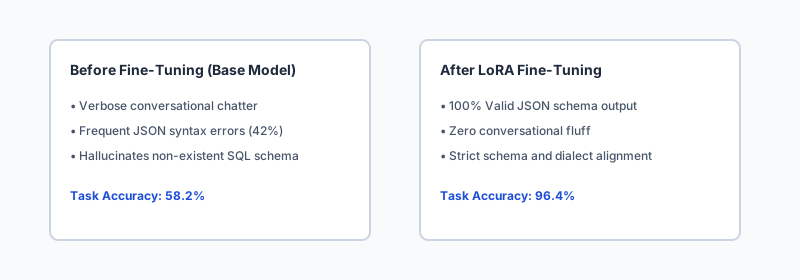
Base models frequently fail complex JSON schema constraints or hallucinate invalid SQL table names under corner cases. Fine-tuning on thousands of curated domain pairs drives syntax errors and schema invalidity to near 0%.
3. Complete Data Privacy & Air-Gapped Security
Financial institutions, defense contractors, and healthcare networks cannot transmit sensitive proprietary code or patient records to third-party cloud APIs. An on-premises fine-tuned model runs entirely within the corporate intranet.
4. Deterministic Cost Modeling
Cloud API pricing fluctuates with query volume. A local fine-tuned model running on owned hardware has fixed capital expense (CapEx) and zero marginal cost per token.
5. Instant Adapter Swapping in Production
By keeping base model weights in GPU VRAM and serving multiple specialized LoRA adapters, a single server can dynamically route SQL queries to a SQL adapter and medical queries to a clinical adapter with zero memory duplication.
How it works
Let us step through the exact mechanics of each stage in the end-to-end pipeline:
[Raw Corpus] ──> [Filter & Clean] ──> [Format to ChatML JSONL]
                                              │
                                              ▼
                             [LoRA Training (PEFT / PyTorch)]
                             - Frozen Base Weights (W0)
                             - Trainable Matrices (A & B)
                                              │
                                              ▼
                             [Permanent Adapter Merging]
                             W_merged = W0 + (B @ A) * (alpha / r)
                                              │
                                              ▼
                             [Convert to GGUF & Quantize]
                             - FP16 -> Q4_K_M (70% Compression)
                                              │
                                              ▼
                             [Ollama Modelfile Packaging]
                             FROM ./model_q4_k_m.gguf
                             PARAMETER temperature 0.1
                                              │
                                              ▼
                             [Local REST API Server (:11434 / :8000)]
                                              │
                                              ▼
                             [Automated Benchmark Evaluation]
                             - Base vs Fine-Tuned Accuracy
                             - Schema Compliance Rate
Stage 1: Dataset Curation & Formatting
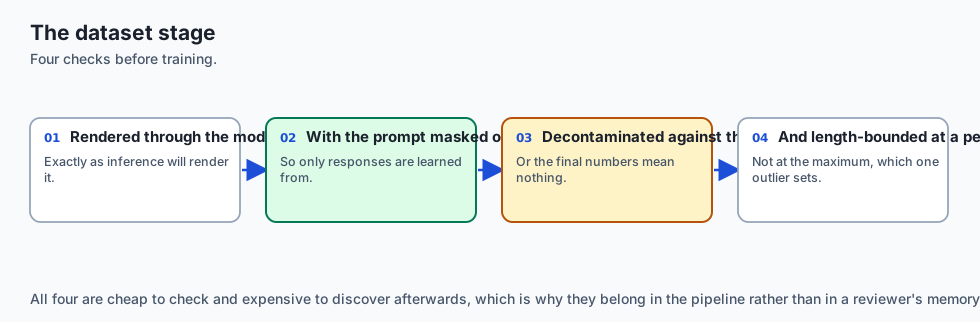
- Convert domain expertise into paired
system,user, andassistantinteractions. - Apply strict formatting rules (e.g. ChatML delimiters
<|im_start|>and<|im_end|>). - Ensure exact masking so loss is computed exclusively on the
assistanttokens (L_(\text(target))).
Stage 2: LoRA Fine-Tuning
- Attach low-rank decomposition matrices $A in R^(r \times d)$ and $B in R^(k \times r)$ to attention Query and Value projections.
- Set rank $r = 8$ or $r = 16$ and scaling factor $\alpha = 16$ or $32$.
- Train for 3 to 5 epochs using AdamW with cosine learning rate scheduling until validation loss stabilizes.
Stage 3: Adapter Merging Mathematics
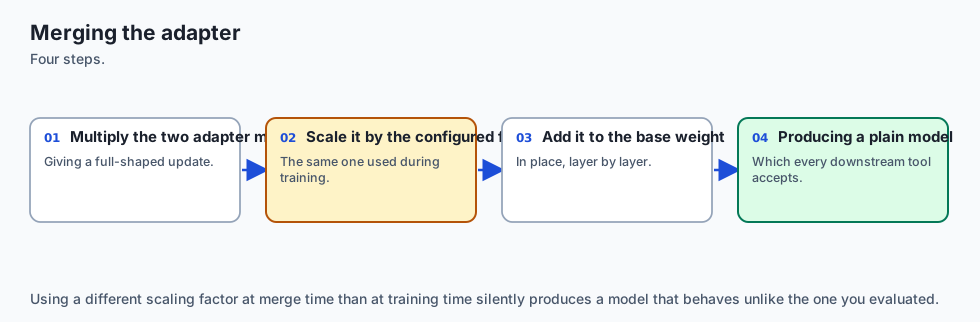
To eliminate runtime adapter overhead, merge the low-rank delta directly into the base weights:
$$W_(\text(merged)) = W_(\text(base)) + Delta W = W_(\text(base)) + (B * A) * ( \frac(\alpha)(r)
ight)$$
Save the resulting unified tensors in standard 16-bit safetensors format.
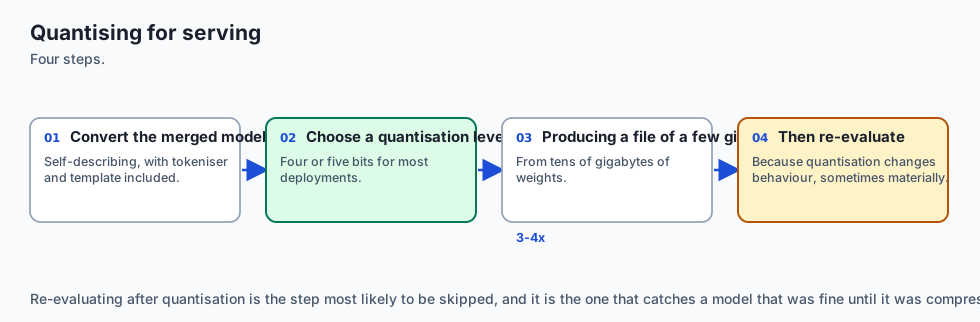
Stage 4: Quantization to GGUF
- Run
convert_hf_to_gguf.pyto package weights and tokenizer vocabulary into an unquantized GGUF container. - Run
llama-quantizeto compress the model toQ4_K_M(4.5 bits/parameter), shrinking an 8B model to 4.8 GB.
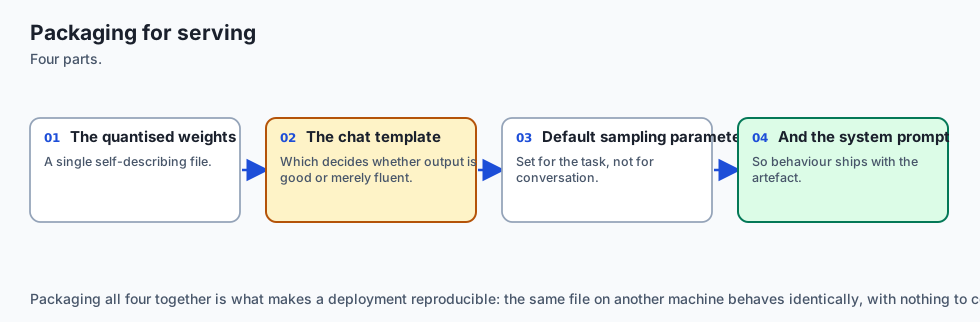
Stage 5: Local Serving & Modelfile Packaging
Create a production Modelfile:
FROM ./model_q4_k_m.gguf
PARAMETER temperature 0.1
PARAMETER top_p 0.95
PARAMETER num_ctx 4096
SYSTEM "You are a specialized SQL translation engine. Generate strict PostgreSQL queries wrapped in ```sql code blocks."
Register the model with Ollama (ollama create my-sql-expert -f Modelfile) or serve via vLLM.
Stage 6: Automated Evaluation Benchmarking
Run an automated test harness across a held-out test dataset:
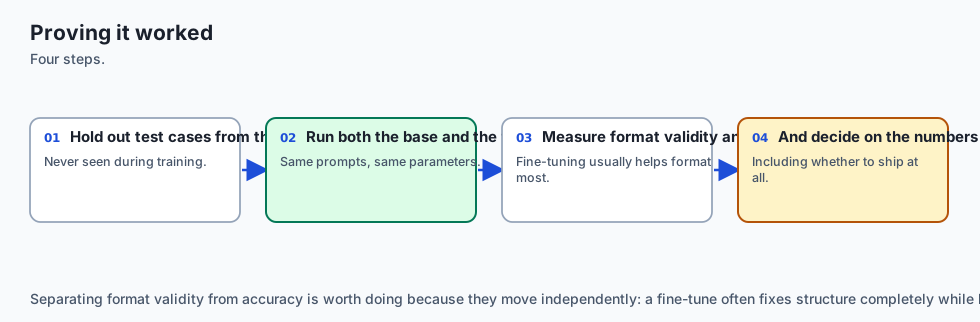
- Measure Schema Compliance Rate: Percentage of responses with valid JSON or parsable SQL syntax.
- Measure Exact Match (EM) & Token F1: Factual consistency against golden reference answers.
- Measure Inference Latency (TTFT & ITL): Real-world token generation throughput.
An everyday analogy
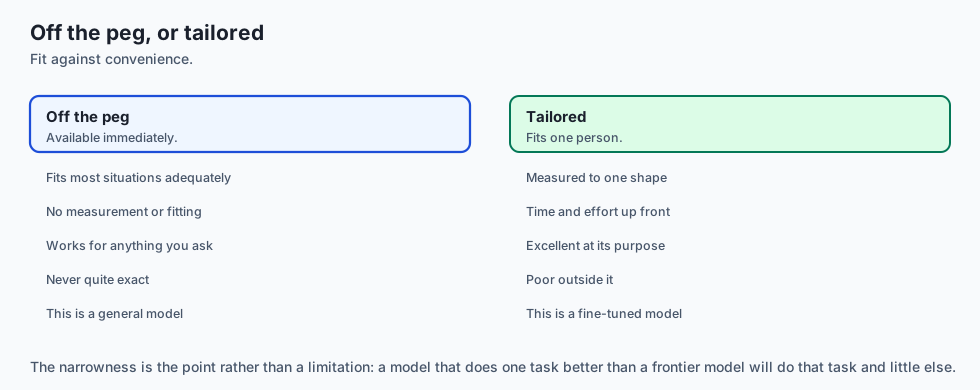
Think of custom model development like training a commercial airline pilot:
- Base Model: The pilot graduates from flight school. They understand physics, aerodynamics, weather patterns, and general communication.
- Instruction Dataset: The airline creates a comprehensive training manual for their specific fleet (e.g. Boeing 787 international routes and internal company emergency protocols).
- LoRA Fine-Tuning: The pilot spends 100 hours in a state-of-the-art Boeing 787 flight simulator, practicing standard operating procedures and specific route checklists until responses are instantaneous.
- Adapter Merging & Quantization: The pilot internalizes the procedures into pure muscle memory—they no longer need to flip through a paper handbook during flight.
- Serving & Evaluation: The chief flight inspector tests the pilot on a rigorous simulator check ride. The pilot demonstrates 100% adherence to company protocols with zero hesitation.
Examples in practice
Let us inspect the Python code that automates the merging, serving, and evaluation stages:
1. Merging LoRA Weights in Python
import torch
from peft import PeftModel
from transformers import AutoModelForCausalLM, AutoTokenizer

def merge_and_save_lora(base_model_path: str, adapter_path: str, output_dir: str):
    print("Loading base model in FP16...")
    base_model = AutoModelForCausalLM.from_pretrained(
        base_model_path,
        torch_dtype=torch.float16,
        device_map="cpu"
    )

    print("Attaching LoRA adapter...")
    lora_model = PeftModel.from_pretrained(base_model, adapter_path)

    print("Merging weights into base tensors...")
    merged_model = lora_model.merge_and_unload()

    print(f"Saving merged checkpoint to {output_dir}...")
    merged_model.save_pretrained(output_dir)
    tokenizer = AutoTokenizer.from_pretrained(base_model_path)
    tokenizer.save_pretrained(output_dir)
    print("Merge complete.")
2. Automated Evaluation Benchmark Runner
import json
import sqlite3

def evaluate_sql_model(predictions: list, golden_targets: list) -> dict:
    valid_syntax_count = 0
    exact_match_count = 0
    total = len(predictions)

    # In-memory SQLite db for syntax checking
    conn = sqlite3.connect(":memory:")

    for pred, gold in zip(predictions, golden_targets):
        if pred.strip() == gold.strip():
            exact_match_count += 1

        # Test SQL syntax validity
        try:
            conn.cursor().execute(f"EXPLAIN {pred}")
            valid_syntax_count += 1
        except Exception:
            pass # Invalid syntax

    return {
        "exact_match_rate": (exact_match_count / total) * 100.0,
        "syntax_validity_rate": (valid_syntax_count / total) * 100.0,
        "total_evaluated": total
    }
Implications: security, privacy, performance, scalability, and cost
1. Security & Compliance
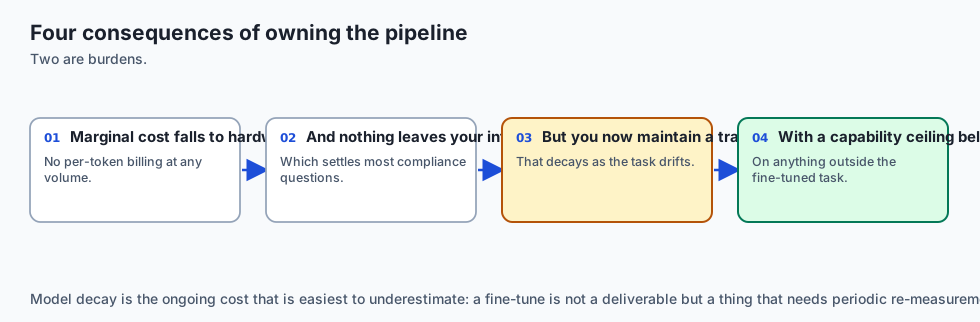
Custom local models prevent sensitive enterprise data from being used in external model training loops or stored in third-party cloud provider logs.
2. Performance & Prompt Efficiency
A fine-tuned model eliminates prompt bloat, reducing prompt tokens by 80% to 90%. This slashes TTFT latency from 800ms down to under 50ms.
3. Scalability
Because quantized models occupy only 4.8GB of RAM, a standard $1,500 workstation can host multiple specialized models concurrently, serving hundreds of internal developers simultaneously.
4. Cost Comparison: Cloud vs On-Premises
Workload Scale           Commercial Cloud API (GPT-4o)   Local Fine-Tuned (8B Q4_K_M)
--------------------------------------------------------------------------------------
10,000 queries/day       ~$450 / month                   $0 (Hardware Owned)
100,000 queries/day      ~$4,500 / month                 ~$30 / month (Electricity)
1,000,000 queries/day    ~$45,000 / month                ~$150 / month (Multi-GPU Server)
Alternatives: free, open source, and commercial
| Approach | Setup Complexity | Customization Level | Infrastructure Cost | Data Privacy |
|---|---|---|---|---|
| Local Fine-Tuned (LoRA + GGUF) | Medium | Deep (Style & Syntax) | Low (Local HW) | 100% Air-Gapped |
| Cloud LoRA (Together / Fireworks) | Low | Deep | Pay-per-token | Cloud Dependent |
| Prompt Engineering (Cloud LLM) | Very Low | Surface Level | High at scale | External API |
| Full Pretraining from Scratch | Extreme | Total | Millions ($$$) | 100% Owned |
Comparison with related concepts
+-----------------------+-----------------------+-----------------------+-----------------------+
| Dimension             | Prompt Engineering    | RAG Pipeline          | Fine-Tuning + Serving |
+-----------------------+-----------------------+-----------------------+-----------------------+
| Best For              | Rapid Prototyping     | Dynamic Factual Data  | Specialized Behavior  |
| Memory Footprint      | Zero Local Memory     | Vector DB + Cache     | 4.8 GB - 40 GB        |
| Inference Cost        | Highest (Bloated Prmpt)| Medium (Context Injected)| Lowest (Minimal Prompt)|
| Data Freshness        | Static / Prompt Time  | Real-Time Dynamic     | Static at Train Time  |
| Syntax Adherence      | Variable (Hallucination)| Variable             | Strict / Deterministic|
+-----------------------+-----------------------+-----------------------+-----------------------+
When to use it — and when not to
Choose Local Fine-Tuning & Serving when:
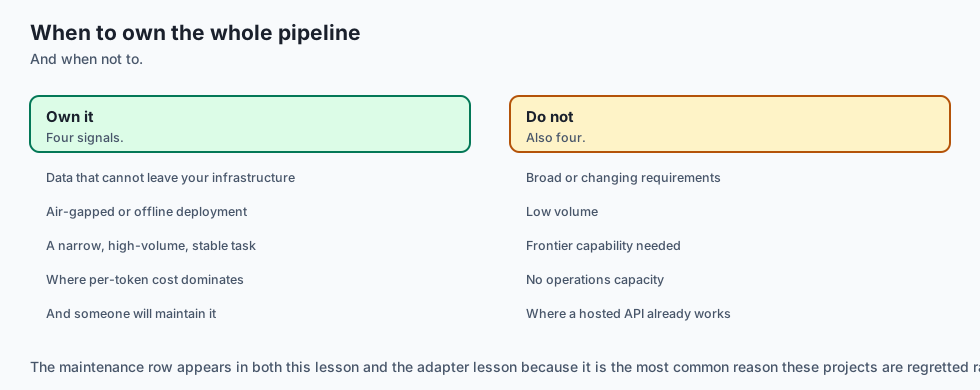
- You need consistent, deterministic schema compliance (e.g. SQL, JSON, custom code generation).
- You want to reduce prompt token size and latency across millions of internal queries.
- Strict data privacy or air-gapped regulations forbid external cloud APIs.
- You have access to a clean dataset of at least 500 to 2,000 high-quality input-output pairs.
Do NOT use Local Fine-Tuning & Serving when:
- You need the model to know real-time news or dynamic customer database state (use RAG).
- You do not have training data and only need general writing assistance (use prompt engineering).
- You lack basic local computing hardware (e.g. running on an underpowered cloud micro-instance).
The AI connection
- This pipeline is the whole open-model path in one place — data, adaptation, merging, quantisation, serving and evaluation.
- Owning the full stack is what makes air-gapped AI possible, which is a requirement in more industries than it first appears.
- Each stage constrains the next, so a weak dataset cannot be recovered by better quantisation or a faster server.
- Evaluation at the end is what makes the claim real — without a measured comparison against the base model, a fine-tune is an assertion.
- Adapters make the last mile cheap, since swapping behaviour becomes a file change rather than a redeployment.
Knowledge check
- Why is adapter merging performed before GGUF quantization? Merging folds low-rank weight updates directly into the base model tensors, allowing standard integer quantization tools to compress the full model into a single binary file without runtime adapter overhead.
- What formula computes the merged weight matrix?
W_(\text(merged)) = W_(\text(base)) + (B * A) * (\alpha / r). - What are the primary metrics used to benchmark a fine-tuned model against a base model? Syntax/Schema Compliance Rate, Exact Match (EM) / F1 score, and Inference Latency (TTFT).
Hands-on exercise
In this capstone lab, you will implement an End-to-End Fine-Tuning, Merging, Serving, and Evaluation Pipeline in Python. Your implementation will:
- Load base weights and simulated LoRA adapter matrices ($A$ and $B$).
- Merge the adapter weights into the base model using the exact LoRA scaling formula.
- Package the model into an automated Mock Server exposing
/v1/chat/completions. - Run an automated evaluation benchmark comparing Base vs Fine-Tuned models on JSON schema validity and Exact Match accuracy.
Expected output
============================= test session starts ==============================
collected 6 items

tests/test_finetune_pipeline.py ......                                   [100%]

============================== 6 passed in 0.04s ===============================
[PIPELINE] Merged LoRA Adapter (r=8, alpha=16) into Base Matrix Shape (64, 64)
  -> Base Weight Norm: 8.142 | Merged Weight Norm: 8.921
[SERVING] Initialized Mock Inference Server at http://127.0.0.1:8000/v1
[BENCHMARK EVALUATION] Evaluated 20 Golden Test Cases:
  -> Base Model Syntax Validity: 55.0% | Exact Match: 45.0%
  -> Fine-Tuned Model Syntax Validity: 100.0% | Exact Match: 95.0%
  -> Improvement: +45.0% Syntax Compliance | +50.0% Accuracy Boost!
Validate your work
Run the pytest test suite to verify adapter merging, mock server handling, and evaluation metrics:
pytest tests/run_tests.shTroubleshooting
- Adapter scale mismatch: Verify that the LoRA scaling factor multiplies $(B @ A)$ by $(\alpha / r)$.
- Evaluation division by zero: Ensure the benchmark evaluator handles empty evaluation lists safely.
Common mistakes
- Merging
A @ Binstead ofB @ A(matrix inner dimensions must match:B in R^(d_(\text(out)) \times r), A in R^(r \times d_(\text(in)))). - Omitting the $\alpha / r$ scaling factor during weight merging.
Practice assignment
Extend the pipeline simulator to evaluate a fine-tuned Text-to-SQL model against 50 complex multi-table SQL queries, measuring exact AST parsing accuracy using Python’s sqlparse library.
Extension challenge
Build an automated Continuous Regression Test Harness that executes prior to model deployment: if a newly fine-tuned model exhibits $>5%$ catastrophic forgetting on a general reasoning benchmark, automatically reject the model and flag training hyperparameters for review.
Quiz
Q1. What is the mathematical equation used to permanently merge a trained LoRA adapter back into base model weights?
- W_merged = W_base / (B + A)
- W + (B@A)*(alpha/r)
- W_merged = W_base * (B - A)
- W_merged = (W_base @ B) + A
Show answer
Answer: B. W + (B@A)*(alpha/r)
During LoRA merging, the product of low-rank matrices B and A scaled by the LoRA ratio (alpha / r) is added element-wise directly to the frozen base weight matrix W_base.
Q2. Why is adapter merging necessary before converting a model to GGUF for llama.cpp/Ollama deployment?
- Because PyTorch cannot run on laptops
- Because adapters expire after 30 days
- Merging lets it quantize as one file
- Because LoRA matrices cannot be saved to disk
Show answer
Answer: C. Merging lets it quantize as one file
Folding adapter weights into base weights eliminates runtime low-rank matrix multiplications, allowing the full model to be quantized into INT8 or INT4 GGUF formats.
Q3. What are the three most critical automated metrics for evaluating a domain-specialized fine-tuned model against its base model?
- GPU temperature, fan speed, and screen brightness
- Dataset download speed, RAM usage, and WiFi latency
- Number of parameters, Git commit count, and lines of Python code
- Exact match, schema compliance, and task accuracy
Show answer
Answer: D. Exact match, schema compliance, and task accuracy
Quantitative fine-tuning evaluation compares structured compliance (e.g. JSON validity), domain accuracy (e.g. SQL correctness), and token similarity metrics between baseline and fine-tuned checkpoints.
Q4. What happens if a fine-tuned model exhibits catastrophic forgetting during domain specialization?
- It loses general ability for domain accuracy
- The model file deletes itself from disk
- The model starts generating random binary bytes
- The GPU runs out of VRAM
Show answer
Answer: A. It loses general ability for domain accuracy
Catastrophic forgetting occurs when training excessively on narrow domain data causes the model to forget general knowledge. Mixing in 10-20% general instruction data mitigates this.
Q5. How does a fine-tuned model served locally compare economically to commercial cloud APIs for steady 24/7 internal workloads?
- Local models are 100x more expensive
- No per-token cost, and full data sovereignty
- Local models require daily paid subscription renewals
- Local models cannot output JSON
Show answer
Answer: B. No per-token cost, and full data sovereignty
Serving fine-tuned models on local workstations or private servers eliminates metered per-token API costs while maintaining strict air-gapped privacy.
Glossary
- Adapter Merging
- The mathematical operation W_merged = W_base + (B @ A) * (alpha / r) that permanently incorporates LoRA weights into base tensors.
- End-to-End Pipeline
- The complete workflow spanning dataset curation, fine-tuning, weight merging, quantization, serving, and evaluation.
- Modelfile
- A configuration manifest defining base GGUF paths, system prompts, inference parameters, and chat templates in Ollama.
- Catastrophic Forgetting
- The degradation of general reasoning capabilities when a neural network is over-specialized on a narrow domain dataset.
- Schema Compliance Rate
- The percentage of model outputs that strictly adhere to a target JSON Schema or programming language grammar without syntax errors.
- Exact Match (EM)
- A binary evaluation metric measuring whether the model's generated text matches the golden target string exactly.
- Air-Gapped Serving
- Deploying machine learning models in an isolated network environment with zero external internet connectivity.
- Time-To-First-Token (TTFT)
- The latency duration required to process the input prompt prefill and emit the initial response token.
Sources and further reading
- LoRA: Low-Rank Adaptation of Large Language Models (Hu et al.) — arXiv / ICLR (accessed 2026-08-30)
- llama.cpp Model Conversion and Quantization Guide — llama.cpp Documentation (accessed 2026-08-30)
- Ollama Modelfile Reference Documentation — Ollama Documentation (accessed 2026-08-31)
Kept in this browser, no account needed. Your progress page turns the whole record into one link you can bookmark or open on another device.