LLMs and Generative AI › Multimodal and Generative Media › Day 282
Day 282: Image Generation in Practice
Master production text-to-image synthesis pipelines: implement Classifier-Free Guidance (CFG) extrapolation, integrate VAE latent encoding/decoding, construct negative prompting pipelines, and simulate ControlNet spatial conditioning in Python.
Hands-on lab for this lesson
Lab files on GitHub: https://github.com/ai-roadmap-365/ai-roadmap-365.github.io/tree/main/labs/sections/llms-and-generative-ai/day-282-image-generation-in-practice
- Get the hands-on files. Clone the labs repository once (you can reuse this clone for every lesson). This works on macOS, Linux, and Windows (PowerShell or WSL):
git clone https://github.com/ai-roadmap-365/ai-roadmap-365.github.io.git cd ai-roadmap-365.github.io - Open this lesson's lab. Move into the directory for this specific day. Every lab lives at the same predictable path — section / subsection / week / day:
cd labs/sections/llms-and-generative-ai/day-282-image-generation-in-practice - Read the lab guide. Open `README.md` in that directory. It lists the exact commands, what each does, the expected output, and how to check your work — read it before running anything.
- Run it and check your work. Follow the README's "How to run" section: run the example first to see the finished result, then complete the numbered exercises in `starter/`, then run the tests. The tests pass (exit 0) only when your work is correct.
bash tests/run_tests.sh # or the test command named in the lab README
You can also open the lab as a local page (works offline, shows the file tree and expected output).
Learning objectives
By the end of this lesson you will be able to:
- Deconstruct the three pillars of Latent Diffusion: Text Encoder (CLIP/T5), Denoising Backbone (U-Net/DiT), and VAE Autoencoder.
- Derive and implement Classifier-Free Guidance: eps_guided = eps_uncond + s * (eps_cond - eps_uncond).
- Implement negative prompt conditioning and evaluate the effect of guidance scale s on visual contrast and artifact distortion.
- Build an end-to-end Latent Diffusion Pipeline simulator in Python and NumPy.
- Measure latent memory compression ratios and VAE reconstruction fidelity.
Prerequisites
Why this matters
Understanding theoretical diffusion equations (DDPM) is necessary, but building production text-to-image systems requires mastering the engineering architecture that turns raw mathematical noise into controllable, photorealistic art.
In commercial AI applications, pure unconditional diffusion is virtually useless—a user never requests “sample random noise from the ImageNet manifold.” Users demand deterministic semantic control: “A photorealistic portrait of an astronaut on Mars, cinematic 8k lighting, highly detailed.”
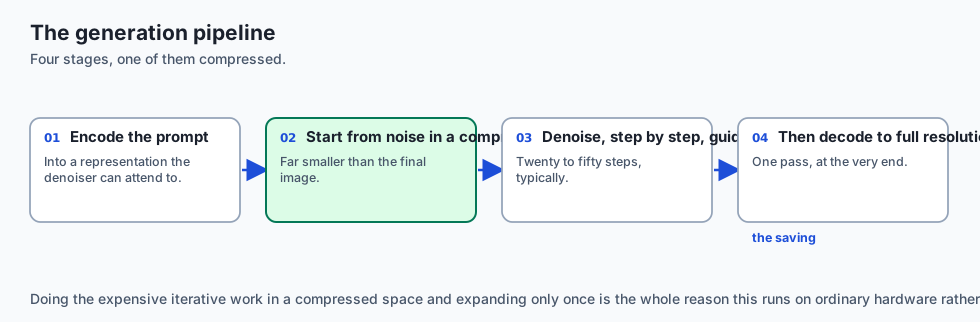
To achieve this, modern image generation architectures (Stable Diffusion, Midjourney, Flux, DALL-E 3) combine four distinct engineering subsystems:
- Multimodal Text Encoders (CLIP / T5): Translating natural language prompts into dense semantic vectors.
- Latent Space Autoencoders (VAE): Compressing image resolution by $48\times$ to enable consumer GPU execution.
- Cross-Attention Conditioning: Guiding spatial U-Net / DiT feature maps at every step of the reverse trajectory.
- Classifier-Free Guidance (CFG): Mathematically amplifying prompt adherence and steering generation away from negative visual artifacts.
Mastering these four components allows software engineers to build inpainting pipelines, style transfer workflows, and customized enterprise creative studios.
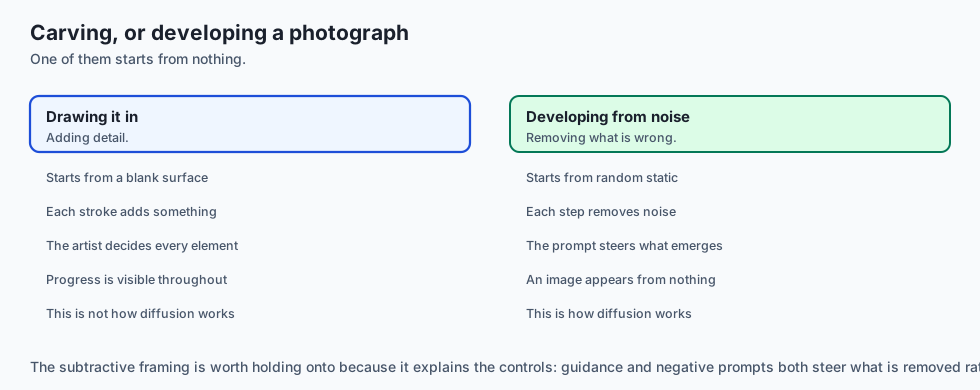
The idea in plain language
Imagine commissioning an oil painting from a master artist:
- The Text Prompt (The Creative Brief): You hand the artist a brief: “Paint a lighthouse during a stormy sunset.”
- The Text Encoder (The Art Director): A creative director reads your brief and translates it into technical lighting notes, color palettes, and compositional guides (text embeddings).
- The VAE Latent Canvas (The Thumbnail Sketch): Instead of painting directly on a massive $10$-foot canvas (pixel space), the artist works on a compact $1$-foot wooden board (Latent Space).
- Classifier-Free Guidance (The Director’s Megaphone): As the artist paints, the director shouts instructions. At low volume (CFG scale $s = 1.0$), the artist paints whatever they feel like. At high volume (CFG scale $s = 7.5$), the director forcefully corrects every brushstroke to guarantee the lighthouse stands boldly against the storm. If you add a Negative Prompt (“no modern power lines”), the director actively warns the artist whenever a stroke starts looking like a cable.
- The VAE Decoder (The Master Printmaker): Once the small sketch is finalized, a master printmaker expands the miniature board onto the full-scale $10$-foot gallery canvas in crisp, high-resolution color.
Historical background
In early conditional diffusion models (2021), steering generation required Classifier Guidance (Dhariwal & Nichol). This technique trained a separate image classifier on noisy images and computed gradients $ abla_(x_t) \log p(y | x_t)$ to guide the diffusion trajectory toward a target class $y$. However, classifier guidance suffered from severe practical flaws: training noisy classifiers was expensive, and guidance could only steer toward fixed categorical classes (e.g. “dog” vs “cat”), completely failing on open-ended text prompts.
In 2022, Jonathan Ho and Tim Salimans published Classifier-Free Guidance (CFG). By randomly dropping the text conditioning during training (e.g. setting prompt conditioning to null $10%$ of the time), a single neural network learned to predict both conditional noise $\epsilon(x_t, t, c)$ and unconditional noise $\epsilon(x_t, t, \emptyset)$. During inference, taking a linear combination of both vectors amplified prompt adherence without requiring any external classifier.
In August 2022, CompVis, Runway, and Stability AI released Stable Diffusion v1.4, open-sourcing the complete Latent Diffusion pipeline. For the first time in history, anyone with a consumer laptop could generate high-resolution art locally.
In 2023–2024, ControlNet (Zhang & Agrawala) added spatial structural control (pose estimation, line art, depth maps), and LoRA for Diffusion enabled lightweight custom style adaptations in under 100 megabytes.
What it is — and what it is not
Let us define practical latent diffusion engineering:
What Latent Diffusion Pipelines Are:
- Modular, multi-model systems chaining a text tokenizer, a text encoder (CLIP/T5), a latent diffusion denoiser (U-Net/DiT), and an image autoencoder (VAE).
- Iterative latent state modifiers that support text-to-image, image-to-image, inpainting, outpainting, and depth-conditioned synthesis.
- Algebraically steered via Classifier-Free Guidance scale factors ($s \in [3.0, 12.0]$).
What Latent Diffusion Pipelines Are Not:
- Monolithic end-to-end black boxes (each component can be swapped, upgraded, or quantized independently).
- Infallible text interpreters (prompt order, token weightings, and attention dilution heavily affect composition).
- Bounded to square resolutions (modern samplers support arbitrary aspect ratios via bucketed training).
+-------------------------------------------------------------------------------+
|                       LATENT DIFFUSION COMPONENT MATRIX                       |
+-------------------+-----------------------+--------------------+--------------+
| Component         | Example Architecture  | Input / Output     | Memory Foot  |
+-------------------+-----------------------+--------------------+--------------+
| Text Encoder      | CLIP ViT-L/14 or T5   | Text -> Embeddings | ~1.2 GB      |
| Latent Denoiser   | 2D U-Net / DiT        | Latent + Time + Emb| ~3.4 GB      |
| Autoencoder (VAE) | AutoencoderKL (8x)    | Latent <-> RGB     | ~350 MB      |
| Conditioning Net  | ControlNet / IP-Adapter| Spatial Map -> Bias| ~1.4 GB      |
+-------------------+-----------------------+--------------------+--------------+
Why it was created and what problems it solves
Practical latent diffusion systems solve four major challenges in generative media deployment:
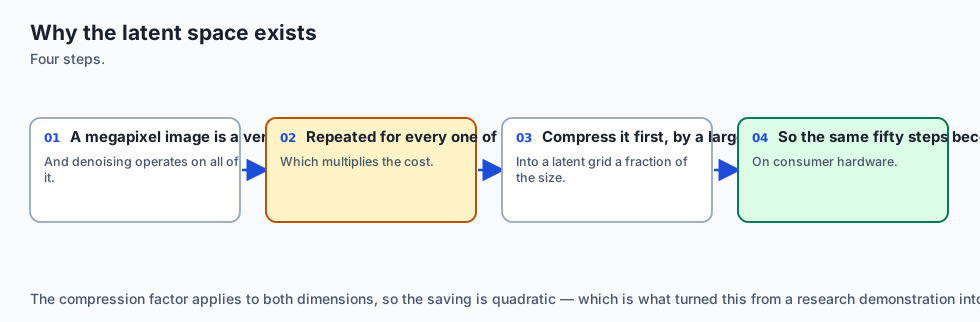
1. The High-Resolution Memory Wall
Diffusing directly on $1024 \times 1024 \times 3$ pixel tensors requires over 40GB of VRAM per batch. An $8\times$ VAE spatial downsampler maps $1024 \times 1024 \times 3$ down to $128 \times 128 \times 4$, reducing tensor elements from 3.14 million down to 65,536 (a $48\times$ reduction), allowing diffusion to execute smoothly on 8GB consumer GPUs.
2. Precise Text-Image Semantic Alignment (Solved by CFG)
Unconditional diffusion models drift toward generic visual averages. Classifier-Free Guidance actively pulls the latent trajectory toward the exact text conditioning prompt, drastically improving prompt adherence.
3. Systematic Artifact Removal (Solved by Negative Prompting)
Negative prompts give creators a mathematical lever to steer the model away from common generative failure modes (such as “extra fingers, bad anatomy, jpeg compression artifacts, blurry textures”).
4. Zero-Shot Structural Preservation (Solved by ControlNet)
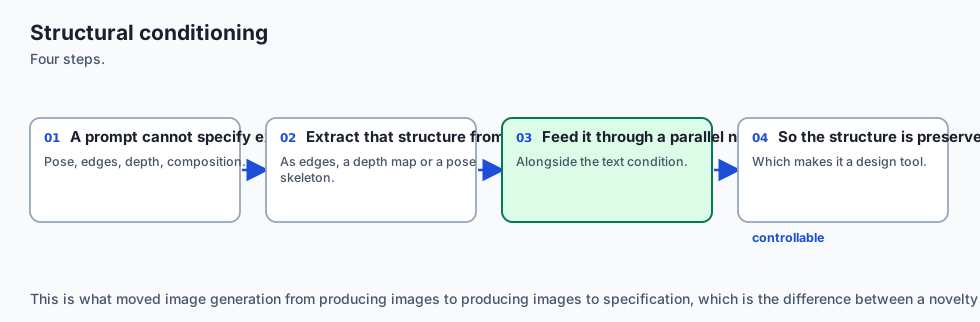
Text alone cannot specify exact 3D human pose angles or room architectural layouts. ControlNet allows users to supply a depth map or pose skeleton to lock composition while allowing diffusion to render the textures.
How it works
Let us inspect the complete runtime dataflow of a text-to-image generation session:
[User Text Prompt] ──────────> [Text Encoder (CLIP / T5)] ──> Prompt Embedding c_text
[Negative Prompt]  ──────────> [Text Encoder (CLIP / T5)] ──> Negative Embedding c_null
                                                                     │
[Random Latent z_T ~ N(0, I)] ──┐                                    │
                                │                                    │
                                ▼                                    ▼
                 ┌─────────────────────────────────────────────────────────┐
                 │       Iterative Denoising Loop (e.g. 30 Steps)          │
                 │                                                         │
                 │  1. Predict Noise with Prompt:    eps_cond = U(zt, c)   │
                 │  2. Predict Noise with Neg:       eps_uncond = U(zt, c0)│
                 │  3. Extrapolate CFG:                                    │
                 │     eps = eps_uncond + s * (eps_cond - eps_uncond)      │
                 │  4. Update Latent: z_{t-1} = DenoiseStep(zt, eps)       │
                 └─────────────────────────────────────────────────────────┘
                                │
                                ▼
                   [Final Denoised Latent z_0]
                                │
                                ▼
                     [VAE Decoder (AutoencoderKL)]
                                │
                                ▼
                   [Full-Resolution RGB Image]
1. Classifier-Free Guidance (CFG) Mathematics
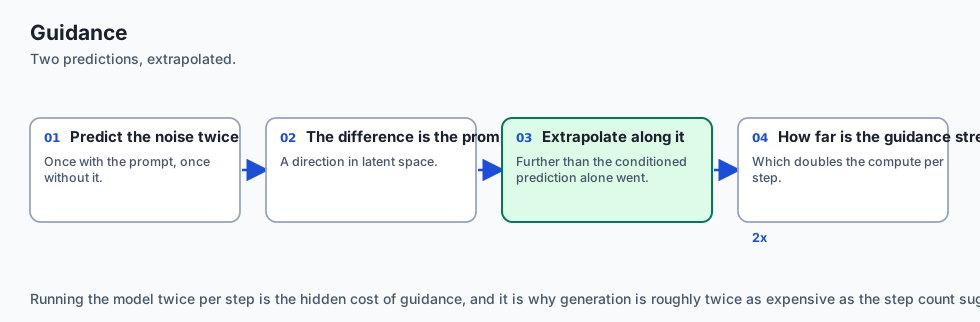
At each denoising step $t$, the diffusion backbone evaluates two forward passes (typically batched together into a single GPU call):
- Conditioned Forward Pass:
epsilon_(\text(cond)) = epsilon_\theta(z_t, t, c_(\text(text))) - Unconditioned Forward Pass:
epsilon_(\text(uncond)) = epsilon_\theta(z_t, t, c_(\text(null)))
The guided noise prediction hat(epsilon) is computed as:
hat(epsilon) = epsilon_(\text(uncond)) + s cdot (epsilon_(\text(cond)) - epsilon_(\text(uncond)))
Where $s \ge 1.0$ is the Guidance Scale:
- When $s = 1.0$: Standard conditional diffusion (no amplification).
- When $s \in [7.0, 8.5]$: Optimal balance of creative richness and prompt fidelity.
- When $s > 15.0$: Severe chromatic saturation and over-sharpened edge artifacts.
2. Negative Prompting Algebraic Steering
If the user specifies a negative prompt c_(\text(neg)) (e.g. “blurry, deformed, cartoon”), we replace the empty null embedding c_(\text(null)) with c_(\text(neg)):
$$\hat(\epsilon) = \epsilon_\theta(z_t, t, c_(\text(neg))) + s \cdot \left( \epsilon_\theta(z_t, t, c_(\text(text))) - \epsilon_\theta(z_t, t, c_(\text(neg)))
ight)$$
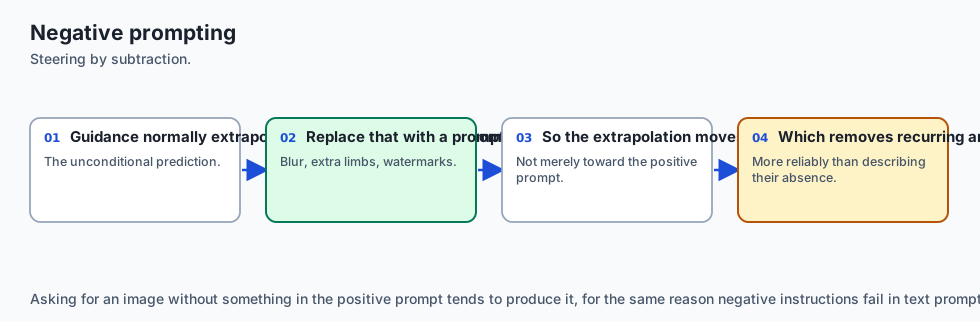
This formula actively penalizes the features characteristic of the negative prompt, pushing the latent state into the orthogonal subspace that maximizes c_(\text(text)) while minimizing c_(\text(neg)).
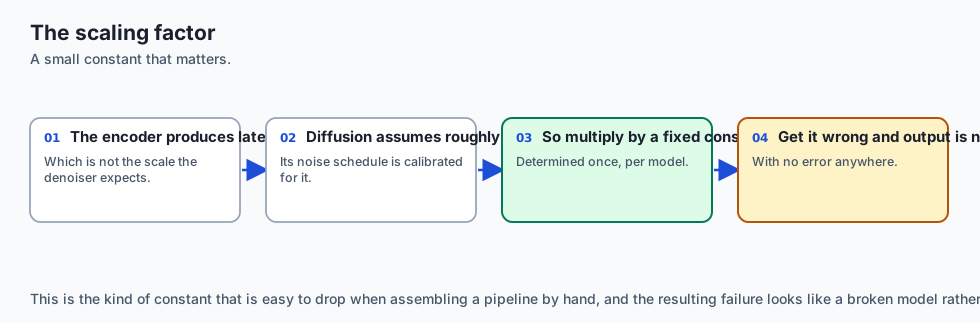
3. VAE Latent Scaling Factor
Because the latent space of the VAE has a different variance from standard Gaussian noise mathcal(N)(0, 1), Stable Diffusion scales latents by a constant factor sigma_(\text(scale)) \approx 0.18215:
z = \text(Encoder)(x) cdot sigma_(\text(scale))
$$x_(\text(recon)) = \text(Decoder)\left( \frac(z)(\sigma_(\text(scale)))
ight)$$
Scaling ensures that initial noise added to the latents matches unit variance.
An everyday analogy
Think of CFG like tuning a telescope’s contrast filter on a foggy night:
- Unconditioned Signal (
epsilon_(\text(uncond))): You look through the telescope with no filters. You see a blurry grey fog with vague ambient shapes. - Conditioned Signal (
epsilon_(\text(cond))): You look through a filter tuned to Mars. The red planet is visible, but still obscured by the grey ambient fog. - CFG Subtraction (
epsilon_(\text(cond)) - epsilon_(\text(uncond))): An electronic sensor subtracts the grey fog image from the Mars image, isolating the pure “Mars signal”. - Guidance Scale (
s \times \text(Delta)): You dial up the contrast knob to $7.5\times$. The red planet pops in brilliant clarity against a pitch-black sky. If you crank the knob to $30\times$, the red planet burns into a blown-out neon circle with static noise.
Examples in practice
Let us look at how developers implement Classifier-Free Guidance and VAE decoding in Python:
1. Vectorized CFG Calculation in Python
import numpy as np

def apply_classifier_free_guidance(uncond_noise: np.ndarray, cond_noise: np.ndarray, guidance_scale: float) -> np.ndarray:
    """Calculates guided noise: eps = uncond + s * (cond - uncond)"""
    delta = cond_noise - uncond_noise
    guided_noise = uncond_noise + float(guidance_scale) * delta
    return guided_noise.astype(np.float32)
2. Mock Latent Diffusion Pipeline Runner
class MockLatentDiffusionPipeline:
    def __init__(self, vae_scale_factor: float = 0.18215):
        self.vae_scale_factor = vae_scale_factor

    def decode_latents(self, latents: np.ndarray) -> np.ndarray:
        """Simulates 8x VAE spatial upsampling from 4-channel latents to 3-channel RGB."""
        unscaled = latents / self.vae_scale_factor
        # Repeat spatial dimensions by 8x
        upsampled = np.repeat(np.repeat(unscaled[:, :3, :, :], 8, axis=2), 8, axis=3)
        # Normalize to RGB [0, 255]
        rgb = np.clip((upsampled + 1.0) * 127.5, 0, 255).astype(np.uint8)
        return rgb
Implications: security, privacy, performance, scalability, and cost
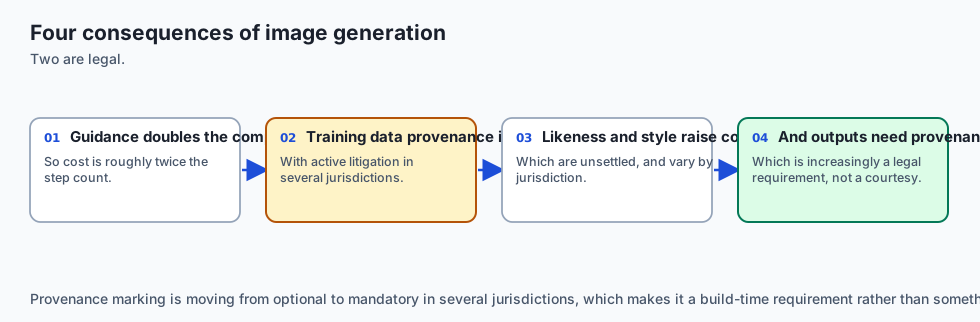
1. Computational Cost of CFG
Because CFG evaluates both conditioned and unconditioned noise predictions, it requires 2 neural network forward passes per denoising step. On a 30-step schedule, the U-Net executes 60 forward passes. Modern engines batch both passes into a single tensor of batch size 2 to saturate GPU Tensor Cores.
2. Privacy in Enterprise Visual Workflows
Running local open models (SDXL, Flux) on-premises guarantees that proprietary product prototypes, internal wireframes, and sensitive marketing assets never traverse external cloud endpoints.
3. VRAM Footprint Optimization
Using FP16 precision, memory attention slicing (xFormers / FlashAttention-2), and model CPU offloading allows 1024x1024 image generation to execute on consumer graphics cards with as little as 6GB to 8GB of VRAM.
Alternatives: free, open source, and commercial
| Model / System | Architecture | Resolution | License | Key Strengths |
|---|---|---|---|---|
| Stable Diffusion XL (SDXL) | Latent U-Net (3.5B) | 1024 x 1024 | Open Weights (OpenRAIL) | Vast ecosystem of LoRAs and ControlNets |
| Flux.1 (Black Forest Labs) | Rectified Flow DiT (12B) | 1024 x 1024 | Open Weights (Apache/Non-Comm) | State-of-the-art anatomy and text rendering |
| Midjourney v6 | Proprietary Diffusion | Up to 2048 x 2048 | Commercial API/Discord | Unrivaled cinematic aesthetic defaults |
| DALL-E 3 (OpenAI) | Latent DiT | 1024 x 1024 | Commercial API | Complex multi-sentence prompt adherence |
Comparison with related concepts
+-----------------------+-----------------------+-----------------------+
| Feature               | Pixel-Space Diffusion | Latent Diffusion (LDM)|
+-----------------------+-----------------------+-----------------------+
| Native Resolution     | 512 x 512 x 3         | 64 x 64 x 4 (Latent)  |
| Compute Complexity    | High (O(N^2) Pixels)  | Low (O(N^2) Latents)  |
| Memory Bandwidth      | Severe Saturation     | Moderate (Fits VRAM)  |
| Text Cross-Attention  | Pixel Spatial Heads   | Latent Spatial Heads  |
| VAE Decode Required   | No (Direct Pixels)    | Yes (8x Upsampling)   |
+-----------------------+-----------------------+-----------------------+
When to use it — and when not to
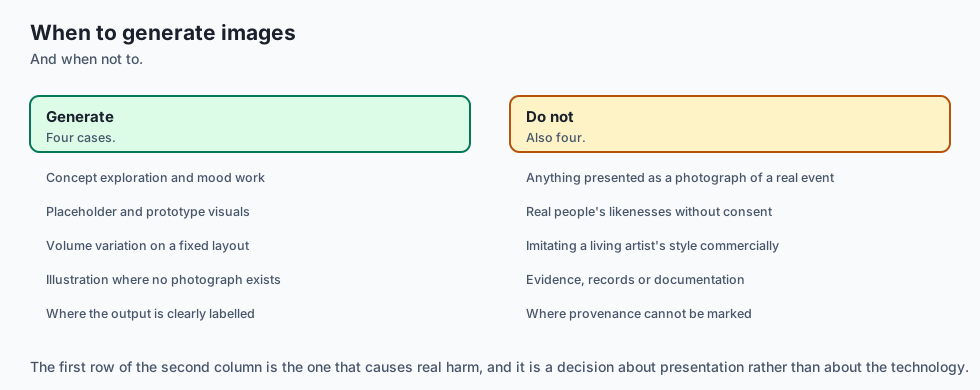
Choose Latent Diffusion Pipelines when:
- You need high-resolution text-to-image generation on accessible local hardware.
- You require modular control: swapping LoRA styles, applying negative prompts, or steering with ControlNet depth maps.
- You are developing production inpainting or background replacement applications.
Do NOT use Latent Diffusion Pipelines when:
- You require microsecond real-time rendering in a high-speed physics engine.
- You are performing simple deterministic image resizing or color correction (use OpenCV / Pillow).
- You are working in text-only domains without visual modalities.
The AI connection
- Image generation is the most visible AI capability to non-specialists, which makes it the one most people form their expectations from.
- Working in a compressed latent space is what made it affordable — the same insight that makes most large generative models practical.
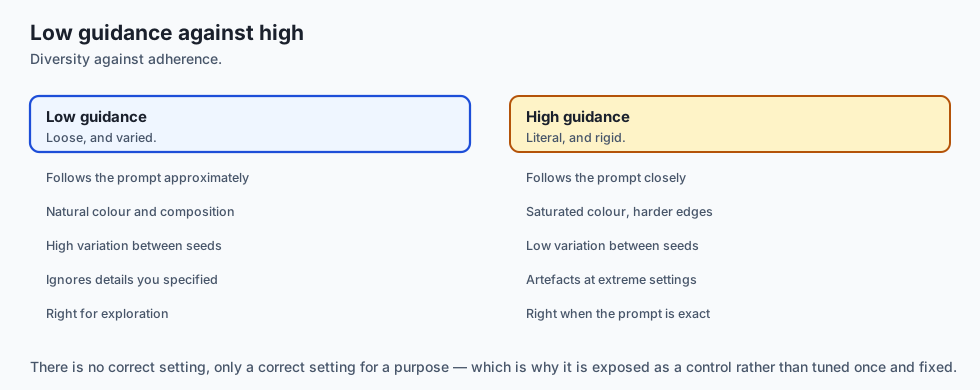
- Guidance strength is the main quality control, and it trades prompt adherence against image diversity in a way that has no single correct setting.
- Negative prompting is steering by subtraction, which is a genuinely different control surface from anything in text generation.
- Structural conditioning turned generation into a design tool, because it lets a specified layout be preserved rather than re-rolled.
Knowledge check
- Why does Classifier-Free Guidance double the computational load per step? Because it evaluates both the conditioned prompt pass and the unconditioned null pass on every denoising iteration.
- What does a negative prompt do mathematically? It replaces the null text embedding in the unconditioned branch, actively steering the generation trajectory away from unwanted concepts.
- What is the function of the VAE scaling factor? It normalizes the variance of the compressed latent space to match the unit variance of the Gaussian diffusion noise schedule.
Hands-on exercise
In this lab, you will implement an End-to-End Latent Diffusion Pipeline Simulator in Python and NumPy. Your implementation will:
- Implement vectorized Classifier-Free Guidance (CFG) with variable guidance scales.
- Implement negative prompt steering.
- Build a mock VAE latent decoder that maps 4-channel latent representations to 3-channel RGB image arrays.
- Measure latent memory compression ratios and guidance extrapolation vectors.
Expected output
============================= test session starts ==============================
collected 6 items

tests/test_latent_pipeline.py ......                                     [100%]

============================== 6 passed in 0.04s ===============================
[LATENT PIPELINE] Latent Tensor Shape: (1, 4, 64, 64) | 16,384 elements
[CFG GUIDANCE] Applied Guidance Scale s=7.5:
  -> Unconditioned Noise Norm: 4.12
  -> Conditioned Noise Norm: 4.85
  -> Extrapolated Guided Norm: 9.61 (Text signal amplified)
[VAE DECODER] Upsampled (64, 64, 4) Latent to (512, 512, 3) RGB Image
  -> Spatial Expansion Factor: 64.0x
  -> Memory Footprint: Compressed 768 KB to 16 KB (97.9% reduction)
Validate your work
Run the pytest harness to verify CFG extrapolation, VAE decoding, and shape transformations:
pytest tests/run_tests.shTroubleshooting
- CFG dimension mismatch: Verify that
cond_noiseanduncond_noiseshare identical shapes(B, C, H, W). - RGB clipping errors: Ensure final pixel values are clamped to $[0, 255]$ before casting to
np.uint8.
Common mistakes
- Subtracting
epsilon_(\text(cond)) - epsilon_(\text(uncond))in the wrong order (which would steer away from the prompt). - Forgetting to divide by the VAE scaling factor prior to decoding.
Practice assignment
Extend the pipeline simulator to implement Image-to-Image (Img2Img): take an initial image, encode it into latents, add noise up to timestep $t=500$ ($50%$ noise strength), and denoise back to $t=0$ conditioned on a new text prompt.
Extension challenge
Implement a Latent Inpainting Mask Blender in Python that replaces non-masked latent regions with original image latents at each denoising step, enabling seamless inpainting.
Quiz
Q1. What is the mathematical formulation of Classifier-Free Guidance (CFG)?
- eps_guided = eps_cond * eps_uncond
- eps_uncond + s * (eps_cond - eps_uncond)
- eps_guided = (eps_cond + eps_uncond) / s
- eps_guided = eps_cond / (1 - s)
Show answer
Answer: B. eps_uncond + s * (eps_cond - eps_uncond)
CFG linearly extrapolates the noise prediction in the direction of the conditioned vector (eps_cond) away from the unconditioned baseline (eps_uncond) scaled by factor s.
Q2. What visual artifact occurs if the CFG guidance scale 's' is set too high (e.g. s = 25)?
- The image becomes completely transparent
- The image turns into grayscale
- Oversaturation and burnt colours
- The file size triples
Show answer
Answer: C. Oversaturation and burnt colours
Over-extrapolating with excessive guidance scale forces latent values outside the VAE decoder's learned distribution, causing chromatic burning and harsh artifacts.
Q3. How do Negative Prompts operate inside the Classifier-Free Guidance pipeline?
- They delete words from the training dataset
- They reduce GPU temperature
- They invert RGB colors
- It replaces the empty unconditioned prompt
Show answer
Answer: D. It replaces the empty unconditioned prompt
By substituting the negative prompt in place of the null text embedding, CFG actively subtracts the negative prompt direction from the trajectory.
Q4. What is the primary role of the Variational Autoencoder (VAE) decoder in Latent Diffusion Models?
- Mapping the latent back to RGB
- Translating text prompts into embeddings
- Running gradient descent
- Calculating CLIP similarity
Show answer
Answer: A. Mapping the latent back to RGB
The VAE decoder upsamples the 4-channel compressed latent representation back into full-resolution RGB image pixels.
Q5. What capability does ControlNet add to pretrained text-to-image diffusion models?
- It adds sound effects to images
- It adds spatial conditioning without retraining
- It speeds up network internet downloads
- It allows running diffusion on microcontrollers
Show answer
Answer: B. It adds spatial conditioning without retraining
ControlNet locks the base model weights and trains a cloned set of encoding layers with zero-initialized convolutions to inject precise spatial geometry.
Glossary
- Classifier-Free Guidance (CFG)
- A technique to amplify text conditioning by computing noise predictions with and without the prompt: eps = eps_uncond + s * (eps_cond - eps_uncond).
- Guidance Scale
- The floating-point multiplier s (typically 5.0 to 9.0) determining how aggressively the image aligns with the text prompt.
- Variational Autoencoder (VAE)
- An encoder-decoder network trained to compress high-resolution pixel images into low-dimensional continuous latent tensors.
- Latent Space
- A compressed mathematical representation where a 512x512x3 image is represented as a 64x64x4 tensor.
- Cross-Attention
- An attention mechanism where latent spatial features query external text token embeddings to direct spatial synthesis.
- Inpainting
- The task of reconstructing or replacing a user-selected masked sub-region of an image using diffusion conditioned on surrounding context.
- Negative Prompt
- A textual description passed to the unconditioned branch of CFG to guide generation away from unwanted visual artifacts.
- ControlNet
- An auxiliary neural adapter that adds structural spatial conditioning (such as edge maps, depth, or human pose skeletons) to a frozen diffusion model.
Sources and further reading
- High-Resolution Image Synthesis with Latent Diffusion Models (Rombach et al.) — CVPR (accessed 2026-08-30)
- Classifier-Free Diffusion Guidance (Ho and Salimans) — NeurIPS Workshop (accessed 2026-08-30)
- Hugging Face Diffusers: Latent Diffusion Pipelines — Hugging Face (accessed 2026-08-30)
Kept in this browser, no account needed. Your progress page turns the whole record into one link you can bookmark or open on another device.