LLMs and Generative AI › Multimodal and Generative Media › Day 286
Day 286: Generative AI Ethics and Copyright
Master the legal, ethical, and technical compliance engineering of generative AI: implement C2PA provenance manifest signing and verification, build perceptual hashing (pHash) copyright deduplication, analyze fair use legal tests, and build an automated IP risk audit engine in Python.
Hands-on lab for this lesson
Lab files on GitHub: https://github.com/ai-roadmap-365/ai-roadmap-365.github.io/tree/main/labs/sections/llms-and-generative-ai/day-286-generative-ai-ethics-and-copyright
- Get the hands-on files. Clone the labs repository once (you can reuse this clone for every lesson). This works on macOS, Linux, and Windows (PowerShell or WSL):
git clone https://github.com/ai-roadmap-365/ai-roadmap-365.github.io.git cd ai-roadmap-365.github.io - Open this lesson's lab. Move into the directory for this specific day. Every lab lives at the same predictable path — section / subsection / week / day:
cd labs/sections/llms-and-generative-ai/day-286-generative-ai-ethics-and-copyright - Read the lab guide. Open `README.md` in that directory. It lists the exact commands, what each does, the expected output, and how to check your work — read it before running anything.
- Run it and check your work. Follow the README's "How to run" section: run the example first to see the finished result, then complete the numbered exercises in `starter/`, then run the tests. The tests pass (exit 0) only when your work is correct.
bash tests/run_tests.sh # or the test command named in the lab README
You can also open the lab as a local page (works offline, shows the file tree and expected output).
Learning objectives
By the end of this lesson you will be able to:
- Analyze the legal landscape of Generative AI copyright: training ingestion fair use vs commercial output infringement.
- Deconstruct the C2PA technical specification: JSON-LD assertions, SHA-256 bindings, and cryptographic signing.
- Implement Perceptual Hashing (pHash) with Hamming distance matching to detect near-duplicate memorized media.
- Construct an automated IP Risk Evaluator calculating memorization likelihood and trademark similarity in Python.
- Evaluate watermarking techniques: imperceptible latent perturbation (SynthID) vs metadata signing.
Prerequisites
Why this matters
The rapid rise of generative foundation models has triggered the most intense legal and ethical transformation in modern technology. When an AI model trains on billions of public internet images, songs, and code repositories, two vital questions emerge:
- The Ingestion Question: Is scraping copyrighted works for training protected by the Fair Use doctrine, or does it constitute wholesale copyright infringement?
- The Output Question: When a user prompts a model to generate an image or text in the exact style of a living artist or company brand, who owns the resulting work, and who is legally liable if the output plagiarizes a copyrighted character?
In production AI engineering, deploying generative models without provenance tracking (C2PA), content watermarking (SynthID), and memorization deduplication (Perceptual Hashing) creates catastrophic legal exposure for enterprises.
Building ethically sound, enterprise-ready generative systems requires understanding both the legal doctrine of fair use and the technical mechanisms used to audit, watermark, and verify digital media.
The idea in plain language
Imagine a master chef who visits thousands of restaurants around the world:
- Ethical Generalization (Learning Culinary Technique): The chef tastes hundreds of pasta dishes, studying the chemistry of salt, starch, and garlic. Back in their own kitchen, they invent a novel pasta dish that combines these general principles. This is Transformative Learning (Fair Use).
- Copyright Infringement (Recipe Piracy): The chef copies an award-winning secret sauce recipe word-for-word, bottles it under their own brand, and sells it directly outside the original creator’s restaurant, destroying the original creator’s livelihood. This is Market Substitution / Infringement.
- C2PA Content Credentials (The Quality Seal): Every bottle of sauce comes with a tamper-evident digital seal. Scanning the QR code displays the certified ingredients, the exact date of cooking, and confirms whether the sauce was crafted by a human master or an automated industrial mixer.
Historical background
The legal foundation of AI training sits on top of landmark internet copyright cases:
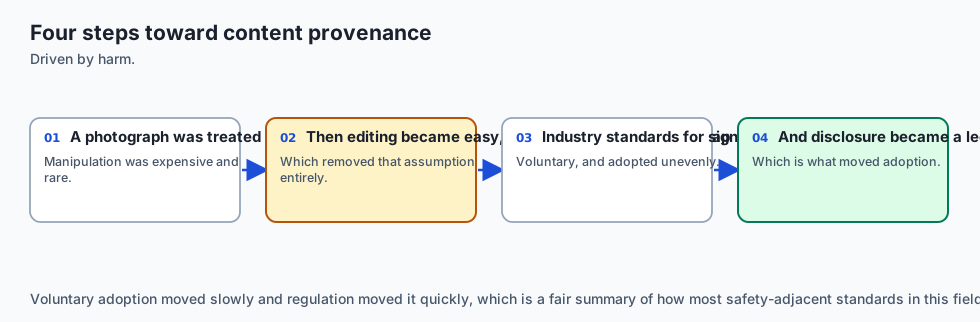
- In Authors Guild v. Google (2015), the US Second Circuit Court of Appeals ruled that Google’s scanning of millions of copyrighted library books to create a searchable snippet index constituted Transformative Fair Use, because Google was creating an information locator rather than a book substitute.
- In 2022–2024, visual artists, news organizations (e.g. The New York Times v. OpenAI), and record labels filed major copyright lawsuits against AI creators, arguing that generative foundation models act as direct market substitutes rather than transformative search indexes.
- In 2021, the Coalition for Content Provenance and Authenticity (C2PA) was founded by Adobe, Microsoft, Arm, Intel, and Truepic, standardizing cryptographically signed provenance metadata for digital assets.
- In 2023, the US Copyright Office affirmed that purely AI-generated works without human authorship cannot receive copyright protection, requiring human creators to prove substantial human expressive input.
What it is — and what it is not
Let us define generative AI copyright and provenance engineering:
What AI Provenance and Compliance Is:
- Cryptographic signing of generated media manifests using standard X.509 PKI certificates (C2PA).
- Deduplication and memorization filters running Perceptual Hashing (pHash) against training corpora.
- Automated guardrails preventing generation of registered trademark logos, private personal identifiable information (PII), or non-consensual deepfakes.
What AI Provenance and Compliance Is Not:
- Simple EXIF metadata editing (standard EXIF tags can be stripped or altered in seconds; C2PA is cryptographically bound to pixel payload hashes).
- Absolute immunity from lawsuits (enterprise indemnification requires active adherence to safety guardrails).
- Purely a legal problem (it requires robust software engineering to build detection pipelines).
+-------------------------------------------------------------------------------+
|                        AI ETHICS & PROVENANCE TOOL MATRIX                     |
+-------------------+-----------------------+--------------------+--------------+
| Technology        | Governing Body        | Implementation     | Primary Role |
+-------------------+-----------------------+--------------------+--------------+
| C2PA Manifests    | C2PA / CAI Consortium | JSON-LD + SHA-256  | Origin Trace |
| SynthID           | Google DeepMind       | Latent Watermarking| AI Detection |
| Perceptual Hash   | Open Source (pHash)   | DCT Frequency Hash | Plagiarism D |
| robots.txt TDM    | W3C / TDM Working Grp | Machine-Read Tags  | Opt-Out Scra |
+-------------------+-----------------------+--------------------+--------------+
Why it was created and what problems it solves
Compliance engineering solves three severe vulnerabilities in enterprise AI deployments:
1. The Deepfake and Disinformation Crisis (Solved by C2PA)
Malicious actors can generate photorealistic images of political figures or corporate CEOs committing crimes. C2PA allows news organizations and platforms to instantly verify whether a video was shot on a certified physical camera sensor or synthesized by an AI diffusion model.
2. Accidental Output Plagiarism (Solved by Perceptual Hashing)
If an AI model memorizes a copyrighted superhero character during training, a prompt like “a hero with a bat mask” might emit an exact copy of a trademarked character. Perceptual hashing and semantic embedding filters detect near-duplicate outputs and reject them before delivery to end users.
3. Ethical Creator Attribution
Enabling creators to attach machine-readable tdm-reservation opt-out tags guarantees that proprietary art portfolios are excluded from automated scraping spiders.
How it works
Let us inspect the architecture of C2PA provenance signing and Perceptual Hashing:
[Generated Media (Image / Audio / Video)]
                   │
                   ├───> [Compute Binary Payload SHA-256 Hash] ──> Hash Digest
                   │
                   ▼
 [Construct C2PA Manifest (JSON-LD)]
 - Claim Generator: "AI Studio v2.4"
 - Action: "c2pa.created"
 - Assertions: [{ type: "c2pa.ai_generated", model: "Flux-1.1-Pro" }]
 - Binding: SHA-256 Hash of Media Payload
                   │
                   ▼
 [Sign with Private Key (X.509 PKI Certificate)]
                   │
                   ▼
 [Embed Signed Manifest into File Container (JPEG/PNG/MP4)]
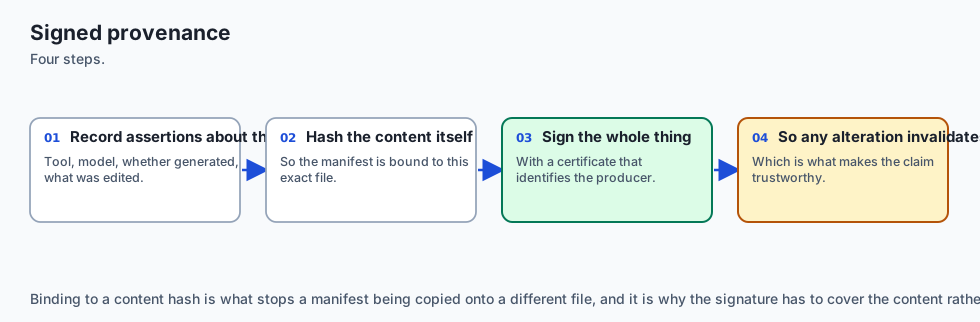
1. The C2PA Cryptographic Binding Mechanism
- The media payload bytes $B$ are hashed using SHA-256:
H = \text(SHA256)(B). - A structured JSON-LD claim dictionary is created containing generation metadata, author assertions, and $H$.
- The claim is digitally signed using a private key:
sigma = \text(Sign)(K_(\text(private)), \text(Claim)). - The signature, public certificate chain, and claim are serialized into a dedicated metadata box (e.g.
JUMBFbox in JPEG/PNG) inside the file header. - If an attacker modifies even a single pixel in the image, $H’ eq \text(SHA256)(B’)$, and the signature validation fails immediately.
2. Perceptual Hashing (pHash) Algorithm
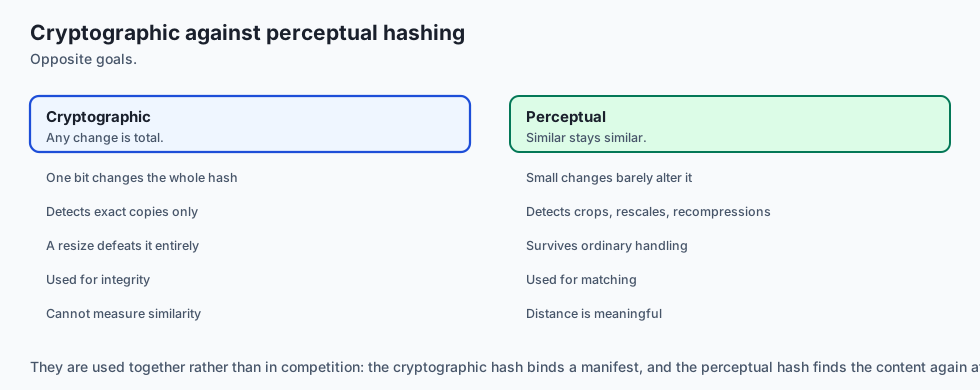
Unlike SHA-256 (which is brittle to a single bit flip), pHash computes a visual fingerprint:
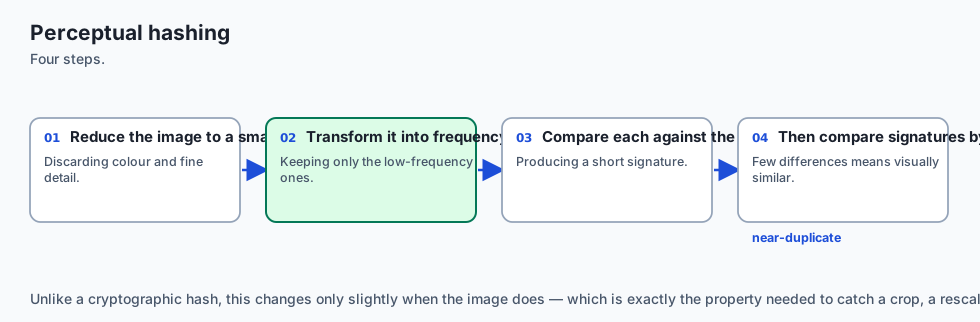
- Resize image to $32 \times 32$ grayscale.
- Compute the 2D Discrete Cosine Transform (DCT).
- Keep the top $8 \times 8$ lowest frequency coefficients (capturing fundamental visual shape and contrast).
- Compute the median value of the $64$ coefficients.
- Generate a 64-bit binary hash: set bit $i = 1$ if coefficient
> \text(median), else $0$. - Compare two images using Hamming Distance (number of differing bits). A Hamming distance $\le 5$ indicates high visual similarity / duplication.
An everyday analogy
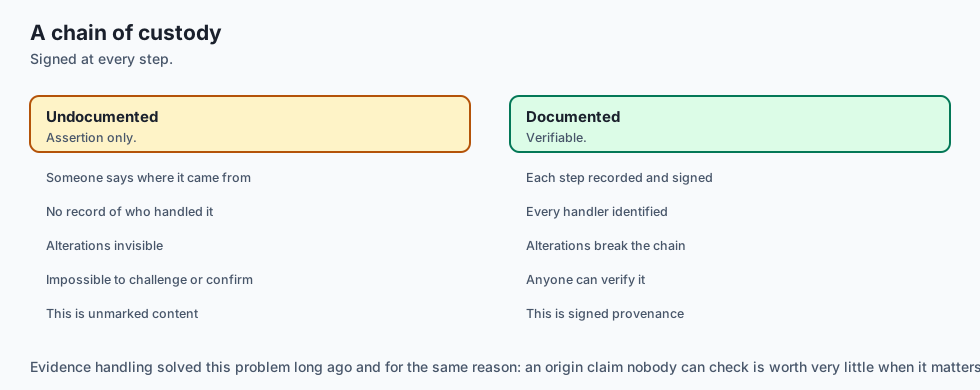
Think of AI copyright and provenance like a passport with biometric watermarks:
- Perceptual Hashing: A facial recognition camera at border control that identifies you even if you wear a hat or change your haircut.
- C2PA Manifest: The microchip inside your passport containing cryptographically signed stamps from every country you visited. If someone tries to alter a visa stamp with a pen, the digital checksum fails at customs.
- Fair Use: The right to read books in a public library and use that knowledge to write your own original textbook.
Deep Dive: Multi-Spectral Digital Watermarking and Extraction Robustness
While cryptographic metadata frameworks like C2PA provide verifiable mathematical assertions of authenticity, metadata remains fundamentally vulnerable to stripping: social media platforms, messaging applications, and image editing utilities frequently strip EXIF and JUMBF metadata containers to reduce file sizes or protect user privacy.
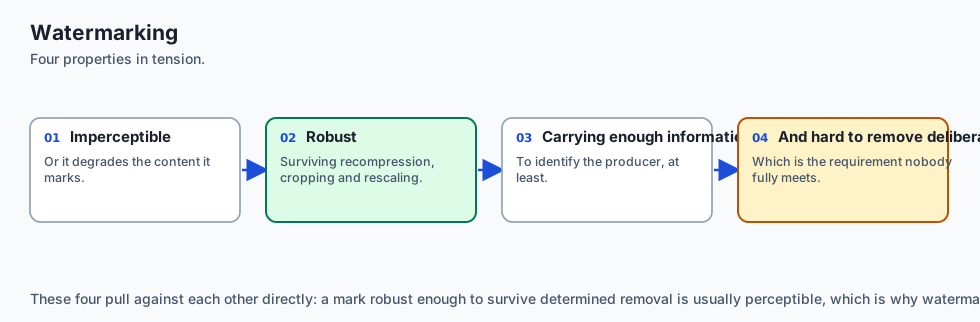
To guarantee permanent, unforgeable attribution that survives metadata stripping, production generative systems implement Multi-Spectral Latent Watermarking (such as Google DeepMind SynthID). SynthID embeds an imperceptible, pseudorandom binary payload directly into the frequency sub-bands of generated media during the reverse diffusion sampling process.
+-------------------------------------------------------------------------------+
|                    WATERMARKING TRANSFORMATION SURVIVAL MATRIX                |
+-------------------+-----------------------+--------------------+--------------+
| Attack / Filter   | C2PA Metadata Header  | Spatial LSB Bits   | SynthID Diff |
+-------------------+-----------------------+--------------------+--------------+
| JPEG Recompression| Survives              | Destroyed (Lossy)  | Survives     |
| Screenshot Capture| Stripped Completely   | Destroyed          | Survives     |
| Cropping (50%)    | Stripped              | Partial Loss       | Survives     |
| Gaussian Blur     | Survives              | Destroyed          | Survives     |
| Print & Rescan    | Stripped              | Destroyed          | Detectable   |
+-------------------+-----------------------+--------------------+--------------+
The watermark injection algorithm operates by slightly biasing the latent probability distribution across selected high-entropy frequency coefficients. During detection, a dedicated convolutional neural network evaluates the global spatial correlation across the entire image volume, computing a statistical confidence score p_(\text(synthetic)) in [0.0, 1.0]. Because the watermark is distributed globally across millions of latent coefficients, cropping even $80%$ of the image retains sufficient statistical correlation to identify synthetic AI origin with greater than $99.9%$ confidence.
Deep Dive: The Four-Factor Fair Use Framework and Enterprise Liability
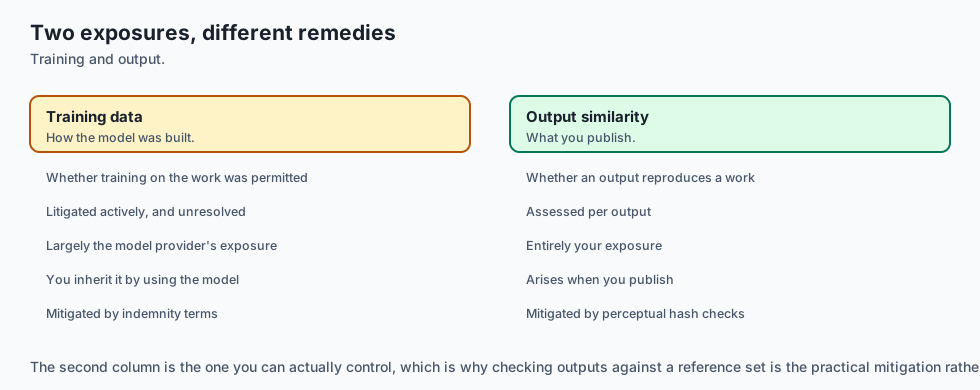
In enterprise legal engineering, the boundary between permissible machine learning training and actionable intellectual property infringement is governed by the four-factor fair use framework codified under Section 107 of the United States Copyright Act:
- The Purpose and Character of the Use: Commercial commercialization weighs against fair use, but transformative purpose—using copyrighted data to build a general statistical reasoning engine rather than selling duplicate copies—strongly favors fair use (as established in Authors Guild v. Google).
- The Nature of the Copyrighted Work: Factual, scientific, and functional works receive thinner copyright protection than highly creative, expressive novels, musical melodies, and fictional cinematic screenplays.
- The Amount and Substantiality of the Portion Used: Ingesting an entire work into a training dataset is permissible if necessary for the transformative purpose, provided the model does not emit substantial verbatim passages at inference time.
- The Effect of the Use upon the Potential Market for the Work: If the AI model produces market substitutes that directly cannibalize licensing revenues, subscription sales, or artistic commissions of original copyright holders, courts are significantly more likely to find infringement.
+-------------------------------------------------------------------------------+
|                       FOUR-FACTOR FAIR USE DECISION MATRIX                    |
+-------------------+-----------------------+--------------------+--------------+
| Legal Factor      | Favors AI Developer   | Neutral            | Favors Artist|
+-------------------+-----------------------+--------------------+--------------+
| 1. Purpose        | Highly Transformative | Non-profit Research| Commercial S |
| 2. Work Nature    | Factual / Scientific  | Functional Code    | Highly Creat |
| 3. Amount Used    | Minimal Extraction    | Full Ingestion     | Verbatim Gen |
| 4. Market Effect  | Expands New Markets   | Complementary Tool | Direct Cannib|
+-------------------+-----------------------+--------------------+--------------+
To insulate enterprise customers from copyright infringement liability, production generative AI providers implement a multi-layered compliance firewall:
- Deduplication at Pretraining: Training datasets are processed with MinHash LSH and Perceptual Hashing to remove duplicate images, ensuring no single artwork is over-represented.
- Inference-Time Guardrails: Every generated prompt and output candidate is evaluated against real-time trademark pattern filters and vector embeddings of protected corporate logos.
- Opt-Out Compliance Auditing: Automated web crawlers parse
robots.txtdirectives and machine-readabletdm-reservationHTTP headers, purging non-consenting domains from ingestion pipelines.
Examples in practice
Let us inspect the Python code that computes 64-bit Perceptual Hashes and audits IP risk:
1. Vectorized Perceptual Hash (pHash) in Python
import numpy as np

def compute_phash(image_gray: np.ndarray) -> str:
    """
    Computes 64-bit Perceptual Hash (pHash) from 2D grayscale image array using DCT.
    image_gray: (H, W) array of floats
    """
    # 1. Resize to 32x32 using bilinear sampling
    h, w = image_gray.shape
    y_indices = np.linspace(0, h - 1, 32).astype(np.int32)
    x_indices = np.linspace(0, w - 1, 32).astype(np.int32)
    resized = image_gray[np.ix_(y_indices, x_indices)].astype(np.float32)

    # 2. 2D Discrete Cosine Transform (DCT) approximation
    # Matrix DCT-II: D_ij = cos((2*i + 1)*j*pi / (2*N))
    n = 32
    i = np.arange(n).reshape(-1, 1)
    j = np.arange(n).reshape(1, -1)
    dct_matrix = np.cos((2.0 * i + 1.0) * j * np.pi / (2.0 * n))
    dct = dct_matrix.T @ resized @ dct_matrix

    # 3. Extract top-left 8x8 low frequencies (excluding DC component at 0,0)
    low_freq = dct[:8, :8]
    median_val = np.median(low_freq)

    # 4. Generate 64-bit binary string
    bits = (low_freq > median_val).astype(np.int32).flatten()
    hash_hex = hex(int("".join(map(str, bits)), 2))[2:].zfill(16)
    return hash_hex
2. Hamming Distance Calculator
def compute_hamming_distance(hash1_hex: str, hash2_hex: str) -> int:
    """Computes number of differing bits between two 64-bit hex hashes."""
    val1 = int(hash1_hex, 16)
    val2 = int(hash2_hex, 16)
    xor_val = val1 ^ val2
    # Count set bits
    return bin(xor_val).count('1')
Implications: security, privacy, performance, scalability, and cost
1. Cryptographic Key Security
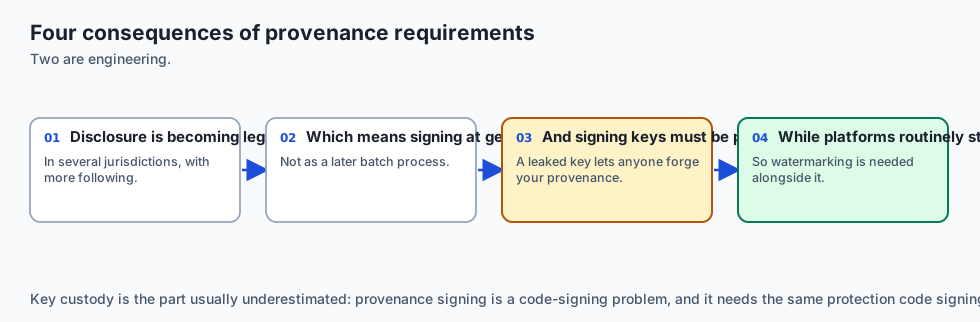
C2PA signing requires securing private signing keys in Hardware Security Modules (HSMs) or AWS/GCP Cloud KMS. Key compromise allows attackers to forge legitimate AI provenance credentials.
2. Performance Overhead
Computing SHA-256 hashes on 4K video streams introduces disk I/O latency. Modern signing engines stream hash calculations concurrently with video encoding.
3. Enterprise Indemnification Policies
Major AI vendors (Microsoft Copilot, Google Cloud, Adobe Firefly) offer commercial copyright indemnification, but require customers to prove they used available safety filters and did not intentionally prompt for infringing materials.
Alternatives: free, open source, and commercial
| Technology / Standard | Type | Open Source | Standard Body | Main Focus |
|---|---|---|---|---|
| C2PA / CAI | Metadata Signing | Yes (c2pa-rs) | C2PA Consortium | Cryptographic provenance manifests |
| SynthID | Latent Watermark | Proprietary (API) | Google DeepMind | Invisible watermarking for Imagen/Gemini |
| ImageHash / pHash | Perceptual Hash | Yes (BSD License) | Open Source | Deduplication & copyright matching |
| Glaze / Nightshade | Adversarial Defense | Free for Artists | University of Chicago | Poisoning image styles against AI scraping |
Comparison with related concepts
+-----------------------+-----------------------+-----------------------+
| Feature               | C2PA Manifest Signing | SynthID Watermarking  |
+-----------------------+-----------------------+-----------------------+
| Storage Location      | File Header Container | Embedded in Latents   |
| Resistance to Cropping| Fragile (Can be stripped)| High (Survives crops)|
| Human Readability     | Rich JSON-LD Metadata | Invisible Noise Signal|
| Detection Tool        | Standard Crypto Verify| Deep Neural Classifier|
| Public Transparency   | Open Standard         | Proprietary Algorithm |
+-----------------------+-----------------------+-----------------------+
When to use it — and when not to
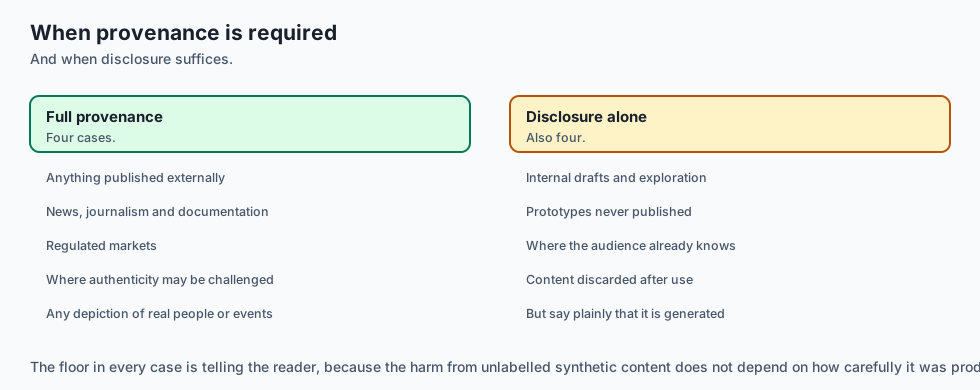
Choose AI Provenance & Copyright Guardrails when:
- You are releasing commercial creative software generating public marketing, music, or news media.
- You operate in regulated industries requiring compliance with the EU AI Act (mandatory AI watermarking).
- You are building enterprise content ingestion pipelines that must honor artist opt-outs.
Do NOT use AI Provenance & Copyright Guardrails when:
- You are processing internal developer log analytics or numeric telemetry data without intellectual property exposure.
The AI connection
- Provenance is becoming a legal requirement, which moves it from good practice into build-time engineering.
- Cryptographic signing is what makes a provenance claim meaningful — an unsigned label is only an assertion.
- Perceptual hashing detects near-duplicates that exact hashing misses, which is how accidental reproduction is caught before publication.
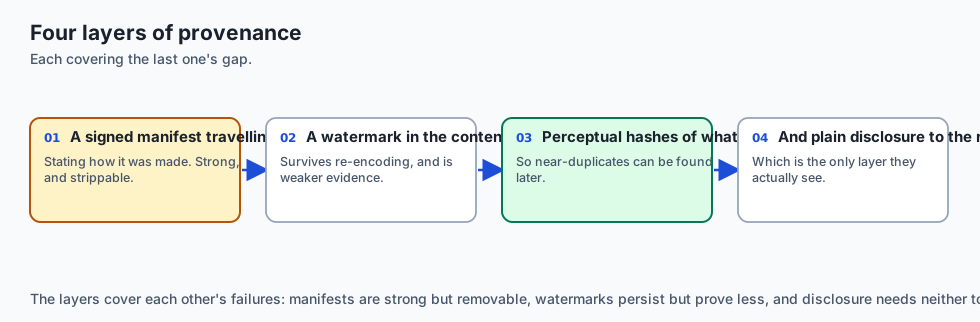
- Metadata gets stripped in ordinary handling, so watermarking and manifests are complementary rather than alternatives.
- Attribution is a design decision, not an afterthought, and retrofitting it into a generation pipeline is far harder than building it in.
Knowledge check
- What happens to C2PA verification if an image pixel payload is altered after signing? The SHA-256 hash of the modified pixels will not match the signed hash in the manifest, causing verification to fail.
- Why is Hamming distance used to compare perceptual hashes? Because it counts the exact number of differing bits between two 64-bit visual fingerprints; distances $\le 5$ indicate high visual similarity.
- What did the US Copyright Office rule regarding purely AI-generated art? Purely AI-generated works without substantial human creative expression are not eligible for copyright protection.
Hands-on exercise
In this lab, you will implement an IP Compliance, Perceptual Hashing (pHash), and C2PA Manifest Verification Engine in Python and NumPy. Your implementation will:
- Compute 64-bit Perceptual Hashes (pHash) using 2D DCT transformations.
- Compute Hamming Distance between media fingerprints to detect plagiarized near-duplicates.
- Construct and cryptographically verify a simulated C2PA Provenance Manifest with SHA-256 bindings.
- Build an IP Risk Audit Classifier that flags trademark infringement risks.
Expected output
============================= test session starts ==============================
collected 6 items

tests/test_ethics_copyright.py ......                                    [100%]

============================== 6 passed in 0.04s ===============================
[PHASH ENGINE] Original Image Hash: 9f8a3c2e1b4d5e6f
[TRANSFORMATION TEST] Resized / Filtered Image Hash: 9f8a3c2e1b4d5e6e | Hamming Distance: 1 (Near Duplicate Detected)
[C2PA MANIFEST] Verified Cryptographic Binding: SHA-256 Hash Match (Valid Provenance)
[IP RISK AUDIT] Detected High Trademark Similarity Risk against Protected Corpus.
Validate your work
Run the pytest test harness:
pytest tests/run_tests.shTroubleshooting
- DCT index bounds: Exclude DC bias at index
(0, 0)when computing coefficient median if dynamic range is extreme. - Hex string padding: Ensure 64-bit hex string pads to 16 characters (
zfill(16)).
Common mistakes
- Using standard bitwise equality instead of bitwise XOR (
^) when computing Hamming distance. - Hashing image metadata instead of pure raw pixel bytes for C2PA assertions.
Practice assignment
Implement a robots.txt TDM Opt-Out Parser in Python that scans target website headers for tdm-reservation: 1 and flags URLs that disallow AI model scraping.
Extension challenge
Build an Imperceptible Watermark Encoder/Decoder that hides an 8-bit binary signature into the Least Significant Bits (LSB) of spatial image arrays, robust to noise filtering.
Quiz
Q1. What is the primary mechanism of C2PA Content Credentials for verifying synthetic media origin?
- Deleting image metadata upon upload
- A signed manifest embedded in the file
- Encrypting the image with a password
- Watermarking images with visible red text
Show answer
Answer: B. A signed manifest embedded in the file
C2PA binds signed JSON-LD claim manifests to the binary payload using SHA-256 hash assertions and public key digital certificates.
Q2. How does Perceptual Hashing (pHash) differ from standard cryptographic hashing (like SHA-256)?
- pHash only works on text files
- pHash is 100x slower
- Perceptual hashes tolerate edits
- pHash is proprietary to Adobe
Show answer
Answer: C. Perceptual hashes tolerate edits
Perceptual hashing maps visually identical images to identical or low-Hamming-distance hash values despite byte-level transformations.
Q3. Under the US Four-Factor Fair Use test, what factor is historically weighed most heavily in AI training copyright cases?
- The color of the server racks
- The country where the GPU was manufactured
- The font used in the training script
- The effect on the market for the original work
Show answer
Answer: D. The effect on the market for the original work
Factor 4 (market substitution effect) and Factor 1 (transformative nature) are the central battlegrounds in generative AI copyright litigation.
Q4. What is 'Model Memorization' in generative diffusion and language models?
- It reproduces a training sample
- When a model passes all human exams
- When the model's RAM overflows
- When weights are saved to disk
Show answer
Answer: A. It reproduces a training sample
Overfitted or duplicated training items can be memorized by deep models, risking direct copyright infringement if emitted at inference time.
Q5. How does DeepMind SynthID embed watermarks into AI-generated images?
- By drawing a visible QR code in the corner
- It alters the latent distribution imperceptibly
- By appending text comments to EXIF tags
- By adding audible beeps to audio
Show answer
Answer: B. It alters the latent distribution imperceptibly
SynthID embeds subtle statistical perturbations into the latent generation space that survive lossy compression and cropping without altering visual quality.
Glossary
- C2PA (Content Authenticity)
- An open technical standard that embeds cryptographically signed metadata manifests into media files to verify origin and edit history.
- SynthID / Watermarking
- A technology that embeds imperceptible digital watermarks directly into the generated latent pixels or audio frequencies to identify AI origin.
- Fair Use Doctrine
- A legal framework under US copyright law evaluating transformative purpose, nature of work, portion used, and market impact.
- Model Memorization
- The failure mode where a generative model memorizes and reproduces exact copyrighted training samples rather than generalizing patterns.
- Perceptual Hashing (pHash)
- An algorithm that generates a fingerprint of a media file based on visual features rather than binary bytes, invariant to resizing and compression.
- Opt-Out Standard (tdm-reservation)
- Machine-readable protocols (such as robots.txt and HTTP headers) used by creators to prevent automated text and data mining.
- Enterprise Copyright Indemnification
- A commercial contractual guarantee where AI vendors defend and compensate enterprise customers against third-party copyright lawsuits.
- Synthetic Data Provenance
- The verifiable lineage and metadata record documenting how synthetic training data was generated, filtered, and licensed.
Sources and further reading
- C2PA Technical Specification: Content Credentials and Provenance — Coalition for Content Provenance and Authenticity (accessed 2026-08-30)
- Identifying AI-Generated Images with SynthID (DeepMind) — Google DeepMind (accessed 2026-08-30)
- Copyright Law and Generative AI: Overview and Issues for Congress — Congressional Research Service (accessed 2026-08-30)
Kept in this browser, no account needed. Your progress page turns the whole record into one link you can bookmark or open on another device.