AI Engineering: Agents and Applications › AI Agents › Day 292
Day 292: Agent Frameworks and When to Use Them
Evaluate modern agent frameworks (LangGraph, CrewAI, AutoGen) and build a deterministic, directed cyclic state graph engine in Python with state reducers and human-in-the-loop checkpoints.
Hands-on lab for this lesson
Lab files on GitHub: https://github.com/ai-roadmap-365/ai-roadmap-365.github.io/tree/main/labs/sections/ai-engineering/day-292-agent-frameworks-and-when-to-use
- Get the hands-on files. Clone the labs repository once (you can reuse this clone for every lesson). This works on macOS, Linux, and Windows (PowerShell or WSL):
git clone https://github.com/ai-roadmap-365/ai-roadmap-365.github.io.git cd ai-roadmap-365.github.io - Open this lesson's lab. Move into the directory for this specific day. Every lab lives at the same predictable path — section / subsection / week / day:
cd labs/sections/ai-engineering/day-292-agent-frameworks-and-when-to-use - Read the lab guide. Open `README.md` in that directory. It lists the exact commands, what each does, the expected output, and how to check your work — read it before running anything.
- Run it and check your work. Follow the README's "How to run" section: run the example first to see the finished result, then complete the numbered exercises in `starter/`, then run the tests. The tests pass (exit 0) only when your work is correct.
bash tests/run_tests.sh # or the test command named in the lab README
You can also open the lab as a local page (works offline, shows the file tree and expected output).
Learning objectives
By the end of this lesson you will be able to:
- Evaluate architectural trade-offs between LangGraph, CrewAI, and Microsoft AutoGen.
- Construct a Directed Cyclic State Graph engine with nodes, conditional edges, and state reducers.
- Implement durable state checkpointing and human-in-the-loop pause-and-resume gates.
- Identify the architectural boundary between custom runtimes and high-level agent frameworks.
- Verify state persistence and graph retry execution with automated test suites.
Prerequisites
Why this matters
As the AI ecosystem matured, open-source and enterprise frameworks emerged to simplify the orchestration of complex agentic workflows. Developers face a bewildering landscape of competing options: LangChain, LangGraph, CrewAI, AutoGen, Semantic Kernel, LlamaIndex Workflows, and custom in-house runtimes. Choosing the wrong framework introduces severe architectural liabilities: brittle abstractions that fight your domain model, high latency from excessive token chatter, and difficult debugging when execution state is hidden within framework callbacks.
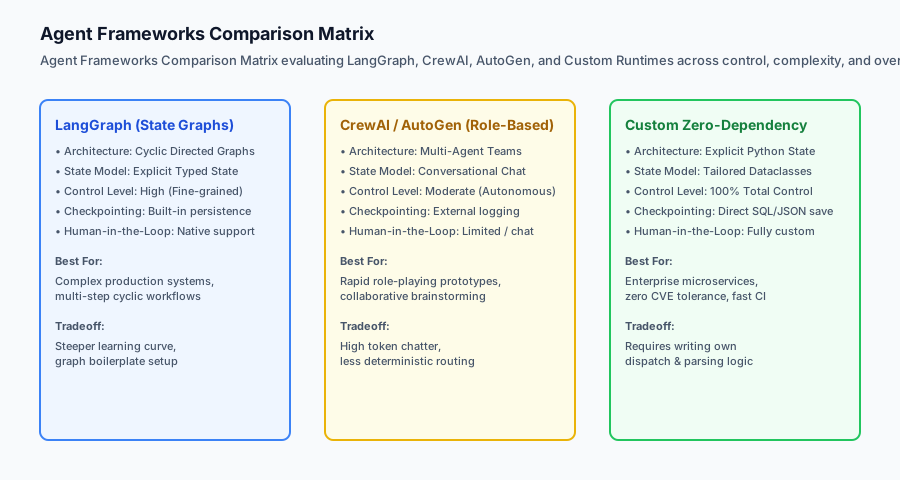
To make rigorous architectural decisions, AI engineers must understand the core design philosophies of major frameworks. State-graph architectures (such as LangGraph) treat agent computation as explicit directed graphs with durable checkpointing and human-in-the-loop approval gates. Role-playing frameworks (such as CrewAI) organize agents into collaborative organizational personas. Custom micro-runtimes prioritize absolute control, zero dependencies, and deterministic testing.
Mastering framework evaluation allows teams to match the right tool to the problem: selecting lightweight custom loops for low-latency production microservices, and utilizing graph engines when managing complex multi-actor workflows requiring persistent state pause-and-resume capabilities.
The idea in plain language
Think of choosing an agent framework like choosing transportation for a delivery logistics fleet:
- CrewAI / AutoGen (The Public Bus Tour): A pre-configured team of passengers (agents with assigned roles like “Researcher”, “Writer”, “Editor”). They talk to each other in conversational circles. It is great for collaborative brainstorming and quick mockups, but difficult to steer with pinpoint precision when you need an exact 5-minute delivery SLA.
- LangGraph (The Automated Railroad Network): You lay down explicit steel tracks (graph edges), switches (conditional routers), and train stations (execution nodes). Every train’s position is recorded in a central dispatch database (checkpointing). You can stop a train at a red light for a human conductor to inspect the cargo before pulling into the station.
- Custom Zero-Dependency Runtime (The Custom Delivery Drone): You build a lightweight carbon-fiber drone designed solely to fly from Point A to Point B in 90 seconds. It carries zero dead weight, incurs zero subscription licensing costs, and delivers with sub-millisecond precision.
Historical background
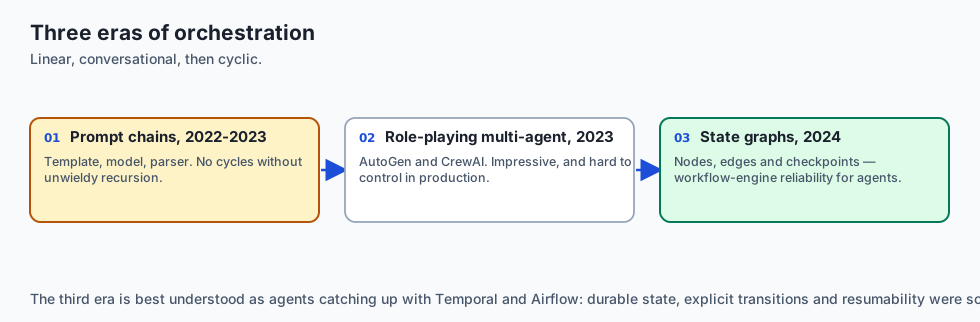
The evolution of agent frameworks mirrors the history of web application frameworks:
1. The Prompt-Chaining Era (2022–2023)
Early frameworks focused on linear pipelines: PromptTemplate | LLM | OutputParser. While effective for simple RAG, these linear chains could not represent cycles, loops, or dynamic error recovery without unwieldy recursion.
2. Multi-Agent Role-Playing (2023)
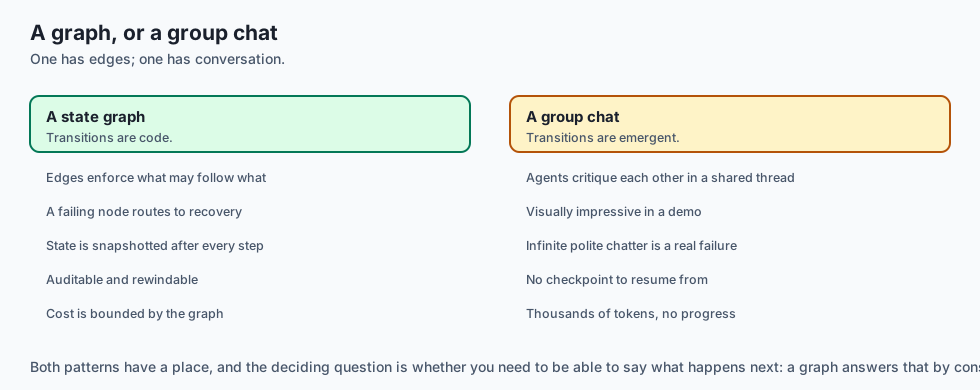
In 2023, Microsoft released AutoGen and João Moura released CrewAI. These frameworks introduced conversational multi-agent collaboration: agents conversed in a shared group chat, critiquing each other’s outputs. While visually impressive, enterprise developers found them difficult to control in production—agents frequently entered infinite conversational chatter and consumed thousands of tokens without making progress.
3. State Graphs and Cyclic Runtimes (2024–Present)
In 2024, LangChain launched LangGraph, formalizing agents as State Graphs. LangGraph separated state definition, node execution, and conditional edge transitions into explicit code, bringing the reliability of state machines and workflow orchestrators (like Temporal and Airflow) to AI agents.
What it is — and what it is not
Let us define the core concepts of state-graph agent architectures:
What a State Graph Is:
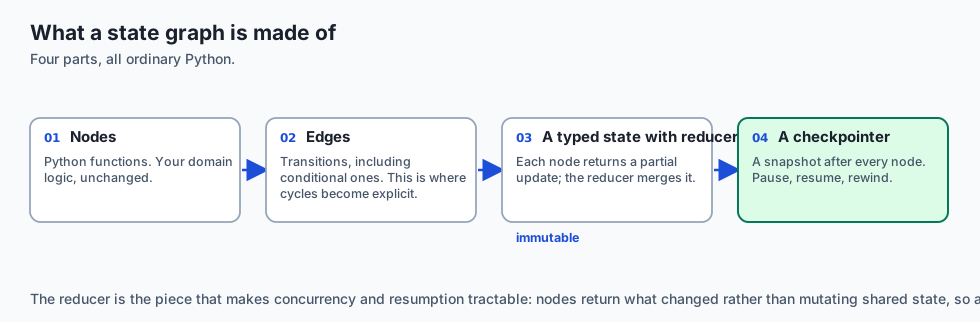
- A directed graph
mathcal(G) = (mathcal(V), mathcal(E))where verticesmathcal(V)are Python execution nodes and edgesmathcal(E)define state transitions. - A central, immutable typed State object that is updated via explicit State Reducers.
- A durable runtime that snapshots state to a database after every node execution, enabling pause, resume, and rewind capabilities.
What a State Graph Is Not:
- An uncontrolled conversational group chat where models talk indefinitely.
- A black-box proprietary platform (graphs are defined entirely in standard Python code).
- A replacement for foundational domain logic (nodes contain your own Python code).
+-------------------------------------------------------------------------------+
|                       FRAMEWORK SELECTION MATRIX                              |
+---------------------+-----------------------+---------------------------------+
| Project Need        | Recommended Approach  | Architectural Rationale         |
+---------------------+-----------------------+---------------------------------+
| Fast Prototyping    | CrewAI / AutoGen      | Out-of-the-box role templates   |
| Complex Multi-Step  | LangGraph / Graph SDK | Durable state, cyclic loops     |
| Low-Latency API     | Custom Zero-Dependency| Zero overhead, sub-ms execution |
| Human Approval Gate | LangGraph Checkpointer| Native pause-and-resume gates   |
| Production RAG      | LlamaIndex Workflows  | Native vector index primitives  |
+---------------------+-----------------------+---------------------------------+
Why it was created and what problems it solves
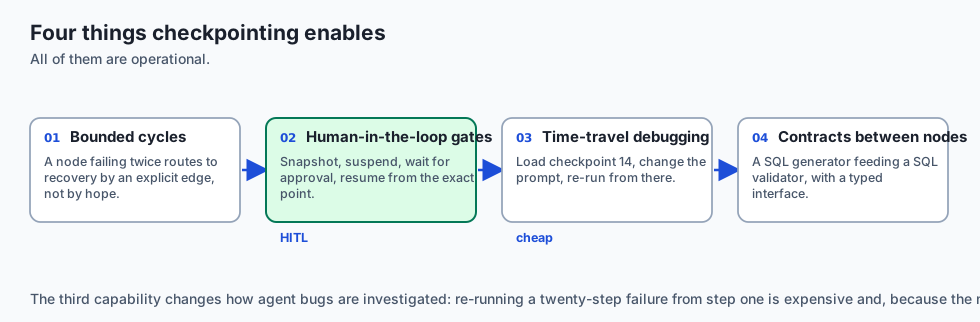
State graph architectures resolve four critical failure modes of naive agent loops:
1. Uncontrollable Cyclic Drift
In unstructured agent loops, models often diverge into infinite loops when receiving unexpected tool observations. In a state graph, edges enforce explicit transition rules: if a tool node fails twice, a conditional edge automatically diverts execution to an error-recovery fallback node.
2. Human-in-the-Loop (HITL) Checkpoints
When an agent is about to execute a high-risk operation (e.g. delete_production_database or transfer_funds($10,000)), the system must pause and await human verification. Graph checkpointers save the state snapshot to disk and suspend the thread. When a human approves the action via a dashboard API, execution resumes seamlessly from the exact checkpoint.
3. Time-Travel Debugging and Trajectory Rewind
When debugging a 20-step failure in production, running the entire agent from step 1 is expensive and slow. With state checkpointing, developers can load checkpoint #14, modify the state or prompt, and re-execute solely from the point of failure.
4. Deterministic Multi-Actor Orchestration
Complex workflows involve distinct specialized roles (e.g. a SQL_Generator node followed by a SQL_Validator node). Graphs enforce strict data contracts between nodes, preventing communication chaos.
How it works
Let us inspect the lifecycle of a State Graph execution engine:
               +----------------------------------+
               |        Initial State Input       |
               |     {"goal": "Migrate DB Schema"}|
               +-----------------+----------------+
                                 |
                                 v
               +-----------------+----------------+
               |        Node 1: Planner           |
               | (Generates migration SQL script) |
               +-----------------+----------------+
                                 |
                                 v
               +-----------------+----------------+
               |       State Reducer & Save       |
               |   (Checkpoint #1 saved to DB)    |
               +-----------------+----------------+
                                 |
                                 v
               +-----------------+----------------+
               |      Conditional Edge Router     |
               |      Is SQL syntax valid?        |
               +--------+----------------+--------+
                        |                |
             (Valid)    |                | (Syntax Error)
                        v                v
          +-------------+--+     +-------+--------+
          | Node 2: Linter |     | Node 1: Planner|
          +-------+--------+     | (Retry Prompt) |
                  |              +----------------+
                  v
          +-------+--------+
          | Checkpoint #2  |
          | (Human Review) |
          +-------+--------+
                  |
                  v (Approved)
          +-------+--------+
          | Node 3: Apply  |
          +----------------+
1. Defining the Typed State and Reducer
In Python, graph state is structured using typed dictionaries or dataclasses:
from typing import TypedDict, Annotated, List
import operator

class AgentState(TypedDict):
goal: str
steps_taken: int
messages: Annotated[List[str], operator.add] # Reducer: appends new items
is_approved: bool
final_output: Optional[str]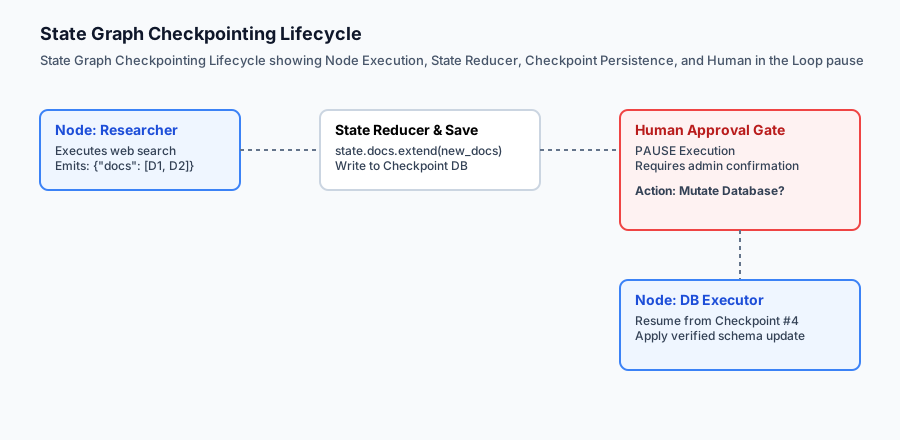
In production state graph deployments, durable state persistence is paired with Thread Isolation and Multi-Tenancy. Each unique user interaction or background job is assigned a globally unique thread_id. When a node writes a state checkpoint, the checkpointer namespaces the state snapshot under (thread_id, checkpoint_ns, checkpoint_id), ensuring that concurrent agent executions never corrupt each other’s memory or leak sensitive session data across organizational boundaries.
2. State Checkpointing and Persistence
Every time a node returns a partial update, the reducer combines it with the existing state and writes the snapshot to a persistent store keyed by (thread_id, checkpoint_id).
An everyday analogy
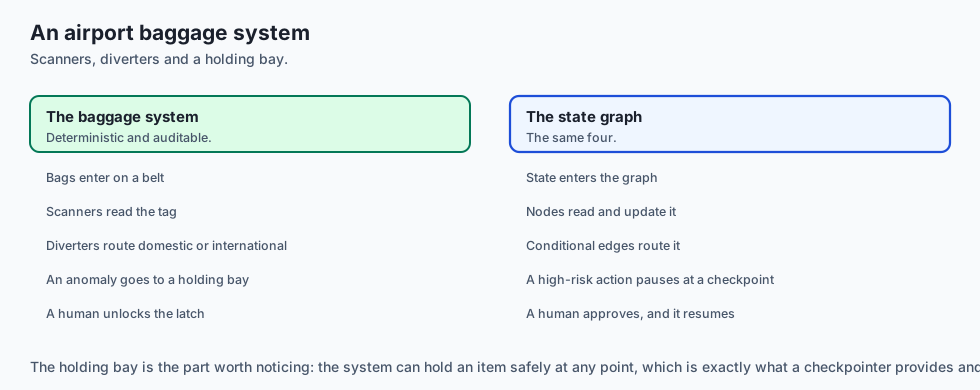
Think of a State Graph like an airport automated baggage handling conveyor system:
- Baggage (State) enters the system on a conveyor belt.
- Sensor Scanners (Nodes) read the barcode tag.
- Pneumatic Diverters (Conditional Edges) route the bag down Conveyor Belt A (domestic) or Conveyor Belt B (international).
- Security Inspection Gate (Human-in-the-Loop): If an X-ray scanner flags an anomaly, the bag is pushed into a holding bay until a human TSA officer physically inspects the contents and unlocks the latch.
The entire system is deterministic, auditable, and capable of holding items safely at any point.
Deep Dive: Distributed State Graphs & Event-Driven Architecture
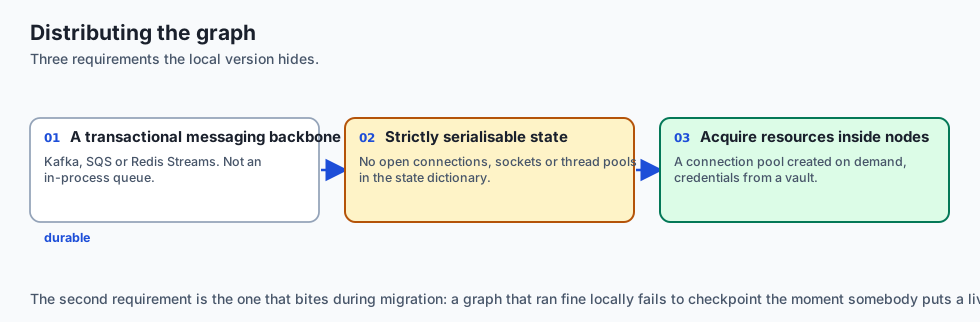
In large-scale enterprise microservice topologies, coordinating distributed state graphs across multi-region cloud environments requires formal event-driven architectures. While an in-memory Python graph suffices for localized CLI tools, mission-critical business processes (such as automated insurance claim adjudication or multi-day legal document discovery) require distributed orchestrators backed by transactional messaging backbones (such as Apache Kafka, Amazon SQS, or Redis Streams).
+-------------------------------------------------------------------------------+
|                     DISTRIBUTED GRAPH ORCHESTRATION TOPOLOGY                  |
+-------------------+-----------------------+--------------------+--------------+
| Component         | Primary Function      | Backend Technology | SLA Target   |
+-------------------+-----------------------+--------------------+--------------+
| Graph State Store | Durable Checkpoints   | PostgreSQL (WAL)   | 99.999% Dur  |
| Message Broker    | Inter-Node Routing    | Redis Streams      | < 5 ms PubSub|
| Worker Nodes      | LLM Execution Pods    | Kubernetes (KEDA)  | Auto-scale   |
| Human Review Gate | WebSocket Admin UI    | Next.js / FastAPI  | Async Pause  |
+-------------------+-----------------------+--------------------+--------------+
When designing state graph checkpoints for distributed execution, state objects must strictly adhere to serializable data contracts. Any unpicklable objects—such as open database connection handles, active SSL sockets, or live thread pools—must be stripped from the state dictionary prior to invoking the state reducer. Instead, nodes instantiate lightweight connection pools on demand or retrieve credentials from secure environment variable vaults.
Examples in practice
Let us inspect a pure Python implementation of a Directed Cyclic State Graph engine:
from typing import Dict, Any, Callable, List, Optional, Tuple

class StateGraphEngine:
    def __init__(self):
        self.nodes: Dict[str, Callable[[Dict[str, Any]], Dict[str, Any]]] = {}
        self.edges: Dict[str, str] = {}
        self.conditional_edges: Dict[str, Tuple[Callable[[Dict[str, Any]], str], Dict[str, str]]] = {}
        self.entry_point: Optional[str] = None
        self.checkpoints: List[Dict[str, Any]] = []

    def add_node(self, name: str, func: Callable[[Dict[str, Any]], Dict[str, Any]]):
        self.nodes[name] = func

    def set_entry_point(self, name: str):
        self.entry_point = name

    def add_edge(self, start_node: str, end_node: str):
        self.edges[start_node] = end_node

    def add_conditional_edges(self, source_node: str, router_fn: Callable[[Dict[str, Any]], str], route_map: Dict[str, str]):
        self.conditional_edges[source_node] = (router_fn, route_map)

    def run(self, initial_state: Dict[str, Any], max_steps: int = 10) -> Dict[str, Any]:
        state = dict(initial_state)
        current_node = self.entry_point
        step = 0

        while current_node and current_node != "END":
            step += 1
            if step > max_steps:
                state["error"] = "Max graph execution steps exceeded."
                break

            # Execute node
            node_fn = self.nodes[current_node]
            update = node_fn(state)
            state.update(update)

            # Record checkpoint
            self.checkpoints.append({
                "step": step,
                "node": current_node,
                "state_snapshot": dict(state)
            })

            # Check for human pause gate
            if state.get("requires_human_approval", False) and not state.get("is_approved", False):
                state["status"] = "PAUSED_FOR_HUMAN_APPROVAL"
                break

            # Determine next node
            if current_node in self.conditional_edges:
                router, rmap = self.conditional_edges[current_node]
                decision = router(state)
                current_node = rmap.get(decision, "END")
            elif current_node in self.edges:
                current_node = self.edges[current_node]
            else:
                current_node = "END"

        return state
Implications: security, privacy, performance, scalability, and cost
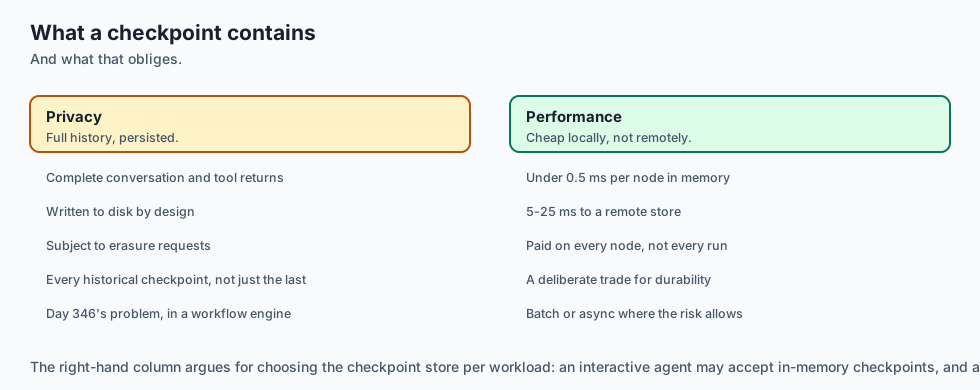
1. State Checkpoint Privacy & Compliance (GDPR)
Because state graph checkpoints capture the complete conversation history and tool returns, persisting checkpoints to disk requires compliance auditing. If a user exercises their GDPR “Right to be Forgotten”, all historical graph checkpoints containing their PII must be purged.
2. Overhead Considerations
A lightweight in-memory State Graph adds less than 0.5 milliseconds of execution overhead per node. However, saving checkpoints to remote distributed databases (e.g. Postgres or Redis) adds network roundtrip latency (5\text( ms) - 25\text( ms)).
Alternatives: free, open source, and commercial
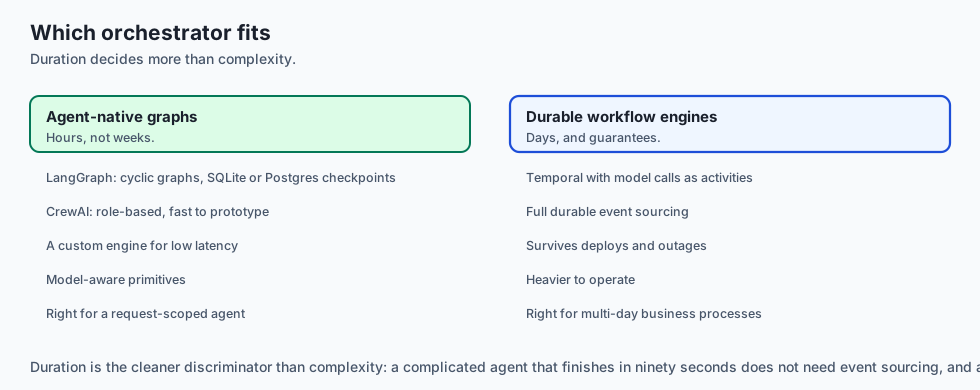
| Framework | Architecture | Checkpointing | Best Fit |
|---|---|---|---|
| LangGraph | Cyclic Directed Graphs | SQLite, Postgres, Redis | Complex enterprise agent graphs |
| CrewAI | Role-Based Agents | File / Local memory | Rapid prototyping, content pipelines |
| Temporal.io + LLMs | Distributed Workflows | Full durable event sourcing | Multi-day mission-critical orchestration |
| Custom Graph Engine | Pure Python State Graph | In-memory / Custom DB | Low-latency microservices |
Comparison with related concepts
+-----------------------+-----------------------+-----------------------+
| Dimension             | Linear Chain (DAG)    | State Graph (Cyclic)  |
+-----------------------+-----------------------+-----------------------+
| Cycles / Loops        | Not Supported         | Native First-Class    |
| Checkpoint Persistence| Difficult             | Automatic per Node    |
| Human-in-the-Loop     | Hard to Resume        | Seamless Pause/Resume |
| Branching Logic       | Static If/Else        | Dynamic Routers       |
+-----------------------+-----------------------+-----------------------+
When to use it — and when not to
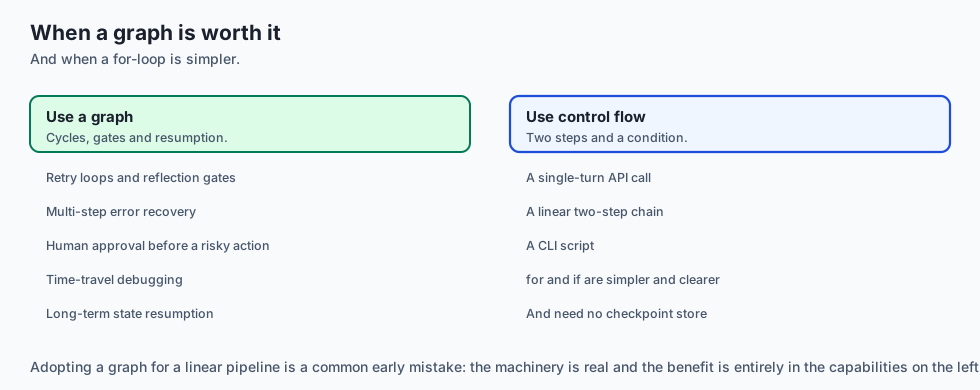
Choose State Graph Frameworks when:
- Workflows require dynamic retry loops, reflection gates, or multi-step error recovery.
- High-risk actions require human approval gates before proceeding.
- You need time-travel debugging and long-term state resumption.
Do NOT use State Graph Frameworks when:
- The task is a simple single-turn API call or linear 2-step prompt chain.
- You are writing a simple CLI script with standard Python control flow (
forloops andifstatements are simpler).
The AI connection
-
Agents need cycles, and prompt chains could not express them — which is what moved the ecosystem from linear pipelines to state graphs.
-
Checkpointing is what makes human approval possible. Pausing before a destructive action requires the run to be resumable, not merely interruptible.
-
Time-travel debugging is uniquely valuable for agents, because reproducing a 20-step failure from step 1 is both slow and non-deterministic.
-
Checkpoints contain the full conversation, so they are personal data with a retention policy — Day 346’s erasure problem, in a workflow engine.
-
The overhead is real but small: half a millisecond in memory, and 5-25 ms once the checkpoint crosses a network, which is a trade you make deliberately.
Knowledge check
- What is the difference between a static edge and a conditional edge in a state graph? A static edge always transitions to a fixed downstream node, while a conditional edge evaluates a router function over the current state to dynamically decide the next destination.
- How does human-in-the-loop work in a state graph? The runtime detects a pause condition, saves the current state snapshot to a persistent checkpointer, and halts. When approval is submitted, execution resumes directly from the saved checkpoint.
- What is a state reducer? A function that determines how partial updates emitted by a node are merged into the global shared state.
Hands-on exercise
In this lab, you will implement a Directed Cyclic State Graph Engine with Checkpointing and Human-in-the-Loop Approval Gates in Python. Your implementation will:
- Build a
StateGraphEnginesupporting nodes, static edges, conditional router edges, and state checkpointing. - Construct a multi-node workflow (
Planner$ o$Validator$ o$ApprovalGate$ o$Executor). - Enforce conditional looping: if validation fails, route back to
Plannerup to 2 times. - Verify execution pause, state persistence, and resumption across unit tests.
Expected output
============================= test session starts ==============================
collected 5 items

tests/test_state_graph.py .....                                          [100%]

============================== 5 passed in 0.04s ===============================
[STATE GRAPH] Initializing workflow with 4 nodes: ['planner', 'validator', 'approval_gate', 'executor']
[STEP 1] Executed node: planner -> Emitted plan: "ALTER TABLE users ADD COLUMN age INT;"
[STEP 2] Executed node: validator -> Router check: "SQL_VALID" -> Transition to approval_gate
[STEP 3] Checkpoint #3 saved -> PAUSED FOR HUMAN APPROVAL.
[RESUMPTION] Admin approval granted -> Resuming from Checkpoint #3.
[STEP 4] Executed node: executor -> Final State: "SUCCESS"
Validate your work
Run the pytest test suite:
pytest tests/run_tests.shTroubleshooting
- Conditional edge KeyError: Ensure router return values match keys in
route_map. - Infinite loop in validation: Ensure the retry counter increments on every iteration.
Common mistakes
- Mutating the shared state dictionary directly without capturing distinct checkpoint snapshots.
- Forgetting to define an explicit
"END"terminal node.
Practice assignment
Add a Time-Travel Rewind Function rewind_to_checkpoint(step_num: int) that resets the active state to an earlier step and resumes execution down an alternative branch.
Extension challenge
Implement a Parallel Node Executor that runs multiple independent sibling nodes concurrently using Python’s concurrent.futures.ThreadPoolExecutor before merging results via a state reducer.
Advanced State Graph Checkpointing Patterns
In mission-critical enterprise deployments, state checkpointing must accommodate complex operational topologies including cross-region disaster recovery, database point-in-time recovery, and multi-tenant audit isolation. By maintaining an immutable append-only event log of every node invocation and state reduction, the state graph runtime can replay historical trajectories deterministically. This guarantees that operational audits can inspect exact intermediate representations, token costs, and tool execution logs for any decision made by the autonomous agent fleet.
Quiz
Q1. What is the primary architectural innovation of graph-based agent frameworks like LangGraph?
- As cyclic graphs with state reducers and checkpoints
- They replace Python with GraphQL
- They eliminate all token costs
- They run directly in browser WebAssembly
Show answer
Answer: A. As cyclic graphs with state reducers and checkpoints
State graphs provide deterministic control over cyclic agent transitions, error handling loops, and human-in-the-loop gates.
Q2. What is a 'State Reducer' in a graph-based agent architecture?
- A function that compresses images
- A function merging a node's update into the state
- A garbage collector for Python dictionaries
- A method for deleting user accounts
Show answer
Answer: B. A function merging a node's update into the state
State reducers control how state mutations (e.g. appending messages or updating counters) are applied cleanly to the graph state.
Q3. When should an engineering team avoid high-level conversational frameworks in favor of a graph or custom engine?
- When building single-turn translation prompts only
- When running on Windows machines
- When you need deterministic routing and audit logs
- When using open-source models
Show answer
Answer: C. When you need deterministic routing and audit logs
Conversational group-chat frameworks lack the deterministic control, checkpointing, and branch predictability needed for mission-critical enterprise systems.
Q4. How does a 'Human-in-the-Loop' breakpoint operate in a state graph?
- The graph runs in reverse
- The human must manually type all LLM tokens
- The server shuts down completely
- It pauses at a node, saves state, and waits
Show answer
Answer: D. It pauses at a node, saves state, and waits
Checkpointed breakpoints allow human review of sensitive actions before execution continues.
Q5. What is the primary difference between a DAG (Directed Acyclic Graph) and an Agent State Graph?
- Cyclic edges let it loop, retry, and recover
- DAGs do not support nodes
- DAGs are only ever used in CSS layout engines
- Agent State Graphs require 100 GPUs
Show answer
Answer: A. Cyclic edges let it loop, retry, and recover
Cycles are fundamental to agentic behavior, allowing models to retry actions, refine code, and observe feedback iteratively.
Glossary
- Directed Cyclic Graph (DCG)
- A graph structure allowing cycles, essential for modeling iterative agent reasoning and retry loops.
- State Reducer
- A function that merges partial updates from execution nodes into the global graph state.
- Conditional Edge
- A dynamic routing edge in a graph whose destination is determined by inspecting the current state.
- Human-in-the-Loop (HITL)
- A safety pattern that pauses graph execution for human review and approval prior to risky mutations.
- Checkpoint Persistence
- Saving graph state snapshots to disk or database after each node execution to support replay and fault tolerance.
- LangGraph
- A production orchestration framework modeling multi-agent workflows as stateful cyclic graphs.
- CrewAI
- A role-playing multi-agent framework orchestrating sequential or hierarchical agent teams.
- AutoGen
- A multi-agent conversational framework from Microsoft enabling agent group-chat collaboration.
Sources and further reading
- LangGraph: Multi-Agent Workflows with Cyclic Graphs (LangChain, 2024) — Open Source Framework Docs (accessed 2026-08-30)
- CrewAI: Orchestrating Autonomous AI Agents (CrewAI Documentation, 2024) — Open Source Framework Docs (accessed 2026-08-30)
- AutoGen: Enabling Next-Gen Multi-Agent Systems (Microsoft Research, 2023) — Technical Publication (accessed 2026-08-30)
Kept in this browser, no account needed. Your progress page turns the whole record into one link you can bookmark or open on another device.