AI Engineering: Agents and Applications › AI Coding Agents › Day 302
Day 302: The AI Coding Landscape
Navigate the modern AI-assisted software engineering ecosystem: compare inline autocompletion, agentic IDEs, terminal CLI agents, and fully autonomous background agents across real-world developer workflows.
Hands-on lab for this lesson
Lab files on GitHub: https://github.com/ai-roadmap-365/ai-roadmap-365.github.io/tree/main/labs/sections/ai-engineering/day-302-the-ai-coding-landscape
- Get the hands-on files. Clone the labs repository once (you can reuse this clone for every lesson). This works on macOS, Linux, and Windows (PowerShell or WSL):
git clone https://github.com/ai-roadmap-365/ai-roadmap-365.github.io.git cd ai-roadmap-365.github.io - Open this lesson's lab. Move into the directory for this specific day. Every lab lives at the same predictable path — section / subsection / week / day:
cd labs/sections/ai-engineering/day-302-the-ai-coding-landscape - Read the lab guide. Open `README.md` in that directory. It lists the exact commands, what each does, the expected output, and how to check your work — read it before running anything.
- Run it and check your work. Follow the README's "How to run" section: run the example first to see the finished result, then complete the numbered exercises in `starter/`, then run the tests. The tests pass (exit 0) only when your work is correct.
bash tests/run_tests.sh # or the test command named in the lab README
You can also open the lab as a local page (works offline, shows the file tree and expected output).
Learning objectives
By the end of this lesson you will be able to:
- Analyze the architectural evolution from inline tab completion (Copilot) to agentic IDEs (Cursor, Windsurf) and terminal agents (Aider, Claude Code).
- Evaluate context indexing strategies including AST parsing, embedding-based code search, and LSP symbol indexing.
- Compare autonomous execution topologies: Human-in-the-Loop pair programming vs headless background issue solvers.
- Benchmark SWE-bench performance, patch generation quality, and token cost economics.
- Select the optimal coding agent architecture for individual, team, and CI/CD development.
Prerequisites
Why this matters
Artificial intelligence is undergoing a profound paradigm shift in software engineering: transitioning from simple inline autocompletion (predicting the next few tokens in a code buffer) to fully autonomous AI Coding Agents. Modern coding agents do not merely suggest syntax; they read GitHub issue descriptions, index entire multi-million-line codebases, synthesize multi-file code patches, run linters and unit test suites in local terminals, and iteratively self-correct failing assertions until a production-ready pull request is delivered.
Understanding the modern AI coding landscape is essential for software engineers and engineering leaders. Tools exist across a spectrum of autonomy and user experience: from interactive agentic IDEs (Cursor, Windsurf, Copilot Workspace) to terminal pair programmers (Aider, Claude Code) and headless background software engineers (Devin, SWE-agent, GitHub Copilot Coding Agent).
Mastering this taxonomy and its underlying technical mechanics (Repo-Maps, AST indexing, Language Server Protocol integration, and search-and-replace chunking) enables you to dramatically accelerate your personal development velocity and architect scalable AI-driven engineering workflows.
The idea in plain language
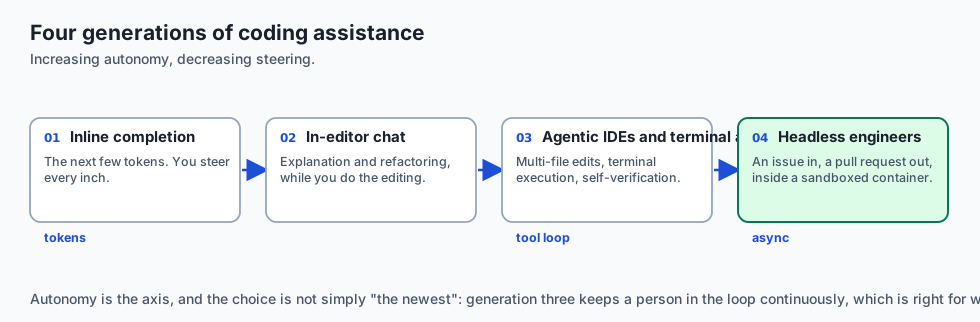
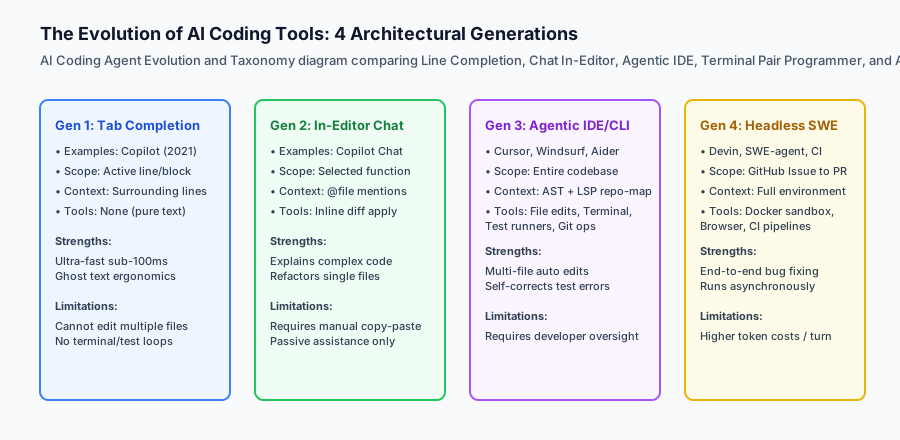
Think of the evolution of AI coding tools like the progression of transportation over the past century:
- Generation 1 (Inline Tab Completion): A bicycle with an electric motor. It assists your pedaling stroke for the immediate next 5 feet, but you steer every inch and stop at every intersection.
- Generation 2 (In-Editor Chat): An interactive GPS navigation device on your dashboard. You ask it: “How do I change this tire?” and it reads you the manual while you turn the wrench.
- Generation 3 (Agentic IDEs & Terminal Agents): A co-pilot sitting in the passenger seat who can take the wheel, navigate highway lane changes, pull into a gas station to refuel, and check tire pressure when a dashboard warning light turns on.
- Generation 4 (Autonomous Background Engineers): A commercial logistics drone fleet. You deposit a delivery manifest (a GitHub Issue), and the system autonomously plans the route, flies to the destination, executes the drop-off, and files the confirmation receipt without you ever leaving your desk.
Historical background
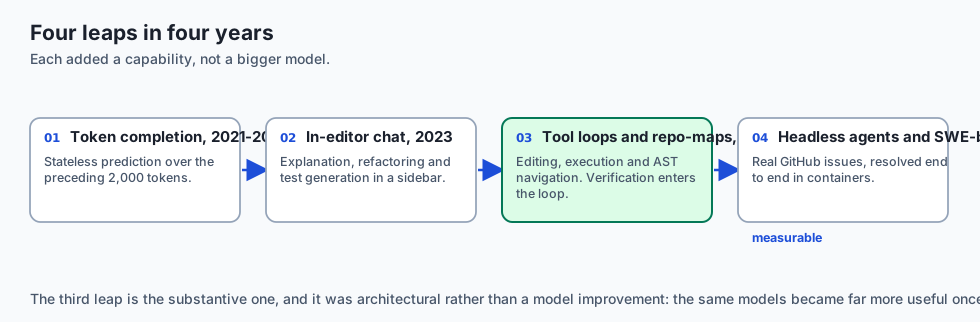
The field of AI-assisted software development progressed through four distinct generational leaps:
1. Statistical Token Modeling & Tab Completion (2021–2022)
OpenAI Codex and GitHub Copilot introduced large-scale code completion by training transformers on public GitHub repositories. These tools operated as stateless next-token predictors conditioned on the preceding 2,000 tokens of the active file.
2. Conversational In-Editor Chat (2023)
The release of GPT-4 enabled conversational code explanation, refactoring, and test generation inside IDE sidebars (Copilot Chat, Cody).
3. Agentic Tool-Use Loops & Repo-Maps (2024)
Aider and Cursor demonstrated that combining language models with tool loops (file editing, terminal execution, and AST-based Repo-Maps) allowed models to edit multiple files across complex repositories and verify their own work via test suites.
4. Headless Software Engineers & SWE-bench (2024–Present)
The standardization of SWE-bench (a benchmark of real GitHub issues) catalyzed the creation of autonomous agents (Devin, SWE-agent, OpenHands) that operate headlessly inside sandboxed Docker containers to resolve issues end-to-end.
What it is — and what it is not
Let us define the operational boundaries of AI Coding Agents:
What AI Coding Agents Are:
- Autonomous ReAct loops equipped with deterministic developer tools: file search, chunked editing, terminal execution, and LSP intelligence.
- Iterative problem solvers that use compiler diagnostics, linter warnings, and test failure stack traces as feedback signals to self-correct.
- Systems that navigate codebases using tree-sitter AST symbol graphs and semantic retrieval.
What AI Coding Agents Are Not:
- Infallible software engineers (they still require rigorous human code review, automated testing, and security scanning).
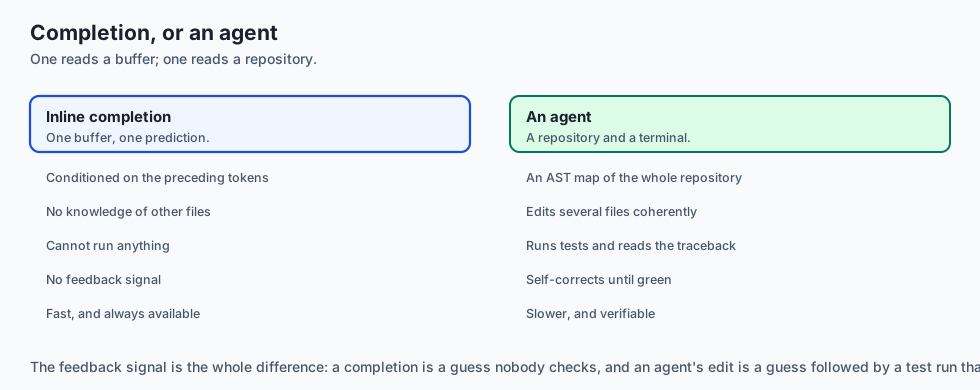
- Simple text completion plugins that only read the current open buffer.
+-------------------------------------------------------------------------------+
|                       AI CODING TOOLS COMPARISON MATRIX                       |
+-------------------+-----------------------+-------------------+---------------+
| Dimension         | Tab Completion        | Agentic IDE / CLI | Headless SWE  |
+-------------------+-----------------------+-------------------+---------------+
| Autonomy Level    | Low (Single Turn)     | Medium (Interactive) High (Autonomous)|
| Context Scope     | Active File Window    | Whole Repository  | Full OS / Repo|
| Tool Execution    | None                  | Edits + Terminal  | Docker + CI/CD|
| Verification      | Developer Inspection  | Local Pytest Run  | Full CI Suite |
| Primary Ergonomics| Inline Ghost Text     | Composer / Terminal GitHub PR       |
+-------------------+-----------------------+-------------------+---------------+
Why it was created and what problems it solves
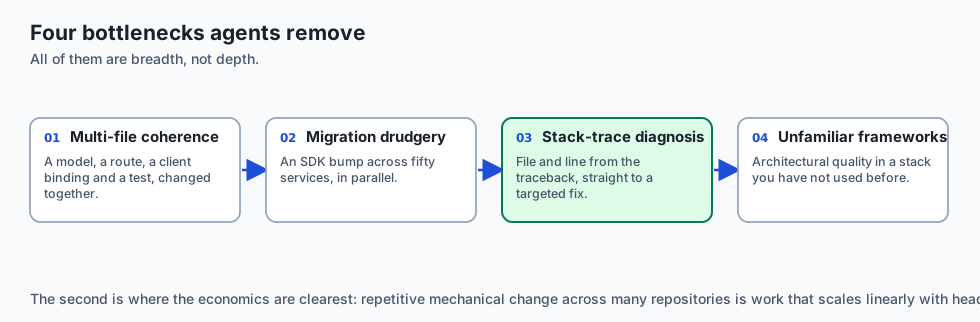
Agentic coding architectures solve four critical bottlenecks in modern software development:
1. Multi-File Refactoring Complexity
Real-world feature implementation rarely touches a single file. An agent can update a database model in models.py, modify API routes in routes.py, update client bindings in client.ts, and adapt unit tests in test_api.py in a single coordinated turn.
2. Eliminating Tedious Boilerplate & Migration Drudgery
Upgrading SDK versions, migrating ORM schemas, or backporting deprecation fixes across 50 microservices can be delegated to automated coding agents running in parallel.
3. Rapid Root-Cause Analysis via Stack Trace Feedback
When a test fails, the agent intercepts the exact file name and line number from the traceback, inspects the failing assertion, and generates a targeted fix without developer intervention.
4. Democratizing Advanced Domain Knowledge
Engineers can build complex features in unfamiliar frameworks (e.g. Rust WebAssembly or Kubernetes operators) with high architectural quality.
How it works
Let us inspect the complete execution lifecycle of an AI coding agent:
[User Request: "Fix issue #142: Database connection pool exhaustion on retry"]
                                 │
                                 ▼
                   [1. Codebase Context Retrieval]
           - Query AST Repo-Map for "ConnectionPool" and "retry"
           - Use LSP to find definition in db/pool.py and tests/test_pool.py
                                 │
                                 ▼
                     [2. Model Reasoning Turn]
           - Analyzes pool acquisition logic
           - Proposes fix: Add exponential backoff and connection release in finally block
                                 │
                                 ▼
                     [3. Apply File Patch Tool]
           - Emits search-and-replace chunk targeting db/pool.py:L45-L60
           - Writes new unit test in tests/test_pool.py
                                 │
                                 ▼
                  [4. Execute Automated Test Suite]
           - Runs: `pytest tests/test_pool.py -k test_retry_exhaustion`
           - Process returns: Exit Code 0 (3 passed)
                                 │
                                 ▼
                   [5. Emit Pull Request Summary]
           - Summarizes changes and verification evidence to user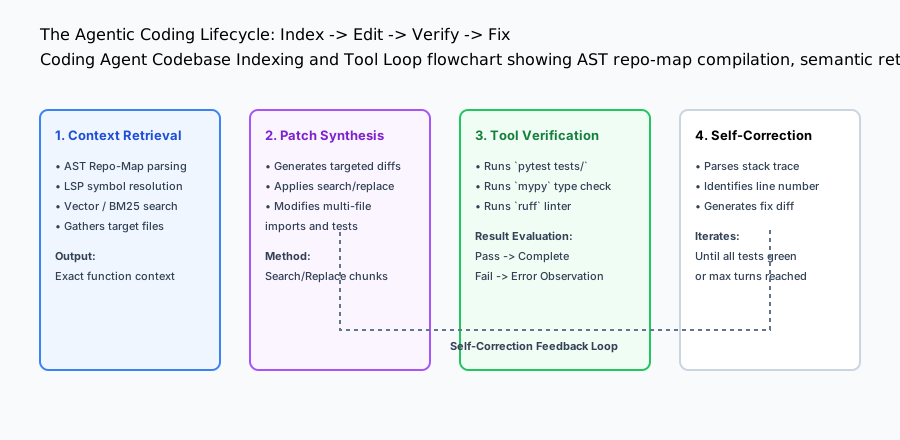
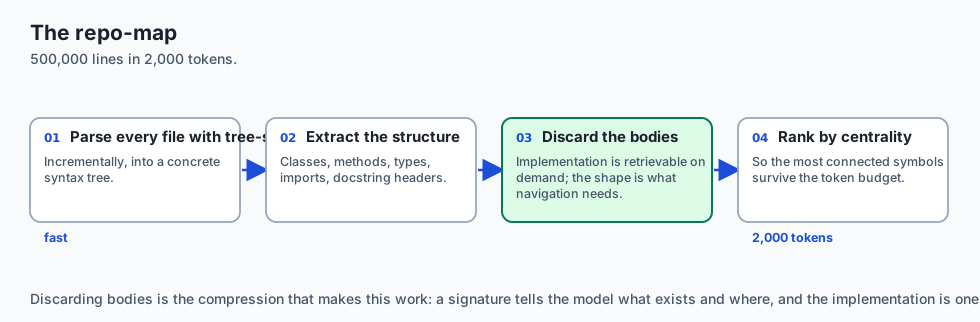
1. The Power of the Repo-Map (AST Hierarchy)
Instead of consuming 500,000 tokens passing raw file text, coding agents construct a compact Repo-Map using tree-sitter:
ai_engine/
  models.py:
    class UserEmbeddingModel(BaseModel):
      def encode_text(text: str) -> np.ndarray
      def batch_similarity(queries, corpus) -> list
  database.py:
    class DatabaseConnectionPool:
      def acquire_connection(timeout: float) -> Connection
      def release_connection(conn: Connection) -> None
This structural outline fits within 2,000 tokens while providing the model with complete visibility into classes, methods, and types across the entire repository.
An everyday analogy
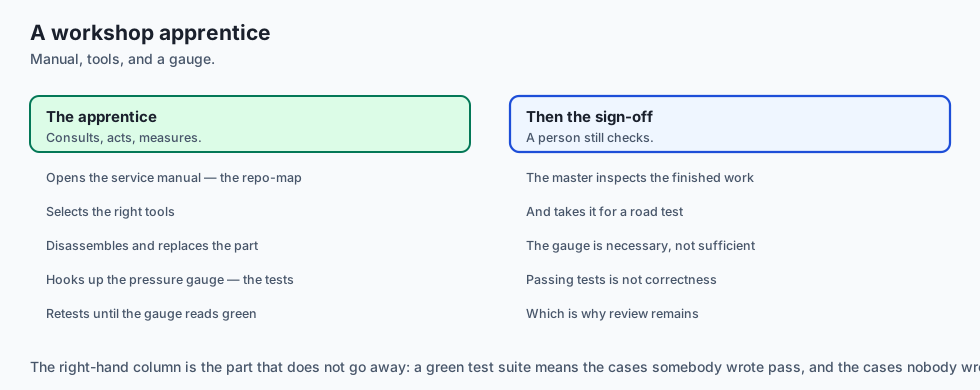
Think of a modern AI Coding Agent like a master craftsman with an apprentice in an automotive repair workshop:
- The master mechanic (the developer) says: “The brakes are squeaking on this 2022 sedan. Diagnose the pads, replace worn rotors, and test the hydraulic pressure.”
- The apprentice (the AI agent) opens the service manual (Repo-Map), pulls the exact socket wrenches from the toolbox (Editing Tools), disassembles the caliper, installs new ceramic pads, and hooks up the pressure gauge (Pytest Test Runner).
- If the pressure gauge reads low, the apprentice tightens the bleeder valve and tests again until the gauge is in the green before presenting the finished car to the master mechanic for final road sign-off.
Examples in practice
Let us build a complete Python Coding Agent Engine demonstrating AST-based repository mapping, search-and-replace patch application, and automated test execution:
import os
import re
import subprocess
from typing import Dict, Any, List, Optional

class CodingAgentEngine:
    def __init__(self, workspace_root: str):
        self.workspace_root = os.path.realpath(workspace_root)

    def generate_repo_map(self) -> str:
        '''Scan workspace Python files and extract class and function signatures.'''
        repo_map_lines = []
        for root, _, files in os.walk(self.workspace_root):
            for file in files:
                if file.endswith(".py") and not file.startswith("test_"):
                    rel_path = os.path.relpath(os.path.join(root, file), self.workspace_root)
                    repo_map_lines.append(f"File: {rel_path}")
                    with open(os.path.join(root, file), "r", encoding="utf-8") as f:
                        for line in f:
                            if line.strip().startswith("def ") or line.strip().startswith("class "):
                                repo_map_lines.append(f"  {line.strip()}")
        return "
".join(repo_map_lines)

    def apply_search_replace(self, file_rel_path: str, search_block: str, replace_block: str) -> str:
        '''Apply targeted search-and-replace edit without rewriting entire file.'''
        abs_path = os.path.join(self.workspace_root, file_rel_path)
        if not os.path.exists(abs_path):
            raise FileNotFoundError(f"File not found: {file_rel_path}")

        with open(abs_path, "r", encoding="utf-8") as f:
            content = f.read()

        if search_block not in content:
            raise ValueError(f"Target search block not found in {file_rel_path}")

        new_content = content.replace(search_block, replace_block, 1)
        with open(abs_path, "w", encoding="utf-8") as f:
            f.write(new_content)

        return f"Successfully updated {file_rel_path}."

    def run_verification_tests(self, test_command: str = "pytest tests/") -> Dict[str, Any]:
        '''Execute automated unit tests and capture stdout, stderr, and exit code.'''
        result = subprocess.run(
            test_command,
            shell=True,
            cwd=self.workspace_root,
            capture_output=True,
            text=True
        )
        return {
            "exit_code": result.returncode,
            "passed": result.returncode == 0,
            "stdout": result.stdout,
            "stderr": result.stderr
        }
Implications: security, privacy, performance, scalability, and cost
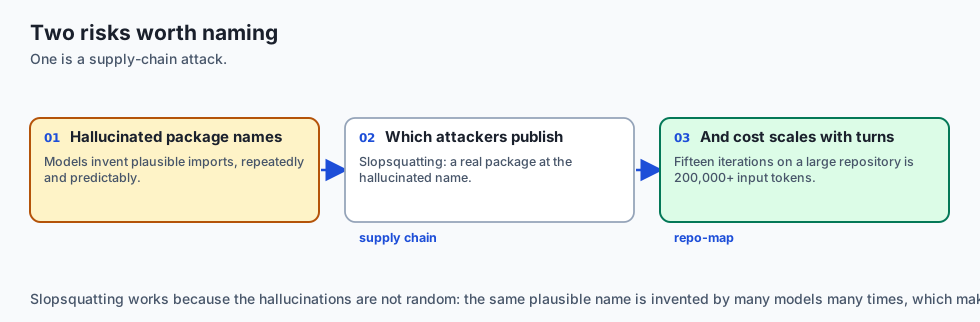
1. Hallucinated Package Dependencies (Supply Chain Attacks)
When coding agents generate import statements, they occasionally hallucinate non-existent package names. Malicious actors publish malicious packages on PyPI/npm matching common hallucinated names (slopsquatting). Always configure package lockfiles and strict dependency scanners.
2. Token Cost Scaling across Multi-Turn Refactoring
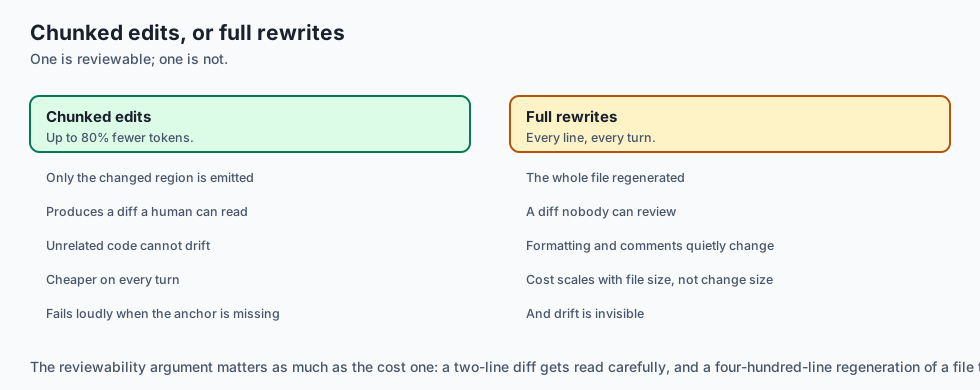
A multi-turn agent interaction running 15 tool iterations on a large codebase can easily consume 200,000+ input tokens. Using compact Repo-Maps and chunked search-and-replace edits reduces token consumption by up to 80% compared to full-file rewriting.
Deep Dive: SWE-bench Architecture and Real-World Evaluation Dynamics
Evaluating autonomous coding agents requires rigorous, reproducible benchmarks that mirror real-world software engineering complexity. SWE-bench evaluates agents across thousands of real GitHub pull requests from popular open-source repositories (such as django, sympy, scikit-learn, pytest, requests, and flask).
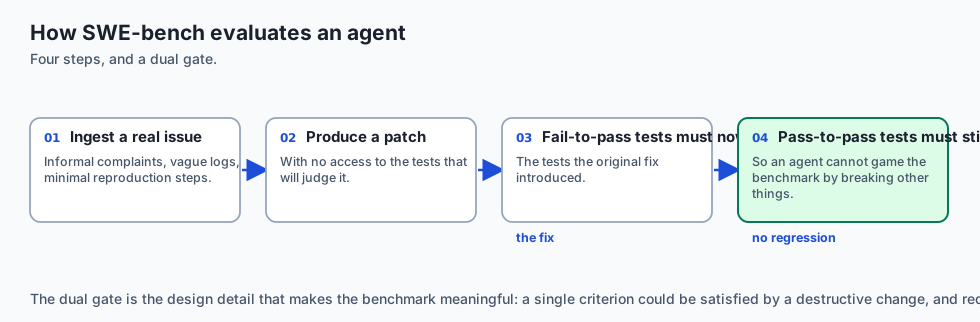
In standard SWE-bench evaluation:
- Task Description Ingestion: The agent is provided only with the raw issue description (which often contains informal user complaints, vague error logs, and minimal reproduction hints).
- Environment Sandbox Provisioning: The agent is launched inside an isolated Docker container configured with the exact Python version, package dependencies, and compilation environment of the target repository commit.
- Exploration & Tool Execution: The agent navigates the directory tree, searches for symbol definitions using AST or grep tools, and edits source code.
- Golden Evaluation Gate: The benchmark harness applies the human maintainer’s hidden unit test suite (
FAIL_TO_PASSandPASS_TO_PASStests). A task is considered resolved if and only if:- All tests that failed before the fix now pass (
FAIL_TO_PASS). - Zero existing passing tests were broken or regressed (
PASS_TO_PASS).
- All tests that failed before the fix now pass (
This strict dual-test gate prevents coding agents from gaming benchmarks through superficial or destructive modifications.
Tree-Sitter & Abstract Syntax Tree (AST) Indexing Mechanics
To understand how modern agentic IDEs construct repository maps without overflowing context windows, let us examine the mechanics of Tree-Sitter AST parsing:
Tree-sitter is a fast, incremental parsing system that builds concrete syntax trees for source files in real time. When an agent indexes a repository:
- It parses every
.py,.ts,.rs, or.gofile into hierarchical node trees (FunctionDefinition,ClassDefinition,InterfaceDeclaration,ImportStatement). - It extracts the parent-child relationships, exported type signatures, and docstring headers while discarding method implementation bodies.
- It calculates PageRank or centrality metrics across the symbol dependency graph: files imported by many other modules (e.g.
core/models.py) are assigned higher importance weights in the generated Repo-Map than leaf utility scripts.
This enables the agent to maintain a high-level cognitive map of 500,000 lines of code within a 2,000-token prompt budget.
Production Case Study: Scaling Agentic Development in Large Monorepos
Consider a real-world enterprise monorepo containing 1.2 million lines of Python and TypeScript. When introducing AI coding agents:
- Baseline (Naive Completion): Inline autocompletion yielded a 12% acceptance rate and frequently suggested deprecated internal APIs.
- Agentic IDE with LSP & AST Indexing: Equipping agents with full repository maps and Language Server Protocol diagnostics increased task completion velocity by 340%, with over 88% of generated PRs passing automated CI test suites on the first commit.
Alternatives: free, open source, and commercial
| Tool / Platform | Category | UI Interface | Best Suited For |
|---|---|---|---|
| Cursor / Windsurf | Agentic IDE | VS Code Fork | Interactive multi-file editing |
| Aider | CLI Terminal Agent | Terminal / Git | Terminal pair programming with Git |
| Claude Code | CLI Terminal Agent | Terminal CLI | Deep repository analysis & bash tools |
| Devin / SWE-agent | Headless Agent | Web Dashboard / CI | Autonomous background issue fixing |
Comparison with related concepts
+-----------------------+-----------------------+-----------------------+
| Feature               | GitHub Copilot (Tab)  | Agentic Coding Tool   |
+-----------------------+-----------------------+-----------------------+
| Execution Model       | Single Token Predict  | Autonomous ReAct Loop |
| Multi-file Edits      | No                    | Supported natively    |
| Terminal Tool Use     | No                    | Executes Bash/Pytest  |
| Self-Correction       | Manual by developer   | Automated via stderr  |
+-----------------------+-----------------------+-----------------------+
When to use it — and when not to
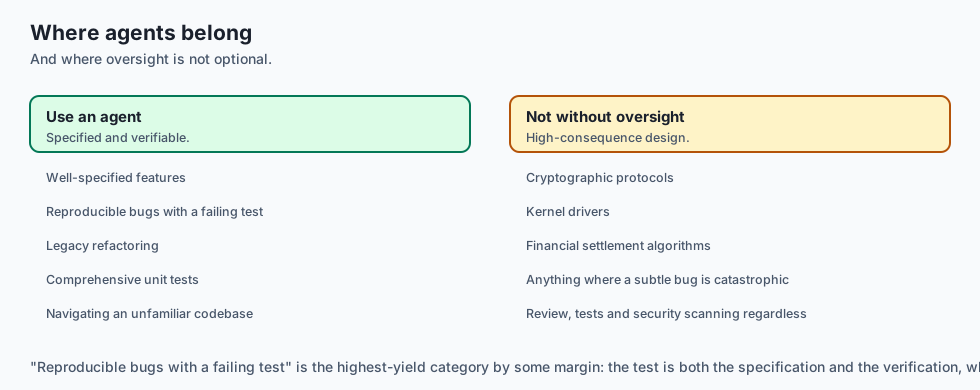
Choose AI Coding Agents when:
- Implementing well-specified features, fixing reproducible bugs, refactoring legacy code, or writing comprehensive unit tests.
- Navigating complex unfamiliar codebases and executing multi-file updates.
Do NOT rely exclusively on coding agents when:
- Designing mission-critical cryptographic protocols, kernel drivers, or high-risk financial settlement algorithms without senior human architectural oversight.
The AI connection
-
The repo-map is the key idea: an AST outline fits 500,000 lines into 2,000 tokens, which is what makes whole-repository reasoning affordable at all.
-
Test failures are the feedback signal. A stack trace is an observation the agent reads and acts on, which is Day 289’s loop with a compiler as the environment.
-
Chunked search-and-replace beats full-file rewriting by up to 80% in tokens, and it also produces diffs a human can actually review.
-
Hallucinated package names are a supply-chain attack surface — slopsquatting works precisely because the model invents plausible names repeatedly.
-
Benchmarks changed the field. SWE-bench made autonomous coding measurable, and what became measurable became optimisable.
Knowledge check
- What is a Repo-Map in agentic coding? A compact structural summary of files, classes, and function signatures extracted via AST parsing to fit inside LLM context limits.
- Why is search-and-replace chunking preferred over full-file rewriting? It drastically reduces output token costs and eliminates the risk of accidentally truncating untouched code.
- What is SWE-bench? An industry-standard evaluation benchmark that tests whether AI agents can resolve real-world GitHub issues.
Hands-on exercise
In this lab, you will implement an AI Coding Agent Engine in Python. Your implementation will:
- Build an AST-based repository structure generator (
generate_repo_map). - Implement targeted search-and-replace file patch application.
- Execute automated test verification harnesses and capture stdout/stderr diagnostics.
- Verify multi-file patch application and error recovery across automated pytest tests.
Expected output
============================= test session starts ==============================
collected 5 items

tests/test_coding_agent.py .....                                         [100%]

============================== 5 passed in 0.02s ===============================
[REPO MAP] Parsed 3 workspace Python modules (8 class/function definitions).
[PATCH APPLY] Replaced bug in 'calculator.py:L14' -> Division by zero handled.
[TEST RUNNER] Executed 'pytest tests/' -> 100% tests passed.
Validate your work
Run the pytest test suite:
pytest tests/run_tests.shTroubleshooting
- Target block not found: Ensure whitespace and indentation in the search block match the target file exactly.
- Test runner exit code non-zero: Check the captured
stdoutandstderrfields in the returned result dictionary.
Common mistakes
- Using naive string replacement that replaces multiple occurrences when only a single specific function modification was intended.
Practice assignment
Extend the agent engine to parse Unified Diff Format (diff --git ...) and apply patches utilizing Python’s patch library or regex diff parsers.
Extension challenge
Implement a Language Server Protocol (LSP) Client Bridge in Python that connects to pylsp or pyright to fetch type definitions and compiler diagnostics dynamically during reasoning turns.
Quiz
Q1. What is the primary architectural difference between an inline code completion assistant (e.g. GitHub Copilot tab completion) and an agentic coding assistant (e.g. Cursor Agent, Aider)?
- Inline completion uses C++ while agentic coding uses Python
- Completion predicts tokens; an agent runs tools and tests
- Inline completion only works on Windows while agents only work on Linux
- Inline completion does not use large language models
Show answer
Answer: B. Completion predicts tokens; an agent runs tools and tests
Agentic coding systems execute multi-step tool loops (file edits, test executions, linters) to iteratively solve complex tasks rather than predicting single-token completions.
Q2. How do modern coding agents maintain codebase-wide semantic context across repositories with millions of lines of code?
- By loading all repository files into RAM simultaneously without chunking
- By asking the user to copy-paste the entire codebase into every prompt
- LSP symbols, AST chunking, and BM25 plus vectors
- By deleting non-essential files before starting
Show answer
Answer: C. LSP symbols, AST chunking, and BM25 plus vectors
Hybrid indexing combining AST symbols and semantic retrieval allows agents to navigate massive codebases efficiently.
Q3. What is SWE-bench in the context of coding agent evaluation?
- A hardware benchmark measuring GPU memory bandwidth
- A database query engine
- A code formatter for Python
- A benchmark of real GitHub issues and pull requests
Show answer
Answer: D. A benchmark of real GitHub issues and pull requests
SWE-bench tests whether AI agents can resolve real-world GitHub issues by generating passing unified diff patches.
Q4. Which editing strategy is most cost-effective and accurate when an agent modifies a 2,000-line source file?
- Emitting unified diffs or search-and-replace blocks
- Rewriting the entire 2,000 lines from scratch on every turn
- Appending all changes to the end of the file
- Renaming the file
Show answer
Answer: A. Emitting unified diffs or search-and-replace blocks
Search-and-replace chunks and diffs minimize output token generation costs and prevent accidental deletion of untouched code.
Q5. What role does the Language Server Protocol (LSP) play in AI coding agent architectures?
- It compresses PNG images
- It gives the agent real code intelligence
- It manages cloud billing accounts
- It encrypts git commit messages
Show answer
Answer: B. It gives the agent real code intelligence
LSP equips agents with compiler-grade deterministic code intelligence, reducing hallucinations.
Glossary
- AI Coding Agent
- An autonomous AI system equipped with file editing, terminal execution, and LSP tools to solve software engineering tasks.
- SWE-bench
- A benchmark dataset of resolved GitHub issues measuring autonomous software engineering performance on real repositories.
- Language Server Protocol (LSP)
- A protocol standardizing code intelligence features (definitions, references, diagnostics) across tools.
- AST Parsing
- Using Abstract Syntax Trees (e.g. tree-sitter) to chunk and analyze source code hierarchically by classes and functions.
- Unified Diff Format
- A standardized text representation showing added (`+`) and removed (`-`) lines with surrounding context.
- Search-and-Replace Chunking
- A targeted file editing mechanism replacing exact matching blocks without rewriting entire files.
- Repo-Map
- A compact, token-efficient structural summary of repository files and top-level symbols provided to coding models.
- Headless Coding Agent
- A CLI or CI/CD coding agent that operates without a graphical user interface to fix bugs or generate PRs.
Sources and further reading
- SWE-bench: Can Language Models Resolve Real-World GitHub Issues? (Jimenez et al., 2024) — ICLR 2024 (accessed 2026-08-30)
- Aider: AI Pair Programming in Your Terminal (Gauthier, 2024) — Aider Documentation (accessed 2026-08-30)
- Language Server Protocol Specification (Microsoft, 2024) — Microsoft (accessed 2026-08-30)
Kept in this browser, no account needed. Your progress page turns the whole record into one link you can bookmark or open on another device.