AI Engineering: Agents and Applications › AI Coding Agents › Day 306
Day 306: Reviewing and Trusting AI-Written Code
Master systematic code review strategies for AI-authored software: identify subtle logic flaws, spot hallucinated dependencies, detect security anti-patterns, and enforce automated multi-layer verification gates.
Hands-on lab for this lesson
Lab files on GitHub: https://github.com/ai-roadmap-365/ai-roadmap-365.github.io/tree/main/labs/sections/ai-engineering/day-306-reviewing-and-trusting-ai-written-code
- Get the hands-on files. Clone the labs repository once (you can reuse this clone for every lesson). This works on macOS, Linux, and Windows (PowerShell or WSL):
git clone https://github.com/ai-roadmap-365/ai-roadmap-365.github.io.git cd ai-roadmap-365.github.io - Open this lesson's lab. Move into the directory for this specific day. Every lab lives at the same predictable path — section / subsection / week / day:
cd labs/sections/ai-engineering/day-306-reviewing-and-trusting-ai-written-code - Read the lab guide. Open `README.md` in that directory. It lists the exact commands, what each does, the expected output, and how to check your work — read it before running anything.
- Run it and check your work. Follow the README's "How to run" section: run the example first to see the finished result, then complete the numbered exercises in `starter/`, then run the tests. The tests pass (exit 0) only when your work is correct.
bash tests/run_tests.sh # or the test command named in the lab README
You can also open the lab as a local page (works offline, shows the file tree and expected output).
Learning objectives
By the end of this lesson you will be able to:
- Catalog common AI coding failure modes: phantom edge cases, silent regressions, package slopsquatting, and superficial test assertions.
- Implement a multi-tier code review checklist (Architectural, Security, Testing, Static Analysis).
- Utilize automated AST scanners and dependency validators to verify AI-generated patches.
- Differentiate between 'plausible-looking code' and mathematically correct, maintainable software.
- Build an Automated AI Code Review and Safety Scanner in Python.
Prerequisites
Why this matters
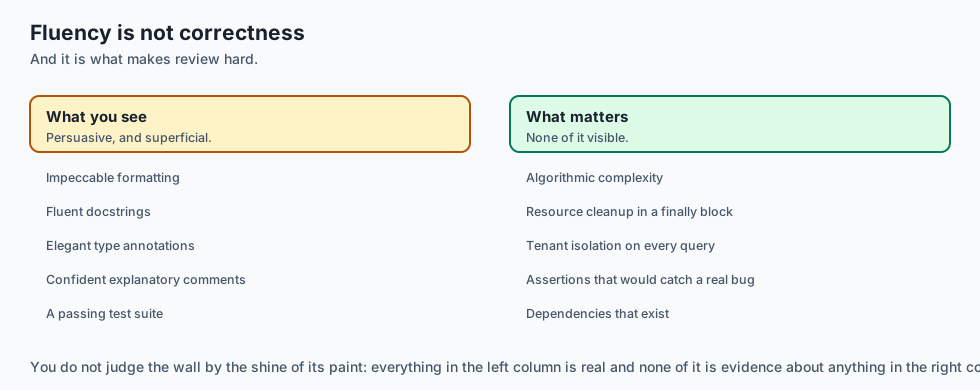
As AI coding agents write an increasing fraction of modern software, the primary bottleneck in software engineering has shifted from code authoring to code review and trust verification. Language models are extraordinarily persuasive: they format code impeccably, generate fluent docstrings, and write elegant type annotations. However, models suffer from Plausibility Bias: code that looks aesthetically perfect on the surface can harbor catastrophic algorithmic flaws, unhandled edge cases, security anti-patterns, or hallucinated third-party dependencies (package slopsquatting).
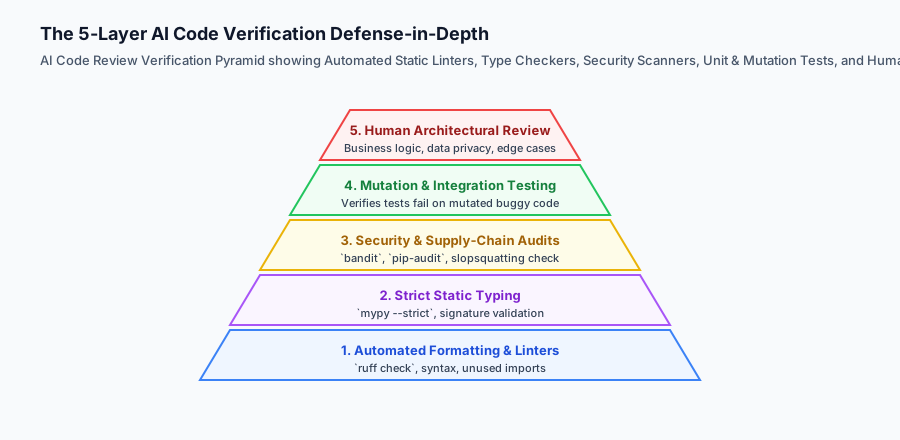
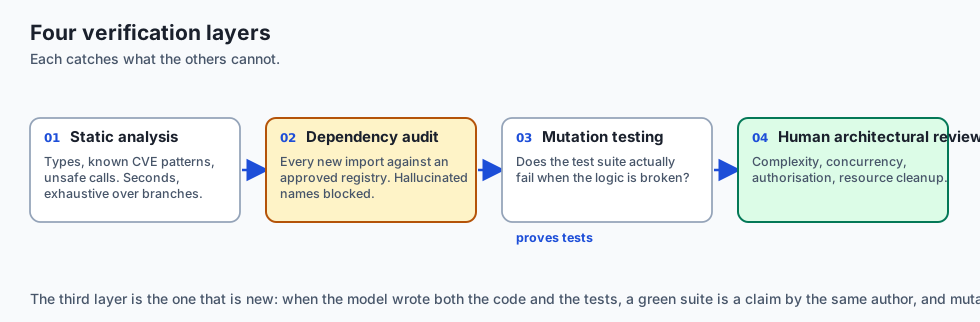
A senior engineer cannot simply glance at a 300-line AI diff, assume it works because the tests passed, and click merge. Engineers must adopt a Defense-in-Depth Verification Strategy: combining static analysis scanners, dependency manifest audits, mutation testing, and rigorous human architectural inspection.
Mastering the science of reviewing and trusting AI-written code is what separates reckless development from high-velocity, production-grade engineering.
The idea in plain language
Think of reviewing AI-written code like inspecting the structural work of a high-speed robotic bricklayer:
- The robot lays 1,000 bricks a minute with laser-straight mortar lines and a sparkling coat of white paint.
- To a casual passerby, the wall looks like a work of art.
- But the structural engineer pulls out their inspection tools:
- Did the robot remember to install the steel rebar inside the concrete cavity?
- Are the anchor bolts fastened to the bedrock foundation, or are they resting on loose dirt?
- If an earthquake hits (Mutation Testing), will the wall flex or collapse into rubble?
You do not judge the wall by the shine of its paint; you judge it by the mathematical integrity of its load-bearing steel.
Historical background
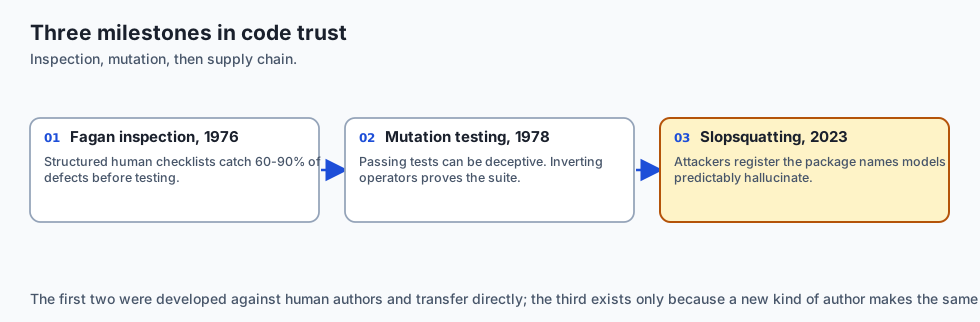
The discipline of automated code review and trust verification evolved through three critical software milestones:
1. The Fagan Code Inspection (Michael Fagan, IBM, 1976)
Fagan formalized structured human code inspection checklists, demonstrating that systematic defect classification catches 60–90% of bugs before testing.
2. Mutation Testing & Test Oracle Verification (1978–Present)
Academic research proved that passing unit tests can be deceptive if the assertions are weak. Inverting Boolean flags or altering math operators (mutation testing) proves whether test suites truly catch regressions.
3. Supply Chain & Hallucinated Dependency Security (2023–Present)
Security researchers documented the rise of slopsquatting: attackers monitoring open-source AI coding datasets to identify commonly hallucinated package names, registering them on PyPI/npm, and planting backdoors in automated builds.
What it is — and what it is not
Let us establish clear boundaries for reviewing AI-generated code:
What AI Code Review Is:
- A rigorous, multi-layered verification process combining automated static analysis, security scanners, and human architectural scrutiny.
- Verifying algorithmic complexity ($O(N)$ vs $O(N^2)$), concurrency thread-safety, and resource cleanup (
try/finallyblocks). - Validating that newly added unit tests actually fail when bugs are injected (mutation testing).
What AI Code Review Is Not:
- Trusting code solely because it is accompanied by polite comments and high confidence text from the model.
- Merging pull requests without checking lockfile diffs for unauthorized new dependencies.
+-------------------------------------------------------------------------------+
|                       AI CODE FAILURE MODES CHECKLIST                         |
+-----------------------+-----------------------------------+-------------------+
| Failure Mode          | Mechanism                         | Detection Tool    |
+-----------------------+-----------------------------------+-------------------+
| Package Slopsquatting | Hallucinated external package     | Dependency audit  |
| Superficial Assertion | `assert res is not None` (Weak)   | Mutation testing  |
| Algorithmic Inefficiency| Naive $O(N^2)$ nested loop      | Profiling/Review  |
| Unhandled Edge Case   | Missing None / Empty string check | AST type check    |
| Insecure Cryptography | Hardcoded salt or weak cipher     | Bandit / Semgrep  |
+-----------------------+-----------------------------------+-------------------+
Why it was created and what problems it solves
Rigorous review methodologies prevent catastrophic failure modes in AI-assisted systems:
1. Preventing Supply Chain Compromise
Automated dependency scanners check all new imports against approved company package registries, immediately blocking hallucinated packages.
2. Eliminating Tautological Tests
Reviewers verify that tests contain strict mathematical assertions (assert balance == 42.50) rather than vacuous checks (assert balance).
3. Catching Resource Leaks
Language models frequently open sockets or database connections without proper context managers (with open(...) as f:), causing production file descriptor exhaustion.
How it works
Let us inspect the complete threat model of Package Slopsquatting:
[1. AI Model Emits Code with Hallucinated Import]
  - Example: `from secure_token_hasher import generate_secure_salt`
                         │
                         ▼
[2. Malicious Threat Actor Registers Package on PyPI]
  - Attacker observes common LLM hallucination patterns
  - Claims name `secure_token_hasher` on public registry
  - Embeds reverse shell in setup.py
                         │
                         ▼
[3. Developer or CI Runs Unchecked Install]
  - `pip install secure_token_hasher`
                         │
                         ▼
[4. Remote Code Execution in Build Environment]
  - Attacker exfiltrates AWS keys and database credentials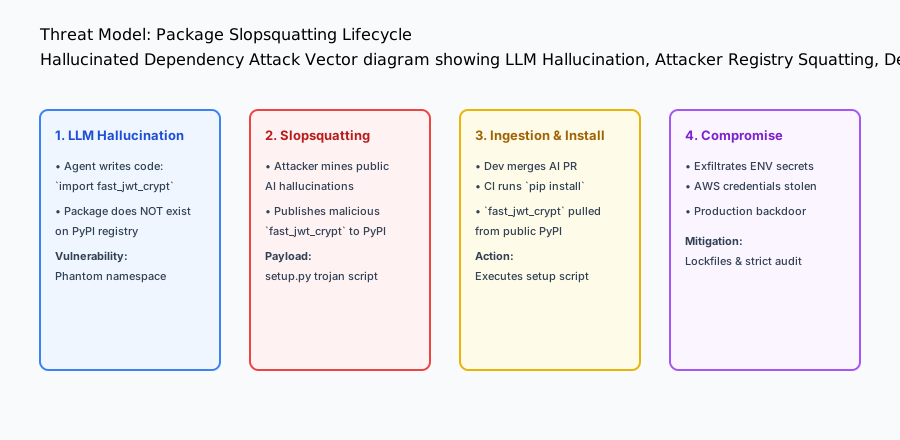
An everyday analogy
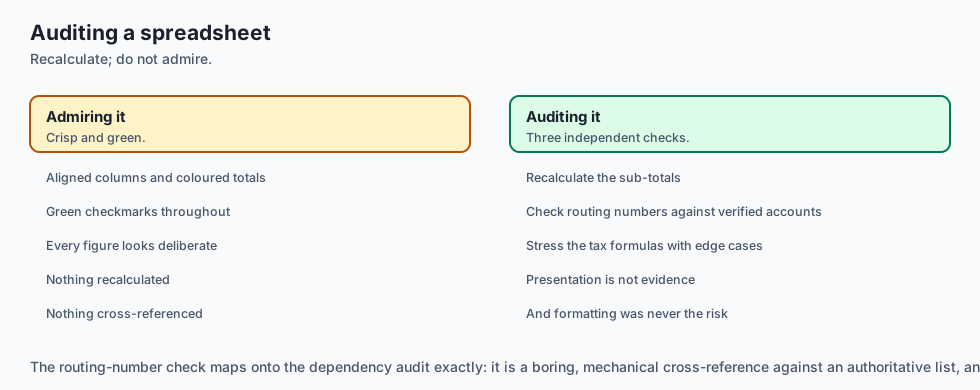
Think of reviewing AI code like evaluating a financial accounting ledger compiled by an automated spreadsheet robot:
- The numbers are aligned in crisp Helvetica typography with colored totals and green checkmarks.
- But the auditor does not just admire the formatting:
- They recalculate the sub-totals manually.
- They check the bank routing numbers against verified corporate accounts (Dependency Audit).
- They stress-test the tax formulas with edge-case deductions (Mutation Testing).
Examples in practice
Let us build a complete Python AI Code Review and Safety Scanner that scans source code for hallucinated imports, weak assertions, and insecure shell invocations:
import ast
import os
from typing import Dict, Any, List

class AICodeReviewScanner:
    def __init__(self, approved_packages: List[str]):
        self.approved_packages = set(approved_packages)

    def scan_file(self, file_path: str) -> Dict[str, Any]:
        '''Parse source code AST and detect security and quality defects.'''
        with open(file_path, "r", encoding="utf-8") as f:
            content = f.read()

        issues = []
        tree = ast.parse(content, filename=file_path)

        for node in ast.walk(tree):
            # Check 1: Insecure Shell Execution
            if isinstance(node, ast.Call):
                if isinstance(node.func, ast.Attribute) and node.func.attr in ("system", "popen"):
                    issues.append({
                        "line": node.lineno,
                        "rule": "INSECURE_SHELL_EXECUTION",
                        "severity": "CRITICAL",
                        "message": f"Avoid using os.{node.func.attr}; use safe subprocess APIs."
                    })

            # Check 2: Unapproved External Imports (Slopsquatting risk)
            if isinstance(node, ast.Import):
                for alias in node.names:
                    pkg_root = alias.name.split('.')[0]
                    if pkg_root not in self.approved_packages:
                        issues.append({
                            "line": node.lineno,
                            "rule": "UNAPPROVED_DEPENDENCY",
                            "severity": "HIGH",
                            "message": f"Import '{pkg_root}' is not in approved package whitelist."
                        })
            elif isinstance(node, ast.ImportFrom):
                if node.module:
                    pkg_root = node.module.split('.')[0]
                    if pkg_root not in self.approved_packages:
                        issues.append({
                            "line": node.lineno,
                            "rule": "UNAPPROVED_DEPENDENCY",
                            "severity": "HIGH",
                            "message": f"ImportFrom '{pkg_root}' is not in approved whitelist."
                        })

            # Check 3: Weak/Tautological Assertions
            if isinstance(node, ast.Assert):
                if isinstance(node.test, ast.Constant) and node.test.value is True:
                    issues.append({
                        "line": node.lineno,
                        "rule": "WEAK_ASSERTION",
                        "severity": "MEDIUM",
                        "message": "Found tautological 'assert True' in test code."
                    })

        return {
            "file": file_path,
            "passed": len(issues) == 0,
            "issue_count": len(issues),
            "issues": issues
        }

if __name__ == "__main__":
    scanner = AICodeReviewScanner(approved_packages=["math", "os", "sys", "pytest", "typing"])
    print("Scanner initialized with standard library packages.")
Implications: security, privacy, performance, scalability, and cost
1. Silent Logic Regressions in Refactorings
When asking an agent to “optimize” a function, models frequently remove edge-case handling (e.g. leap year checks or negative number guards) to produce cleaner-looking code. Enforce high test coverage on edge cases.
2. Cognitive Fatigue in Human Reviewers
Reading hundreds of lines of AI-generated diffs causes reviewer fatigue. Relying on automated AST scanners and linters to catch mechanical issues frees the human engineer to focus exclusively on architectural invariants and business logic.
Deep Dive: The Taxonomy of AI Software Vulnerabilities and OWASP Top 10 for LLMs
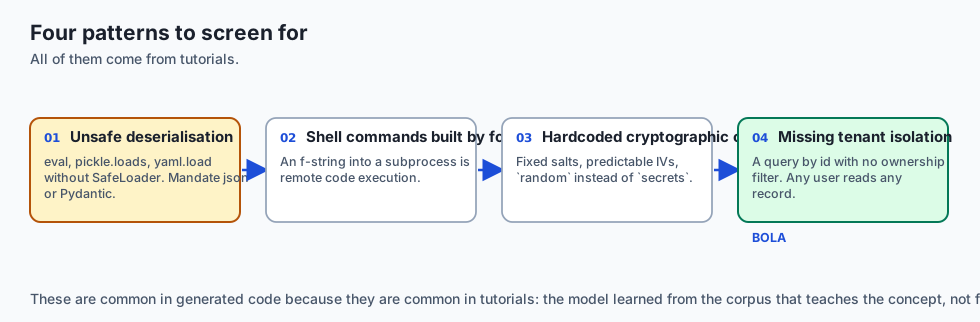
When reviewing AI-generated code, senior engineers must screen for security anti-patterns specific to machine-learning code generators:
-
Insecure Deserialization & Eval Injection: Language models often reach for
eval(),pickle.loads(), oryaml.load()(withoutSafeLoader) when parsing dynamic data. Reviewers must mandatejson.loads()or Pydantic validation. -
Insecure Subprocess Invocations: Models frequently construct shell commands using formatted strings (
f"ffmpeg -i {user_input_path} output.mp4"). This creates direct Remote Code Execution (RCE) vulnerabilities via shell injection (user_input_path = "video.mp4; rm -rf /"). Reviewers must enforce array-based execution (subprocess.run(["ffmpeg", "-i", user_input_path, "output.mp4"])). -
Hardcoded Cryptographic Constants: Models trained on public tutorials often hardcode cryptographic salt values, predictable IVs, or weak random number generators (
import randominstead ofimport secrets). -
Broken Object Level Authorization (BOLA / IDOR): When creating database query endpoints, models often forget to include tenant or user ownership checks (
SELECT * FROM invoices WHERE id = :invoice_id), allowing any authenticated user to view any other customer’s billing data.
Automated Mutation Testing as a Trust Verification Gate
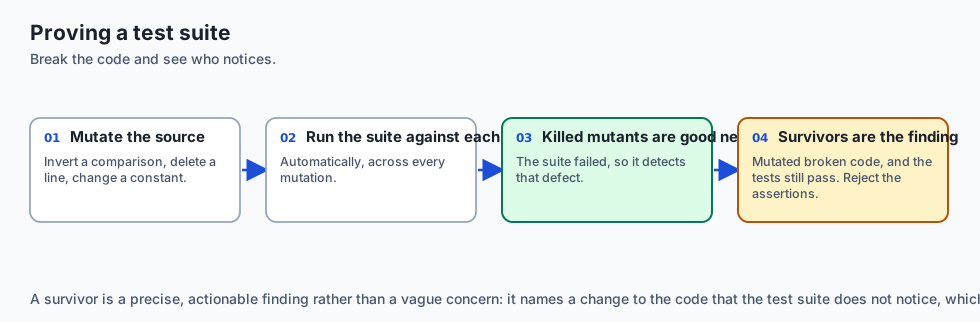
To prove that AI-generated unit tests are robust, automated CI pipelines can execute Mutation Testing (using tools like mutmut):
- A mutator inverts comparison operators (changing
<to<=,==to!=), deletes statement lines, and replaces constant numbers. - If all mutants are successfully “killed” (the test suite fails on every mutant), the test suite is mathematically proven to possess high defect detection power.
- If mutants survive (tests still pass despite mutated broken code), the reviewer knows the AI generated superficial assertions that must be rejected.
Alternatives: free, open source, and commercial
| Tool / Method | Scope | Focus Area | Best Suited For |
|---|---|---|---|
| AST Quality Scanner | Python AST | Imports, Shell escapes | Pre-commit security gate |
| Bandit | Python AST | Known security CVEs | Static security analysis |
| Mutmut / Cosmic Ray | Python Bytecode | Mutation testing | Validating test suite strength |
| Semgrep | Multi-Language | Custom security rules | Enterprise repo auditing |
Comparison with related concepts
+-----------------------+-----------------------+-----------------------+
| Verification Layer    | Manual Glance Review  | Multi-Layer AI Review |
+-----------------------+-----------------------+-----------------------+
| Slopsquatting Defense | None (Human overlooks)| Automated AST check   |
| Tautological Tests    | Missed (~70% of time) | Mutation test catches |
| Security Flaws        | High escape rate      | Bandit / Semgrep gate |
| Review Speed          | Slow & Inconsistent   | Sub-second automated  |
+-----------------------+-----------------------+-----------------------+
When to use it — and when not to
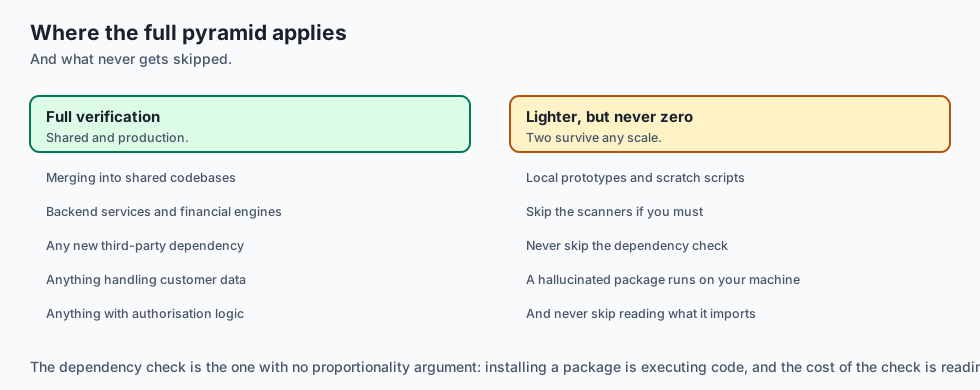
Enforce Full Verification Pyramids when:
- Merging AI-authored code into shared production codebases, backend services, or financial engines.
- Adding any new external third-party package dependencies.
Do NOT require heavy security scanners for:
- Local experimental prototypes or disposable scratchpad scripts.
Deep Dive: Static vs Dynamic vs Symbolic Verification Strategies
To build a high-trust verification pipeline for AI-generated code, organizations deploy a combination of three complementary verification strategies:
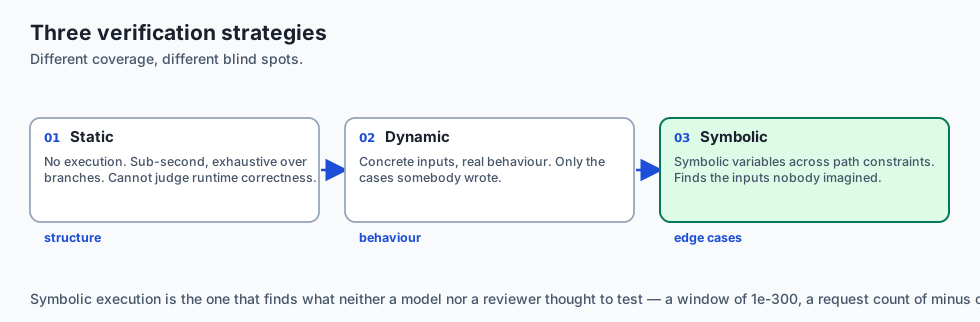
- Static Analysis (AST & Type Checkers):
- How it works: Analyzes source code structure without executing the program.
- Tools:
mypy,ruff,bandit,semgrep. - Strengths: Instantaneous sub-second feedback, exhaustive code branch coverage, catches type mismatches and known CVEs.
- Limitations: Cannot evaluate runtime algorithmic correctness or dynamic data transformations.
- Dynamic Testing (Unit, Integration & Mutation):
- How it works: Executes compiled bytecode against concrete inputs and validates output assertions.
- Tools:
pytest,coverage.py,mutmut. - Strengths: Validates actual business logic and error handling behavior under real execution conditions.
- Limitations: Only as good as the test cases provided; vulnerable to superficial assertions.
- Symbolic Execution & Formal Verification:
- How it works: Evaluates mathematical equations representing program logic across all possible input domains.
- Tools:
Z3 Theorem Prover,CrossHair. - Strengths: Mathematically proves that an invariant (e.g.
balance >= 0) holds across every possible integer value without exception. - Limitations: High computational complexity; best suited for mission-critical cryptography and financial settlement code.
The 10-Point Human Code Review Gate for AI Pull Requests
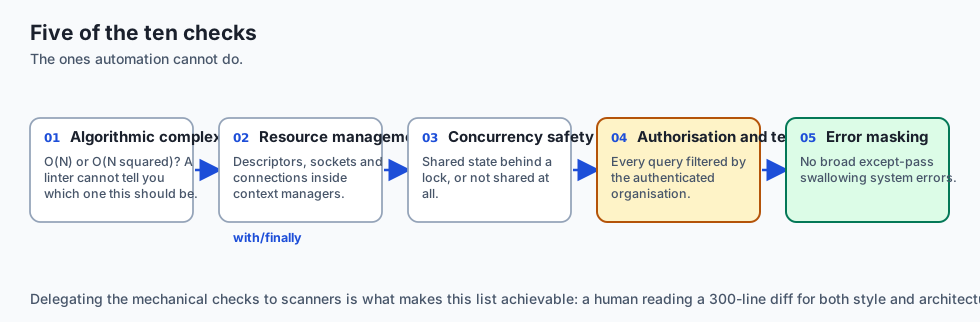
When reviewing an AI-generated pull request before production merge, senior engineers must verify the following 10-Point Trust Checklist:
- Algorithmic Complexity: Is the time and space complexity optimal ($O(N)$ vs $O(N^2)$)?
- Resource Management: Are all file descriptors, network sockets, and database connections enclosed in context managers (
with/try...finally)? - Concurrency Safety: Are shared in-memory dictionaries protected by async mutex locks or thread locks?
- Zero Hallucinated Dependencies: Are all imported packages listed in
requirements.txt/pyproject.tomland verified against CVE databases? - Input Sanitization: Are all user parameters parameterized in SQL queries and shell invocations?
- Authorization & Tenant Isolation: Does every query filter by the authenticated user’s organization ID?
- Error Masking: Did the agent avoid broad
except Exception: passblocks that swallow critical system errors? - Mutation Test Validation: Do the newly authored unit tests fail when business logic bugs are injected?
- Docstring & Type Signature Accuracy: Do type annotations accurately reflect actual runtime returns?
- Clean Git Commit History: Are commit messages concise, descriptive, and linked to issue tracker tickets?
Advanced Topic: Symbolic Execution and Path Constraint Solving
While dynamic testing executes specific concrete test inputs, Symbolic Execution evaluates program logic across symbolic variables, identifying edge cases that human engineers and AI models frequently overlook.
Consider an authentication rate limiter function:
def check_rate_limit(request_count: int, window_seconds: float, is_premium: bool) -> bool:
    if is_premium:
        return request_count < 1000
    if window_seconds <= 0:
        return False
    return (request_count / window_seconds) <= 10.0
An AI model might write unit tests for is_premium=True and typical values like request_count=50, window_seconds=60.
However, a symbolic execution tool (such as CrossHair or Z3) explores symbolic mathematical branches:
- What happens when
window_seconds = 1e-300? (Floating point underflow / division by tiny float). - What happens when
request_count = -1? (Negative request counts might bypass rate limiting if not guarded). - What happens when
request_countexceeds integer limits?
Incorporating symbolic constraint solvers into your AI code review pipeline mathematically guarantees that edge cases are defended before code is merged to production.
Case Study: Detecting a Silent Financial Precision Defect
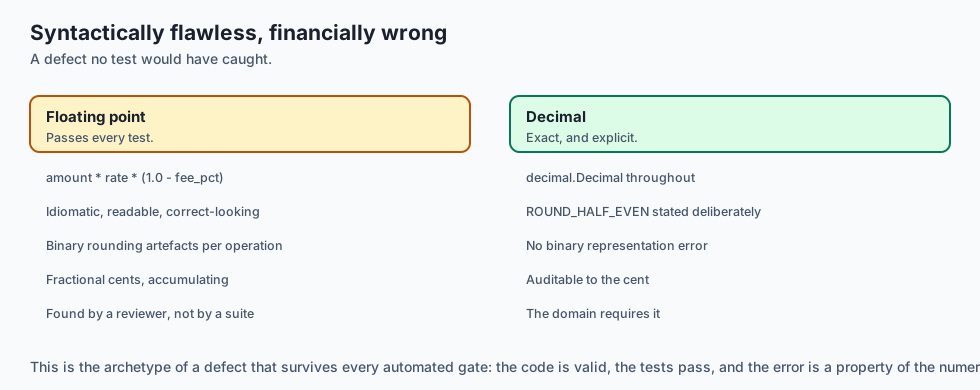
In a high-throughput foreign exchange trading platform, an AI coding agent was asked to implement a currency conversion fee calculator. The agent produced syntactically flawless Python code utilizing standard IEEE 754 floating-point arithmetic (amount * rate * (1.0 - fee_pct)).
- During human code review, the senior engineer noticed that floating-point operations introduce subtle binary rounding artifacts (e.g.
0.1 + 0.2 != 0.3). - In high-volume currency trading, fractional cent rounding errors accumulate into significant financial discrepancies.
- The review gate rejected the pull request and directed the agent to refactor the entire module using Python’s
decimal.Decimalwith explicitROUND_HALF_EVENbankers rounding mode.
The AI connection
-
Fluency is not correctness, and models are extremely fluent. Impeccable formatting and confident docstrings are exactly what makes a bad diff hard to reject.
-
The bottleneck moved from authoring to review, which means review capacity is now the constraint on how fast a team can safely ship.
-
A passing test proves less than it used to. If the model wrote the test as well, mutation testing is the only thing that says the assertions are real.
-
Slopsquatting is an AI-specific supply-chain attack — attackers register the names models predictably hallucinate, and the import looks entirely ordinary.
-
Models optimise toward clean-looking code, and edge-case guards are what looks untidy, so “optimise this” is the request most likely to delete a leap-year check.
Knowledge check
- What is Plausibility Bias? The human cognitive bias to assume cleanly formatted AI code is logically correct without deep verification.
- What is Package Slopsquatting? The security threat where attackers register hallucinated package names on public registries to execute supply chain attacks.
- How does Mutation Testing validate test quality? By injecting deliberate bugs into code to verify that the test suite fails when defects are present.
Hands-on exercise
In this lab, you will implement an AI Code Review & Security Scanner in Python. Your implementation will:
- Parse Python source files using the
astmodule. - Flag dangerous shell executions (
os.system,os.popen). - Audit import statements against an approved package whitelist to prevent slopsquatting.
- Detect weak tautological assertions (
assert True) in test files. - Verify defect detection across automated pytest tests.
Expected output
============================= test session starts ==============================
collected 5 items

tests/test_code_review.py .....                                          [100%]

============================== 5 passed in 0.02s ===============================
[SECURITY SCAN] Scanned 3 files.
[DETECTED ISSUES] Flagged 1 unapproved dependency ('hallucinated_auth') and 1 os.system call.
[STATUS] Code review gate successfully blocked unsafe PR.
Validate your work
Run the pytest test suite:
pytest tests/run_tests.shTroubleshooting
- AST parse error: Ensure target source files contain valid Python syntax.
- Standard library package flagged: Add standard modules (
sys,os,math) to the approved package list.
Common mistakes
- Merging pull requests where AI agents added new unreviewed dependencies to
requirements.txt.
Practice assignment
Extend the scanner to detect Hardcoded Secrets & API Keys matching regex patterns like sk-ant-api[a-zA-Z0-9_-]{20,}.
Extension challenge
Implement an automated Mutation Testing Runner in Python that programmatically inverts > to <= and == to != in source files and asserts that test suites exit with code 1.
Quiz
Q1. What is the phenomenon of 'Plausibility Bias' when reviewing AI-generated code?
- A compiler error in Python 3.12
- A hardware failure in GPU memory
- Clean formatting makes reviewers trust flawed logic
- An encryption protocol
Show answer
Answer: C. Clean formatting makes reviewers trust flawed logic
Plausibility bias occurs when clean formatting masks dangerous underlying logical or security defects.
Q2. What is 'Package Slopsquatting' (hallucinated dependency vulnerability) in AI code generation?
- When an agent writes code too fast
- A type of CSS animation
- A database compression algorithm
- The model invents a package an attacker can then publish
Show answer
Answer: D. The model invents a package an attacker can then publish
Attackers register hallucinated package names on public registries to execute supply chain attacks.
Q3. How should a reviewer verify that an agent's newly written unit tests are actually testing the business logic rather than trivially passing?
- Break the implementation and check the tests fail
- Check if the file is green in git
- Delete the test file
- Run the tests again with a higher GPU memory limit
Show answer
Answer: A. Break the implementation and check the tests fail
Mutation testing validates that test suites catch real bugs rather than containing tautological `assert True` assertions.
Q4. Which automated verification tools should gate every AI-generated pull request before human merge?
- Only an email notification
- Linters, type checks, security scans, and tests
- No tools are needed if the model is large enough
- A spell checker
Show answer
Answer: B. Linters, type checks, security scans, and tests
Multi-layer automated quality gates catch static, dynamic, and security flaws before human review.
Q5. Why is verifying time-complexity and resource consumption crucial when reviewing AI-written algorithms?
- It reduces disk usage
- Python does not support these algorithms at all
- It often writes O(N^2) where O(N) exists
- It makes git commits smaller
Show answer
Answer: C. It often writes O(N^2) where O(N) exists
Models prioritize syntax completion over algorithmic efficiency, frequently introducing performance bottlenecks.
Glossary
- Plausibility Bias
- Accepting flawed code because its syntax, formatting, and docstrings appear highly professional.
- Package Slopsquatting
- Supply chain attack vector where attackers register hallucinated package names on public registries.
- Mutation Testing
- Injecting deliberate bugs into code to verify that test suites accurately catch and fail on defects.
- Superficial Assertion
- A weak test assertion (e.g. `assert res is not None`) that passes without validating correctness.
- Dependency Auditing
- Verifying all imported packages exist in approved manifest files and contain no known CVEs.
- Silent Regression
- When an agent subtly breaks existing edge-case handling without triggering syntax errors.
- Bandit Security Scanner
- A static analysis tool designed to find common security issues in Python source code.
- Quality Gate Pipeline
- An automated CI suite of type checking, linting, security scans, and test suites gating PR merges.
Sources and further reading
- Large Language Models for Code: A Survey of Security Vulnerabilities (Pearce et al., 2022) — IEEE S&P (accessed 2026-08-30)
- Package Slopsquatting: Attacks on Hallucinated AI Dependencies (Lanyado, 2023) — Vulcan Cyber (accessed 2026-08-30)
- Mutation Testing in Practice (Jia & Harman, 2011) — IEEE TSE (accessed 2026-08-30)
Kept in this browser, no account needed. Your progress page turns the whole record into one link you can bookmark or open on another device.