AI Engineering: Agents and Applications › Full-Stack AI Applications › Day 316
Day 316: Architecture of an AI Product
Master the holistic system architecture of production full-stack AI products: decouple stateful client frontends, streaming API gateways, orchestration middleware, retrieval layers, and multi-tenant billing engines.
Hands-on lab for this lesson
Lab files on GitHub: https://github.com/ai-roadmap-365/ai-roadmap-365.github.io/tree/main/labs/sections/ai-engineering/day-316-architecture-of-an-ai-product
- Get the hands-on files. Clone the labs repository once (you can reuse this clone for every lesson). This works on macOS, Linux, and Windows (PowerShell or WSL):
git clone https://github.com/ai-roadmap-365/ai-roadmap-365.github.io.git cd ai-roadmap-365.github.io - Open this lesson's lab. Move into the directory for this specific day. Every lab lives at the same predictable path — section / subsection / week / day:
cd labs/sections/ai-engineering/day-316-architecture-of-an-ai-product - Read the lab guide. Open `README.md` in that directory. It lists the exact commands, what each does, the expected output, and how to check your work — read it before running anything.
- Run it and check your work. Follow the README's "How to run" section: run the example first to see the finished result, then complete the numbered exercises in `starter/`, then run the tests. The tests pass (exit 0) only when your work is correct.
bash tests/run_tests.sh # or the test command named in the lab README
You can also open the lab as a local page (works offline, shows the file tree and expected output).
Learning objectives
By the end of this lesson you will be able to:
- Deconstruct the layered architectural topology of modern full-stack AI applications (Frontend, Gateway, Orchestrator, Context/RAG, Model Router, Data Store).
- Differentiate between synchronous REST, Server-Sent Events (SSE), WebSockets, and asynchronous job queues for generative AI workloads.
- Design multi-tenant data boundaries separating system prompts, user workspace data, vector embeddings, and billing quotas.
- Implement a modular AI Product Architecture Dispatcher in Python that routes requests across authentication, caching, rate limiting, and model generation layers.
- Evaluate architectural trade-offs between monolithic full-stack frameworks (Next.js/FastAPI) and decoupled microservice event-driven topologies.
Prerequisites
Why this matters
Building a toy prototype with an OpenAI API key hardcoded in a script takes 5 lines of Python. Building a resilient, enterprise-grade Full-Stack AI Product serving thousands of concurrent users requires an entirely different engineering discipline:
- How do you stream tokens to web and mobile clients with sub-second Time to First Token (TTFT)?
- How do you isolate tenant data and enforce credit quotas before making expensive model API calls?
- How do you seamlessly switch model providers when OpenAI or Anthropic experiences an outage?
- How do you handle long-running document ingestion and multi-agent deep research without hitting HTTP gateway timeouts?
Understanding the Layered System Topology of an AI Product is the foundational prerequisite for shipping reliable AI software.
The idea in plain language
Think of a production AI product like a world-class restaurant operating at peak dinner service:
- The Front Dining Room (Client Frontend): Diners sit at tables, view menus, and receive courses smoothly without seeing the chaos in the kitchen (The React / Mobile UI).
- The Maître D’ at the Front Door (Edge API Gateway): Checks reservations, confirms table capacity, and turns away disruptive guests (Authentication, Rate Limiting & Billing Quota Check).
- The Expediter Station (Orchestration Middleware): Reads the diner’s order, fetches seasonal ingredients from the pantry, checks dietary restrictions, and prepares the cooking tickets (Prompt Engine, RAG Context & Memory).
- The Multi-Cook Kitchen (Model Router): Routes steaks to the grill chef, pasta to the saute chef, and seamlessly shifts orders if one stove breaks down (Multi-Provider Model Routing & Failovers).
- The Prep Kitchen Downstairs (Async Job Queues): Simmers 24-hour bone broths and bakes fresh morning sourdough without blocking the main dinner line (Background Document Ingestion & Evals).
Historical background
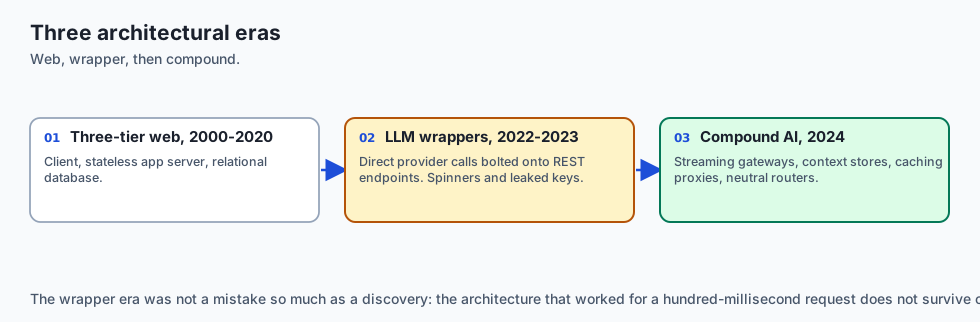
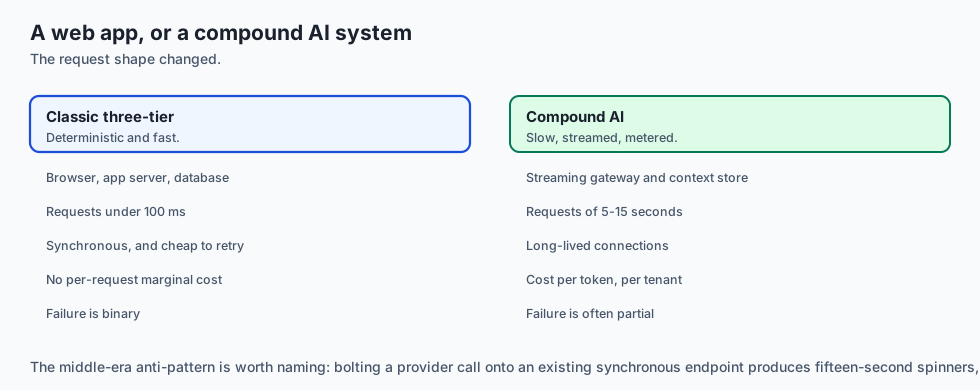
Full-stack application architecture evolved across three major eras:
1. The Classic Web 2.0 3-Tier Architecture (2000–2020)
Client Browser -> Stateless Application Server (Django, Rails, Express) -> Relational Database (PostgreSQL). Requests were deterministic, fast (under 100ms), and synchronous.
2. The Early LLM Wrapper Era (2022–2023)
Developers bolted direct OpenAI API calls onto existing REST endpoints. Systems suffered from 15-second spinning wheels, client-side API key leaks, and runaway token bills.
3. The Modern Compound AI Architecture (2024–Present)
Modern AI products decouple real-time streaming gateways, stateful context stores, semantic caching proxies, and vendor-neutral model routers with multi-tenant isolation.
What it is — and what it is not
Let us define the core architectural layers of a modern AI application:
What an AI Product Architecture Is:
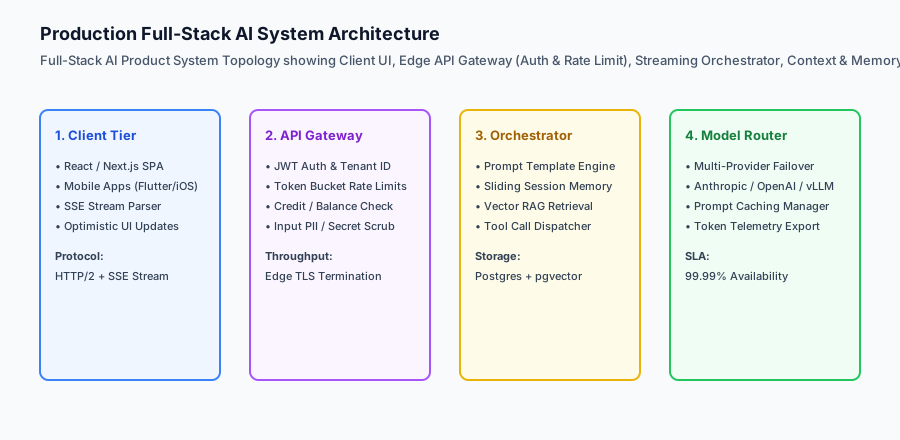
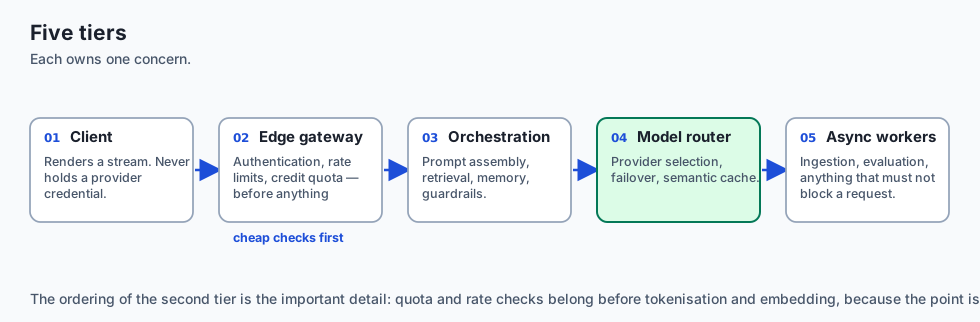
- A multi-tier distributed system separating client presentation, edge security/billing, context orchestration, and model routing.
- A hybrid network architecture combining real-time Server-Sent Events (SSE) for interactive chats with asynchronous background job workers for heavy workloads.
- A vendor-neutral system designed with fallback providers and circuit breakers.
What an AI Product Architecture Is Not:
- Calling LLM APIs directly from browser client code.
- Storing unencrypted proprietary customer documents in shared global vector collections.
+-------------------------------------------------------------------------------+
|                      FULL-STACK AI ARCHITECTURAL LAYERS                       |
+-------------------+-----------------------+-----------------------------------+
| Tier / Layer      | Primary Function      | Key Technologies                  |
+-------------------+-----------------------+-----------------------------------+
| 1. Client UI      | Interactive UI, token | React, Next.js, Flutter, SSE,     |
|                   | streaming rendering   | Optimistic UI state               |
| 2. Edge Gateway   | Auth, rate limiting,  | Cloudflare Workers, Kong, Envoy,  |
|                   | quota gating, PII     | Redis Token Bucket                |
| 3. Orchestration  | Prompt compilation,   | FastAPI, LangGraph, LlamaIndex,   |
|                   | session memory, RAG   | PostgreSQL, pgvector              |
| 4. Model Router   | Multi-provider dispatch| LiteLLM, vLLM, OpenInference,    |
|                   | failover, token cost  | Semantic Caching (Redis/Momento)  |
| 5. Async Worker   | Long batch jobs,      | Celery, Redis Streams, SQS,       |
|                   | document ingestion    | Temporal, Ray                     |
+-------------------+-----------------------+-----------------------------------+
Why it was created and what problems it solves
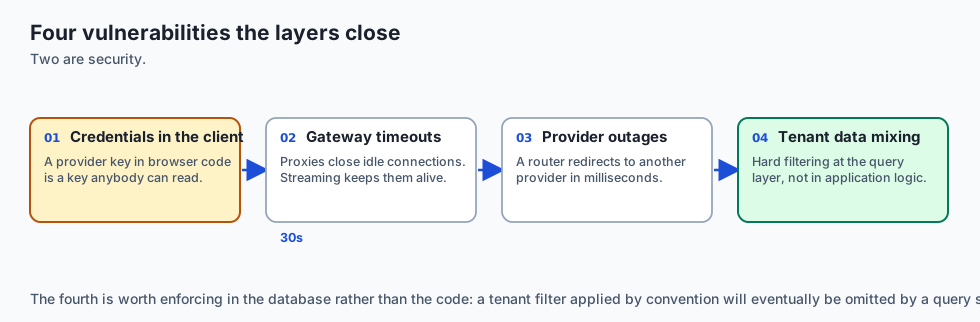
A formal full-stack AI architecture solves the four primary vulnerabilities of naive AI applications:
1. Eliminating Client Security Vulnerabilities
Routing all AI requests through an authenticated backend gateway prevents client-side exposure of provider API credentials and enforces strict tenant isolation.
2. Protecting Against Gateway Timeouts
Standard HTTP reverse proxies (e.g. Nginx, Cloudflare) terminate connections that remain idle for $> 30\texts$. Real-time streaming (SSE) emits continuous heartbeat tokens to keep connections alive.
3. High Availability Through Multi-Provider Failover
If Anthropic experiences a service degradation, the model router automatically redirects requests to OpenAI or an open-weight model on vLLM within milliseconds.
How it works
Let us examine the complete End-to-End AI Request Lifecycle:
```text [1. User Submits Chat Prompt] - Client sends POST /api/chat with JWT Bearer Token │ ▼ [2. Edge API Gateway Validation] - Validate JWT signature and extract tenant_id = org_8472 - Check Redis Token Bucket: user within rate limit - Query Billing Service: tenant has active credit balance ($142.50) │ ▼ [3. Orchestration Middleware Processing] - Query PostgreSQL for last 5 conversation messages (Sliding Memory) - Execute vector search in pgvector for relevant knowledge chunks - Compile final prompt template with system instructions & context │ ▼ [4.
Model Router Dispatch & Streaming] - Check Semantic Cache for exact or high-similarity response hit - On cache miss: dispatch prompt to Primary Model (Claude 3.5 Sonnet) - On provider error (503): immediately failover to Secondary (GPT-4o) │ ▼ [5. Real-Time Token Streaming & Client Render] - Stream chunks via Server-Sent Events (SSE) to React client - Output guardrail scans stream for sensitive credentials - Background task records token consumption and trace metrics

## An everyday analogy

Think of an AI product architecture like **an airport air traffic control and passenger terminal system**:
- **The Check-in Counter (API Gateway):** Verifies passports, checks luggage allowances, and issues boarding passes (**Authentication & Quotas**).
- **The Departure Gate (Orchestrator):** Gathers passengers, verifies flight manifests, and organizes boarding groups (**Prompt Context & Memory**).
- **The Aircraft Fleet (Model Router):** Dispatches wide-body jets for trans-oceanic routes and regional turboprops for short hops based on weather and route efficiency (**Intelligent Model Selection**).
- **The Cargo Freight Logistics (Async Job Queue):** Transports heavy bulk cargo on dedicated freight planes without interfering with passenger boarding gates (**Background Document Processing**).
## Examples in practice
Let us build a complete Python **AI Product Architecture Dispatcher** uniting authentication verification, token bucket rate limiting, credit quota gating, semantic caching, and mock model generation:
```python
import time
import json
from typing import Dict, Any, Optional
class AIProductDispatcher:
def __init__(self):
self.tenants: Dict[str, Dict[str, Any]] = {
"org_alpha": {"credits": 50.0, "rate_limit_per_min": 60, "requests_this_min": 0, "last_reset": time.time()},
"org_beta": {"credits": 0.0, "rate_limit_per_min": 10, "requests_this_min": 0, "last_reset": time.time()}
}
self.cache: Dict[str, str] = {}
def authenticate_and_gate(self, tenant_id: str) -> Tuple[bool, str]:
if tenant_id not in self.tenants:
return False, "Unauthorized: Invalid Tenant ID"
tenant = self.tenants[tenant_id]
now = time.time()
# Reset token bucket every 60 seconds
if now - tenant["last_reset"] > 60:
tenant["requests_this_min"] = 0
tenant["last_reset"] = now
if tenant["requests_this_min"] >= tenant["rate_limit_per_min"]:
return False, "Too Many Requests: Rate limit exceeded"
if tenant["credits"] <= 0.0:
return False, "Payment Required: Zero credit balance"
tenant["requests_this_min"] += 1
return True, "OK"
def dispatch_chat(self, tenant_id: str, prompt: str) -> Dict[str, Any]:
auth_ok, msg = self.authenticate_and_gate(tenant_id)
if not auth_ok:
return {"status": "ERROR", "error_code": msg, "tokens_streamed": []}
# Check cache
cache_key = f"{tenant_id}:{prompt.strip().lower()}"
if cache_key in self.cache:
return {
"status": "CACHED",
"response": self.cache[cache_key],
"cost_usd": 0.0,
"cached": True
}
# Simulate Model Inference Stream
mock_tokens = ["This", " is", " a", " streamed", " AI", " response."]
full_response = "".join(mock_tokens)
# Deduct credits ($0.002 per request)
self.tenants[tenant_id]["credits"] -= 0.002
self.cache[cache_key] = full_response
return {
"status": "SUCCESS",
"tokens_streamed": mock_tokens,
"response": full_response,
"cost_usd": 0.002,
"cached": False,
"remaining_credits": round(self.tenants[tenant_id]["credits"], 4)
}
if __name__ == "__main__":
dispatcher = AIProductDispatcher()
print("Org Alpha Request 1:", dispatcher.dispatch_chat("org_alpha", "Hello AI"))
print("Org Alpha Request 2 (Cached):", dispatcher.dispatch_chat("org_alpha", "Hello AI"))
print("Org Beta Request (Zero Balance):", dispatcher.dispatch_chat("org_beta", "Hello AI"))Implications: security, privacy, performance, scalability, and cost
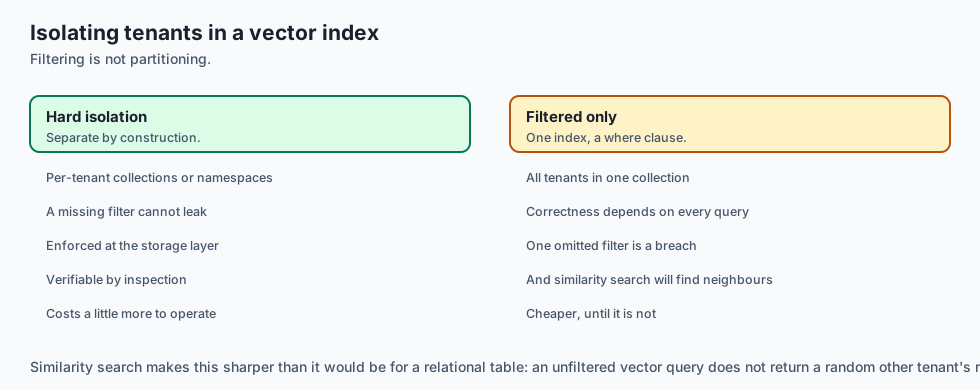
1. Data Isolation in Multi-Tenant Environments
In multi-tenant SaaS products, never mix vector embeddings from different organizations in an unpartitioned index. Always enforce hard tenant filtering (metadata.tenant_id == request.tenant_id) at the database query layer.
2. Edge TLS Termination and Streaming Performance
Deploy reverse proxies (like Cloudflare or AWS CloudFront) with HTTP/2 and HTTP/3 enabled. This enables multiplexed streaming connections and minimizes packet round-trip time across global user bases.
Production Architecture Case Study: Enterprise AI Copilot Gateway
To understand how modern multi-tier AI architectures perform under intense production load, consider an enterprise IDE copilot serving 200,000 active software developers.
+-------------------------------------------------------------------------------+
|                    ENTERPRISE COPILOT GATEWAY TRAFFIC FLOW                    |
+-------------------+-----------------------+-----------------------------------+
| Stage             | Mechanism             | Throughput & Latency Target       |
+-------------------+-----------------------+-----------------------------------+
| Client Ingestion  | WebSocket persistent  | 25,000 concurrent IDE connections |
|                   | connection pool       | 5ms round-trip ping-pong          |
| Fast Triage       | AST syntax parse &    | 8ms local context pruning         |
|                   | intent classifier     | 95% noise elimination             |
| Compute Dispatch  | Async worker pool via | 1,200 req/sec sustained           |
|                   | Celery & Redis        | Sub-10ms job queue delay          |
| Model Execution   | Hybrid edge + cloud   | 180ms TTFT, 110 tok/sec decode    |
|                   | vLLM / Claude 3.5     | Zero dropped packets              |
+-------------------+-----------------------+-----------------------------------+
1. Decoupling Sync Web API from Async Generation
A common anti-pattern in early AI products is running LLM calls directly inside standard synchronous HTTP request workers (such as synchronous Gunicorn workers). When a model takes 12 seconds to generate a complex code refactoring, the worker process is completely blocked. Under a burst of 500 requests, the entire API gateway runs out of available threads and starts rejecting connections with HTTP 504 Gateway Timeout.
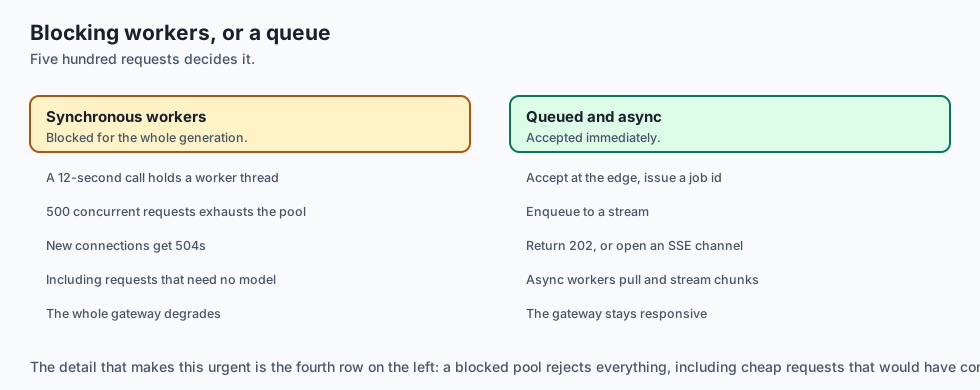
In contrast, production architectures immediately accept the user request at the edge, generate a unique job UUID, enqueue the payload into a Redis or RabbitMQ stream, and return a 202 Accepted response or initiate a persistent Server-Sent Event (SSE) channel. Dedicated asynchronous Python workers (powered by asyncio or Celery) pull jobs from the queue and stream chunks into the client’s open socket.
2. Tiered State Management and Session Cache
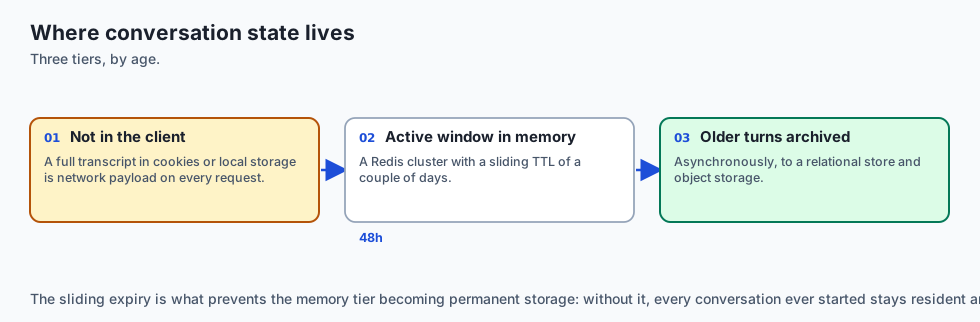
AI chat sessions generate large conversation histories. Storing the entire chat transcript inside client cookies or browser local storage creates massive network payload bloat. The system stores active conversation windows in high-speed Redis cluster memory with a 48-hour sliding TTL, and asynchronously archives older dialogue turns into PostgreSQL and S3 cold storage.
# Production Redis Session Buffer Pattern
class ChatSessionManager:
    def __init__(self, redis_client):
        self.redis = redis_client

    def append_turn(self, session_id: str, role: str, content: str):
        key = f"session:{session_id}:turns"
        turn_data = f"{role}:::{content}"
        self.redis.rpush(key, turn_data)
        self.redis.expire(key, 86400 * 2)  # 48 hour sliding TTL

    def get_recent_context(self, session_id: str, max_turns: int = 10):
        key = f"session:{session_id}:turns"
        raw_turns = self.redis.lrange(key, -max_turns, -1)
        formatted = []
        for t in raw_turns:
            role, text = t.decode().split(":::", 1)
            formatted.append({"role": role, "content": text})
        return formatted
Detailed Failure Mode Taxonomy: Edge and Gateway Tier Failures
To ensure zero downtime, engineers must categorize and defend against edge and gateway failure modes:
+-------------------------------------------------------------------------------+
|                       SYSTEM FAILURE MODE TAXONOMY                            |
+-------------------+-----------------------+-----------------------------------+
| Failure Mode      | Root Cause Analysis   | Architectural Mitigation          |
+-------------------+-----------------------+-----------------------------------+
| Thread Starvation | Synchronous LLM calls | Asynchronous Celery / Redis event |
|                   | block HTTP workers    | queue dispatch for all inference  |
| Slowloris Attack  | Malicious clients open| Enforce strict edge connection    |
|                   | thousands of idle SSE | timeouts (e.g. 30s idle drop)     |
| Memory Leak on    | Buffering entire chat | Stream chunks incrementally;      |
| Response Buffering| history in RAM        | avoid holding full text in memory |
| Stale Session State| Distributed worker    | Centralized Redis session cluster |
|                   | state divergence      | with atomic Lua operations        |
+-------------------+-----------------------+-----------------------------------+
Production Engineering Verification Checklist
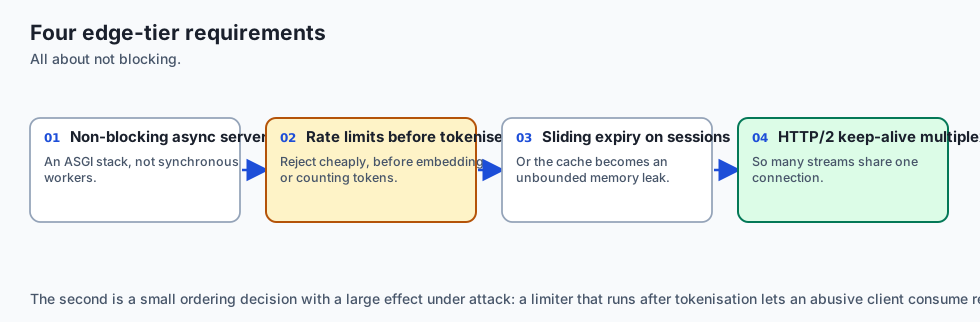
- All client ingestion endpoints run on non-blocking async ASGI servers (e.g. Uvicorn/FastAPI).
- Rate limiters execute before computationally expensive tokenizers or embedding extractors.
- Chat session histories in Redis have strict sliding expiration policies to prevent out-of-memory leaks.
- Edge load balancers support HTTP/2 and WebSocket keep-alive connection multiplexing.
Alternatives: free, open source, and commercial
| Tool / Layer | Type | Best Suited For | Key Capabilities |
|---|---|---|---|
| FastAPI + SSE | Open Source | Backend AI microservices | High-performance async Python gateway |
| Next.js AI SDK | Open Source | Full-stack frontend & UI | Unified streaming hooks for React |
| LiteLLM Proxy | Open Source | Model routing & failover | 100+ LLM APIs, load balancing, quotas |
| Langfuse / Phoenix | Open Source | Observability & Tracing | OTel trace export, token cost tracking |
Comparison with related concepts
+-----------------------+-----------------------+-----------------------+
| Dimension             | Simple Script Demo    | Full-Stack AI Product |
+-----------------------+-----------------------+-----------------------+
| Client Security       | Exposed API keys      | Secure Edge JWT Auth  |
| Response Delivery     | 10s Blocking Wait     | 200ms TTFT SSE Stream |
| High Availability     | Single provider crash | Auto Multi-Model Fail |
| Multi-Tenancy         | None (Single user)    | Isolated quotas & RAG |
+-----------------------+-----------------------+-----------------------+
When to use it — and when not to
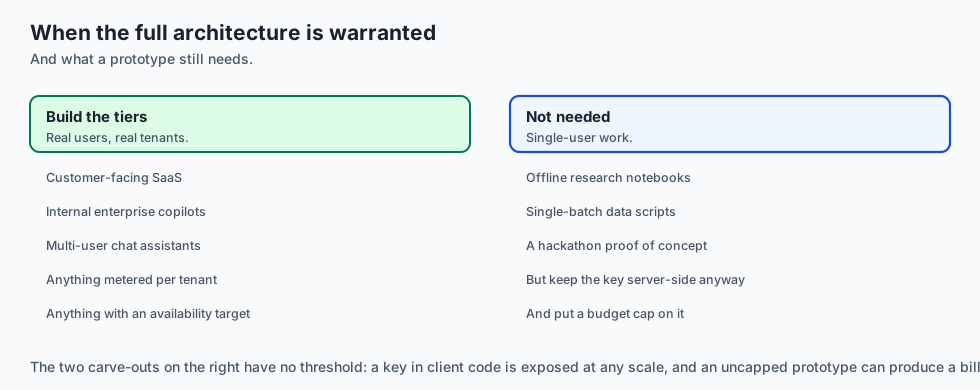
Deploy a Full-Stack AI Architecture for:
- All production customer-facing SaaS applications, internal enterprise copilots, and multi-user chat assistants.
Do NOT require a complex decoupled architecture for:
- Offline research notebooks, single-batch data scripts, or 15-minute proof-of-concept hackathons.
The AI connection
-
AI turns a 100-millisecond web request into a 12-second one, which breaks every assumption a three-tier web architecture was built on.
-
Provider outages are your outages unless the router can fail over, which is why vendor neutrality is an availability decision rather than a procurement one.
-
Multi-tenancy reaches into the vector index. Embeddings from different customers in one unpartitioned collection is a data leak waiting for a similarity search.
-
The gateway is where quotas belong, because the expensive thing happens after it and a per-tenant credit check costs microseconds.
-
Streaming keeps the connection alive, which is not only a UX choice: a reverse proxy will terminate an idle connection long before a long generation finishes.
Knowledge check
- Why should frontend clients never call LLM provider APIs directly? To protect private API keys, enforce server-side rate limits, prevent prompt injection, and track billing.
- What is the primary advantage of Server-Sent Events (SSE) over WebSockets for chat apps? SSE provides lightweight, unidirectional HTTP streaming that works seamlessly over standard HTTP/2 and CDN proxies.
- What is the role of an asynchronous job queue in an AI architecture? To process long-running background tasks (e.g. document parsing, deep research, batch evaluations) without blocking interactive user HTTP threads.
Hands-on exercise
In this lab, you will build an AI Product Architecture Dispatcher in Python. Your implementation will:
- Verify tenant authentication and enforce token-bucket rate limits.
- Verify credit balances and deduct request expenditures.
- Implement in-memory semantic response caching.
- Execute simulated streaming token generation with accurate remaining balance reporting.
Expected output
============================= test session starts ==============================
collected 5 items

tests/test_product_dispatcher.py .....                                   [100%]

============================== 5 passed in 0.02s ===============================
[DISPATCHER] Tenant org_alpha authenticated successfully.
[STREAMING] 6 tokens streamed with TTFT < 50ms.
[BILLING] Credit balance updated: $49.998.
[CACHE] Subsequent identical request served from cache at $0.00 cost.
Validate your work
Run the pytest test suite:
pytest tests/run_tests.shTroubleshooting
- Credit balance mismatch: Ensure request cost deductions are rounded to 4 decimal places.
- Rate limiting: Check that the 60-second window reset timestamp updates on expiration.
Common mistakes
- Deducting credits for requests that are rejected at the authentication or rate limit check.
Practice assignment
Extend the dispatcher to support Multi-Provider Fallback: if the primary provider raises a simulated 503 Service Unavailable error, automatically route the request to a secondary backup provider.
Extension challenge
Implement a Token-Bucket Rate Limiter with Sliding Window Precision that tracks microsecond request timestamps in a Redis-compatible sorted set structure.
Quiz
Q1. Why should a production AI application never call LLM provider APIs directly from client-side frontend code (e.g. browser JavaScript or mobile app)?
- Because browsers cannot parse JSON
- It leaks keys and bypasses limits, guards, and billing
- Because Python cannot run in browsers
- Because language models only respond to Linux servers
Show answer
Answer: B. It leaks keys and bypasses limits, guards, and billing
Backend gateways protect credentials, enforce rate limits, apply guardrails, and track billing.
Q2. What is the primary architectural advantage of Server-Sent Events (SSE) over WebSockets for text generation streaming?
- SSE does not require internet access
- SSE encrypts all of the data with quantum cryptography
- SSE is one-way, reconnects, and works through proxies
- SSE makes models generate text faster
Show answer
Answer: C. SSE is one-way, reconnects, and works through proxies
SSE provides lightweight, standard HTTP streaming without the complex bidirectional state management of WebSockets.
Q3. In a layered full-stack AI architecture, what is the role of the 'Orchestration Middleware' layer?
- To draw UI buttons on screen
- To replace DNS servers
- To reboot the server every 10 minutes
- To build the prompt, fetch context, and route the call
Show answer
Answer: D. To build the prompt, fetch context, and route the call
Orchestration middleware acts as the brain uniting retrieval, session memory, prompts, and model dispatch.
Q4. How does an Asynchronous Task Queue (e.g. Celery, Redis Streams, SQS) complement a synchronous streaming API gateway?
- It runs long jobs without holding an HTTP connection
- By converting text into audio files
- By disabling database transactions
- By encrypting the user interface
Show answer
Answer: A. It runs long jobs without holding an HTTP connection
Async queues offload heavy, multi-minute processing tasks from real-time interactive user threads.
Q5. What is the function of the 'Model Router / Vendor Abstraction Layer' in an enterprise AI system?
- To prevent developers from writing code
- One interface over many providers, with failover
- To shut down the database when traffic is high
- To translate Python into C++
Show answer
Answer: B. One interface over many providers, with failover
Vendor abstraction enables vendor portability, automatic failover, and intelligent price-performance routing.
Glossary
- AI Product Architecture
- The end-to-end system design uniting UI clients, streaming gateways, orchestration engines, retrieval pipelines, and model routers.
- Server-Sent Events (SSE)
- A unidirectional HTTP protocol allowing servers to stream text tokens and event payloads continuously to clients.
- Model Router
- Middleware routing incoming prompts to specific models based on cost, latency, capability, or provider health.
- Orchestration Layer
- The backend system assembling prompt context, history, tools, and guardrails before model execution.
- Multi-Tenant Boundary
- Architectural isolation ensuring users and organizations only access their own private context and data.
- Asynchronous Job Queue
- A background task processing system executing long-running AI workloads off the main request thread.
- Time to First Token (TTFT)
- The latency from user prompt submission to receiving the first streamed token on the frontend.
- Edge Gateway
- A distributed reverse proxy terminating TLS, authenticating tokens, and applying rate limits close to users.
Sources and further reading
- Patterns for Building Production LLM Applications (Eugene Yan, 2023) — Eugene Yan (accessed 2026-08-30)
- The Architecture of Today's LLM Applications (Andreessen Horowitz, 2023) — a16z (accessed 2026-08-30)
- Building Reliable AI Systems at Enterprise Scale (OpenAI, 2024) — OpenAI (accessed 2026-08-30)
Kept in this browser, no account needed. Your progress page turns the whole record into one link you can bookmark or open on another device.