AI Engineering: Agents and Applications › Full-Stack AI Applications › Day 319
Day 319: Auth, Quotas, and Billing
Master multi-tenant authentication, token-level billing, credit pre-authorization, and tiered rate limiting: design Stripe meter integration, token-budget enforcement, and tenant isolation in Python.
Hands-on lab for this lesson
Lab files on GitHub: https://github.com/ai-roadmap-365/ai-roadmap-365.github.io/tree/main/labs/sections/ai-engineering/day-319-auth-quotas-and-billing
- Get the hands-on files. Clone the labs repository once (you can reuse this clone for every lesson). This works on macOS, Linux, and Windows (PowerShell or WSL):
git clone https://github.com/ai-roadmap-365/ai-roadmap-365.github.io.git cd ai-roadmap-365.github.io - Open this lesson's lab. Move into the directory for this specific day. Every lab lives at the same predictable path — section / subsection / week / day:
cd labs/sections/ai-engineering/day-319-auth-quotas-and-billing - Read the lab guide. Open `README.md` in that directory. It lists the exact commands, what each does, the expected output, and how to check your work — read it before running anything.
- Run it and check your work. Follow the README's "How to run" section: run the example first to see the finished result, then complete the numbered exercises in `starter/`, then run the tests. The tests pass (exit 0) only when your work is correct.
bash tests/run_tests.sh # or the test command named in the lab README
You can also open the lab as a local page (works offline, shows the file tree and expected output).
Learning objectives
By the end of this lesson you will be able to:
- Architect multi-tenant authentication and authorization models (API keys, JWT scopes, organization RBAC) for AI platforms.
- Implement Token Bucket and Sliding Window rate limiting algorithms for requests-per-minute (RPM) and tokens-per-minute (TPM).
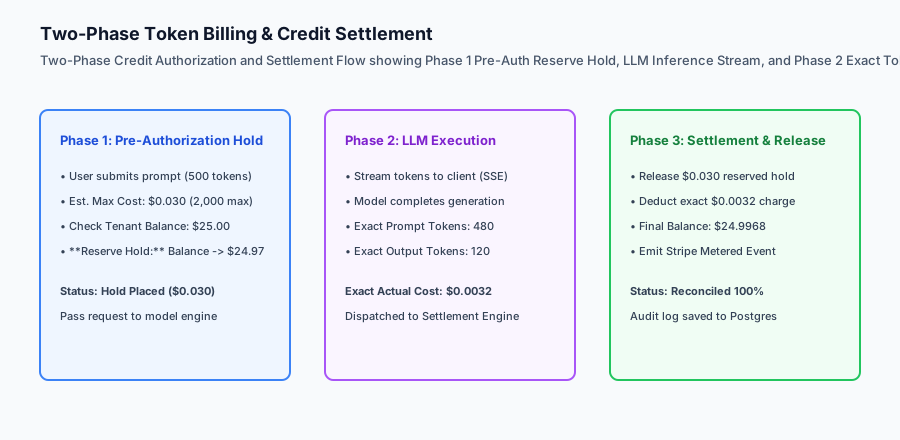
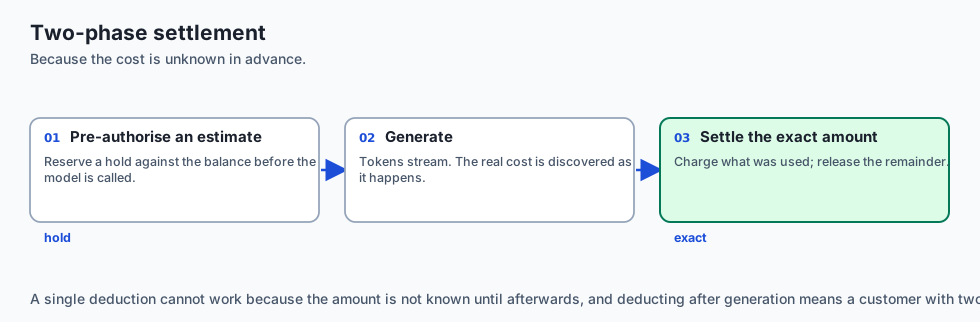
- Design Credit Pre-Authorization reserving estimated token costs before LLM invocation and settling exact token charges upon completion.
- Build a production-grade Auth, Quotas & Billing Engine in Python supporting API key hashing, credit reservations, token settlement, and tier-based rate limiting.
- Integrate metered usage pipelines with billing aggregators (e.g. Stripe Metered Billing / Lago).
Prerequisites
Why this matters
Deploying a generative AI product to the public without robust authentication, rate limiting, and credit governance is a recipe for instant financial disaster. Malicious actors or runaway recursive agent scripts can consume thousands of dollars in GPU token bills in minutes.
- How do you securely authenticate API clients and hash secret keys?
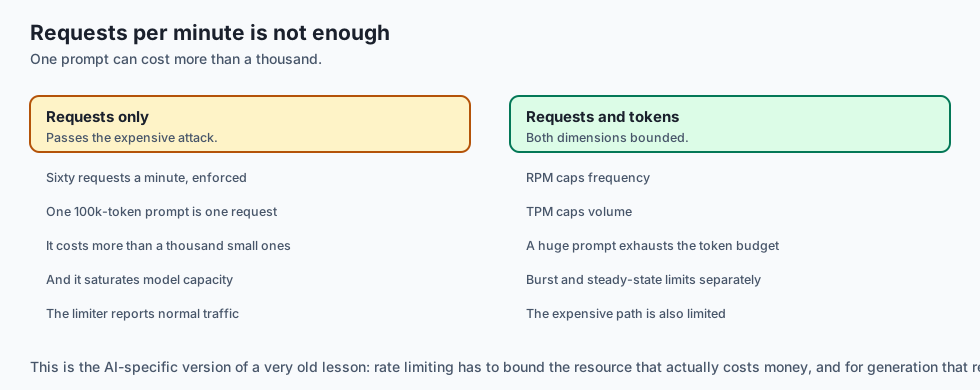
- How do you enforce dual rate limits (Requests Per Minute and Tokens Per Minute)?
- How do you guarantee that a user with $0.02 remaining on their balance cannot trigger a $2.50 long-context generation?
In this lesson, we master Multi-Tenant Authentication, Token Quotas, and Two-Phase Credit Settlement: the infrastructure that protects your AI application from fraud and powers usage-based monetization.
The idea in plain language
Think of AI token billing like pumping gasoline at a self-service gas station:
- Card Swipe & Pre-Auth (Phase 1: Pre-Authorization): When you insert your credit card into the pump, the station places a temporary $100 hold on your card (Checking Balance & Reserving Funds). If your card has only $3.00 available, the pump locks automatically and refuses to dispense fuel (Preventing Fraud).
- Dispensing Fuel (Phase 2: Model Inference Stream): You pump exactly $24.50 worth of gasoline into your tank (Exact Token Generation).
- Final Settlement (Phase 3: Settlement): The pump releases the $100 temporary hold and charges your card exactly $24.50 (Reconciling Actual Usage).
Historical background
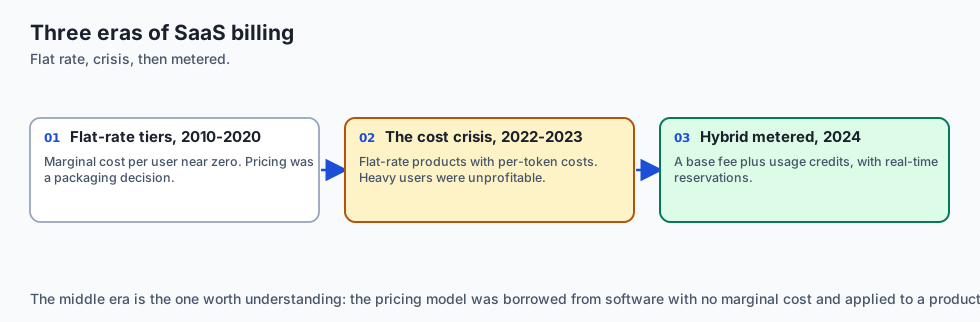
SaaS monetization and API authentication progressed through three major generations:
1. Flat-Rate Subscription Tiering (2010–2020)
Users paid $20/month for unlimited CRUD database operations. Computational cost per user was fractions of a cent, making flat-rate pricing sustainable.
2. The Early LLM Cost Crisis (2022–2023)
Startups offered flat $20/month access to frontier LLMs. Power users generated millions of tokens per day, causing companies to lose $100+ per month per subscriber.
3. Modern Metered Token Economics (2024–Present)
Modern AI companies implement hybrid billing: a monthly base platform fee paired with metered token usage credits, enforced via real-time two-phase credit reservations (Stripe Metering, Lago, Octane).
What it is — and what it is not
Let us define the core components of AI billing and quota infrastructure:
What AI Auth & Billing Is:
- Cryptographically hashed API key verification with organization and tenant scoping.
- Dual-rate limiting tracking both request frequency (RPM) and token volume (TPM) in sliding memory.
- A two-phase transaction pipeline: pre-authorizing an estimated credit hold before LLM invocation, and settling exact token counts upon completion.
What AI Auth & Billing Is Not:
- Deducting credits before knowing whether the model successfully finished or crashed.
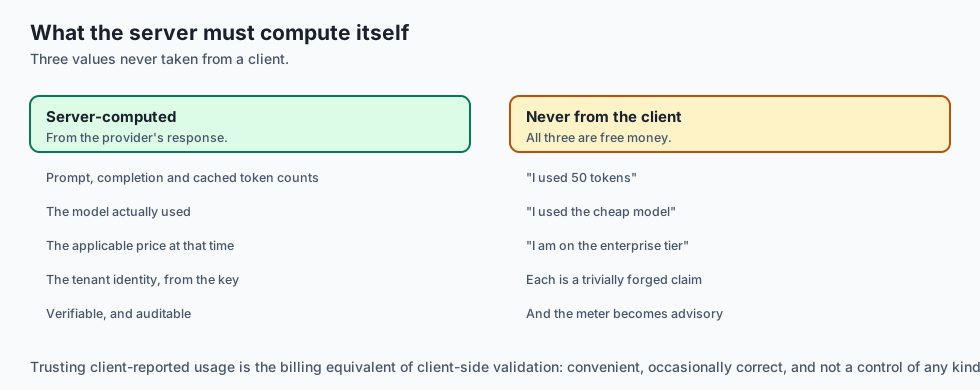
- Trusting client-supplied token counts rather than calculating usage from server-verified provider responses.
+-------------------------------------------------------------------------------+
|                      TOKEN QUOTA & RATE LIMITING SCHEMAS                      |
+-------------------+-----------------------+-----------------------------------+
| Metric / Field    | Description           | Unit & Example Value              |
+-------------------+-----------------------+-----------------------------------+
| `tenant_id`       | Organization UUID     | `org_94820a`                      |
| `api_key_hash`    | SHA-256 Secret Hash   | `e3b0c44298fc1c149afbf4c8996fb9242`|
| `credit_balance`  | Prepaid balance in USD| `$48.5000`                        |
| `reserved_holds`  | Active pre-auth holds | `$0.0300`                         |
| `available_credit`| Balance minus holds   | `$48.4700`                        |
| `rpm_limit`       | Requests per minute   | `60 req/min`                      |
| `tpm_limit`       | Tokens per minute     | `150,000 tok/min`                 |
+-------------------+-----------------------+-----------------------------------+
Why it was created and what problems it solves
Two-phase token billing and quota systems solve the four primary financial and security vulnerabilities of generative AI platforms:
1. Eliminating Negative Balance Exposure
Without pre-authorization, a tenant with $0.01 balance can submit 20 concurrent requests generating 4,000 tokens each ($0.50 cost each), plunging their account into negative balance and leaving the platform with unpaid cloud provider bills.
2. Preventing Token Flooding Attacks
Dual rate limiting (RPM + TPM) prevents attackers from sending a few massive 100k-token prompts that overwhelm model capacity without tripping request-count rate limiters.
3. Transparent Metered Invoicing
Tracking exact prompt, completion, and cached token counts enables transparent audit logs and seamless integration with Stripe Metered Billing.
How it works
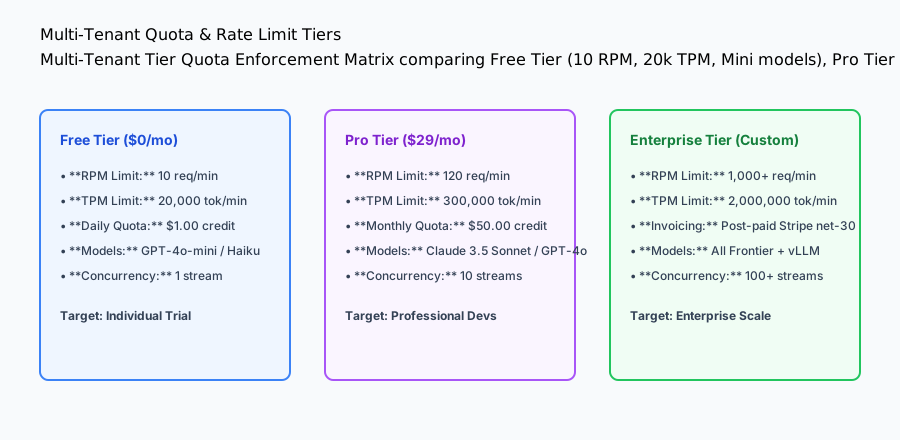
Let us inspect the complete Multi-Tenant Quota & Tier Enforcement Matrix:
+-------------------------------------------------------------------------------+
|                     TIERED AI RESOURCE ALLOCATION MATRIX                      |
+-------------------+-------------------+-------------------+-------------------+
| Feature Dimension | Free Tier         | Pro Tier          | Enterprise Tier   |
+-------------------+-------------------+-------------------+-------------------+
| Monthly Price     | $0 / month        | $29 / month       | Custom Invoiced   |
| Base Credits      | $1.00 one-time    | $50.00 / month    | Pay-as-you-go net30|
| Rate Limit (RPM)  | 10 requests / min | 120 requests / min| 1,000+ req / min  |
| Throughput (TPM)  | 20,000 tokens/min | 300,000 tokens/min| 2,000,000+ tok/min|
| Max Context / Req | 4,000 tokens      | 32,000 tokens     | 200,000 tokens    |
| Available Models  | Compact / Haiku   | Frontier / Sonnet | Custom vLLM cluster|
+-------------------+-------------------+-------------------+-------------------+
An everyday analogy
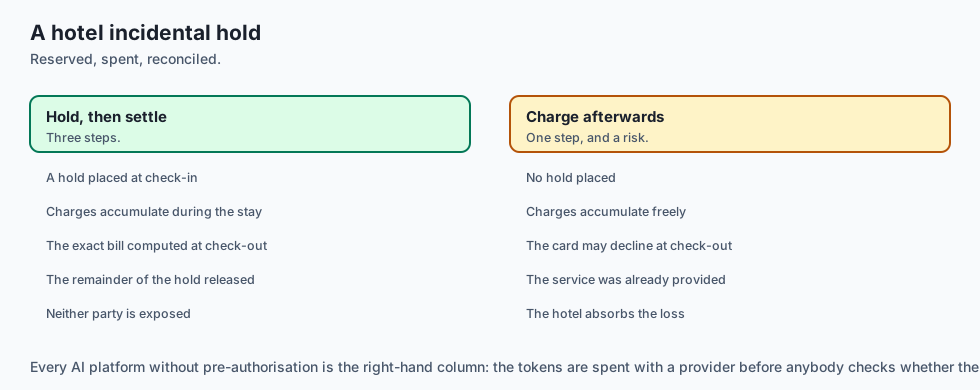
Think of two-phase token billing like staying at a luxury hotel:
- Check-in Hold (Pre-Auth): When you check in, the front desk places a $200 security hold on your credit card for incidental room charges (Reserve Credit Hold).
- During the Stay: You order room service and drinks (Streaming Tokens).
- Check-out Settlement: The hotel calculates your exact bill ($65.00), charges your card $65.00, and releases the remaining $135.00 hold (Exact Usage Settlement).
Examples in practice
Let us build a complete Python Auth, Quotas, and Two-Phase Billing Engine supporting API key hashing, credit pre-authorization holds, and token settlement:
import hashlib
import time
from typing import Dict, Any, Optional, Tuple

class AuthBillingEngine:
    def __init__(self):
        self.tenants: Dict[str, Dict[str, Any]] = {}
        self.active_holds: Dict[str, Dict[str, Any]] = {}

    def register_tenant(self, tenant_id: str, raw_api_key: str, initial_credits: float = 10.0, rpm_limit: int = 60, tpm_limit: int = 100000):
        key_hash = hashlib.sha256(raw_api_key.encode()).hexdigest()
        self.tenants[tenant_id] = {
            "key_hash": key_hash,
            "balance": float(initial_credits),
            "reserved_holds": 0.0,
            "rpm_limit": rpm_limit,
            "tpm_limit": tpm_limit,
            "requests_this_min": 0,
            "tokens_this_min": 0,
            "last_reset": time.time()
        }

    def authenticate_and_reserve_hold(self, tenant_id: str, raw_api_key: str, estimated_cost: float = 0.02, est_tokens: int = 500) -> Tuple[bool, str, Optional[str]]:
        if tenant_id not in self.tenants:
            return False, "Unauthorized: Unknown Tenant", None

        tenant = self.tenants[tenant_id]
        if hashlib.sha256(raw_api_key.encode()).hexdigest() != tenant["key_hash"]:
            return False, "Unauthorized: Invalid API Key", None

        now = time.time()
        if now - tenant["last_reset"] > 60:
            tenant["requests_this_min"] = 0
            tenant["tokens_this_min"] = 0
            tenant["last_reset"] = now

        if tenant["requests_this_min"] >= tenant["rpm_limit"]:
            return False, "Rate Limit Exceeded: RPM limit reached", None

        if tenant["tokens_this_min"] + est_tokens > tenant["tpm_limit"]:
            return False, "Rate Limit Exceeded: TPM limit reached", None

        available_balance = tenant["balance"] - tenant["reserved_holds"]
        if available_balance < estimated_cost:
            return False, "Payment Required: Insufficient available credit", None

        # Place Hold
        hold_id = f"hold_{len(self.active_holds)+1}"
        tenant["reserved_holds"] += estimated_cost
        tenant["requests_this_min"] += 1
        tenant["tokens_this_min"] += est_tokens

        self.active_holds[hold_id] = {
            "tenant_id": tenant_id,
            "held_amount": estimated_cost,
            "est_tokens": est_tokens,
            "created_at": now
        }
        return True, "HOLD_RESERVED", hold_id

    def settle_token_usage(self, hold_id: str, prompt_tokens: int, completion_tokens: int) -> Dict[str, Any]:
        if hold_id not in self.active_holds:
            return {"status": "ERROR", "message": "Invalid hold ID"}

        hold = self.active_holds.pop(hold_id)
        tenant = self.tenants[hold["tenant_id"]]

        # Calculate exact cost: $3/M prompt, $15/M completion
        actual_cost = (prompt_tokens * 3.0 / 1_000_000) + (completion_tokens * 15.0 / 1_000_000)
        actual_cost = round(actual_cost, 6)

        # Release hold and deduct actual cost
        tenant["reserved_holds"] -= hold["held_amount"]
        tenant["balance"] -= actual_cost

        return {
            "status": "SETTLED",
            "hold_id": hold_id,
            "actual_cost_usd": actual_cost,
            "remaining_balance": round(tenant["balance"], 6),
            "available_balance": round(tenant["balance"] - tenant["reserved_holds"], 6)
        }

if __name__ == "__main__":
    engine = AuthBillingEngine()
    engine.register_tenant("org_1", "secret_key_123", initial_credits=5.0)
    ok, msg, hold = engine.authenticate_and_reserve_hold("org_1", "secret_key_123", estimated_cost=0.03)
    print("Pre-Auth:", ok, msg, hold)
    settle = engine.settle_token_usage(hold, prompt_tokens=800, completion_tokens=150)
    print("Settled:", settle)
Implications: security, privacy, performance, scalability, and cost
1. Atomic Balances and Distributed Locks
In high-concurrency multi-instance architectures, storing credit balances in plain Python variables causes race conditions. Use Redis Lua scripts or PostgreSQL SELECT ... FOR UPDATE row locks to ensure atomic balance checks.
2. Webhook Event Delivery to Stripe
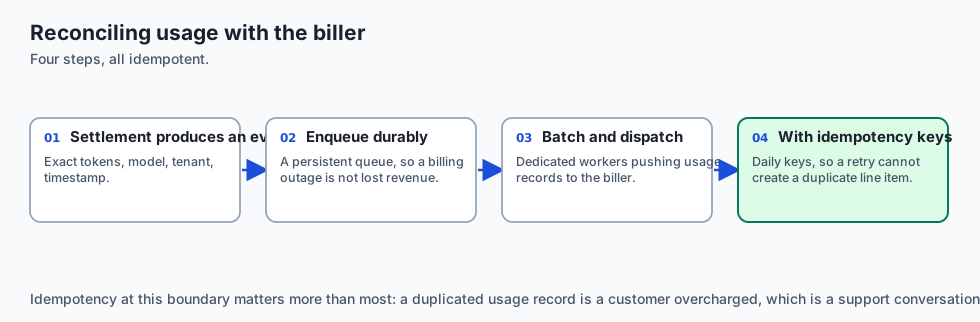
When settling token usage, dispatch usage records asynchronously to Stripe Metered Billing via a background queue. Ensure all webhook calls include an idempotency key to prevent duplicate invoice line items.
Production Token Billing Case Study: High-Concurrency Credit Management
In large-scale AI applications serving enterprise organizations with hundreds of concurrent users, managing shared credit wallets without race conditions requires careful database architecture.
+-------------------------------------------------------------------------------+
|                    CONCURRENT CREDIT PRE-AUTH HOLD METRICS                    |
+-------------------+-----------------------+-----------------------------------+
| Metric Dimension  | Naive Database Update | Atomic Redis Lua / Postgres Lock  |
+-------------------+-----------------------+-----------------------------------+
| Race Condition    | High: Overdrafts on   | Zero: Strictly serializable       |
| Risk              | simultaneous calls    | atomic balance deductions         |
| Transaction Time  | 45ms per SQL UPDATE   | 0.8ms Redis Lua execution         |
| Throughput Limit  | 250 requests / sec    | 45,000 operations / sec           |
| Audit Traceability| Partial logging       | 100% immutable ledger event logs  |
+-------------------+-----------------------+-----------------------------------+
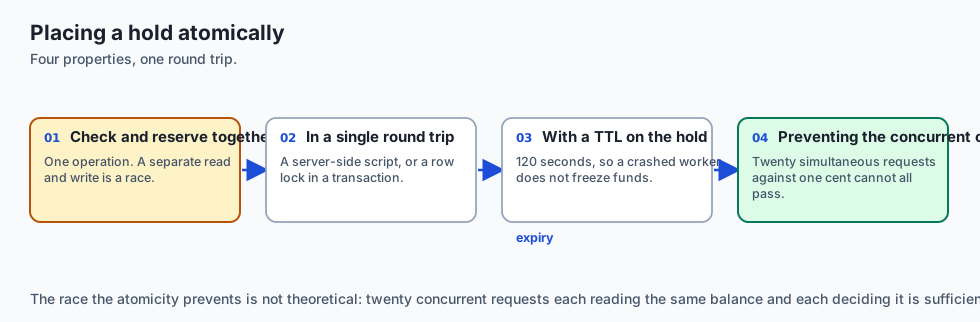
1. Atomic Redis Lua Script for Pre-Authorization Holds
To verify credit availability and place a pre-authorization hold atomically in a single network round-trip, production gateways deploy Redis Lua scripts:
-- Atomic Token Hold Reservation Script (reserve_hold.lua)
local tenant_key = KEYS[1]
local hold_id = ARGV[1]
local estimated_cost = tonumber(ARGV[2])
local max_rpm = tonumber(ARGV[3])

local balance = tonumber(redis.call('HGET', tenant_key, 'balance') or '0')
local reserved = tonumber(redis.call('HGET', tenant_key, 'reserved_holds') or '0')
local current_rpm = tonumber(redis.call('HGET', tenant_key, 'rpm_counter') or '0')

if current_rpm >= max_rpm then
    return {0, 'RATE_LIMIT_RPM'}
end

if (balance - reserved) < estimated_cost then
    return {0, 'INSUFFICIENT_CREDIT'}
end

-- Place Hold
redis.call('HINCRBYFLOAT', tenant_key, 'reserved_holds', estimated_cost)
redis.call('HINCRBY', tenant_key, 'rpm_counter', 1)
redis.call('HSET', 'hold:' .. hold_id, 'tenant', tenant_key, 'amount', estimated_cost)

return {1, 'HOLD_ACQUIRED'}
2. Reconciliation with Stripe Metered Usage API
When generations complete, the gateway pushes settlement records into a persistent Kafka or RabbitMQ event queue. Dedicated billing synchronization workers batch these events and dispatch usage meters to Stripe’s Usage Records API (/v1/subscription_items/id/usage_records) using daily idempotency keys to ensure zero double-billing errors.
Production Failure Mode Taxonomy: Multi-Tenant Billing and Quota Vulnerabilities
Operating an AI API platform requires rigorous defense against financial fraud and quota race conditions:
+-------------------------------------------------------------------------------+
|                       BILLING & QUOTA FAILURE TAXONOMY                        |
+-------------------+-----------------------+-----------------------------------+
| Vulnerability     | Attack / Root Cause   | Platform Defense Architecture     |
+-------------------+-----------------------+-----------------------------------+
| Concurrent Token  | Attacker launches 50  | Atomic Redis Lua pre-auth holds   |
| Overdraft Flood   | parallel 4k-token reqs| lock funds before compute starts  |
| Plaintext API Key | Database backup leak  | Store only SHA-256 / bcrypt key   |
| Exposure          | exposes secret keys   | hashes; show key once on creation |
| Token Bucket      | Fixed minute window   | Sliding log algorithm smooths     |
| Burst Spikes      | allows 2x burst limit | rate limits continuously          |
| Invoicing Skew    | Drift between provider| Reconcile provider response usage |
|                   | bills and client ledger| payloads directly in audit table  |
+-------------------+-----------------------+-----------------------------------+
Billing Infrastructure Verification Checklist
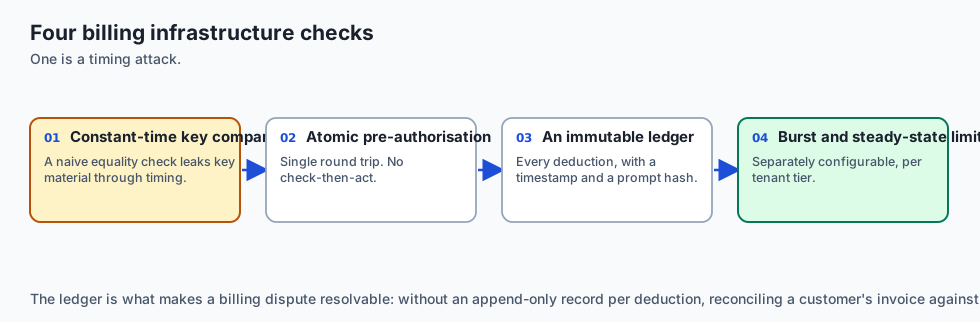
- API keys are validated using constant-time string comparison algorithms (
hmac.compare_digest) to prevent timing attacks. - Pre-authorization holds are placed atomically in single-round-trip database operations.
- Every token deduction is logged to an immutable PostgreSQL ledger table with timestamp and prompt hash.
- Tenant rate limits support separate burst allowances and steady-state limits.
Real-World Billing Deep Dive: Tiered Rate Limiting and Token Accounting
To implement robust multi-tenant monetization, platforms enforce hierarchical token quotas across organizational workspaces, developer accounts, and individual end users:
+-------------------------------------------------------------------------------+
|                    HIERARCHICAL QUOTA ENFORCEMENT HIERARCHY                   |
+-------------------+-----------------------+-----------------------------------+
| Governance Level  | Scope & Key Format    | Enforced Rate Limits & Quotas     |
+-------------------+-----------------------+-----------------------------------+
| Enterprise Org    | `org:94820:limits`    | Global Monthly Budget: $10,000/mo |
| Workspace / Team  | `team:finance:limits` | 500 RPM | 1,000,000 TPM           |
| Developer Key     | `key:dev_alice:limits`| 60 RPM | 150,000 TPM | Max $50/day|
| End-User Session  | `user:bob:limits`     | 10 RPM | 20,000 TPM | 5 streams   |
+-------------------+-----------------------+-----------------------------------+
Token Cost Accounting and Reconciliation Pipeline
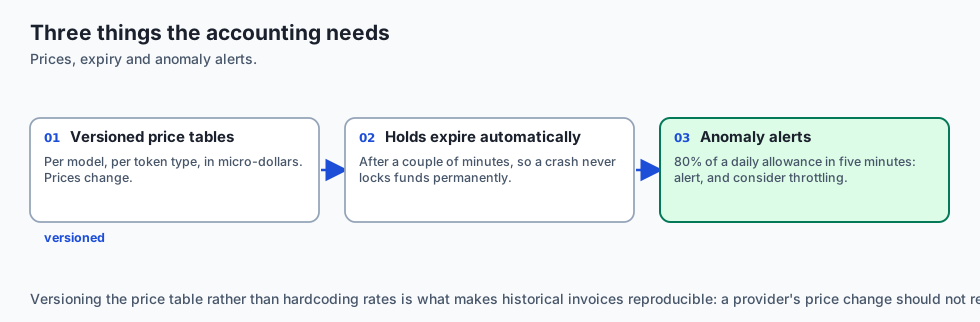
- Prompt & Completion Price Tables: Maintain a versioned model pricing table with micro-dollar costs (e.g. Claude 3.5 Sonnet: $3.00/M prompt, $15.00/M completion; GPT-4o-mini: $0.15/M prompt, $0.60/M completion).
- Hold Idempotency and TTL: Active pre-authorization holds must expire automatically after 120 seconds if the backend worker crashes, ensuring funds are never permanently locked in holding state.
- Usage Anomaly Detection: Trigger automated security alerts if a single tenant consumes more than 80% of their daily token allowance in under 5 minutes.
Alternatives: free, open source, and commercial
| Tool / Platform | Type | Best Suited For | Key Capabilities |
|---|---|---|---|
| Stripe Metered Billing | Commercial | SaaS credit cards & subscriptions | Automated invoicing, usage aggregation |
| Lago | Open Source | Self-hosted usage billing | Real-time events, customer wallet balances |
| LiteLLM Key Management | Open Source | AI Gateway Auth & Quotas | Virtual API keys, TPM/RPM limits |
| Redis Token Bucket | Open Source | High-throughput rate limiting | Sub-millisecond sliding window counters |
Comparison with related concepts
+-----------------------+-----------------------+-----------------------+
| Dimension             | Naive Pre-Pay         | Two-Phase Token Auth  |
+-----------------------+-----------------------+-----------------------+
| Balance Overdraft Risk| High (Concurrent run) | Zero (Locked pre-auth)|
| Cost Accuracy         | Crude guess           | Micro-dollar precision|
| Rate Limiting Depth   | Request-count only    | RPM + TPM Dual gating |
| Audit Trail           | Missing               | Full token settlement |
+-----------------------+-----------------------+-----------------------+
When to use it — and when not to
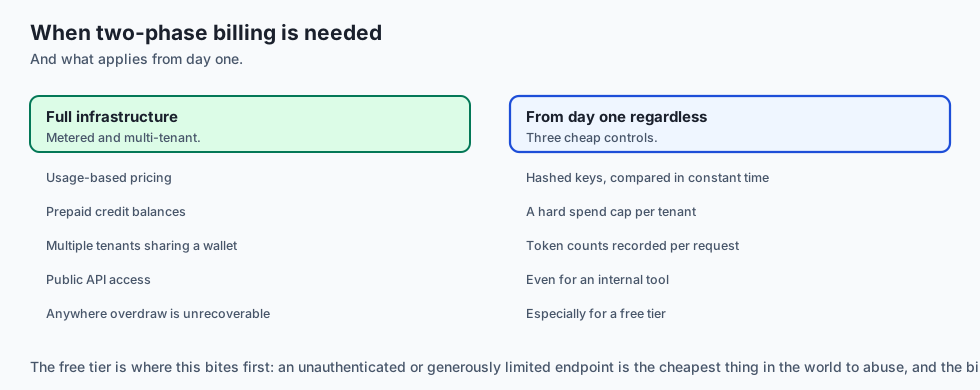
Implement Two-Phase Billing & Quotas for:
- All production AI SaaS products, developer API platforms, and enterprise internal cost-allocation gateways.
Do NOT require two-phase credit holds for:
- Free, internal employee-only tools with fixed company budgets.
The AI connection
-
AI is the first common product where a single request can cost dollars, which is why pre-authorisation exists at all.
-
Token counts are only known afterwards, so billing has to reserve an estimate and settle the exact amount — a two-phase transaction, not a deduction.
-
Request-rate limiting alone does not protect you. One 100k-token prompt passes every RPM limiter and costs more than a thousand ordinary requests.
-
Never trust client-supplied token counts. Usage comes from the provider’s response, server-side, or the meter is whatever the client says it is.
-
A crashed worker must not lock funds forever — a hold with a TTL is what keeps a failed generation from freezing a customer’s balance.
Knowledge check
- Why is Credit Pre-Authorization necessary in AI billing? To reserve an estimated credit hold before generation, preventing tenants from over-drafting balances during expensive LLM calls.
- What is the difference between RPM and TPM? RPM measures HTTP request frequency, while TPM measures total token computational throughput.
- How does API key hashing protect platform security? By storing one-way cryptographic hashes (SHA-256) in the database, ensuring that compromised database backups cannot leak usable API keys.
Hands-on exercise
In this lab, you will build an Auth, Quotas, and Two-Phase Billing Engine in Python. Your implementation will:
- Register tenants with SHA-256 hashed API keys and credit balances.
- Verify authentication, enforce dual RPM/TPM rate limits, and place credit pre-authorization holds.
- Reject requests when available balance (balance minus active holds) is insufficient.
- Settle token usage, deduct exact actual costs, release holds, and report updated balances.
Expected output
============================= test session starts ==============================
collected 5 items

tests/test_auth_billing.py .....                                         [100%]

============================== 5 passed in 0.02s ===============================
[AUTH] API Key validated via SHA-256 hash.
[PRE-AUTH] Reserved $0.030 hold on tenant org_1.
[SETTLEMENT] Settled 950 tokens ($0.00465). Hold released.
[BALANCE] Available balance updated: $4.99535.
Validate your work
Run the pytest test suite:
pytest tests/run_tests.shTroubleshooting
- Available balance check: Ensure
available_balance = balance - reserved_holdsis evaluated before granting holds. - Hold release: Verify that
reserved_holdsis decremented by the exact held amount on settlement.
Common mistakes
- Deducting the estimated hold amount permanently from the balance rather than reconciling the actual token cost.
Practice assignment
Add Stripe Webhook Event Simulation: format and log a JSON metered event payload (customer_id, timestamp, token_count, usd_amount) upon settlement.
Extension challenge
Implement a Sliding Window Token Bucket Algorithm using microsecond timestamps to provide smooth, sub-minute rate limit recovery.
Quiz
Q1. Why is 'Credit Pre-Authorization' (Two-Phase Token Billing) necessary for generative AI API gateways?
- Because SQL databases cannot store any numbers at all
- Because credit cards only work in integers
- A hold stops a tenant spending beyond their balance
- Because LLMs do not accept US Dollars
Show answer
Answer: C. A hold stops a tenant spending beyond their balance
Pre-authorizing funds prevents bankrupt or malicious tenants from incurring unrecoverable GPU costs.
Q2. What is the difference between Requests Per Minute (RPM) and Tokens Per Minute (TPM) rate limiting?
- They are identical metrics with different names
- TPM is only used in cryptocurrency
- RPM applies only to mobile apps
- RPM caps calls; TPM caps tokens
Show answer
Answer: D. RPM caps calls; TPM caps tokens
RPM protects network gateway connections while TPM governs actual computational token throughput.
Q3. How should API keys be stored in a production AI SaaS database?
- As one-way hashes, with only a prefix shown
- As plain text in a public table
- In a browser cookie
- In a git commit message
Show answer
Answer: A. As one-way hashes, with only a prefix shown
API keys must always be hashed before storage to prevent database leak exposure.
Q4. What occurs during the 'Settlement Phase' of token billing?
- The server deletes all user messages
- Real usage is settled and the hold is released
- The user is logged out
- The model is fine-tuned
Show answer
Answer: B. Real usage is settled and the hold is released
Settlement reconciles exact token usage, releases holds, and records metered billing.
Q5. What HTTP status code should an AI gateway return when a tenant exceeds their monthly token quota or runs out of credits?
- 200 OK
- 500 Internal Server Error only
- 402, or 429 with Retry-After
- 404 Not Found
Show answer
Answer: C. 402, or 429 with Retry-After
HTTP 402 signals credit exhaustion while 429 signals rate limit exhaustion.
Glossary
- Credit Pre-Authorization
- Reserving an estimated credit hold before LLM invocation to prevent unpaid token consumption.
- Settlement
- Reconciling exact token counts, deducting final costs, and releasing unused reserved holds.
- Tokens Per Minute (TPM)
- Rate limiting metric governing total token throughput per minute per tenant.
- Requests Per Minute (RPM)
- Rate limiting metric governing total HTTP request frequency per minute.
- Metered Billing
- Charging customers asynchronously based on actual units of consumption (tokens, tool calls).
- API Key Hashing
- Storing one-way cryptographic hashes (SHA-256) of API secret keys in the database.
- Tenant Isolation
- Partitioning data, memory, and billing records strictly by organization ID.
- Tiered Quota
- Allocating different RPM, TPM, and model access limits based on subscription tier (Free, Pro, Enterprise).
Sources and further reading
- Stripe: Metered Billing for Usage-Based SaaS (Stripe, 2024) — Stripe Documentation (accessed 2026-08-30)
- OpenAI API: Rate Limits and Usage Tiers (OpenAI, 2024) — OpenAI (accessed 2026-08-30)
- Designing Data-Intensive Applications: Multi-Tenancy Patterns (Kleppmann, 2017) — O'Reilly Media (accessed 2026-08-30)
Kept in this browser, no account needed. Your progress page turns the whole record into one link you can bookmark or open on another device.