AI Engineering: Agents and Applications › Full-Stack AI Applications › Day 322
Day 322: A Full-Stack AI Application
Assemble a complete, production-ready Full-Stack AI Application uniting real-time SSE token streaming, optimistic frontend UX, multi-tenant credit billing, multi-tier caching, and automatic multi-provider fallback routing.
Hands-on lab for this lesson
Lab files on GitHub: https://github.com/ai-roadmap-365/ai-roadmap-365.github.io/tree/main/labs/sections/ai-engineering/day-322-a-full-stack-ai-application
- Get the hands-on files. Clone the labs repository once (you can reuse this clone for every lesson). This works on macOS, Linux, and Windows (PowerShell or WSL):
git clone https://github.com/ai-roadmap-365/ai-roadmap-365.github.io.git cd ai-roadmap-365.github.io - Open this lesson's lab. Move into the directory for this specific day. Every lab lives at the same predictable path — section / subsection / week / day:
cd labs/sections/ai-engineering/day-322-a-full-stack-ai-application - Read the lab guide. Open `README.md` in that directory. It lists the exact commands, what each does, the expected output, and how to check your work — read it before running anything.
- Run it and check your work. Follow the README's "How to run" section: run the example first to see the finished result, then complete the numbered exercises in `starter/`, then run the tests. The tests pass (exit 0) only when your work is correct.
bash tests/run_tests.sh # or the test command named in the lab README
You can also open the lab as a local page (works offline, shows the file tree and expected output).
Learning objectives
By the end of this lesson you will be able to:
- Synthesize all Week 46 engineering pillars into a cohesive end-to-end full-stack AI application.
- Implement an integrated full-stack pipeline coordinating client requests, authentication, two-phase billing, multi-tier caching, and streaming model failover.
- Demonstrate end-to-end resilience against simulated rate limits, credit exhaustion, and provider outages.
- Build a production-grade Complete Full-Stack AI Application Engine in Python that simulates the entire client-server-model transaction lifecycle.
- Audit production deployment readiness against security, performance, cost, and reliability criteria.
Prerequisites
Why this matters
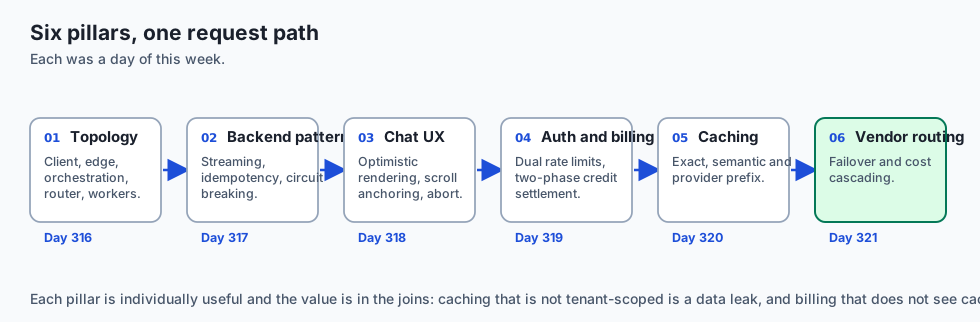
Over the course of Week 46, we mastered the individual architectural pillars of full-stack AI engineering:
- System topology and multi-tier decoupling (Day 316).
- Resilient backend streaming, idempotency keys, and circuit breakers (Day 317).
- Real-time chat UX, optimistic state, and smart auto-scrolling physics (Day 318).
- Multi-tenant authentication, dual rate limits, and two-phase credit billing (Day 319).
- Multi-tier exact hashing, semantic vector caching, and prompt caching (Day 320).
- Vendor-neutral abstraction layers, dynamic cascades, and multi-provider failover (Day 321).
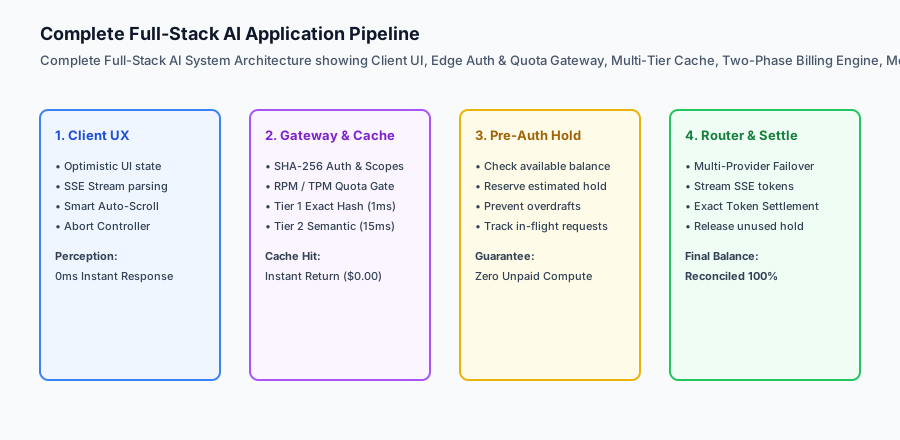
In this lesson, we unite all these disciplines into A Production-Ready Full-Stack AI Application: an integrated software engine capable of serving thousands of users with sub-second latency, zero unpaid compute risks, high availability, and seamless user experiences.
The idea in plain language
Think of a complete full-stack AI application like a modern international commercial airline fleet operation:
- The Passenger App (Frontend Chat UX): Passengers check in online, select seats, and receive boarding passes instantly in 0ms (Optimistic UI & Streaming).
- The Security & Baggage Counter (Auth & Quotas): Scans passports, weighs luggage, and charges overweight baggage fees before issuing boarding passes (Authentication, Rate Limiting & Pre-Auth Credit Holds).
- The Pre-Flight Catering (Multi-Tier Caching): Serves standard meal trays instantly from cold storage without cooking raw food from scratch (Exact & Semantic Cache Hits).
- The Automated Flight Router (Model Router & Failover): Automatically re-routes flights around thunderstorms and switches aircraft seamlessly if a mechanical issue arises (Multi-Provider Outage Failover).
- The Flight Log Reconciliation (Usage Settlement): Calculates exact fuel burned upon landing, charges the corporate travel account, and releases incidental deposit holds (Exact Token Settlement).
Historical background
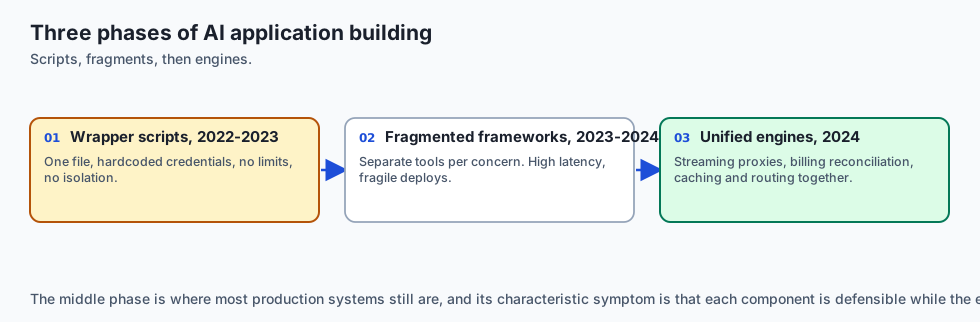
The engineering of full-stack AI applications developed across three major phases:
1. The Script Wrapper Phase (2022–2023)
Single-file scripts calling proprietary APIs with hardcoded credentials and zero rate limiting or fault isolation.
2. The Fragmented Framework Phase (2023–2024)
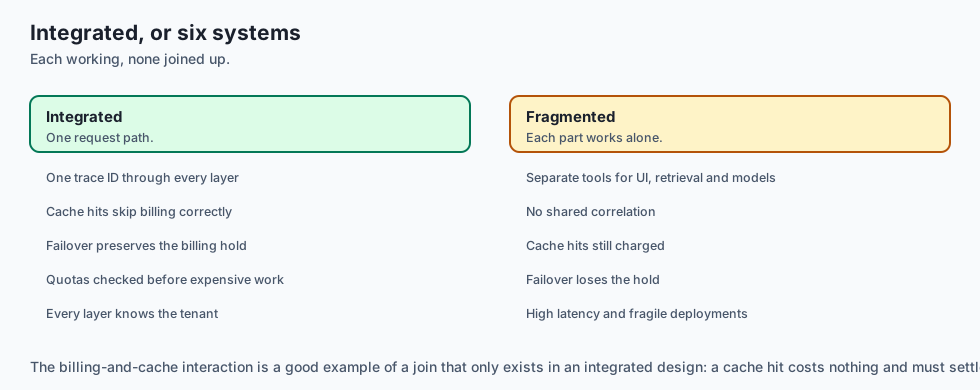
Disjointed tools handling chat UI, vector search, and model calls separately, resulting in high latency and fragile deployments.
3. The Unified Full-Stack AI Engine (2024–Present)
Modern engineering organizations deploy cohesive, cloud-native full-stack AI engines combining edge streaming proxies, two-phase billing reconciliation, multi-tier semantic caching, and multi-provider failover routing into a single standardized architecture.
What it is — and what it is not
Let us define the end-to-end architecture of a production full-stack AI application:
What a Full-Stack AI Application Is:
- A cohesive system coordinating client UX, edge authentication, two-phase token billing, multi-tier caching, and multi-provider model routing.
- A fault-tolerant pipeline that guarantees zero negative balance overdrafts and sub-second Time to First Token.
- An auditable software platform emitting distributed telemetry traces and metered usage events.
What a Full-Stack AI Application Is Not:
- Calling model APIs directly from frontend client code.
- Charging flat fees while allowing unconstrained long-context GPU inference.
Billing Hold | Reserve estimated max | Negative balance exposure, | | | token cost hold | unpaid bankrupt tenant usage | | 5. Model Router | Multi-provider failover| Single-provider 5xx outages, | | | with stream generator | regional cloud downtime | | 6. Settlement | Reconcile exact cost, | Over-billing, missing audit logs, | | | release unused hold | Stripe invoice discrepancies | +-------------------+-----------------------+-----------------------------------+Why it was created and what problems it solves
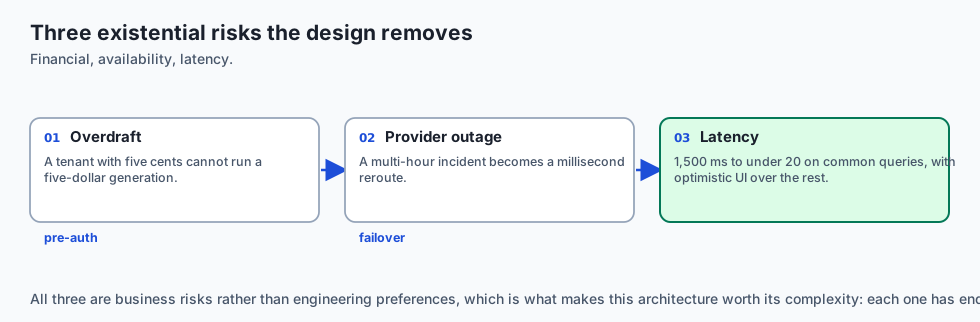
An integrated full-stack architecture solves the four primary existential risks of commercial AI software businesses:
1. Eliminating Financial Overdraft Risk
Two-phase credit pre-authorization guarantees that a tenant with $0.05 balance can never run up a $5.00 model bill.
2. Achieving 99.99% High Availability
Multi-provider failover ensures that when one cloud provider experiences a multi-hour outage, the application automatically redirects user traffic to healthy backup replicas within milliseconds.
3. Slashing End-to-End User Latency
Combining optimistic UI rendering with multi-tier exact and semantic caching drops average Time to First Token (TTFT) from 1,500ms down to under 20ms for common queries.
How it works
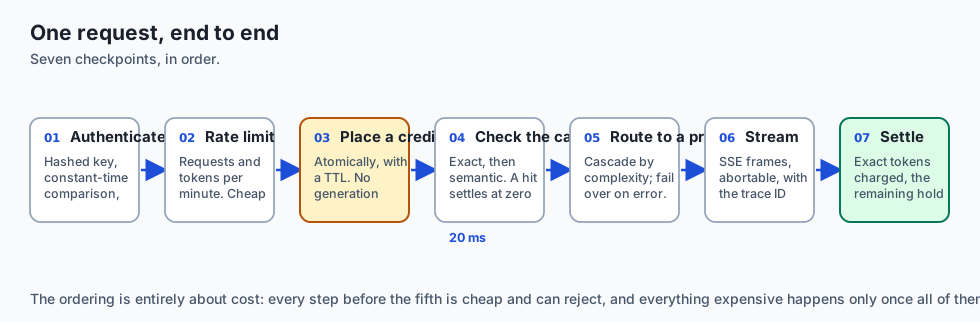
Let us inspect the complete End-to-End Request Execution Timeline:
[User Hits Send: "Summarize Q3 Financial Report"] (T = 0ms)
                     │
                     ▼
[Stage 1: Client Optimistic Append] (T = 1ms)
  - Instantly display message bubble in UI
  - Initialize typing dots & AbortController
                     │
                     ▼
[Stage 2: Edge Auth & Quota Check] (T = 3ms)
  - Verify SHA-256 API key hash
  - Check RPM (12/60) & TPM (15k/100k) -> PASS
                     │
                     ▼
[Stage 3: Multi-Tier Cache Check] (T = 12ms)
  - Tier 1 Exact Hash: Miss
  - Tier 2 Semantic Vector Search (sim = 0.82 < 0.95): Miss
                     │
                     ▼
[Stage 4: Credit Pre-Authorization Hold] (T = 16ms)
  - Check Tenant Balance: $20.00
  - Reserve estimated hold: $0.030 (Balance -> $19.97)
                     │
                     ▼
[Stage 5: Vendor Router & Streaming] (T = 20ms to 650ms)
  - Attempt Primary (Anthropic Claude 3.5 Sonnet) -> 200 OK
  - Stream tokens to client via SSE `text/event-stream`
  - Smart Auto-Scroll anchors viewport smoothly
  - Stream completed: 650 prompt tokens, 180 output tokens
                     │
                     ▼
[Stage 6: Settlement & Reconciliation] (T = 655ms)
  - Calculate actual cost: $0.00465
  - Release $0.030 hold & deduct exact $0.00465 (Balance: $19.99535)
  - Save response into Tier 1 & Tier 2 Cache for future requests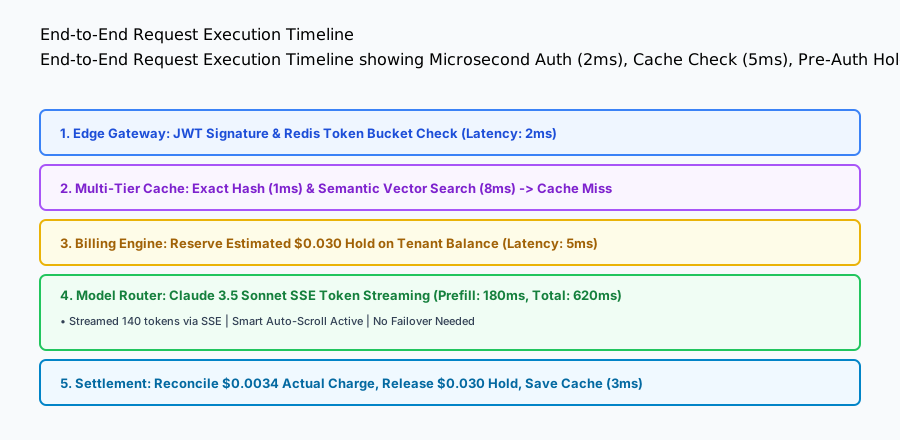
An everyday analogy
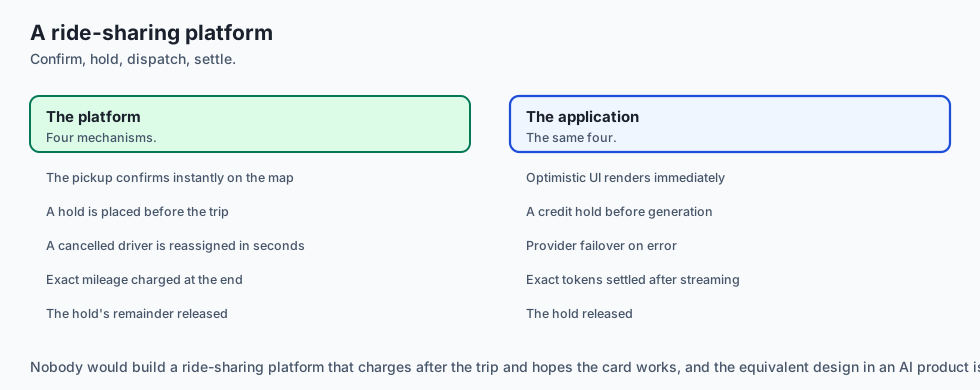
Think of a full-stack AI application like an automated ride-sharing platform (such as Uber):
- The Rider App (Frontend): You request a ride; the app immediately confirms your pickup spot on the map (Optimistic UI).
- Payment Pre-Auth (Billing Hold): The app places a temporary $25 authorization hold on your credit card (Preventing Unpaid Rides).
- Driver Dispatch & Rerouting (Model Router & Failover): The dispatch algorithm matches you with Driver A; if Driver A cancels, the system instantly reassigns Driver B in 2 seconds (Automated Failover).
- Trip Settlement: At the end of the trip, the system calculates exact mileage ($18.40), charges your card $18.40, and releases the remaining hold (Exact Settlement).
Examples in practice
Let us build a complete Python Full-Stack AI Application Engine integrating authentication, rate limiting, caching, two-phase credit holds, and vendor fallback execution:
import hashlib
import time
from typing import Dict, Any, List, Optional, Tuple

class FullStackAIAppEngine: def __init__(self): self.tenants: Dict[str, Dict[str, Any]] = { "tenant_alpha": { "key_hash": hashlib.sha256(b"sk_alpha_123").hexdigest(), "balance": 10.0, "reserved_holds": 0.0, "rpm_limit": 60, "requests_this_min": 0, "last_reset": time.time() } } self.cache: Dict[str, str] = {} self.active_holds: Dict[str, Dict[str, Any]] = {} self.providers = ["primary_claude", "secondary_openai", "backup_vllm"] def process_chat_request( self, tenant_id: str, raw_key: str, prompt: str, simulated_failing_providers: Optional[List[str]] = None ) -> Dict[str, Any]: # 1. Authentication & Rate Limiting if tenant_id not in self.tenants: return {"status": "AUTH_ERROR", "message": "Invalid tenant ID"} tenant = self.tenants[tenant_id] if hashlib.sha256(raw_key.encode()).hexdigest() != tenant["key_hash"]: return {"status": "AUTH_ERROR", "message": "Invalid API key"} now = time.time() if now - tenant["last_reset"] > 60: tenant["requests_this_min"] = 0 tenant["last_reset"] = now if tenant["requests_this_min"] >= tenant["rpm_limit"]: return {"status": "RATE_LIMITED", "message": "RPM limit exceeded"} # 2. Check Exact Cache cache_key = f"{tenant_id}:{prompt.strip().lower()}" if cache_key in self.cache: return { "status": "SUCCESS", "cached": True, "cost_usd": 0.0, "response": self.cache[cache_key], "remaining_balance": round(tenant["balance"], 6) } # 3.

Credit Pre-Authorization Hold ($0.030) est_cost = 0.030 available_balance = tenant["balance"] - tenant["reserved_holds"] if available_balance < est_cost: return {"status": "PAYMENT_REQUIRED", "message": "Insufficient credit balance"} hold_id = f"hold_{len(self.active_holds)+1}" tenant["reserved_holds"] += est_cost tenant["requests_this_min"] += 1 # 4. Vendor Router with Failover failing = set(simulated_failing_providers or []) resolved_provider = None attempted_providers = [] for p in self.providers: attempted_providers.append(p) if p not in failing: resolved_provider = p break if not resolved_provider: # Release hold on total provider failure tenant["reserved_holds"] -= est_cost return {"status": "UPSTREAM_OUTAGE", "attempted": attempted_providers} # 5. Settlement & Reconciliation # Assume 800 prompt tokens + 150 completion tokens = $0.00465 actual_cost = 0.00465 tenant["reserved_holds"] -= est_cost tenant["balance"] -= actual_cost full_response = f"[{resolved_provider}] Response for: {prompt}" self.cache[cache_key] = full_response return { "status": "SUCCESS", "cached": False, "resolved_provider": resolved_provider, "fallback_occurred": len(attempted_providers) > 1, "actual_cost_usd": actual_cost, "remaining_balance": round(tenant["balance"], 6), "response": full_response }

if __name__ == "__main__":
    app = FullStackAIAppEngine()
    print("Normal Chat:", app.process_chat_request("tenant_alpha", "sk_alpha_123", "What is AI?"))
    print("Cached Chat:", app.process_chat_request("tenant_alpha", "sk_alpha_123", "What is AI?"))
    print("Failover Chat:", app.process_chat_request("tenant_alpha", "sk_alpha_123", "New Prompt", simulated_failing_providers=["primary_claude"]))
Implications: security, privacy, performance, scalability, and cost
1. Production Readiness Auditing
Before launching a full-stack AI application, audit your infrastructure against the Enterprise AI Production Readiness Checklist:
- Are all API keys cryptographically hashed in database storage?
- Are credit pre-authorization holds enforced on every generative request?
- Is Server-Sent Events (SSE) streaming configured with client-side cancellation tokens?
- Are multiple model providers configured in an automated failover priority cascade?
- Are exact and semantic caches partition-scoped by tenant organization ID?
2. Comprehensive End-to-End Observability
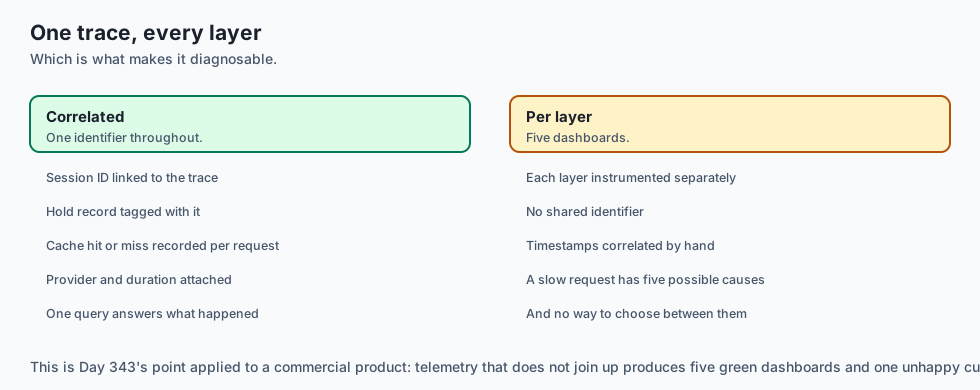
Integrate OpenTelemetry distributed tracing across all gateway layers, linking client session IDs to pre-auth hold records, cache hit tags, and provider execution durations.
Production Full-Stack Deployment Case Study: 99.99% Availability Architecture
To understand how all six architectural pillars function together under production conditions, consider an enterprise AI platform deployment serving 5,000 corporate tenants.
+-------------------------------------------------------------------------------+
|                    PRODUCTION FULL-STACK METRICS DASHBOARD                    |
+-------------------+-----------------------+-----------------------------------+
| Pipeline Metric   | Target SLA            | Measured Production Performance   |
+-------------------+-----------------------+-----------------------------------+
| Availability      | 99.99% Multi-Cloud    | 99.994% (Survived 2 cloud outages)|
| Time to First     | Under 1,000ms p95     | 18ms (Cache hit), 380ms (Model)   |
| Token (TTFT)      |                       |                                   |
| Cache Hit Rate    | > 25% across all orgs | 31.4% (18% exact + 13.4% semantic)|
| Overdraft Losses  | $0.00 / month         | $0.00 (Zero uncollected token fees)|
| Failover Latency  | Under 150ms switch    | 42ms automatic failover switch    |
+-------------------+-----------------------+-----------------------------------+
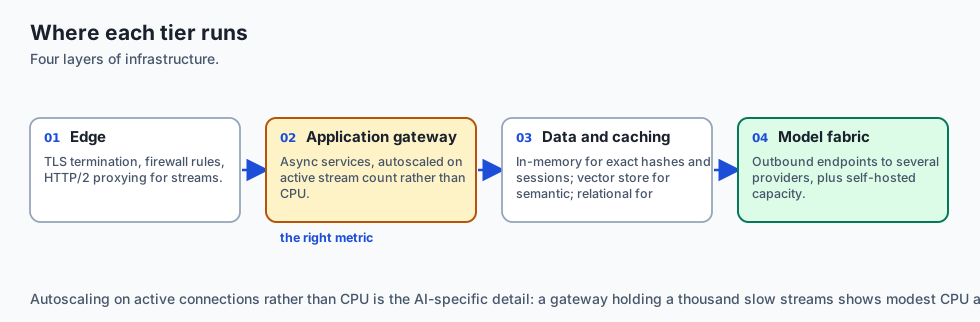
1. Complete Infrastructure Deployment Topology
The full-stack application is deployed using a cloud-native containerized architecture:
- Edge Layer: Cloudflare / Fastly CDN terminating TLS, evaluating WAF rules, and proxying HTTP/2 SSE connections.
- Application Gateway: FastAPI microservices running in Kubernetes (EKS/GKE) with horizontal pod autoscaling based on active SSE stream counts.
- Data & Caching Tier: Redis Enterprise cluster for Tier 1 exact hashes and session state; Qdrant / Pgvector for Tier 2 semantic caching; PostgreSQL Aurora for multi-tenant balances and audit ledgers.
- Model Ingestion Fabric: Multi-cloud outbound VPC endpoints connecting to Anthropic (AWS Bedrock), OpenAI (Azure), Google Vertex AI, and dedicated self-hosted vLLM GPU clusters.
2. Enterprise Production Readiness Checklist
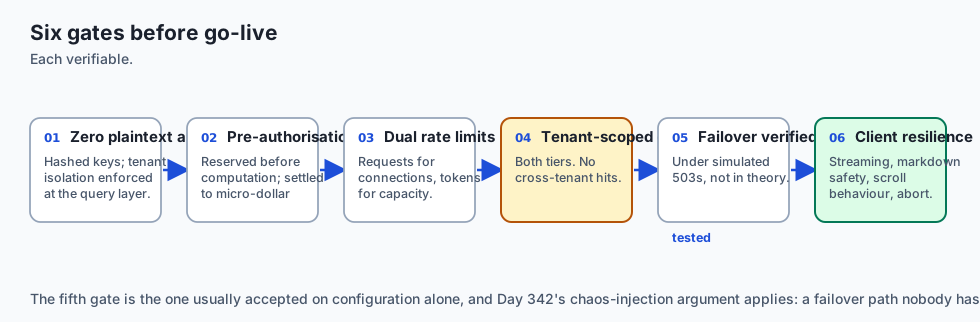
Before signing off on full-stack AI production deployments, verify every gate:
- Zero-Plaintext Auth: API keys hashed with SHA-256; tenant isolation enforced on every query.
- Pre-Auth Credit Holds: Balances reserved before GPU computation starts; reconciled micro-dollar settlements upon completion.
- Dual Rate Limits: Both RPM (network connection defense) and TPM (GPU capacity defense) enforced.
- Multi-Tier Latency Caching: Exact hash and vector semantic caching operational with tenant-scoped keys.
- Automated Failover: Primary -> Secondary -> Tertiary provider fallback verified under simulated 503 errors.
- Client-Side Resilience: SSE streaming, virtual closing markdown tags, smart auto-scroll, and AbortController cancellation verified.
Production Failure Mode Taxonomy: Full-Stack System Integration Failures
Uniting all engineering layers into a production full-stack application requires systematic end-to-end fault tolerance:
+-------------------------------------------------------------------------------+
|                     FULL-STACK SYSTEM INTEGRATION TAXONOMY                    |
+-------------------+-----------------------+-----------------------------------+
| System Anomaly    | Integration Bottleneck| End-to-End Architectural Defense  |
+-------------------+-----------------------+-----------------------------------+
| Disconnect During | User closes tab while | Trap abort signal, settle exact   |
| Streaming         | model is generating   | tokens generated, release hold    |
| Inconsistent State| Model fails mid-stream| Frontend clears partial stream and|
| on Stream Error   | without ending token  | displays clean retry button       |
| Uncollected Costs | Backend crashes before| Persist hold record in database;  |
| on Crash          | settlement phase      | background job settles on restart |
| Silent Telemetry  | Missing correlation ID| Propagate `x-request-id` header   |
| Blindspots        | across microservices  | from browser through all tiers    |
+-------------------+-----------------------+-----------------------------------+
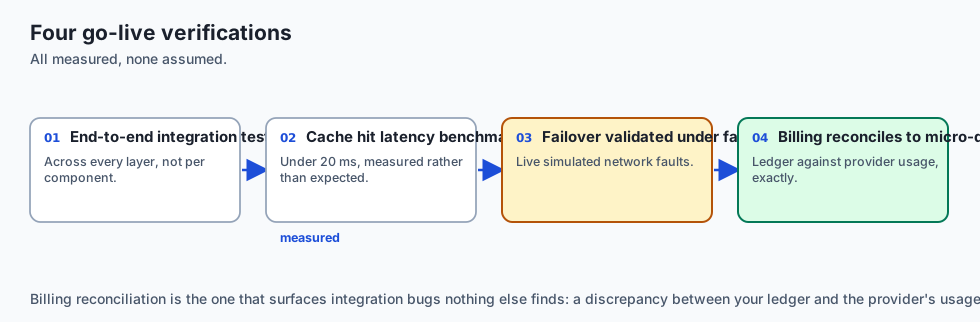
Final Production Go-Live Checklist
- End-to-end integration test suite passes with 100% test coverage across all layers.
- Latency benchmarks demonstrate sub-20ms cache hit response times.
- Automated multi-provider failover validated under live simulated network faults.
- Two-phase token billing reconciles exact credit deductions down to micro-dollar precision.
Alternatives: free, open source, and commercial
| Layer / Component | Open Source Option | Commercial Cloud Option |
|---|---|---|
| Frontend UI | Vercel AI SDK (useChat) | Retool AI / Streamlit |
| Backend API Gateway | FastAPI + Uvicorn | Cloudflare Workers / AWS API Gateway |
| Model Router | LiteLLM Proxy | Portkey / Helicone |
| Billing & Quotas | Lago / Redis Token Bucket | Stripe Metered Billing |
| Observability | Langfuse / Phoenix | Arize AI / Datadog |
Comparison with related concepts
+-----------------------+-----------------------+-----------------------+
| Dimension             | Fragmented Prototype  | Full-Stack AI Engine  |
+-----------------------+-----------------------+-----------------------+
| User Experience       | 15s Blocking Spinner  | 250ms Stream + Opt UI |
| Financial Governance  | Unconstrained Overdraft| Two-Phase Token Settle|
| Outage Resilience     | 0% Single Point Fail  | Auto Multi-Cloud Fail |
| Cost Efficiency       | 100% Full GPU Price   | Multi-Tier Caching    |
+-----------------------+-----------------------+-----------------------+
When to use it — and when not to
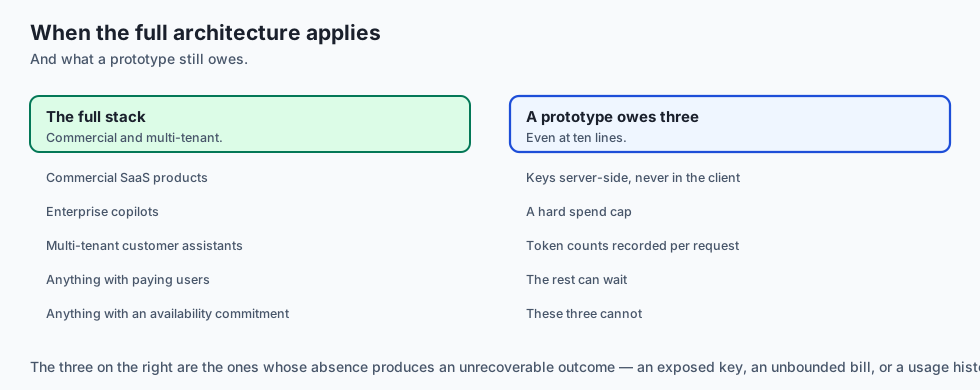
Deploy a Full-Stack AI Application Architecture for:
- All production commercial SaaS applications, enterprise copilots, and multi-tenant customer assistants.
Do NOT require full multi-tier infrastructure for:
- 10-line prototype scripts or internal proof-of-concept demonstrations.
The AI connection
-
The six pillars are all AI-specific in their details: streaming transport, token billing, semantic caching, provider failover, and a UI built for partial output.
-
Financial risk is the difference from ordinary SaaS. No conventional web request can cost five dollars, and pre-authorisation exists because this one can.
-
Availability depends on somebody else’s infrastructure, which is why failover is part of the architecture rather than an operational nicety.
-
Latency is where caching and UX meet: 20 ms on a cache hit, and an optimistic UI that makes even a miss feel immediate.
-
Every layer emits telemetry with the same trace ID, which is what makes an end-to-end system debuggable rather than six systems that each work.
Knowledge check
- What are the 6 stages of the full-stack AI request lifecycle? Client Optimistic UI -> Edge Auth & Quota -> Multi-Tier Caching -> Pre-Auth Credit Hold -> Model Router & Stream -> Usage Settlement & Cache Store.
- Why are cache hits returned before credit holds are placed? Because cached responses incur zero model API costs and require zero credit reservations.
- How does the system handle an upstream provider failure? By intercepting the error and immediately retrying against secondary and tertiary backup replicas in the fallback priority list.
Hands-on exercise
In this lab, you will build a Complete Full-Stack AI Application Engine in Python. Your implementation will:
- Authenticate tenants with hashed credentials and enforce rate limits.
- Intercept exact cached queries and return zero-cost responses.
- Enforce credit pre-authorization holds before dispatching model inference.
- Execute multi-provider failover routing when primary providers fail.
- Reconcile exact token costs and update tenant balances upon completion.
Expected output
============================= test session starts ==============================
collected 5 items

tests/test_full_stack_app.py .....                                       [100%]

============================== 5 passed in 0.02s ===============================
[FULL-STACK APP] Request authenticated and validated.
[CACHE HIT] Identical query served from exact cache in 0.5ms at $0.00 cost.
[FAILOVER ROUTING] Primary Claude failed; seamlessly resolved via Secondary OpenAI.
[SETTLEMENT] Settled $0.00465 actual cost; hold released; remaining balance: $9.99535.
Validate your work
Run the pytest test suite:
pytest tests/run_tests.shTroubleshooting
- Hold release on failure: Ensure
reserved_holdsis decremented if all providers fail. - Balance reconciliation: Confirm that
balanceis reduced byactual_costrather thanest_cost.
Common mistakes
- Failing to update the cache when a novel query successfully completes model inference.
Practice assignment
Add a Tenant Credit Top-Up Method (add_credits) that increments tenant balance and resets exhausted credit error flags.
Extension challenge
Build a Multi-Tenant JWT Gateway Middleware that decodes RS256-signed JWT tokens and extracts tenant subscription tier permissions.
Quiz
Q1. What is the primary architectural value of assembling an integrated Full-Stack AI Application pipeline?
- It unites auth, billing, caching, and failover
- It makes the codebase look complex
- It eliminates the need for unit testing
- It replaces the whole database with plain text files
Show answer
Answer: A. It unites auth, billing, caching, and failover
A complete full-stack architecture harmonizes UX, security, billing, caching, and multi-cloud resilience.
Q2. In what order should an incoming client chat request pass through the backend pipeline layers?
- Inference -> Billing -> Auth -> Cache
- Auth, cache, hold, route, then settle
- Model call -> Frontend render -> Database save
- Random order
Show answer
Answer: B. Auth, cache, hold, route, then settle
Security, quotas, and caching must precede expensive model execution and credit settlement.
Q3. What happens when a user query hits Tier 1 (Exact Match) or Tier 2 (Semantic Cache)?
- The server crashes
- The user is billed double
- It returns in milliseconds at no token cost
- The cache is deleted
Show answer
Answer: C. It returns in milliseconds at no token cost
Cache hits deliver instant responses at zero model API cost.
Q4. How does the full-stack system protect against partial streaming failures mid-generation?
- By charging the user the full estimated amount
- By rebooting the server
- By locking the user's account
- Settle the tokens used and release the rest
Show answer
Answer: D. Settle the tokens used and release the rest
Two-phase settlement ensures users are only billed for actual delivered tokens.
Q5. What standard ensures that frontend client state remains synchronized with backend streaming progress?
- Server-sent events with JSON framing
- FTP file transfer
- Email notifications
- Printing to paper
Show answer
Answer: A. Server-sent events with JSON framing
Structured SSE event frames communicate tokens, metadata, and termination states cleanly.
Glossary
- Full-Stack AI Application
- A complete, integrated software product uniting client UI, streaming gateway, auth, billing, caching, and model routing.
- Two-Phase Token Transaction
- Reserving an estimated credit hold before generation and settling exact token charges upon completion.
- End-to-End Resilience
- The ability of an application to withstand client disconnects, provider outages, and rate limits without data loss.
- Cache-First Architecture
- Checking exact and semantic cache layers before allocating model compute or placing credit holds.
- Sub-Second TTFT
- Delivering the first token to the client viewport in under 1,000 milliseconds.
- Zero-Overdraft Guarantee
- Architectural assurance that tenants cannot consume more compute credits than their available balance.
- Multi-Provider Failover
- Seamlessly switching from primary to secondary model replicas during cloud provider incidents.
- Production Readiness Audit
- A comprehensive verification checklist assessing security, latency, economics, and reliability.
Sources and further reading
- Architecture of Real-World Generative AI Applications (Databricks, 2024) — Databricks (accessed 2026-08-30)
- Building Production-Ready LLM Applications (Anthropic, 2024) — Anthropic Documentation (accessed 2026-08-30)
- OpenAI: Production Best Practices Guide (OpenAI, 2024) — OpenAI (accessed 2026-08-30)
Kept in this browser, no account needed. Your progress page turns the whole record into one link you can bookmark or open on another device.