AI Engineering: Agents and Applications › Production Retrieval and Pipelines › Day 328
Day 328: Privacy in AI Systems

Handle personal data in a retrieval system so a deletion actually lands: redact identifiers at the boundary before one record becomes six, track every store a subject reaches, and verify an erasure by reading back rather than by trusting that the delete calls returned.
Hands-on lab for this lesson
Lab files on GitHub: https://github.com/ai-roadmap-365/ai-roadmap-365.github.io/tree/main/labs/sections/ai-engineering/day-328-privacy-in-ai-systems
- Get the hands-on files. Clone the labs repository once (you can reuse this clone for every lesson). This works on macOS, Linux, and Windows (PowerShell or WSL):
git clone https://github.com/ai-roadmap-365/ai-roadmap-365.github.io.git cd ai-roadmap-365.github.io - Open this lesson's lab. Move into the directory for this specific day. Every lab lives at the same predictable path — section / subsection / week / day:
cd labs/sections/ai-engineering/day-328-privacy-in-ai-systems - Read the lab guide. Open `README.md` in that directory. It lists the exact commands, what each does, the expected output, and how to check your work — read it before running anything.
- Run it and check your work. Follow the README's "How to run" section: run the example first to see the finished result, then complete the numbered exercises in `starter/`, then run the tests. The tests pass (exit 0) only when your work is correct.
bash tests/run_tests.sh # or the test command named in the lab README
You can also open the lab as a local page (works offline, shows the file tree and expected output).
Learning objectives
By the end of this lesson you will be able to:
- Trace how one document multiplies into text, chunks, embeddings, caches and traces, and why deleting the primary row is insufficient.
- Detect and pseudonymise identifiers at the boundary, with detector ordering that prevents partial redaction.
- Explain why a pseudonym must be salted and why pseudonymised data is not anonymous.
- Maintain a data-flow record and verify an erasure by re-reading every store.
- Explain why an embedding is not an anonymous artefact.
Prerequisites
Why this matters
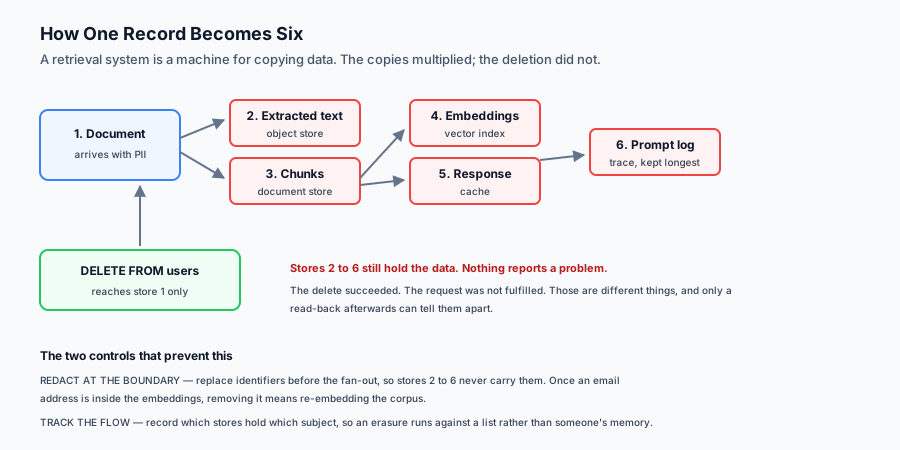
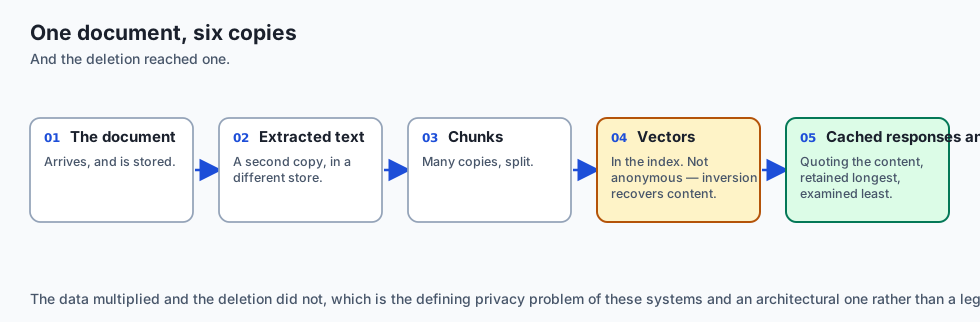
A retrieval system is a machine for copying data. A document arrives, is extracted into text, split into chunks, embedded into vectors, written to an index, cached in a response, and logged in a trace. One record has become six, in six different stores, with six different retention policies — most of which nobody chose deliberately.
Now someone exercises their right to erasure. You delete the row from the database and reply confirming it is done.
It is not done. The chunks are in the vector index. The response is in the cache. The prompt and completion are in yesterday’s observability trace. The extracted text is in an object store nobody has looked at since the migration. Every one of those is still personal data, still retrievable, and still capable of appearing in an answer.
This is the defining privacy problem of AI systems, and it is not primarily a legal problem. It is an architectural one: the data multiplied, and the deletion did not.
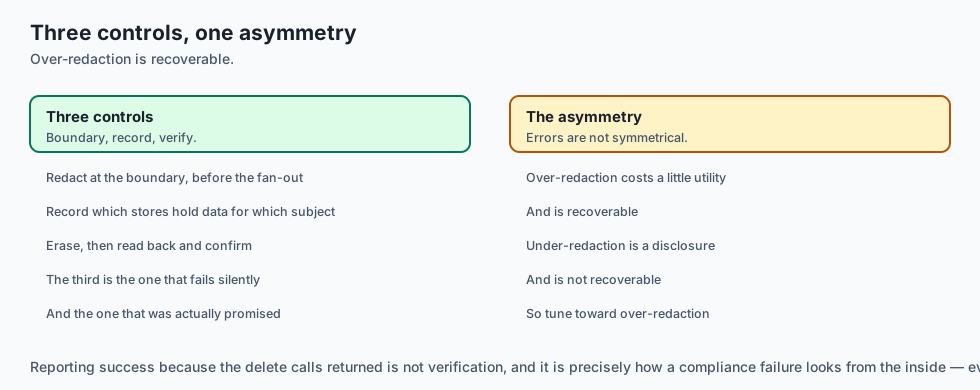
Today is about the three controls that address it — redact at the boundary, track where data flows, and verify that deletion landed — with an emphasis on the third, because it is the one that fails silently.
The idea in plain language
Three controls, in the order they pay off.
Minimise, then redact. Data you never collected cannot leak, cannot be subpoenaed, and does not need deleting. Data you must collect should have identifiers replaced at the boundary — before it fans out — with stable pseudonyms, so records remain linkable for debugging without carrying the identity.
Track the flow. Maintain an explicit record of which stores hold data for which subject. This sounds bureaucratic until the first erasure request, at which point it is the difference between an answer and a guess.
Verify the erasure. Issue the deletes, then read back and confirm the subject is gone from every store. Reporting success because the delete calls returned is not verification, and it is exactly how a compliance failure looks from the inside: entirely normal.
The asymmetry worth internalising: over-redaction costs a little utility and is recoverable. Under-redaction is a disclosure and is not.
Historical background
Data protection law, 1995 onward
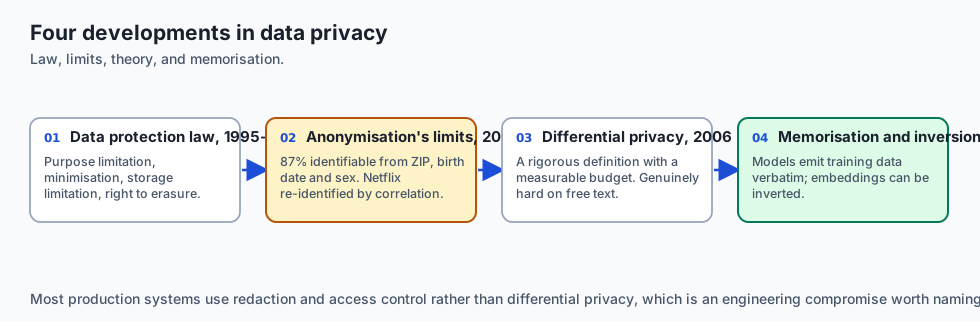
The EU Data Protection Directive, and the GDPR that replaced it in 2018, established the principles this lesson implements: purpose limitation, data minimisation, storage limitation, and the right to erasure under Article 17. California’s CCPA and CPRA created comparable obligations in the United States. The engineering vocabulary — subject, controller, processor, purpose — comes from here.
Anonymisation and its limits, 2000s
Latanya Sweeney showed in 2000 that 87 percent of the US population was uniquely identifiable from ZIP code, birth date and sex alone. The Netflix Prize dataset was de-anonymised in 2008 by correlation with public IMDb ratings. The lesson, learned repeatedly since: removing names does not anonymise data. Combinations of ordinary attributes identify people.
Differential privacy, 2006
Dwork and colleagues gave the first rigorous definition of privacy loss, with a measurable budget. It is the strongest tool available and is genuinely hard to apply to free text, which is why most production systems use redaction and access control instead — an engineering compromise worth naming honestly rather than pretending otherwise.
Memorisation and extraction, 2019 onward
Carlini and colleagues demonstrated that language models memorise and can be induced to emit training data verbatim, including personal information. Related work showed embedding inversion: recovering substantial content from an embedding vector. This closed off a comfortable assumption — that a vector is a harmless numeric artefact — and it is the reason a vector index must be treated as a store of personal data.
What it is — and what it is not
Privacy engineering for AI systems is designing so that personal data is collected minimally, transformed early, tracked deliberately, and deletable provably.
What it is
It is architectural. Where redaction happens determines how far identifiers travel, and that is a design decision made once and expensive to revisit.
It is an inventory problem. Most privacy failures are not sophisticated attacks; they are a store nobody remembered.
It is verifiable. Deletion either propagated or it did not, and that is testable — which makes it unusual among privacy properties.
What it is not
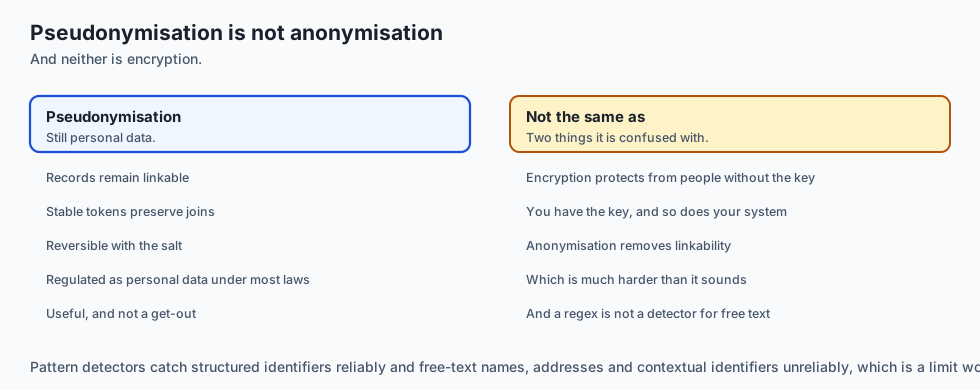
It is not encryption. Encryption protects data from people without the key. Privacy engineering is about what your own system does with data it is entitled to hold.
It is not anonymisation. Pseudonymisation — what this lab implements — keeps records linkable and remains personal data under most regulations. Calling it anonymised is a category error with legal consequences.
It is not solved by a regex. Pattern detectors catch structured identifiers. They do not catch a name in free text, an unusual job title, or a combination of ordinary facts that identifies one person.
Why it was created and what problems it solves
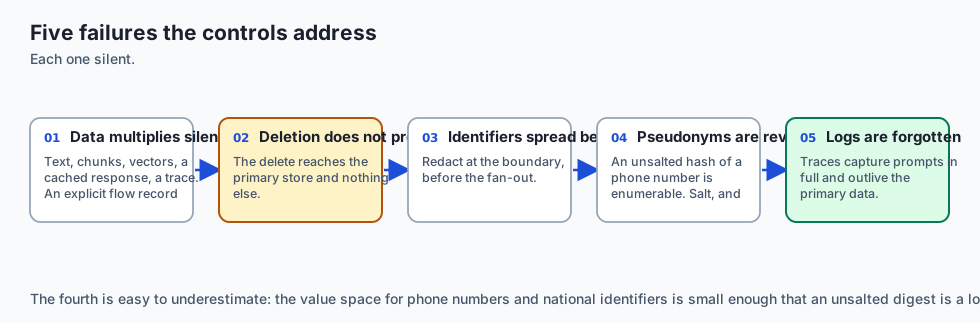
Data multiplies silently. One document becomes text, chunks, vectors, a cached response and a trace. Solution: an explicit flow record naming every store.
Deletion does not propagate. The delete reaches the primary store and nothing else. Solution: erasure that reads back and reports which stores still hold the subject.
Identifiers spread before anyone thinks about them. Once an email address is in the embeddings, removing it means re-embedding. Solution: redact at the boundary, before the fan-out.
Pseudonyms are reversed. An unsalted hash of a phone number is trivially reversed by enumeration — the space is small. Solution: salt, and keep the salt somewhere the data is not.
Logs are forgotten. Observability traces capture prompts and completions in full, and are usually retained longer than the primary data. Solution: treat traces as personal data with their own retention, and redact before logging.
How it works
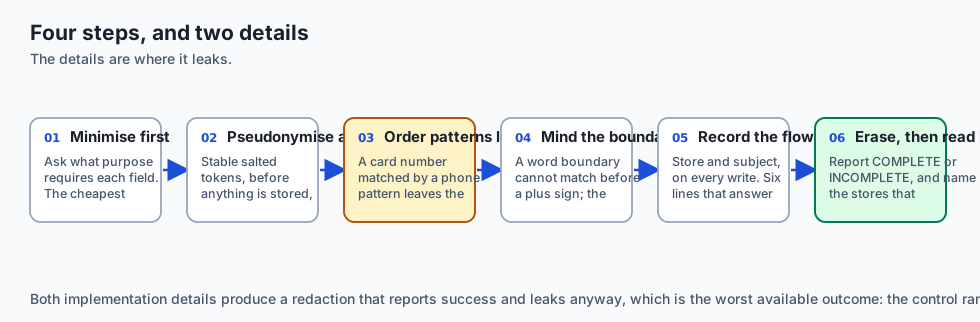
Minimise first. For each field, ask what purpose requires it. Fields with no answer should not be collected. This is the cheapest control and the one most often skipped, because collecting everything feels free at the time.
Detect and pseudonymise at the boundary. Run detectors over incoming text and replace matches with stable, salted pseudonyms before anything is stored, chunked or embedded.
Two implementation details matter more than they look:
Ordering. Longer, more specific patterns must run first. A card number matched by a phone pattern is partially consumed, and the leftover digits are left in the text — a redaction that reports success and leaks anyway.
Boundaries. A word boundary cannot match before a +, so a naive phone pattern leaves the country code behind. That stray + is cosmetic on its own and is a reliable signal that the match was partial.
Record the flow. Every write records the store and the subject. Six lines of bookkeeping that answer “where is this person’s data?” definitively.
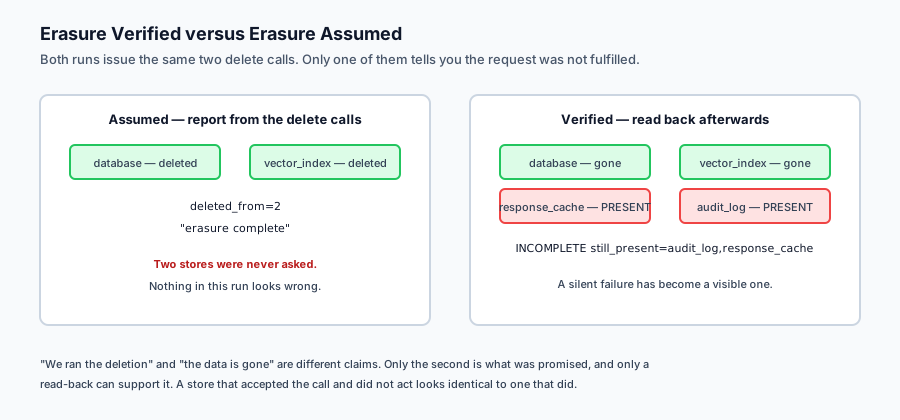
Erase and verify. Issue deletes to every store the flow record names, then re-read and report which stores still hold the subject. The report should distinguish COMPLETE from INCOMPLETE, and the incomplete case should name the stores.
The verification is not defensive programming. It is the difference between “we ran the deletion” and “the data is gone”, and only the second is what was promised.
An everyday analogy
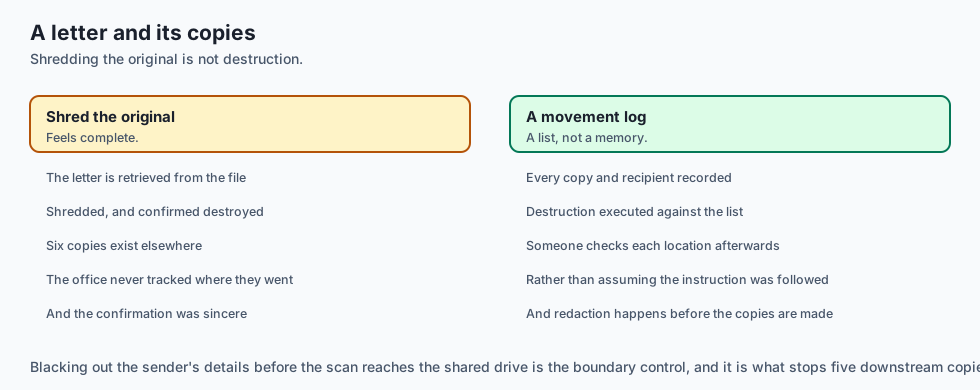
Think of a letter arriving at a large office.
It is opened and scanned. The scan goes to a shared drive. Someone emails a summary to three colleagues. The summary is quoted in a meeting minute. The original is filed. A copy sits in the scanner’s memory.
Someone now asks for their letter to be destroyed. You retrieve the original from the file and shred it, and confirm the letter has been destroyed.
You are wrong, and you are wrong in a way that feels complete. Six copies exist and you addressed one, because the office never tracked where copies went.
The competent version of this office keeps a movement log — every copy, every recipient — so a destruction request is executed against a list rather than a memory. And when it is done, someone checks each location rather than assuming the instruction was followed.
Redaction is the office that blacks out the sender’s details on the scan before it goes to the shared drive, so the five downstream copies never carry them.
Examples in practice
Here is the measured output from today’s lab, redacting a support ticket:
From: [email:c4e2790ada]
Phone: [phone:749f96d705]
Card ending [card:1442489716] was charged twice.
Reported from [ip:555fff71c9]. Reference SSN [national_id:8975e0fdf2].
findings: card=1 email=1 ip=1 national_id=1 phone=1
pseudonym stable across records: True
Five categories detected, each replaced with a stable token. The stability line matters: the same email produces the same pseudonym in a different record, so an engineer debugging a ticket chain can still follow one person through it without ever seeing who they are.
Then the flow and the erasure:
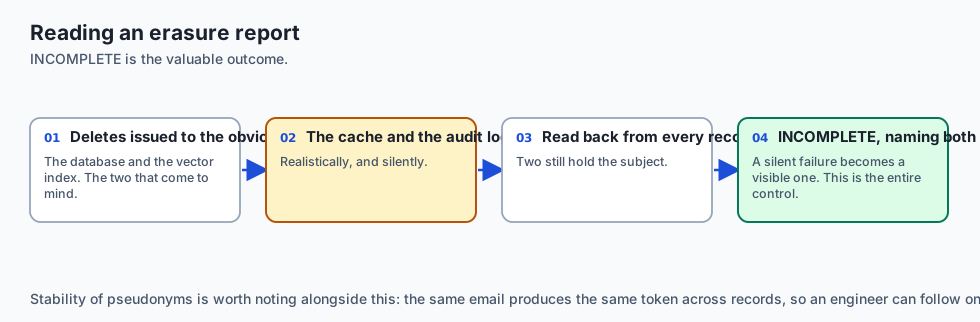
subject-42 present in: ['audit_log', 'database', 'response_cache', 'vector_index']
--- erasure, first attempt (the stores someone remembered) ---
INCOMPLETE deleted_from=2 still_present=audit_log,response_cache
--- erasure, complete ---
COMPLETE deleted_from=2 still_present=none
The first attempt is the realistic one. Someone deletes from the database and the vector index — the two stores that come to mind — and the cache and the audit log are missed. Without a read-back, that run reports two successful deletions and looks like a completed request.
The INCOMPLETE line, naming the two remaining stores, is the entire value of the control. It converts a silent failure into a visible one.
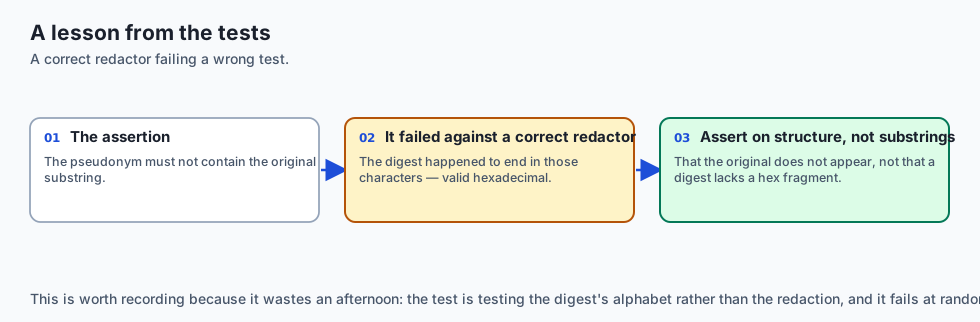
One more finding worth recording, from writing the tests rather than the code. A test asserting that the token does not contain "ada" failed against a perfectly correct redactor, because the SHA-256 digest happened to end in ada — which is valid hexadecimal. A privacy test that produces false alarms gets muted, and a muted test protects nothing. Assert on the whole identifier and on fragments containing non-hex characters.
Implications: security, privacy, performance, scalability, and cost
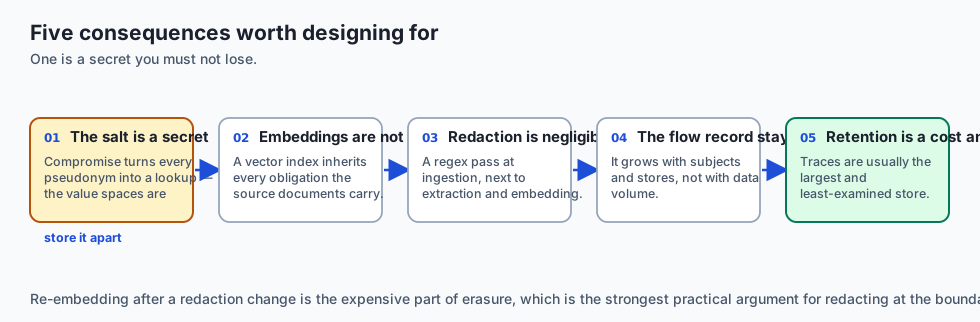
Security. The pseudonymisation salt is a secret. Compromising it turns every pseudonym back into a lookup, because the value space for phone numbers and national identifiers is small enough to enumerate. Store it apart from the data it protects.
Privacy. Embeddings are not anonymous. Inversion attacks recover meaningful content from vectors, so a vector index holds personal data and inherits every obligation the source documents carry — including deletion.
Performance. Redaction is a regular-expression pass over text at ingestion, which is negligible next to extraction and embedding. There is no performance argument for skipping it.
Scalability. The flow record grows with subjects and stores, not with data volume, so it stays small. The expensive part of erasure is re-embedding after a redaction change, which is a strong argument for redacting at the boundary the first time.
Cost. Retention is a cost as well as a risk. Traces holding full prompts and completions are frequently the largest and least-examined store in an AI system, and they are usually kept far longer than anyone intended.
Alternatives: free, open source, and commercial
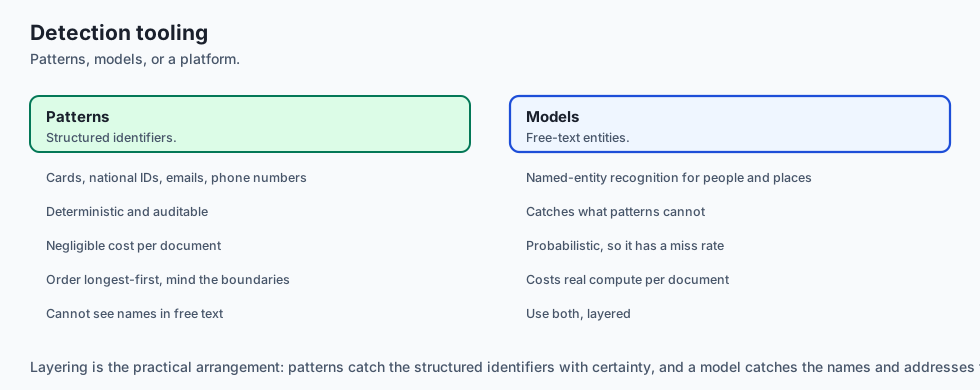
Microsoft Presidio — MIT-licensed, the strongest open-source option. Combines pattern detectors with named-entity recognition, so it catches names in free text that regular expressions cannot.
spaCy with an NER model — MIT-licensed, general-purpose. More work to wire up, and useful when you need entity detection beyond a fixed identifier list.
scrubadub — Apache-2.0, lightweight, pattern-based. Comparable in scope to today’s lab.
Cloud DLP services — Google Cloud DLP, AWS Macie, Azure Purview. Broad detector coverage and classification, priced per unit scanned, and they require sending the data to the provider — which is a data-residency decision, not a technical one.
OpenDP and Google’s differential privacy libraries — the rigorous option, for aggregate statistics rather than free text.
The honest default: Presidio for detection, your own pseudonymisation with a well-protected salt, and an explicit flow record that you maintain yourself, because only you know your stores.
Comparison with related concepts
Pseudonymisation versus anonymisation. Pseudonymisation is reversible with the key or salt and remains personal data under the GDPR. Anonymisation is irreversible and takes the data out of scope. Almost everything called anonymisation in practice is pseudonymisation.
Redaction versus encryption. Encryption keeps data readable with a key. Redaction removes it. For data you do not need, redaction is the stronger control — there is no key to lose.
Privacy versus security. Security keeps out people who should not have access. Privacy governs what you do with data you are entitled to hold. A perfectly secure system can be a privacy disaster.
Data minimisation versus retention limits. Minimisation is not collecting it. Retention is deleting it later. Minimisation is strictly better where you have the choice, because it eliminates a class of failure rather than scheduling one.
When to use it — and when not to
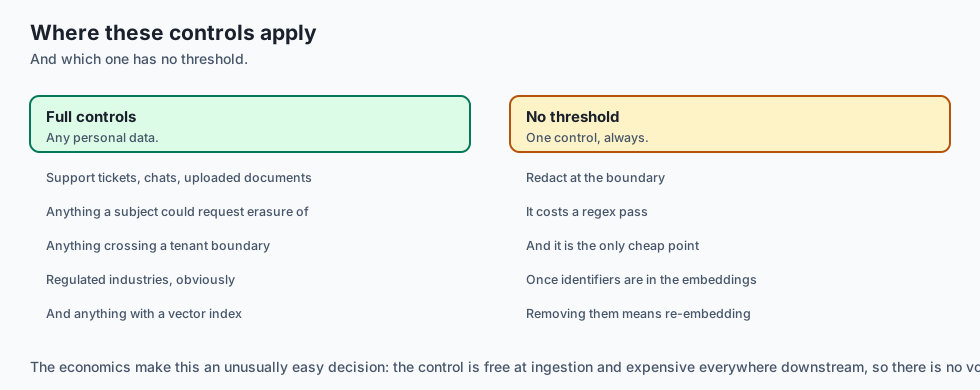
Apply all three controls when the system handles data about identifiable people, when users can request deletion, when data crosses a tenant boundary, or when traces and caches persist prompts — which is nearly always, and nearly always by default rather than by decision.
Scale it down when the corpus is genuinely public documents with no personal data, or a purely internal tool over synthetic fixtures. Even then, the flow record is worth keeping: it costs almost nothing and it is the artefact you will wish existed the first time someone asks where data went.
Never skip the verification. Redaction and flow tracking are improvements. Verified erasure is the difference between a promise kept and a promise made.
The AI connection
-
A retrieval system is a machine for copying data, which is what makes erasure an architectural problem rather than a database operation.
-
Embeddings are not anonymous. Inversion attacks recover meaningful content from vectors, so a vector index inherits every obligation its source documents carry.
-
Models memorise and can be induced to emit training data, which is why what enters a fine-tune is a different decision from what enters a database.
-
Redacting at the boundary is the only cheap point. Once an identifier is in the embeddings, removing it means re-embedding the corpus.
-
Traces are usually the largest and least-examined store in an AI system, and are routinely retained far longer than the primary data they describe.
Knowledge check
- One document becomes six stored artefacts. Name them, and explain why deleting the database row is insufficient.
- Why must longer, more specific detection patterns run before shorter ones?
- Why does an unsalted hash fail as a pseudonym for a phone number?
- Why is an embedding not an anonymous artefact?
- A privacy test asserting a token does not contain
"ada"failed against a correct redactor. Why, and what should it assert instead?
Hands-on exercise
You will build detection and pseudonymisation, a data-flow record, and verified erasure. It runs offline against synthetic identifiers that are invalid by construction — example.com is reserved, 192.0.2.0/24 is the reserved TEST-NET-1 range, and the card number fails the Luhn check.
Open starter/privacy.py in the lab directory and implement the stubbed functions, then run the tests.
Expected output
Running python3 examples/privacy_demo.py produces:
--- redacted ---
From: [email:c4e2790ada]
Phone: [phone:749f96d705]
Card ending [card:1442489716] was charged twice.
Reported from [ip:555fff71c9]. Reference SSN [national_id:8975e0fdf2].
findings: card=1 email=1 ip=1 national_id=1 phone=1
pseudonym stable across records: True
--- data flow ---
subject-42 present in: ['audit_log', 'database', 'response_cache', 'vector_index']
--- erasure, first attempt (the stores someone remembered) ---
INCOMPLETE deleted_from=2 still_present=audit_log,response_cache
--- erasure, complete ---
COMPLETE deleted_from=2 still_present=none
--- minimisation ---
kept: {'tier': 'pro'}
The INCOMPLETE line is the one that matters. Two deletes succeeded and the request still was not fulfilled — and without the read-back, this run would have looked entirely successful.
Validate your work
Run bash tests/run_tests.sh. All nineteen tests must pass, grouped by control so a failure names what broke.
Then check two things by inspection. Redact the demo ticket and confirm no fragment of any original identifier survives — including the leading + on the phone number. And run an erasure against a subset of stores; the report must say INCOMPLETE and name the stores still holding the subject.
Troubleshooting
A stray + remains after redacting a phone number. A word boundary cannot match before +, because + is not a word character. Use a negative lookbehind on word characters instead.
A card number is reported as a phone number. Your detectors are running in the wrong order. Longer, more specific patterns must claim their spans first.
Pseudonyms differ for the same value. You are salting per call rather than using a fixed salt, or including position in the hash. The same value must always produce the same token.
Erasure reports COMPLETE when stores remain. You are reporting based on the delete calls rather than re-reading. Query the flow again after deleting and report what is still there.
A test asserting a fragment is absent fails on correct output. Check whether the fragment is valid hexadecimal — short hex strings appear inside digests by coincidence.
Common mistakes
Treating detection as sufficient. The question is not “did it find identifiers” but “is any part of them left”.
Calling pseudonymised data anonymous. It is still personal data, and the distinction is legal as well as technical.
Forgetting the audit log and the response cache. They are stores, they hold personal data, and they are usually retained longest.
Reporting erasure from the delete calls rather than a read-back.
Practice assignment
Add a retention policy to the data-flow record: each store declares a maximum age, and a sweep reports which subjects are held past it.
Then write two tests. One proving the sweep finds an over-retained subject in a store with a short policy. The other proving that a store with no declared policy is reported as a finding rather than silently treated as unlimited — an undeclared retention period is a gap, not a permission.
Extension challenge
Implement re-identification risk scoring on quasi-identifiers. Given records with attributes such as postcode, birth year and job title, compute the size of the group sharing each combination, and flag any record that is unique or near-unique.
Then demonstrate the point Sweeney made: build a fixture where every direct identifier has been removed and a substantial fraction of records are still uniquely identified by three ordinary attributes.
Report the real number. If your fixture shows that most records are safely grouped, say so and then change the attribute distribution until they are not — the finding is that the risk depends entirely on the data’s shape, which is precisely why it must be measured rather than assumed.
Quiz
Q1. One document becomes six stored artefacts. Why is deleting the database row insufficient?
- It is sufficient, because the other stores are derived and expire automatically
- Because database deletes are soft by default
- The same data lives in several stores; delete hit one
- Because the other copies are encrypted and therefore out of scope
Show answer
Answer: C. The same data lives in several stores; delete hit one
The data multiplied and the deletion did not. Every derived store is a place the erasure has to reach, and the trace is usually retained longest.
Q2. Why must longer, more specific detection patterns run before shorter ones?
- Because shorter patterns are slower to evaluate
- Ordering makes no difference as long as every pattern runs
- Because regular expressions are evaluated in reverse order
- A short pattern can eat part of a longer identifier
Show answer
Answer: D. A short pattern can eat part of a longer identifier
Partial redaction is the dangerous outcome — it looks like a success and leaks anyway. Claiming spans with the most specific detector first prevents it.
Q3. Why does an unsalted hash fail as a pseudonym for a phone number?
- The value space is small enough to enumerate
- Because hashes are reversible by design
- Because hashing is too slow at scale
- Because hashes collide too frequently for phone numbers
Show answer
Answer: A. The value space is small enough to enumerate
A salt makes the precomputation useless, which is why the salt is a secret and must be stored apart from the data it protects.
Q4. Why is an embedding not an anonymous artefact?
- Because embeddings store the original text alongside the vector
- Inversion can recover content, so it is personal data
- Because embeddings are always logged in plain text
- Because vector databases do not support deletion
Show answer
Answer: B. Inversion can recover content, so it is personal data
Treating a vector index as harmless numbers is the comfortable assumption this research closed off. It is a store of personal data and must be included in an erasure.
Q5. A privacy test asserting a token does not contain "ada" failed against a correct redactor. Why, and what should it assert instead?
- The redactor was broken and the test was right
- Because the test ran before redaction completed
- "ada" is valid hex and appeared by coincidence
- Because tokens are case-sensitive and the fragment was lowercase
Show answer
Answer: C. "ada" is valid hex and appeared by coincidence
A privacy test that raises false alarms gets muted, and a muted test protects nothing. Choose fragments that cannot occur in a digest by chance.
Glossary
- Data Minimisation
- Collecting only the fields a stated purpose requires. The cheapest privacy control, since data never collected cannot leak and does not need deleting.
- Pseudonymisation
- Replacing an identifier with a stable stand-in so records remain linkable without carrying identity. Still personal data under most regulations.
- Anonymisation
- Irreversible transformation that takes data out of scope. Much harder than it sounds, and frequently claimed for what is really pseudonymisation.
- Salt
- A secret value combined with input before hashing, which defeats precomputed lookup of a small value space such as phone numbers.
- Right to Erasure
- A data subject's right to have their personal data deleted, which must reach every derived store rather than only the primary one.
- Data Flow Record
- An explicit account of which stores hold data for which subject, so an erasure runs against a list rather than someone's memory.
- Verified Erasure
- Deleting and then re-reading to confirm the subject is absent, as distinct from reporting success because the delete calls returned.
- Quasi-Identifier
- An attribute that is not identifying alone but becomes so in combination, such as postcode with birth date and sex.
- Embedding Inversion
- Recovering meaningful content from an embedding vector, which is why a vector index holds personal data rather than harmless numbers.
- Differential Privacy
- A rigorous definition of privacy loss with a measurable budget. The strongest available tool, and difficult to apply to free text.
Sources and further reading
- General Data Protection Regulation, Article 17 — Right to Erasure — EU GDPR Information Portal (accessed 2026-08-31)
- Simple Demographics Often Identify People Uniquely (Sweeney, 2000) — Carnegie Mellon University, Data Privacy Lab (accessed 2026-08-31)
- Extracting Training Data from Large Language Models (Carlini et al., 2021) — arXiv (accessed 2026-08-31)
- Text Embeddings Reveal (Almost) As Much As Text (Morris et al., 2023) — arXiv (accessed 2026-08-31)
- Microsoft Presidio — Data Protection and De-identification SDK — Microsoft (accessed 2026-08-31)
Kept in this browser, no account needed. Your progress page turns the whole record into one link you can bookmark or open on another device.