Deployment, MLOps, and Security › Containers and Cloud › Day 332
Day 332: Docker Compose for Multi-Service Apps
Read a Compose file as the dependency graph it is, and find the three failures that are visible before anything runs. Learn why depends_on waits for the container rather than the service, and measure the four seconds during which an API is up and its database cannot answer.
Hands-on lab for this lesson
Lab files on GitHub: https://github.com/ai-roadmap-365/ai-roadmap-365.github.io/tree/main/labs/sections/deployment-mlops-and-security/day-332-docker-compose-for-multi-service-apps
- Get the hands-on files. Clone the labs repository once (you can reuse this clone for every lesson). This works on macOS, Linux, and Windows (PowerShell or WSL):
git clone https://github.com/ai-roadmap-365/ai-roadmap-365.github.io.git cd ai-roadmap-365.github.io - Open this lesson's lab. Move into the directory for this specific day. Every lab lives at the same predictable path — section / subsection / week / day:
cd labs/sections/deployment-mlops-and-security/day-332-docker-compose-for-multi-service-apps - Read the lab guide. Open `README.md` in that directory. It lists the exact commands, what each does, the expected output, and how to check your work — read it before running anything.
- Run it and check your work. Follow the README's "How to run" section: run the example first to see the finished result, then complete the numbered exercises in `starter/`, then run the tests. The tests pass (exit 0) only when your work is correct.
bash tests/run_tests.sh # or the test command named in the lab README
You can also open the lab as a local page (works offline, shows the file tree and expected output).
Learning objectives
By the end of this lesson you will be able to:
- Detect dependency cycles and report each one once rather than once per member.
- Produce a stable startup order, and explain why a cycle has none.
- Distinguish a host-port conflict from two containers sharing an internal port.
- Model what service_started and service_healthy actually wait for.
- Explain why a correctly wired stack reports ready later, and why that is the honest number.
Prerequisites
Why this matters
An AI application is almost never one container. There is the API, a database for application state, a vector store, a worker for the slow jobs, and usually a cache. Running those by hand means five docker run commands with the right flags in the right order, and getting one wrong at 9am on a Monday.
Compose replaces that with a file. That part is easy and is not what this lesson is about.
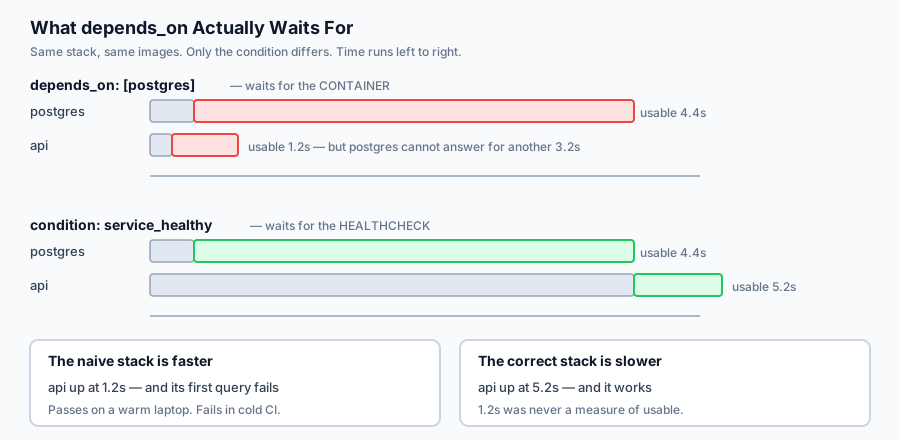
What this lesson is about is a single word that behaves differently from how everyone reads it. depends_on does not mean “wait until the database is ready”. It means “start that container first”. The difference, measured in today’s lab:
api      usable at 1.2s
postgres usable at 4.4s
The API reports itself up three seconds before the database it queries can accept a connection. Its first query fails.
On your laptop, where Postgres is warm and the page cache is full, it usually does not fail. In CI, where everything is cold, it usually does. That is the worst failure distribution available: it passes where you are looking and fails where you are not, and the resulting bug is filed as “flaky CI” rather than “our startup ordering is wrong”.
The idea in plain language
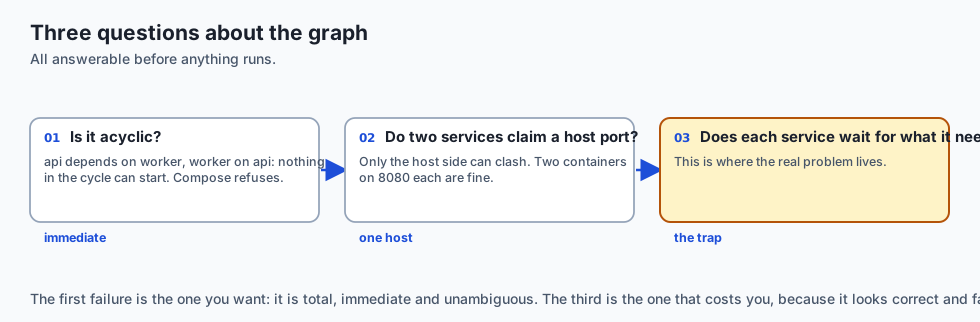
A Compose file describes a graph. The services are nodes, depends_on gives the edges, and three properties of that graph decide whether the stack works.
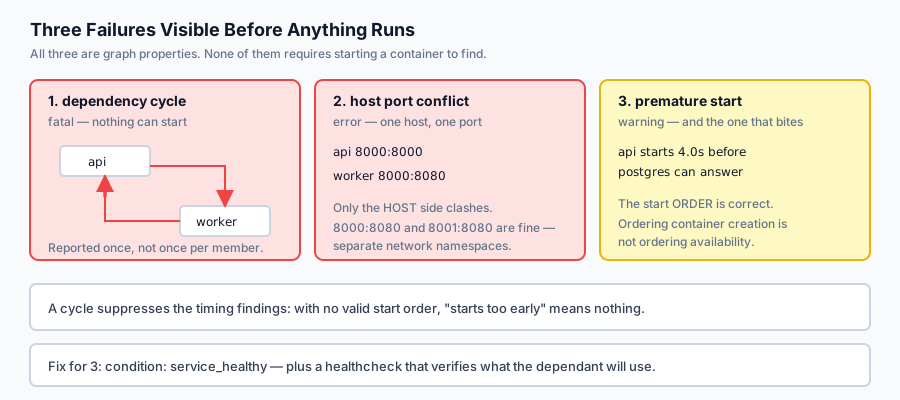
Is it acyclic? If api depends on worker and worker depends on api, nothing in the cycle can ever start. Compose refuses the file, and the error is clear — this is the failure you want, because it happens immediately and unambiguously.
Do any two services claim the same host port? Only the host side can clash. Two containers happily listen on 8080 each because they are in separate network namespaces; ports: ["8000:8080"] binds 8000 on the host, and there is exactly one host.
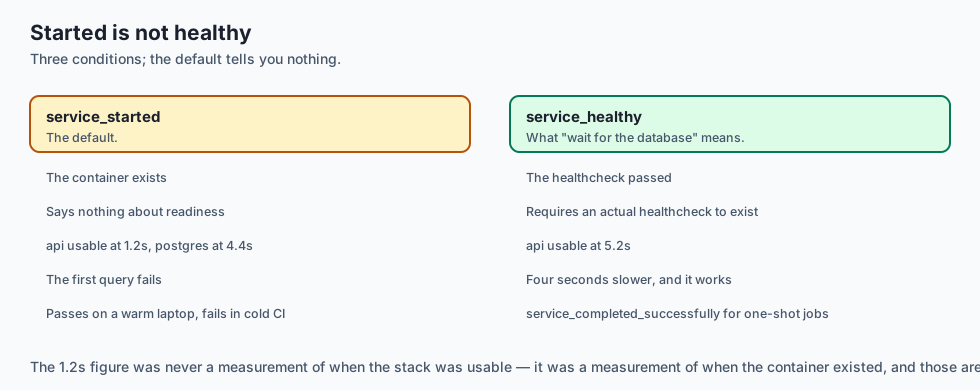
Does each service wait for what it actually needs? This is where the real problem lives. There are three conditions:
service_started— the container exists. The default, and it tells you almost nothing.service_healthy— the healthcheck passed. This is what “wait for the database” means.service_completed_successfully— a one-shot job exited zero. For migrations and seeding.
Writing depends_on: [postgres] gets you the first. Writing it with condition: service_healthy, plus an actual healthcheck on Postgres, gets you the second. The difference is four seconds of not crashing.
Historical background
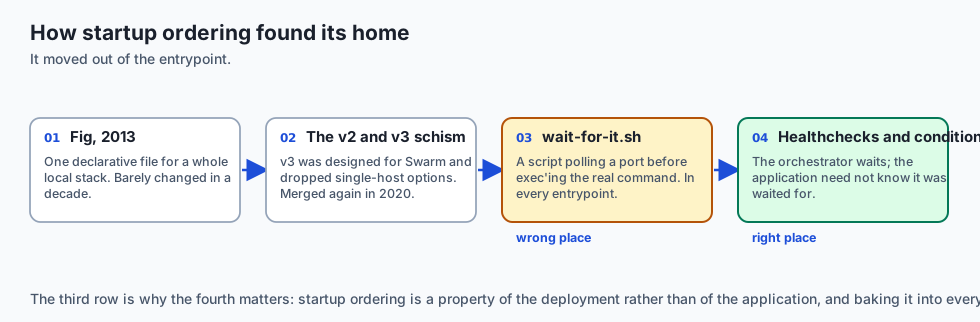
Fig, 2013
Compose began life as Fig, an independent tool for describing multi-container applications in YAML. Docker acquired it in 2014 and renamed it. The core idea — one declarative file for a whole local stack — has barely changed in a decade, which is unusual and says something about how right it was.
The v2 and v3 schism
Compose file format v3 was designed with Docker Swarm in mind and dropped several options that only made sense on a single host. For years people chose a version number based on which features they needed. The Compose Specification, from 2020, merged the lines again; modern files omit version: entirely.
wait-for-it.sh and the era of shell scripts
Before dependency conditions existed, the standard answer to “wait for the database” was a shell script that polled a TCP port before exec’ing the real command. wait-for-it.sh and dockerize were everywhere. They worked, and they put startup ordering into every image’s entrypoint — which is the wrong place for it, because it is a property of the deployment rather than of the application.
Healthchecks, Docker 1.12 (2016) and Compose conditions
HEALTHCHECK in a Dockerfile, then condition: service_healthy in Compose, moved the problem to where it belongs: the orchestrator waits, and the application does not need to know it was waited for. Kubernetes readiness probes are the same idea at a larger scale, which is tomorrow’s lesson.
What it is — and what it is not
Compose is a declarative description of a multi-container application on one host.
What it is
It is a local development and small-deployment tool. One machine, several containers, one file.
It is a dependency graph with ordering semantics, which is why graph questions are the useful ones to ask of it.
It is the readable version of a long docker run command, and its main value is that the flags stop being tribal knowledge.
What it is not
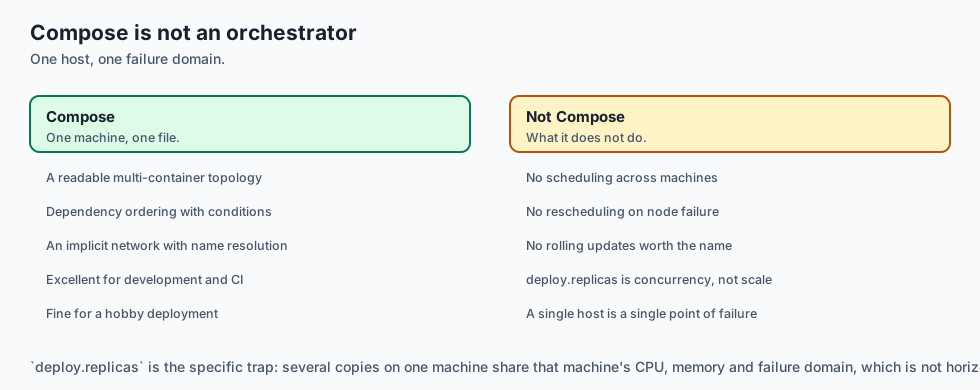
It is not an orchestrator. No scheduling across machines, no rescheduling on node failure, no rolling updates worth the name. That is tomorrow.
It is not a production deployment for anything that must stay up. A single host is a single point of failure.
It is not a way to avoid understanding networking. Services reach each other by name on a shared network, and knowing that is what stops you publishing a database port to the world.
Why it was created and what problems it solves
Five docker run commands in the right order. Undocumented, and different on every machine. Solution: one file, in the repository.
Networking assembled by hand. Solution: an implicit network where services resolve each other by service name.
“It works on my machine” at the stack level. Solution: the same file starts the same topology everywhere.
Startup ordering by hope. Solution: dependency conditions — though only if you use them, which is the point of today.
Local environments that drift from each other. Solution: a versioned file rather than a wiki page.
How it works
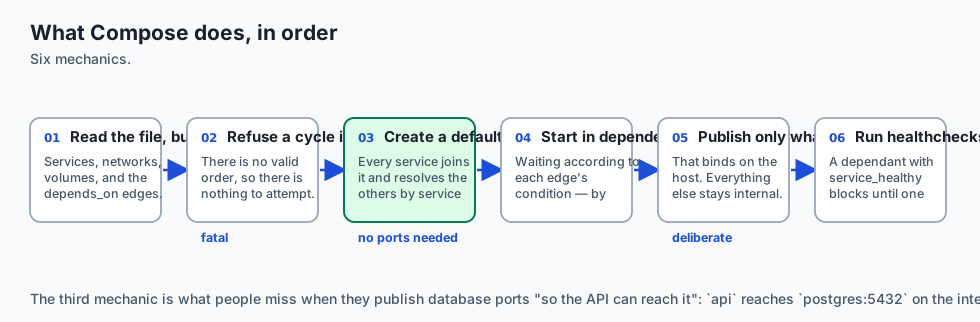
Compose reads the file and builds a graph. Services, networks, volumes, and the depends_on edges between them.
It refuses a cycle immediately. There is no valid order, so there is nothing to attempt.
It creates a default network. Every service joins it and is reachable by its service name. api connects to postgres:5432 with no port published at all — this is the part people miss when they publish database ports “so the API can reach it”.
It starts services in dependency order, waiting according to each edge’s condition. With no condition it waits only for the container to be created.
It publishes only what ports: asks for. That binds on the host. Everything else stays on the internal network.
Healthchecks run on an interval and a service is healthy only after one passes. A dependant with condition: service_healthy blocks until then, which is exactly the four seconds the naive stack skips.
An everyday analogy
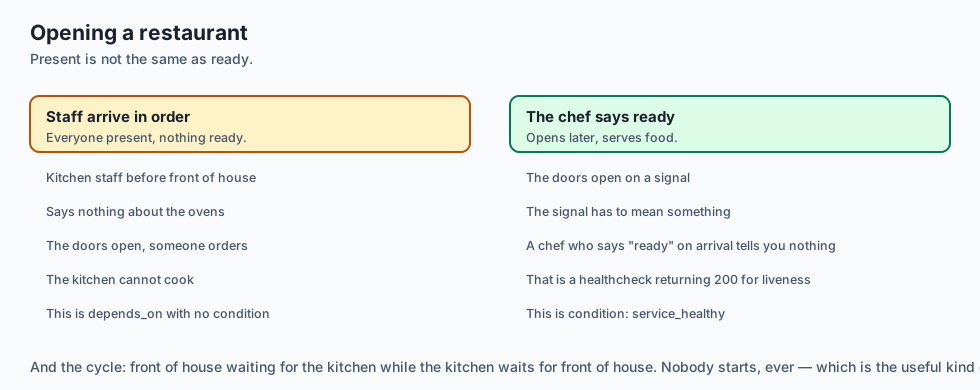
Think of opening a restaurant for the evening.
depends_on with no condition is the rule “the kitchen staff arrive before the front of house”. Fine, and it says nothing about the ovens being hot. The doors open, someone orders, and the kitchen cannot cook — everybody is present and nothing is ready.
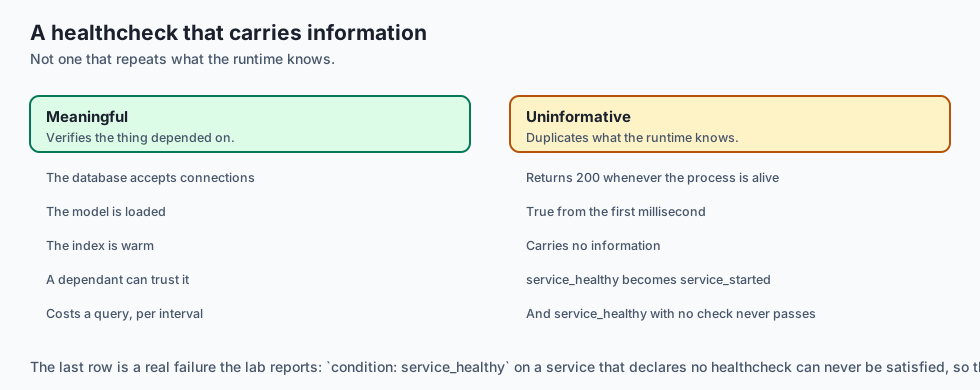
condition: service_healthy is the rule “the doors open when the head chef says the kitchen is ready”. The head chef saying so is the healthcheck, and it has to mean something: a chef who says “ready” the moment they walk in has given you a signal that carries no information, which is exactly what a healthcheck returning 200 whenever the process is alive does.
The restaurant opens later under the second rule. It also serves food.
And the cycle: front of house waiting for the kitchen while the kitchen waits for front of house. Nobody starts, ever, and the useful thing about this failure is that it is total and immediate rather than intermittent.
Examples in practice
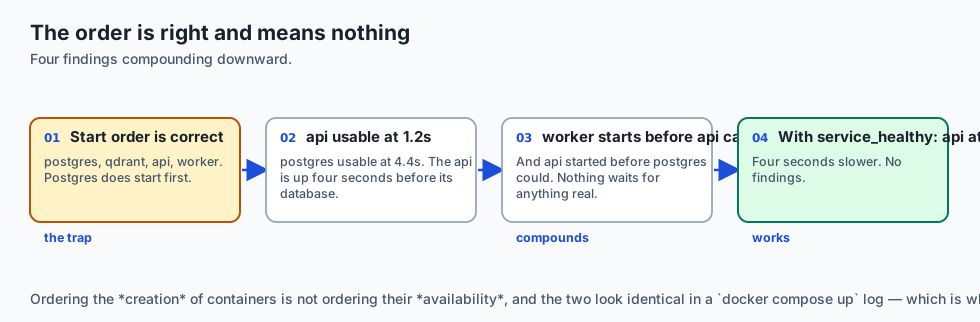
The measured output from today’s lab. One stack — postgres, qdrant, api, worker — wired two ways:
--- depends_on with no condition ---
  start order  postgres -> qdrant -> api -> worker
  usable at    api 1.2s  postgres 4.4s  qdrant 2.3s  worker 1.2s
  [starts-before-ready] api    starts 4.0s before 'postgres' can answer
  [starts-before-ready] api    starts 1.9s before 'qdrant' can answer
  [starts-before-ready] worker starts 3.8s before 'postgres' can answer
  [starts-before-ready] worker starts 0.6s before 'api' can answer
The start order is correct. Postgres does start before the api. That is the trap — the ordering looks right and means nothing, because ordering the creation of containers is not ordering their availability.
Look at the fourth finding especially: the worker starts before the api can answer, and the api itself started before Postgres could answer. Nothing in the chain waits for anything real, so the error compounds downward.
--- depends_on: service_healthy ---
  usable at    api 5.2s  postgres 4.4s  qdrant 2.3s  worker 5.8s
  no findings
The api is now usable at 5.2s instead of 1.2s. Four seconds slower, and it works. The first number was never a measurement of when the stack was usable; it was a measurement of when the container existed.
And the file that cannot start at all:
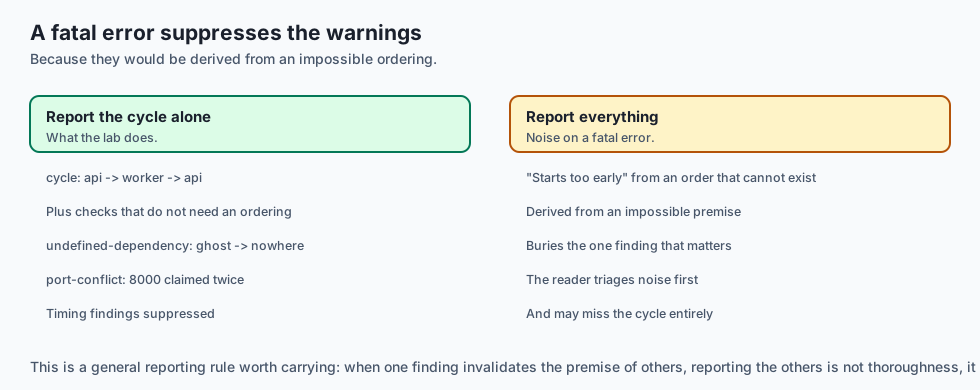
  cannot start: dependency cycle: api -> worker -> api
  [undefined-dependency] ghost depends on 'nowhere'
  [port-conflict] host port 8000 is claimed by 2 services: api, worker
Note that the cycle suppresses the timing findings. With no valid start order, “starts too early” is not a meaningful claim, and reporting warnings derived from an impossible ordering would be noise on top of a fatal error.
Implications: security, privacy, performance, scalability, and cost
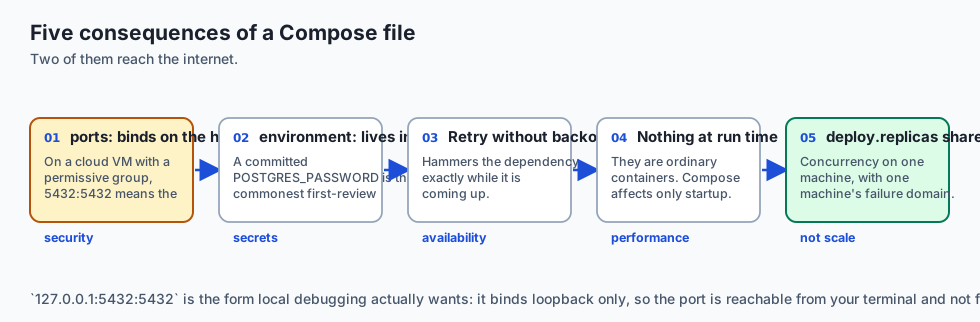
Security. ports: binds on the host. On a cloud VM with a permissive security group, ports: ["5432:5432"] on Postgres means the internet can reach your database. Services on the Compose network already reach each other by name, so a published port is a deliberate decision about outside traffic, not a prerequisite for internal traffic. 127.0.0.1:5432:5432 binds loopback only, which is what local debugging actually wants.
Secrets. environment: values live in the file, and the file lives in Git. Use env_file: with the file gitignored, or Docker secrets. A committed POSTGRES_PASSWORD is the most common finding in any first review of a Compose stack.
Availability. A service that starts before its dependency is ready does not fail quietly. It retries, and if the retry has no backoff it hammers the dependency exactly while that dependency is trying to come up — turning a slow start into a failed one.
Performance. Compose adds nothing at run time; the containers are ordinary containers. What it affects is startup, and only through ordering.
Scalability and cost. deploy.replicas on a single host shares that host’s CPU and memory. It is not horizontal scaling; it is concurrency on one machine, with one machine’s failure domain.
Alternatives: free, open source, and commercial
Docker Compose — Apache-2.0, the default, and the right answer for local development. Compose V2 is a Docker CLI plugin rather than a separate Python tool.
Podman Compose / podman kube play — daemonless and rootless. podman-compose reads Compose files; podman kube play reads Kubernetes YAML, which makes it a useful stepping stone toward tomorrow.
Kubernetes with kind or minikube — a real orchestrator locally. Much heavier, and worth it when local and production should be the same shape.
Tilt and Skaffold — development loops on top of Kubernetes, with file watching and live reload. They solve the iteration problem Compose solves, against a cluster.
Dev Containers — the VS Code specification, which uses Compose underneath for multi-service setups. A different interface to the same mechanism.
Managed local stacks — Supabase CLI, LocalStack and similar ship a curated Compose file for a specific dependency set. Convenient, and worth reading rather than only running.
The honest default: Compose for local development, with service_healthy conditions and real healthchecks, and a different tool for production.
Comparison with related concepts
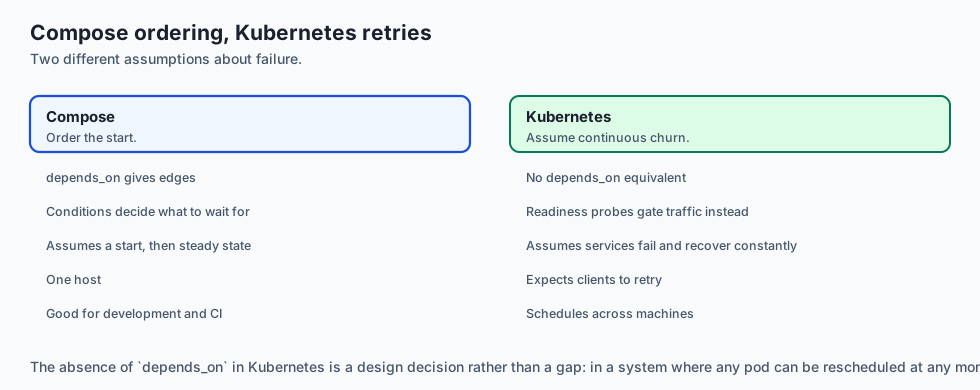
Compose versus Kubernetes. Compose describes a topology on one host; Kubernetes schedules across many and keeps them running. Compose’s depends_on is a startup ordering; Kubernetes has no equivalent, because it assumes services fail and recover continuously and expects clients to retry.
depends_on versus a healthcheck. They are two halves of one mechanism. The condition says what to wait for; the healthcheck is what makes the answer meaningful. service_healthy on a service with no healthcheck can never be satisfied — which is why the lab reports it.
ports versus expose versus nothing. ports binds on the host; expose documents intent; nothing at all is sufficient for service-to-service traffic. Most services need the third.
Healthcheck versus liveness. A healthcheck that returns 200 whenever the process is alive duplicates what the runtime already knows. A useful one verifies the thing a dependant is about to rely on — that the database accepts connections, that the model is loaded.
When to use it — and when not to
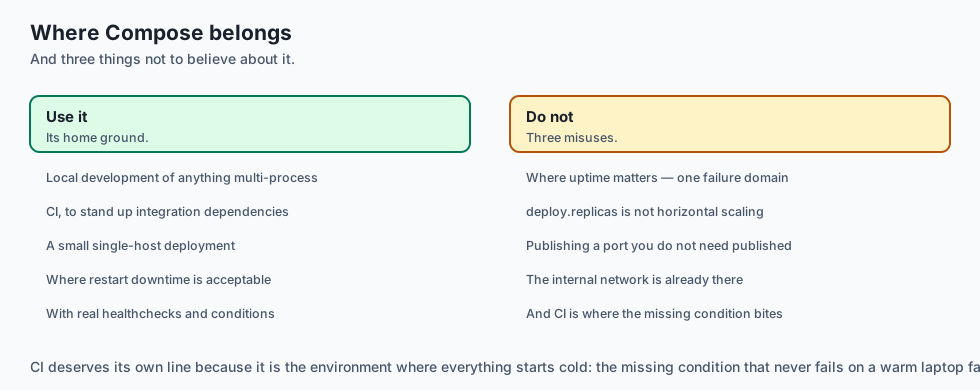
Use it for local development of anything with more than one process. This is its home ground and it is very good at it.
Use it in CI to stand up dependencies for integration tests — and note that CI is exactly where the missing condition bites, because everything starts cold.
Use it for a small single-host deployment where downtime during a restart is acceptable. A hobby project, an internal tool.
Do not use it where uptime matters. One host, one failure domain, no rescheduling.
Do not use deploy.replicas and believe you have scaled. You have several copies on one machine.
Do not publish a port you do not need published. The internal network is already there.
The AI connection
-
AI services have the longest startup in the stack, because loading a model is seconds to minutes — which makes
service_starteda uniquely bad signal here. -
A useful healthcheck for an AI service verifies the model is loaded, not that the process is alive. The runtime already knows the process is alive.
-
A vector store is the dependency most likely to be reached before it is ready, since index warm-up happens after the port opens.
-
Retry without backoff turns a slow start into a failed one — the API hammers the store exactly while the store is trying to come up.
-
The same idea returns as a Kubernetes readiness probe tomorrow, which is what Day 359’s live-but-not-ready failure is built on.
Knowledge check
- Why is the correctly wired stack in the lab slower to report ready, and why is that the better number?
- Why do
8000:8080and8001:8080not conflict when both containers listen on 8080? - Why does a dependency cycle suppress the “starts before ready” findings rather than being reported alongside them?
condition: service_healthyon a service that defines no healthcheck — what happens, and why does the lab treat it as an error?- Why does publishing a database port not help the API reach it?
Hands-on exercise
You will build the graph checks — cycles, ports, ordering, readiness — and measure what a dependency condition changes.
Open starter/compose_graph.py in the lab directory and implement the stubbed functions, then run the tests. Docker Compose is not required.
Expected output
Running python3 examples/compose_demo.py wires one stack two ways:
--- what the condition changed ---
  api usable at    1.2s  ->  5.2s
  worker usable at 1.2s  ->  5.8s
  premature starts 4  ->  0
The numbers get worse and the stack starts working. That is the lesson.
Validate your work
Run bash tests/run_tests.sh. All twenty-six tests must pass.
Then check three things by inspection. Under service_started, the api must be usable before postgres is — if the two wirings behave identically, ready_times is treating service_started as though it waited for readiness, and the whole comparison collapses. A three-service cycle must be reported once rather than three times. And a cycle must suppress the timing findings, because there is no order to reason about.
Troubleshooting
A cycle is reported once per member. Rotate each cycle to start at its smallest name and keep a set of what you have emitted.
startup_order loops forever. Check for a cycle first and raise.
The two wirings behave identically. Under service_started a dependant may begin at ready_times[dep] - dep.ready_seconds, not at ready_times[dep].
healthy-without-healthcheck never fires. The check is about the target of the dependency, not the service declaring it.
Common mistakes
Comparing container ports rather than host ports, so nothing ever conflicts.
Treating a self-dependency as acceptable; Compose will not start such a file.
Letting an undefined dependency block the start order — it is a separate finding, and the service is not waiting on anything real.
“Fixing” the correct stack to be as fast as the naive one, which optimises away the entire point.
Practice assignment
Add restart policies and client retry to the model, then answer the question the lesson raises but does not settle: if the client retries with backoff, is service_healthy still necessary?
Model a service that retries three times with exponential backoff, count the failed requests during startup under each of the four combinations (condition or not, retry or not), and write a test pinning the result. The answer is more interesting than a flat yes or no — retry recovers, and it recovers after emitting errors that will page someone, while the condition prevents them being emitted at all.
Extension challenge
Point this at a real docker-compose.yml you already operate.
Parse it with yaml.safe_load, build the Service graph — depends_on appears in both a list form and a mapping form with conditions, so handle both — and run the review over it.
Then do the part that is uncomfortable: for every starts-before-ready finding, work out whether it has ever caused a failure you attributed to something else. Flaky integration tests, a service that needs a restart after compose up, an error in the logs at boot that “always looks like that”. Startup ordering bugs are rarely filed as startup ordering bugs, which is exactly why they survive so long.
Quiz
Q1. In the lab the correctly wired stack reports its API usable at 5.2s instead of 1.2s. Why is the slower number the better one?
- Because slower startup reduces load on the database
- Because the 1.2s measurement was taken with a warm cache
- Because Compose adds overhead when healthchecks are enabled
- At 1.2s it was running but not yet usable
Show answer
Answer: D. At 1.2s it was running but not yet usable
The naive number measures when a container exists. The slower number measures when the service can serve, which is the thing anyone actually cares about.
Q2. Two services map 8000:8080 and 8001:8080. Both containers listen on 8080. Why is there no conflict?
- Only the host side of the mapping can clash
- Because Compose automatically remaps duplicate container ports
- Because port 8080 is reserved and never conflicts
- Because only the first service to start binds its port
Show answer
Answer: A. Only the host side of the mapping can clash
This is why the lab's port check inspects only the host side. The host has one of each port; a container has its own.
Q3. Why does a dependency cycle suppress the "starts before ready" findings rather than being reported alongside them?
- Because cycles are rare enough not to matter
- With no valid order there are no start times
- Because Compose reports cycles itself, so the tool does not need to
- Because timing findings are only relevant in production
Show answer
Answer: B. With no valid order there are no start times
Reporting warnings derived from an impossible ordering would be noise stacked on top of a fatal error.
Q4. A service declares the service_healthy condition on a dependency that defines no healthcheck. What happens?
- Compose falls back to service_started automatically
- The healthcheck is inherited from the base image
- The condition can never be satisfied, so it waits forever
- The dependant starts immediately and logs a warning
Show answer
Answer: C. The condition can never be satisfied, so it waits forever
The condition and the healthcheck are two halves of one mechanism. Declaring one without the other is a stall waiting to happen.
Q5. Why does publishing a database port not help the API reach the database?
- Because databases require a dedicated network driver
- Because the API must use the container IP rather than a name
- Because published ports are only available after the healthcheck passes
- Services already resolve by name; ports is for outside
Show answer
Answer: D. Services already resolve by name; ports is for outside
The wrong mental model here produces a database exposed to the internet on any cloud VM with a permissive security group.
Glossary
- Compose File
- A declarative description of a multi-container application on one host — services, networks, volumes, and the dependencies between them.
- Service
- One container definition in a Compose file, reachable by its service name on the default network without publishing any port.
- depends_on
- A startup ordering edge. On its own it waits only for the dependency's container to be created, which is the single most misread word in Compose.
- service_started
- The default condition. The container exists. It says nothing about whether the service can answer a request.
- service_healthy
- A condition satisfied when the dependency's healthcheck passes. What "wait for the database" actually means.
- service_completed_successfully
- A condition satisfied when a one-shot container exits zero. For migrations, seeding and index building.
- Healthcheck
- A command the runtime runs on an interval to decide whether a container is healthy. A useful one verifies what a dependant is about to rely on, not merely that the process is alive.
- Premature Start
- A service that begins work before a dependency can answer it. Passes on a warm laptop, fails in cold CI, and gets filed as flakiness.
- Dependency Cycle
- A loop in the depends_on graph. Nothing in it can start, and the failure is total and immediate rather than intermittent.
- Host Port Binding
- The left-hand side of a ports mapping. It binds on the host, which on a cloud VM with a permissive security group can mean the internet.
- Compose Network
- The implicit network every service joins, where services resolve one another by name. Its existence is why most services need no published port at all.
Sources and further reading
- The Compose Specification — Compose Specification (accessed 2026-08-31)
- Control Startup Order in Compose — Docker Documentation (accessed 2026-08-31)
- Compose File Reference — services — Docker Documentation (accessed 2026-08-31)
- Dockerfile Reference — HEALTHCHECK — Docker Documentation (accessed 2026-08-31)
- podman-compose — Containers organisation (accessed 2026-08-31)
Kept in this browser, no account needed. Your progress page turns the whole record into one link you can bookmark or open on another device.