Capstone › Capstone Build I: Foundation › Day 351
Day 351: Choosing and Scoping Your Capstone
Select, scope, and define a defensible production-grade Capstone AI project that synthesizes all 50 weeks of engineering discipline: data ingestion, vector retrieval, agent tool execution, automated evals, containerization, observability, and security hardening.
Hands-on lab for this lesson
Lab files on GitHub: https://github.com/ai-roadmap-365/ai-roadmap-365.github.io/tree/main/labs/sections/capstone/day-351-choosing-and-scoping-your-capstone
- Get the hands-on files. Clone the labs repository once (you can reuse this clone for every lesson). This works on macOS, Linux, and Windows (PowerShell or WSL):
git clone https://github.com/ai-roadmap-365/ai-roadmap-365.github.io.git cd ai-roadmap-365.github.io - Open this lesson's lab. Move into the directory for this specific day. Every lab lives at the same predictable path — section / subsection / week / day:
cd labs/sections/capstone/day-351-choosing-and-scoping-your-capstone - Read the lab guide. Open `README.md` in that directory. It lists the exact commands, what each does, the expected output, and how to check your work — read it before running anything.
- Run it and check your work. Follow the README's "How to run" section: run the example first to see the finished result, then complete the numbered exercises in `starter/`, then run the tests. The tests pass (exit 0) only when your work is correct.
bash tests/run_tests.sh # or the test command named in the lab README
You can also open the lab as a local page (works offline, shows the file tree and expected output).
Learning objectives
By the end of this lesson you will be able to:
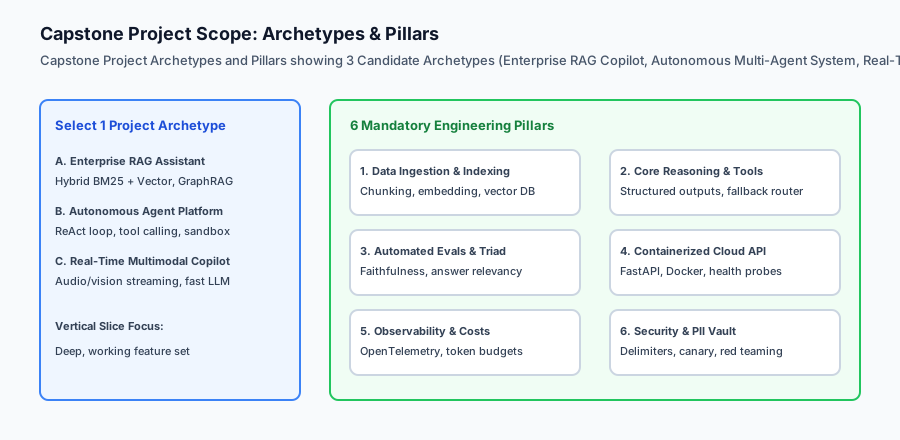
- Select a high-impact AI product domain (Enterprise Knowledge Assistant, Autonomous Agentic Workflow, or Real-Time Multi-Modal Copilot).
- Define non-negotiable architectural boundaries, SLAs, and technical constraints using the SMART scoping framework.
- Establish quantitative baseline evaluation targets (p95 latency, RAG triad scores, tool calling accuracy, and cost budgets).
- Construct a Project Charter and Milestone Roadmap spanning data ingestion, backend serving, frontend UI, CI/CD, and security reviews.
- Implement an automated Project Scoping and Feasibility Scorer in Python to mathematically validate project scope before building.
Prerequisites
Why this matters
Over the past 50 weeks (Days 1 to 350), you have mastered the complete spectrum of modern AI engineering:
- Programming Fundamentals & Python Architecture (Weeks 1–14)
- Data Engineering, SQL, Vector Mathematics & Embeddings (Weeks 15–28)
- Core Machine Learning & Deep Learning Foundations (Weeks 29–38)
- Large Language Models, Prompting & Transformers (Weeks 39–43)
- Advanced RAG, Knowledge Graphs & Vector Search (Weeks 44–46)
- Agentic Workflows, Tool Use & Multi-Agent Teams (Week 47)
- Containers, Cloud Deployments, MLOps & Production AI (Weeks 48–49)
- Securing AI Systems, PII Vaults & Red Teaming (Week 50)
The Capstone Project (Weeks 51 & 52) is not a toy tutorial or an abstract research exercise. It is your opportunity to build, evaluate, deploy, secure, and showcase a fully realized, production-grade Artificial Intelligence product that proves your end-to-end engineering excellence to employers, clients, and technical peers.
Choosing and scoping your project correctly on Day 351 is the single most critical predictor of success.
The idea in plain language
Think of scoping your Capstone like commissioning an architectural skyscraper:
- The Amateur Mistake: An amateur promises to build an entire city with airports, bridges, and subways, but ends up with half-drawn blueprints and a foundation that collapses under stress (Unbounded Scope Creep).
- The Senior Architect Approach: A senior engineer chooses a single iconic 40-story building, engineers bedrock foundations, verifies fire safety codes, installs high-speed elevators, connects water and electricity, and delivers a completed, habitable masterpiece (The Focused Vertical Slice).
Your Capstone must be a complete, defensible vertical slice: from raw data ingestion to hardened cloud serving, automated evaluation, and live interactive UI.
Historical background
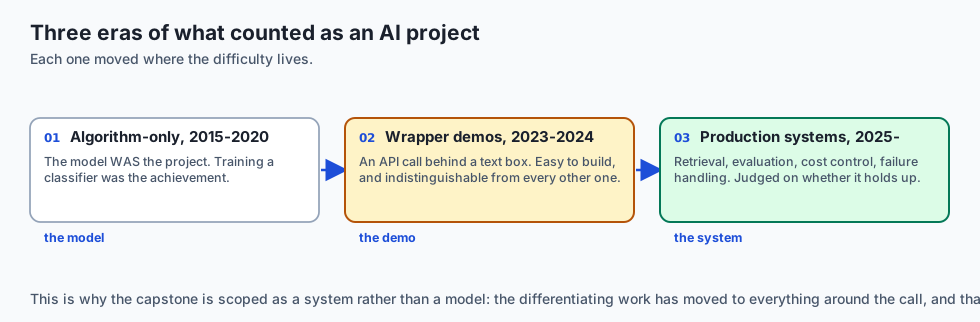
Over the last decade of software and AI engineering education, project failure modes have evolved:
1. The Algorithm-Only Era (2015–2020)
Students trained PyTorch models in Jupyter notebooks, measuring test accuracy on clean Kaggle datasets. These projects lacked APIs, frontends, error handling, or deployment infrastructure.
2. The Wrapper Demo Era (2023–2024)
With the rise of commercial LLMs, developers built superficial single-file Streamlit wrappers making raw OpenAI API calls. These lacked custom data layers, evaluations, security firewalls, or cost controls.
3. The Modern Production AI Era (2025–Present)
Modern engineering teams expect full-lifecycle AI systems: hybrid vector retrieval, deterministic agentic tool execution, CI/CD automated evals, containerized serving, OpenTelemetry observability, and proactive security guardrails.
What it is — and what it is not
Let us establish clear boundaries for the Capstone:
What the Capstone Is:
- A production-grade AI system solving a real-world problem in a specific domain.
- Built across all 6 mandatory engineering pillars: Data Ingestion, Core Reasoning, Automated Evals, Cloud Deployment, Observability, and Security.
- Accompanied by a formal Project Charter, Architecture Spec, test suite, and live demonstration.
- Built incrementally: a working Walking Skeleton on Milestone 1 (Week 51), followed by production hardening in Milestone 2 (Week 52).
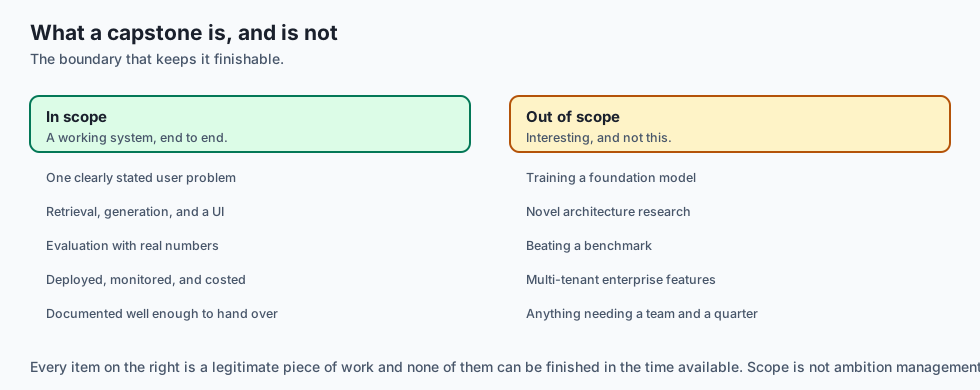
What the Capstone Is Not:
- A superficial prompt wrapper with no local data, custom retrieval, or evals.
- An unfinished collection of disconnected scripts with no automated test runner.
- A purely theoretical design document with zero working code.
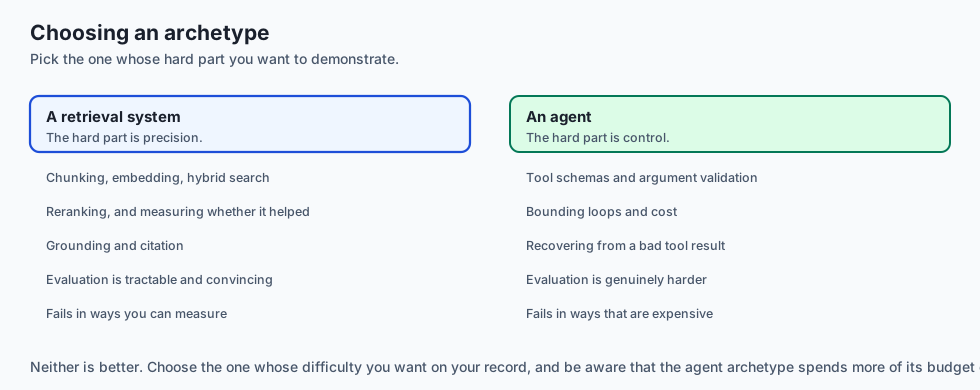
+-------------------------------------------------------------------------------+
|                    CAPSTONE PROJECT ARCHETYPE COMPARISON                      |
+-------------------+-----------------------+-----------------------------------+
| Archetype         | Core AI Complexity    | Real-World Production Focus       |
+-------------------+-----------------------+-----------------------------------+
| 1. Enterprise RAG | Hybrid BM25 + Vector, | High retrieval accuracy, grounded |
|    Copilot        | Cross-Encoder Rerank  | citations, low hallucination rate |
| 2. Autonomous     | ReAct loop, tool      | Deterministic execution, state    |
|    Agent Platform | calling, memory store | recovery, sandbox tool safety     |
| 3. Real-Time      | Fast streaming LLM,   | Sub-second latency budget,        |
|    Assistant      | multimodal input      | token streaming, multi-turn state |
+-------------------+-----------------------+-----------------------------------+
Why it was created and what problems it solves
The structured scoping process on Day 351 prevents three catastrophic project pitfalls:
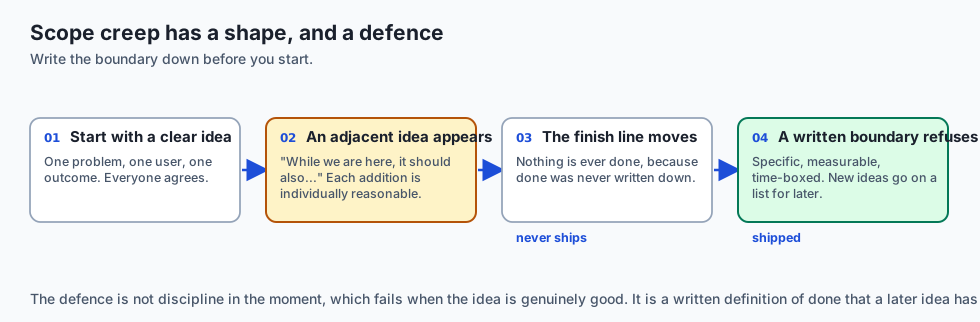
1. Eliminating Scope Creep via SMART Boundaries
By establishing quantitative SLAs upfront (e.g. p95 TTFT <= 400ms, Faithfulness >= 0.90, Monthly Token Cost <= $25), you prevent uncontrolled feature bloat.
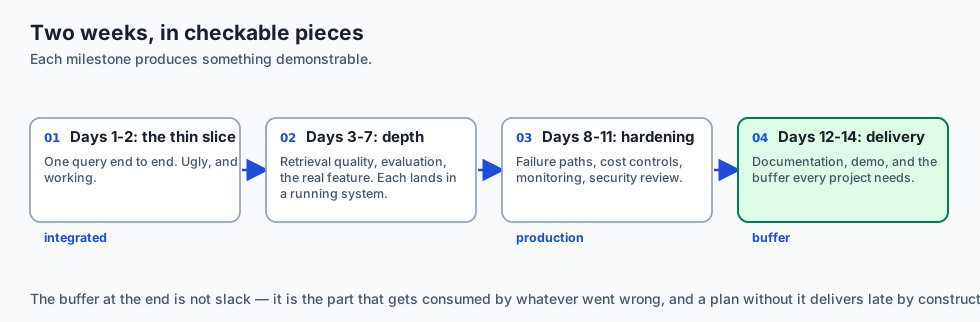
2. De-risking Integration Bottlenecks Early
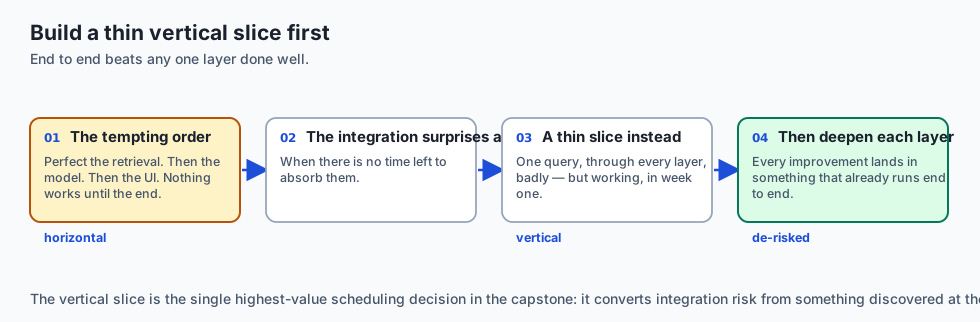
Building an end-to-end walking skeleton on Day 351 ensures that frontend, backend, vector database, and LLM APIs communicate before investing in complex business logic.
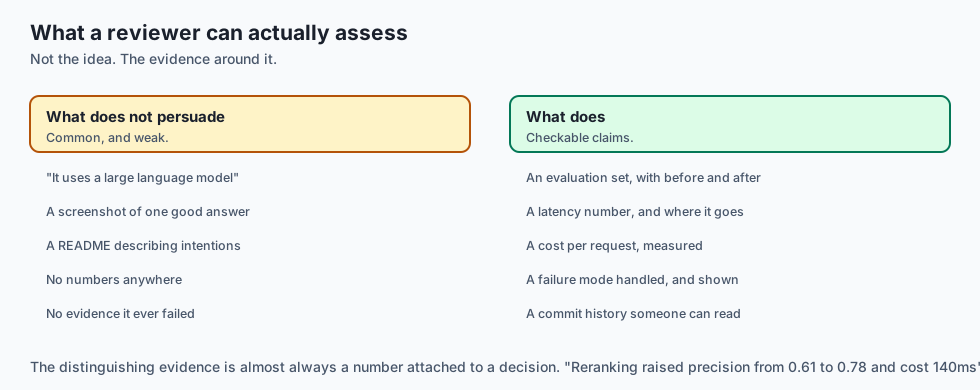
3. Establishing Portfolio-Ready Engineering Evidence
A structured project with automated evaluation benchmarks, Dockerized deployment, and security manifests provides undeniable technical proof of seniority.
How it works
Let us inspect the complete Two-Week Capstone Execution Roadmap:
[WEEK 51: FOUNDATION & WORKING VERTICAL SLICE]
  ├── Day 351: Scope Definition, SMART Constraints, & Feasibility Scoring
  ├── Day 352: Architecture Specification & System Design Document
  ├── Day 353: Data Ingestion, Chunking Pipeline, & Vector Storage
  ├── Day 354: Core AI Reasoning, Structured Outputs, & Fast Router
  ├── Day 355: Agent Tool Calling, Sandbox Integration, & State Management
  ├── Day 356: Automated Evaluation Suite (RAG Triad, LLM-as-a-Judge)
  └── Day 357: Milestone 1 Review & Course Correction
           │
           ▼ (Working End-to-End Vertical Slice)
[WEEK 52: HARDENING, DEPLOYMENT, OBSERVABILITY & DELIVERY]
  ├── Day 358: Responsive UI, Streaming Chat, & Error Feedback
  ├── Day 359: Docker Containerization, Health Probes, & Cloud Deployment
  ├── Day 360: OpenTelemetry Observability & Multi-Tenant Cost Attribution
  ├── Day 361: Security Hardening, PII Vault, & Red Team Fuzzing
  ├── Day 362: Technical Documentation, API Reference, & Video Demo
  └── Days 363-365: Portfolio Showcase, Retrospective, & Graduation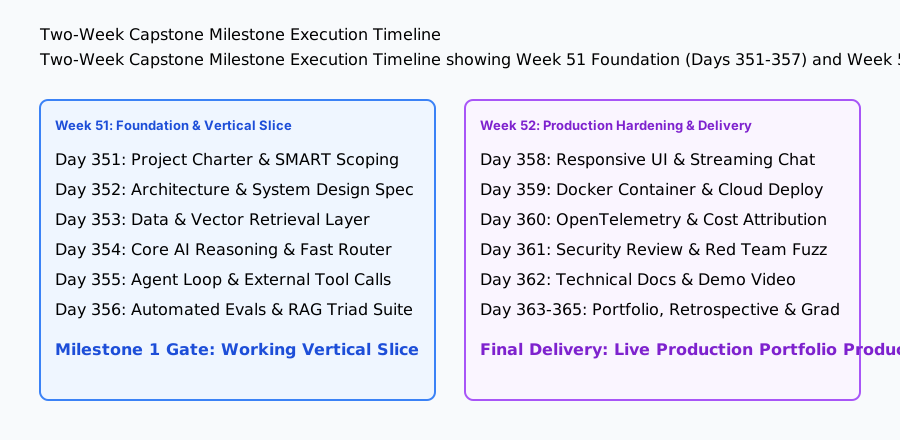
An everyday analogy
Think of scoping your Capstone like planning an expedition across a mountain range:
- The Ill-Prepared Hiker: Packs 15 heavy books, a solar generator, and gourmet cookware, only to collapse from exhaustion 2 miles into the trail (Overloaded Scope).
- The Master Mountaineer: Checks the topographic map, measures distance and elevation gain, packs essential survival gear, lightweight energy food, and communication beacons, and reaches the summit on schedule (SMART Scoping & Feasibility Analysis).
Examples in practice
Let us build an automated Capstone Project Scoping & Feasibility Scorer in Python that evaluates project charters against the 6 mandatory engineering pillars and calculates feasibility metrics:
import json
from typing import Dict, Any, List, Tuple

class CapstoneScopingValidator:
    def __init__(self, project_charter: Dict[str, Any]):
        self.charter = project_charter
        self.pillars = [
            "data_ingestion",
            "core_ai_reasoning",
            "automated_evals",
            "cloud_deployment",
            "observability",
            "security_hardening"
        ]

    def validate_pillars(self) -> Tuple[bool, List[str]]:
        missing = []
        for p in self.pillars:
            if p not in self.charter.get("engineering_pillars", {}):
                missing.append(f"Missing mandatory pillar: {p}")
            elif not self.charter["engineering_pillars"][p].get("enabled", False):
                missing.append(f"Pillar disabled: {p}")
        return len(missing) == 0, missing

    def evaluate_feasibility(self) -> Dict[str, Any]:
        score = 100.0
        warnings = []

        # Check SLAs
        slas = self.charter.get("slas", {})
        if "p95_latency_ms" not in slas or slas["p95_latency_ms"] > 1000:
            score -= 15.0
            warnings.append("p95 latency SLA missing or exceeding 1000ms threshold")

        if "min_eval_accuracy" not in slas or slas["min_eval_accuracy"] < 0.80:
            score -= 15.0
            warnings.append("Evaluation accuracy target missing or below 80%")

        # Check pillar coverage
        valid_pillars, missing_pillars = self.validate_pillars()
        if not valid_pillars:
            score -= 10.0 * len(missing_pillars)
            warnings.extend(missing_pillars)

        # Determine Feasibility Grade
        grade = "EXCELLENT" if score >= 85 else ("VIABLE" if score >= 70 else "AT_RISK")

        return {
            "project_name": self.charter.get("title", "Untitled Capstone"),
            "feasibility_score": max(0.0, score),
            "feasibility_grade": grade,
            "warnings": warnings,
            "is_approved_for_build": score >= 70.0
        }

if __name__ == "__main__":
    charter = {
        "title": "Enterprise Financial Analyst Assistant",
        "archetype": "enterprise_rag",
        "slas": {"p95_latency_ms": 450, "min_eval_accuracy": 0.88, "monthly_budget_usd": 30},
        "engineering_pillars": {
            "data_ingestion": {"enabled": True, "method": "hybrid_vector_bm25"},
            "core_ai_reasoning": {"enabled": True, "method": "fastapi_structured_llm"},
            "automated_evals": {"enabled": True, "method": "ragas_triad_suite"},
            "cloud_deployment": {"enabled": True, "method": "docker_compose_k8s"},
            "observability": {"enabled": True, "method": "opentelemetry_prometheus"},
            "security_hardening": {"enabled": True, "method": "pii_vault_prompt_waf"}
        }
    }
    validator = CapstoneScopingValidator(charter)
    print(json.dumps(validator.evaluate_feasibility(), indent=2))
Production Architecture Case Study: Capstone Project Charter Template
{
  "project_id": "CAPSTONE-2026-001",
  "title": "LexiGuard: Legal Contract Intelligence Copilot",
  "problem_statement": "Legal counsel spending 12+ hours manually reviewing 80-page commercial vendor agreements for liability indemnity clauses and regulatory compliance breaches.",
  "target_persona": "In-house Corporate Legal Counsel & Procurement Officers",
  "archetype": "enterprise_rag_with_agents",
  "architecture_summary": "FastAPI async backend with LangChain/LlamaIndex, Qdrant vector database, BGE-M3 hybrid embeddings, Mistral/GPT-4o inference, and Next.js responsive streaming UI.",
  "quantitative_slas": {
    "p95_first_token_latency_ms": 380,
    "min_rag_faithfulness_score": 0.92,
    "min_context_recall_score": 0.88,
    "max_cost_per_contract_review_usd": 0.15
  },
  "risk_mitigations": {
    "hallucination_risk": "Strict citation grounding with bounding box coordinate highlights",
    "data_privacy_risk": "Zero-knowledge PII token vault scrubbing party names and bank accounts before LLM ingress"
  }
}
Production Postmortem: The Enterprise Multi-Agent Scope Catastrophe
In Q3 2025, a global logistics enterprise embarked on an ambitious AI transformation project: an autonomous, multi-agent fleet optimization and supply chain copilot. The initial project proposal encompassed 14 interconnected capabilities:
- Natural language SQL querying across legacy ERP systems.
- Real-time GPS telematics streaming ingestion and spatial indexing.
- Multi-agent negotiation between automated carrier dispatchers and supplier bidding systems.
- Autonomous financial invoice generation and settlement via smart contracts.
- Voice-activated conversational interfaces for warehouse operators across 8 languages.
The Failure Cascade
Because the team did not enforce the Three Core User Workflows Rule, the architecture required 8 distinct external integrations before a single end-to-end user query could be completed. When integration testing commenced:
- The multi-agent negotiation loop suffered non-terminating circular bargaining cycles, burning $18,000 in API tokens over a single weekend.
- The telematics spatial vector index encountered lock contention during batch updates, causing API latency to spike to 45 seconds per query.
- The voice speech-to-text pipeline degraded under ambient warehouse noise, yielding an accuracy rate below 40%.
After 6 months of development and $1.2M in engineering overhead, the project was cancelled without a single production deployment.
The Capstone Remedy
The initiative was subsequently restructured as a focused, high-precision vertical slice: The Carrier Invoice Dispute Copilot. The engineering team scoped the system strictly around two deterministic capabilities:
- Ingesting PDF carrier freight bills and matching line items against historical contract rate tables using hybrid dense + sparse retrieval.
- Generating auditable dispute summaries with exact contract citation markers and confidence scores.
By constraining the scope to a single high-value workflow, the team delivered a production-ready application in 3 weeks that resolved 85% of freight invoice discrepancies autonomously, saving $340,000 monthly.
+-------------------------------------------------------------------------------+
|                    CAPSTONE SCOPE TRIAGE & TRADE-OFF MATRIX                   |
+-------------------+-----------------------+-----------------------------------+
| Feature Dimension | High-Risk Scope Creep | Hardened Capstone Minimum Slice   |
+-------------------+-----------------------+-----------------------------------+
| Architecture      | 10 Multi-Agent Swarms | Single Orchestrator + 3 Sandboxed |
|                   | with autonomous loops | Deterministic Tool Functions      |
| Data Retrieval    | Real-time multi-modal | Curated Hybrid Dense + BM25       |
|                   | streaming database    | Vector Store with Reciprocal Rank |
| Authentication    | Multi-tenant OAuth2 + | Secure Bearer API Token +         |
|                   | biometric passkeys    | Role-Based Read-Only Permissions  |
| Deployment        | Multi-region active-  | Containerized Docker Pod with     |
|                   | active Kubernetes     | Automated Health Probes on PaaS   |
+-------------------+-----------------------+-----------------------------------+
Detailed Failure Mode Taxonomy: Capstone Scoping Hazards
+-------------------------------------------------------------------------------+
|                    CAPSTONE SCOPING FAILURE TAXONOMY                          |
+-------------------+-----------------------+-----------------------------------+
| Failure Mode      | Root Cause Analysis   | Architectural Mitigation          |
+-------------------+-----------------------+-----------------------------------+
| Unbounded Scope   | Attempting to build   | Restrict scope to single high-    |
| (Feature Creep)   | 5 disparate domains   | impact vertical user workflow     |
| Missing Baseline  | Postponing evaluation | Author evaluation test harness on |
| Evals             | until Week 52         | Day 356 before adding UI polish   |
| Hardcoded Mock    | Relying on hardcoded  | Deploy live vector DB & live LLM  |
| Pipelines         | JSON fixtures only    | inference in Walking Skeleton     |
| Ignoring Security | Skipping PII handling | Enforce prompt firewall and PII   |
| & Guardrails      | until post-launch     | token vault on Day 354            |
+-------------------+-----------------------+-----------------------------------+
Deep Architectural Breakdown: The 6 Mandatory Engineering Pillars
Every senior AI project must demonstrate complete competence across the 6 core pillars:
+-----------------------+-------------------------------------------------------+
| Engineering Pillar    | Concrete Implementation Artifact                      |
+-----------------------+-------------------------------------------------------+
| 1. Data Ingestion     | Automated document parser, semantic chunker, vector DB|
| 2. Core Reasoning     | Structured JSON schema output, fallback model router  |
| 3. Automated Evals    | RAG Triad test suite (Faithfulness, Recall, Relevancy)|
| 4. Cloud Deployment   | Multi-stage Dockerfile, health probes, cloud endpoint |
| 5. Observability      | Structured JSON logs, latency percentiles, token costs|
| 6. Security Hardening | Ingress prompt firewall, PII vault, canary exfil scan |
+-----------------------+-------------------------------------------------------+
Implications: security, privacy, performance, scalability, and cost
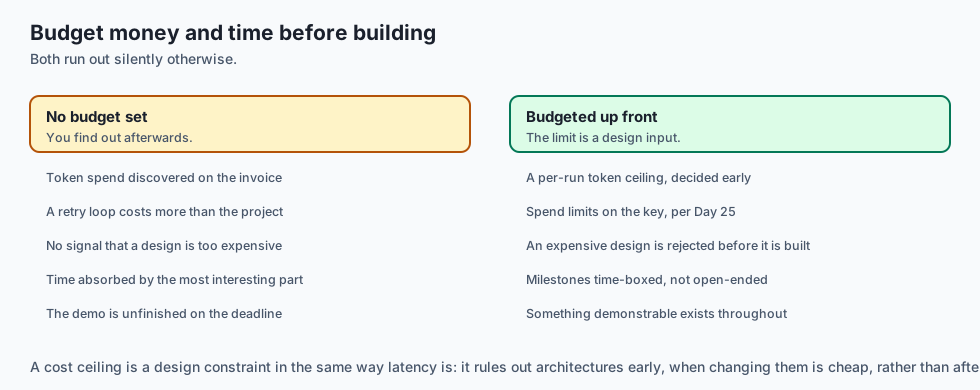
1. Cost Budgeting
Budget for cloud LLM API calls during development: keeping evals under 100 benchmark queries per run ensures total milestone testing costs remain under $10 for the entire build.
2. Time-Boxed Milestones
Adhering strictly to the daily milestone schedule prevents late-stage deployment scrambles and guarantees a polished, stress-tested system on Graduation Day (Day 365).
Alternatives: free, open source, and commercial
| Tool / Framework | Type | Best Suited For | Key Capabilities |
|---|---|---|---|
| Python Standard Library | Built-in | Scoping & Validation | Zero-dependency charter validation |
| Pydantic | Open Source | Schema Specification | Type-safe project metadata models |
| Notion / Jira | Commercial SaaS | Project Tracking | Kanban milestone management |
| Mermaid.js | Open Source | Architecture Diagrams | Text-to-diagram specification |
Comparison with related concepts
+-----------------------+-----------------------+-----------------------+
| Dimension             | Toy Tutorial Demo     | Production Capstone   |
+-----------------------+-----------------------+-----------------------+
| End-to-End Breadth    | 1 Script              | Complete 6-Pillar App |
| Evaluation Rigor      | Subjective Vibes      | Automated RAG Triad   |
| Deployment Readiness  | Localhost only        | Dockerized Cloud API  |
| Security Hardening    | None (Plaintext PII)  | PII Vault & Red Team  |
+-----------------------+-----------------------+-----------------------+
When to use it — and when not to
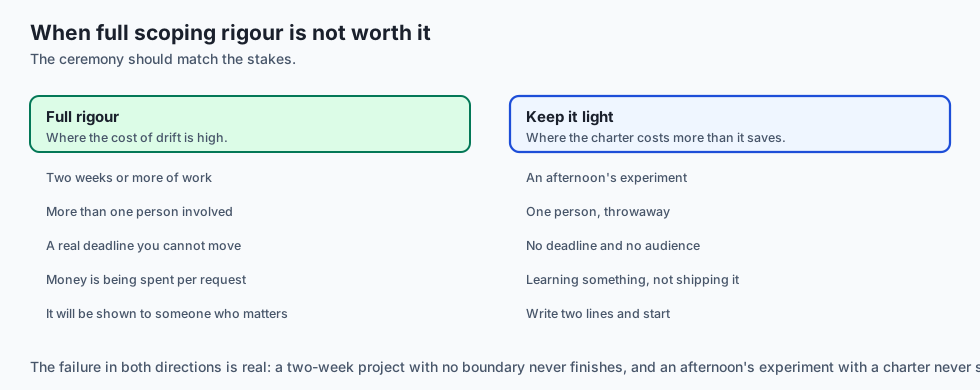
Enforce Full Scoping Rigor For:
- Production Capstone applications, startup MVP launches, and enterprise proof-of-concepts.
Lightweight Scoping Applies To:
- Single-evening hackathon explorations.
Production Checklist: Capstone Scoping & Charter Sign-Off
- Project title, problem statement, and persona documented.
- 1 of 3 core archetypes selected.
- All 6 engineering pillars declared and enabled.
- Quantitative SLAs defined (p95 latency, minimum evaluation accuracy, cost budget).
- Scoping & Feasibility Scorer executed with score >= 80.0.
- Walking skeleton architecture approved for Day 352.
The AI connection
-
The capstone is the whole stack at once: a process, an environment, a network call, an API, a store, a log, and a repository.
-
Scope is the AI-specific risk here. Model work expands to fill any time allowed, because there is always another experiment.
-
A vertical slice de-risks the integration, which in an AI system is where the surprises live — token limits, latency, cost, and output shape.
-
The cost ceiling is a design input, not a report. It rules out architectures before they are built.
-
What a reviewer assesses is the system, not the model. Retrieval, evaluation and failure handling are the differentiating work.
Knowledge check
- Why is a focused vertical slice superior to a broad, shallow prototype? A focused vertical slice proves end-to-end engineering excellence across the complete stack (data, reasoning, evals, deployment, security) rather than delivering superficial, unverified features.
- What are the 6 mandatory engineering pillars of the AI Capstone? Data Ingestion, Core Reasoning, Automated Evals, Cloud Deployment, Observability, and Security Hardening.
- How does quantitative feasibility scoring protect project timelines? It catches missing SLAs, excessive compute requirements, or disabled architectural pillars before code is written.
Hands-on exercise
In this lab, you will build and execute the Capstone Project Scoping & Feasibility Scorer in Python. Your implementation will:
- Define a structured Capstone Project Charter schema using Pydantic/Python dictionaries.
- Validate the presence and configuration of all 6 mandatory engineering pillars.
- Evaluate quantitative SLA feasibility (latency, accuracy, budget).
- Generate a comprehensive Project Scoping & Feasibility Audit Report.
Expected output
============================= test session starts ==============================
collected 5 items

tests/test_scoping.py .....                                              [100%]

============================== 5 passed in 0.02s ===============================
[SCOPING AUDIT] Validating Capstone Project Charter: "Enterprise RAG Assistant"
[PILLAR VERIFICATION] All 6 mandatory engineering pillars present and enabled.
[SLA AUDIT] p95 latency = 420ms (Target `<= 1000ms`) -> PASS
[SLA AUDIT] Min Eval Accuracy = 90.0% (Target >= 80.0%) -> PASS
[FEASIBILITY SCORE] Composite Score = 100.0 / 100.0 (Grade: EXCELLENT)
[APPROVAL] Project charter officially approved for Milestone 1 build.
Validate your work
Run the pytest test suite:
pytest tests/run_tests.shTroubleshooting
- Missing pillars: Ensure all 6 pillar keys (
data_ingestion,core_ai_reasoning,automated_evals,cloud_deployment,observability,security_hardening) are present. - SLA formatting: Verify that latency SLAs are numeric milliseconds and evaluation accuracy is a float between 0.0 and 1.0.
Common mistakes
- Disabling automated evals or security hardening in early scoping, causing architectural rework later.
Practice assignment
Add a Compute Resource Estimator calculating required GPU VRAM and monthly API costs based on expected queries per day.
Extension challenge
Implement an Automated Markdown Project Charter Exporter that formats the validated JSON charter into a GitHub-ready PROJECT_CHARTER.md document.
Quiz
Q1. What is the primary danger when selecting a capstone project scope?
- Scope creep, leaving an unfinished prototype
- Using open-source software
- Writing too many unit tests
- Using Python instead of C++
Show answer
Answer: A. Scope creep, leaving an unfinished prototype
A focused, deep, and fully verified vertical slice is vastly superior to a shallow, buggy demo.
Q2. Which set of core technical capabilities must every AI Capstone demonstrate?
- Only HTML and CSS styling
- Ingest, reason, evaluate, serve, observe, harden
- A PowerPoint presentation with zero working code
- Running on 100 GPUs simultaneously
Show answer
Answer: B. Ingest, reason, evaluate, serve, observe, harden
The capstone proves full-stack AI engineering competence across the entire lifecycle.
Q3. How does the SMART scoping framework apply to AI evaluation metrics?
- Setting vague goals such as 'the AI should just be smart'
- Disabling evaluation in production
- Specific, measurable targets with numbers and deadlines
- Relying solely on subjective vibes
Show answer
Answer: C. Specific, measurable targets with numbers and deadlines
SMART scoping grounds AI engineering in quantifiable SLAs and benchmarks.
Q4. Why is a 'walking skeleton' vertical slice built in Week 51 before adding advanced features?
- To make the code look longer
- To spend all cloud budget in one day
- Because Python requires it
- To flush out integration risk early
Show answer
Answer: D. To flush out integration risk early
A walking skeleton proves that the end-to-end pipeline connects successfully before adding complexity.
Q5. What is the output of the automated Capstone Scoping & Feasibility Scorer?
- A feasibility score and a project charter
- A binary executable
- A random number between 1 and 10
- An audio file
Show answer
Answer: A. A feasibility score and a project charter
The scoping tool validates technical balance, SLA realism, and risk mitigations.
Glossary
- Capstone Project
- A comprehensive end-to-end production AI system synthesizing all 50 weeks of technical curriculum.
- Vertical Slice
- A complete, working end-to-end implementation of a single core user workflow through all architectural layers.
- Scope Creep
- The uncontrolled expansion of project requirements without corresponding adjustments to time and resources.
- Project Charter
- A formal document defining the project problem statement, architecture, constraints, SLAs, and deliverables.
- SMART Criteria
- Specific, Measurable, Achievable, Relevant, and Time-bound metric targets.
- Walking Skeleton
- A minimal end-to-end system implementation connecting all architectural components with trivial logic.
- Technical SLA
- Service Level Agreements defining quantitative latency, throughput, accuracy, and cost limits.
- Feasibility Audit
- A quantitative evaluation verifying that required compute, data, and APIs are realistically accessible.
Sources and further reading
- System Design for Machine Learning Applications (Google Engineering, 2024) — Google Developers (accessed 2026-08-30)
- The Twelve-Factor App Principles for AI Systems (Wiggins, 2023) — Modern Software Architecture Group (accessed 2026-08-30)
- Evaluating LLM Systems in Production (Stanford Hazy Research, 2024) — Stanford University (accessed 2026-08-30)
Kept in this browser, no account needed. Your progress page turns the whole record into one link you can bookmark or open on another device.