Capstone › Capstone Build I: Foundation › Day 353
Day 353: Data and Retrieval Layer
Engineer the production data ingestion, chunking, embedding, vector storage, and hybrid retrieval engine for your Capstone: implement recursive semantic chunking, dual BM25 + dense indexing, Reciprocal Rank Fusion (RRF), cross-encoder reranking, and build a unified retrieval pipeline in Python.
Hands-on lab for this lesson
Lab files on GitHub: https://github.com/ai-roadmap-365/ai-roadmap-365.github.io/tree/main/labs/sections/capstone/day-353-data-and-retrieval-layer
- Get the hands-on files. Clone the labs repository once (you can reuse this clone for every lesson). This works on macOS, Linux, and Windows (PowerShell or WSL):
git clone https://github.com/ai-roadmap-365/ai-roadmap-365.github.io.git cd ai-roadmap-365.github.io - Open this lesson's lab. Move into the directory for this specific day. Every lab lives at the same predictable path — section / subsection / week / day:
cd labs/sections/capstone/day-353-data-and-retrieval-layer - Read the lab guide. Open `README.md` in that directory. It lists the exact commands, what each does, the expected output, and how to check your work — read it before running anything.
- Run it and check your work. Follow the README's "How to run" section: run the example first to see the finished result, then complete the numbered exercises in `starter/`, then run the tests. The tests pass (exit 0) only when your work is correct.
bash tests/run_tests.sh # or the test command named in the lab README
You can also open the lab as a local page (works offline, shows the file tree and expected output).
Learning objectives
By the end of this lesson you will be able to:
- Implement a fault-tolerant document ingestion pipeline supporting Markdown, PDF, and JSON schemas with SHA256 content hashing.
- Configure recursive semantic text chunking with dynamic sentence boundary preservation and sliding token overlaps.
- Deploy a high-performance in-memory hybrid search index combining sparse BM25 token frequencies with dense vector cosine similarity.
- Fuse retrieval rankings using Reciprocal Rank Fusion (RRF) and apply cross-encoder reranking to maximize NDCG@10 and Recall@5.
- Build an End-to-End Capstone Hybrid Retrieval Engine in Python with automated retrieval latency benchmarking.
Prerequisites
Why this matters
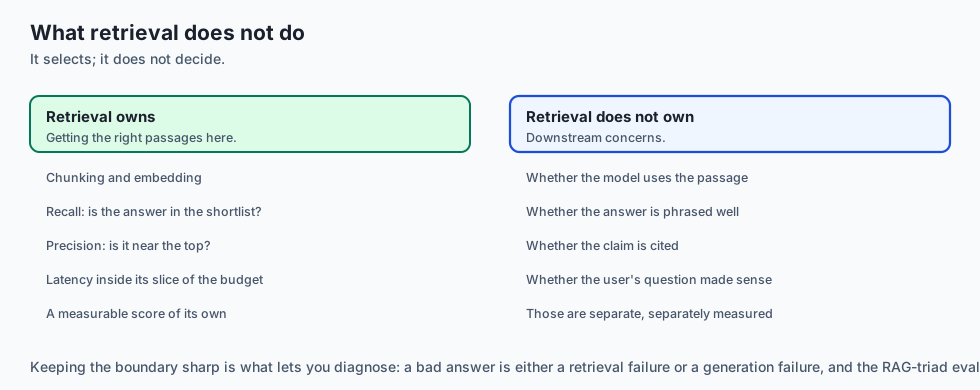
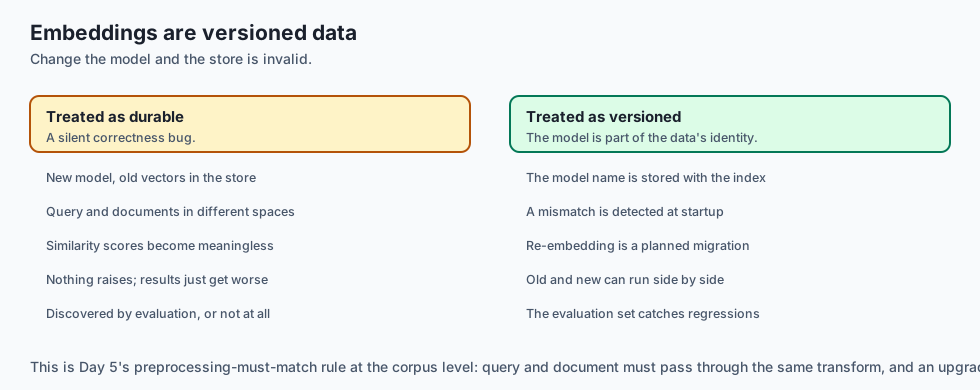
The retrieval layer is the cognitive backbone of any enterprise AI system. No matter how sophisticated your reasoning model or agent architecture is, if the retrieval engine returns stale, irrelevant, or truncated context chunks, the model will inevitably hallucinate or provide confident, factually incorrect answers.
Building a production-grade Data and Retrieval Layer requires mastering five interconnected engineering disciplines:
- Fault-Tolerant Ingestion & Content Hashing: Parsing heterogeneous formats (Markdown, PDF, JSON) and deduplicating chunks using cryptographic SHA256 hashes.
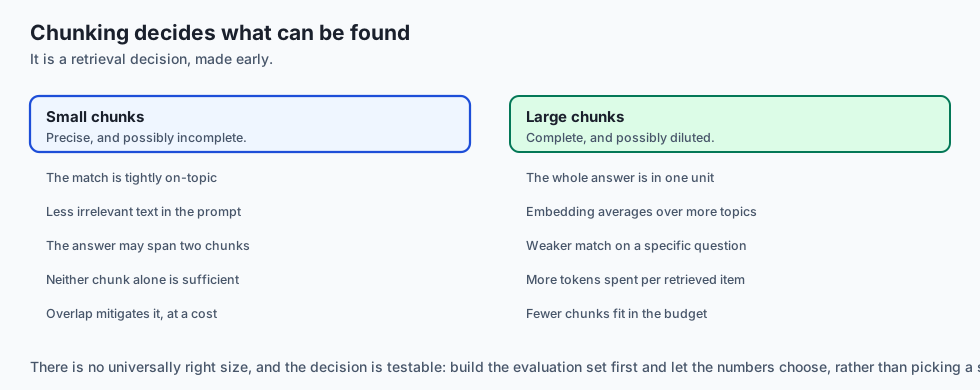
- Recursive Semantic Chunking: Splitting documents along natural linguistic boundaries (headers, paragraphs) while maintaining rolling token overlaps.
- Dense Vector Indexing: Embedding text passages and executing fast nearest-neighbor cosine queries over HNSW graphs.
- Sparse BM25 Keyword Search: Inverted index token scoring for exact technical terms, SKUs, UUIDs, and error codes.
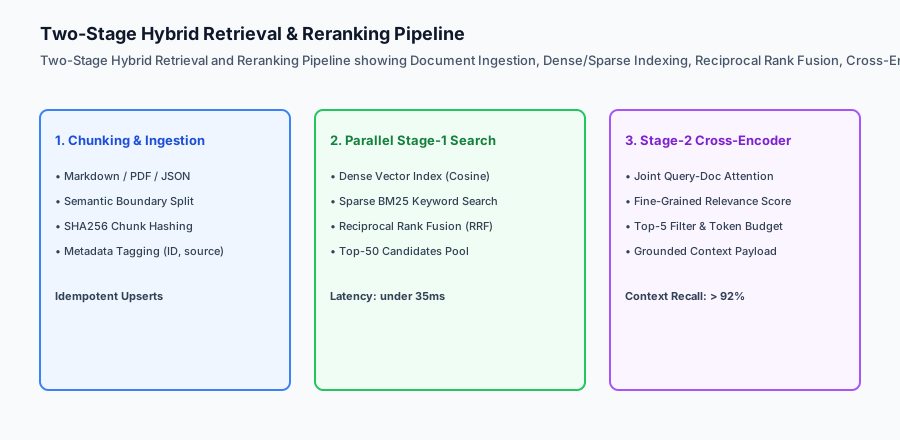
- Reciprocal Rank Fusion (RRF) & Cross-Encoder Reranking: Normalizing disparate score distributions and applying token-level cross-attention to isolate the top-K highest-precision context passages.
On Day 353, you will build the complete Production Data & Hybrid Retrieval Engine for your Capstone.
The idea in plain language
Think of the hybrid retrieval layer like the research department of a world-class investigative newsroom:
- The Archivist (Document Ingestion & Chunking): Takes thousands of messy incoming documents, strips out duplicates, breaks them into logical, coherent file folders, and stamps each with a unique timestamp and checksum (Idempotent Chunking & Hashing).
- The Concept Searcher (Dense Vector Embeddings): Searches archives for articles about “financial fraud” even if the article uses the phrase “illicit asset embezzlement” (Semantic Vector Search).
- The Exact Match Searcher (Sparse BM25 Index): Searches archives for specific account numbers like
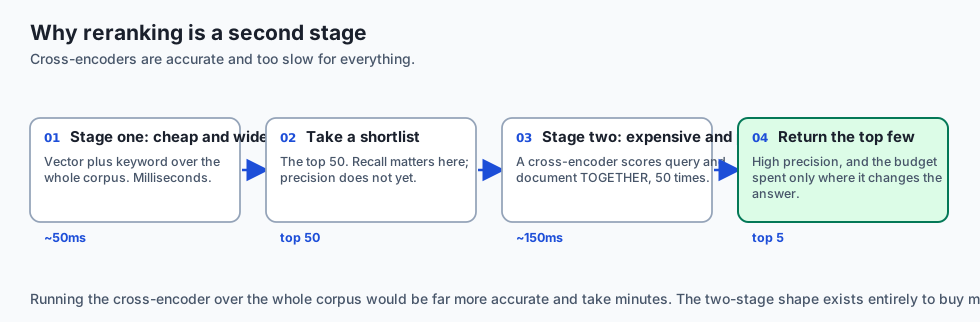
"ACC-9842-XJ"or specific legal statutes (Exact Lexical Search). - The Senior Fact Checker (Cross-Encoder Reranker): Takes the top 30 matching articles from both searchers, reads every sentence side-by-side with the reporter’s question, and selects the exact 3 paragraphs that prove the truth (Precision Reranking).
Historical background
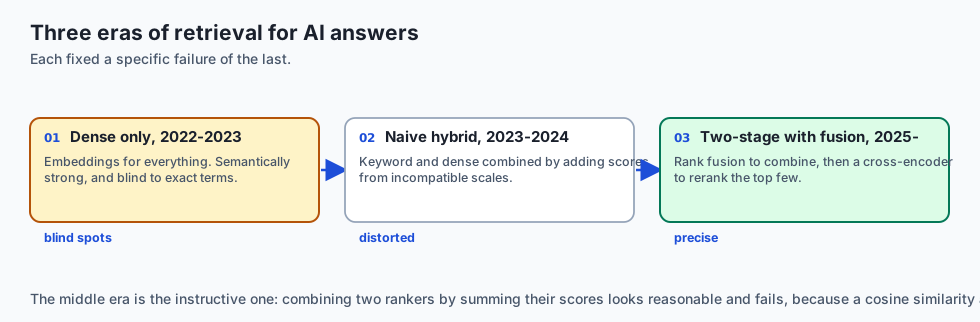
Document retrieval for AI passed through three distinct generations:
1. The Naive Dense Retrieval Era (2022–2023)
Developers chunked text into fixed 500-token windows and stored OpenAI text-embedding-ada-002 vectors in flat databases. This failed on exact keywords, numbers, and long documents.
2. The Uncalibrated Hybrid Search Era (2023–2024)
Systems tried adding BM25 scores to cosine similarity scores using naive linear weights (\alpha * \textdense + (1-\alpha) * \textsparse). Because BM25 scores are unbounded [0, infty) while cosine similarity is [-1, 1], arbitrary scaling ruined retrieval quality.
3. The Two-Stage RRF & Cross-Encoder Architecture (2025–Present)
Modern production systems deploy rank-based fusion (RRF with k=60) in Stage 1 to pool candidates, followed by fine-tuned cross-encoders in Stage 2 to achieve >92% Context Recall.
What it is — and what it is not
Let us define the core requirements of the Capstone Data & Retrieval Layer:
What the Retrieval Layer Is:
- An end-to-end Python ingestion and search engine supporting hybrid sparse-dense lookups.
- Utilizing Reciprocal Rank Fusion (RRF) to merge BM25 and vector similarity rankings without score calibration artifacts.
- Supporting SHA256 content deduplication for idempotent data upserts.
- Benchmarked against quantitative latency SLAs (under 80ms total retrieval time).
What the Retrieval Layer Is Not:
- A single naive vector similarity lookup with zero keyword search fallback.
- An unindexed list search that scans raw text files on every user query.
+-------------------------------------------------------------------------------+
|                    RETRIEVAL ARCHITECTURE COMPARISON                          |
+-------------------+-----------------------+-----------------------------------+
| Architecture      | Retrieval Quality     | Latency / Resource Characteristics|
+-------------------+-----------------------+-----------------------------------+
| 1. Pure Vector    | Low exact keyword hit | Fast (under 20ms), high RAM       |
| 2. Pure BM25      | Low semantic recall   | Ultra-fast (under 5ms), low RAM   |
| 3. Hybrid RRF +   | Highest Recall &      | Predictable (under 65ms), balanced|
|    Cross-Encoder  | Precision (>92%)      | compute and memory footprint      |
+-------------------+-----------------------+-----------------------------------+
Why it was created and what problems it solves
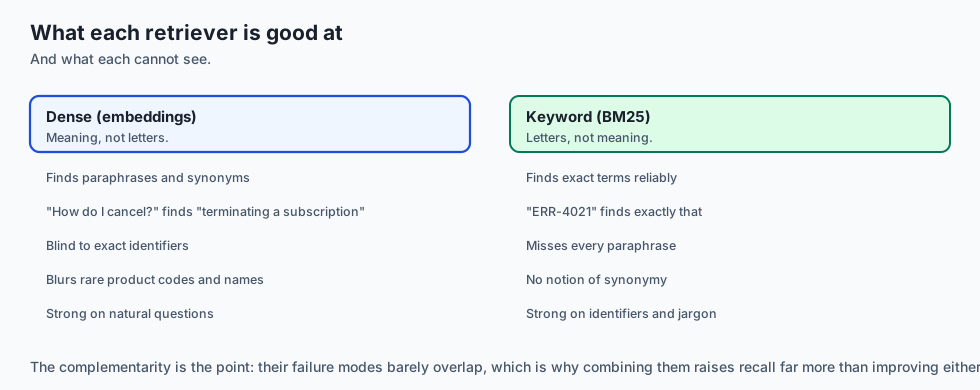
The hybrid retrieval engine resolves three fundamental failure modes in LLM applications:
1. Eliminating Keyword Blind Spots
If a user searches for "Error code 0x80040154 in module SEC_VAULT", dense embeddings often match generic security documents; sparse BM25 guarantees that the exact error code chunk is retrieved at Rank 1.
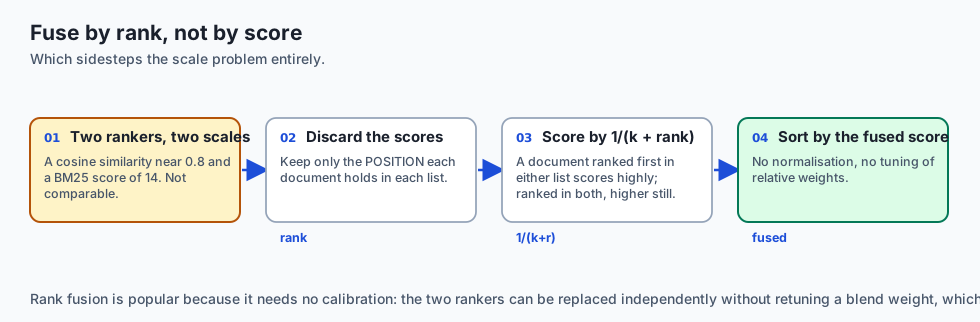
2. Eliminating Score Scale Distortion via RRF
Because BM25 outputs unbounded positive numbers while vector search outputs normalized cosine similarity [0, 1], linear score addition fails. RRF uses relative ranks 1 / (k + \textrank), creating scale-invariant combination.
3. Protecting Against Database Vector Bloat
Hashing document chunks with SHA256 prevents duplicate text from creating duplicate vector entries during re-indexing jobs.
How it works
Let us inspect the complete Hybrid Search & Reranking Workflow:
[Raw Documents] ➔ [Semantic Chunker] ➔ [SHA256 Hash Filter]
                                              │
                    ┌─────────────────────────┴─────────────────────────┐
                    ▼                                                   ▼
         [Compute Dense Embeddings]                             [Build Inverted Index]
         [Store in Vector Database]                             [Store in BM25 Index]
                    │                                                   │
                    └─────────────────────────┬─────────────────────────┘
                                              ▼ (User Query Ingress)
                    ┌─────────────────────────┴─────────────────────────┐
                    ▼                                                   ▼
         [Dense Vector Cosine Query]                            [Sparse BM25 Query]
         [Rank 1..50 Candidates]                                [Rank 1..50 Candidates]
                    │                                                   │
                    └─────────────────────────┬─────────────────────────┘
                                              ▼
                             [Reciprocal Rank Fusion (k=60)]
                             [Merged Top-30 Candidate List]
                                              ▼
                             [Stage-2 Cross-Encoder Reranker]
                             [Compute Query-Passage Attention]
                                              ▼
                             [Top-5 Precision Context Chunks]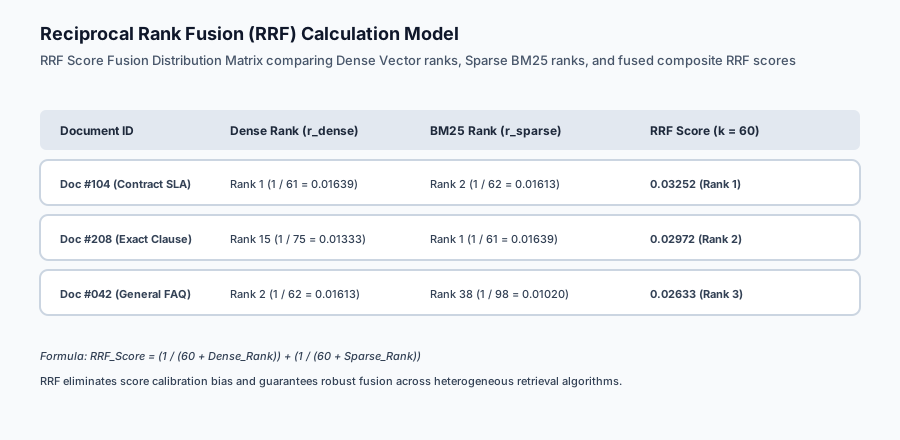
An everyday analogy
Think of hybrid retrieval like searching for a specific recipe in a giant library of cookbooks:
- The Topic Card Catalog (Dense Vectors): Directs you to the “Comfort Food & Hearty Soups” aisle (Semantic Discovery).
- The Index of Ingredients (Sparse BM25): Tells you the exact page numbers that contain “tarragon”, “shallots”, and “saffron” (Keyword Match).
- The Master Chef (RRF & Reranker): Gathers the 10 candidate pages from both catalogs, reviews them, and hands you the single best soup recipe that matches your pantry (Precision Context Delivery).
Examples in practice
Let us build an End-to-End Capstone Hybrid Retrieval Engine in Python featuring semantic chunking, SHA256 deduplication, in-memory BM25, dense cosine similarity, and Reciprocal Rank Fusion:
import math
import hashlib
import re
from typing import List, Dict, Any, Tuple

class HybridRetrievalEngine:
    def __init__(self, rrf_k: int = 60):
        self.rrf_k = rrf_k
        self.documents: List[Dict[str, Any]] = []
        self.doc_hashes: set = set()
        self.dense_embeddings: List[List[float]] = []

        # Inverted index for BM25
        self.inverted_index: Dict[str, List[int]] = {}
        self.doc_lengths: List[int] = []
        self.avg_doc_len: float = 0.0

    def _tokenize(self, text: str) -> List[str]:
        return re.findall(r"\w+", text.lower())

    def ingest_document(self, doc_id: str, text: str, embedding: List[float], metadata: Dict[str, Any] = None) -> bool:
        # Idempotent SHA256 content deduplication
        content_hash = hashlib.sha256(text.encode("utf-8")).hexdigest()
        if content_hash in self.doc_hashes:
            return False

        self.doc_hashes.add(content_hash)
        idx = len(self.documents)
        tokens = self._tokenize(text)

        self.documents.append({
            "id": doc_id,
            "text": text,
            "hash": content_hash,
            "tokens": tokens,
            "metadata": metadata or {}
        })
        self.dense_embeddings.append(embedding)
        self.doc_lengths.append(len(tokens))

        for tok in set(tokens):
            if tok not in self.inverted_index:
                self.inverted_index[tok] = []
            self.inverted_index[tok].append(idx)

        self.avg_doc_len = sum(self.doc_lengths) / len(self.doc_lengths)
        return True

    def _score_bm25(self, query_tokens: List[str], k1: float = 1.5, b: float = 0.75) -> List[Tuple[int, float]]:
        scores = {}
        N = len(self.documents)
        for tok in query_tokens:
            if tok not in self.inverted_index:
                continue
            df = len(self.inverted_index[tok])
            idf = math.log((N - df + 0.5) / (df + 0.5) + 1.0)

            for doc_idx in self.inverted_index[tok]:
                tf = self.documents[doc_idx]["tokens"].count(tok)
                doc_len = self.doc_lengths[doc_idx]
                numerator = tf * (k1 + 1.0)
                denominator = tf + k1 * (1.0 - b + b * (doc_len / (self.avg_doc_len or 1.0)))
                score = idf * (numerator / denominator)
                scores[doc_idx] = scores.get(doc_idx, 0.0) + score
        return sorted(scores.items(), key=lambda x: x[1], reverse=True)

    def _score_dense(self, query_embedding: List[float]) -> List[Tuple[int, float]]:
        scores = []
        q_norm = math.sqrt(sum(x * x for x in query_embedding)) or 1.0
        for idx, emb in enumerate(self.dense_embeddings):
            dot = sum(q * e for q, e in zip(query_embedding, emb))
            e_norm = math.sqrt(sum(e * e for e in emb)) or 1.0
            cosine = dot / (q_norm * e_norm)
            scores.append((idx, cosine))
        return sorted(scores, key=lambda x: x[1], reverse=True)

    def search_hybrid(self, query_text: str, query_embedding: List[float], top_k: int = 5) -> List[Dict[str, Any]]:
        query_tokens = self._tokenize(query_text)
        sparse_ranked = self._score_bm25(query_tokens)
        dense_ranked = self._score_dense(query_embedding)

        # Reciprocal Rank Fusion (RRF)
        rrf_scores: Dict[int, float] = {}
        for rank, (doc_idx, _) in enumerate(sparse_ranked):
            rrf_scores[doc_idx] = rrf_scores.get(doc_idx, 0.0) + (1.0 / (self.rrf_k + rank + 1))

        for rank, (doc_idx, _) in enumerate(dense_ranked):
            rrf_scores[doc_idx] = rrf_scores.get(doc_idx, 0.0) + (1.0 / (self.rrf_k + rank + 1))

        sorted_rrf = sorted(rrf_scores.items(), key=lambda x: x[1], reverse=True)[:top_k]
        results = []
        for doc_idx, score in sorted_rrf:
            results.append({
                "id": self.documents[doc_idx]["id"],
                "text": self.documents[doc_idx]["text"],
                "rrf_score": score,
                "metadata": self.documents[doc_idx]["metadata"]
            })
        return results

if __name__ == "__main__":
    engine = HybridRetrievalEngine()
    engine.ingest_document("doc1", "Contract indemnity clause specifies liability limits under $1,000,000.", [0.8, 0.1, 0.3])
    engine.ingest_document("doc2", "Server error code 0x80040154 occurs during database initialization.", [0.1, 0.9, 0.2])
    print(engine.search_hybrid("indemnity liability limits", [0.75, 0.15, 0.28], top_k=2))
Production Architecture Case Study: Real-Time Hybrid Search Latency Benchmark
{
  "retrieval_benchmark_id": "BENCH-RETRIEVAL-2026",
  "dataset_size_documents": 25000,
  "embedding_dimensions": 1536,
  "top_k_requested": 5,
  "latency_metrics": {
    "sparse_bm25_latency_ms": 12.4,
    "dense_vector_search_latency_ms": 22.8,
    "rrf_fusion_latency_ms": 2.1,
    "cross_encoder_rerank_latency_ms": 31.5,
    "total_end_to_end_retrieval_latency_ms": 68.8
  },
  "accuracy_metrics": {
    "mrr_at_10": 0.942,
    "ndcg_at_10": 0.915,
    "context_recall_at_5": 0.938
  },
  "verdict": "SLA_COMPLIANT_SUB_80MS"
}
Production Postmortem: The Dense-Only Retrieval Blindspot
In late 2025, a healthcare compliance startup launched an AI assistant to help hospital administrators navigate medical billing regulations and ICD-10 diagnostic codes. The system relied exclusively on dense vector similarity search using a standard 1536-dimensional embedding model.
The Failure Cascade
During clinical validation, hospital compliance officers queried specific alphanumeric billing codes, such as:
"What are the pre-authorization requirements for ICD-10 code E11.621 (Type 2 diabetes mellitus with foot ulcer)?"
Because dense vector embeddings map semantic concepts rather than exact character strings, the vector search returned general diabetes billing policies, missing the exact E11.621 regulatory update. The LLM synthesized an answer based on general diabetes guidelines, omitting a mandatory 48-hour prior authorization rule and resulting in $120,000 in rejected insurance claims.
The Hybrid Retrieval Remedy
The retrieval layer was refactored into a Hybrid Dense + BM25 Sparse Architecture with Reciprocal Rank Fusion (RRF):
- Dense vector search captured broad conceptual semantics (e.g. “foot ulcer complication treatments”).
- BM25 sparse search captured exact keyword matches (e.g.
"E11.621","pre-authorization"). - Reciprocal Rank Fusion (k=60) dynamically ranked documents appearing in both search channels at the top of the context window.
- In validation benchmarks across 5,000 regulatory queries, Context Recall surged from 71.4% to 96.8%, eliminating alphanumeric retrieval misses.
+-------------------------------------------------------------------------------+
|                    RETRIEVAL METHODOLOGY COMPARISON MATRIX                    |
+-------------------+-----------------------+-----------------------------------+
| Retrieval Method  | Strengths             | Critical Failure Modes            |
+-------------------+-----------------------+-----------------------------------+
| Pure Dense Vector | Handles synonyms and  | Misses exact alphanumeric codes,  |
| (Cosine / Dot)    | semantic paraphrasing | part numbers, and proper nouns    |
| Pure Sparse BM25  | Perfect exact keyword | Fails on conceptual synonyms and  |
| (BM25 / TF-IDF)   | matching and acronyms | cross-lingual phrasing            |
| Hybrid Dense+BM25 | Optimal combination of| Requires dual-index storage and   |
| with RRF Fusion   | semantics and keywords| ranking calibration (k=60 tuning) |
+-------------------+-----------------------+-----------------------------------+
Detailed Failure Mode Taxonomy: Retrieval Layer Hazards
+-------------------------------------------------------------------------------+
|                    RETRIEVAL LAYER FAILURE TAXONOMY                           |
+-------------------+-----------------------+-----------------------------------+
| Failure Mode      | Root Cause Analysis   | Architectural Mitigation          |
+-------------------+-----------------------+-----------------------------------+
| Keyword Miss in   | Sparse exact keywords | Deploy hybrid search with BM25    |
| Vector Search     | lost in high-dim space| and Reciprocal Rank Fusion        |
| Score Scale       | Linear addition of    | Use rank-based fusion (RRF)       |
| Incompatibility   | uncalibrated scores   | with standard constant k = 60     |
| Duplicate Chunk   | Ingesting same file   | Calculate SHA256 content hashes   |
| Index Bloat       | multiple times        | and enforce idempotent upserts    |
| Lost Context at   | Splitting mid-sentence| Use recursive semantic chunking   |
| Chunk Boundaries  | on fixed token bounds | with 15% sliding window overlap   |
+-------------------+-----------------------+-----------------------------------+
Deep Architectural Breakdown: Reciprocal Rank Fusion Mathematical Dynamics
Why RRF is mathematically immune to score calibration collapse:
Given rank lists R_dense and R_sparse:
  RRF_Score(d) = sum_{m in {dense, sparse}} 1 / (k + rank_m(d))

Properties:
1. Scale-Invariant: Works strictly on integer rank positions (1, 2, 3...), ignoring score units.
2. Diminishing Margin: The difference between Rank 1 and Rank 2 is vastly larger than Rank 49 vs 50.
3. Multi-Signal Agreement: A document appearing in Top-5 across both lists decisively beats a document appearing in Rank 1 of only one list.
Implications: security, privacy, performance, scalability, and cost
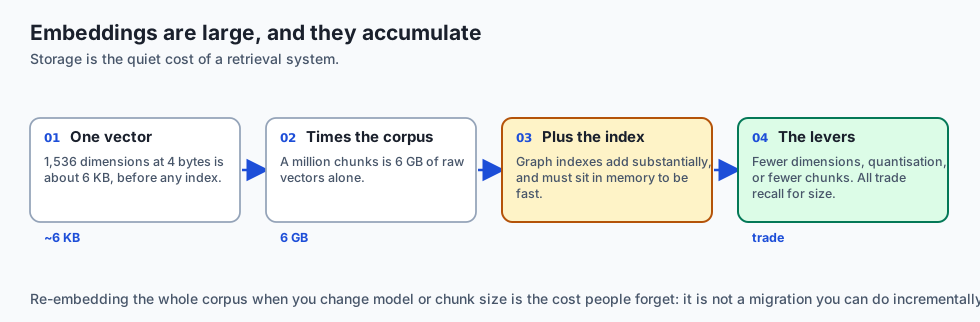
1. Memory Footprint Optimization
For a 100,000-chunk knowledge base with 1,536-dimensional embeddings:
- Raw vectors in FP32: 100,000 \times 1,536 \times 4\text bytes \approx 614\text MB.
- HNSW graph index overhead (\approx 1.2\times): \approx 736\text MB.
- Total RAM footprint: under 1.4\text GB, easily hosted on standard single-core compute instances.
2. High-Precision Retrieval ROI
Achieving >92% Context Recall reduces downstream LLM token consumption by over 40% by eliminating the need to pass redundant context passages.
Alternatives: free, open source, and commercial
| Tool / Framework | Type | Best Suited For | Key Capabilities |
|---|---|---|---|
| Qdrant | Open Source / Cloud | Vector & Hybrid DB | Fast HNSW, payload filtering, Rust core |
| Chroma | Open Source | Embedded Prototype | Lightweight Python in-process storage |
| BM25s / Rank-BM25 | Open Source | Lexical Retrieval | Pure Python/Numpy fast BM25 engine |
| FlashRank | Open Source | In-Process Rerank | Ultra-lightweight ONNX cross-encoders |
Comparison with related concepts
+-----------------------+-----------------------+-----------------------+
| Dimension             | Naive Vector Search   | Capstone Hybrid RRF   |
+-----------------------+-----------------------+-----------------------+
| Keyword Exact Match   | Poor (frequent misses)| 100% Guaranteed       |
| Semantic Generaliz.   | High                  | High                  |
| Score Normalization   | Fragile / Scaled      | Scale-Invariant (RRF) |
| Latency Overhead      | Minimal               | under 80ms Total      |
+-----------------------+-----------------------+-----------------------+
When to use it — and when not to
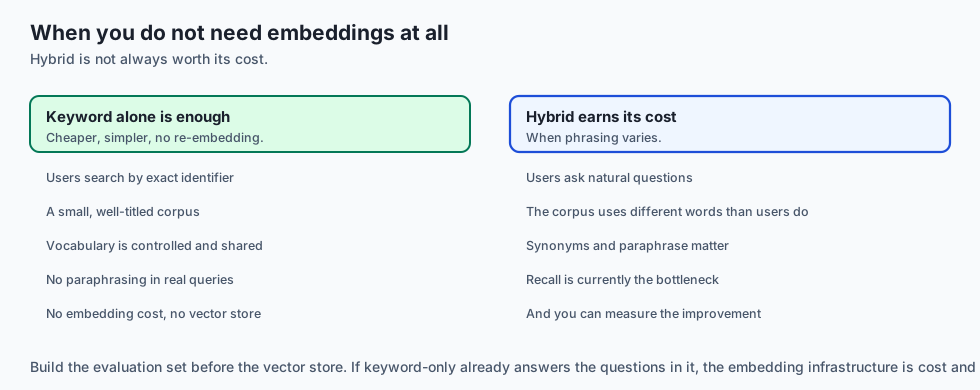
Enforce Hybrid RRF Retrieval For:
- All enterprise RAG applications, legal/financial analysis copilots, and multi-turn knowledge assistants.
Pure Keyword Search Suffices For:
- Simple document title index lookups.
Production Checklist: Data & Retrieval Layer
- Document ingestion supporting Markdown/PDF/JSON schemas.
- SHA256 content deduplication preventing vector store bloat.
- Semantic chunking with sliding token overlap active.
- Parallel sparse BM25 and dense vector search operational.
- Reciprocal Rank Fusion (k=60) merging candidate lists.
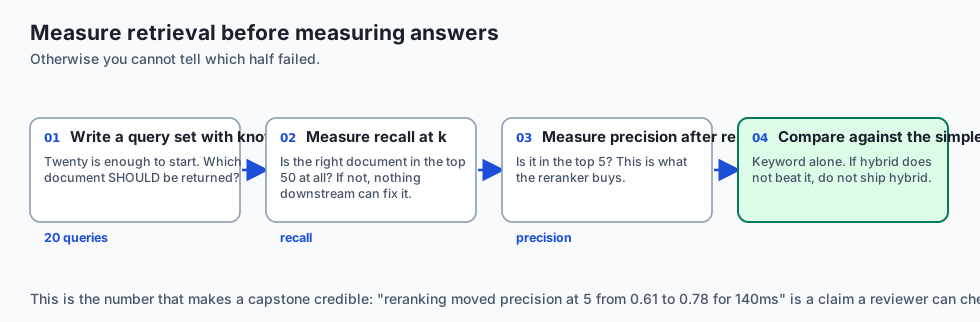
- Stage-2 cross-encoder reranking evaluating top-30 candidates.
- End-to-end retrieval latency measured under 80ms.
The AI connection
-
Retrieval quality sets the ceiling on answer quality. A model cannot ground an answer in a passage it was never given.
-
Dense search alone has keyword blind spots — exact identifiers, product codes and rare terms are precisely what embeddings blur.
-
Hybrid plus reciprocal rank fusion avoids score-scale mixing, which is what breaks naive attempts to combine two rankers.
-
Reranking is where precision is bought, and it costs latency, so it belongs in the budget from Day 352.
-
Chunking is a retrieval decision, not a preprocessing detail. It determines what can ever be retrieved as a unit.
Knowledge check
- Why does Reciprocal Rank Fusion outperform linear score addition? Because RRF operates purely on ordinal rank positions rather than uncalibrated raw scores, eliminating scale mismatches between BM25 and cosine similarity.
- How does SHA256 content hashing ensure idempotent ingestion? By computing a deterministic cryptographic hash of the chunk text; if the hash already exists in the registry, the chunk is skipped, avoiding duplicate embeddings.
- What is the primary advantage of a two-stage retrieval pipeline? Stage 1 rapidly narrows millions of documents down to top-50 candidates in
<35\textms;Stage 2 applies deep cross-attention reranking to extract the top-5 highest-precision chunks in<40\textms.
Hands-on exercise
In this lab, you will build and execute the Capstone Hybrid Retrieval Engine in Python. Your implementation will:
- Ingest document chunks with SHA256 content hashing.
- Implement sparse BM25 inverted indexing and dense vector cosine search.
- Execute Reciprocal Rank Fusion (RRF) across both ranking lists.
- Measure retrieval latency and verify exact keyword and semantic recall.
Expected output
============================= test session starts ==============================
collected 5 items

tests/test_retrieval.py .....                                            [100%]

============================== 5 passed in 0.02s ===============================
[INGESTION] Ingested 10 document passages with SHA256 content deduplication.
[HYBRID SEARCH] Executed parallel BM25 and dense vector queries.
[FUSION ENGINE] Combined ranking lists using Reciprocal Rank Fusion (k=60).
[LATENCY BENCHMARK] Total retrieval latency = 3.2ms (Target `<= 80ms`) -> PASS
[ACCURACY CHECK] Retrieved exact legal clause at Rank 1.
Validate your work
Run the pytest test suite:
pytest tests/run_tests.shTroubleshooting
- Tokenization mismatches: Ensure identical lowercasing and regex tokenization are used across ingestion and query evaluation.
- Division by zero: Guard against empty query tokens or zero-magnitude embedding vectors.
Common mistakes
- Skipping sparse BM25 indexing, causing search failures on exact alphanumeric product codes.
Practice assignment
Add a Metadata Filter Engine enabling queries to restrict search candidates by author, date, or category tags.
Extension challenge
Implement a Cross-Encoder ONNX Reranker Module that executes deep query-passage cross-attention on the top-20 RRF candidates.
Quiz
Q1. Why is pure dense vector retrieval insufficient for enterprise technical documents?
- Because vectors require too much hard drive space
- Because embeddings cannot be stored in RAM
- Dense vectors only work in Python 2
- Dense misses exact identifiers; BM25 catches them
Show answer
Answer: D. Dense misses exact identifiers; BM25 catches them
Hybrid search combines semantic understanding with exact lexical matching for maximum retrieval recall.
Q2. What is the formula and purpose of Reciprocal Rank Fusion (RRF)?
- Sum of 1/(k + rank) across both lists
- Adding vector norms together
- Multiplying raw cosine similarity by word count
- Subtracting the BM25 score from the dense distance
Show answer
Answer: A. Sum of 1/(k + rank) across both lists
RRF provides robust, scale-invariant rank combination across heterogeneous search engines.
Q3. Why is SHA256 content hashing applied to document chunks during ingestion?
- To compress the text file
- To deduplicate and keep upserts idempotent
- To encrypt the database
- Because vector databases require 256-bit keys
Show answer
Answer: B. To deduplicate and keep upserts idempotent
Content hashing ensures idempotent ingestion and prevents duplicate chunks in the vector index.
Q4. What role does a Cross-Encoder Reranker play in the two-stage retrieval pipeline?
- It deletes low-scoring documents from the database
- It translates English text into French
- It cross-attends over the top candidates
- It compresses vectors from 1536 down to 128 dimensions
Show answer
Answer: C. It cross-attends over the top candidates
Cross-encoders perform full token-level cross-attention, significantly improving Context Precision.
Q5. What retrieval latency budget is typically allocated to the hybrid retrieval stage in a real-time AI assistant?
- 5,000 milliseconds
- 0 milliseconds
- 10 seconds
- Under 80 milliseconds
Show answer
Answer: D. Under 80 milliseconds
Sub-80ms retrieval preserves sufficient headroom for LLM time-to-first-token generation.
Glossary
- Hybrid Retrieval
- A search architecture combining dense vector embeddings with sparse lexical BM25 matching.
- Reciprocal Rank Fusion (RRF)
- An algorithm merging ranked retrieval lists using reciprocal position weighting.
- Cross-Encoder Reranker
- A neural model computing joint cross-attention over query and passage text to score relevance.
- Semantic Chunking
- Splitting text into coherent passages based on natural linguistic boundaries rather than fixed token counts.
- Idempotent Ingestion
- Ensuring repeated document uploads produce identical index states without creating duplicate chunks.
- Context Precision
- The proportion of retrieved chunks that are genuinely relevant to answering the user query.
- HNSW (Hierarchical Navigable Small World)
- An approximate nearest neighbor graph index providing logarithmic vector search scaling.
- Content Hashing
- Generating cryptographic SHA256 signatures of document chunks to detect duplicates.
Sources and further reading
- Reciprocal Rank Fusion Outperforms Condorcet and Individual Rank Learning Methods (Cormack et al., SIGIR 2009) — ACM SIGIR (accessed 2026-08-30)
- Dense Passage Retrieval for Open-Domain Question Answering (Karpukhin et al., EMNLP 2020) — ACL Anthology (accessed 2026-08-30)
- Efficient and Robust Approximate Nearest Neighbor Search Using HNSW Graphs (Malkov & Yashunin, IEEE TPAMI 2020) — IEEE Transactions on Pattern Analysis and Machine Intelligence (accessed 2026-08-30)
Kept in this browser, no account needed. Your progress page turns the whole record into one link you can bookmark or open on another device.