Capstone › Capstone Build II: Ship It › Day 359
Day 359: Deploying Your Capstone
Ship the capstone behind gates that can each refuse: preflight checks that cost nothing to fail, a health check that separates "the process started" from "it can serve", a canary that risks a fraction of traffic and decides on error rate rather than elapsed time, and a rollback that swaps a pointer instead of rebuilding.
Hands-on lab for this lesson
Lab files on GitHub: https://github.com/ai-roadmap-365/ai-roadmap-365.github.io/tree/main/labs/sections/capstone/day-359-deploying-your-capstone
- Get the hands-on files. Clone the labs repository once (you can reuse this clone for every lesson). This works on macOS, Linux, and Windows (PowerShell or WSL):
git clone https://github.com/ai-roadmap-365/ai-roadmap-365.github.io.git cd ai-roadmap-365.github.io - Open this lesson's lab. Move into the directory for this specific day. Every lab lives at the same predictable path — section / subsection / week / day:
cd labs/sections/capstone/day-359-deploying-your-capstone - Read the lab guide. Open `README.md` in that directory. It lists the exact commands, what each does, the expected output, and how to check your work — read it before running anything.
- Run it and check your work. Follow the README's "How to run" section: run the example first to see the finished result, then complete the numbered exercises in `starter/`, then run the tests. The tests pass (exit 0) only when your work is correct.
bash tests/run_tests.sh # or the test command named in the lab README
You can also open the lab as a local page (works offline, shows the file tree and expected output).
Learning objectives
By the end of this lesson you will be able to:
- Build a preflight gate that reports every blocker at once and deploys nothing when it fails.
- Distinguish liveness from readiness, and explain why one probe cannot answer both questions.
- Decide a canary on an error budget rather than on elapsed time.
- Implement rollback as a reversible pointer swap rather than a rebuild.
- Explain why an irreversible migration blocks the whole release path.
Prerequisites
Why this matters
There is a particular feeling that comes with a first deployment: the thing you built is now somewhere other than your laptop, and other people can reach it. It is genuinely satisfying, and it is also the moment the questions change.
They stop being “does it work?” and become “what happens when it does not?”
Because it will not, eventually. A dependency will be unreachable. A configuration value will be missing in the environment you did not test. A model provider will return errors for eleven minutes. A change that was fine locally will be wrong against real data. None of that is a failure of care — it is the normal condition of running software.
What separates a system you can operate from one that operates you is not the absence of failure. It is whether you can see it, stop it, and reverse it.
That is what today builds: gates that refuse a bad build before it ships, health checks that tell the truth about whether the thing actually works, a canary that risks a fraction of traffic rather than all of it, and a rollback that is a data operation rather than a rebuild.
None of it is exotic. All of it is the difference between a bad ten minutes and a bad afternoon.
The idea in plain language
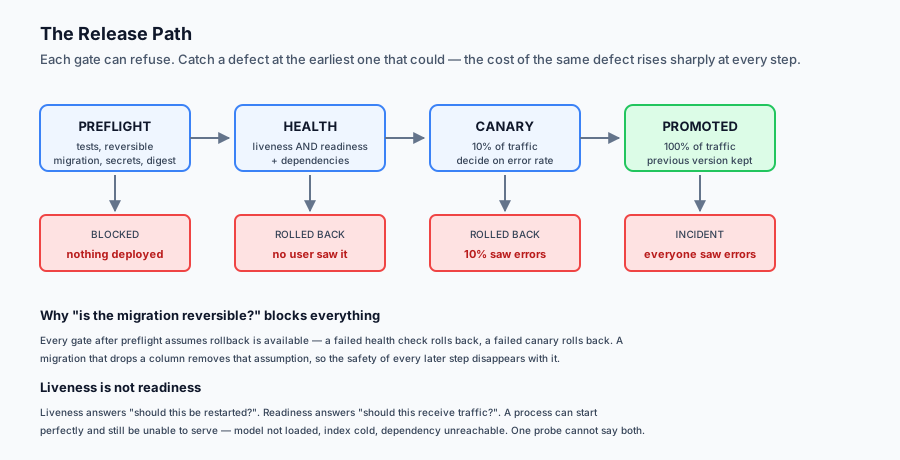
A deployment is a sequence of gates, each of which can say no. The design principle is that a failure should be caught by the earliest gate that could possibly catch it, because cost rises sharply at every step.
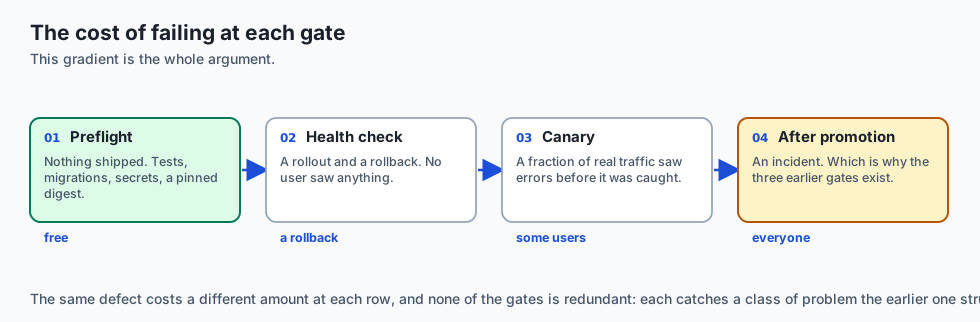
Preflight runs before anything ships. Did tests pass, is the migration reversible, are the secrets present, is the image pinned. Failing here costs nothing.
Health runs after the new version starts. It answers a question people routinely get wrong: not “is the process running?” but “can it actually serve?” Failing here costs a rollback and no user impact.
Canary sends a small fraction of real traffic to the new version and watches. Failing here costs a rollback and a small amount of user impact.
Promotion moves everything across. Failing after here costs a real incident — which is why the earlier gates exist.
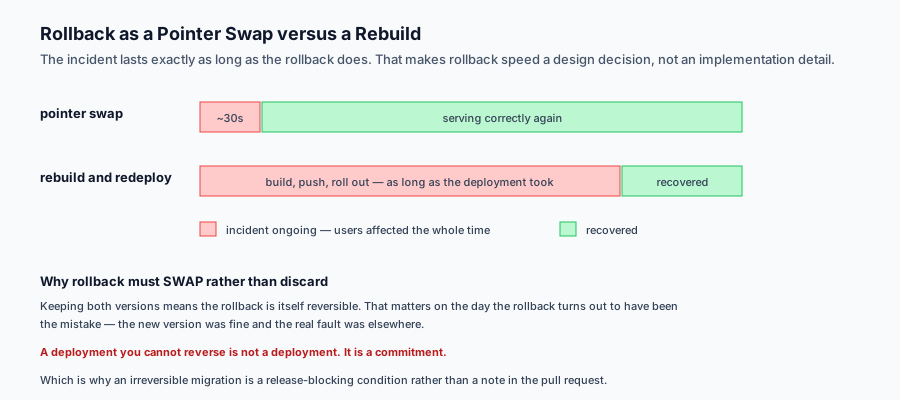
And underneath all of them: rollback must be a data operation. Swapping which artefact is live takes seconds. Rebuilding takes as long as the deployment did, and the incident continues throughout.
Historical background
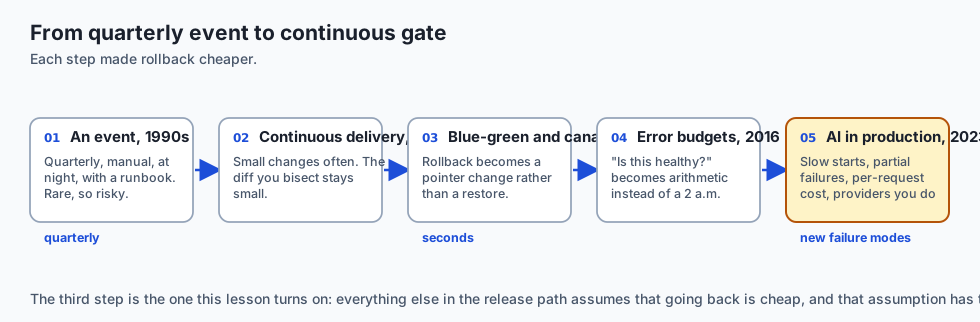
Deployment as an event, 1990s
Releases were quarterly, manual, and performed at night by someone with a runbook. The rarity was self-reinforcing: because deploying was risky, you did it seldom; because you did it seldom, each one carried more change and was riskier still.
Continuous delivery, 2010
Humble and Farley’s Continuous Delivery argued the opposite: deploy small changes often, and make the pipeline itself the thing you trust. The insight that matters here is that small deployments are safer, because the diff you are bisecting when something breaks is small.
Blue-green and canary releases, 2010s
Two environments, one live; switch traffic to release, switch back to roll back. Canary refined it by shifting a fraction first. Both reframed rollback from “restore from backup” to “change a pointer” — which is the reframing this lesson turns on.
Progressive delivery and error budgets, 2016 onward
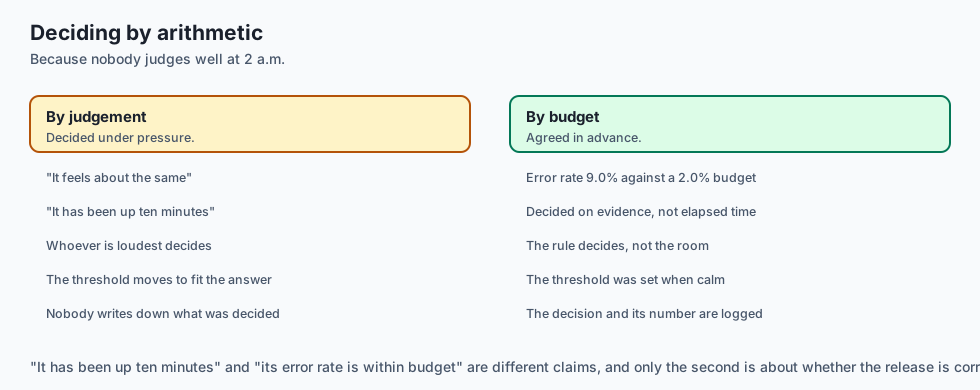
Google’s SRE practice supplied the vocabulary for deciding automatically: an error budget makes “is this release healthy?” a measurable question with a stated threshold rather than a judgement call made under pressure at 2 a.m.
AI systems in production, 2023 onward
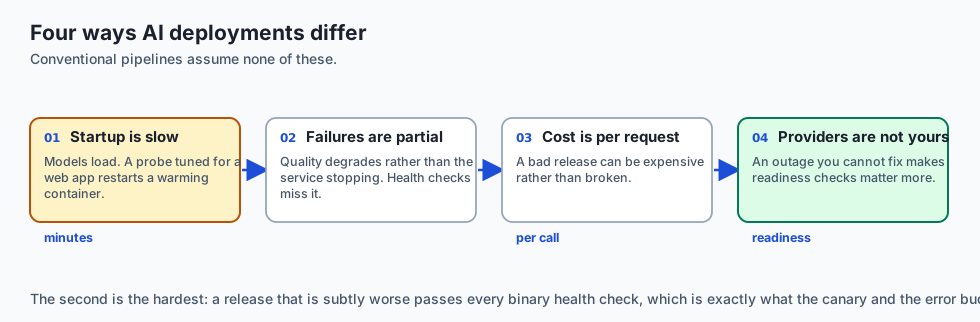
AI deployments added properties conventional web services do not have. Startup is slow because models load. Failures are often partial and probabilistic rather than binary. Cost is per request, so a bad release can be expensive as well as broken. And model providers are a dependency you do not control, which makes readiness checks more important rather than less.
What it is — and what it is not
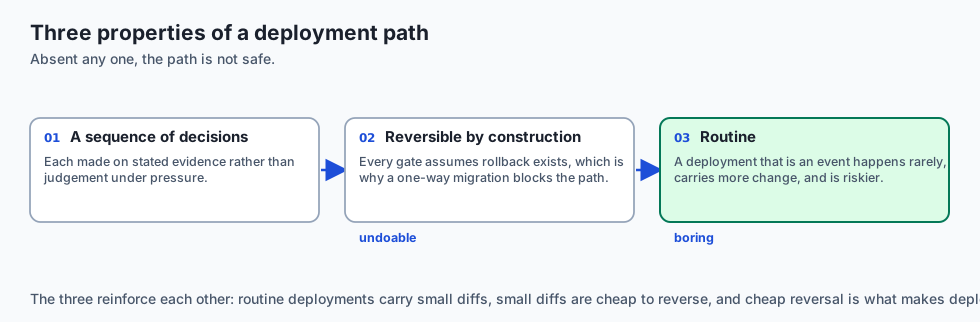
Deployment is the controlled process of replacing a running version with a new one, with the ability to stop and reverse at every stage.
What it is
It is a sequence of decisions, each made on stated evidence rather than on judgement under pressure.
It is reversible by construction. Every gate assumes rollback is available, which is why an irreversible migration blocks the whole path.
It is routine. A deployment that is an event is a deployment that happens rarely, carries more change, and is riskier.
What it is not
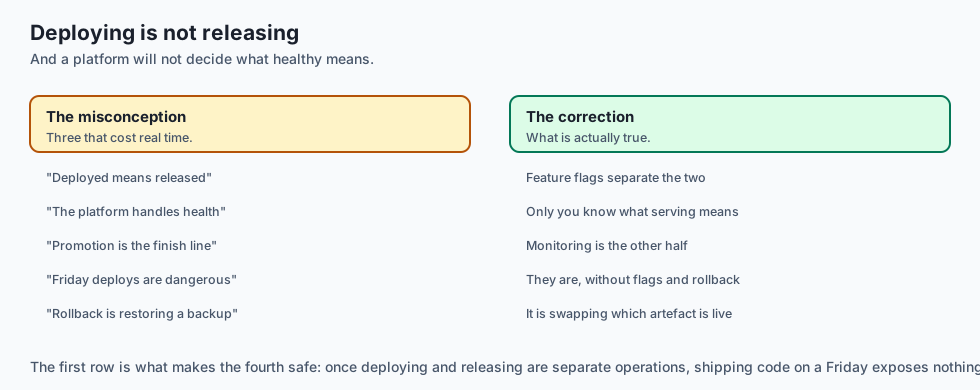
It is not the same as release. Deploying puts code in production; releasing exposes it to users. Feature flags separate them, and that separation is what lets you deploy on a Friday.
It is not solved by a platform. Kubernetes, Fly.io and Cloud Run all deploy things. None of them decides what “healthy” means for your system — that is yours.
It is not finished at promotion. Monitoring is tomorrow, and the two are halves of the same job.
Why it was created and what problems it solves
Bad builds reach production. Solution: preflight gates that are cheap now and expensive later — tests, reversible migrations, present secrets, a pinned image digest.
“It’s running” mistaken for “it works.” A container starts, the orchestrator reports green, and every request fails because the model never loaded or a dependency is unreachable. Solution: separate liveness from readiness, and check dependencies.
All traffic at once. A release with a subtle problem affects everyone before anyone notices. Solution: a canary at a small percentage with a decision rule.
Rollback that is a rebuild. The incident lasts as long as a full deployment. Solution: keep the previous artefact live-able and swap a pointer.
Deciding under pressure. Nobody makes good judgements at 2 a.m. Solution: an error budget, agreed in advance, so the decision is arithmetic.
How it works
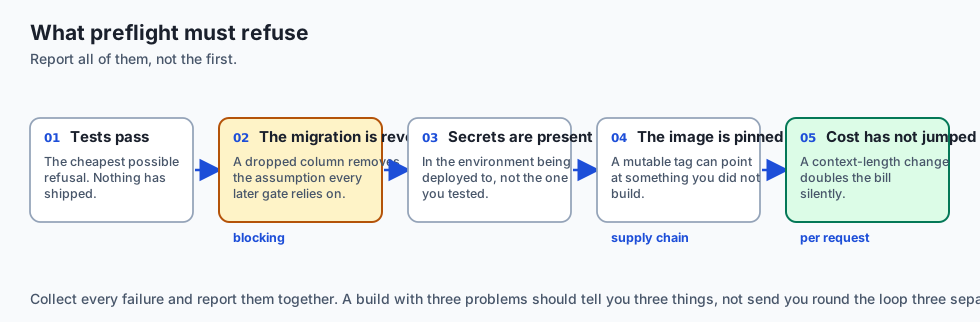
Preflight. Collect every reason not to deploy, and report all of them rather than stopping at the first — a build with three problems should tell you three things, not send you round the loop three times.
The condition that deserves special attention is reversibility of migrations. Every other gate assumes rollback is possible. A migration that drops a column removes that assumption, and with it the safety of every subsequent step. If you take one habit from today, it is to treat “can this be undone?” as a release-blocking question.
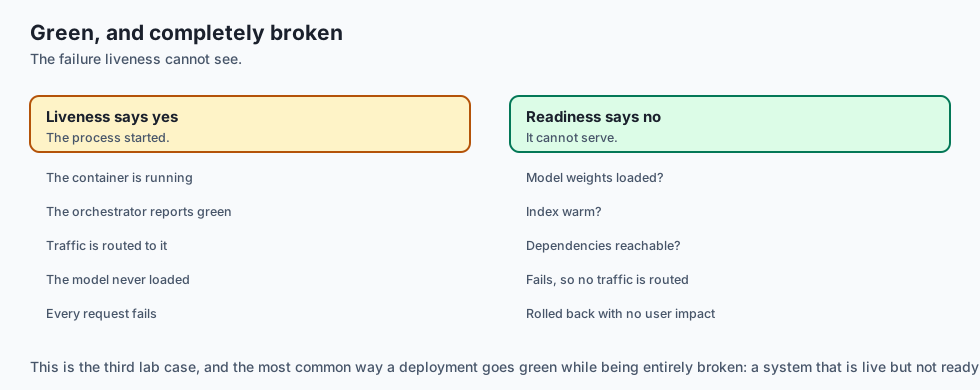
Deploy and check health. Start the new version and ask two different questions. Liveness: is the process alive? Readiness: can it serve — model loaded, index warm, dependencies reachable? A system that is live but not ready is the most common way a deployment goes green while being completely broken.
Canary. Route a small percentage of real traffic and measure. Decide on evidence, not elapsed time: “it has been up ten minutes” is a different claim from “its error rate is within budget”, and only the second is about correctness.
Promote or roll back. Within budget, move to 100 percent and record the previous version. Over budget, return traffic to the old version immediately.
Rollback. Swap which version is live. Keep the old one — a rollback that discards it cannot itself be undone, which matters when the rollback was the mistake.
An everyday analogy
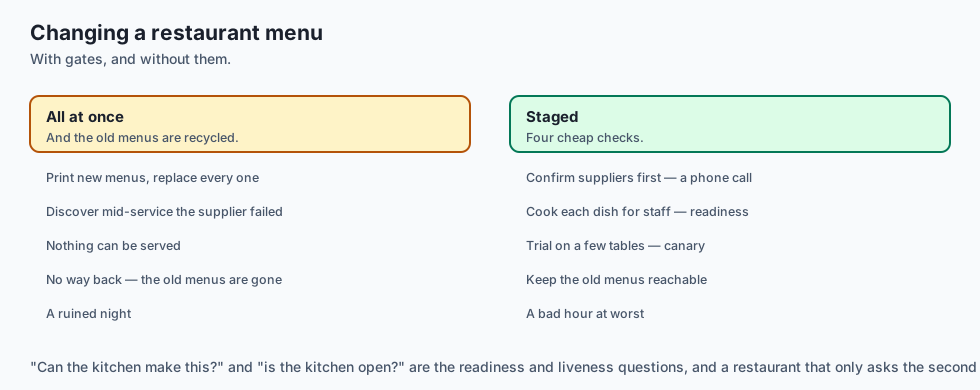
Think of a restaurant changing its menu.
The reckless version: print the new menus, replace every old one, and find out during service that the new supplier cannot deliver. Now nothing can be served, and the old menus are in the recycling.
The professional version has gates. Before printing, check the suppliers exist and the kitchen can make the dishes — that is preflight, and it costs a phone call. Then cook one of each new dish for staff before anyone orders — that is a readiness check, and it answers “can we actually make this?” rather than “is the kitchen open?” Then offer the new menu on a few tables and watch what comes back — the canary. Only then replace every menu.
And keep the old menus. Not in the recycling. Somewhere you can reach in thirty seconds, because the difference between a bad night and a ruined one is entirely whether you can go back.
Examples in practice
Here is the measured output from today’s lab — five deployments, each stopping at a different gate:
--- clean release ---
  deploying    rolling out v1.1.0
  canary       10% of traffic
  promoted     v1.1.0 at 100%
  => promoted live=v1.1.0 traffic_to_new=100%

--- irreversible migration ---
  blocked      migration is not reversible
  => blocked live=v1.0.0 traffic_to_new=0%

--- starts but cannot serve ---
  deploying    rolling out v1.1.0
  rolled_back  health check failed: readiness
  => rolled_back live=v1.0.0 traffic_to_new=0%

--- canary exceeds error budget ---
  deploying    rolling out v1.1.0
  canary       10% of traffic
  rolled_back  error rate 9.0% exceeds budget 2.0%
  => rolled_back live=v1.0.0 traffic_to_new=0%
Read the cost gradient down that list. The irreversible migration was caught before anything shipped — nothing deployed, no user saw anything. The readiness failure cost a rollout and a rollback, still with no user impact. The canary failure reached 10 percent of real traffic before being caught, so some users saw errors.
The same defect caught at each of those points costs a different amount, and that is the entire argument for having several gates rather than one good one.
Note also what the third case demonstrates. The process started successfully — liveness was fine. Readiness was not, so it could not serve. A deployment system that only checks liveness reports that release as healthy and leaves it serving errors to everyone.
And the rollback:
  promoted: promoted live=v1.1.0 traffic_to_new=100%
  rolled_back  back to v1.0.0
  => rolled_back live=v1.0.0 traffic_to_new=0%
One operation, no rebuild. And because it swaps rather than discards, rolling back again returns to v1.1.0 — which matters on the day the rollback turns out to have been the mistake.
Implications: security, privacy, performance, scalability, and cost
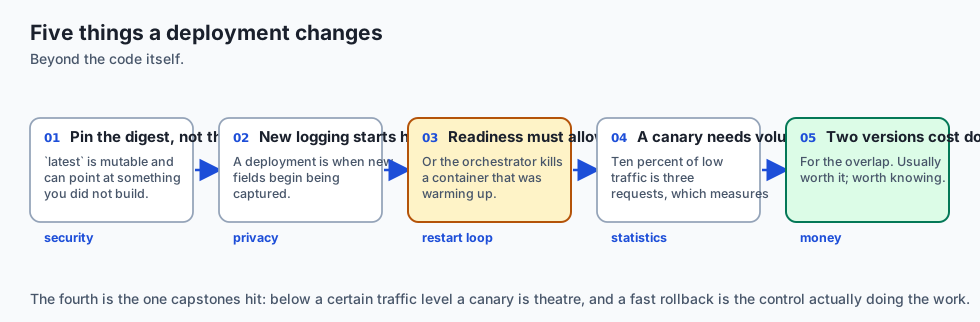
Security. Pinning the image to a digest rather than a tag is a supply-chain control: latest is mutable and can point at something you did not build. Secrets belong in the environment, never in the image — an image is a distributable artefact and anything inside it travels with it.
Privacy. A new version may log differently. A deployment is the moment new fields start being captured, so it is the right time to check what the logs will now contain.
Performance. AI services start slowly because models load. Readiness must account for that or the orchestrator will kill a container that was simply still warming up, producing a restart loop that looks like a crash.
Scalability. A canary needs enough traffic for its error rate to mean anything. At low volume, ten percent of traffic may be three requests, and three requests cannot distinguish a two percent error rate from a nine percent one. Below a certain scale, canary is theatre and a fast rollback is the real control.
Cost. Running two versions during a canary costs roughly double for the overlap. A bad AI release can also be expensive rather than merely broken — a change that doubles context length doubles the bill, silently, and a cost check belongs in preflight alongside the tests.
Alternatives: free, open source, and commercial
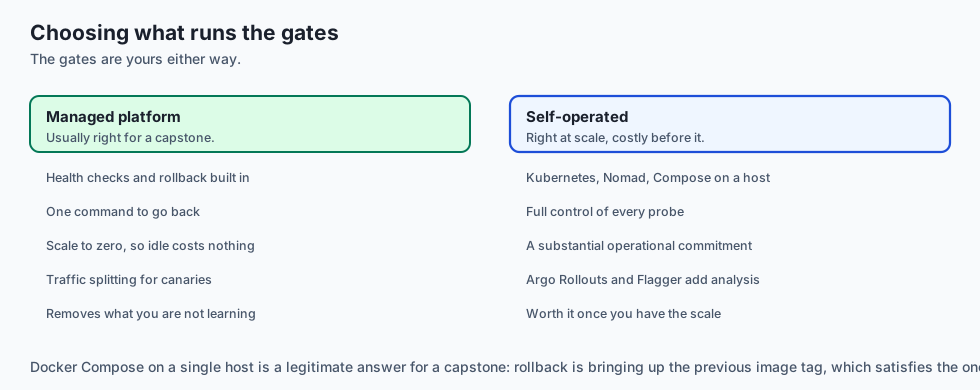
Docker Compose on a single host — free, no orchestrator, and entirely adequate for a capstone. Rollback is docker compose up with the previous image tag.
Kubernetes — Apache-2.0, with rolling updates, readiness probes and kubectl rollout undo built in. Powerful, and a substantial operational commitment for one service.
Nomad — MPL-2.0, considerably simpler than Kubernetes for a small number of services.
Fly.io, Railway, Render — managed platforms with generous free tiers, health checks and one-command rollback. For a capstone these are usually the right answer: they remove the parts that are not what you are learning.
Cloud Run and equivalents — scale to zero, so an idle capstone costs nothing, with traffic splitting for canaries built in.
Argo Rollouts and Flagger — Apache-2.0, progressive delivery for Kubernetes with automated analysis and rollback. The right tool once you have the scale to need it.
The honest default for a capstone: a managed platform with health checks and one-command rollback. The gates in this lesson are yours regardless of what runs them.
Comparison with related concepts
Deployment versus release. Deploying puts code in production; releasing exposes it. Feature flags separate them, which is what makes deploying frequently safe.
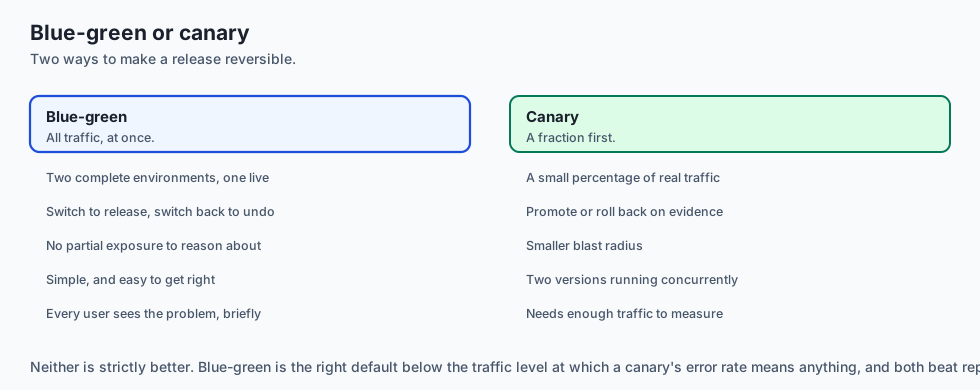
Blue-green versus canary. Blue-green switches all traffic at once between two complete environments — simple, and no partial exposure. Canary shifts gradually, catching problems with less blast radius at the cost of running two versions and needing enough traffic to measure.
Liveness versus readiness. Liveness answers “should this be restarted?” Readiness answers “should this receive traffic?” Using one probe for both is why systems get restarted while merely warming up, and why broken systems keep receiving requests.
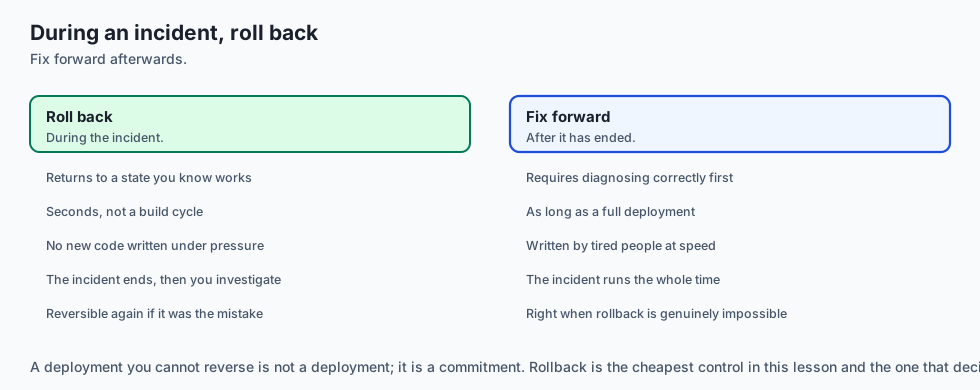
Rollback versus roll-forward. Rollback returns to the last known-good state. Roll-forward fixes and deploys again. Rollback is almost always right during an incident: it is faster, and it is the option you already know works.
When to use it — and when not to
Build the full path when the system has users who will notice, when a failure costs something, or when more than one person can deploy — in which case the gates are also how they agree on what “ready” means.
Simplify when the capstone is a demonstration with no live users. Preflight and rollback are still worth having, because they are cheap. A canary over three requests is not measuring anything.
Never skip rollback. It is the cheapest of all these controls and the one that determines how bad a bad day gets. A deployment you cannot reverse is not a deployment — it is a commitment.
The AI connection
-
AI deployments break the assumptions conventional pipelines are built on. Startup is slow because models load, so a readiness probe tuned for a web app restarts a container that was merely warming up.
-
Failures are probabilistic, not binary. A release that is subtly worse passes every health check, which is what the canary and the error budget catch.
-
Cost is per request, so a bad release can be expensive rather than broken — a context-length change doubles the bill silently, and preflight should say so.
-
Model providers are a dependency you do not control, which makes readiness checks more important than for a system whose dependencies are all yours.
-
Rollback is the one control that always works — the reason Day 344’s incident response starts by asking what changed, and whether it can be undone.
Knowledge check
- Why does an irreversible migration block the entire release path rather than just its own step?
- A container starts and the orchestrator reports it healthy, but every request fails. Which check was missing?
- Why should a canary decide on error rate rather than on elapsed time?
- Why must rollback swap versions rather than discard the one being replaced?
- Why is a canary close to meaningless on a low-traffic service, and what should you rely on instead?
Hands-on exercise
You will implement the release path — preflight, health, canary, promotion and rollback — and watch the same defect cost different amounts depending on which gate catches it.
Open starter/release.py in the lab directory and implement the stubbed functions, then run the tests.
Expected output
Running python3 examples/release_demo.py runs five deployments and one rollback. Abridged:
--- clean release ---
  deploying    rolling out v1.1.0
  canary       10% of traffic
  promoted     v1.1.0 at 100%
--- irreversible migration ---
  blocked      migration is not reversible
--- starts but cannot serve ---
  rolled_back  health check failed: readiness
--- canary exceeds error budget ---
  rolled_back  error rate 9.0% exceeds budget 2.0%
--- rollback after a bad promotion ---
  rolled_back  back to v1.0.0
Notice how far each failure travelled before being caught. The migration never deployed. The readiness failure deployed but served nobody. The canary failure reached ten percent of real traffic.
Validate your work
Run bash tests/run_tests.sh. All seventeen tests must pass, grouped by gate so a failure names which one let a bad build through.
Then check two things by inspection. A blocked build must leave live_version unchanged and traffic_to_new at zero — a preflight failure deploys nothing at all. And rolling back twice must return to the newer version, because rollback swaps rather than discards.
Troubleshooting
A blocked build still changes the live version. You are raising after mutating. Collect the blockers and return before touching any state.
Preflight reports only one problem. You are returning at the first failure. Accumulate them all; three problems should mean one trip round the loop, not three.
A failed health check still reaches canary. You are checking health after routing traffic. Check before.
Rolling back twice does nothing the second time. You are setting previous_version to None instead of swapping. Swap both, so the operation is itself reversible.
Common mistakes
Treating liveness and readiness as the same check. They answer different questions and have different consequences.
Deciding on elapsed time. “It’s been up ten minutes” says nothing about correctness.
Discarding the old version at promotion, which makes rollback impossible exactly when it is needed.
Letting an unpinned image tag through preflight. latest is mutable, and mutable means someone else can change what you deploy.
Practice assignment
Add a cost gate to preflight. Give each build an estimated cost per thousand requests, and block a release whose cost has risen by more than a stated percentage against the currently live version.
Then write two tests: one proving a large cost increase blocks the release, and one proving a small increase does not. This matters because an AI release can be perfectly correct and still be a problem — a change that doubles context length breaks nothing and doubles the bill, and no functional test will notice.
Extension challenge
Implement automatic canary analysis over a traffic window. Rather than a single error rate, feed the canary a sequence of per-minute samples, and decide using both a threshold and a minimum sample count.
Then find and report the point at which the analysis becomes untrustworthy: at what request volume can it no longer distinguish a two percent error rate from a nine percent one with any confidence?
Report the real number for your parameters. It will be larger than you expect, and it is the honest answer to why canaries are ineffective on low-traffic services — the sample simply is not there, no matter how carefully the threshold is chosen.
Quiz
Q1. Why does an irreversible migration block the entire release path rather than only its own step?
- Because migrations always run last and would fail anyway
- Every later gate assumes rollback is still available
- Because irreversible migrations are slower to apply
- Because the orchestrator refuses to schedule them
Show answer
Answer: B. Every later gate assumes rollback is still available
The later gates are only safe because they can retreat. Removing the retreat removes their safety, which is why reversibility is a release-blocking question.
Q2. A container starts and the orchestrator reports it healthy, but every request fails. Which check was missing?
- A liveness probe
- A disk-space check
- A readiness probe
- A version check
Show answer
Answer: C. A readiness probe
One probe cannot answer both questions. Liveness decides whether to restart; readiness decides whether to send traffic, and conflating them is why broken systems keep receiving requests.
Q3. Why should a canary decide on error rate rather than on elapsed time?
- Because measuring time requires a synchronised clock
- Because elapsed time varies between environments
- Because error rates are cheaper to compute
- An error budget makes it arithmetic, not judgement
Show answer
Answer: D. An error budget makes it arithmetic, not judgement
The point of agreeing a budget in advance is that nobody makes good judgements during an incident. The threshold is decided when it is calm.
Q4. Why must rollback swap versions rather than discard the one being replaced?
- It makes the rollback itself reversible
- To save storage on the registry
- Because discarding requires a rebuild of the old version
- Because orchestrators refuse to delete a running image
Show answer
Answer: A. It makes the rollback itself reversible
A one-way rollback is another irreversible operation performed under pressure, which is exactly the situation the whole lesson is trying to avoid.
Q5. Why is a canary close to meaningless on a low-traffic service, and what should you rely on instead?
- Because low-traffic services do not fail; rely on monitoring
- Ten percent of a small volume distinguishes nothing
- Because canaries need a load balancer, which small services lack
- Because error budgets only apply above a certain request rate
Show answer
Answer: B. Ten percent of a small volume distinguishes nothing
Below a certain scale the sample simply is not there, however carefully the threshold is chosen. Speed of recovery becomes the real control.
Glossary
- Preflight Gate
- Checks run before anything ships — tests, reversible migrations, present secrets, a pinned image. The cheapest place to fail.
- Liveness
- Whether a process is running. Answers "should this be restarted?" and nothing more.
- Readiness
- Whether a process can actually serve — model loaded, index warm, dependencies reachable. Answers "should this receive traffic?"
- Canary Release
- Routing a small fraction of real traffic to a new version and deciding on measured evidence before promoting.
- Error Budget
- An agreed threshold of acceptable failure, which turns a release decision into arithmetic rather than a judgement made under pressure.
- Blue-Green Deployment
- Two complete environments with one live, switching all traffic at once. Simple, with no partial exposure.
- Rollback
- Returning to the last known-good version. A data operation — swapping which artefact is live — not a rebuild.
- Roll-Forward
- Fixing and deploying again rather than returning. Slower during an incident, because the fix is unproven.
- Image Digest Pinning
- Referring to a container image by its content hash rather than a mutable tag, so what deploys cannot change underneath you.
- Deployment versus Release
- Deploying puts code in production; releasing exposes it to users. Feature flags separate the two, which is what makes frequent deployment safe.
Sources and further reading
- Continuous Delivery: Reliable Software Releases (Humble & Farley, 2010) — Addison-Wesley (accessed 2026-08-31)
- Site Reliability Engineering — Release Engineering — Google (accessed 2026-08-31)
- Kubernetes Documentation — Liveness, Readiness and Startup Probes — The Kubernetes Authors (accessed 2026-08-31)
- Argo Rollouts — Progressive Delivery and Analysis — Argo Project (accessed 2026-08-31)
Kept in this browser, no account needed. Your progress page turns the whole record into one link you can bookmark or open on another device.