Programming with Python › Files, Errors, and Object-Oriented Python › Day 67
Day 67: Classes and Objects
After this lesson you will be able to replace a dictionary plus a pile of functions that assume its keys with a class that binds state to the behaviour maintaining its invariants: you will write __init__, self, methods, staticmethods and classmethods knowing exactly what each receives, defend a rule with a @property that rejects an invalid value, give every class a __repr__ that makes debugging possible, avoid the shared-mutable-class-attribute bug, decide honestly whether a class is even the right tool, and build a minimal object system from dicts and closures so you can see that a class is a dictionary of state plus a dictionary of functions with syntax on top.
Hands-on lab for this lesson
Lab files on GitHub: https://github.com/ai-roadmap-365/ai-roadmap-365.github.io/tree/main/labs/sections/programming-with-python/day-067-classes-and-objects
- Get the hands-on files. Clone the labs repository once (you can reuse this clone for every lesson). This works on macOS, Linux, and Windows (PowerShell or WSL):
git clone https://github.com/ai-roadmap-365/ai-roadmap-365.github.io.git cd ai-roadmap-365.github.io - Open this lesson's lab. Move into the directory for this specific day. Every lab lives at the same predictable path — section / subsection / week / day:
cd labs/sections/programming-with-python/day-067-classes-and-objects - Read the lab guide. Open `README.md` in that directory. It lists the exact commands, what each does, the expected output, and how to check your work — read it before running anything.
- Run it and check your work. Follow the README's "How to run" section: run the example first to see the finished result, then complete the numbered exercises in `starter/`, then run the tests. The tests pass (exit 0) only when your work is correct.
bash tests/run_tests.sh # or the test command named in the lab README
You can also open the lab as a local page (works offline, shows the file tree and expected output).
Learning objectives
By the end of this lesson you will be able to:
- Explain the problem a class solves — state and the rules governing it drifting apart when a dict is passed into functions nobody is obliged to call — and demonstrate the failure with real output
- Distinguish a class (the blueprint) from an instance (a concrete thing with its own state), proving two instances have distinct identities while sharing one type
- Explain why __init__ is an initializer and not a constructor, showing that the object already exists when it runs, and name a practical consequence of the difference
- Show that obj.m(x) is Class.m(obj, x) by inspecting a bound method's __func__ and __self__, and explain why self is an explicit parameter in Python
- Contrast instance attributes with class attributes, reproduce the shared-mutable-class-attribute bug with real output, and fix it inside __init__
- Choose correctly among an instance method, a @staticmethod, and a @classmethod, using a classmethod as an alternative constructor that builds objects from CSV rows
- Define __repr__ and __str__ for their correct audiences, and justify why every class deserves a __repr__ for debugging
- Enforce an invariant with @property, including a setter that rejects an invalid value, and explain the single-underscore convention and double-underscore name mangling
- Decide whether a problem deserves a class at all, choosing instead a dict, a NamedTuple, a dataclass, an enum, or a plain function when those fit better
- Build a minimal object system from dicts and closures, then inspect the result with type(), dir(), __dict__, and vars() to expose the machinery a class provides
Prerequisites
- Day 66: exceptions and error-handling strategy — raising ValueError to refuse an invalid state is how an invariant is defended
- Day 65: CSV and JSON in the real world — the classmethod alternative constructor builds objects straight from parsed rows
- Day 63: designing a small program well — a pure core and a thin shell, the shape the practice assignment reuses
- Day 58: scope and closures — the from-scratch object system is a dict of closures over one captured state dict
- Days 52-54: lists and dictionaries, since an object is literally a dictionary of state
- Comfort running a script from the terminal with python3
Why this matters
Look back at the programs you have written since Day 49. A pattern keeps recurring, and it has been getting heavier. You have some related values — an owner, a balance, a list of movements — and you hold them in a dictionary. Then you write functions that operate on that dictionary, and every one of them takes it as the first argument. deposit(account, 50). withdraw(account, 30). describe(account). Each function silently assumes the dictionary has exactly the keys it expects, and nothing anywhere states what those keys are or what rules they must satisfy.
That arrangement works until it does not, and the way it fails is worth seeing precisely. Here is the dict version of an account, running in the Day 67 lab:
ada: 120.00 (2 entries)
rejected: insufficient funds
after a direct edit: ada: -500.00 (2 entries)
The second line is your withdraw function doing its job: it checked the balance and refused an overdraft. The third line is the same account holding minus five hundred, because somebody wrote account["balance"] = -500 and no function was involved. Every rule you carefully encoded lives in functions that nobody is obliged to call. The dictionary is wide open, and the guard rails are optional.
A class closes that gap. It binds the state and the behaviour that maintains its rules into one named thing, so the rules stop being a convention and start being enforced. Here is the same session against the class version:
ada: 120.00 (2 entries)
rejected: insufficient funds
rejected: balance cannot be negative (got -500.00)
after the refused edit: ada: 120.00 (2 entries)
repr: Account(owner='ada', balance=120.00)
The direct edit is now refused, by the object itself, without anyone remembering to check.
This matters for your AI goal more than almost anything else in this week. Every library in the second half of this course is built out of classes. When you load a model, you get an object. When you tokenize text, a tokenizer object does it. Datasets, agents, tool definitions, retrievers, evaluation harnesses — all objects, all with __init__ signatures you must read, attributes you must inspect, and methods whose behaviour is documented mostly by their source code. Today is what turns library documentation from a set of spells you copy into code you can actually read.
The idea in plain language
Think of a passport office. The office works from one template: what fields a passport carries, how many pages it has, what makes it valid, what happens when it is stamped. The template is not a passport. You cannot travel on it. It is the definition — the rules and the shape.
Every passport the office issues is a separate physical booklet made from that template. Each has its own holder, its own number, its own stamps. Two passports issued five minutes apart are two different objects in the world; filling one with stamps does nothing to the other. Yet both obey exactly the same rules, because both came from the same template.
That is the whole of today. A class is the template. An object, also called an instance, is one thing made from it. The class says what every instance will carry and what every instance can do; the instance carries its own values.
The part that surprises people is where the two halves live. The state — this passport’s holder, this account’s balance — lives on the instance, one separate copy each. The behaviour — the functions that read and change that state — lives on the class, one shared copy for everyone. Neither passport carries its own private copy of the rulebook; both consult the office’s single copy. That split is not a detail. It is the mechanism, and once you can see it, everything else about classes stops being magic.
Historical background
Classes came out of a simulation problem. In the early 1960s at the Norwegian Computing Center in Oslo, Ole-Johan Dahl and Kristen Nygaard were building tools to simulate real-world systems — ships moving through ports, that sort of thing. Simulating a world means representing many things of the same kind, each with its own state, all following the same rules. Their language Simula 67 introduced classes and objects to express exactly that, and it is generally credited as the first object-oriented programming language. Dahl and Nygaard received both the ACM Turing Award and the IEEE John von Neumann Medal in 2001 for the work.
The idea was taken much further at Xerox PARC in the 1970s, where the Smalltalk team built a language in which everything — numbers, classes themselves — was an object communicating by messages. Smalltalk pushed object orientation from “a useful construct for simulation” into a whole way of structuring programs, and its influence runs through most of what came after.
Python has had classes from the beginning. Guido van Rossum released Python 0.9.0 in February 1991, and that first public release already included classes with inheritance, along with exceptions, functions, and the core data types. Classes were not bolted on later; they were part of the language’s original design. That history explains something you will feel today: Python’s object model is simple and exposed. You can look directly at the dictionaries that make an object work, which is exactly what you will do in the lab.
What it is — and what it is not
A class is a statement that creates one object — the class object — carrying a dictionary of names. Some of those names hold ordinary values (class attributes); most hold function objects (methods). Calling the class produces a new instance, which gets its own dictionary for its own state and a link back to the class where the shared behaviour lives.
The misconceptions here cost real time, so be precise about what a class is not.
| Common misconception | The reality |
|---|---|
| ”A class is a place to group related functions.” | If the functions do not share state, that is what a module is for. A class whose instances hold nothing is a namespace with extra typing. |
”__init__ is the constructor.” | The object already exists when __init__ runs. __init__ receives the finished object as self and fills it in. It returns None; returning anything else is an error. |
”self is a keyword.” | It is an ordinary parameter name, the first one, filled in automatically by the call machinery. You could name it anything; everyone names it self. |
| ”Methods are stored inside each object.” | One function object per method lives on the class. A million instances share it. Only state is copied per instance. |
| ”A double underscore makes an attribute private.” | It renames it. __pin inside class Vault becomes _Vault__pin, which is reachable by anyone who types that name. It prevents accidents, not access. |
| ”Classes make code faster.” | They add an attribute lookup and a bound-method creation per call. You pay a small cost for organisation, and you should want to. |
| ”Every group of related values deserves a class.” | Only if there are rules to enforce or behaviour to attach. Otherwise a dict or a record type is clearer and shorter. |
| ”A class attribute is a per-instance default.” | For immutable values it behaves like one. For a list or dict it is one shared object, and mutating it through any instance changes it for all of them. |
Why it was created and what problems it solves
Classes exist because state and the rules governing it drift apart. Your withdraw function knows the balance must stay non-negative. The dictionary does not. Anyone with a reference to it can break the rule without going near your function. Binding them together means the rule travels with the data.
self is explicit because Python prefers visible mechanism to hidden mechanism. In many languages an instance’s fields are magically in scope inside a method. In Python they are reached through a named parameter, which means a method is an ordinary function whose first argument happens to be an object — and you can call it that way yourself, which you will do below. The cost is four extra characters; the benefit is that there is nothing to guess.
The @property decorator exists so that adding a rule does not force a rewrite. Suppose balance starts life as a plain attribute and later needs validation. Without properties, every reader would have to change from acct.balance to acct.get_balance(). With a property, the attribute keeps its name and syntax while gaining a function behind it — callers never notice.
@classmethod exists because a class often needs more than one way to be built. __init__ takes the arguments that describe an object directly. But you may also want to build one from a CSV row, from a JSON payload, or from a database record. An alternative constructor receives the class itself as cls and returns a new instance, so Account.from_csv_row("ada,120.50") reads as what it is.
__repr__ exists so that debugging is possible. An object without one prints as its class name and a memory address — no information at all about its state. A single method turns every print statement, every list display, and every debugger view into something readable.
How it works
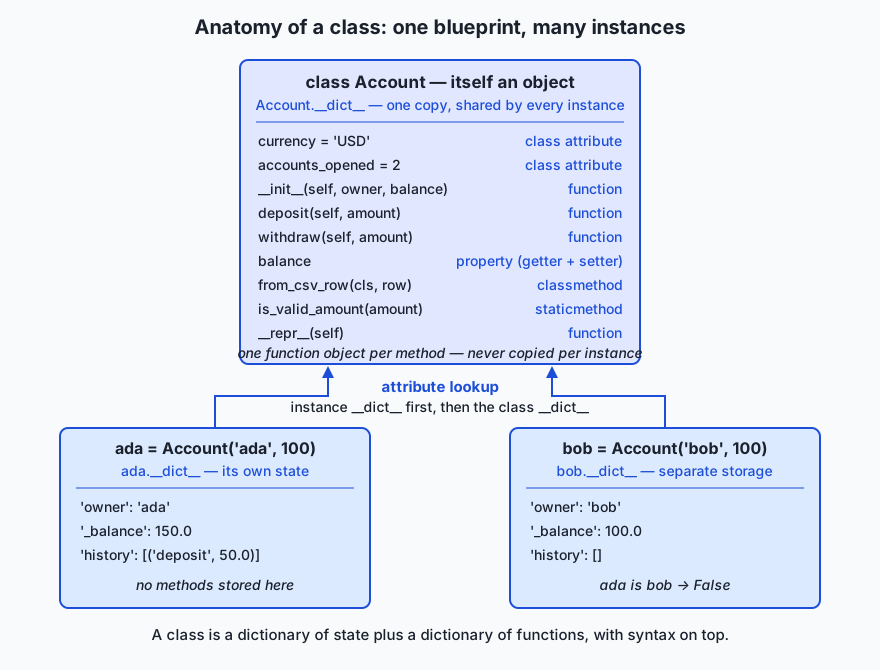
The architecture diagram shows the arrangement in full. On the left, the class object holds one dictionary containing currency, accounts_opened, and the function objects for __init__, deposit, withdraw, describe, __repr__, the balance property, the from_csv_row classmethod, and the is_valid_amount staticmethod. On the right, two instances, each with its own small dictionary of state and nothing else. The arrow between them is the rule that makes everything work: an attribute lookup checks the instance dictionary first, and falls back to the class dictionary when it finds nothing.
A class is a template; an instance is a thing
Two instances of the same class are genuinely two objects:
class Passport:
    def __init__(self, holder, number):
        self.holder = holder
        self.number = number


a = Passport("ada", "P1001")
b = Passport("bob", "P1002")
a.holder: ada | b.holder: bob
a is b: False
id(a) == id(b): False
type(a) is type(b): True
a == b (no __eq__ defined): False
default repr of a: <__main__.Passport object at 0x...>They hold different values, they are not the same object, and their identities differ — but type(a) is type(b) is True, because both were made from one template. One caution about that last line: the hex number in a default representation is the object’s address in memory and it changes on every run. It has been shown as 0x... here deliberately. Never write a test or copy an example that depends on it.
__init__ initializes; it does not construct
This distinction is not pedantry, and here is the proof:
class Probe:
    def __init__(self, label):
        print("  inside __init__, self already exists")
        print("  type(self):", type(self).__name__)
        print("  vars(self) before I set anything:", vars(self))
        self.label = label
inside __init__, self already exists
type(self): Probe
vars(self) before I set anything: {}
__init__ returned: NoneBy the time your code runs, the object exists, has a type, and has an empty attribute dictionary waiting to be filled. __init__ is handed that object as self and fills it in. It returns None — it is not producing the object, it is preparing one.
Why does the distinction matter in practice? Three consequences. First, __init__ cannot decide to return a different object or a cached one; it can only configure what it was given. Second, if __init__ raises, a partly-built object may already exist, so anything acquired earlier in it needs cleaning up. Third — most practically — an alternative constructor cannot be a second __init__. There is only one. That is precisely why @classmethod exists.
self and the bound-method mechanism
A method call has no magic in it. Watch:
class Counter:
    def bump(self, amount):
        self.total = getattr(self, "total", 0) + amount
        return self.total


c = Counter()
type(Counter.bump): function
type(c.bump): method
c.bump.__self__ is c: True
c.bump.__func__ is Counter.bump: True
c.bump(5) -> 5
Counter.bump(c, 5) -> 10Read that carefully, because it is the whole mechanism. Reached through the class, bump is a plain function. Reached through an instance, the same function comes back wrapped as a bound method — an object holding two references: __func__, the original function, and __self__, the instance it was reached through. Calling the bound method calls the function with __self__ inserted as the first argument.
So c.bump(5) genuinely is Counter.bump(c, 5). The last two lines prove it: both calls ran, both incremented the same counter, which is why the totals are 5 and then 10.
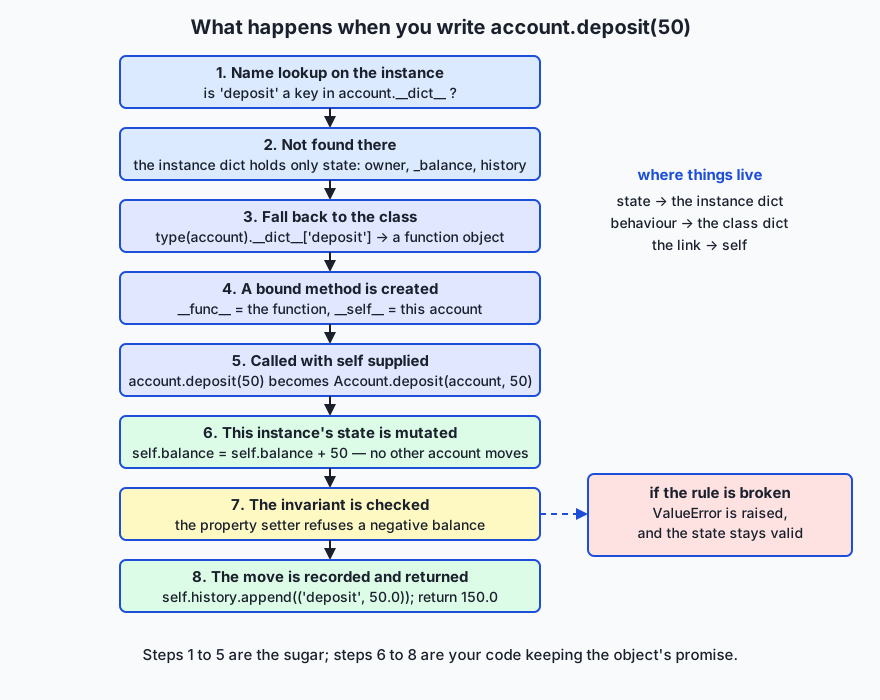
The flow diagram traces all eight steps for a real call. Python looks for deposit in the instance dictionary and does not find it, because instance dictionaries hold only state. It falls back to the class dictionary and finds the function. It creates a bound method. It calls it with self supplied. Your code then mutates that one instance’s state, the property setter checks the rule, and the new balance is returned. Steps one to five are the language’s sugar; steps six to eight are your code keeping the object’s promise.
Instance attributes versus class attributes
An attribute assigned inside __init__ through self belongs to that instance. An attribute assigned in the class body belongs to the class and is shared. For an immutable value that is harmless and useful. For a mutable value it is the classic bug:
class Office:
    country = "Norway"
    issued = []          # one list, created once, shared by everyone

    def __init__(self, city):
        self.city = city

    def issue(self, name):
        self.issued.append(name)
oslo.issued: ['ada', 'bob']
bergen.issued: ['ada', 'bob']
same list object? True
it is really on the class: ['ada', 'bob']
vars(oslo): {'city': 'Oslo'}
'issued' in vars(oslo): FalseThe Oslo office issued one passport and the Bergen office issued one, and both now report two. The list was created once, when the class statement ran, and self.issued.append(...) never created anything on the instance — it looked issued up (missing on the instance, found on the class) and mutated the one shared list. The vars(oslo) line is the tell: the instance dictionary contains only city.
The fix is one line — create the list inside __init__:
    def __init__(self, city):
        self.city = city
        self.issued = []
fixed -> o2.issued: ['ada'] | b2.issued: ['bob']
fixed -> same list object? FalseThere is a related subtlety worth knowing. Reading a class attribute through an instance works, but assigning through an instance creates a new instance attribute that shadows it:
oslo.country: Norway | 'country' in vars(oslo): False
after assigning to oslo.country, vars(oslo): {'city': 'Oslo', 'country': 'Norway (Oslo branch)'}
bergen.country still: Norway
Reads fall back to the class; writes always land on the instance. Only Office.country = ... changes it for everyone.
Methods, staticmethods, and classmethods
Three kinds of function can live on a class, and each earns its place differently.
class Ticket:
    prefix = "TK"

    def __init__(self, number):
        self.number = number

    @staticmethod
    def is_valid_number(value):
        return isinstance(value, int) and value > 0

    @classmethod
    def from_csv_row(cls, row):
        parts = [f.strip() for f in row.split(",")]
        if len(parts) != 1:
            raise ValueError(f"expected one field, got {row!r}")
        return cls(int(parts[0]))

    def __repr__(self):
        return f"Ticket(number={self.number!r})"
Ticket.is_valid_number(7): True
Ticket.is_valid_number(-7): False
Ticket.is_valid_number('7'): False
Ticket.from_csv_row('42'): Ticket(number=42)
type in the class dict -> is_valid_number: staticmethod
type in the class dict -> from_csv_row: classmethod
from_csv_row('1,2') -> ValueError - expected one field, got '1,2'An instance method takes self and needs one particular object. A staticmethod takes neither self nor cls; it is a plain function that belongs with the class conceptually — a validation rule, a unit conversion — and lives there so it can be found. A classmethod takes cls, the class itself, and its overwhelmingly common use is the alternative constructor: it builds and returns a new instance.
That from_csv_row is the direct tie back to Day 65. You now read a CSV row with csv.DictReader, hand each row to Account.from_csv_row, and get a list of validated objects instead of a list of dictionaries you hope are well-formed. The lab does exactly that with four rows and reports loaded 4 accounts, total 2225.75 USD.
__repr__ versus __str__
Two methods produce text, for two different audiences:
class Money:
    def __init__(self, amount):
        self.amount = amount

    def __repr__(self):
        return f"Money(amount={self.amount!r})"

    def __str__(self):
        return f"{self.amount:.2f} USD"
print(m) -> 49.50 USD
repr(m) -> Money(amount=49.5)
str(m) -> 49.50 USD
in a list -> [Money(amount=49.5)]
f-string uses str: 49.50 USD
no __str__ defined, print falls back to __repr__: ReprOnly(amount=49.5)__str__ is for a person reading output. __repr__ is for you, debugging — it should be unambiguous, and by convention it should look like the code that would recreate the object. Note the fourth line: a list displays its elements with __repr__, never __str__, which is why a class without one produces a list of memory addresses when you print it.
The last line is the rule to remember: define __repr__ on every class you write. If you define only __repr__, str() and print() fall back to it and everything is readable. If you define only __str__, your debugger and your lists stay useless. One of the two is worth ten times the other, and it is not the one beginners reach for first.
Encapsulation, Python style
Python has no private attributes. It has two conventions and one mechanism.
A single leading underscore — _balance — means “this is internal; I may change it without warning.” It is enforced entirely by other programmers reading it. Nothing stops access.
A double leading underscore triggers name mangling: inside class Vault, the name __pin is rewritten to _Vault__pin.
class Vault:
    def __init__(self, pin):
        self._hint = "internal, by convention"
        self.__pin = pin

    def check(self, guess):
        return guess == self.__pin
vars(v): {'_hint': 'internal, by convention', '_Vault__pin': '1234'}
v._hint reachable: internal, by convention
hasattr(v, '__pin'): False
hasattr(v, '_Vault__pin'): True
v.check('1234'): True
v.__pin -> AttributeError - 'Vault' object has no attribute '__pin'The attribute is genuinely stored under the mangled name, so v.__pin fails from outside while self.__pin works inside the class. It is not a security feature — anyone can type v._Vault__pin — and its actual purpose is avoiding accidental name collisions between classes. Reach for a single underscore by default.
The real tool for enforcing rules is @property, which turns attribute syntax into a function call:
class Passport2:
    def __init__(self, holder, pages):
        self.holder = holder
        self.pages = pages          # goes through the setter below

    @property
    def pages(self):
        return self._pages

    @pages.setter
    def pages(self, value):
        if not isinstance(value, int) or value < 1:
            raise ValueError(f"pages must be a positive integer, got {value!r}")
        self._pages = value

    @property
    def is_thick(self):
        return self._pages >= 48
ok.pages: 32 | ok.is_thick: False
stored under: {'holder': 'ada', '_pages': 32}
rejected 0: pages must be a positive integer, got 0
rejected -3: pages must be a positive integer, got -3
rejected '32': pages must be a positive integer, got '32'
pages after three refusals: 32
computed property has no setter: AttributeError - property 'is_thick' of 'Passport2' object has no setterThree invalid values were refused and the object still holds 32 — that is an invariant being defended. Note where the value really lives: _pages, in the instance dictionary, with pages a property on the class. Note too that self.pages = pages inside __init__ goes through the setter, so the validation applies at creation as well as afterwards. And is_thick is a computed property with no setter, so it cannot fall out of sync with _pages and cannot be assigned at all.
Building an object system from scratch
Here is the claim to test: a class is a dictionary of state plus a dictionary of functions, with syntax on top. Build one without the class keyword, using only closures from Day 58:
def make_account(owner, balance=0.0):
    state = {"owner": owner, "balance": float(balance)}

    def deposit(amount):
        state["balance"] += float(amount)
        return state["balance"]

    def describe():
        return f"{state['owner']}: {state['balance']:.2f}"

    return {"deposit": deposit, "describe": describe, "state": state}
The returned dictionary is a method table; state is the instance dictionary, kept alive by the closure. Now the same thing with class, and both driven identically:
hand['describe'](): ada: 150.00
sugar.describe():   ada: 150.00
identical: True

type(hand):         dict
type(sugar):        Account
type(Account):      type

hand's state:       {'owner': 'ada', 'balance': 150.0}
vars(sugar):        {'owner': 'ada', 'balance': 150.0}
sugar.__dict__ is vars(sugar): True

hand's method table: ['deposit', 'describe']
Account's methods:   ['deposit', 'describe']
'deposit' in vars(sugar): False

dir(sugar), non-dunder: ['balance', 'deposit', 'describe', 'owner']
dunder count on dir(sugar): 29

two hand objects share a function: False
two instances share one function:  True
Every line earns its place. The two versions produce identical output, so the class added no behaviour. type(Account) is type — the class is itself an object, made from a template of its own. vars(sugar) and the hand-built state hold exactly the same dictionary contents, which is the claim made concrete. vars() and __dict__ are the same object, one a function and one an attribute. dir() shows the merged view a user sees — state and behaviour together — while 'deposit' in vars(sugar) is False, proving the method was never on the instance at all.
The last two lines are what the class buys you. The hand-built version creates fresh function objects for every account, so a thousand accounts means three thousand functions. The class stores one function per method and shares it across every instance, which is why the arrow in the architecture diagram points from instance to class rather than duplicating anything.
An everyday analogy
Return to the passport office and map the pieces exactly.
The class is the office’s template and rulebook: what fields a passport carries, how many pages, what counts as valid. Nobody travels on the template.
Each instance is one issued booklet, with its own holder and its own stamps. Passport("ada", "P1001") is the office issuing one.
__init__ is the filling-in desk, and this is where the initializer-not-constructor point becomes obvious. The blank booklet has already been printed and handed to the clerk. The clerk does not manufacture it; the clerk writes the holder’s details into the booklet in front of them. That booklet is self.
self is this booklet, the one on the desk. Every rule in the rulebook is written about “the booklet”, and the clerk supplies which one.
An instance attribute is something printed in one booklet: this holder, these stamps. A class attribute is something printed on the office wall: the issuing country, one copy for all. And the shared-mutable bug becomes obvious in these terms — if the office keeps one stamp page pinned to the wall instead of putting one in each booklet, every traveller’s stamps appear in everyone’s record.
A method is a procedure in the rulebook: to stamp a passport, check pages remain, add the stamp, record the date. One copy, applied to whichever booklet is on the desk.
A staticmethod is a rule that needs no booklet at all: a passport number is two letters followed by four digits. True regardless of whose passport it is.
A classmethod is an alternative intake procedure: given a completed paper form, produce a passport. It is handed the office itself, not a booklet, and its output is a new booklet.
A property is the clerk at the counter. The pages field looks like a slot you write into, but a person stands between you and it, and if you hand over minus three pages they refuse. That refusal is why the booklet is always valid.
Name mangling is writing a note in the margin under a long internal filing code. Determined people can look it up. It exists so two different departments do not overwrite each other’s notes — not to keep secrets.
And the analogy shows what a class is not: an office with no rules, issuing booklets nobody checks, is just a stack of blank paper — a dict with extra ceremony.
Examples in practice
Three shapes, all from the lab, all captured from real runs.
One: the conversion, proved. The lab’s compare.py drives the dict version and the class version through an identical list of moves, then compares the results:
--- same behaviour, two designs ---
dict version : ada: 130.00 (4 entries)
class version: ada: 130.00 (4 entries)
descriptions identical: True
histories identical:    True

--- what changed is what happens when a rule is broken ---
dict version accepted a negative balance: -500
class version refused it: balance cannot be negative (got -500.00)
class balance unchanged: 10.0
This is what a good refactor looks like: identical behaviour on the normal path, different behaviour when a rule is broken. The class did not add features; it removed the possibility of an invalid object.
Two: the alternative constructor doing real work. Feeding examples/accounts.csv through Account.from_csv_row — Day 65’s parsing, today’s objects:
--- loading a CSV file through the alternative constructor ---
   Account(owner='ada', balance=100.00)
   Account(owner='bob', balance=250.50)
   Account(owner='cleo', balance=0.00)
   Account(owner='dev', balance=1875.25)
loaded 4 accounts, total 2225.75 USD
Four readable lines, because __repr__ was defined. Without it those would be four memory addresses, and every one different on the next run.
Three: the machinery, opened up. The lab’s machinery.py prints where everything lives:
--- state lives on the instance ---
vars(ada): {'owner': 'ada', '_balance': 150.0, 'history': [('deposit', 50.0)]}
vars(bob): {'owner': 'bob', '_balance': 100.0, 'history': []}
'history' in ada.__dict__: True
'deposit' in ada.__dict__: False

--- behaviour lives on the class ---
class attributes and methods:
    accounts_opened -> int
    balance -> property
    currency -> str
    deposit -> function
    describe -> function
    from_csv_row -> classmethod
    is_valid_amount -> staticmethod
    withdraw -> function
Account.currency: USD
ada.currency (found on the class): USD
'currency' in ada.__dict__: False

--- a method call is a function call with self supplied ---
type(Account.deposit): function
type(ada.deposit): method
ada.deposit.__self__ is ada: True
ada.deposit.__func__ is Account.deposit: True
Account.deposit(ada, 10) moved the balance 150.00 -> 160.00
Read that against the architecture diagram and they are the same picture: two instance dictionaries holding only state, one class dictionary holding everything else, and lookups falling from instance to class.
Implications: security, privacy, performance, scalability, and cost
Security. Do not mistake underscores for access control. A single underscore is a note to other programmers; a double underscore is a rename anyone can undo by typing the mangled name. If a value must not leak — an API key, a password — the protection is not storing it in an attribute that lands in logs. Which brings up a real hazard of __repr__: it gets printed, logged, and included in exception messages. A __repr__ that dumps a credential will put it in every log line that mentions the object. Show identifying state, never secrets.
Privacy. Objects tend to accumulate. A single class holding a user’s name, address, and history means those fields travel together into every function, cache, and log that touches it. That is convenient and it is also how data ends up somewhere it should not be. Keep classes narrow, and be deliberate about what __repr__ reveals.
Performance. Attribute access on an instance is a dictionary lookup, and a method call adds a bound-method object. Both are fast, and both are more work than a local variable. In a hot loop, self.balance read a million times is a million dictionary lookups; hoisting it into a local first is a standard fix when profiling says so — and only then. The __init__ call itself is real work too, so creating millions of tiny objects is measurably slower than holding the same data in lists. Classes are for organisation, not speed.
Memory. Here is where the shared-behaviour design pays. Methods cost nothing per instance. What each instance costs is its own __dict__ plus its values, which is why the from-scratch closure version is genuinely heavier: it copies every function per object. At a million objects the difference is large.
Scalability of the code itself. This is the real return. A dict-and-functions design grows by adding functions that each re-assume the shape of the data, so the number of places that must agree grows with every function. A class grows by adding methods next to the state and the invariant they maintain, so the rule stays in one place. That is the difference between a program you can still change at ten thousand lines and one you cannot.
Cost. Nothing today costs money. class, property, staticmethod, and classmethod are built into Python; dataclasses, collections, typing, and enum are in the standard library. The only paid tier anywhere in this area is commercial support for third-party validation libraries, and the libraries themselves are free and open source.
Alternatives: free, open source, and commercial
A hand-written class is one of several ways to model structured data in Python, and it is not always the right one. Everything below except the last row is in the standard library at no cost; the last is free and open source, installed with pip.
| Option | What it is | When to choose it | Cost |
|---|---|---|---|
plain dict | Keys to values, no schema, no rules | Short-lived, ad-hoc, or genuinely dynamic keys; parsed JSON you pass straight through | Free, built in |
collections.namedtuple | A factory making immutable tuple subclasses with named fields | Fixed, immutable records; anywhere a tuple is already used and positions have become unreadable | Free, standard library |
typing.NamedTuple | The same, declared as a class with annotations, and it can hold methods | An immutable record you want annotated, with defaults and a few small methods | Free, standard library |
dataclasses.dataclass | A decorator that writes __init__, __repr__, and __eq__ from annotations | A mutable bag of fields that needs little or no validation — the common case | Free, standard library |
| hand-written class | A class you write yourself | State with invariants to defend, or behaviour beyond storing fields | Free, built in |
enum.Enum | A fixed set of named constant members | A field with a closed set of legal values — status, mode, role | Free, standard library |
| pydantic | A third-party library that validates and coerces data from annotations | Untrusted input crossing a boundary: API payloads, config files, model outputs | Free, open source (pip install pydantic) |
Plain dict — how, with an example. Reach for it when the data has no rules and a short life.
p = {"holder": "ada", "number": "P1001", "pages": 32}
print(p["holder"], p["pages"])
p["pages"] = -3
ada 32
nothing stopped the bad value: {'holder': 'ada', 'number': 'P1001', 'pages': -3}
a typo just adds a key: {'holder': 'ada', 'number': 'P1001', 'pages': -3, 'holdr': 'bob'}Both failure modes in three lines: no validation, and a misspelled key silently creates a new one rather than raising.
collections.namedtuple — how, with an example. Choose it for immutable records, especially where tuples are already in play.
from collections import namedtuple

Pass1 = namedtuple("Pass1", "holder number pages")
n = Pass1("ada", "P1001", 32)
Pass1(holder='ada', number='P1001', pages=32)
n.holder: ada | n[0]: ada | tuple unpack: ada
_replace makes a new one: Pass1(holder='ada', number='P1001', pages=48)
immutable: AttributeError - can't set attributeYou get a readable __repr__, equality by value, and indexing and unpacking for free, because it really is a tuple. Changing a field means _replace, which returns a new object.
typing.NamedTuple — how, with an example. The same immutability, declared readably, with defaults and methods.
from typing import NamedTuple


class Pass2(NamedTuple):
    holder: str
    number: str
    pages: int = 32

    def is_thick(self):
        return self.pages >= 48
Pass2(holder='ada', number='P1001', pages=32)
t.is_thick(): False | default used: 32
still a tuple: True | equality by value: TrueChoose this over collections.namedtuple in new code: same result, far more readable, and it takes methods.
dataclasses — how, with an example. Choose it when you want a mutable record and would otherwise write an __init__ that only assigns arguments to attributes. Day 69 covers it properly; this is the shape.
from dataclasses import dataclass, field


@dataclass
class Pass3:
    holder: str
    number: str
    pages: int = 32
    stamps: list = field(default_factory=list)
Pass3(holder='ada', number='P1001', pages=32, stamps=[])
mutable, and __repr__/__eq__ written for you: Pass3(holder='ada', number='P1001', pages=48, stamps=[]) | True
default_factory gives each one its own list: ['OSL'] []
but no validation by default: Pass3(holder='ada', number='P1001', pages=-3, stamps=['OSL'])Three things to notice. __init__, __repr__, and __eq__ were written for you. field(default_factory=list) exists precisely because of today’s shared-mutable bug — it creates a new list per instance. And the last line is the honest limit: a dataclass accepts minus three pages without complaint. It is a record, not a guarantee.
A hand-written class — how, with an example. Choose it the moment there is a rule to defend.
class Pass4:
    def __init__(self, holder, number, pages=32):
        self.holder = holder
        self.number = number
        self.pages = pages
        self.stamps = []

    @property
    def pages(self):
        return self._pages

    @pages.setter
    def pages(self, value):
        if not isinstance(value, int) or value < 1:
            raise ValueError(f"pages must be a positive integer, got {value!r}")
        self._pages = value

    def stamp(self, port):
        if len(self.stamps) >= self._pages:
            raise ValueError("no pages left to stamp")
        self.stamps.append(port)
        return len(self.stamps)

    def __repr__(self):
        return f"Pass4(holder={self.holder!r}, pages={self._pages!r}, stamps={len(self.stamps)})"
new: Pass4(holder='ada', pages=32, stamps=0)
stamp -> 1
after: Pass4(holder='ada', pages=32, stamps=1)
refused: pages must be a positive integer, got -3
unchanged: Pass4(holder='ada', pages=32, stamps=1)Compare that last line with the dataclass output above. Same fields; only this version guarantees they are sane.
enum.Enum — how, with an example. Choose it whenever a field has a closed set of legal values.
from enum import Enum


class Status(Enum):
    VALID = "valid"
    EXPIRED = "expired"
    REVOKED = "revoked"
Status.VALID | VALID | valid
compare by identity: True | membership: True
all members: ['VALID', 'EXPIRED', 'REVOKED']
from a stored string: Status.EXPIRED
an invalid state cannot be constructed: 'lost' is not a valid StatusThe last line is the point. With plain strings, "expird" is a typo that flows through your program until something behaves oddly. With an enum it raises at the boundary, and Status("expired") is how you convert a value read from a CSV or JSON file into something checked.
pydantic — the honest word. Pydantic is a third-party library that generates validation from type annotations: you declare the shape, and it checks and coerces incoming data, raising a structured error listing every field that failed. It is free and open source, installed with pip install pydantic, and it is not in the standard library, so it is a dependency you are choosing. Choose it at boundaries where data is untrusted — an incoming API request, a config file, a structured response from a model — and where you want every validation failure reported at once rather than one at a time. Do not reach for it for internal objects whose values your own code produced; a property and a ValueError are enough there, cost nothing, and add no dependency. It is worth knowing about now because it appears throughout the AI tooling ecosystem, where validating model output against a declared schema is a routine need. This lab installs nothing, so pydantic is described here rather than demonstrated — the exact command above is the whole of getting started.
Comparison with related concepts
| Concept A | Concept B | Key difference |
|---|---|---|
| class | instance | The class is the template, created once by the class statement; an instance is one thing made from it, with its own __dict__ |
| instance attribute | class attribute | Instance attributes live in the instance dictionary, one per object; class attributes live on the class, one shared — and a shared mutable one is the classic bug |
__init__ | a constructor | __init__ receives an object that already exists and fills it in, returning None. It cannot choose what object to return |
| function | bound method | Reached through the class you get a function; reached through an instance you get a bound method holding __func__ and __self__ |
| instance method | @staticmethod | The method takes self and needs a particular object; the staticmethod takes neither self nor cls and just belongs with the class |
@staticmethod | @classmethod | The classmethod receives the class as cls, which lets it build and return a new instance — the alternative-constructor pattern |
__repr__ | __str__ | __repr__ is unambiguous output for you, used by lists and debuggers; __str__ is friendly output for a user. print falls back to __repr__ |
_name | __name | A single underscore is a convention with no enforcement; a double underscore is rewritten to _Class__name, which prevents collisions, not access |
| plain attribute | @property | Same syntax at the call site; the property routes reads and writes through functions, so a rule can be added without changing any caller |
| class | module | A module groups names once; a class is a template that can be instantiated many times, each with its own state |
| class | dataclass | A dataclass writes __init__, __repr__, and __eq__ from annotations but validates nothing; write the class by hand when there is an invariant |
| class | dict | A dict is open storage with no rules; a class binds the rules to the state, so an invalid object cannot be created or reached |
When to use it — and when not to
The decision is narrower than it first looks. Use this table.
| What you have | Use this | Why |
|---|---|---|
| State and an invariant and two or more behaviours | A hand-written class | The rule lives with the data it governs, and cannot be bypassed |
| A bag of related fields with no rules, mutable | A dataclass | You get __init__, __repr__, and __eq__ free without writing them |
| A bag of related fields, immutable | typing.NamedTuple | Immutability is the guarantee, and it is still a tuple where that helps |
| A field with a closed set of legal values | enum.Enum | An illegal value cannot be constructed at all |
| Untrusted data crossing a boundary | pydantic, or hand-written validation | Every failure reported at once, at the edge of your program |
| Short-lived or genuinely dynamic keys | A plain dict | A class would add ceremony and remove flexibility |
| Exactly one operation on some values | A function | There is no state to keep between calls |
| A set of related functions sharing no state | A module | That is what modules are for |
So: do not write a class as a namespace for loose functions — that is a module wearing a costume. Do not write a class where a dict will do, when there is no behaviour and no invariant. Do not write one expecting it to be faster; it will be slightly slower, and that is a fine trade for the organisation. And do not add get_balance() and set_balance() methods around a plain attribute — that is a habit from languages without properties, and in Python it just makes callers type more.
Do write one the moment you catch yourself passing the same dictionary into every function in a module, or writing a comment explaining which keys a dictionary must have, or fixing the same “somebody set this to a bad value” bug twice.
Tomorrow, Day 68, takes this further into inheritance and the rest of the dunder methods — how one class builds on another, and how __eq__, __len__, and their relatives let your objects work with the language’s own operators. Everything there rests on the lookup rule you saw today.
And this is where the thread reaches your AI goal. Every framework you touch from here on is class-based. You will write model = SomeModel(...), tokenizer = Tokenizer.from_pretrained(...), agent = Agent(tools=[...]), dataset = Dataset(...). Look at those again with today’s eyes: from_pretrained is a classmethod alternative constructor, exactly like from_csv_row. The arguments to __init__ are the state the object will carry. The attributes you inspect are in an instance __dict__ you can print with vars(). The methods you call are functions on the class, and you can read their source because you now know where they live. When a library’s documentation is thin — and it often is — the ability to open its source, find the __init__, and see what an object actually holds is the difference between copying an example and knowing what you are running.
Knowledge check
Try these from memory before looking back:
- Why is
__init__an initializer rather than a constructor, and give one practical consequence of the difference. - Rewrite
acct.deposit(50)as an explicit call through the class, and name the two attributes on the bound method that make it possible. - A class body contains
history = []. Two instances are created and one appends to its history. What does the other one’s history contain, and why? - When does a
@classmethodearn its place over a@staticmethod, and what does each receive as its first argument? - If you can only define one of
__repr__and__str__, which do you define, and what breaks if you choose the other? - What exactly does a double leading underscore do to an attribute name, and why is that not a security feature?
- Give a case where a dataclass is the right choice and a case where it is not, in one sentence each.
Hands-on exercise
The Day 67 lab converts a dict-plus-functions program into a class and then opens the hood on what a class actually is. Work in the lab directory; every command below is run from there.
First see the problem, then the fix:
python3 examples/account_dict.py
python3 examples/account.py
Watch the last line of each. The dict version accepts a direct edit that sets the balance to minus five hundred; the class version refuses the same edit.
Then prove the conversion changed nothing it should not have, reproduce the shared-attribute bug, build an object without the class keyword, and open the machinery:
python3 examples/compare.py
python3 examples/shared_bug.py
python3 examples/closure_object.py
python3 examples/machinery.py
Now open starter/account.py and work through its five numbered exercises in order — writing __init__, fixing the deliberate shared-list bug, adding deposit and withdraw, adding the validating balance property, and adding __repr__ and from_csv_row. Then record what you observe in starter/inspection-notes.md for exercise 6. Run your work as you go:
python3 starter/account.py
bash tests/run_tests.sh
Expected output
The heart of the lab is these two sessions side by side, captured from a real run:
$ python3 examples/account_dict.py
ada: 120.00 (2 entries)
rejected: insufficient funds
after a direct edit: ada: -500.00 (2 entries)

$ python3 examples/account.py
ada: 120.00 (2 entries)
rejected: insufficient funds
rejected: balance cannot be negative (got -500.00)
after the refused edit: ada: 120.00 (2 entries)
repr: Account(owner='ada', balance=120.00)
The shared-attribute bug and its fix:
$ python3 examples/shared_bug.py
--- buggy: one list shared by every instance ---
ada.history: [('ada', 10), ('bob', 20)]
bob.history: [('ada', 10), ('bob', 20)]
same list object? True
it lives on the class: [('ada', 10), ('bob', 20)]
instance __dict__ of ada: {'owner': 'ada'}

--- fixed: one list per instance ---
cleo.history: [('cleo', 10)]
dev.history: [('dev', 20)]
same list object? False
instance __dict__ of cleo: {'owner': 'cleo', 'history': [('cleo', 10)]}
And the from-scratch object next to the same thing written with class:
--- same answers, different amount of sugar ---
outputs identical: True
hand-built keeps state in a captured dict; the class keeps it in the instance __dict__
hand-built copies every function per account; the class stores one function per method, shared
two hand-built accounts share no functions: False
two class instances share one function: True
With the starter still unfinished, the suite reports:
28 checks, 0 failure(s).With all five exercises complete, the same command runs the full class checks against your file too, and reports:
34 checks, 0 failure(s).Everything in this lab is deterministic except one thing, documented honestly in the lab’s expected-output/FIELDS.md: an object printed without a custom __repr__ shows a memory address that differs on every run. No captured output and no test depends on one.
Validate your work
You are done when you can check every box:
-
python3 examples/account_dict.pyends with a balance of-500.00, andpython3 examples/account.pyrefuses that same edit. -
python3 examples/compare.pyprintsdescriptions identical: Trueandhistories identical: True. -
python3 examples/compare.pyreportsloaded 4 accounts, total 2225.75 USD. -
python3 examples/shared_bug.pyprintssame list object? Truefor the buggy class andFalsefor the fixed one. -
python3 examples/machinery.pyshowsada.deposit.__self__ is ada: Trueandada.deposit.__func__ is Account.deposit: True. - Your
starter/account.pyruns with noNotImplementedErrorremaining. - Two accounts you create have separate histories:
a.history is b.historyisFalse. - Assigning a negative balance to your account raises
ValueErrorand leaves the balance unchanged. -
repr()of your account readsAccount(owner='ada', balance=120.00), not a memory address. -
Account.from_csv_row('cleo, 250.00')returns an account, andAccount.from_csv_row('nonsense')raisesValueError. -
bash tests/run_tests.shprints34 checks, 0 failure(s).and exits 0.
Troubleshooting
TypeError: deposit() missing 1 required positional argument. You called the method on the class rather than an instance — Account.deposit(50) instead of acct.deposit(50). Through the class there is no self to supply, so you must pass it: Account.deposit(acct, 50).
TypeError: __init__() takes 2 positional arguments but 3 were given. You forgot self in the method signature, so your first real argument is being bound to it. Every instance method’s first parameter is self.
One account’s history shows another account’s movements. The shared-mutable class attribute. The list is at class level. Delete it from the class body and create self.history = [] inside __init__.
AttributeError: 'Account' object has no attribute 'balance'. Usually the property getter returns self.balance instead of self._balance, or __init__ never assigned it. If the getter names the property itself you get infinite recursion instead — the getter calls itself forever.
RecursionError: maximum recursion depth exceeded. The same cause. Inside the getter read self._balance; inside the setter write self._balance. The property is the public name, the underscore name is the storage.
Your __repr__ prints but print(obj) shows a memory address. You spelled it __repr__ with the wrong number of underscores, or defined it outside the class body. It needs exactly two on each side, and it must be indented inside the class.
AttributeError: 'Vault' object has no attribute '__pin'. Name mangling, working as designed. From outside the class the attribute is _Vault__pin. From inside, self.__pin works.
The starter raises NotImplementedError. Expected until you finish that exercise. Each unfinished method raises on purpose, so an empty method cannot be mistaken for a working one.
Common mistakes
- Forgetting
selfin a method signature. The most common first-day error, and the resulting message names a count of arguments rather than the real cause. - Assigning a mutable default in the class body. One list, shared forever. State goes in
__init__. - Assuming a class attribute is a per-instance default. Reads fall back to the class; a write always creates an instance attribute that shadows it.
- Writing
get_x/set_xpairs around a plain attribute. Python has properties. Keep the attribute name and add the rule behind it. - Defining
__str__and not__repr__. Your lists and your debugger stay unreadable. If you write only one, write__repr__. - Putting a secret in
__repr__. It ends up in every log line and traceback that mentions the object. - Expecting a double underscore to be private. It is a rename that prevents collisions, not access.
- Making a class out of things with no invariant and no behaviour. That is a dataclass or a dict, and either is shorter.
- Validating in
__init__only. If the attribute can be reassigned later, the rule must live in a property setter, which__init__then goes through too.
Practice assignment
Build library.py in the Day 63 shape — a pure core plus a thin shell — modelling a library’s lending desk with two classes.
Book carries a title, an author, a copy count, and how many copies are currently lent. Its invariant: copies lent is never negative and never exceeds the total. Expose lent as a property whose setter defends both halves of that rule, expose available as a read-only computed property, give it a __repr__ that shows the title and the availability, and give it a from_csv_row classmethod that builds a book from title,author,copies and raises ValueError on a row with the wrong number of fields.
Library holds a collection of books keyed by title. Its methods: add(book), lend(title), accept_return(title), and report() returning a list of description strings. lend must raise a clear ValueError when the title is unknown or no copy is available. Add a class attribute loan_days = 21 and a staticmethod is_valid_title(value) that rejects anything that is not a non-empty string.
Requirements: no function may take a dict of book fields as an argument — the objects carry their own state; every invariant is defended in a property setter rather than checked by callers; both classes define __repr__; and the CSV loading uses csv.DictReader from Day 65 rather than splitting on commas.
Then verify three specific things, from a real run rather than by inspection. First, that two Book objects made from the same class have separate state — print vars() of each. Second, that lending the last copy succeeds and the next attempt raises. Third, that vars(Library) shows loan_days, is_valid_title, and every method, while vars(some_library) shows only its books. That last check is today’s central idea in one command.
Extension challenge
One: make the shared-mutable bug impossible to miss. Write a function audit(cls) that takes a class and returns the names of every class attribute whose value is mutable — a list, dict, or set — by walking vars(cls) and checking each value’s type. Run it against the lab’s shared_bug.py and confirm it flags the buggy class and clears the fixed one. Then run it against a class of your own that you believe is correct.
Two: build the object system further. Extend the make_account closure version so it supports class attributes: give the factory a shared dictionary that all accounts consult when a name is missing from their own state, and write a lookup(obj, name) function that checks the instance state first and falls back to the shared dictionary — implementing by hand the arrow in today’s architecture diagram. Then prove your lookup and Python’s attribute access agree on the same set of names.
Three: measure what a class costs. Using time.perf_counter, compare creating one million dicts against creating one million instances of a simple class, and compare a million dictionary reads against a million attribute reads. Then use sys.getsizeof on one instance’s __dict__ versus the equivalent dict. Write down the four numbers with your machine and Python version next to them, exactly as this lesson does. You will have measured the real cost of the organisation you gained — and you will find it is small, which is the point.
Quiz
Q1. You hold an account as a dictionary and enforce "the balance is never negative" inside a `withdraw` function. What is the weakness of that design?
- Dictionaries cannot store floating-point numbers accurately enough for money
- The function will be slower than a method because of the extra argument
- The rule only applies to code that chooses to call the function — a direct assignment to the key bypasses it entirely
- Dictionaries cannot hold a list, so the movement history has nowhere to live
Show answer
Answer: C. The rule only applies to code that chooses to call the function — a direct assignment to the key bypasses it entirely
The dictionary is open storage. Every rule you encode lives in functions nobody is obliged to call, so `account["balance"] = -500` succeeds and leaves the object in a state your own code says is impossible. A class closes that gap by routing the assignment through a property setter that refuses it.
Q2. Why is `__init__` described as an initializer rather than a constructor?
- The object already exists when `__init__` runs — it is handed the finished object as `self`, fills it in, and returns None
- It is only called when you explicitly ask for it, unlike a constructor
- It constructs the class, not the instance
- The name is historical; the two words mean exactly the same thing in Python
Show answer
Answer: A. The object already exists when `__init__` runs — it is handed the finished object as `self`, fills it in, and returns None
Printing `vars(self)` on the first line of `__init__` shows an empty dictionary on an object that already has a type and an identity. That is why `__init__` cannot return a different or cached object, and why an alternative constructor must be a `@classmethod` rather than a second `__init__` — there is only one.
Q3. What are the two attributes on a bound method that make `acct.deposit(50)` work?
- `__name__` and `__doc__`
- `__dict__` and `__class__`
- `__init__` and `__repr__`
- `__func__`, the original function on the class, and `__self__`, the instance it was reached through
Show answer
Answer: D. `__func__`, the original function on the class, and `__self__`, the instance it was reached through
Reached through the class, `deposit` is a plain function. Reached through an instance it comes back wrapped as a bound method holding those two references, and calling it calls the function with `__self__` inserted as the first argument. That is the whole mechanism: `acct.deposit(50)` genuinely is `Account.deposit(acct, 50)`.
Q4. A class body contains `history = []`. Two instances are created and one of them appends an entry. What does the other instance's `history` contain?
- An empty list, because each instance is given its own copy at creation
- The same entry, because the list was created once when the class statement ran and both instances share it
- Nothing — reading it raises AttributeError until it is assigned in `__init__`
- A copy of the entry, so the two lists are equal but not the same object
Show answer
Answer: B. The same entry, because the list was created once when the class statement ran and both instances share it
The list is a single object created once, at class-definition time. `self.history.append(...)` never creates anything on the instance: the lookup misses the instance dictionary, falls back to the class, and mutates the one shared list. `vars(instance)` proves it — `history` is not in there. The fix is `self.history = []` inside `__init__`.
Q5. When does a `@classmethod` earn its place over a `@staticmethod`?
- When the function needs the class itself — most often to build and return a new instance, as an alternative constructor like `from_csv_row`
- When the function must be callable without creating an instance first
- When the function is too long to be an ordinary method
- When the function needs to modify a class attribute rather than an instance attribute
Show answer
Answer: A. When the function needs the class itself — most often to build and return a new instance, as an alternative constructor like `from_csv_row`
Both are callable on the class, so that is not the distinguishing feature. The classmethod receives the class as `cls` and can therefore call `cls(...)` to produce an instance; the staticmethod receives neither `self` nor `cls` and is simply a related function stored where it can be found, such as a validation rule.
Q6. If you can only define one of `__repr__` and `__str__` on a class, which should you define?
- `__str__`, because it is what `print` calls first
- Neither matters unless you plan to write the object to a file
- It makes no difference — Python generates whichever is missing from the other
- `__repr__`, because `print` and `str()` fall back to it, and lists and debuggers use it exclusively
Show answer
Answer: D. `__repr__`, because `print` and `str()` fall back to it, and lists and debuggers use it exclusively
Define only `__repr__` and everything stays readable: `print` falls back to it, and a list of your objects displays properly. Define only `__str__` and your lists and debugger still show memory addresses, which is exactly when you need the information most. One caution: `__repr__` appears in logs and tracebacks, so never put a secret in it.
Q7. What does a double leading underscore, as in `self.__pin` inside `class Vault`, actually do?
- It makes the attribute genuinely private and unreachable from outside the class
- It renames the attribute to `_Vault__pin`, which prevents accidental name collisions but not deliberate access
- It marks the attribute read-only after `__init__` has finished
- It excludes the attribute from `vars()` and from the default `__repr__`
Show answer
Answer: B. It renames the attribute to `_Vault__pin`, which prevents accidental name collisions but not deliberate access
Name mangling is a rename, and `vars(v)` shows the attribute stored under `_Vault__pin` in plain sight. From outside, `v.__pin` raises AttributeError while `v._Vault__pin` works fine. Its real purpose is avoiding collisions between classes, not security — for a value that must not leak, the answer is not to store it in an attribute that reaches your logs.
Q8. You have a group of related fields that need `__init__`, `__repr__`, and `__eq__`, but no rules to enforce. What is the best choice?
- A hand-written class, because any structured data deserves one
- A plain dict, because writing any class for this is over-engineering
- A dataclass, which writes those three methods from your annotations — with a hand-written class reserved for when an invariant must be defended
- An enum, because it groups related names together
Show answer
Answer: C. A dataclass, which writes those three methods from your annotations — with a hand-written class reserved for when an invariant must be defended
A dataclass removes exactly the boilerplate you would otherwise type, and `field(default_factory=list)` avoids today's shared-mutable bug. Its honest limit is that it validates nothing — it will accept a negative page count without complaint. Write the class by hand the moment there is a rule that must hold, and use an enum when a field has a closed set of legal values.
Glossary
- class
- A template that says what every object made from it will carry and what it can do. The `class` statement runs once and produces one object — the class itself — holding a dictionary of class attributes and the function objects for its methods.
- object
- A thing in memory with a type, an identity, and its own state. In Python everything is one, including functions, modules, and classes themselves.
- instance
- One object made from a particular class. Two instances of the same class have distinct identities and their own separate attribute dictionaries, while sharing one copy of every method.
- instantiation
- Calling a class to produce a new instance, as in `Account("ada", 100)`. Python creates the empty object first and then hands it to `__init__` to be filled in.
- __init__
- The initializer. It receives an object that already exists as `self`, sets its attributes, and returns None. It is not a constructor: it cannot choose or replace the object it was given, which is why alternative constructors are classmethods.
- self
- The conventional name for a method's first parameter, which receives the instance the method was reached through. It is an ordinary parameter, not a keyword, and Python makes it explicit so the mechanism is visible rather than hidden.
- instance attribute
- A value stored in one object's own `__dict__`, usually assigned through `self` inside `__init__`. Each instance has its own, so changing one changes nothing else.
- class attribute
- A value assigned in the class body, stored once on the class and seen by every instance. Harmless for immutable values; a shared object for mutable ones, which is the classic bug this lesson reproduces.
- method
- A function defined in a class body. It lives on the class as a single shared function object and receives the instance as its first argument when called through one.
- bound method
- What you get when you reach a function through an instance: an object holding `__func__`, the original function, and `__self__`, the instance. Calling it calls the function with `__self__` supplied as the first argument.
- staticmethod
- A function stored on a class that receives neither `self` nor `cls`. It belongs with the class conceptually — a validation rule, a unit conversion — rather than needing any particular object.
- classmethod
- A function that receives the class itself as `cls`. Its overwhelmingly common use is the alternative constructor: it calls `cls(...)` and returns a new instance built from some other representation, such as a CSV row.
- alternative constructor
- A second way to build an instance, written as a classmethod because there can only be one `__init__`. `Account.from_csv_row("ada,120.50")` is one, and it is how parsed data becomes validated objects.
- __repr__
- The method producing unambiguous text about an object, for you rather than for a user. Lists and debuggers use it exclusively, and `print` falls back to it, which is why every class deserves one. Never put a secret in it — it reaches logs and tracebacks.
- __str__
- The method producing friendly text about an object, for a person reading output. `print`, `str()`, and f-strings use it when it exists and fall back to `__repr__` when it does not.
- property
- An attribute backed by functions. `@property` makes reads call a getter and `@name.setter` makes writes call a setter, so a rule can be added to an existing attribute without changing a single caller.
- invariant
- A rule that must hold for an object to be valid — the balance is never negative, the pages lent never exceed the total. A class earns its place by making an invariant impossible to break rather than merely documented.
- encapsulation
- Keeping state and the behaviour that maintains it together, and routing changes through that behaviour. Python does it with conventions and properties rather than access keywords.
- name mangling
- The rewriting of a double-underscore attribute name inside a class body: `__pin` in `class Vault` is stored as `_Vault__pin`. It prevents accidental collisions between classes; it is not access control, since anyone can type the mangled name.
- __dict__
- The dictionary an object uses to store its attributes. An instance's holds only state; a class's holds its class attributes and every method. `vars(obj)` returns the same object.
- attribute lookup
- The rule that resolves a dotted name: search the instance dictionary first, then fall back to the class. Reads fall back; writes always land on the instance, creating an attribute that shadows the class one.
- dataclass
- A standard-library decorator that writes `__init__`, `__repr__`, and `__eq__` from a class's annotations. Ideal for a mutable bag of fields; it validates nothing, so a hand-written class still wins where an invariant must hold.
- namedtuple
- An immutable record with named fields that is still a tuple, so it indexes, unpacks, and compares by value. `collections.namedtuple` is the factory form; `typing.NamedTuple` is the readable class form that also accepts methods.
- enum
- A class defining a fixed set of named constant members. Its value is that an illegal member cannot be constructed at all, so a typo raises at the boundary instead of flowing quietly through the program.
Sources and further reading
- Classes — Python Software Foundation (accessed 2026-07-19)
- The Python Data Model — Python Software Foundation (accessed 2026-07-19)
- Built-in Functions: property() — Python Software Foundation (accessed 2026-07-19)
- Object-oriented programming — Wikipedia (accessed 2026-07-19)
- Simula — Wikipedia (accessed 2026-07-19)
Kept in this browser, no account needed. Your progress page turns the whole record into one link you can bookmark or open on another device.