Programming with Python › Files, Errors, and Object-Oriented Python › Day 66
Day 66: Exceptions and Error Handling Strategy
After this lesson you will treat error handling as a design decision rather than a syntax feature: you will read any traceback frame by frame, place handlers at the level that can actually decide, use try/except/else/finally for what each block is for, catch narrowly and never swallow, chain translated errors with raise ... from err so the cause survives, choose EAFP or LBYL for stated reasons, and build a retry decorator with backoff that gives up honestly.
Hands-on lab for this lesson
Lab files on GitHub: https://github.com/ai-roadmap-365/ai-roadmap-365.github.io/tree/main/labs/sections/programming-with-python/day-066-exceptions-and-error-handling-strategy
- Get the hands-on files. Clone the labs repository once (you can reuse this clone for every lesson). This works on macOS, Linux, and Windows (PowerShell or WSL):
git clone https://github.com/ai-roadmap-365/ai-roadmap-365.github.io.git cd ai-roadmap-365.github.io - Open this lesson's lab. Move into the directory for this specific day. Every lab lives at the same predictable path — section / subsection / week / day:
cd labs/sections/programming-with-python/day-066-exceptions-and-error-handling-strategy - Read the lab guide. Open `README.md` in that directory. It lists the exact commands, what each does, the expected output, and how to check your work — read it before running anything.
- Run it and check your work. Follow the README's "How to run" section: run the example first to see the finished result, then complete the numbered exercises in `starter/`, then run the tests. The tests pass (exit 0) only when your work is correct.
bash tests/run_tests.sh # or the test command named in the lab README
You can also open the lab as a local page (works offline, shows the file tree and expected output).
Learning objectives
By the end of this lesson you will be able to:
- Explain why error handling is a design problem, and compare return codes with raised exceptions by naming each strategy's specific failure mode
- Describe what the interpreter does on a raise — constructing the exception, searching each frame for a matching handler, recording and abandoning frames that do not match — and read a real traceback in the correct order
- Use all four blocks of try/except/else/finally for their intended purpose, and state why finally still runs when the try block returns
- Navigate the built-in exception hierarchy, order except clauses specific-first, and explain why KeyboardInterrupt and SystemExit sit outside Exception
- Distinguish raise, raise X, and raise X from err, and read the difference between the implicit-context and direct-cause lines in a chained traceback
- Define a minimal custom exception and justify when one earns its place over a built-in
- Choose between EAFP and LBYL for a stated reason, including the race condition that makes an exists-then-open check insufficient
- Apply a placement strategy — fail fast at the boundary, propagate through the middle, handle where you can act — and log with logging.exception rather than print
- Build a retry decorator with exponential backoff from scratch, retry only errors a later attempt might survive, and re-raise with the cause chained
Prerequisites
- Day 64 and Day 65: reading and writing files, and CSV/JSON in the real world — the two days that generate the failures this lesson gives a policy to
- Day 58: functions returning functions — closures and decorators, which the retry helper is built from
- Day 63: designing a small program well — the pure core and thin shell this lesson places handlers within
- Days 51-57: control flow, collections, functions, modules, and the standard library
- Comfort running a script from the terminal with python3 and reading its exit code
Why this matters
For two days you have been handling data you did not create. Day 64 gave you bytes in and out of files; Day 65 gave those bytes an agreed structure. Both days ended at the same door and did not walk through it: what should your program actually do when the file is not there, when line 2 is not valid JSON, when the severity field says high where a number belongs?
The syntax half of that question takes ten minutes to learn. try, except, and you are done. The half that matters — the half that separates a script from a program — is the design question underneath it: which failures does each part of your code have the authority to decide about? That is not a Python question. It is an architecture question, and getting it wrong produces the worst class of bug there is, the one that does not look like a bug.
The concrete consequence is silence. A program that wraps its whole body in except: pass never crashes, and it also never tells you that it read zero of the four thousand records it was supposed to read. It prints done. It exits 0. The scheduler that runs it nightly reports success for six weeks. This is not hypothetical: the lab for today hands you exactly that program, and its total is wrong in a way no exit code reveals.
This lands directly on your AI work. Every call to a hosted model can fail with a rate limit, a timeout, a truncated response, or a body that is supposed to be JSON and is not. Production systems built on those calls live or die on three things you will build today — a retry policy, a timeout budget, and structured error logging. And in a data pipeline, a swallowed exception has a very specific cost: you get a model trained on half a dataset, with no error anywhere to tell you which half.
The idea in plain language
An exception is a way for code to say “I cannot do the job you asked, and I am not going to pretend otherwise” — and to say it to whoever is in a position to decide what happens next, rather than to its immediate caller only.
That last clause is the whole idea. When a function returns an error code, the error stops at the caller: the caller must check it, must decide what to do, and must pass it along by hand if it cannot. When a function raises, the error travels. It leaves the function, leaves the caller, and keeps going outward through the chain of calls until it reaches a piece of code that says “I know what to do with this one.” If nobody says that, it reaches the top, and Python prints the whole route it took and stops the program.
So the decision you are making all day is not “should I use try/except here”. It is where should this failure be allowed to stop? Some failures are decisions a small function can make. Most are not. A parser that finds a bad number knows the number is bad; it does not know whether that means skip the line, reject the file, or halt the shift. Somebody higher up knows that. The parser’s job is to describe the problem precisely and get out of the way.
The mistake almost everyone makes at first is handling failures too early and too broadly — catching everything, right where it happens, because it feels responsible. It is the opposite of responsible. It takes a decision that belonged to someone with more context and makes it, silently, with less.
Historical background
Before exceptions there were return codes. In C — and in the operating system interfaces beneath every language you use, including Python’s — a function that might fail returns a sentinel value: NULL for a failed allocation, -1 for a failed system call, with the actual reason deposited in a global variable named errno. The convention is old and it works, in the sense that a disciplined programmer can write correct code with it. The trouble is what happens when the programmer is not disciplined at that exact moment. Nothing forces the check. fclose(f); compiles, runs, and returns a value nobody looked at.
Structured exception handling as we know it grew from work in the 1970s. John Goodenough’s 1975 paper on exception handling and language design set out the vocabulary, and Barbara Liskov’s CLU language gave the mechanism a serious first implementation. Ada, in 1980, brought raise-and-handle into a widely used language. C++ added exceptions in the early 1990s, and Java made them unavoidable in 1995 with checked exceptions — a compiler-enforced rule that a method must either handle a declared exception or declare that it throws it. Java’s experiment is instructive precisely because it was partly a failure: developers, forced to write handlers they did not want, wrote empty ones, and the language that tried hardest to prevent ignored errors produced an enormous body of code that ignores errors in a syntactically approved way.
Python has had exceptions since its first public release in 1991, and Guido van Rossum chose them as the primary error mechanism rather than an escape hatch. Two later additions matter for today. try/finally and try/except were separate statements until Python 2.5 unified them, which is why you can now write all four blocks together. And PEP 3134, in Python 3.0, added exception chaining: when one exception is raised while another is being handled, Python keeps both, so a traceback can show you the failure you saw and the failure that caused it. That single feature is the difference between a log line that helps and one that wastes an afternoon.
What it is — and what it is not
Error handling strategy means: deciding which conditions are expected and which are bugs, choosing the level of your program where each expected condition gets decided, making sure the information needed for that decision survives the trip, and guaranteeing that resources are released no matter which path the program takes out.
The misconceptions here are expensive, so let us be precise about what this is not.
| Common misconception | The reality |
|---|---|
| ”Error handling means adding try/except.” | It means deciding where failures stop. A try/except in the wrong function is worse than none at all, because it makes the wrong decision invisibly. |
| ”A program that never crashes is robust.” | A program that never crashes may simply be lying. except: pass guarantees no crash and guarantees no information. |
”except Exception: catches everything.” | It does not catch KeyboardInterrupt, SystemExit, or GeneratorExit, and that is deliberate. A bare except: does catch them, which is why Ctrl-C stops working. |
| ”Catching an error and printing it is handling it.” | Only if the program can then do something sensible. Printing and continuing with corrupt state is swallowing with extra steps. |
”raise inside a handler is fine.” | Bare raise re-raises the current exception intact. raise NewError(...) without from still records the original as context, but raise NewError(str(err)) throws the traceback away. |
| ”Exceptions are for exceptional situations only.” | A missing file is not exceptional; it is Tuesday. Python’s own idiom uses exceptions for ordinary expected conditions. What matters is that you handle them deliberately. |
”assert validates input.” | assert vanishes entirely when Python runs with -O. Validation that can disappear is not validation. |
| ”Retrying makes an operation reliable.” | Retrying a deterministic failure just fails more slowly. Retrying without a cap turns your bug into a load attack on someone else’s service. |
| ”The traceback is noise to hide from users.” | The traceback is the single most valuable diagnostic your program produces. Hide it from the user, never from the log. |
Why it was created and what problems it solves
Exceptions exist because return codes are optional and failures are not. With a raise, the failure cannot be ignored by inaction: doing nothing means the exception continues outward, and eventually the program stops. The default behaviour of an unhandled error is loud. That inversion — silence requires effort, noise is free — is the entire point.
The call-stack unwind exists so the failure reaches the level that can decide. A function three layers down does not know whether one bad record should end the run. Unwinding carries the problem outward until it meets code that has the context to choose.
The traceback exists because knowing what failed is half a diagnosis. You also need how you got there, and the sequence of calls is that answer. Python collects each abandoned frame on the way out and prints them all.
finally exists because cleanup must not depend on success. An open file, a held lock, a started transaction — each must be released whether the block finished, returned early, or blew up. finally is the only construct that promises to run on every path out.
else exists to keep the try block small. Code that must run only when nothing raised belongs in else, not at the end of try, so a KeyError from your success path cannot be mistaken for a KeyError from the risky call.
Exception chaining (PEP 3134) exists because a translated error loses its cause. When a low-level ValueError becomes a high-level RecordError, you want both in the log. raise ... from err says the causation was deliberate.
The class hierarchy exists so you can catch at exactly the width you need — FileNotFoundError when only that matters, OSError when any filesystem problem does, Exception when you are the last line of defence and are about to log everything.
How it works
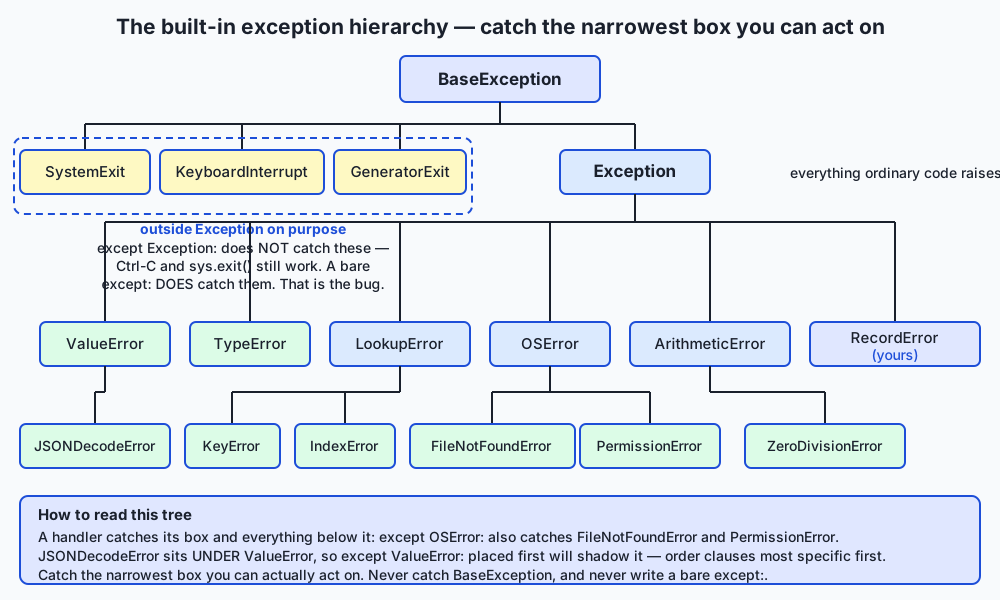
Every exception in Python is an object, and every one of them descends from BaseException. The tree in the diagram is not trivia — it is the mechanism by which except decides whether to fire. An except clause matches if the raised exception is an instance of the named class or any of its subclasses. So except LookupError: catches a KeyError and an IndexError; except OSError: catches FileNotFoundError, PermissionError, and IsADirectoryError; except Exception: catches nearly everything your own code will ever raise.
Nearly. Look at the dashed box on the left of the diagram. SystemExit, KeyboardInterrupt, and GeneratorExit hang off BaseException beside Exception, not under it. That placement is a deliberate design decision, and you can check it yourself:
>>> issubclass(KeyboardInterrupt, Exception)
False
>>> issubclass(SystemExit, Exception)
False
Those three are not errors. They are control-flow signals: “the user pressed Ctrl-C”, “somebody called sys.exit()”, “this generator is being closed”. Putting them outside Exception means a well-behaved except Exception: — a broad catch at the top of a program, logging and continuing — cannot accidentally trap a Ctrl-C. A bare except: sits at BaseException level and catches them all, which is exactly why a program with a bare except inside a loop cannot be interrupted from the keyboard.
What actually happens on a raise
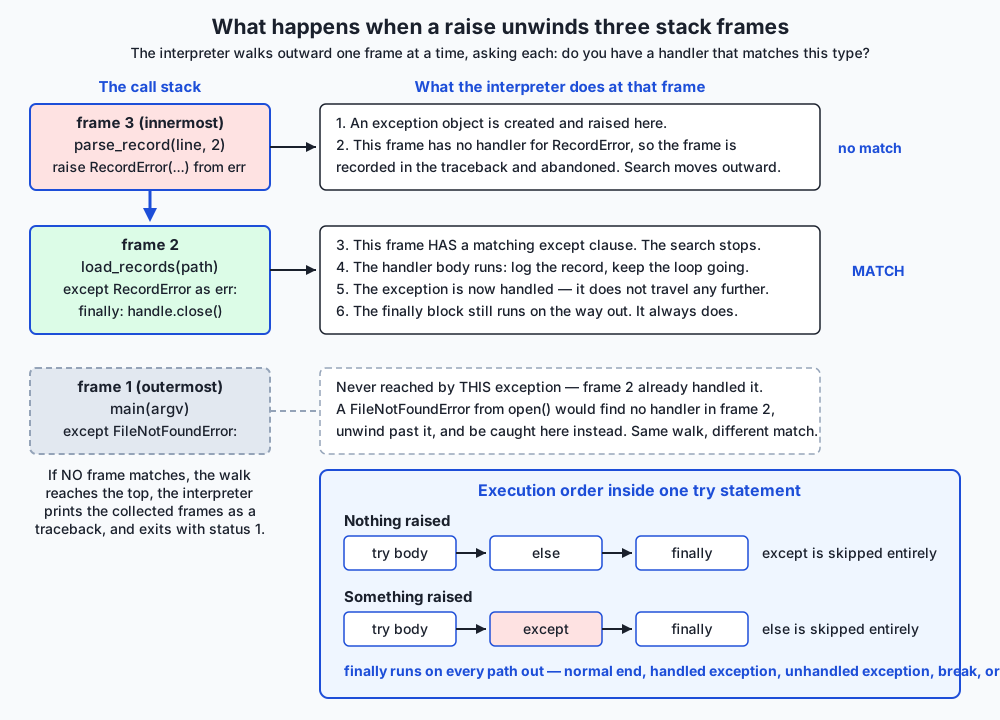
When raise executes, four things happen in order.
- An exception object is constructed.
RecordError("line 2: missing field 'severity'")is an ordinary object with a message, a type, and — once raised — a traceback attached to it. - The current frame is searched for a handler. A frame is one function call’s private workspace: its local variables and its position in the code. The interpreter asks whether the raise happened inside a
trywhoseexceptclauses name a matching type. - If there is no match, the frame is abandoned. Before leaving, the interpreter records the file, line, and function in the traceback, and runs any
finallyblock that frame owns. Then it resumes the search in the caller’s frame. - This repeats outward until a frame matches — at which point the search stops and that handler runs — or until the stack is exhausted, in which case Python prints the collected frames and exits with status 1.
The flow diagram traces exactly that walk for the lab’s program. parse_record raises. It has no handler for RecordError, so it is recorded and abandoned. load_records is checked next and does have except RecordError as err: — the search stops, the handler logs the record and lets the loop continue, and main never sees the exception at all. The same diagram notes the contrast: a FileNotFoundError from open() finds no match in load_records, unwinds past it, and is caught in main. Same walk, different frame, because the frames declared different interests.
Reading a real traceback
Here is a genuine traceback, captured by running the lab’s unhandled version against a file whose severity field says high. The absolute paths have been shortened to <lab>; yours will show wherever you cloned the repository, and that difference is normal:
Traceback (most recent call last):
  File "<lab>/examples/raw_triage.py", line 45, in <module>
    sys.exit(main(sys.argv))
             ~~~~^^^^^^^^^^
  File "<lab>/examples/raw_triage.py", line 40, in main
    print("total severity:", total_severity(argv[1]))
                             ~~~~~~~~~~~~~~^^^^^^^^^
  File "<lab>/examples/raw_triage.py", line 32, in total_severity
    total += read_severity(json.loads(line))
             ~~~~~~~~~~~~~^^^^^^^^^^^^^^^^^^
  File "<lab>/examples/raw_triage.py", line 21, in read_severity
    return int(record["severity"])
ValueError: invalid literal for int() with base 10: 'high'
Read it in this order, and never any other.
Last line first. ValueError: invalid literal for int() with base 10: 'high'. That is the type and the message — the what. Everything above it is the how you got here.
Second-to-last frame block, next. line 21, in read_severity with the source line return int(record["severity"]). That is where the exception was actually raised. The ~~~^^^ carets underneath a call in the other frames (a feature of recent Python versions; older ones omit them) point at the exact sub-expression that failed.
Then walk upward to see the route. Line 45 called main, which at line 40 called total_severity, which at line 32 called read_severity. The frames print outermost first, innermost last, which is why the phrase at the top is “most recent call last”. Beginners read tracebacks top-down and conclude the bug is in sys.exit. It is not. The bug is in the last frame, and the frames above it are the path.
try / except / else / finally
The full statement has four blocks, and each one has a job:
handle = open(path, "r", encoding="utf-8")
try:
    records = [parse_record(line, n) for n, line in enumerate(handle, 1)]
except RecordError as err:
    logging.exception("rejected a record")
    return []
else:
    logging.info("read %d records", len(records))
    return records
finally:
    handle.close()
try holds the smallest amount of code that can fail — ideally the risky call and nothing else. Every extra line inside it is a line whose own accidental KeyError will be caught by a handler meant for something else.
except holds the response, and there may be several clauses tried in order, top to bottom. Order matters enormously because matching includes subclasses: if you write except ValueError: before except json.JSONDecodeError:, the second clause is dead code, since JSONDecodeError is a subclass of ValueError. Specific first, general last, always.
else holds the code that must run only when nothing raised. Two reasons it earns its keep: it keeps the try block minimal, and it makes the success path explicit to a reader.
finally holds cleanup, and it runs on every path out — normal completion, a handled exception, an unhandled one travelling through, a break, or a return. That last case surprises people: if the try block executes return records, Python evaluates the return value, then runs finally, then actually returns. The cleanup is not skipped by an early exit. (The with statement you met on Day 64 is built on exactly this guarantee; with open(...) is a finally: close() you did not have to write.)
Chaining: raise versus raise ... from err
When you catch a low-level error and raise a higher-level one, Python tracks the relationship either way — but it tells the reader two different stories.
Raise a new exception inside a handler without from, and Python records the original as the implicit context. Here is the real output:
Traceback (most recent call last):
  File "ctx.py", line 5, in <module>
    lookup({})
  File "ctx.py", line 2, in lookup
    return config["retries"]
KeyError: 'retries'

During handling of the above exception, another exception occurred:

Traceback (most recent call last):
  File "ctx.py", line 7, in <module>
    raise RuntimeError("configuration is incomplete")
RuntimeError: configuration is incomplete
“During handling of the above exception, another exception occurred” is Python’s careful way of saying: these two are related in time, and I do not know whether that was on purpose. It is what you see when the second error was an accident — a bug in your handler.
Add from err and the wording changes to a claim of causation. This is the lab’s real captured log, with paths shortened:
ERROR: rejected record on line 2
Traceback (most recent call last):
  File "<lab>/examples/triage.py", line 56, in parse_record
    record = {"id": raw["id"], "severity": int(raw["severity"])}
ValueError: invalid literal for int() with base 10: 'high'

The above exception was the direct cause of the following exception:

Traceback (most recent call last):
  File "<lab>/examples/triage.py", line 176, in load_records
    records.append(parse_record(line, line_number))
  File "<lab>/examples/triage.py", line 64, in parse_record
    raise RecordError(f"line {line_number}: severity is not a whole number") from err
RecordError: line 2: severity is not a whole number
“The above exception was the direct cause” is a deliberate statement by you, the author, stored on the new exception. Use from err whenever you are translating an error on purpose. Use from None — rarely — when the underlying cause is a genuinely irrelevant implementation detail you do not want in the log.
And the third option: a bare raise inside a handler re-raises the current exception completely intact, traceback and all. That is how you log a failure at one level and still let it travel:
try:
    dispatch(counts)
except ConnectionError:
    logging.exception("dispatch failed; letting the caller decide")
    raise            # not `raise err` — bare raise keeps everything
Your own exception classes
A custom exception is a class that inherits from Exception. Classes get their own lesson tomorrow, on Day 67, so today you use exactly one form and no more:
class RecordError(Exception):
    """One intake record could not be admitted."""
That is the complete definition. No methods, no attributes, nothing to understand beyond “it is an Exception with a name of your choosing”. Tomorrow that syntax will stop being a magic incantation.
When does a custom exception earn its place? When callers need to catch your failure specifically and not confuse it with the failures of the machinery you used. parse_record may fail because of json.JSONDecodeError, KeyError, TypeError, or ValueError. A caller that wants to say “a record was bad, skip it” should not have to name all four — and worse, except ValueError: at that level would also catch a ValueError accidentally raised by the caller’s own code. One RecordError translates four mechanical failures into one meaningful one. When you have nothing to add beyond what a built-in already says, use the built-in.
EAFP versus LBYL
Two styles, both valid, with different failure modes.
Look Before You Leap checks first: if os.path.exists(path): open(path). Easier to Ask Forgiveness than Permission just tries it and handles the failure: try: open(path) except FileNotFoundError:. Python’s community strongly prefers EAFP, and the reason is not aesthetic — it is a race condition. Between your exists() check and your open() call, time passes. Another process can delete the file, revoke your permission, or rename the directory. The check told you the truth about a moment that has already ended, and you must handle FileNotFoundError anyway. Now you have two code paths for one failure, and only one of them is tested.
The same applies to dictionaries. if "severity" in record: use(record["severity"]) performs two lookups and is fine for a local dict nobody else can touch. EAFP performs one and is honest about the failure. LBYL is genuinely better in two situations: when the check is cheap and the failure is common enough that exception overhead matters in a hot loop, and when a value must be validated for policy reasons rather than mechanical ones — a severity of 9 is a perfectly good integer, and only a range check catches it.
The strategy layer
Here is the actual doctrine, and it is where the hospital comes in.
Fail fast at the boundary. Validate at the edges of your program — the command line, the file it opens, the API response it parses. A malformed input that reaches the middle of your program has already cost you the ability to give a clear message about it.
Let it propagate through the middle. Functions in the middle should mostly not catch. If a function cannot make a decision about a failure, catching it there can only lose information.
Handle where you can act. The test for whether a handler belongs somewhere is a single question: after this except block runs, does the program do something genuinely different and correct? If the answer is “it logs and carries on with broken state”, the handler is in the wrong place.
Retry only what a later attempt might survive. A ConnectionError might succeed in 200 milliseconds. A ValueError from parsing "high" as an integer will fail identically forever; retrying it three times just wastes 350 milliseconds before failing. Cap the attempts, use exponential backoff, and when you give up, re-raise with the cause chained.
Log with logging.exception, not print. Called from inside an except block, it records the message and the full chained traceback at ERROR level, with a timestamp, a logger name, and a destination you configure once. Here is a real run:
ERROR triage: could not read severity for record r-1002
Traceback (most recent call last):
  File "log.py", line 5, in <module>
    int("high")
ValueError: invalid literal for int() with base 10: 'high'
INFO triage: run finished
print(err) would have given you invalid literal for int() with base 10: 'high' and nothing else — no level, no timestamp, no traceback, no route, and it would have gone to whatever stream happened to be attached.
Distinguish an expected condition from a bug. A missing file, a malformed record, a rate limit: expected. Your program should have a considered response. A TypeError because you passed a list where a dict belonged: a bug. Your program should not have a considered response — it should stop, loudly, so you fix it.
And assert is not error handling. Run the same script two ways and watch the check evaporate:
$ python3 a.py
AssertionError: x must be positive
$ python3 -O a.py
-5
Under -O the assertion is not merely ignored; it is not compiled into the program. Use assert for internal invariants you are documenting for yourself and for tests. For anything a user or a file can cause, raise ValueError(...).
Building @retry from scratch
You met decorators on Day 58: a decorator is a function that takes a function and returns a replacement. A retry decorator is the clearest possible use for one, because “try this again” is entirely orthogonal to what “this” is. Here is the lab’s implementation, complete:
def retry(attempts=3, base_delay=0.05, sleep=time.sleep):
    """Return a decorator that retries a callable with exponential backoff."""

    def decorate(function):
        def wrapper(*args, **kwargs):
            last_error = None
            for attempt in range(1, attempts + 1):
                try:
                    return function(*args, **kwargs)
                except (ConnectionError, TimeoutError) as err:
                    last_error = err
                    if attempt == attempts:
                        break
                    delay = base_delay * (2 ** (attempt - 1))
                    print(f"attempt {attempt} failed ({err}); retrying in {delay:.2f}s",
                          file=sys.stderr)
                    sleep(delay)
            raise DispatchError(
                f"{function.__name__} gave up after {attempts} attempts"
            ) from last_error

        wrapper.__name__ = function.__name__
        return wrapper

    return decorate
Five decisions are worth naming. The tuple (ConnectionError, TimeoutError) is the retry policy expressed as types — nothing else is retried, so a ValueError propagates on the first attempt as it should. last_error is captured because it is needed after the loop, outside the except block. The backoff doubles: base_delay * 2 ** (attempt - 1) gives 0.05 s then 0.10 s, so a struggling service is not hammered by every client at a fixed interval. The loop breaks rather than raising inside the handler, keeping the final raise in one place. And the final raise ... from last_error means the caller who catches DispatchError still gets the ConnectionError in the traceback.
Run against a service that never answers, this is the real output — a DispatchError with its cause attached:
attempt 1 failed (offline ward system never answers); retrying in 0.05s
attempt 2 failed (offline ward system never answers); retrying in 0.10s
Traceback (most recent call last):
  File "<lab>/examples/triage.py", line 152, in dispatch_offline
    raise ConnectionError("offline ward system never answers")
ConnectionError: offline ward system never answers

The above exception was the direct cause of the following exception:

Traceback (most recent call last):
  File "<lab>/examples/dispatch_demo.py", line 30, in <module>
    triage.dispatch_offline(COUNTS)
  File "<lab>/examples/triage.py", line 123, in wrapper
    raise DispatchError(
        f"{function.__name__} gave up after {attempts} attempts"
    ) from last_error
triage.DispatchError: dispatch_offline gave up after 3 attempts
One caution for real systems: the sleep parameter is injectable so tests can run instantly, and the flaky operation in the lab is deterministic so the output above is identical on every run. Real retry policies add jitter — a small random offset to each delay — so that a thousand clients recovering from the same outage do not all retry in lockstep and knock the service back over.
An everyday analogy
A hospital emergency department is an error-handling strategy that people’s lives depend on, and it is organised exactly the way your program should be.
Triage at the door is failing fast at the boundary. The triage nurse does not treat anybody. The nurse assesses, assigns a severity, and turns away what does not belong there at all — a patient needing a different facility is redirected in the first minute, not after four hours of tests. That is validation at the edge: reject what the system cannot handle while rejecting is still cheap.
A nurse who finds something outside their authority escalates. They do not guess and they do not quietly do nothing. They describe the problem precisely — vitals, history, what they observed — and hand it to someone with the authority to decide. That is a raise. The except clauses in each frame are the standing orders at each level: this I am cleared to handle, that goes up.
The chart is the traceback. By the time the case reaches the consultant, it carries the whole route — who saw the patient, in what order, what each of them found. A consultant handed a bare diagnosis with no history is exactly a developer handed print(err).
finally is the ward that gets cleaned regardless. However the case ends — discharged, admitted, transferred, or worse — the bed is stripped and the equipment sterilised. Nobody makes that conditional on the outcome, and neither should your close().
Retry with backoff is paging a specialist who does not answer. You call again in a minute, then in two. You do not call three hundred times a second, and after a few attempts you escalate rather than waiting forever. Crucially, you only re-page for reasons a second call might fix. If the specialist is on leave for a fortnight, calling again is not a strategy.
And the cardinal sin has a name here too. A nurse who noticed something alarming, wrote nothing down, and sent the patient home because the shift was busy — that is except Exception: pass. The department reports a normal night. Everybody’s numbers look fine. The failure is real and nobody knows.
The analogy holds even at its edges. KeyboardInterrupt and SystemExit outside the Exception branch are the fire alarm: it is not a patient, it is not triaged, and no ward-level protocol is allowed to absorb it. When the building says evacuate, you evacuate.
Examples in practice
The lab’s parse_record is the strategy in miniature — four narrow handlers, ordered most-specific-first, each translating a mechanical failure into one meaningful one, with else for the policy check:
try:
    raw = json.loads(line)
    record = {"id": raw["id"], "severity": int(raw["severity"])}
except json.JSONDecodeError as err:
    raise RecordError(f"line {line_number}: not valid JSON") from err
except KeyError as err:
    raise RecordError(f"line {line_number}: missing field {err.args[0]!r}") from err
except ValueError as err:
    raise RecordError(f"line {line_number}: severity is not a whole number") from err
else:
    if not 1 <= record["severity"] <= 5:
        raise RecordError(f"line {line_number}: severity is outside 1-5")
    return record
json.JSONDecodeError must come before ValueError because it is a subclass of it — reverse those two clauses and the specific message is unreachable. The range check lives in else so that a KeyError raised by the check itself could never be mistaken for a parse failure.
One level up, the loop handles what it can act on and leaves the rest alone:
handle = open(path, "r", encoding="utf-8")   # NOT wrapped — a bad path is not our decision
try:
    for line_number, line in enumerate(handle, start=1):
        try:
            records.append(parse_record(line, line_number))
        except RecordError as err:
            logging.exception("rejected record on line %d", line_number)
            problems.append(str(err))
finally:
    handle.close()
And main — the boundary — is where a missing file becomes an exit code:
try:
    records, problems = load_records(path)
except FileNotFoundError as err:
    print(f"error: no such intake file: {err.filename}", file=sys.stderr)
    logging.exception("intake file missing")
    return 1
The behavioural difference is visible from the terminal. A bad record costs one line and exit 0:
$ python3 -u examples/triage.py examples/samples/missing-field.jsonl ; echo "exit: $?"
admitted 2 record(s), rejected 1
immediate  1
urgent     1
routine    0
rejected: line 2: missing field 'severity'
attempt 1 failed (ward system unavailable (call 1)); retrying in 0.05s
attempt 2 failed (ward system unavailable (call 2)); retrying in 0.10s
dispatched 2 record(s) to the ward system
exit: 0
A bad path stops the run with exit 1:
$ python3 -u examples/triage.py examples/samples/no-such-file.jsonl ; echo "exit: $?"
error: no such intake file: examples/samples/no-such-file.jsonl
exit: 1
Now compare the same missing file through a program with a bare except:
$ python3 -u examples/swallowing.py examples/samples/no-such-file.jsonl ; echo "exit: $?"
total severity: 0
done
exit: 0
A total of zero, the word done, and a success exit code, from a file that does not exist. That is the bug this entire lesson exists to prevent.
Implications: security, privacy, performance, scalability, and cost
Security. A swallowed exception hides precisely the events you most need to see — a permission denial, a failed integrity check, an unexpected authentication result. Attackers rely on that silence. A bare except: additionally traps KeyboardInterrupt, so an operator cannot stop a misbehaving process from the keyboard. In the other direction, an unhandled exception shown to a user is a disclosure risk: a traceback carries file paths, function names, and often the offending values themselves.
Privacy. That last point is the privacy issue. Tracebacks quote source lines and can print arguments; a chained traceback can include the raw record that failed. If those records contain personal data, your error log has just become a data store with a retention policy nobody wrote. Log identifiers, not payloads.
Performance. Raising and handling an exception costs more than a comparison, so LBYL genuinely wins in a hot loop where the failure is common — the classic case is a dictionary lookup executed millions of times. But try costs almost nothing when nothing is raised, which is why EAFP is the default. The expensive mistake is elsewhere: an uncapped retry loop against a failing service turns one slow request into indefinite waiting, and there is no timeout on time.sleep waiting for something that will never work.
Scalability. Retry policy is a scalability question in disguise. When a shared service degrades, every client’s retries arrive simultaneously and finish the job the outage started — the “thundering herd”. Exponential backoff spreads them out; jitter spreads them further; a cap on attempts stops them entirely. A retry policy without all three is a load generator.
Cost. In money terms, the two costs are re-running and re-training. A pipeline that swallowed errors produces output that looks complete, so nobody re-runs it until the damage surfaces downstream — by which time the correct fix is to find the original data, re-run the pipeline, and re-train whatever learned from the bad version. For paid APIs, retries are billed: a failed call that gets retried three times may be charged three times, so an uncapped retry is a direct, unbounded line item.
Alternatives: free, open source, and commercial
Everything in the standard library below is free and built in. The paid tier appears only in hosted error tracking, where a company runs the servers that receive your errors.
| Option | What it is | When to choose it | Cost |
|---|---|---|---|
try/except | The language mechanism | Always — this is the substrate everything else sits on | Free, built in |
logging | The stdlib logging framework | Any program that runs unattended or must leave a record | Free, built in |
contextlib.suppress | A context manager that swallows named exception types | The narrow, deliberate “this failure is genuinely fine” case | Free, built in |
warnings | Non-fatal messages about deprecated or suspect usage | Telling a developer something without stopping the program | Free, built in |
sys.excepthook / traceback | Last-resort hook and traceback formatting | Controlling what an unhandled exception looks like on exit | Free, built in |
| Hosted error tracking (for example Sentry) | A service that receives, groups, and alerts on exceptions | Once errors happen on machines you cannot read logs on | Free tier available; paid tiers by volume |
Structured logging libraries (for example structlog, python-json-logger) | Emit log records as JSON objects rather than prose lines | When machines, not humans, read the logs | Free, open source (pip install) |
try/except — how, with an example. Choose it whenever a specific failure has a specific response. Catch the narrowest type that covers what you can act on, and bind the instance when you need its details:
try:
    data = json.loads(payload)
except json.JSONDecodeError as err:
    raise ResponseError(f"model returned non-JSON at char {err.pos}") from err
logging — how, with an example. Choose it the moment output outlives the terminal. Configure once at the boundary; call logging.exception only from inside a handler, because it reads the exception currently being handled:
import logging

logging.basicConfig(filename="run.log", filemode="w", level=logging.INFO,
                    format="%(asctime)s %(levelname)s %(name)s: %(message)s")
log = logging.getLogger("triage")
try:
    admit(record)
except RecordError:
    log.exception("rejected record %s", record["id"])   # message + full traceback
The five levels — DEBUG, INFO, WARNING, ERROR, CRITICAL — let one program serve a quiet production run and a noisy debugging session from the same code, changing only level=.
contextlib.suppress — how, with an example. Choose it when doing nothing is genuinely the correct response and you want that intent to be unmistakable. It is except X: pass with the crucial difference that it names X, so it is a decision rather than an accident:
import contextlib, os

with contextlib.suppress(FileNotFoundError):
    os.remove("triage.tmp")      # already gone is exactly as good as removed
Never pass Exception to it. At that width it is the bare-except anti-pattern wearing better clothes.
warnings — how, with an example. Choose it to tell a developer that something still works but should change. Unlike an exception it does not unwind anything; the program keeps running. This is the real output:
misc.py:13: DeprecationWarning: severity field will be required in a future version
  warnings.warn("severity field will be required in a future version", DeprecationWarning)
still running after the warning
Note that DeprecationWarning is hidden by default outside __main__; the run above used python3 -W always. Warnings are for your callers, not your users.
sys.excepthook and traceback — how, with an example. Choose traceback when you want to format an exception yourself — printing a caught one, or storing the text. Choose sys.excepthook to control what a completely unhandled exception looks like on the way out, which is how command-line tools print a clean message while still writing the full detail to a log:
import sys, traceback

def last_words(exc_type, exc_value, exc_tb):
    print(f"unhandled {exc_type.__name__}: {exc_value}", file=sys.stderr)
    traceback.print_exception(exc_type, exc_value, exc_tb)

sys.excepthook = last_words
That produced, on a real run: unhandled ValueError: severity is not a whole number, followed by the full traceback and exit status 1.
Hosted error tracking — when to choose it. Once your code runs somewhere you cannot read the log file — a server, a worker fleet, a user’s machine — you need errors to come to you. Services such as Sentry receive exceptions over the network, group identical ones together so a thousand occurrences become one issue with a count, attach the traceback and environment, and alert you. Typically you add a client library and one initialisation call, after which unhandled exceptions are reported automatically. These services generally offer a free tier for individuals and small volumes, with paid plans priced by event volume and retention; check the current terms yourself rather than trusting a figure quoted anywhere, including here. The trade-off is real: you are sending diagnostic data, which may include sensitive values, to a third party.
Structured logging — when to choose it. A prose log line has to be parsed with regular expressions before anything can query it. A structured logger emits each record as a JSON object — level, message, timestamp, plus whatever fields you attach — so a log aggregator can filter on a field directly. Choose it when logs are read by machines or when you need to answer questions like “how many rejections mentioned a missing severity, per hour”. The stdlib can approximate this with a custom Formatter; libraries such as structlog and python-json-logger are free, open source, and save you writing it.
Comparison with related concepts
| Concept A | Concept B | Key difference |
|---|---|---|
| Return code | Raised exception | A return code can be ignored by doing nothing; an exception propagates by doing nothing. Silence requires effort |
except Exception: | bare except: | Exception spares KeyboardInterrupt, SystemExit, and GeneratorExit; a bare except traps them, so Ctrl-C stops working |
raise (bare) | raise err | Bare re-raises the current exception with its traceback intact; raise err inside a handler is nearly the same but bare is the idiom, and raise SomeError(str(err)) discards the route entirely |
raise X from err | raise X in a handler | from sets __cause__ and prints “direct cause” — a deliberate claim. Without it Python sets __context__ and prints “during handling”, which reads as an accident |
| EAFP | LBYL | LBYL’s check describes a moment that has already passed; the file can vanish between the check and the open. EAFP has one code path and no race |
else block | Code at the end of try | else runs only when nothing raised and is not itself covered by the handlers, so its own errors are not misattributed |
finally | Code after the try statement | finally runs on every exit path including return, break, and an exception travelling through. Code after the statement runs only if control reaches it |
assert | raise ValueError(...) | assert is removed entirely under -O. Use it for internal invariants and tests, never for validating input |
| Expected condition | Bug | A missing file deserves a considered response; a TypeError from your own wrong argument deserves a crash and a fix |
logging.exception | print(err) | The first records level, timestamp, logger, and the full chained traceback to a configured destination; the second records one line of text to whatever stream is attached |
contextlib.suppress(X) | except X: pass | Functionally equivalent for a named X; suppress makes the deliberateness syntactically obvious and cannot drift into a bare except |
| Retryable error | Deterministic error | A ConnectionError may succeed on the next attempt; a ValueError from bad input will fail identically forever. Retrying the second wastes time and money |
When to use it — and when not to
Handle an exception where the handler can make the program do something genuinely different and correct: reject one record and continue, fall back to a cached value, retry a transient failure, or report clearly and exit non-zero. Catch the narrowest type that covers what you can act on, order the clauses specific-first, use else for the success path and finally for cleanup, translate low-level errors into your own with from err when callers need to catch your failure by name, and log with logging.exception so the traceback survives even when the user sees one clean line.
Do not catch what you cannot act on — letting it propagate is a decision, and usually the right one. Do not write a bare except: at all; it catches Ctrl-C. Do not write except Exception: pass outside a suppress with a named type, and if you find one in code you inherit, treat it as a defect to be reported rather than a style choice. Do not validate with assert. Do not retry a deterministic failure or retry without a cap. Do not put the whole body of a function inside one try — the block should be as small as the risky operation. And do not swallow an error in a data pipeline for any reason at all: producing fewer records than you were asked for, without saying so, is the single most damaging thing a pipeline can do.
The through-line from the last two days is exact. Day 64 opened files, Day 65 parsed their contents, and both generated failures they had no policy for. Today gave them a policy. Tomorrow, Day 67, the two-line class RecordError(Exception) you have been using on trust becomes a class you understand completely — inheritance, initialisers, attributes and all — and today’s custom exceptions are the first thing you will re-read with new eyes.
And this closes the AI thread. Every call you make to a hosted language model can fail in four distinct ways, and all four are ordinary: a rate limit because you sent requests faster than your tier allows, a timeout because generation took longer than your client was willing to wait, a truncated response because the output hit a token ceiling mid-sentence, and invalid JSON because the model was asked for structured output and produced something almost-but-not-quite parseable. Three of those are transient and belong behind a @retry with backoff; the fourth is a validation failure that no amount of retrying fixes without also changing the prompt. Production AI systems are, to a surprising degree, exactly this: a retry policy, a timeout budget, and structured error logging wrapped around a call that usually works. And the failure that costs the most is still the quiet one — a swallowed exception in a data pipeline does not crash anything, it simply produces a model trained on half a dataset, with metrics that look plausible and no error anywhere to explain them.
Knowledge check
Try these from memory before looking back:
- In what order do traceback frames print, and which line do you read first?
- Name the three exception types that sit outside
Exception, and explain what breaks when a bareexcept:catches them. - What is the difference between the “during handling” and “direct cause” lines in a chained traceback, and which one do you cause on purpose?
- Why must
except json.JSONDecodeError:come beforeexcept ValueError:? - Give the race condition that makes
if os.path.exists(path)insufficient before opening a file. - What does
finallydo when thetryblock contains areturn? - Why is
assertunsuitable for validating a value that came from a file? - Which of a
ConnectionErrorand aValueErroris worth retrying, and why is retrying the other one actively harmful?
Hands-on exercise
In the Day 66 lab you are handed a program that never crashes and is therefore broken. You will reproduce three real tracebacks and read them frame by frame, replace a bare except: with narrow handlers plus else and finally, add a minimal custom exception raised with from, write a @retry decorator with backoff, and log every failure with logging.exception so the full traceback survives in a file while the user sees one clean line.
Work in the lab directory; every command below is run from there.
First, generate real failures and read them:
python3 examples/raw_triage.py examples/samples/no-such-file.jsonl
python3 examples/raw_triage.py examples/samples/bad-severity.jsonl
python3 examples/raw_triage.py examples/samples/missing-field.jsonl
Then see what the bare except costs, and what the rebuilt program does instead:
python3 examples/swallowing.py examples/samples/no-such-file.jsonl ; echo "exit: $?"
python3 examples/triage.py examples/samples/missing-field.jsonl ; echo "exit: $?"
python3 examples/triage.py examples/samples/no-such-file.jsonl ; echo "exit: $?"
python3 examples/triage.py examples/samples/bad-severity.jsonl triage.log
cat triage.log
python3 examples/dispatch_demo.py
Now fill in starter/traceback-notes.md, complete the three numbered exercises in starter/triage.py, run your version, and check your work:
python3 starter/triage.py examples/samples/missing-field.jsonl
bash tests/run_tests.sh
Expected output
A correct run of the reference on a file with a missing field produces exactly this — captured on the authoring machine, and deterministic, because the flaky operation counts calls rather than reading a clock:
$ python3 -u examples/triage.py examples/samples/missing-field.jsonl ; echo "exit: $?"
admitted 2 record(s), rejected 1
immediate  1
urgent     1
routine    0
rejected: line 2: missing field 'severity'
attempt 1 failed (ward system unavailable (call 1)); retrying in 0.05s
attempt 2 failed (ward system unavailable (call 2)); retrying in 0.10s
dispatched 2 record(s) to the ward system
exit: 0
And the log that run leaves behind, showing the chaining:
ERROR: rejected record on line 2
Traceback (most recent call last):
  File "<lab>/examples/triage.py", line 56, in parse_record
    record = {"id": raw["id"], "severity": int(raw["severity"])}
ValueError: invalid literal for int() with base 10: 'high'

The above exception was the direct cause of the following exception:

Traceback (most recent call last):
  File "<lab>/examples/triage.py", line 176, in load_records
    records.append(parse_record(line, line_number))
RecordError: line 2: severity is not a whole number
Your tracebacks will not match ours character for character, and they are not meant to. A traceback prints the absolute path of every file in the stack, so yours show wherever you cloned the repository; the captured files shorten the lab directory to <lab> for readability. What must match is the exception type, the message, the order of the frames, and the exit code.
Validate your work
You are done when you can check every box:
-
raw_triage.pyon the three sample files ends inFileNotFoundError,ValueError, andKeyErrorrespectively, each with exit 1. -
swallowing.pyon a file that does not exist printsdoneand exits0— you have seen the lie with your own eyes. -
triage.pyonintake.jsonlprintsadmitted 5 record(s), rejected 0and exits 0. -
triage.pyonmissing-field.jsonlrejects line 2 by name, still summarizes the other two records, and exits0. -
triage.pyon a missing file printserror: no such intake file: ...and exits1. -
triage.logcontains anERRORline, a full traceback, and the wordsThe above exception was the direct cause of the following exception. -
dispatch_demo.pyshows backoff delays of0.05sthen0.10s, a success, and then a chainedDispatchError. -
starter/traceback-notes.mdis filled in with all three tracebacks and every question answered. -
bash tests/run_tests.shprints0 failure(s).and exits0.
Troubleshooting
Your paths differ from the captured ones. Expected and correct. A traceback prints absolute paths; the captured files shortened them to <lab>. Compare types, messages, frame order, and exit codes.
No ~~~^^^ caret lines under your call frames. Fine-grained error locations are a feature of newer Python versions. Older ones print the same frames without the carets; nothing is wrong.
Your specific message never appears — you always get the generic one. Clause order. json.JSONDecodeError is a subclass of ValueError, so a ValueError clause placed first shadows it. Specific first, always.
Your chained traceback shows “during handling” rather than “direct cause”. You raised inside the handler without from err. Add it.
Your log file is empty. Either logging.basicConfig ran after the first log call (it only configures once, and the first call wins), or you called logging.exception outside an except block, where there is no current exception to record.
ValueError: I/O operation on closed file. A finally: handle.close() that runs before you finished reading — usually because the return you thought was at the end of the function is inside the try.
The starter raises NotImplementedError. Expected until you finish that exercise. Each unfinished function raises on purpose so an empty function cannot be mistaken for a working one.
Common mistakes
- A bare
except:. It catchesKeyboardInterruptandSystemExit, so your program cannot be stopped from the keyboard. There is no case where this is right. except Exception: pass. The cardinal sin. If doing nothing really is correct, say which type withcontextlib.suppress(ThatType).- Handling too early. A function that cannot make a decision about a failure should not catch it.
- Wrapping the whole function body in one
try. The block should be as small as the risky operation, or a handler meant for the parse will catch a bug in your success path. raise RecordError(str(err)). That discards the traceback. Useraise RecordError(...) from err.- Ordering handlers general-first. The broad clause wins and every specific one below it is dead code.
- Retrying a
ValueError. It will fail identically every time; you have only made failure slower. - Using
printwhere the program runs unattended. No level, no timestamp, no traceback, and it goes wherever stdout happens to point. - Validating with
assert. Under-Othe check does not exist.
Practice assignment
Build checkfiles.py, a program in the Day 63 shape — a pure core plus a thin shell — that validates a directory of JSONL records and reports on every problem rather than stopping at the first.
Your spec: given a directory path, process every .jsonl file in it. Each line must be valid JSON, must be an object, and must have a string id and an integer severity between 1 and 5. Collect every violation as (filename, line number, reason) and print a summary at the end: files scanned, records accepted, records rejected grouped by reason. Write the full detail — including chained tracebacks — to checkfiles.log with logging.exception, while standard output stays one clean line per problem.
Requirements that carry the lesson: define exactly one custom exception, RecordError, in the minimal two-line form; raise it from your parser with from err in every case; put the range check in an else block; do not catch anything in your parser that you cannot translate; let a missing directory propagate to the shell, which reports it and exits 2; use finally to guarantee every file handle closes; and make the exit code meaningful — 0 when everything was accepted, 1 when any record was rejected, 2 for a usage or path failure.
Then prove it. Create three broken files: one with a malformed JSON line, one whose severity is the string "high", and one with a severity of 9. Confirm all three are reported with distinct reasons, that the run continues past each, that checkfiles.log contains a chained traceback for each, and that the exit code is 1. Finally, run it with an empty directory and confirm the exit code is 0 and nothing crashes.
Extension challenge
One: build a retry policy worth shipping. Extend the @retry decorator with three additions. Add a retry_on parameter so the caller supplies the tuple of retryable types, defaulting to (ConnectionError, TimeoutError). Add a max_total_seconds budget so retrying stops when the elapsed time exceeds it, even if attempts remain — this is the timeout budget every API client needs. Add deterministic jitter derived from the attempt number, and write a comment explaining why real policies randomize the delay and why a test suite cannot. Then write tests proving each addition, injecting a fake sleep that records the delays instead of waiting.
Two: measure the cost of the two styles. Using timeit, compare LBYL (if key in d) against EAFP (try: d[key]) for a dictionary lookup, at three hit rates: the key is present 99% of the time, 50%, and 1%. Report the three pairs of numbers and state the crossover point you measured. Then explain in two sentences why the answer for a file is different from the answer for a dictionary even where the timings agree.
Three: write a failure-mode catalogue for an API client. Without making any network calls, write client_policy.py containing a function per failure mode — rate limit, timeout, truncated response, invalid JSON — each raising a realistic exception, and a driver that shows your handling strategy for each: which are retried, which are validated and re-raised, which halt the run, and what each logs. Use a fake transport that raises on command so the whole thing is deterministic and offline. Then write, in a comment at the top, the one-paragraph policy your code implements — because that paragraph, not the code, is the actual deliverable of an error-handling strategy.
Quiz
Q1. A traceback fills your terminal. Which line do you read first, and why?
- The first line, because frames print innermost-first and the topmost frame is where the error happened
- The "Traceback (most recent call last):" header, because it names the failing module
- The last line, because it carries the exception type and message; the frames above it are only the route that led there
- Any line containing your own filename, because the standard library is never at fault
Show answer
Answer: C. The last line, because it carries the exception type and message; the frames above it are only the route that led there
Frames print outermost first and innermost last — that is exactly what "most recent call last" means. The final line gives the type and message (the what), the frame directly above it is where the raise happened (the where), and the frames above that are the call path (the how you got here). Reading top-down is the classic beginner error and leads people to blame whichever function happened to start the program.
Q2. Why do KeyboardInterrupt and SystemExit sit outside Exception in the class hierarchy?
- Because they are control-flow signals rather than errors, so a broad "except Exception" used for logging cannot accidentally trap Ctrl-C or a deliberate exit
- Because they are raised by the operating system rather than by Python, and therefore cannot inherit from a Python class
- Because they are deprecated and kept only for backward compatibility with Python 2
- Because they carry no message, and Exception requires every subclass to carry one
Show answer
Answer: A. Because they are control-flow signals rather than errors, so a broad "except Exception" used for logging cannot accidentally trap Ctrl-C or a deliberate exit
You can verify the placement directly: issubclass(KeyboardInterrupt, Exception) returns False. The design lets a program put a broad "except Exception" at its top level to log and continue without swallowing the user pressing Ctrl-C or a call to sys.exit(). A bare "except:" sits at BaseException level and catches them all, which is precisely why a bare except inside a loop makes a program impossible to interrupt from the keyboard.
Q3. A function opens a file inside a try block and returns a value from inside that same try block. When does the finally block run?
- It is skipped, because the return leaves the function before finally is reached
- Only if an exception was raised; a clean return bypasses it
- Before the try block, as setup rather than cleanup
- After the return value is evaluated and before the function actually returns, because finally runs on every path out
Show answer
Answer: D. After the return value is evaluated and before the function actually returns, because finally runs on every path out
This is the guarantee that makes finally worth having. Python evaluates the return expression, runs the finally block, and only then hands the value back to the caller. The same holds for break, for a handled exception, and for an unhandled one travelling through. It is also the mechanism the "with" statement is built on — "with open(...)" is a finally-close you did not have to write.
Q4. You write "except ValueError:" above "except json.JSONDecodeError:". What happens?
- Both clauses fire, in order, so the error is handled twice
- The JSONDecodeError clause is unreachable, because JSONDecodeError is a subclass of ValueError and the broader clause is tested first
- Python raises a SyntaxError at import time for the overlapping clauses
- The clauses are automatically reordered from most specific to least specific
Show answer
Answer: B. The JSONDecodeError clause is unreachable, because JSONDecodeError is a subclass of ValueError and the broader clause is tested first
Except clauses are tested top to bottom, and a clause matches the named class or any of its subclasses. Since JSONDecodeError inherits from ValueError, the ValueError clause matches first and the specific one below it is dead code — silently, with no warning of any kind. The rule is absolute: specific first, general last.
Q5. Why is "if os.path.exists(path): open(path)" insufficient, even though the check looks correct?
- Because os.path.exists returns True for directories as well as files
- Because the check is slower than simply opening the file
- Because exists() cannot see files whose names contain non-ASCII characters
- Because time passes between the check and the open — the file can be deleted, renamed, or made unreadable in between, so FileNotFoundError must be handled anyway
Show answer
Answer: D. Because time passes between the check and the open — the file can be deleted, renamed, or made unreadable in between, so FileNotFoundError must be handled anyway
This is a race condition. The check tells you the truth about a moment that has already ended by the time you act on it, so the handler is still required — and now the same failure has two code paths, only one of which anyone tests. That is the concrete argument behind Python's preference for asking forgiveness rather than permission: one path, no race, and the failure is handled where it actually occurs.
Q6. What is the difference between "raise RecordError(...) from err" and raising RecordError inside a handler without "from"?
- With "from", Python sets __cause__ and the traceback reads "direct cause" — a deliberate claim of causation by the author; without it, Python sets __context__ and prints "during handling", which reads as an accident
- With "from", the original exception is discarded to keep the traceback short
- Without "from", the original exception is lost entirely and cannot be recovered
- They are identical; "from" is a readability convention with no runtime effect
Show answer
Answer: A. With "from", Python sets __cause__ and the traceback reads "direct cause" — a deliberate claim of causation by the author; without it, Python sets __context__ and prints "during handling", which reads as an accident
Python tracks the relationship either way — nothing is lost without "from" — but it tells the reader two different stories. "During handling of the above exception, another exception occurred" means the two are related in time and Python does not know whether that was intentional; it is what you see when the second error is a bug in your handler. "The above exception was the direct cause of the following exception" is a statement you made on purpose, and it is the one you want whenever you are deliberately translating a low-level error into a meaningful one.
Q7. Which statement about "assert" is correct?
- It is the recommended way to validate arguments that came from a file or a user
- It raises ValueError, which makes it interchangeable with an explicit raise
- It is removed entirely when Python runs with -O, so validation written with it simply ceases to exist
- It runs only in test files and is ignored everywhere else
Show answer
Answer: C. It is removed entirely when Python runs with -O, so validation written with it simply ceases to exist
Under -O the assertion is not merely skipped at runtime — it is not compiled into the program at all. A script whose assert fails with AssertionError under "python3 a.py" runs straight through and prints the invalid value under "python3 -O a.py". Validation that can vanish is not validation. Use assert for internal invariants you are documenting for yourself, and for tests; for anything a user or a file can cause, raise ValueError explicitly.
Q8. Your retry decorator wraps a call that raises ValueError because a field says "high" where an integer belongs. What does retrying three times achieve?
- It gives the value time to be corrected upstream, which is why retries default to catching everything
- Nothing except a slower failure — the input is unchanged, so a deterministic error fails identically every attempt, and each one costs time and possibly money
- It converts the ValueError into a TimeoutError, which is easier to handle at the boundary
- It succeeds roughly a third of the time, because the parser's internal state is reset between attempts
Show answer
Answer: B. Nothing except a slower failure — the input is unchanged, so a deterministic error fails identically every attempt, and each one costs time and possibly money
A retry is a bet that conditions will differ next time. That bet is sound for a ConnectionError or a TimeoutError, which may well succeed 200 milliseconds later, and worthless for a deterministic failure on unchanged input. This is why the retry policy is expressed as a tuple of types rather than a blanket catch: retrying the wrong error wastes wall-clock time, and against a paid API it can be billed once per attempt.
Glossary
- exception
- An object a piece of code raises to say it cannot do the job it was asked to do. Unlike a return code it travels outward on its own, so ignoring it takes effort rather than inattention.
- raise
- The statement that starts an exception on its journey. A bare raise inside a handler re-raises the exception currently being handled, with its traceback completely intact.
- return code
- The older error strategy, still used throughout C and the operating system interfaces beneath Python: a function signals failure with a sentinel value such as -1 or NULL. Its failure mode is that nothing forces the caller to look.
- call stack
- The chain of function calls currently in progress, each one a frame holding its own local variables and position in the code. A raised exception unwinds this chain outward, frame by frame.
- frame
- One function call's private workspace: its local variables and where it is in the code. When no handler in a frame matches, the interpreter records the frame in the traceback and abandons it.
- unwinding
- The interpreter's outward walk from the raising frame toward the top of the stack, asking each frame in turn whether it has a matching handler and running each abandoned frame's finally block on the way.
- traceback
- The call stack printed as text when an exception goes unhandled, one block per frame. Frames print outermost first and innermost last — hence "most recent call last" — so the useful lines are at the bottom.
- handler
- An except clause plus its body. It matches if the raised exception is an instance of the named class or any subclass of it, and clauses are tested top to bottom, which is why specific types must come first.
- exception hierarchy
- The tree of built-in exception classes rooted at BaseException. It is not trivia: it is the mechanism by which an except clause decides whether to fire, and it lets you catch at exactly the width you can act on.
- BaseException
- The root of the hierarchy. SystemExit, KeyboardInterrupt, and GeneratorExit hang directly off it, deliberately outside Exception, because they are control-flow signals rather than errors.
- bare except
- Writing "except:" with no type. It sits at BaseException level, so it catches Ctrl-C and sys.exit() along with everything else — which is why a program containing one inside a loop cannot be stopped from the keyboard. There is no situation in which it is correct.
- swallowing
- Catching an exception and doing nothing useful with it, classically "except Exception: pass". It guarantees the program never crashes and guarantees it never tells you anything, which is how a pipeline reports success while producing half a dataset.
- else block
- The part of a try statement that runs only when the try body raised nothing. It exists to keep the try block small, so an error raised by the success path can never be mistaken for one raised by the risky call.
- finally block
- The part of a try statement that runs on every path out — normal completion, a handled exception, an exception travelling through, a break, or a return. It is the only construct that makes that promise, and the "with" statement is built on it.
- exception chaining
- Keeping the original exception attached when a new one is raised during the handling of it. Introduced by PEP 3134 in Python 3.0, it is the difference between a log line that explains a failure and one that wastes an afternoon.
- __cause__
- The attribute set by "raise X from err" — an explicit claim by the author that err caused X. The traceback prints "The above exception was the direct cause of the following exception".
- __context__
- The attribute Python sets automatically when a new exception is raised while another is being handled, with no "from". The traceback prints "During handling of the above exception, another exception occurred", which reads as an accident rather than a decision.
- custom exception
- An exception class you define yourself, in its minimal form a two-line class inheriting from Exception. It earns its place when callers need to catch your failure by name rather than guessing at the four built-in types your implementation happens to raise.
- EAFP
- "Easier to ask forgiveness than permission" — attempt the operation and handle the failure. Python's default style, because it has one code path and no window between checking and acting.
- LBYL
- "Look before you leap" — test a precondition before acting. Genuinely better when the check is cheap and the failure common in a hot loop, or when a value must be validated for policy reasons rather than mechanical ones.
- race condition
- A bug caused by time passing between two operations that were assumed to be simultaneous. It is the concrete argument against exists-then-open: the file can be deleted or made unreadable in the gap, so the handler is required regardless.
- fail fast
- Validating at the boundary and stopping immediately when the program cannot do its job. A malformed input that reaches the middle of a program has already cost you the ability to report it clearly.
- retry with backoff
- Attempting a failed operation again after a delay that grows with each attempt, capped at a fixed number of tries. Only worth doing for errors a later attempt might survive; retrying a deterministic failure just fails more slowly.
- jitter
- A small random offset added to each retry delay so that many clients recovering from the same outage do not retry in lockstep and knock the service over again.
- logging.exception
- The logging call that records a message plus the full chained traceback at ERROR level. It reads the exception currently being handled, so it is only ever called from inside an except block.
- contextlib.suppress
- A context manager that discards the exception types you name. Functionally the same as "except X: pass" for a named X, but it makes the deliberateness syntactically obvious and cannot drift into a bare except. Never pass Exception to it.
- assert
- A statement that raises AssertionError when its condition is false — and that is removed entirely when Python runs with -O. Use it for internal invariants and tests, never for validating anything a user or a file can supply.
Sources and further reading
- Errors and Exceptions — Python Software Foundation (accessed 2026-07-19)
- Built-in Exceptions — Python Software Foundation (accessed 2026-07-19)
- PEP 3134 — Exception Chaining and Embedded Tracebacks — Python Software Foundation (accessed 2026-07-19)
- logging — Logging facility for Python — Python Software Foundation (accessed 2026-07-19)
- Exception handling — Wikipedia (accessed 2026-07-19)
Kept in this browser, no account needed. Your progress page turns the whole record into one link you can bookmark or open on another device.