Programming with Python › Data Formats and Pipelines › Day 94
Day 94: Data Validation with pydantic
After this lesson you will be able to treat your program's boundary as a place with a name and a rule rather than a hopeful assumption — declaring what "valid" means once, in the annotations you were already writing, and having it enforced on every record that crosses; building a miniature validator from __annotations__ first, so you can see exactly which decisions pydantic made on your behalf and why collecting every error rather than raising on the first is harder than it looks; stating precisely which conversions pydantic v2 performs in its default lax mode and which it refuses, and switching to strict mode when guessing is worse than failing; distinguishing required, optional and nullable, which are three separate facts routinely collapsed into one; reading a ValidationError properly, using its loc and type and never its msg, for the same reason a FastAPI 422 body's msg is not an API; expressing a rule that no single field can carry with model_validator, and a derived value with computed_field; serializing with model_dump and model_dump_json and saying exactly where the round trip stops being symmetric; using TypeAdapter on things that are not models at all; and finally building the thing the rest of the week depends on — a data-quality gate that meets a two-thirds-bad batch, keeps what is good, refuses what is not, counts both, and reports every refusal well enough for somebody to go and fix the source, all without the run ever crashing.
Hands-on lab for this lesson
Lab files on GitHub: https://github.com/ai-roadmap-365/ai-roadmap-365.github.io/tree/main/labs/sections/programming-with-python/day-094-data-validation-with-pydantic
- Get the hands-on files. Clone the labs repository once (you can reuse this clone for every lesson). This works on macOS, Linux, and Windows (PowerShell or WSL):
git clone https://github.com/ai-roadmap-365/ai-roadmap-365.github.io.git cd ai-roadmap-365.github.io - Open this lesson's lab. Move into the directory for this specific day. Every lab lives at the same predictable path — section / subsection / week / day:
cd labs/sections/programming-with-python/day-094-data-validation-with-pydantic - Read the lab guide. Open `README.md` in that directory. It lists the exact commands, what each does, the expected output, and how to check your work — read it before running anything.
- Run it and check your work. Follow the README's "How to run" section: run the example first to see the finished result, then complete the numbered exercises in `starter/`, then run the tests. The tests pass (exit 0) only when your work is correct.
bash tests/run_tests.sh # or the test command named in the lab README
You can also open the lab as a local page (works offline, shows the file tree and expected output).
Learning objectives
By the end of this lesson you will be able to:
- Explain why hand-written validation rots, by comparing a longhand validator against the same rules declared once as annotations, and naming the four things the longhand version structurally cannot do
- Build a miniature validator from __annotations__ that distinguishes absent from null with a sentinel, applies an explicit coercion policy, recurses into nested models, and collects every error rather than raising on the first
- Declare a schema with BaseModel, Field constraints, and Annotated types that name a constrained value once and reuse it, including nested models and lists of models
- State which conversions pydantic v2 performs in lax mode and which it refuses, demonstrate the difference with strict=True, and choose between them by asking whether guessing is worse than failing
- Distinguish required, optional and nullable as three separate facts, and prove the distinction from the generated JSON Schema rather than from memory
- Read a ValidationError: find every problem in one pass, and use each entry's loc, type and input — never its msg — as the interface tests and reports are written against
- Write field_validator and model_validator functions in before and after modes, and choose between them by whether the rule concerns one field or the combination
- Serialize with model_dump and model_dump_json, control the output with by_alias, exclude and exclude_none, and identify the three ways the validate-then-dump round trip is not symmetric
- Use TypeAdapter to validate and serialize types that are not models, and read the leading index in a list error's loc
- Choose the model_config options that change behaviour rather than style — extra, frozen, str_strip_whitespace, validate_assignment — and justify extra="forbid" as a security setting rather than a preference
- Build a data-quality gate that processes a whole batch without crashing, emits the valid records, and writes a report naming every rejected record with its loc and type
- Place validation as the middle of three layers — the type checker before the program runs, the validator as data arrives, the database constraint as data is stored — and say what each catches that the others structurally cannot
- Compare pydantic against dataclasses with manual validation, attrs, marshmallow, cerberus, jsonschema and TypedDict with a static checker, with when to choose each, and state which of them were actually run
- Connect the day to AI practice: a language model's structured output is untrusted text claiming to be JSON, a tool call is a validated argument object, and every dataset reaching training passes a gate like this one or fails silently
Prerequisites
- Day 75 — type hints and static checking; the annotations you already write are exactly what pydantic reads at runtime
- Day 82 — a first web API with FastAPI, where a 422 body was your first ValidationError rendered as JSON, and where loc and type were already the parts worth reading
- Day 88 — INSERT, UPDATE, CHECK and UNIQUE constraints; the third of the three layers this lesson places validation among
- Day 92 — JSON and serialization formats; a record only becomes a problem once it has been parsed into Python objects
- Day 55 — exceptions, try/except, and the difference between an error that should end a run and one that should be collected
- Day 43 — a working python3 on your PATH; the lab installs two pinned packages into its own virtual environment
Why this matters
Here is a bug I want you to feel before we name anything.
A nightly job reads a sensor feed, averages the readings, and writes one number to a dashboard. It has run for eight months. This morning the number is 41.
Nobody panics, because 41 is plausible. It is a Tuesday. Somebody notices a week later, when a different report disagrees, and the investigation takes two days. The cause turns out to be one record in one file, in which the humidity field arrived as 118 instead of 61. Nothing threw. Nothing logged. The average absorbed it, the dashboard drew it, and a plausible wrong number sat on a screen for nine days.
Now the second bug, from the same job, three weeks later. A different record has "pm2_5": "not-measured" where a number belonged. This time something did throw:
Traceback (most recent call last):
  ...
ValueError: could not convert string to float: 'not-measured'
The job died on record four of twelve thousand. The other 11,996 records — the good ones — were not processed. Nobody learned about any of the other problems in the file, because the run never got that far. The next morning somebody fixed record four, re-ran it, and it died on record nine hundred.
Those two bugs look opposite and they are the same bug. Nothing in that program had ever been told what a valid record is. So the first bad value was accepted and the second one was fatal, and which one you got was an accident of what happened to be wrong.
Here is the framing that fixes both, and it is worth taking away even if you never write a line of pydantic:
A program’s boundary is where data stops being your problem and starts being your responsibility.
Everything crossing that line — a JSON body, a CSV row, an environment variable, a config file, a message off a queue, a language model’s reply — is untrusted until something checks it. Not untrusted in the sense of hostile, necessarily. Untrusted in the sense that you did not make it and you cannot vouch for it, and the moment you pass it inward, every assumption downstream is one you have taken on personally.
The cost of getting this wrong lands in four places, and they are worth naming separately because they need different fixes.
Wrong answers look right. This is the expensive one. An out-of-range humidity does not announce itself; it just moves an average. The failure is silent, so the clock on discovery starts whenever somebody happens to compare two numbers.
One bad record ends the run. The opposite failure, and the one that wastes people rather than corrupting data. A pipeline that raises on the first malformed row processes nothing and tells you about exactly one problem.
The rules live nowhere. When “valid” is expressed as scattered if statements, it is enforced in four of the five places that build a record, and nobody can tell you which four. Adding a field means editing every one of them, and the fifth is found by an outage.
The errors are unusable. ValueError: could not convert string to float: 'not-measured' does not say which record, which field, or what else was wrong in the same file. Whoever owns the source data cannot act on it.
Today’s tool fixes all four at once, and the reason it can is almost embarrassing: you were already writing the rules down. Every time you annotate humidity_pct: int, you have stated a rule. pydantic’s whole proposition is to take that annotation — which the type checker reads before your program runs, and then throws away — and enforce it at runtime, on every value that crosses.
This is also the day the rest of the week rests on. Day 98’s section project is a pipeline, and a pipeline without a gate is a pipeline that either lies or dies.
The idea in plain language
Think of your program as a country and its boundary as the border.
Data arriving at the border is a shipment with a declaration attached. The declaration claims the crate contains twelve micrograms of particulate matter, taken at a station called ST-KLM, at six in the morning on the fifteenth of August. Your job at the border is to decide, before the crate goes anywhere, whether the declaration is true and whether the contents are legal.
There are three ways to run a border, and every codebase has tried all three.
Wave everything through. Fast, cheap, and the reason the dashboard said 41.
Inspect by hand, crate by crate. One officer, one written procedure, one paragraph per item. It works. It is also where the procedure and the crates drift apart, slowly, until the officer is checking things that no longer arrive and waving through things that do.
Publish the rules and check every crate against them. The rules exist once, in one place, as a document. Every crate is checked against that same document. When the rules change, they change in one place. When a crate fails, the rejection notice cites the rule, names the item, and lists every problem with the shipment rather than the first.
That third one is a schema, and pydantic is a way of writing it in the annotations you were writing anyway.
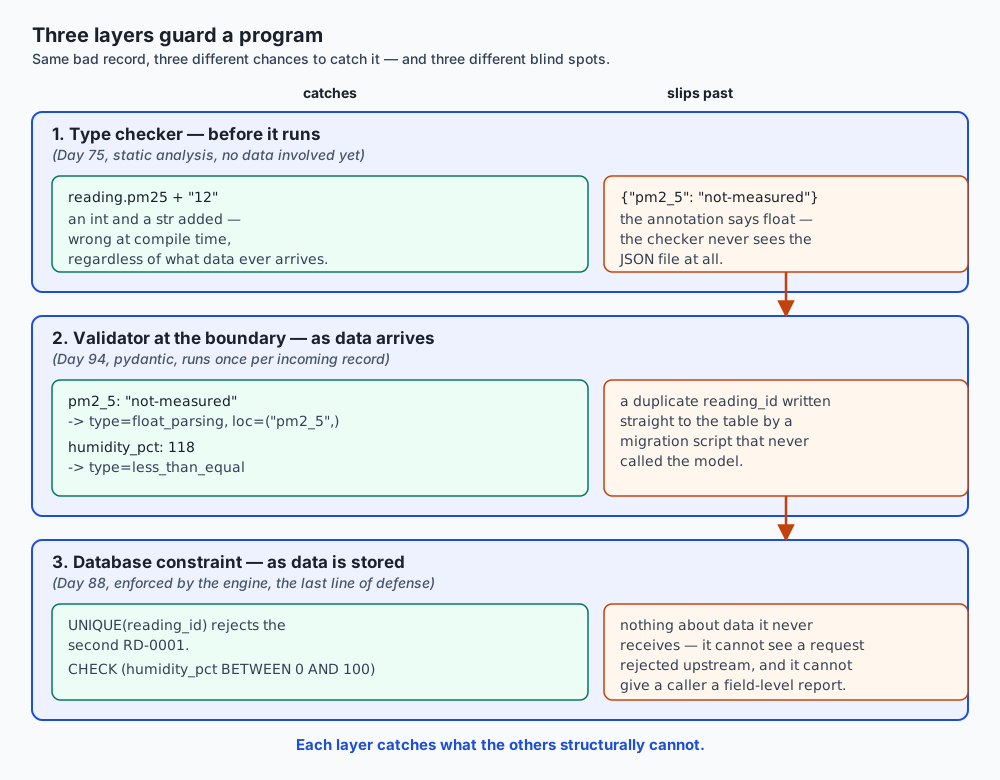
And here is the part that makes today fit into the course rather than sit beside it. You have now met all three members of a family, and they are usually taught as if they were rivals:
- The type checker, before it runs (Day 75). Reads your annotations statically. Catches code that could never work.
- The validator, as data arrives (today). Reads the same annotations at runtime. Catches data that is wrong now.
- The database constraint, as data is stored (Day 88). Catches anything that reached the table by any route at all.
They are not rivals and they are not redundant. Each one catches something the others structurally cannot, and the word “structurally” is doing real work there — it is not that the others are less thorough, it is that they are not present at the right moment. We will make that precise shortly.
Historical background
Python has had optional type annotations since PEP 3107 in 2006, but for years they were syntax without a consumer — you could write def f(x: int) and the interpreter would store the annotation in f.__annotations__ and do absolutely nothing with it. PEP 484 in 2014 gave them a meaning, the typing module gave them a vocabulary, and static checkers gave them teeth. The Python typing documentation is still explicit that the runtime does not enforce them; they are for tools.
That left a gap that was obvious in hindsight. Programs had, sitting right there in the source, a machine-readable description of what every value was supposed to be — and at the boundary, where it mattered most, nobody was reading it.
Several projects filled the gap from different directions. marshmallow (2013) came from the web world and asked you to declare a schema class separately from your data class. attrs (2015) came from the “classes are too much boilerplate” direction and added validators as an option. jsonschema came from the standards direction, implementing a language-independent specification. cerberus took the “rules as a dictionary” approach. Python’s own dataclasses arrived in 3.7 (2018) and deliberately stopped short: they generate __init__, __repr__ and __eq__ from annotations and, as the dataclasses documentation makes clear, they do not validate anything.
pydantic’s bet, made in 2017, was different and slightly cheeky: the annotation is the schema. Not a schema derived from the annotation, not a schema declared alongside it — the annotation itself. Write humidity_pct: int and you have declared a runtime rule.
The bet paid off for a reason that had little to do with validation. FastAPI adopted pydantic as its request and response layer, and suddenly the same annotation was doing four jobs at once: it told the type checker what the value was, validated the incoming request, generated the OpenAPI schema, and serialised the response. The FastAPI documentation is built entirely on that idea, and Day 82’s 422 responses were pydantic errors rendered as JSON — you have already read one, before you knew what it was.
Version 2, released in 2023, rewrote the validation core in Rust as a separate package, pydantic-core. The pydantic documentation states this plainly as the architecture. I am going to be careful here, because performance claims are where technical writing usually starts inventing things: the Rust core is a documented fact about how the library is built; the specific speed multiplier you may have seen quoted is not something I measured, and I am not going to repeat a number I did not produce. What I can tell you from this machine is that the reference suite in today’s lab — 47 tests, several hundred validations — completes in 0.34 seconds, and that validation never showed up as something worth thinking about at this scale.
Version 2 also changed the API, and the change is worth knowing because half the tutorials you will find online are still v1. This lesson uses v2 throughout:
| The v1 way | The v2 way |
|---|---|
@validator("field") | @field_validator("field") |
@root_validator | @model_validator |
Model.parse_obj(data) | Model.model_validate(data) |
instance.dict() | instance.model_dump() |
instance.json() | instance.model_dump_json() |
class Config: inside the model | model_config = ConfigDict(...) |
parse_obj_as(list[T], data) | TypeAdapter(list[T]).validate_python(data) |
If you find an answer online using the left column, it is not wrong, it is old. Translate it.
What it is — and what it is not
pydantic is a runtime validation and serialization library. You declare a class; it builds a validator from the annotations; you feed it untrusted data; you get back either a typed object or an exception describing every problem.
It is not a static type checker. It runs when your program runs, on real values. Day 75’s checker runs before, on code. They read the same annotations for different purposes and neither replaces the other.
It is not an ORM. Day 93’s SQLAlchemy models describe rows in tables and know how to load and save them. A pydantic model describes a shape and knows how to check it. They are frequently used together — the API layer validates with pydantic and persists with SQLAlchemy — and the fact that both are called “models” has confused a great many people.
It is not a parser in the byte-handling sense. Something else turns bytes into dicts and lists — json.load, a CSV reader, an HTTP framework. pydantic starts once you have Python objects. (It does offer model_validate_json, which parses and validates in one step, but the parsing is still parsing.)
It is not a serialization format. JSON is a format. model_dump_json produces JSON. pydantic is the thing in the middle that decides what is allowed to become JSON and what a JSON document is allowed to become.
It is not an authorization check. A record can be perfectly valid and still be one this caller has no business submitting. Validation asks “is this well-formed?”; authorization asks “are you allowed?”. Conflating them is a classic way to build a system that is careful about the wrong thing.
And one more, because it is the most common misconception among people who have used it a little: it is not a coercion library that happens to validate. The coercion is real and it is the part people notice first, but the coercion rules are a deliberate, conservative policy that we are about to look at closely — and you can turn the whole thing off.
Why it was created and what problems it solves
Let me show you the “before” honestly, because the argument only works if the hand-written version is written fairly rather than as a straw man.
Here is boundary validation done by hand. It works. It is roughly what every codebase grows.
def validate_reading_by_hand(raw):
    problems = []
    if not isinstance(raw, dict):
        return None, ["record is not an object"]
    clean = {}

    reading_id = raw.get("reading_id")
    if reading_id is None:
        problems.append("reading_id is missing")
    elif not isinstance(reading_id, str):
        problems.append("reading_id is not a string")
    else:
        clean["reading_id"] = reading_id

    station = raw.get("station")
    if station is None:
        problems.append("station is missing")
    elif not isinstance(station, dict):
        problems.append("station is not an object")
    else:
        code = station.get("code")
        if not isinstance(code, str):
            problems.append("station.code is missing or not a string")
        else:
            clean["station_code"] = code

    pm = raw.get("pm2_5")
    if pm is None:
        problems.append("pm2_5 is missing")
    else:
        try:
            clean["pm25"] = float(pm)
        except (TypeError, ValueError):
            problems.append("pm2_5 is not a number")

    # ... and one more block per field, forever
    return (None, problems) if problems else (clean, [])
Note what is right about it. It collects problems rather than raising on the first — that is the good instinct, and it is rarer than it should be. It distinguishes absent from malformed. It returns a clean record.
Now note what it cannot do, and be precise, because “it’s verbose” is not an argument.
Run it over the lab’s twelve-record batch and it accepts ten and rejects two. The pydantic schema over the same batch rejects seven. The four extra rejections are:
| Record | What is wrong | Why the hand-written version misses it |
|---|---|---|
| 4 | humidity_pct is 118 | There is no range check anywhere. Adding one means another if, and another, per field, per bound. |
| 6 | station.code is "ST-north" | There is no pattern check. It is a string, and a string is all the code asked for. |
| 8 | recorded_at is "15/08/2026 10:00" | Nothing looks at the timestamp at all. Adding date handling means picking a parser and a policy. |
| 9 | pm2_5 is 612.5 with no explanatory note | A rule spanning two fields. There is no natural place to put it, so it goes at the end and gets forgotten. |
And the deeper problems, which no amount of extra if statements fix:
- The rules live in a function, so they are enforced only where the function is called. Add a second code path that builds a reading and you have a second, unvalidated boundary. Nothing tells you.
- The errors are prose.
"pm2_5 is not a number"cannot be counted, grouped, alerted on, or turned into a report that says “43 records failed the same rule”. A machine cannot act on a sentence. - There is no schema to publish. You cannot hand this function to a front-end team, generate documentation from it, or use it to constrain a language model’s output.
- It rots. Not metaphorically. A field gets renamed in the model and not in the validator, and the validator silently stops checking it, because
raw.get("humidty_pct")returnsNonejust like an absent key.
Here is the same thing declared:
StationCode = Annotated[str, StringConstraints(pattern=r"^ST-[A-Z]{3}$")]
Percent     = Annotated[int, Field(ge=0, le=100)]
Micrograms  = Annotated[float, Field(ge=0.0, le=1000.0)]

class Station(BaseModel):
    model_config = ConfigDict(extra="forbid", str_strip_whitespace=True, frozen=True)
    code: StationCode
    name: str = Field(min_length=1, max_length=60)
    elevation_m: int = Field(ge=-500, le=9000)

class Reading(BaseModel):
    model_config = ConfigDict(extra="forbid", str_strip_whitespace=True,
                              validate_assignment=True, populate_by_name=True)
    reading_id: Annotated[str, StringConstraints(pattern=r"^RD-\d{4}$")]
    station: Station
    recorded_at: datetime
    pm25: Micrograms = Field(alias="pm2_5")
    temperature_c: float = Field(ge=-90.0, le=60.0)
    humidity_pct: Percent
    operator: str | None
    notes: str | None = None
That is the complete set of rules, in one place, checked identically everywhere, generating its own JSON Schema, producing machine-readable errors — and shorter than the hand-written version that checked four fields.
How it works
What happens at instantiation
When you define a BaseModel subclass, pydantic reads the class’s annotations at class creation time and builds a validator — in v2, a compiled schema handed to the Rust core. That happens once, when the module is imported. Validating a record then runs that prepared validator rather than interpreting your annotations afresh, which is where the speed comes from.
Three ways in, and the difference matters:
Reading(reading_id="RD-0042", ...)          # keyword arguments
Reading.model_validate(raw_dict)            # a dict — the boundary case
Reading.model_validate_json(raw_text)       # parse and validate in one step
At the boundary you almost always want the second or third, because the data arrived as a document, not as keyword arguments.
Coercion, and the surprise everyone gets
This is where beginners are ambushed, so rather than describe the rules I am going to show you what this machine actually said when asked. Every row below is a real TypeAdapter(...).validate_python(...) call in pydantic 2.13.4, run twice — once in the default mode and once with strict=True:
input                    declared as  lax (default)                      strict=True
----------------------------------------------------------------------------------------
'42'                     int          42                                 refused: int_type
'42.0'                   int          42                                 refused: int_type
'  42  '                 int          42                                 refused: int_type
'forty-two'              int          refused: int_parsing               refused: int_type
42.0                     int          42                                 refused: int_type
42.7                     int          refused: int_from_float            refused: int_type
True                     int          1                                  refused: int_type
'3.14'                   float        3.14                               refused: float_type
3                        float        3.0                                3.0
42                       str          refused: string_type               refused: string_type
None                     str          refused: string_type               refused: string_type
'yes'                    bool         True                               refused: bool_type
'true'                   bool         True                               refused: bool_type
1                        bool         True                               refused: bool_type
'2026-08-15T06:00:00Z'   datetime     datetime.datetime(2026, 8, 15, 6, 0, tzinfo=TzInfo(0)) refused: datetime_type
'15/08/2026'             date         refused: date_from_datetime_parsing refused: date_type
1786773600               datetime     datetime.datetime(2026, 8, 15, 6, 0, tzinfo=TzInfo(0)) refused: datetime_type
'[1, 2]'                 list[int]    refused: list_type                 refused: list_type
(1, 2)                   list[int]    [1, 2]                             refused: list_type
set[1, 2]                list[int]    [1, 2]                             refused: list_type
Read that table twice; there is more in it than there looks.
The organising rule of lax mode is not “convert anything plausible”. It is closer to convert when the conversion is unambiguous and loses nothing. "42" to 42 loses nothing, so it happens. 42.7 to 42 would discard the .7, so it is refused with int_from_float. And note the row that surprises people most: "42.0" as an int is accepted, because the fractional part is zero and therefore nothing is lost. That is consistent, once you see the rule.
Four specific things to carry away:
Truevalidates as the integer1.boolgenuinely is a subclass ofintin Python, and this is the one lax rule I would call genuinely hazardous — a checkbox arriving where a count was expected is a bug that survives to production.42does not validate as astr. Coercion is not symmetric; numbers do not become strings by default, because that direction is almost always a mistake rather than a convenience.'yes'validates asTrue. There is a fixed set of accepted spellings, and it does not include everything you might guess.inttofloatis the one conversion strict mode still allows. Everything else in the strict column is a refusal.
When to use strict mode: when a wrong guess is worse than a rejection. Money, identifiers, anything from a source that is supposed to be well typed already — a database row, another service’s response, a message from a system you control. When to stay lax: when everything genuinely arrives as text and coercing it is the whole job. A CSV has no types. A query string has no types. An environment variable has no types. Refusing to coerce there means writing the coercion yourself, worse.
You can request strictness at three scopes: Model.model_validate(data, strict=True) for one call, Field(strict=True) for one field, ConfigDict(strict=True) for a whole model. Per-field is the most useful in practice: strict on the identifier and the amount, lax on everything else.
Field, Annotated, and saying it once
Field carries constraints, defaults, aliases and documentation:
name: str = Field(min_length=1, max_length=60, description="Human-readable site name")
elevation_m: int = Field(ge=-500, le=9000)
pm25: float = Field(alias="pm2_5")
The problem with writing Field(ge=0, le=100) inline is that the moment you need it on a second field you repeat it, and the moment you need it on a ninth you get one of them wrong. Annotated fixes that by letting you name the constrained type:
Percent = Annotated[int, Field(ge=0, le=100)]
humidity_pct: Percent
battery_pct: Percent
signal_pct: Percent
This is the modern idiom and it is worth adopting as a default. Static type checkers see through Annotated to the underlying int, so you keep everything Day 75 gave you; pydantic sees the metadata and enforces it. Percent now means something in your codebase, which is a documentation win as much as a validation one.
Nested models and lists of models
Nesting requires nothing special. Declare a field as another model, and pydantic validates it in its own right:
class Reading(BaseModel):
    station: Station     # validated as a Station
The important consequence is in the error report. A failure inside the nested model produces loc = ("station", "code") — the path, not just the field. On a list, the index leads: loc = (1, "station") means the second element. That path is what lets a report point at a specific place in a specific record in a large document.
Required, optional, nullable — three different things
These get collapsed into one idea constantly, and the confusion is expensive. Look at these two lines:
operator: str | None          # REQUIRED and NULLABLE
notes: str | None = None      # OPTIONAL and nullable
They differ in exactly one character-sequence — the default — and that difference is the whole distinction.
| Key may be absent? | Value may be null? | Example | |
|---|---|---|---|
| Required, not nullable | No | No | reading_id: str |
| Required, nullable | No | Yes | operator: str | None |
| Optional, not nullable | Yes | No | retries: int = 3 |
| Optional, nullable | Yes | Yes | notes: str | None = None |
Nullable is about the type. Optional is about the default. They are independent. All four combinations are meaningful and all four are used.
The confusion has a historical cause worth knowing: the older spelling Optional[str] means nullable, not optional, which is precisely backwards from the English word. X | None is clearer and is what you should write now.
You never have to argue about this, because the schema will tell you:
required fields : ['humidity_pct', 'operator', 'pm2_5', 'reading_id', 'recorded_at', 'station', 'temperature_c']operator is there. notes is not. Settled.
Reading a ValidationError properly
This is the single most practically useful section of the day.
A ValidationError reports every problem it found in one pass, not the first. Feed it a record broken in three ways and you get three entries:
pydantic: 3 validation error(s)
  station.elevation_m
    type=int_parsing input='high'
  pm2_5
    type=float_parsing input='unreadable'
  humidity_pct
    type=int_type input=None
One round trip, three fixes. Compare that to the hand-written float() that raised on the first one.
exc.errors() gives you a list of dictionaries, each carrying four keys:
| Key | What it is | Assert on it? |
|---|---|---|
loc | A tuple locating the problem: ("humidity_pct",), ("station", "code"), (1, "station") | Yes |
type | A symbolic name for the rule broken: float_parsing, less_than_equal, extra_forbidden | Yes |
input | The offending value, echoed back | In a report, yes. In a test, rarely. |
msg | English prose: “Input should be a valid number” | Never |
Assert on type and loc. Never on msg. The prose is not a stable API. A library is entitled to improve a sentence in any release, and a suite that greps error text passes right up until somebody rewords a message, then fails for a reason that has nothing to do with your code.
Day 82 made exactly this point about a FastAPI 422 body — and it is not an analogy, it is literally the same structure, serialised to JSON. If you learned then to read detail[0].loc and detail[0].type rather than the message, you already had today’s habit.
Two details worth knowing before they bite:
locuses the alias, not the field name. Ifpm25carriesalias="pm2_5", the error says("pm2_5",). That is correct and deliberate: the report has to name the key the caller actually sent, or it is useless to whoever owns the file. It also means a test asserting("pm25",)will fail.typenames have their own shape worth checking rather than assuming. In this lab a model-widefrozen=Truereportsfrozen_instance, not the per-fieldfrozen_field. I found that out by running it, and it is a nice small demonstration of why “assert ontype” does not mean “guess thetype”.
Validators: field and model, before and after
Constraints handle “this value must be in this range”. Validators handle everything else.
@field_validator("recorded_at", mode="after")
@classmethod
def timestamp_must_carry_a_timezone(cls, value: datetime) -> datetime:
    if value.tzinfo is None:
        raise ValueError("recorded_at must include a timezone offset")
    return value
Two modes, and the choice is mechanical once you see it:
mode="before"runs on the raw input, before pydantic’s own parsing. Use it to repair — to accept a legacy date format and hand back a realdatetime, to split a string into a list, to unwrap a value some upstream system double-encoded.mode="after"runs on the already-validated, already-typed value. Use it to check something the type system cannot express, or to normalise — the lab turns a whitespace-only note intoNone, because an empty string is not a note.
You raise a plain ValueError. You never construct a ValidationError yourself; pydantic catches your ValueError and folds it into the report as an entry of type value_error located at that field.
model_validator is the same idea one level up, for rules no single field can carry:
@model_validator(mode="after")
def a_high_reading_must_be_explained(self) -> "Reading":
    if self.pm25 > 500.0 and not (self.notes and self.notes.strip()):
        raise ValueError("a pm25 reading above 500 requires a note explaining it")
    return self
Above 500 micrograms the instrument is either witnessing something serious or misbehaving, and the difference is not in the number — so the schema demands that a human wrote down which it was. That rule needs to see two fields at once, so it cannot live on either. Its error carries an empty loc, which is exactly right: no single field is at fault, the combination is.
computed_field
A property that is serialised but never accepted as input:
@computed_field
@property
def band(self) -> str:
    if self.pm25 <= 12.0: return "good"
    if self.pm25 <= 35.4: return "moderate"
    ...
band now appears in model_dump() and in the generated JSON Schema. It cannot be set. Consumers get the derived label without every consumer re-deriving it, and nobody can lie about it.
Serialization, and where the round trip breaks
reading.model_dump()        # Python objects; recorded_at stays a datetime
reading.model_dump_json()   # a JSON string; recorded_at becomes ISO 8601 text
The ISO 8601 rendering is what makes the JSON form portable — most-significant-first at fixed widths, so it also sorts correctly as text, which Day 91 leaned on.
Both take by_alias, include, exclude and exclude_none, and that is where you decide what an outward-facing extract may contain. Excluding the operator’s name at the serialiser rather than in six call sites is the whole reason those arguments exist.
Now the part people get wrong. Model.model_validate(instance.model_dump()) is not guaranteed to work. Here is this machine refusing it:
model_validate(model_dump())                  -> refused: band [extra_forbidden]
model_validate(model_dump(by_alias, -band))   -> accepted
Three reasons the round trip is asymmetric, and all three are correct behaviour:
- Computed fields go out and cannot come in.
bandis serialised because a consumer wants it, and refused on the way back becauseextra="forbid"is doing its job. Nothing computed is an input. - Aliases point the other way on output.
model_dump()uses field names; validation expects alias names. Henceby_alias=True. - Normalising validators change the value on purpose. A trimmed string or a blanked note means the object is deliberately not identical to what arrived.
The bug is not any of the three. The bug is assuming they compose.
TypeAdapter: validation for things that are not models
Not everything you need to check is a model. A list of integers, a dict keyed by station code, a bare datetime, a union:
TypeAdapter(list[int]).validate_python(["1", "2"])   # -> [1, 2]
TypeAdapter(list[int]).dump_json([1, 2])             # -> b'[1,2]'
TypeAdapter(list[Reading]).validate_python(rows)     # a whole batch in one call
Validating a batch through a TypeAdapter is the concise option, and its errors carry the element index first: loc[0]=(1, 'station') means the second element’s station. Note the trade-off, because it decides which one you want: a TypeAdapter over the whole list raises once for the whole list. If you want the run to continue past a bad element — and at a gate you do — you validate element by element instead.
The model_config options that change behaviour
Most configuration is style. Four are not:
| Option | Default | What it changes |
|---|---|---|
extra | "ignore" | "forbid" turns an unexpected key from a silent discard into an extra_forbidden error. This is how a misspelled field name gets caught. Set it deliberately; it is a security setting, not a preference. |
frozen | False | True makes the model immutable. Assignment raises with type frozen_instance. Good for value objects that should never be edited after they cross the boundary. |
str_strip_whitespace | False | True trims every string on the way in. Removes an entire class of “why doesn’t this match?” bug from human-entered and CSV-sourced data. |
validate_assignment | False | True re-validates on every attribute assignment, so an object that was legal when built cannot be made illegal afterwards. Costs a validation per write. |
populate_by_name=True is the other one worth knowing: it lets an aliased field be filled by either name, which is what you want when one model serves both an external feed and your own internal callers.
Validation as a data-quality gate
Everything so far has been about one record. This is about a batch, and it is the part that makes the day matter.
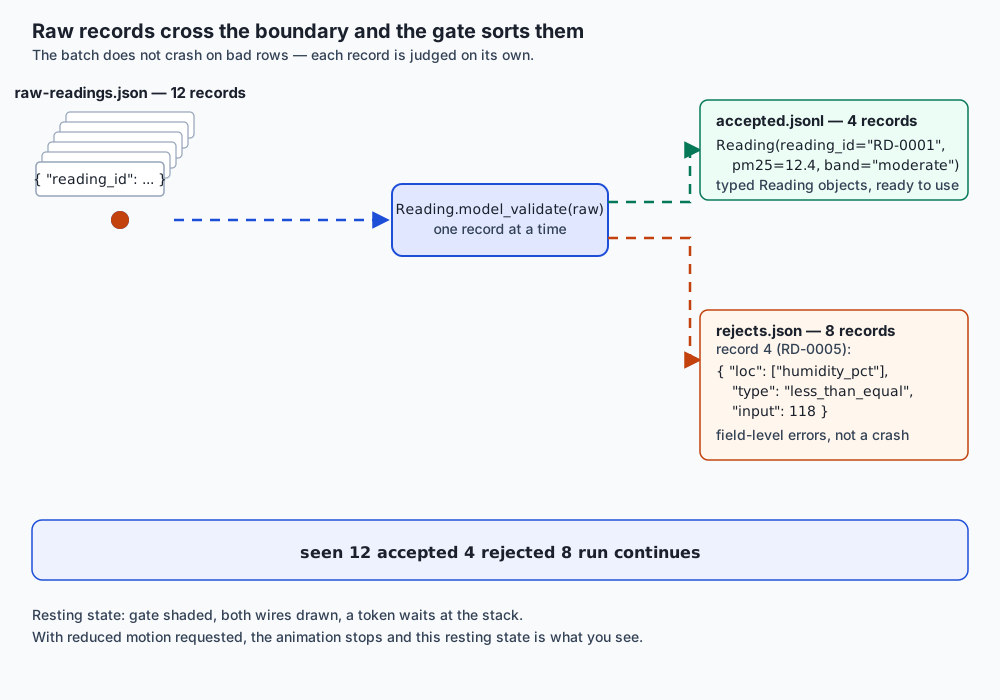
The rule is easy to state and easy to get wrong:
One bad record must not end the run.
The shape is small:
def run_gate(records):
    result = GateResult()
    seen_ids = {}
    for index, raw in enumerate(records):
        raw_id = raw.get("reading_id") if isinstance(raw, dict) else None
        try:
            reading = Reading.model_validate(raw)
        except ValidationError as exc:
            result.rejected.append(Rejection(index, raw_id, tidy(exc.errors())))
            continue                      # <- the entire lesson is this line
        first_seen = seen_ids.get(reading.reading_id)
        if first_seen is not None:
            result.rejected.append(Rejection(index, reading.reading_id, [{
                "loc": ["reading_id"], "type": "duplicate_id",
                "msg": f"reading_id already used by record {first_seen}",
                "input": reading.reading_id}]))
            continue
        seen_ids[reading.reading_id] = index
        result.accepted.append(reading)
    return result
Five things are load-bearing in there, and none of them are the validation:
except ... continue. The record is refused; the loop is not.- The id is pulled from the raw record before validating, so a record that fails can still be named.
- The duplicate check lives here and not in the schema, because uniqueness is a property of the batch. No per-record model can see it. This is why a gate is a place and not just a model — and it is exactly the seam where a database
UNIQUEconstraint earns its keep as a third layer. - Both counts are kept. “8 rejected” is a number you can trend, alert on and threshold.
- The errors are kept structured.
locandtypeper rejection, so the report can be grouped and counted rather than merely read.
And the piece people leave out: a gate should be able to fail the build. The lab’s --fail-over flag exits non-zero when the reject rate crosses a line you chose. A gate that can never fail is a log line.
An everyday analogy
Return to the border, and follow one shipment all the way through, because every piece of machinery in this lesson has a counterpart there.
A crate arrives with a declaration — that is the raw dict. The published tariff schedule, which says what may enter and in what quantities, is the model. It exists once, it is written down, and it applies identically to every crate, which is the difference between a rule and a habit.
The officer checks the declaration against the schedule. Some discrepancies are resolved rather than refused: the declaration says weight "340" in text and the schedule wants a number, and everyone agrees what that means, so it is read as 340 and noted. That is lax coercion. But a declared weight of “about half a tonne” is not resolved, because resolving it would mean guessing, and a guess written into a customs record is worse than a rejection. That is int_parsing refusing "forty-two".
Some borders run strict: the declaration must be on the correct form, in the correct units, with no interpretation whatsoever. Slower, more rejections, and exactly right when the cargo is valuable enough that a wrong guess costs more than a delay.
A crate containing another crate is opened and checked in its own right, and the rejection notice says which inner crate — station.code, not just “something inside was wrong”.
The notice itself is the interesting part. A good one lists every problem with the shipment, because sending the shipper home to fix one thing and come back is how a queue forms. It cites the rule number — that is type — and the line on the declaration — that is loc. It also includes a sentence in plain language for the human reading it, and that sentence is not what the shipper’s software should be programmed against, because the wording gets revised and the rule numbers do not.
Some rules cannot be checked line by line. “Perishable goods require a refrigeration certificate” needs two lines at once, and the notice for it cannot point at either line alone — so it is filed against the shipment. That is model_validator and its empty loc.
Meanwhile the border does not close because one crate failed. Twelve arrive, four pass, eight are held, and at the end of the day there is a log: which crates, which rules, which declared values. If more than a set fraction of a day’s shipments are held, that is escalated — because a spike in rejections usually means something changed upstream, not that eight shippers independently became careless.
Finally, and this is the bit that makes the analogy earn its place: the border is not the only control. There are rules about what may be manufactured in the first place (the type checker), and rules the warehouse enforces about what may sit on a shelf (the database constraint). A crate that came in through a side entrance never met the border officer — and that is precisely the case the warehouse rule exists for.
Examples in practice
The from-scratch build
Before using the tool, build the toy. The point is not to compete with pydantic; it is to make every decision pydantic makes for you visible, by making you make it yourself.
The core is small. A model is an ordinary class whose annotations describe its fields:
def declared_fields(model):
    hints = typing.get_type_hints(model)
    return {name: hint for name, hint in hints.items() if not name.startswith("_")}
Already there is a lesson. Use typing.get_type_hints, not model.__annotations__ — because under from __future__ import annotations every annotation is a string until something resolves it. That single detail is why hand-rolled validators so often work in one module and mysteriously fail in another.
Second decision: what does “present” mean?
class _Missing:
    __slots__ = ()
    def __repr__(self): return "MISSING"
    def __bool__(self): return False

MISSING = _Missing()
You need a sentinel, because None cannot do this job. A field explicitly set to null and a field nobody wrote are two different facts about the world, and if absence is represented by None you have thrown one of them away before you started. This is exactly the required-versus-nullable distinction, arrived at from the implementation side.
Third: which conversions are allowed? An explicit table, and every entry is a judgement:
COERCIONS = {
    (str, int): _str_to_int,
    (str, float): _str_to_float,
    (int, float): _int_to_float,
}
And the absences matter more than the presences. (float, int) is refused because it loses information silently. (bool, int) is refused because isinstance(True, int) is True in Python and letting a checkbox arrive where a count was wanted is a bug that survives to production — which means the naive check has to come before the isinstance test, or every True in the input quietly becomes a perfectly acceptable 1. (str, bool) is refused because there is no single right answer; every codebase picks differently, so this one picks nothing.
Fourth, and the one that looks easy: collect all errors, do not raise on the first. It sounds like a small change from raise to errors.append. It is not, and here is why:
- After a field fails, you must keep going rather than return — but you must also not build the object, because it would be half-formed.
- A nested model returns a list of errors that have to be spliced in with their paths rewritten, so
("code",)from insideStationbecomes("station", "code")at the top. - Extra-key detection has to happen after the field loop, because you only know which keys are unexpected once you know which are expected.
- Every error needs a stable shape —
loc,type,msg,input— decided up front, or callers cannot write anything against it.
About two hundred lines, and it does five things: finds the fields, decides what present means, applies a coercion policy, recurses into nesting, and collects everything. Over the lab’s batch it rejects 3 of 12.
The pydantic schema rejects 7 — and the four extra rejections are a range, a pattern, a date format and a cross-field rule. None of those are exotic. Each one would be a function the toy needs hand-written, per field, and kept correct forever. That is the argument, and it is only convincing because you built the toy first.
The gate on a real batch
read      12 records from raw-readings.json
accepted  4
rejected  8

  record 2 (RD-0003): operator [missing]
  record 3 (RD-0004): pm2_5 [float_parsing]
  record 4 (RD-0005): humidity_pct [less_than_equal]
  record 5 (RD-0006): humidity_pct [missing]; humidty_pct [extra_forbidden]
  record 6 (RD-0007): station.code [string_pattern_mismatch]
  record 7 (RD-0001): reading_id [duplicate_id]
  record 8 (RD-0009): recorded_at [datetime_from_date_parsing]
  record 9 (RD-0010): <record> [value_error]

wrote accepted.jsonl and rejects.json to out/
Read the rejections; each one teaches something different.
Record 5 shows the misspelling caught twice: humidty_pct is an unexpected key, and humidity_pct is now missing. Under the default extra="ignore" you would get only the second half, and the record would look like it simply forgot a field. The pair of errors is what tells you it was a typo rather than an omission.
Record 6 shows the nested path. station.code, not “something in the station”.
Record 7 is the duplicate, and note which one is rejected: the second occurrence, at index 7. The first RD-0001 was accepted and kept. That ordering is a policy decision the gate makes explicitly.
Record 9 has an empty loc, rendered as <record>. That is the cross-field rule.
And the last line of the counts is the whole point: the process exited 0. A batch two-thirds bad produced four good records and a report.
The same schema in an API
You have already used this without knowing. A FastAPI endpoint that declares a pydantic model as its body parameter runs exactly this validation on every request, and a failure becomes a 422 whose detail is the same list of entries with the same loc and type. The FastAPI documentation builds the whole request layer on it. Day 82’s detail[0].loc == ["body", "title"] was this, with "body" prepended to say which part of the request the path is relative to.
The thing not shown here
pydantic-settings is the companion package for loading configuration from environment variables and .env files into a validated model — which is a genuinely good idea, because an environment variable is a boundary and os.environ.get("PORT") returning None at 3am is a rite of passage nobody enjoys. It is a separate distribution and it is not installed in this lab. I am describing it from its documentation and reproducing no output from it, and the lab’s test harness asserts that it really is absent so that this statement cannot quietly become false.
Implications: security, privacy, performance, scalability, and cost
Security: extra="forbid" is a security setting. The default is "ignore", which silently drops unexpected keys. The mild consequence is the lost typo. The serious one is mass assignment: if a model is ever built from user-supplied data and has a field the user should not control — is_admin, owner_id, price — then whether an unexpected key is ignored or forbidden is the difference between a vulnerability and a 422. Set it deliberately.
Security: validation is not authorization. A perfectly valid record can be one this caller has no business submitting. Keep the two checks separate and run both.
Security: unbounded input and hostile regexes. An unconstrained str will happily try to validate a 500 MB field; set max_length on anything crossing a real boundary. And StringConstraints(pattern=...) compiles a regular expression, which a carelessly written pattern can be made to backtrack catastrophically on. The two patterns in the lab — ^ST-[A-Z]{3}$ and ^RD-\d{4}$ — are anchored, fixed-length and free of nested quantifiers, which is what makes them safe. Prefer that shape.
Privacy: the reject report is the leak. This is the one people do not see coming. Every error entry carries input — the value that failed — by design, because a report you cannot act on is useless. That is fine when the bad value is 118. It is not fine when the bad value is a password submitted into the wrong field, a full card number that failed a length check, or an identifier that failed a pattern. Three rules follow: decide where the report goes before deciding what it contains; redact input for fields you have classified as sensitive; and never log the whole raw record on failure. Note that a missing error’s input is the entire record — that is pydantic’s behaviour, and it is exactly the case to redact on a real feed.
Privacy: quarantine is durable storage of unvetted data. Writing rejected records somewhere so the source can be repaired is good practice, and it means you now hold a file of exactly the data you were unable to vet. Give it a retention period and an access rule on day one, not after the first audit.
Performance. v2’s validation core is written in Rust and shipped as pydantic-core; that is a documented architectural fact, and I am stating it as such rather than as a benchmark. What I measured on this machine is narrow and I will not stretch it: the lab’s 47-test suite, running several hundred validations, completes in 0.34 seconds. At this scale validation is not a cost worth thinking about. At millions of records per run it becomes one, and the honest advice is the same as always — measure your own workload, because the shape of your models matters more than any published multiplier.
Two structural performance notes that hold regardless: model construction happens once at import, so the per-record cost is running a prepared validator rather than interpreting annotations; and validate_assignment=True costs a validation on every attribute write, which is invisible on a record you build once and real in a loop that mutates.
Scalability. The gate pattern as written loads the batch into memory. For a genuinely large file, rewrite run_gate to take an iterator and yield results — the validation is unchanged, only the plumbing moves. Keep the counters exact, because they are what you alert on.
Cost. pydantic is MIT-licensed, free, with no paid tier, no account and no service. The real cost of this day is a design cost: deciding where your boundaries are. Most codebases have more of them than anyone realises, and half the value of learning this is the audit it prompts.
Alternatives: free, open source, and commercial
I ran pydantic 2.13.4 for this lesson, on Python 3.14.0. Every output quoted above came from that. I did not run any of the others — they are not installed in this lab, and everything below is described from documentation and from the shape of each library’s published API. Where I would be guessing, I say so.
pydantic — free, open source, MIT. Choose it when the data crosses a boundary, when you want the annotation and the schema to be the same thing, and when you want JSON Schema out for free. Use BaseModel for structures and TypeAdapter for anything else. Its weakness is that it is opinionated about coercion, which is a feature at a text boundary and an irritation when you wanted strict types and forgot to ask.
class Station(BaseModel):
    code: Annotated[str, StringConstraints(pattern=r"^ST-[A-Z]{3}$")]
dataclasses with manual validation — free, standard library. Choose it when the data is already yours, the object is internal, and the checks are one or two __post_init__ assertions. Zero dependencies is a real argument in a library that others will install. The dataclasses documentation is clear that no validation is provided; __post_init__ is the hook you get.
@dataclass
class Station:
    code: str
    def __post_init__(self):
        if not re.match(r"^ST-[A-Z]{3}$", self.code):
            raise ValueError("bad station code")
The moment you write the third such block, you are writing the “before” from earlier in this lesson.
attrs — free, open source, MIT. Predates dataclasses and is more powerful: converters, validators, slots, and a field(validator=...) API. Choose it when you want rich class-building and are content to write validation as small functions. It is not primarily a boundary tool — there is no JSON Schema generation — so it and pydantic are aimed at different problems more than they compete.
marshmallow — free, open source, MIT. The schema is a separate class from the data class. Choose it when you want that separation deliberately — several serializations of one object, or a schema that must vary by context — or when you are already in an ecosystem built around it. The cost is that the schema and the class can drift, which is the exact problem pydantic’s “the annotation is the schema” bet was made to avoid.
cerberus — free, open source, ISC. Rules as a plain dictionary rather than as a class. Choose it when the rules are data — loaded from a config file, assembled at runtime, edited by someone who does not write Python. That is a genuinely different requirement and it is the case where a class-based library fights you.
jsonschema — free, open source, MIT. Implements the JSON Schema standard, so the schema is language-independent and can be shared with a front end, a Go service and a test suite. Choose it when the contract must be shared across languages. The trade-off is that you validate a dict and get a dict back — no typed Python object at the end. A common and sensible pairing is to author in pydantic and publish model_json_schema() for other languages to consume.
TypedDict with a static checker — free, standard library plus a checker. Describes the shape of a dictionary for Day 75’s checker. Choose it when the data genuinely is a dictionary throughout and the checking you want is static. Be clear-eyed about the limit: it does nothing at runtime. A TypedDict will not notice that the JSON you just loaded has a string where an int belongs. It is a Day 75 tool, not a Day 94 one, and confusing the two is how a codebase ends up believing it validates.
| Runtime check | Typed object out | JSON Schema out | Rules as data | Standard library | |
|---|---|---|---|---|---|
| pydantic | Yes | Yes | Yes | No | No |
| dataclasses + manual | Only what you write | Yes | No | No | Yes |
| attrs | Yes | Yes | No | No | No |
| marshmallow | Yes | Via a separate class | Partly | No | No |
| cerberus | Yes | No — dicts | No | Yes | No |
| jsonschema | Yes | No — dicts | It is the schema | Yes | No |
| TypedDict + checker | No | No — dicts | No | No | Yes |
All seven are free and open source. There is no commercial validation library worth naming in this space, which is itself informative: the problem is well enough understood, and the open-source options are good enough, that nobody has managed to sell one.
Comparison with related concepts
Validation versus parsing. Parsing turns bytes into structure and asks nothing about meaning. json.loads('{"humidity_pct": 118}') succeeds perfectly. Validation asks whether the structure makes sense. You need both, in that order, and a library that blurs them tends to give you confusing errors when the input was not even JSON.
Validation versus type checking. Day 75’s checker reads annotations before the program runs and never sees data. pydantic reads the same annotations at runtime and sees nothing else. A TypedDict gives you the first with none of the second; a bare isinstance check gives you the second with none of the first. The reason it feels like they should be one thing is that they share a notation — and sharing the notation is precisely pydantic’s contribution.
Validation versus database constraints. The one that gets argued about, so let us be precise about who catches what.
| Runs | Catches | Cannot catch | |
|---|---|---|---|
| Type checker (Day 75) | Before the program runs | Code that could never work: an int added to a str | Anything about actual data — it never sees a byte |
| Validator (Day 94) | As data arrives | Data wrong now, with a field-level report a caller can act on | Anything that reaches storage without passing through it |
| Database constraint (Day 88) | As data is stored | Anything reaching the table by any route: a migration, a manual UPDATE, another service | Anything about data it never receives; and it cannot give a caller a field-level report |
The middle column is why “the model already checks it, drop the NOT NULL” is bad advice. The model protects the path through your application. The constraint protects the table from every path, including the ones you did not write and the ones that do not exist yet. Anyone proposing to drop one is proposing that a future mistake go uncaught.
The right-hand column is why the reverse advice is equally bad. A CHECK constraint gives the caller an opaque integrity violation. It cannot say “field humidity_pct failed rule less_than_equal, you sent 118”, and it certainly cannot report eight problems at once.
Validation versus assertions. An assert states something you believe is already true and can be compiled away with -O. A validator states something you are checking because you do not believe it yet. Using assert at a boundary is a real bug, because in an optimised run the check disappears.
Validation versus tests. A test checks your code against data you chose. A validator checks data you did not choose against your code. They fail at different times, for different people, and neither substitutes for the other.
When to use it — and when not to
Use it at every boundary, and be generous about what counts as one. An HTTP request body, obviously. Also: a config file, an environment variable, a CSV, a webhook payload, a message off a queue, another service’s response, a language model’s output, and the results of a database query if the schema is older than your model. If you did not create the value in this process, it is a boundary.
Use it when the rules need to be published. JSON Schema out for free means a front-end team, a documentation page and a generation constraint can all read the same contract.
Use it when errors need to be actionable by somebody else. loc plus type is a report a data owner can work from. A ValueError with a sentence is not.
Use it when the same rules apply in several places. The value is proportional to the number of places that would otherwise each need their own check.
Do not use it for values you created three lines ago. Validating your own freshly-built internal object is ceremony. Boundaries are places, not habits, and applying validation everywhere devalues it exactly where it matters.
Do not use it in a hot inner loop over data you already validated. Validate at the boundary, then trust the typed object. If a profiler shows validation inside a tight loop, the fix is usually that the boundary is in the wrong place.
Do not reach for it in a library where a dependency would be unwelcome. A small utility package that other people install has a real argument for dataclasses and a few explicit checks.
Do not use it as an authorization layer, an ORM, or a business-rules engine. A model_validator expressing a rule that genuinely varies by caller, by tenant, or by time of day belongs in code that can see those things. The test is whether the rule is a property of the data or a property of the situation.
Do not use it if the rules must be edited by non-programmers at runtime. That is cerberus’s case, and it is a legitimate one.
A rule of thumb that has served well: if the data came from outside this process, validate it; if it came from inside, trust it. Almost every argument about where to put validation dissolves once you can say which side of that line the value is on.
Knowledge check
Before the quiz, check yourself against these. If any answer is hazy, the section it comes from is worth re-reading.
- What are the four keys on a
ValidationErrorentry, and which two should a test assert on? Why is the third one useful in a report but rarely in a test, and why should the fourth never be asserted on at all? operator: str | Noneandnotes: str | None = None. A record arrives with neither key. What happens to each, and which single property accounts for the difference?- Which of these does lax mode accept:
"42"as anint,"42.0"as anint,42.7as anint,Trueas anint,42as astr? State the organising rule rather than memorising the list. - Which conversion does strict mode still allow?
- A rule says a reading above 500 requires an explanatory note. Which decorator, which mode, and what
locdoes its error carry? - Why does
Model.model_validate(instance.model_dump())sometimes fail? Name all three causes. - Your model has
pm25withalias="pm2_5". A bad value arrives. What is the error’sloc, and why that one? - Name one mistake the database constraint catches that the validator structurally cannot, and one the validator catches that the constraint structurally cannot.
- Why is
extra="forbid"described as a security setting rather than a preference? - In the gate, why is the record’s id pulled from the raw dictionary before validating?
Hands-on exercise
The lab is Guard the Boundary. You are handed twelve air-quality records, eight of them wrong in eight different realistic ways, and you build the gate that lets the good ones through without ever crashing.
Work in this order — it is the order the lesson took, and each step earns the next:
- Run
starter/byhand.py. This is the “before”: validation written longhand. It accepts 10 of 12. Count what it never looks at. - Read
examples/scratch_validator.py, then runexamples/scratch_demo.py. The miniature validator collects every error rather than raising on the first, and rejects 3 of 12. Find the four records it waves through and say, for each, which rule it lacks. - Run
examples/coercion.py. Predict five rows before you look. Most people get"42.0"as anintandTrueas anintwrong. - Work exercises 1-6 in
starter/models.py: theAnnotatedtypes, the nestedStation, theReadingwith its alias and its required/optional/nullable trio, twofield_validators, the cross-fieldmodel_validator, and thecomputed_field. Delete one@pytest.mark.skipline as each starts to pass. - Run
examples/serialize.pyand watch the round trip fail, then work out from the output why. - Work exercises 7-10 in
starter/gate.py: the result types,run_gatewith itsexcept ... continue, the batch-level duplicate rule, and the two output files. - Run
bash tests/run_tests.sh.
Every assertion you write must be on type or loc. If you find yourself reaching for msg, stop — that is the habit today exists to prevent.
Expected output
python3 examples/gate.py:
read      12 records from raw-readings.json
accepted  4
rejected  8

  record 2 (RD-0003): operator [missing]
  record 3 (RD-0004): pm2_5 [float_parsing]
  record 4 (RD-0005): humidity_pct [less_than_equal]
  record 5 (RD-0006): humidity_pct [missing]; humidty_pct [extra_forbidden]
  record 6 (RD-0007): station.code [string_pattern_mismatch]
  record 7 (RD-0001): reading_id [duplicate_id]
  record 8 (RD-0009): recorded_at [datetime_from_date_parsing]
  record 9 (RD-0010): <record> [value_error]

wrote accepted.jsonl and rejects.json to out/
python3 examples/scratch_demo.py, the two lines that carry the argument:
from scratch : accepted 9, rejected 3
pydantic     : accepted 5, rejected 7
python3 examples/serialize.py, the round-trip section:
model_validate(model_dump())                  -> refused: band [extra_forbidden]
model_validate(model_dump(by_alias, -band))   -> accepted
bash tests/run_tests.sh ends with:
62 checks, 0 failure(s).Full captures of every script are in the lab’s expected-output/ directory. Read expected-output/FIELDS.md first — it says which lines are fixed and which may legitimately differ on your machine.
Validate your work
python3 -c "import pydantic; print(pydantic.VERSION)"prints2.13.4from the lab’s environment.pytest tests -qends47 passed.pytest starter -qends1 passed, 9 skippedbefore you begin, and10 passedwhen every exercise is done.python3 examples/gate.pyexits 0 on a batch that is two-thirds bad, andout/rejects.jsonnames all eight refusals withloc,type,msgandinput.python3 examples/gate.py --fail-over 0.1; echo $?prints1.bash tests/run_tests.shreports62 checks, 0 failure(s).and exits 0.
Check number 4 is the one that matters. If the gate raises, nothing else in the lab is worth much.
Troubleshooting
ModuleNotFoundError: No module named 'pydantic' — the interpreter running the script is not the one the packages were installed into. Create the lab’s virtual environment and run everything through .venv/bin/python3, or point the harness at an interpreter you already have with PYTHON=... PYTEST=... bash tests/run_tests.sh.
The error’s loc says pm2_5 but my field is pm25 — correct and deliberate. loc names the key the caller sent, because the report has to be usable by whoever owns the source file. Assert on ("pm2_5",).
band [extra_forbidden] when I feed a dump back in — band is a computed field, serialised on the way out and refused on the way in. The trip that works is model_validate(model_dump(by_alias=True, exclude={"band"})).
value_error with an empty loc — that is the model_validator. Its loc is empty because no single field is at fault.
datetime_from_date_parsing on a date that looks fine — 15/08/2026 10:00 is unambiguous to a human and ambiguous to a parser. If you must accept a local format, parse it yourself in a field_validator(mode="before") and hand pydantic a real datetime.
A naive timestamp is refused with value_error, not a parse error — 2026-08-15T06:00:00 parses fine as a datetime; it just has no timezone, which is caught one step later by the field validator.
ModuleNotFoundError: No module named 'models' — run python3 examples/gate.py from the lab directory, or cd examples && python3 gate.py. The scripts import by bare name.
out/ keeps reappearing — gate.py writes there by default. rm -rf out, or pass --out-dir.
The lab’s troubleshooting.md has the full list, with the exact messages this lab produces.
Common mistakes
Asserting on msg. The most common and the most seductive, because the test reads beautifully and passes today. It breaks on an upgrade for a reason unrelated to your code. Use type and loc.
Letting the gate raise “just for now”. The except ValidationError: ... continue is the entire exercise. A gate that raises on the first bad record is not a gate.
Pulling the id after validating. If you read reading.reading_id inside the try, a record that fails validation cannot be named in the report — which is the one case the report exists for.
Confusing optional with nullable. X | None makes a field nullable. A default makes it optional. Check model_json_schema()["required"] rather than reasoning about it.
Expecting the schema to catch the duplicate. It cannot. Uniqueness is a property of the batch, and no per-record model can see it.
Leaving extra at its default. Then humidty_pct vanishes silently and the record merely looks incomplete. Set extra="forbid" deliberately.
Assuming the round trip is symmetric. It is not, for three separate correct reasons.
Reaching for float() inside a validator to “help”. If you find yourself repairing values in mode="after", ask whether the repair belongs in mode="before" or whether it should be a rejection. Silent repair is how you get a defaulted humidity that is indistinguishable from a measured one.
Practice assignment
Apply the day to something of your own, and make the rules earn their place.
Take a real, messy dataset you have to hand — an export from a service you use, a CSV somebody emailed you, the output of an earlier day’s lab. If you have nothing, use a public data file you can download once.
- Look before modelling. Open it and write down, in prose, ten rules you believe hold. Include at least one range, one pattern, one required-and-nullable field, and one rule spanning two fields.
- Model it. Write a pydantic model expressing all ten. Use
Annotatedfor any constraint that appears more than once. Setextra="forbid"from the start. - Run it over the whole file with a gate. Do not let it raise. Emit the valid records and write a report.
- Read the report and be surprised. Some of your ten rules will be wrong, and this is the point of the assignment: at least one thing you were certain about will turn out not to hold in the data. Decide, for each, whether the rule was wrong or the data is.
- Group the rejections by
typeand bylocand produce a count per rule. A gate that says “1,204 rejected” is less useful than one that says “1,198 of them failed the same pattern on the same field”, which usually means one upstream change rather than 1,198 mistakes. - Add a threshold and make the script exit non-zero when the reject rate crosses it. Pick the number and write down why.
- Write four tests: one asserting a specific
typeat a specificloc; one proving a valid record produces the values you expect; one proving the run completes with a non-zero reject count rather than raising; and one assertingmodel_json_schema()["required"]contains exactly the fields you intended.
Write a short note answering: which of your ten rules was wrong, how the data told you, and which rule you would have missed entirely without the report.
Extension challenge
Pick one. Each is a real pattern rather than an exercise.
1. Structured output with a retry loop. Take a schema and use model_json_schema() as the contract for a text-generating system. Parse the reply, validate it, and on failure feed the ValidationError entries back as the next instruction. Count the attempts. This loop is the standard pattern in production systems, and building it will teach you more about why loc and type are structured than any amount of reading.
2. Discriminated unions. Extend the feed with calibration records that have a different shape. Model both with Field(discriminator="type") and confirm the errors name the right branch. Then remove the discriminator and look at the error report you get instead — it is a mess, and that mess is the argument for the feature.
3. Make the gate streaming. Rewrite run_gate to take an iterator and yield results, so a ten-million-row file never has to fit in memory. Keep the counts exact and the report complete.
4. Quarantine and repair. Write rejects to out/quarantine.jsonl, then write a second script that reads the quarantine, applies exactly one repair rule, re-validates, and reports how many were rescued. Then write down the retention policy for that file — that part is not optional.
5. Schema stability tests. Snapshot model_json_schema() to a file and add a test that fails when it changes. A schema change is an API change; make it visible in review rather than in an incident.
6. Build the fourth layer. Add SQLAlchemy models (Day 93) with NOT NULL, UNIQUE and CHECK matching your pydantic rules. Then deliberately insert a bad row bypassing the pydantic model and watch the constraint catch it. That demonstration is worth more than the paragraph in this lesson.
7. Compare a peer honestly. Express one model in attrs or marshmallow, install it, and write down three things that were harder and one that was easier. Then decide whether you would switch, and why not.
The AI thread
This is one of the most load-bearing days in the course, and the reason is that modern AI practice is made of this problem.
Structured output is exactly this problem, with a worse source. When you ask a language model for JSON, what comes back is text that claims to be JSON. It may have a trailing comma. It may be wrapped in a code fence. It may have invented a field, dropped a required one, returned "unknown" where a number belonged, or produced a perfectly formed object whose values are wrong in ways only a range check will catch. A schema is what decides whether the reply is usable, and the fact that pydantic generates JSON Schema for free is why the same model class can be the prompt constraint, the parser and the check. The retry loop — validate, and on failure hand the model its own ValidationError entries as the next instruction — works precisely because those entries are structured, name a loc and a type, and report every problem at once rather than one per round trip. Everything you learned today about reading errors properly is load-bearing there.
Tool calling is a validated argument object. When a model calls a function, the arguments arrive as a JSON object generated by a system that does not execute your code and has no idea what your function requires. Between the model and the function there is a schema, and if there is not, there is a bug waiting. The schema you hand the model to describe the tool and the schema you validate its call against should be the same object — which is exactly the “the annotation is the schema” bet from 2017, arriving somewhere nobody anticipated.
Every dataset reaching training passes a gate like this one, or fails silently. This is the part I most want to land. A corpus with 0.3% malformed records does not crash anything. It trains. The model learns from the malformed records too, and nothing anywhere reports a number. Every filtering, deduplication and quality-scoring step in a data pipeline is a validation gate with a policy attached, and the difference between a pipeline that says “rejected 41,204 of 3.1M, 39,880 of them for the same rule on the same field” and one that says nothing is the difference between a dataset you can reason about and one you can only hope about.
And the evaluation problem is the same problem again. When a model’s output is scored, the scorer parses something. If the parse or the validation fails and the failure is swallowed, the score is computed over the subset that happened to parse — and that subset is not random, because outputs fail to parse for reasons correlated with being bad. A silent validation failure in an evaluation harness produces a number that is too high, looks plausible, and is believed.
The through-line of the day holds all the way down: untrusted input needs a place with a name where somebody decided what valid means. Whether the sender is a sensor, a vendor’s export, a user’s form, another team’s service or a language model, the answer is the same shape. Declare the rules once. Enforce them at the boundary. Report every problem, not the first. Count what you refused. And never, ever let a bad record quietly become a plausible number on somebody’s screen.
Quiz
Q1. You are writing a test that a bad request is rejected for the right reason. Which part of a ValidationError entry should the assertion read?
- msg, because it is the only part a human can understand, and a test is read by humans
- The str() of the whole exception, because it contains everything and so cannot miss anything
- loc and type, because they are the machine-readable parts pydantic treats as an interface
- input, because it is the actual offending value and therefore the most specific thing available
Show answer
Answer: C. loc and type, because they are the machine-readable parts pydantic treats as an interface
Each entry carries four things, and they are not equal. `type` is a short symbolic name for the rule that was broken — `float_parsing`, `less_than_equal`, `extra_forbidden` — and `loc` is a tuple locating it in the input. Both are meant to be branched on, and both are stable within a major version. `msg` is English prose, and a library is entitled to improve a sentence in any release; a suite that greps it passes until the day somebody rewords "Input should be a valid number" and then fails for a reason that has nothing to do with your code. This is not a pydantic quirk: it is the same argument Day 82 made about a FastAPI 422 body, which is literally the same structure serialised to JSON. Option 3 is a subtler trap — `input` is genuinely useful in a report a human reads, but asserting on it tests your fixture rather than your schema, and on a `missing` error the `input` is the entire record rather than the field, which is rarely what the assertion meant. Option 1 is the worst of both: it matches on prose while looking rigorous.
Q2. A model declares `operator: str | None` and `notes: str | None = None`. A record arrives with neither key present. What happens?
- Both are accepted and both become None, because both annotations permit None
- Both are rejected, because neither key was supplied and both fields declare a type
- operator is accepted as None and notes is rejected, because a default is not the same as a value
- operator is rejected with a missing error and notes is accepted as None
Show answer
Answer: D. operator is rejected with a missing error and notes is accepted as None
Required, optional and nullable are three separate facts and only two of them are visible in the type. **Nullable** is about the type: both fields say `str | None`, so both may hold `None`. **Required** is about the default: `operator` has none, so the key must be present; `notes` has `= None`, so the key may be absent. **Optional** is that second property and nothing else — it is not a statement about `None` at all, which is why the older `Optional[str]` spelling caused so much confusion by appearing to say the opposite. So `operator` is required-and-nullable: you may send `null`, but you must send something. `notes` is optional-and-nullable: you may leave it out. You can settle this without arguing, from the schema pydantic generates: `Reading.model_json_schema()["required"]` lists `operator` and does not list `notes`. And the fourth combination exists too — a field can be optional and not nullable, such as `retries: int = 3`, where the key may be absent but `null` is refused.
Q3. In pydantic v2's default mode, which of these is refused rather than converted?
- 42.7 validated as an int
- The string "42" validated as an int
- The integer 3 validated as a float
- The boolean True validated as an int
Show answer
Answer: A. 42.7 validated as an int
The rule behind lax mode is not "convert anything plausible" — it is closer to "convert when the conversion is unambiguous and loses nothing". `"42"` to `42` loses nothing. `3` to `3.0` loses nothing. `True` to `1` loses nothing either, and is accepted because `bool` genuinely is a subclass of `int` in Python; whether that is a good idea is a separate argument, but it is what was observed in pydantic 2.13.4 and it is a real source of surprise. `42.7` to `42` would silently discard the `.7`, so it is refused with the error type `int_from_float`. That distinction is worth internalising, because it is the shape of the whole policy: the library will do work for you, and it will not make a decision on your behalf that quietly destroys information. Notice also that `"42.0"` as an int IS accepted, for the same reason — the fractional part is zero, so nothing is lost. If you want none of this, `strict=True` refuses every one of these except `3` to `3.0`.
Q4. Your pipeline validates ten thousand records a night. Tonight forty of them are malformed. What should the pipeline do?
- Raise on the first bad record so the problem is impossible to ignore
- Process all ten thousand, emit the 9,960 valid records, and write a report naming each of the 40 with its loc and type
- Silently skip the bad records so the run is never interrupted
- Coerce the bad records into something valid using sensible defaults, so nothing is lost
Show answer
Answer: B. Process all ten thousand, emit the 9,960 valid records, and write a report naming each of the 40 with its loc and type
Option 0 is the instinct, and it costs you the night: the run processes nothing, and you learn about exactly one of the forty problems. Tomorrow you fix it and learn about the second. Option 2 is worse in a quieter way — the run looks healthy, the count is short by forty, and nobody notices until a number downstream is wrong. Option 3 is the most dangerous of all, because inventing data is not repairing it; a defaulted humidity of 50 is indistinguishable from a measured one the moment it is written down. The gate does the third thing: it never lets one bad record end the run, it keeps the good ones moving, and it produces a report that is specific enough for whoever owns the source to fix it — which record, which field, which rule, which value. The counts matter as much as the details, because "40 rejected" is a number you can trend, alert on, and put a threshold under. That threshold is the missing piece in the question: a gate should also be able to fail the build when the reject rate crosses a line you chose, because a gate that can never fail is a log line.
Q5. A record must carry an explanatory note whenever its pm25 reading exceeds 500. Where does that rule belong?
- On the pm25 field, as Field(le=500)
- On the notes field, as a field_validator that checks pm25
- Nowhere in the model — it is business logic and belongs in the calling code
- On the model, as a model_validator(mode="after")
Show answer
Answer: D. On the model, as a model_validator(mode="after")
The question to ask is: how many fields does this rule need to see at once? A constraint like `ge=0` or `max_length=60` concerns one value, so it goes on the field, and `Annotated` lets you name it once and reuse it. This rule concerns two values together — a reading above 500 is fine if there is a note and not fine if there is not — so no per-field constraint can express it. Option 0 misreads the rule entirely: 612.5 is a legal measurement, not an illegal one. Option 1 is closer but fights the machinery: a `field_validator` on `notes` receives only that field's value, and reaching for another field's value from inside it means depending on validation order, which is a fragile thing to depend on. `model_validator(mode="after")` runs once the object exists with every field already validated, takes `self`, and returns `self`; raising a plain `ValueError` inside it produces an entry with type `value_error` and an **empty** `loc`, which is exactly right, because no single field is at fault. Option 2 is the position worth arguing with rather than dismissing: it is defensible when the rule genuinely varies by caller, and indefensible when the rule is a property of the data itself, because then it will be enforced in four of the five places that construct the record.
Q6. You validate a record, call model_dump() on the result, and pass that straight back to model_validate(). It fails. What is the most likely reason?
- The dump contains a computed field, which the model refuses as an input under extra="forbid"
- model_dump() is lossy and should never be used; only model_dump_json() round-trips correctly
- Validation is not idempotent in pydantic v2, so a second pass always fails
- The datetime was serialised to a string, which no longer validates as a datetime
Show answer
Answer: A. The dump contains a computed field, which the model refuses as an input under extra="forbid"
This surprises people because both halves are behaving correctly. A `computed_field` is serialised on the way out — that is its entire purpose, since consumers want the derived value — and it is refused on the way in, because `extra="forbid"` is doing its job and nothing computed is an input. The bug is assuming the two compose. Two other asymmetries lurk in the same place and are worth knowing: `model_dump()` uses **field names** by default while validation expects **alias names**, so an aliased field breaks the trip unless you pass `by_alias=True`; and any validator that normalises a value — trimming whitespace, turning a blank string into `None` — means the object is deliberately not identical to what arrived. Option 3 is a real hazard in the general case but not here: `model_dump()` leaves a `datetime` as a `datetime`, and even the ISO 8601 string that `model_dump_json()` produces would validate back happily. The working round trip in the lab is `Reading.model_validate(reading.model_dump(by_alias=True, exclude={"band"}))`, and the fact that it needs two arguments is the lesson.
Q7. Your ORM model already declares NOT NULL and a CHECK constraint for the same rules your pydantic model enforces. Should you drop one?
- Yes — drop the database constraints, since the model already guarantees the data is valid before it is stored
- No — they catch different things, because the constraint sees every path to the table and the model only sees the path through your application
- Yes — drop the pydantic model, since the database is the last word and enforcing it twice is duplication
- It does not matter, because a CHECK constraint and a Field constraint compile to the same thing at runtime
Show answer
Answer: B. No — they catch different things, because the constraint sees every path to the table and the model only sees the path through your application
They look redundant and they guard different territory, which is the whole reason the three-layer picture is worth carrying. The type checker runs before the program does and catches code that could never work — passing a `str` where an `int` was declared — and it never sees a single byte of real data. The validator runs as data arrives and catches data that is wrong now, with a field-level report you can hand back to a caller, which is something no database will ever give you. The database constraint runs as data is stored and catches anything that reached the table **by any route**: a migration, a manual UPDATE at 2am, a second service written by another team, a bug that bypassed your gate entirely. Option 0 assumes your application is the only writer, which is true right up until it is not, and the failure is silent. Option 2 throws away the ability to reject a request with a useful message and forces every error to arrive as an opaque integrity violation. Option 3 is simply wrong — one runs in the database engine, the other in your process, and they can disagree.
Q8. A vendor feed sends a field called pm2_5, and your codebase calls it pm25. You declare `pm25: float = Field(alias="pm2_5")`. A record arrives with pm2_5 set to "not-measured". What loc does the error carry?
- ("pm25",), because loc always names the model field
- An empty tuple, because the failure is a parsing failure rather than a field failure
- ("pm2_5",), because loc names the key the caller actually sent
- Both names, since pydantic reports the field and the alias as two separate entries
Show answer
Answer: C. ("pm2_5",), because loc names the key the caller actually sent
The report exists to be handed to whoever owns the source data, and telling them that `pm25` is wrong when their file contains no such key is useless. So `loc` uses the alias — the name on the wire — and this is one of the small design decisions that shows pydantic was built for boundaries rather than for internal bookkeeping. It also means a test asserting `("pm25",)` will fail, which is a good early lesson in reading the actual error rather than the one you expected. The symmetry runs the other way on output and catches people a second time: `model_dump()` gives you `pm25` by default and `model_dump(by_alias=True)` gives you `pm2_5`, so the direction has to be chosen at each end. If the thing consuming your output is the same vendor system, you almost certainly want `by_alias=True`. And `populate_by_name=True` is the escape hatch that lets the field be filled by either name on the way in, which is useful when the same model serves an external feed and your own internal callers.
Glossary
- Boundary
- The line where data crosses from somewhere you do not control into somewhere you do — an HTTP body, a CSV row, an environment variable, a config file, a message off a queue, a language model's reply. On one side it is somebody else's problem; on the other it is your responsibility. Validation is what you do at that line, and the practical rule is that there should be a small number of such lines and each should have a name.
- Validation
- Checking, at runtime, that a value satisfies the rules you declared for it, and refusing it when it does not. Distinct from parsing, which turns bytes into objects and asks nothing about whether the objects make sense, and from type checking, which happens before the program runs and never sees a byte of real data.
- Coercion
- Converting a value to the declared type rather than refusing it — accepting the string "42" where an int was asked for. Convenient at a boundary where everything arrives as text, and dangerous when the conversion could be wrong in a way nobody notices. Every coercion rule is a judgement call about which mistakes are more likely than which inconveniences.
- Lax mode
- pydantic v2's default. Conversions that are unambiguous and lossless are performed: "42" becomes 42, "14.8" becomes 14.8, 3 becomes 3.0, a tuple becomes a list. Conversions that would lose information are refused: 42.7 as an int fails with int_from_float rather than silently truncating. Verified in pydantic 2.13.4 by asking, not by reading.
- Strict mode
- The opposite policy, requested per call with strict=True, per field with Field(strict=True), or per model with ConfigDict(strict=True). No conversions are attempted; a value must already be the declared type. In pydantic 2.13.4 the one exception observed is int to float, which is still accepted. Reach for it when a wrong guess is worse than a rejection — money, identifiers, anything from a source that is supposed to be well typed already.
- Field validator
- A function attached to one field with @field_validator("name"), running either before pydantic's own parsing (mode="before", where the value is still whatever arrived) or after it (mode="after", where the value is already the declared type). It raises a plain ValueError, which pydantic folds into the ValidationError as an entry of type value_error located at that field.
- Model validator
- A function attached to the whole model with @model_validator, for a rule no single field can express — the record is valid only if two fields agree, or if one is present when another has a particular value. In mode="after" it receives the built object and returns it; in mode="before" it receives the raw input. Its errors carry an empty loc, because no one field is at fault.
- ValidationError
- The exception pydantic raises when input does not satisfy a model. Its defining property is that it reports every problem it found in one pass rather than the first, so a caller fixes a file in one round trip instead of ten. exc.errors() returns a list of entries, each carrying loc, type, msg and input.
- loc
- A tuple locating one error inside the input: ("humidity_pct",) for a top-level field, ("station", "code") for a field of a nested model, (1, "station") for the second element of a validated list. It uses the alias when the field has one, because the report has to name the key the caller actually sent. Together with type it forms the part of a ValidationError that is safe to write tests against.
- Error type
- A short machine-readable string naming the rule that was broken — missing, float_parsing, less_than_equal, extra_forbidden, string_pattern_mismatch, datetime_from_date_parsing, value_error, frozen_instance. Stable within a major version and intended to be branched on. Its counterpart msg is human prose, is free to be reworded in any release, and is therefore the one field nothing should ever assert on.
- Alias
- A second name for a field: the name the data uses on the wire, as distinct from the name your code prefers. Field(alias="pm2_5") lets a vendor export be read into a field called pm25. The alias is what appears in an error's loc, and by default it is not what appears in model_dump output — you ask for that with by_alias=True.
- Serialization
- Turning a validated object back into transportable data. model_dump() produces Python objects and leaves a datetime as a datetime; model_dump_json() produces a JSON string and renders it as ISO 8601 text. Both take exclude, include, by_alias and exclude_none, which is where you decide what an outward-facing extract may contain.
- Round-trip asymmetry
- The fact that Model.model_validate(instance.model_dump()) is not guaranteed to work, for three ordinary reasons: computed fields are written on the way out but refused on the way in under extra="forbid"; aliases mean the default dump uses field names while validation expects wire names; and a validator that normalises a value means the object is not identical to what arrived. All three are correct behaviours; the bug is assuming they compose.
- TypeAdapter
- Validation and serialization for a type that is not a BaseModel — list[int], dict[str, Reading], a Union, a plain datetime. TypeAdapter(list[Reading]).validate_python(rows) validates a whole batch in one call, and the errors it raises carry the element index as the first component of loc, so the report names which row failed.
- Computed field
- A property decorated with @computed_field, so that it appears in the model's serialized output and in its JSON Schema while never being an input. Useful for a value derived from other fields that consumers want and nobody should be able to set. It is the most common cause of a surprising round-trip failure.
- Discriminated union
- A union of several models where one field decides which member applies, declared with Field(discriminator="kind"). Without it, pydantic tries every member and reports errors from all of them, which is slow and produces an unreadable report; with it, the discriminator is read first and only the matching model is tried, so the errors name the right branch.
- Data-quality gate
- The place in a pipeline where every incoming record is validated, the valid ones continue, and the invalid ones are collected, counted and reported rather than crashing the run. Its defining property is what it does NOT do: it does not raise on the first bad record. A gate that stops at the first problem processes nothing and tells you about one thing.
- Quarantine
- Writing rejected records somewhere durable rather than discarding them, so the source can be repaired and the batch re-run. The counterpart of the reject report: the report says what was wrong, the quarantine holds what was wrong with it. Both raise a disclosure question, because a rejected record's contents are exactly the data you were not able to vet.
- extra="forbid"
- The model_config setting that turns an unexpected key from a silent discard into a refusal of type extra_forbidden. It is what catches a misspelled field name, which the default extra="ignore" loses without a sound. It is also a security control: whether an unexpected key is ignored or forbidden decides whether a model built from user-supplied data can be mass-assigned a field the user should not control.
- validate_assignment
- The model_config setting that re-runs validation when a field is assigned after construction, so an object that was legal when built cannot be made illegal afterwards. Off by default, because it costs a validation on every write. frozen=True is the stronger version: no assignment at all, reported as frozen_instance.
- Annotated type
- typing.Annotated[T, ...] carrying pydantic constraints alongside the base type, so a constrained value can be named once and reused — Percent = Annotated[int, Field(ge=0, le=100)]. It is the modern way to avoid repeating ge=0, le=100 on nine fields and then getting it wrong on the tenth, and it works with static type checkers, which see only the T.
- JSON Schema
- A standard vocabulary for describing the shape of JSON data. model_json_schema() generates one from your annotations for free. It is what FastAPI publishes as OpenAPI, and it is what you hand a language model when you want structured output back — which is why the same schema can serve as documentation, as request validation and as a generation constraint.
- Structured output
- Asking a language model for JSON matching a schema rather than for prose. The model returns text claiming to be JSON; a parse and a validation decide whether it is usable. This is exactly the boundary problem of this lesson, with a particularly unreliable source on the other side, and it is why the retry loop that feeds the validation errors back to the model is the standard pattern rather than a hack.
Sources and further reading
- pydantic documentation — pydantic (accessed 2026-08-16)
- Models — pydantic (accessed 2026-08-16)
- typing — Support for type hints — Python Software Foundation (accessed 2026-08-16)
- dataclasses — Data Classes — Python Software Foundation (accessed 2026-08-16)
- FastAPI documentation — FastAPI (accessed 2026-08-16)
- ISO 8601 — Wikipedia (accessed 2026-08-16)
Kept in this browser, no account needed. Your progress page turns the whole record into one link you can bookmark or open on another device.