Math, Statistics, and Data › pandas and Data Wrangling › Day 126
Day 126: A Reproducible Cleaning Pipeline
After this lesson you will be able to demonstrate that a cleaning step which recomputes its threshold from whatever data is currently passing through it is not idempotent, and fix it so that pipeline(pipeline(df)) equals pipeline(df) exactly; write an explicit tie-break so a pipeline's row order is deterministic regardless of arrival order, and prove two independent runs on the same input hash identically; build a step log that reconciles -- every step's rows-out equals the next step's rows-in -- and use it to find exactly which step silently changed a row count; write an input contract and an output contract that both raise, naming the offending column or condition, and prove the output contract can genuinely fail by sabotaging a step on purpose; show that a .pipe() chain and sequential function calls produce an identical frame, and state the real inspectability cost .pipe() chaining carries; demonstrate that swapping two steps changes a pipeline's result and explain why the declared order is not arbitrary; checkpoint a frame to Parquet between stages and prove the round-trip preserves every dtype exactly, including a nullable Int64 column's missing value; and build a manifest recording an input hash, a config hash, a step log and an output hash, proving it is stable across runs and sensitive to a one-byte input change.
Hands-on lab for this lesson
Lab files on GitHub: https://github.com/ai-roadmap-365/ai-roadmap-365.github.io/tree/main/labs/sections/math-statistics-and-data/day-126-a-reproducible-cleaning-pipeline
- Get the hands-on files. Clone the labs repository once (you can reuse this clone for every lesson). This works on macOS, Linux, and Windows (PowerShell or WSL):
git clone https://github.com/ai-roadmap-365/ai-roadmap-365.github.io.git cd ai-roadmap-365.github.io - Open this lesson's lab. Move into the directory for this specific day. Every lab lives at the same predictable path — section / subsection / week / day:
cd labs/sections/math-statistics-and-data/day-126-a-reproducible-cleaning-pipeline - Read the lab guide. Open `README.md` in that directory. It lists the exact commands, what each does, the expected output, and how to check your work — read it before running anything.
- Run it and check your work. Follow the README's "How to run" section: run the example first to see the finished result, then complete the numbered exercises in `starter/`, then run the tests. The tests pass (exit 0) only when your work is correct.
bash tests/run_tests.sh # or the test command named in the lab README
You can also open the lab as a local page (works offline, shows the file tree and expected output).
Learning objectives
By the end of this lesson you will be able to:
- Demonstrate that a clip step recomputing its threshold from the current frame is not idempotent, and fix it by reading a fixed threshold from configuration so that pipeline(pipeline(df)) equals pipeline(df) exactly
- Write a pipeline step as a pure, named, frame-to-frame function testable on its own against a small fixture, rather than a notebook cell whose correctness depends on execution order
- Show that a sort with no explicit tie-break gives a different result depending on row arrival order among tied values, and fix it by naming a secondary sort key
- Prove two independent runs on the same input and configuration produce a byte-identical content hash
- Build a step log recording each step's rows_in, rows_out and delta, and use it to confirm every step's rows_out equals the next step's rows_in and the total change equals the sum of the per-step deltas
- Write an input contract that raises, naming the offending column, on a frame with a missing column or a wrong dtype
- Write an output contract that raises, naming the violated condition, when a step is deliberately sabotaged -- proving the contract can genuinely fail rather than merely appearing to pass
- Compose the same pipeline two ways -- sequential function calls and a DataFrame.pipe() chain -- prove they produce an identical result, and state the real readability-versus-inspectability tradeoff between them
- Demonstrate that swapping two steps (normalising strings before deduplicating, versus after) changes which rows survive, and state which order a pipeline declares as required and why
- Checkpoint an intermediate frame to Parquet and prove the round-trip preserves every dtype exactly, including a nullable Int64 column's missing value, where CSV would not
- Build a manifest tying a pipeline's output back to its input hash, its configuration hash and its step log, and prove the manifest is stable across repeated runs and changes on a one-byte input change
- Separate a pipeline's thresholds, mappings and column lists into a configuration structure the pipeline reads, so re-running with different parameters never means editing the pipeline's logic
Prerequisites
- Day 120 -- pandas Series and DataFrames, dtypes and Copy-on-Write; every frame in this lesson is built the way that day taught
- Day 121 -- loading and inspecting data, and Parquet preserving dtypes exactly where CSV does not, used directly in this lesson's checkpoint exercise
- Day 122 -- boolean masks and the partition invariant, the direct ancestor of this lesson's step-log reconciliation habit
- Day 123 -- groupby and the reconciliation habit (check that the parts sum back to the whole), generalised here from one aggregation to a whole multi-step pipeline
- Day 124 -- merging and reshaping, and pandas 3.0's dedicated str extension dtype for plain string columns, which this lesson's input contract and idempotence guard are written against directly
- Day 125 -- the cleaning techniques themselves (mean imputation, to_numeric(errors="coerce"), string normalisation, the cleaning-contract idea); this lesson does not re-teach them, only the engineering that makes applying them reproducible
- A working python3 on your PATH; the lab creates its own virtual environment with pandas 3.0.5 pinned exactly
Why this matters
Here is a cleaning step that looks completely reasonable. It clips extreme values in an amount column to the 99th percentile, so a handful of outliers don’t distort a downstream mean:
>>> ceiling = df["amount"].quantile(0.99)
>>> df["amount"] = df["amount"].clip(upper=ceiling)
Run it once, on this lesson’s seven-row lab data, and order 7’s amount — a genuine $1,250.00 sale — clips down to 1236.5. Run the exact same step again, on the frame it just produced, and order 7’s amount changes again, to 1223.675. Same code. Same function. No exception, no warning, and the second number is not obviously wrong — it looks like a perfectly plausible clipped value. It is simply a different answer than the first run gave, computed from data the step had already altered.
Nobody deliberately runs a notebook cell twice in a row. But a scheduled job that retries after a timeout does exactly that. An Airflow task re-triggered after a flaky network blip does exactly that. A colleague who re-runs “the cleaning script” on last week’s already-cleaned export, because they weren’t sure if it had been run, does exactly that. Every one of those situations re-applies your pipeline to data that has already been through it once — and a pipeline that is not idempotent will drift, silently, without a single line of output telling anyone it happened.
That is this lesson’s whole subject, stated as one sentence you can check with one line of code: pipeline(pipeline(df)) must equal pipeline(df), exactly. Six days into pandas — Day 120 through Day 125 — you have learned dtypes and Copy-on-Write, loading and inspecting, masks and filters, split-apply-combine, joins and reshaping, and the cleaning techniques themselves: mean imputation, coercing strings to numbers, normalising text. Every one of those is a transformation you now know how to write correctly, once. Today is not about a new transformation. It is about the difference between a notebook that produced the right answer once and a pipeline — something you can hand to a colleague, schedule to run next month, and trust to produce the same answer every time it runs, including the times nobody meant for it to run twice.
By the end of today you will be able to name the specific step designs that break idempotence and fix them; write an explicit tie-break so a sort’s output does not depend on the order rows happened to arrive in; build a step log that tells you exactly which step in a seven-step chain silently dropped a row; write contracts at both ends of a pipeline that fail loudly, on purpose, when something is wrong; and build a manifest — a small, boring JSON file — that is the only thing standing between “this number is wrong” and “we have no way to know why.”
The idea in plain language
A pipeline, in the sense this lesson uses the word, is a sequence of named steps applied to data in a fixed order, where every step is a function that takes a frame and returns a frame. That is the whole definition. The interesting part is not the sequence — you already know how to chain pandas operations — it is the four properties a reproducible pipeline needs that an ordinary sequence of notebook cells does not automatically have.
Idempotence means running the whole pipeline twice in a row, feeding the first run’s output back in as the second run’s input, gives you back exactly what the first run gave you. Not approximately — exactly. This is not a property pandas gives you for free. It is a property you have to design into every single step, because pandas is perfectly happy to let a step compute something new from data that has already been transformed.
Determinism means the same input, run through the same pipeline with the same configuration, always produces the same output — including the order of the rows. This sounds like it should be automatic, and mostly it is, with one sharp exception: sorting. A “stable” sort preserves the relative order of rows that tie on the sort key, but it says nothing about what that relative order was before the sort — two frames with the same tied values, built in a different row order, will come out sorted differently unless you name an explicit second key to break the tie.
A step log that reconciles is Day 123’s habit — after any groupby aggregation, check that the parts sum back to the whole — generalised from one aggregation to an entire multi-step pipeline. Every step records how many rows it saw and how many it produced. Read that log after the fact, and you can point at exactly which step in a seven-step chain quietly discarded a fifth of your data, instead of only noticing that the final total looks smaller than you expected.
Contracts at both ends are Day 125’s idea — assert what your data is supposed to look like, rather than assuming it — made structural rather than optional. An input contract checks that a frame arriving from outside the pipeline has the columns and dtypes the pipeline needs, and raises immediately, naming the problem, if it does not. An output contract checks that what comes out the other end actually keeps the promises the pipeline is supposed to make. Neither contract is worth anything until you have proven it can actually fail — a check that has only ever run against correct data has never really been tested.
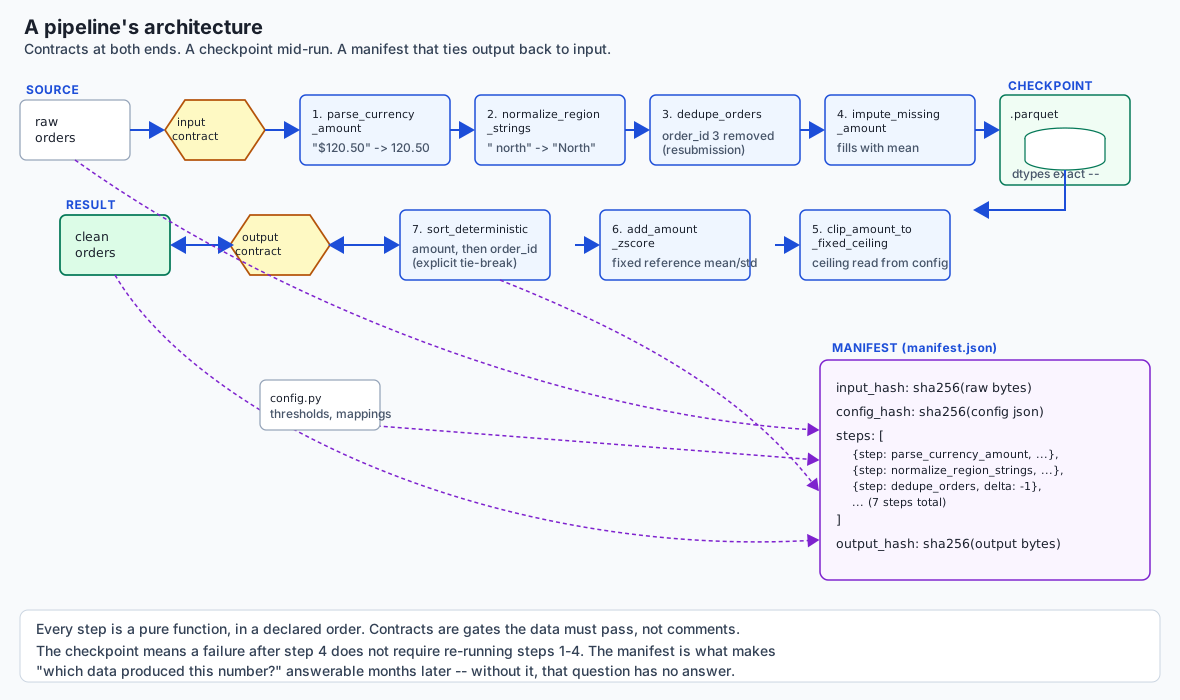
Picture the architecture diagram below: raw data enters through an amber input-contract gate, passes through seven named steps in a declared order, checkpoints to a small Parquet file partway through, passes an amber output-contract gate, and exits as clean data — while a purple manifest box off to the side quietly collects four things: a hash of the input, a hash of the configuration, the full step log, and a hash of the output. Nothing about that manifest changes what the pipeline computes. It exists purely so that, months from now, someone can answer “which data, and which settings, produced this exact number?” without guessing.
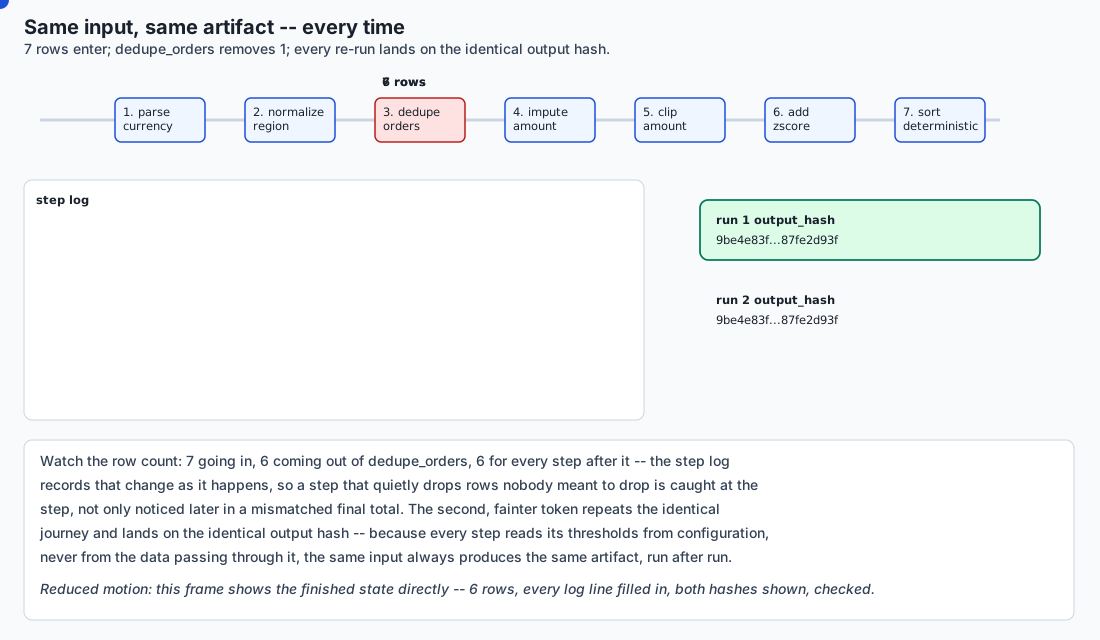
Now watch the same pipeline in motion. A token carrying a row count travels through the seven steps; watch it shrink from 7 to 6 exactly at the dedupe_orders step, and stay at 6 for everything after. A step-log panel fills in beside it, one line per step, as the token passes. At the end, the token reaches a hash. Then a second, fainter token repeats the exact same journey — and lands on the exact same hash. That repetition is the entire argument of this lesson, made visual: the same input, run through the same pipeline, produces the same artifact, every single time, including the second time.
Hold one image from the everyday-analogy section in reserve for now, because it will do a lot of work later: a pipeline is a recipe you hand to someone else, not a dish you cooked once. A recipe that says “add salt until it tastes right” is not reproducible — “until it tastes right” depends on who is tasting and what they already added. A recipe that says “add 4 grams of salt” is. Today is about turning “clean the data until it looks right” into something with the second recipe’s precision.
Historical background
Idempotence did not originate in data engineering. It is formally named and required in RFC 2616, the HTTP/1.1 specification published in June 1999, which defines GET, PUT and DELETE as idempotent methods — a client is explicitly permitted to retry any of them after a failed or uncertain response, because the specification requires that repeating the same request produces the same server state as making it once. POST is deliberately left out of that guarantee, which is exactly why “don’t double-click the buy button” became a widely known piece of web folklore: a POST request has no promised idempotence, so retrying it can genuinely create a second order. The same distinction — some operations are safe to retry, some are not, and the difference has to be a designed property, not an accident — is precisely what separates the fixed-ceiling clip step in this lesson’s lab from the recomputing-percentile one.
Apache Parquet, the file format this lesson’s checkpoints use, was announced in 2013 as a joint open-source effort between Twitter and Cloudera, built around the columnar-storage ideas described in Google’s 2010 Dremel paper. Its design goal was efficient, schema-preserving storage for large analytical datasets — which is exactly why it round-trips a nullable integer column’s missing values exactly, where a text format like CSV cannot, because Parquet’s file format stores the column’s declared type and nullability directly rather than re-inferring them from printed characters on read.
The SHA-256 hash function this lesson’s content_hash and config_hash functions build on is part of the SHA-2 family, designed by the U.S. National Security Agency and published by NIST in FIPS 180-2 in 2002. It has no known practical collision (two different inputs producing the same digest), which is exactly the property a content hash needs: if two frames hash differently, they are different; if two frames hash the same, in practice, they are the same.
The discipline of keeping configuration separate from code — this lesson’s CONFIG dictionary, holding every threshold this pipeline uses, so that changing a number never means editing a function — is formalised as Factor III of the Twelve-Factor App, a set of software-as-a-service design principles published by Adam Wiggins at Heroku in 2011. Its specific argument, “store config in the environment” (or, as this lesson’s smaller-scale version does, in a data structure the code reads rather than embeds), is that code and configuration change for different reasons, at different times, decided by different people — and conflating them means every parameter change requires a code change and a code review, when it should require neither.
pandas’ own DataFrame.pipe, which this lesson uses to compose the same seven steps a second way, exists specifically so a chain of function calls can read top to bottom, left to right, the way R’s magrittr/dplyr pipe operator (%>%) does — rather than nesting deeply as seventh(sixth(fifth(fourth(third(second(first(df))))))), which puts the first operation applied at the innermost, hardest-to-read position. .pipe() is documented in pandas’ own reference, cited in this lesson’s sources, as the tool for exactly that: composable functions, chained.
The version installed for this lesson, checked directly:
>>> import pandas; pandas.__version__
'3.0.5'
Nothing in this lesson’s core mechanics — idempotence, determinism, contracts, checkpointing, manifests — is new to pandas 3.0 or specific to it. One detail this lesson’s own code is written against is version-specific and worth stating plainly, because it changes what “the input contract’s dtype check” actually has to look for: pandas 3.0’s default string-inference behaviour gives a plain Python string column its own dedicated str extension dtype, not the historical object dtype. This lesson’s pipeline.py encodes that fact directly in REQUIRED_INPUT_COLUMNS, and steps.py’s idempotence guard on the currency-parsing step checks for a non-numeric dtype rather than the specific string "object", for exactly this reason — confirmed by running the code and reading the raised error, not assumed from memory.
What it is — and what it is not
A reproducible pipeline is a sequence of pure, named functions, each one frame-to-frame, applied in a declared order, with contracts checked at both ends. That is the complete definition this lesson works from. Every step is testable on its own, against a fixture small enough to compute the right answer by hand — which is exactly how the exercises in this lesson’s lab are written: not against a sample of “real” data, whose correct output nobody actually knows, but against a seven-row table this lesson built, whose correct output is known in advance because the table’s contents are literal, specified values.
It is not a notebook. A notebook’s defining hazard is out-of-order execution: cell 7 can run before cell 4 if you clicked them in that order, and the kernel’s state at any moment depends on the entire history of what you happened to run, in what order, including cells you have since deleted. A function-based pipeline has no such history — calling pipeline(df) today produces exactly the same result as calling pipeline(df) in six months, because nothing about the call depends on anything except its own arguments.
It is not automatically idempotent just because every individual step “looks like” a pure function. parse_currency_amount(df) and clip_amount_to_recomputed_percentile(df) are both, syntactically, pure functions: no global state, no side effects, a DataFrame in, a DataFrame out. Only one of them is idempotent. The difference is not purity — it is whether the function’s output depends only on its declared, fixed configuration, or also on incidental facts about whatever data happens to be passed in this particular call. A step that computes “the 99th percentile of whatever I was handed” has smuggled a piece of data-dependent state into what looks, from the outside, like a stateless function.
It is not the same problem a workflow runner like Prefect or Dagster solves, and conflating the two is a common and expensive mistake. A workflow runner schedules when a pipeline runs, retries a failed step automatically, and gives you a dashboard showing what ran and when. None of that has any bearing on whether the pipeline computes the right answer when it runs — a beautifully scheduled, automatically retried pipeline that recomputes its clip threshold from the current data will produce a beautifully scheduled, automatically retried wrong number, over and over, on every retry. Scheduling and correctness are genuinely separate concerns, covered separately in this lesson’s Tools section, and a plain function pipeline with no workflow runner at all is a completely legitimate, sufficient answer for a huge share of real cleaning work — the runner earns its keep only once you actually need automatic scheduling, retries across a fleet of jobs, or cross-team observability into which pipeline touched what.
It is not “the same as” a declarative schema-validation library like pandera, even though both check that data conforms to expectations. This lesson’s check_input_contract and check_output_contract are hand-written Python functions, chosen deliberately so every reader can see exactly what a contract does without learning a second library’s API first. pandera, covered in Tools, expresses the same idea — required columns, required dtypes, value-range checks — as a declarative schema object rather than an imperative function, which becomes worth the extra dependency once a pipeline has enough columns and enough rules that hand-writing every check becomes its own maintenance burden.
Why it was created and what problems it solves
Every property this lesson names exists to answer one recurring, expensive question: why does this pipeline give a different answer on Tuesday than it gave on Monday, when nothing about the code changed? Three specific ways that question gets asked, and the specific pipeline property that answers each one:
“I ran the same script twice and got two different numbers.” This is the idempotence failure this lesson opens with, and it is not a hypothetical — it is the single most common way a scheduled data pipeline silently corrupts itself. A step that clips to a recomputed percentile, appends a column derived from “today’s date,” or accumulates a running total by adding to an existing column rather than recomputing it from source, all share the same shape: correct the first time, wrong every time after, with nothing in the code that looks obviously broken. Idempotence turns “did this already run?” from a question that requires checking logs and comparing timestamps into a question that does not matter — running it again, on purpose or by accident, is safe by design.
“The report from last week’s run doesn’t match this week’s run on the same file.” This is a determinism failure, and the specific mechanism this lesson focuses on — an unstated tie-break in a sort — is genuinely subtle, because the two runs can each look perfectly reasonable in isolation. Nobody notices that sort_values("amount") alone leaves tied rows in an arbitrary order, because within one run, the order looks fine. The problem only shows up when two runs, built from data that arrived in a different order for a completely unrelated reason (a different export order from a source system, a different order after a groupby with sort=False), disagree on where the tied rows land.
“Step four is supposed to keep every row, and somehow we lost 20% of the data.” Without a step log, answering this means adding print statements to a script, one at a time, re-running the whole thing between each addition, until the culprit is found by elimination — the exact debugging experience Day 121’s inspection-battery discipline exists to prevent for a single frame, generalised here to an entire pipeline. With a step log, the answer is already sitting in a list of dictionaries: read down the delta column, and the step responsible for the drop announces itself.
“A production model’s predictions changed, and nobody knows if the data changed or the model changed.” This is the manifest’s reason for existing, and it is this lesson’s AI thread, covered in full in Implications below. Without a recorded input hash and configuration hash, “did the training data change?” is not a question with an answer — it is a question that requires re-deriving the training set from scratch and hoping the result matches whatever is running in production, which is expensive, slow, and sometimes impossible if the original source data has since changed underneath you.
How it works
Walk the full mechanism on this lesson’s lab data: seven orders, with a currency-formatted amount, an inconsistently cased region, a nullable Int64 priority with one missing value, and — deliberately built in — order_id 3, a resubmission of order_id 1 that differs only in region’s whitespace and casing.
>>> raw.dtypes
order_id    int64
region        str
amount        str
priority    Int64
dtype: object
>>> raw
   order_id  region     amount  priority
0         1   north    $120.50         1
1         2   South    $980.00         2
2         3   north    $120.50         1
3         4   EAST      $75.00      <NA>
4         5   South        NaN         3
5         6    west     $60.00         2
6         7    East  $1,250.00         1
Step one: the input contract runs before anything else. check_input_contract walks a small dictionary — {"order_id": "int64", "region": "str", "amount": "str", "priority": "Int64"} — checking each required column exists with exactly the declared dtype, and raises ContractError, naming the offending column, the moment one does not match:
>>> broken = raw.drop(columns=["priority"])
>>> pipeline.run_pipeline(broken, CONFIG)
pipeline.ContractError: input contract violated: missing required column 'priority'
>>> broken2 = raw.copy()
>>> broken2["order_id"] = broken2["order_id"].astype("float64")
>>> pipeline.run_pipeline(broken2, CONFIG)
pipeline.ContractError: input contract violated: column 'order_id' has dtype 'float64', expected 'int64'
Step two: seven named steps run, in the declared order, each one logged. parse_currency_amount strips $ and , and converts to float64, but only when the column is not already numeric — the guard that makes it idempotent. normalize_region_strings strips whitespace and title-cases. dedupe_orders sorts by order_id for a deterministic “first occurrence,” then drops rows matching on ["region", "amount", "priority"] — deliberately excluding order_id itself, because a resubmitted order is assigned a new ID by the intake system; the whole point is to catch a duplicate whose ID differs. impute_missing_amount fills the one missing amount with the column’s own mean. clip_amount_to_fixed_ceiling clips to a number read from CONFIG, never recomputed. add_amount_zscore computes a z-score against fixed reference statistics, also from CONFIG. sort_deterministic sorts by amount, with order_id as an explicit tie-break.
>>> df, log = pipeline.run_pipeline(raw, CONFIG)
>>> df
   order_id region  amount  priority  amount_zscore
0         6   West    60.0         2      -1.600000
1         4   East    75.0      <NA>      -1.500000
2         1  North   120.5         1      -1.196667
3         5  South   497.1         3       1.314000
4         2  South   900.0         2       4.000000
5         7   East   900.0         1       4.000000
Seven rows became six: order_id 3, the resubmission, is gone, and order_id 1 — the original — survives. Two different rows, order_id 2 and order_id 7, both land on amount == 900.0 after clipping: order_id 2’s real amount, $980, and order_id 7’s real amount, $1,250, both exceed the configured ceiling of 900.0 and both get clipped down to exactly that number, which is precisely the tie sort_deterministic’s order_id tie-break exists to resolve.
Step three: the step log, read after the fact.
>>> for entry in log: print(entry)
{'step': 'parse_currency_amount', 'rows_in': 7, 'rows_out': 7, 'delta': 0}
{'step': 'normalize_region_strings', 'rows_in': 7, 'rows_out': 7, 'delta': 0}
{'step': 'dedupe_orders', 'rows_in': 7, 'rows_out': 6, 'delta': -1}
{'step': 'impute_missing_amount', 'rows_in': 6, 'rows_out': 6, 'delta': 0}
{'step': 'clip_amount_to_fixed_ceiling', 'rows_in': 6, 'rows_out': 6, 'delta': 0}
{'step': 'add_amount_zscore', 'rows_in': 6, 'rows_out': 6, 'delta': 0}
{'step': 'sort_deterministic', 'rows_in': 6, 'rows_out': 6, 'delta': 0}
Every step’s rows_out equals the next step’s rows_in — that reconciliation is what proves the log is a complete, unbroken account of what happened, not a partial one. The total change, 6 - 7 = -1, equals the sum of every step’s delta, and dedupe_orders is the only step responsible for it. On a real pipeline with dozens of steps, this is the difference between “our row count is smaller than we expected, somewhere” and “step 14, specifically, dropped 8,400 rows — go look at step 14.”
Step four: the output contract runs after the last step, and only after. It checks that amount has no remaining missing values, that its dtype is genuinely numeric, that no value exceeds the configured clip ceiling, and that the required derived column amount_zscore exists. A contract that has only ever been checked against correctly-produced output has never actually been tested — so this lesson’s lab sabotages a step on purpose to prove the check has teeth:
>>> import pipeline as P
>>> P.clip_amount_to_fixed_ceiling = lambda d, c: d  # a "clip" step that clips nothing
>>> P.run_pipeline(raw, CONFIG)
pipeline.ContractError: output contract violated: 'amount' has a value above the clip ceiling 900.0 (max seen: 1250.0)
Step five: idempotence, checked directly. The pipeline’s own output — with amount already numeric, already deduplicated, already clipped — is fed back through the seven step functions a second time, and compared to the first run’s output:
>>> once, _ = pipeline.apply_steps_logged(raw, CONFIG)
>>> twice, _ = pipeline.apply_steps_logged(once, CONFIG)
>>> once.equals(twice)
True
Every threshold every step reads comes from CONFIG, never from once itself — so twice computes nothing new. Compare that against the deliberately broken clip step, run the same way:
>>> once_broken = steps.clip_amount_to_recomputed_percentile(prepared)
>>> twice_broken = steps.clip_amount_to_recomputed_percentile(once_broken)
>>> once_broken.loc[once_broken["order_id"] == 7, "amount"].iloc[0]
1236.5
>>> twice_broken.loc[twice_broken["order_id"] == 7, "amount"].iloc[0]
1223.675
>>> once_broken.equals(twice_broken)
False
Step six: hashing, checkpointing and the manifest. content_hash builds a SHA-256 digest of a frame’s exact CSV bytes; config_hash does the same for the configuration, serialised with sorted keys so key order never matters. checkpoint_to_parquet writes an intermediate frame to disk; load_checkpoint reads it back, dtype for dtype, including a nullable Int64 column’s missing value — where a CSV round-trip would lose the distinction between “this integer is missing” and “this column is actually floats.” build_manifest collects all four pieces — input hash, config hash, step log, output hash — into one small JSON-serialisable dictionary, walked in full in Examples in practice below.
An everyday analogy
You are handing a recipe to a friend who has never cooked this dish and will make it without you in the room. Every property this lesson names is a property that separates a genuinely usable recipe from a description of what you happened to do once.
Idempotence is the difference between “add salt until it tastes right” and “add 4 grams of salt.” The first instruction is not reproducible, because “tastes right” depends on who is tasting, how salty the stock already was, and how much salt got added the last time someone followed this same step — it is a step whose result depends on state outside the instruction itself. “Add 4 grams of salt” produces the same dish whether it is followed once or, by some kitchen mishap, followed twice by two different people who each thought the other hadn’t done it yet — well, followed twice would actually be 8 grams, which is exactly the point: the fix is not “make salt idempotent,” it is “make the whole recipe idempotent” by having the salt step check whether salt has already been added, the same way this lesson’s parse_currency_amount checks whether amount is already numeric before trying to strip currency symbols from it a second time.
Determinism and the tie-break show up the moment two ingredients need to go into the pan “in the order you have them.” If your friend happened to unpack their grocery bag with the onions on top, and you happened to unpack yours with the garlic on top, “add them in the order you have them” gives two different pans, even though both of you followed the instruction exactly. A reproducible recipe says “onions first, then garlic” — an explicit tie-break, not a delegation to whatever order the ingredients happened to arrive in.
A step log is the difference between a recipe that just says “cook until done” and a kitchen timer log: preheat at 2:00, oil in the pan at 2:03, onions in at 2:04, three minutes later garlic — a record you can check afterward if the dish comes out wrong, to find out which step ran long, rather than only knowing that something, somewhere, went wrong.
Contracts at both ends are the recipe’s own quality gates: “the oven must read 200°C before you put the tray in” (an input contract — check the conditions before you start) and “the internal temperature must reach 74°C before you take it out” (an output contract — check the result actually meets the promise, not just that you followed the steps). A recipe that only lists steps, with no check that the oven was actually hot or the food is actually done, trusts that everything upstream and downstream went right — and a contract you have never watched fail is a contract you have never actually tested; a smoke alarm that has never once gone off during a test is not proof your kitchen is safe, it is proof you have never tested the alarm.
A checkpoint is the recipe telling you “you can prepare the sauce up to two days ahead and refrigerate it” — so if the main course goes wrong on the night, you are not starting the sauce over from raw tomatoes. A manifest is the card taped to the container in the fridge: which recipe, which day, which substitutions were made. Without it, “why does this sauce taste different from the batch three weeks ago?” is a question nobody in the kitchen can actually answer — the substitution that mattered was never written down.
Examples in practice
Every value below is captured from a real run against pandas 3.0.5, pyarrow 25.0.1 and NumPy 2.5.2, using the exact raw_orders table and CONFIG defined in this lesson’s lab (labs/.../day-126-a-reproducible-cleaning-pipeline/starter/data.py), so every number here is independently reproducible by running that lab.
Determinism, proven across two entirely independent runs.
>>> df_a, _ = pipeline.run_pipeline(build_raw_orders(), CONFIG)
>>> df_b, _ = pipeline.run_pipeline(build_raw_orders(), CONFIG)
>>> df_a.equals(df_b)
True
>>> pipeline.content_hash(df_a) == pipeline.content_hash(df_b)
True
>>> pipeline.content_hash(df_a)
'9be4e83f364282312519c793338db734a8472c3b22bbb05848df30f87fe2d93f'
Two calls to build_raw_orders() build two separate DataFrame objects from the same literal values — nothing is shared between them in memory — and the pipeline still produces byte-identical output. That specific 64-character hex string is a real, captured digest; expected-output/FIELDS.md in this lesson’s lab records honestly that the literal digest depends on pandas’ CSV-formatting details and is not promised to match across every future pandas release, while the equality between two runs is the property this lesson’s assertions actually rely on, and that property holds on any correctly installed copy of this exact pinned version.
The tie-break, made concrete. Two orders — 2 and 7 — both land on amount == 900.0. Sort by amount alone, with no second key, and the result depends on which order the tied rows arrived in:
>>> forward = prepared.sort_values("amount", kind="stable")
>>> backward = prepared.iloc[::-1].sort_values("amount", kind="stable")
>>> forward.loc[forward["amount"] == 900.0, "order_id"].tolist()
[2, 7]
>>> backward.loc[backward["amount"] == 900.0, "order_id"].tolist()
[7, 2]
Same values, same “stable” sort, different order — because “stable” only ever promised to preserve arrival order among ties, and the two calls above handed it two different arrival orders on purpose. Naming order_id as an explicit second key removes the dependency entirely:
>>> forward2 = prepared.sort_values(["amount", "order_id"], kind="stable")
>>> backward2 = prepared.iloc[::-1].sort_values(["amount", "order_id"], kind="stable")
>>> forward2.loc[forward2["amount"] == 900.0, "order_id"].tolist()
[2, 7]
>>> backward2.loc[backward2["amount"] == 900.0, "order_id"].tolist()
[2, 7]
Order dependence: normalising before deduplicating versus after. This lesson’s data hides a resubmitted order (order_id 3) whose region differs from the original (order_id 1) only in whitespace and casing — " north" versus "north". The declared order runs normalize_region_strings before dedupe_orders:
>>> declared, _ = pipeline.run_pipeline(raw, CONFIG)
>>> len(declared)
6
>>> 3 in declared["order_id"].tolist()
False
Reverse the two steps — deduplicate on the raw, unnormalised strings, then normalise — and the duplicate is invisible, because " north" and "north" compare unequal as raw strings:
>>> swapped = pipeline.run_pipeline_swapped_order(raw, CONFIG)
>>> len(swapped)
7
>>> {1, 3}.issubset(set(swapped["order_id"].tolist()))
True
The difference runs deeper than row count. Because impute_missing_amount’s fill value is the column’s own mean at the moment it runs, and the swapped pipeline still has 7 rows (including the un-caught duplicate) when it computes that mean, order_id 5’s imputed amount is not the same number in the two versions:
>>> declared.loc[declared["order_id"] == 5, "amount"].iloc[0]
497.1
>>> swapped.loc[swapped["order_id"] == 5, "amount"].iloc[0]
434.333333...
Neither order is universally “correct” for every dataset — a resubmission-detection pipeline clearly wants the declared order here — but the two orders are demonstrably not interchangeable, and a pipeline that does not state which order it requires, and why, is leaving that decision to whoever happened to type the function calls in a particular sequence.
The Parquet checkpoint, with a nullable Int64 carried through intact.
>>> before = normalize_region_strings(parse_currency_amount(raw))
>>> before["priority"].tolist()
[1, 2, 1, <NA>, 3, 2, 1]
>>> before.dtypes["priority"]
Int64Dtype()
>>> pipeline.checkpoint_to_parquet(before, path)
>>> after = pipeline.load_checkpoint(path)
>>> before.equals(after)
True
>>> after.dtypes["priority"]
Int64Dtype()
>>> after["priority"].tolist()
[1, 2, 1, <NA>, 3, 2, 1]
Order_id 4’s missing priority survives the round trip as a genuine missing Int64 value, not as NaN in a column silently upgraded to float64 — the exact failure Day 121 demonstrated for CSV, and the specific reason this lesson’s checkpoints are Parquet rather than CSV.
The manifest, stable across runs and sensitive to one changed byte.
>>> manifest_a = pipeline.build_manifest(build_raw_orders(), CONFIG, log_a, df_a)
>>> manifest_b = pipeline.build_manifest(build_raw_orders(), CONFIG, log_b, df_b)
>>> manifest_a["input_hash"] == manifest_b["input_hash"]
True
>>> manifest_a["output_hash"] == manifest_b["output_hash"]
True
Now change one character — order_id 6’s amount, "$60.00" becomes "$60.01" — and re-run:
>>> changed = raw.copy()
>>> changed.loc[5, "amount"] = "$60.01"
>>> pipeline.content_hash(raw) == pipeline.content_hash(changed)
False
>>> changed_df, _ = pipeline.run_pipeline(changed, CONFIG)
>>> pipeline.content_hash(df_a) == pipeline.content_hash(changed_df)
False
>>> pipeline.config_hash(CONFIG) == pipeline.config_hash(CONFIG)
True
One byte, changed on purpose, changes both the input hash and the output hash — and leaves the config hash untouched, because the configuration itself never changed. That combination — input changed, config unchanged, output changed — is precisely the signature a manifest lets you read off, months later, without re-deriving anything: if input_hash differs between two runs and config_hash does not, the data changed, not the settings.
Implications: security, privacy, performance, scalability, and cost
A training set is the output of a pipeline, and this lesson’s manifest is the only thing that makes a model’s behaviour attributable — this is the AI thread, and it deserves to be stated plainly rather than as an afterthought. When a deployed model’s predictions shift unexpectedly, the first diagnostic question anyone asks is “did the data change, or did the model change?” If the training pipeline that produced last month’s data and this month’s data recorded a manifest each time — an input hash, a config hash, a step log, an output hash — that question is a lookup: compare the two input_hash values. If it did not, the question requires re-deriving both datasets from source, hoping the source data has not since changed underneath you, and comparing the results by hand — which is slower, more error-prone, and sometimes flatly impossible once upstream data has moved on. Reproducible data preparation is not a tidiness preference. It is the precondition for being able to say, with evidence rather than a guess, why a model behaves the way it does.
Idempotence is a security property, not merely a convenience, wherever a pipeline runs as part of an automated system. A retry-safe pipeline can be re-triggered after a timeout, a crash, or a network partition with no risk of corrupting its own output — which is exactly the property that makes automatic retries a safe default in a scheduler. A pipeline that is not idempotent turns “automatically retry on failure” from a resilience feature into a data-corruption hazard: the retry itself becomes the bug. This is precisely why HTTP’s specification bothers to define idempotence formally for GET, PUT and DELETE — the whole reason to know a method is idempotent is that it tells you retrying it is safe.
Contracts have a privacy dimension worth naming directly. An input contract that checks column names and dtypes, run before any transformation touches the data, is also the first and cheapest place to catch a genuinely wrong file — the wrong dataset entirely, mistakenly pointed at a pipeline meant for something else, containing columns (and possibly people) that were never supposed to be there. Catching that at the input gate, before a single row is processed, is strictly better than discovering it three steps in, after some of that data has already been written to a checkpoint or logged in an error message.
Performance: checkpointing trades disk space for restart cost, and the trade is usually a clear win. Writing an intermediate frame to Parquet costs disk I/O and some CPU for compression; the payoff is that a failure partway through an expensive pipeline — a slow join, a costly feature computation — resumes from the last checkpoint instead of from scratch. For this lesson’s seven-row lab, that trade is invisible; for a pipeline processing millions of rows where step five alone takes forty minutes, a checkpoint after step four is the difference between a five-minute recovery and a forty-minute one, every single time step five fails partway through a long-running job.
Scalability: everything this lesson demonstrates operates entirely in memory, on one machine, and the properties do not automatically survive a move to a distributed system. A pipeline scaled out across a Spark or Dask cluster introduces a genuinely new source of non-determinism this lesson’s single-process examples never encounter: partition order across workers is not guaranteed to be stable run to run, which means “sort by amount, tie-break on order_id” has to be an explicit, distributed-aware operation, not an assumption carried over unchanged from a single-machine pandas pipeline. The properties — idempotence, determinism, contracts, a manifest — remain exactly as necessary at scale; the specific mechanics of achieving determinism change.
Cost: every tool this lesson actually ran is free. pandas, PyArrow, NumPy, pytest, and Python’s own hashlib, json, logging and pathlib carry no licence fee and no paid tier for anything demonstrated here. The engineering time cost is the honest one worth naming: writing a step’s input and output contracts, and proving they can fail, takes real time up front — time that is reliably cheaper than the alternative, which is a multi-day, log-diffing investigation the first time a silently non-idempotent step corrupts a production dataset and nobody can say when it started.
Alternatives: free, open source, and commercial
Plain functions plus DataFrame.pipe (ran). Free, open source (BSD 3-Clause pandas licence), no paid tier. This lesson’s entire pipeline is built this way — and it is a genuinely sufficient answer for a large share of real cleaning work, not a simplified stand-in for “the real tool.” Compose steps as sequential assignments (df = step1(df); df = step2(df, config)) when you want the easiest place to insert an inspection between two steps; compose the identical steps with .pipe() when you want the chain to read as one flowing statement:
>>> via_pipe = (
...     raw.pipe(parse_currency_amount)
...        .pipe(normalize_region_strings)
...        .pipe(dedupe_orders, CONFIG)
...        .pipe(impute_missing_amount, CONFIG)
...        .pipe(clip_amount_to_fixed_ceiling, CONFIG)
...        .pipe(add_amount_zscore, CONFIG)
...        .pipe(sort_deterministic)
... )
>>> via_pipe.equals(declared)
True
Both forms compute the identical result — this lesson ran both and confirmed it directly, rather than assuming .pipe() is “just” nicer syntax. The genuine cost of .pipe() chaining is inspectability: there is nowhere to drop a print(df.shape) or a debugger breakpoint between two links in the chain without breaking the chain apart again into separate statements, which sequential assignment gives you for free at every single step. Choose .pipe() when the chain is short and well-tested and you want it to read cleanly; choose sequential assignment while you are still developing or debugging a pipeline, when you expect to need to inspect an intermediate frame.
pandera (docs only — not installed in this lesson’s environment, and no output from it is reproduced anywhere here). pandera lets a schema — required columns, dtypes, value ranges, custom row-level checks — be declared as a pandera.DataFrameSchema object and validated with a single call, rather than hand-written as a sequence of if statements the way this lesson’s check_input_contract and check_output_contract are. Its documentation describes both a class-based API resembling pydantic models and a more concise object-based API, and it raises a structured SchemaError listing every failing check at once, rather than stopping at the first one, which becomes genuinely valuable once a schema has enough rules that debugging them one at a time is its own time sink. pandera is free and open source (MIT licence), with no separate paid tier for the validation library itself. Choose it once a pipeline’s contracts have grown past what is comfortable to read as hand-written if/raise statements; the hand-written form this lesson uses has the advantage that every reader, at any experience level, can see exactly what it does without first learning pandera’s schema syntax.
Great Expectations (docs only — not installed in this lesson’s environment, no output reproduced). A more heavyweight declarative data-validation framework, expressing checks as named “expectations” (expect_column_values_to_not_be_null, expect_column_values_to_be_between) that can be run against a dataset and produce a human-readable validation report, often as part of a CI pipeline gating whether new data is allowed to proceed downstream. Its open-source core is free (Apache 2.0 licence); Great Expectations Cloud, a hosted layer for storing validation results, alerting, and collaboration across a team, is a paid product built on top of the free core. Choose it over a hand-written contract, or over pandera, when the checks themselves need to be visible and auditable by people who are not going to read the pipeline’s source code — a data-quality report is a very different artifact from a raised exception, and Great Expectations is built specifically to produce the former.
A workflow runner — Prefect or Dagster (docs only — neither installed here, no output reproduced). Both are free, open-source (Apache 2.0-family licences) Python frameworks for scheduling pipeline runs, retrying failed steps automatically, and giving operational visibility — a dashboard showing which run of which pipeline succeeded, failed, or is currently in progress — with a paid managed-cloud tier (Prefect Cloud, Dagster+) layered on top of each free core, covering hosted scheduling and team-level observability. Both are explicit that they solve scheduling, retries and observability — genuinely different concerns from the correctness properties this lesson is about. Running run_pipeline under Prefect gives you automatic retries on failure; it gives you nothing at all toward making the pipeline idempotent, which is exactly why this lesson’s idempotence and determinism work has to happen at the pipeline-function level, independent of whatever eventually schedules it. A plain function pipeline, called directly or from a simple cron job, is genuinely enough once a pipeline runs on one schedule with no cross-team dependency on watching it run — reach for a workflow runner once you need automatic retries across many pipelines, dependency graphs between them, or a shared dashboard other teams rely on.
Comparison with related concepts
| Concept | What it guarantees | What it does NOT guarantee | Where covered |
|---|---|---|---|
| A pure function | Same output for the same arguments, no side effects | Nothing about whether repeated CALLS with data-derived arguments give the same result | Today, “What it is — and what it is not” |
| Idempotence | pipeline(pipeline(df)) equals pipeline(df) | Determinism across two INDEPENDENTLY built inputs — a pipeline can be idempotent and still non-deterministic if it depends on wall-clock time or randomness | Today, exercise 1 |
| Determinism | Same input + same config always gives the same output, byte for byte | Idempotence — a deterministic pipeline can still change its own output on a second pass if it is not ALSO idempotent | Today, exercise 2 |
| A step log | Rows in/out per step, so a silent drop is locatable | Correctness of the VALUES a step computes — a step can preserve every row and still compute the wrong number | Today, exercise 3 |
| An input/output contract | The frame at that boundary meets a stated shape | Correctness of everything in between the two boundaries | Today, exercises 4-5 |
| A checkpoint | A failure partway through does not require a full re-run | Nothing about correctness — checkpointing a wrong intermediate result just makes the wrong result faster to reach again | Today, exercise 8 |
| A manifest | Provenance: which input, config and steps produced this exact output | Nothing about whether the pipeline’s LOGIC was correct — a manifest documents what ran, not whether it should have | Today, exercise 9 |
| A workflow runner (Prefect, Dagster) | Scheduling, automatic retries, cross-run observability | Nothing about correctness of any individual run — see Alternatives above | Today, Tools |
The row most worth re-reading is idempotence versus determinism, because the two are easy to conflate and are genuinely independent properties. A pipeline that appends pd.Timestamp.now() as a column is deterministic in the sense that it does not depend on row order or arrival order — but it is not idempotent, because the second call produces a different timestamp than the first. A pipeline that reads a fixed configuration and always produces the same result from the same input, but sorts with no tie-break, is close to idempotent (rerunning it on its own output changes nothing about the values) while still failing determinism (two independently built inputs with the same values in different row orders can produce different row orders out). This lesson’s pipeline needs, and has, both.
When to use it — and when not to
Build these properties into any pipeline that will run more than once, by more than one person, or on a schedule. That describes essentially all real data preparation work outside of a genuinely one-off, throwaway exploration — the moment a cleaning script is going to be handed to a colleague, run again next month on fresh data, or trusted as an input to a model that other people rely on, the cost of adding an input contract, an output contract, a step log and a manifest is small compared to the cost of the debugging session that happens the first time it silently produces a wrong number.
Reach for .pipe() chaining specifically when the pipeline is short, stable, and you are not actively debugging it — its readability wins once every step is already trusted; its inspectability cost is a real tax while you are still developing or troubleshooting a step.
Reach for a declarative contract library (pandera, Great Expectations) once hand-written if/raise contracts have grown past what is comfortable to read, or once the checks themselves need to be legible to people who will never read the pipeline’s Python source. Keep hand-written contracts, as this lesson does, while the number of rules is small and every reader benefits from seeing exactly what each check does without an extra dependency.
Reach for a workflow runner (Prefect, Dagster) once you need automatic retries, a dependency graph across multiple pipelines, or a shared dashboard other teams rely on — never as a substitute for making the pipeline itself idempotent and deterministic first. Scheduling a non-idempotent pipeline just automates how often it corrupts its own output.
Do not skip the manifest because a pipeline “isn’t that important.” The exact situations where a manifest turns out to matter — a model behaves unexpectedly in production, a stakeholder asks why a number changed since last quarter — are, almost by definition, situations nobody predicted in advance. The cost of building the manifest is paid once, up front, regardless of whether it is ever needed; the cost of not having it is paid, at a much higher rate, exactly when it is needed most.
Do not treat a checkpoint as a substitute for correctness. A checkpoint makes recovering from a crash cheap. It does nothing at all to make a wrong intermediate result right — checkpointing a step that silently drops a fifth of your rows just makes that mistake faster to reach on every subsequent run.
Knowledge check
Answer each question before checking quiz.yml.
- A clip step recomputes its threshold from the current frame every time it runs. What specific property does this violate, and what is the general fix?
- Two rows tie on a sort key. Why can a “stable” sort still give two different results across two independently built frames with the same values?
- What does a step log let you discover that a single before/after row-count comparison does not?
- Why does feeding a pipeline’s own output back into its INPUT contract raise an error that has nothing to do with idempotence?
- What is the point of deliberately sabotaging a step to make an output contract fail, rather than only confirming the contract passes on correct data?
- What real, non-cosmetic cost does
.pipe()chaining have compared to sequential function calls? - Why does deduplicating a table before normalising its string columns give a different answer than normalising first?
- Why is Parquet, rather than CSV, used for this lesson’s checkpoint?
Hands-on exercise
The lab for this lesson, “A Pipeline You Can Re-run,” lives at
labs/sections/math-statistics-and-data/day-126-a-reproducible-cleaning-pipeline/
and walks all nine properties covered above as a real, runnable pytest
suite: idempotence (with the broken step demonstrated before the fix),
determinism and an explicit tie-break, a step log that reconciles, input
and output contracts proven able to fail, .pipe() equivalence,
order-dependence, a Parquet checkpoint round-trip, and a manifest checked
for stability and sensitivity to a one-byte change.
Set up and run the reference suite first:
cd labs/sections/math-statistics-and-data/day-126-a-reproducible-cleaning-pipeline
python3 -m venv .venv
.venv/bin/pip install -r requirements/requirements.txt
.venv/bin/pytest examples
Then open starter/00_brief.md and starter/test_pipeline.py, and replace
each pytest.skip(...) with a real assertion, checking your progress with:
.venv/bin/pytest starter -vExpected output
17 passed in 0.08sfor pytest examples, and, on the checked-in starter,
17 skipped in 0.02sfor pytest starter. bash tests/run_tests.sh ends with:
16 checks, 0 failure(s)and exits 0.
Validate your work
Run bash tests/run_tests.sh from the lab directory. It confirms the
installed pandas matches requirements.txt exactly, runs the reference
suite and requires 17 passed, runs your exercise suite, confirms
pytest examples starter in one invocation fails to collect at all rather
than silently shadowing one directory’s tests, solves every exercise in a
temporary scratch copy to prove a fully-completed suite passes,
deliberately breaks one assertion to prove the suite can genuinely fail,
restores it, and checks no .parquet, .json or .csv file — and no
__pycache__ — was left behind.
Troubleshooting
See troubleshooting.md in the lab directory for the full list, grouped
by the exact message you see — including the single most common mistake
with this lab’s layout: never run pytest examples starter in one
command, because every module in this lab (data, steps, pipeline,
conftest, test_pipeline) is defined identically in both directories,
and pytest aborts collection outright with an import file mismatch
rather than quietly shadowing one directory with the other.
Common mistakes
- Checking idempotence with
pipeline.run_pipeline(which enforces the INPUT contract) instead ofpipeline.apply_steps_logged(which does not) — the input contract correctly rejects a pipeline’s own output, becauseamountis supposed to be numeric by then, which is a different fact from whether the pipeline is idempotent. - Sorting by the primary key alone and assuming a “stable” sort makes the result deterministic — stability only preserves arrival order among ties; it does not remove the dependency on what that arrival order was.
- Writing an output contract, running it once against correct data, and calling it done — without deliberately sabotaging a step to confirm the contract can actually fail, there is no evidence the check does anything at all.
- Assuming
.pipe()and sequential function calls have a performance difference — they do not; the real difference is inspectability, not speed.
Practice assignment
Take a small, hand-built dataset of your own — five to ten rows is plenty — with at least one text column that has whitespace or casing variants of the same value, and at least one numeric column that needs parsing (currency symbols, thousands separators, or similar). Build a three- or four-step pipeline as pure functions, then:
- Write an input contract checking your required columns and dtypes, and confirm it raises, naming the column, when you deliberately drop or mistype one.
- Write a step log and confirm it reconciles across every step.
- Check
pipeline(pipeline(df))equalspipeline(df)exactly. If it does not on your first attempt, find the step responsible and explain, in one sentence, what data-dependent state it was smuggling in. - Build a manifest with an input hash, a config hash, and an output hash, and confirm it is stable across two independent runs on the same data.
Write down, in one paragraph, which step in your own pipeline was hardest to make idempotent, and why.
Extension challenge
Take a pipeline you have already written for this course — the Week 18 project, or an earlier lab — and retrofit it with everything covered today: an input contract, an output contract proven able to fail, a step log, a checkpoint at the most expensive stage, and a manifest. Then simulate the exact failure this lesson opens with: call your pipeline three times in a row, feeding each output back in as the next call’s input, and confirm all three outputs are identical. If any step in your pipeline is not idempotent, identify the specific data-dependent computation responsible, fix it so it reads from a fixed configuration instead, and re-run the three-times check to confirm it now holds.
Quiz
Q1. A clip step computes ceiling = df["amount"].quantile(0.99) and clips to it, every time it runs. Run once on raw data, order 7's amount clips to about 1236.5. Run the SAME step again on that output, order 7's amount changes to about 1223.675. What property does this step lack?
- Idempotence -- applying the step twice in a row changes the result a second time
- A step log -- the step does not record its own row count
- An output contract -- the step does not check its own result
- Determinism -- the step produces a different result on different machines
Show answer
Answer: A. Idempotence -- applying the step twice in a row changes the result a second time
Idempotence is exactly the property that pipeline(pipeline(df)) equals pipeline(df). This step fails it because it recomputes its threshold from whatever data is CURRENTLY passing through it -- the second call sees already-clipped data and computes a new, lower ceiling from it. The fix is to read a fixed threshold from configuration instead of recomputing it from the frame.
Q2. Two rows both land on amount == 900.0 after clipping. Sorting by amount alone, using a "stable" sort, gives a different relative order for these two rows depending on whether they arrived in the DataFrame forward or reversed. What does this demonstrate?
- A bug in pandas' sort implementation
- A stable sort only preserves arrival order among tied values -- it is not the same thing as a deterministic order across two independently built frames, which requires an explicit tie-break
- Floating-point numbers can never be compared for exact equality
- The sort should have used quicksort instead of a stable sort
Show answer
Answer: B. A stable sort only preserves arrival order among tied values -- it is not the same thing as a deterministic order across two independently built frames, which requires an explicit tie-break
"Stable" means equal elements keep their relative input order -- it says nothing about what that input order was. Two independently built frames with the same two tied values in different arrival orders will sort differently unless a secondary key (here, order_id) is named explicitly to break the tie. Determinism requires that explicit tie-break; a stable sort alone does not provide it.
Q3. A pipeline's step log shows dedupe_orders with rows_in=7 and rows_out=6, and every other step with rows_in equal to the previous step's rows_out. What does this log let you discover that a single "N rows in, N rows out" summary would not?
- The exact runtime of each step in milliseconds
- Whether the pipeline used .pipe() or sequential function calls
- Exactly WHICH step changed the row count and by how much, so a step that unexpectedly discards a fifth of the data is caught at that step rather than only noticed in the final total
- Nothing extra -- the summary and the per-step log carry the same information
Show answer
Answer: C. Exactly WHICH step changed the row count and by how much, so a step that unexpectedly discards a fifth of the data is caught at that step rather than only noticed in the final total
A single before/after row count tells you THAT rows were lost somewhere; a per-step log tells you WHERE. Reading the log after the fact is how you discover that one specific step -- not the pipeline as a whole -- is quietly discarding rows nobody meant to discard, which the reconciliation habit from groupby (Day 123) generalises to an entire multi-step pipeline.
Q4. A pipeline's input contract requires the "amount" column to have dtype "str". Feeding the PIPELINE'S OWN OUTPUT (where "amount" is now float64, exactly as the pipeline is supposed to leave it) back into that same contract raises ContractError. Is this a bug in the pipeline?
- Yes -- a correct pipeline must always accept its own output as valid input
- Yes -- this proves the pipeline is not idempotent
- No -- ContractError should never be raised under any circumstances
- No -- the input contract is a check on freshly-ingested external data specifically, and idempotence is a property of the transformation itself, checked by applying the step functions directly rather than by re-running the input-contract-gated entry point
Show answer
Answer: D. No -- the input contract is a check on freshly-ingested external data specifically, and idempotence is a property of the transformation itself, checked by applying the step functions directly rather than by re-running the input-contract-gated entry point
The input contract and idempotence are two different, both-necessary checks. The input contract protects the pipeline from malformed external data on ingestion; idempotence is a property of the step functions themselves, verified by applying them twice in a row directly, not by forcing an already-transformed frame back through a contract written for raw input.
Q5. An output contract asserts "amount" never exceeds the configured clip ceiling. A step is sabotaged into a no-op that skips clipping entirely, and the pipeline is re-run. What is the point of confirming the contract THEN raises an error, rather than just confirming it does not raise an error on normal input?
- It proves the contract can genuinely catch a real violation, not merely that it happens to agree with correct output -- an untested contract could be vacuously true and would never catch anything
- There is no point -- if it passes on normal input, that alone proves it works correctly
- It measures how fast the contract check runs
- It is only useful for debugging, never for demonstrating correctness
Show answer
Answer: A. It proves the contract can genuinely catch a real violation, not merely that it happens to agree with correct output -- an untested contract could be vacuously true and would never catch anything
A check that only ever runs against already-correct data has never actually been exercised -- it could be written wrong (checking the wrong column, using the wrong comparison) and still "pass" every time simply because it never encounters a violation. Deliberately sabotaging a step and confirming the contract raises is the only way to prove the contract does real work.
Q6. Building a DataFrame with steps chained via .pipe() versus the same steps called sequentially, one assignment at a time, produce identical output frames. What real, non-cosmetic tradeoff does the lesson identify between the two styles?
- .pipe() chains are always faster because pandas optimises them internally
- Sequential calls cannot use configuration arguments, only .pipe() can
- There is no real tradeoff; the two styles are interchangeable in every respect
- .pipe() chains read well top to bottom, but there is nowhere to insert a breakpoint or an intermediate df.shape check between two links without breaking the chain apart -- sequential calls give that inspectability for free
Show answer
Answer: D. .pipe() chains read well top to bottom, but there is nowhere to insert a breakpoint or an intermediate df.shape check between two links without breaking the chain apart -- sequential calls give that inspectability for free
Both styles produce the same result and neither has a performance edge -- .pipe() is composing the same function calls, just written differently. The genuine tradeoff is readability against inspectability: a .pipe() chain reads as one flowing statement, but debugging an intermediate step means breaking the chain apart again, which sequential assignment never requires.
Q7. A pipeline's data contains a resubmitted order whose region string differs only in whitespace and casing from the original (" north" vs "North"). Deduplicating BEFORE normalising region strings misses this duplicate; deduplicating AFTER normalising catches it. What does this demonstrate about pipeline order?
- This is a bug in pandas' string comparison, not a property of step order
- Some steps commute and some do not -- normalising before deduplicating gives a different, and here more correct, answer than the reverse, so the pipeline must declare its required order and the reason rather than leaving it arbitrary
- Deduplication should always run first, in every pipeline, as a universal rule
- Step order never affects the result, only step logic does
Show answer
Answer: B. Some steps commute and some do not -- normalising before deduplicating gives a different, and here more correct, answer than the reverse, so the pipeline must declare its required order and the reason rather than leaving it arbitrary
Comparing raw, unnormalised strings treats " north" and "North" as different values, so a content-based deduplication run first cannot recognise them as the same order. Running normalisation first collapses the casing/whitespace difference before deduplication compares rows, catching the duplicate. Neither order is universally "correct" for every dataset -- the point is that the choice changes the answer and must be a stated decision, not an accident of write order.
Q8. A Parquet checkpoint of a DataFrame containing a nullable Int64 column with one missing value is reloaded, and the reloaded column is still Int64 with the missing value in the same position. Why is Parquet used for this checkpoint instead of CSV?
- Parquet and CSV behave identically for this case; the choice is purely stylistic
- Parquet files are always smaller than CSV files, which is the only reason to prefer them
- CSV cannot represent negative numbers
- CSV round-trips every value through text with no explicit dtype or nullability information, so a nullable Int64 column with a missing value typically comes back as float64 with NaN -- Parquet preserves the schema, including nullability, exactly
Show answer
Answer: D. CSV round-trips every value through text with no explicit dtype or nullability information, so a nullable Int64 column with a missing value typically comes back as float64 with NaN -- Parquet preserves the schema, including nullability, exactly
This is Day 121's finding, used directly here: CSV has no way to declare a column's dtype or that None specifically means "a missing integer" rather than "a missing float" -- reading it back requires re-inferring types from text, and a nullable integer with a gap typically becomes float64 with NaN. Parquet stores the schema explicitly, so the round-trip preserves the exact dtype and the exact missing-value marker.
Glossary
- pipeline (data)
- A named sequence of pure, frame-to-frame functions applied in a declared order, with contracts checked at both ends, so the same input and configuration always produce the same output -- as opposed to an ad hoc sequence of notebook cells run in whatever order they happen to be clicked.
- idempotence
- The property that applying an operation a second time to its own output produces the same result as applying it once: pipeline(pipeline(df)) equals pipeline(df). A pipeline that lacks this property drifts silently every time it happens to run twice, which a retried scheduled job does routinely.
- determinism
- The property that the same input and configuration always produce a byte-identical output, including row order -- which requires every sort to name an explicit tie-break, because a "stable" sort only preserves whatever order tied rows happened to arrive in.
- input contract
- A check, run before a pipeline's first step, that a frame has every required column with the required dtype. Raises immediately, naming the offending column, rather than letting a malformed frame fail confusingly several steps later.
- output contract
- A check, run after a pipeline's last step, that the result meets the promises the pipeline is supposed to keep (no missing values in a required column, no value above a configured ceiling, a required derived column present). Proven meaningful only by demonstrating it can genuinely fail when a step is sabotaged, not merely that it passes on correct input.
- step log
- A record, built while a pipeline runs, of each step's name, rows in, rows out, and the net change. Read after the fact, it is how a silently row-dropping step is discovered rather than guessed at -- the reconciliation habit from groupby (Day 123) generalised to a whole pipeline.
- checkpoint
- An intermediate result written to disk (here, Parquet) between expensive pipeline stages, so a failure partway through does not require re-running everything from the start. Parquet is used rather than CSV because it preserves dtypes exactly, including a nullable Int64 column's missing values, where CSV round-trips everything through text and loses them (Day 121).
- manifest
- A small JSON record tying a pipeline's output back to its origin: the input's content hash, the configuration's hash, the step log, and the output's content hash. The only thing that makes "which data produced this number?" answerable months later without guessing.
- content hash
- A cryptographic digest (here, SHA-256 via hashlib) computed from a frame's or a config's exact serialised bytes. Two runs on identical input produce an identical hash; changing even one byte of the input changes the hash. The specific hex digest can depend on serialisation details (float formatting, key order) and is not promised to match across different library versions -- the STABILITY and SENSITIVITY properties are what a pipeline actually relies on.
- order dependence
- The fact that some pipeline steps produce different, equally defensible results depending on which order they run in -- normalising string casing before deduplicating catches variant-cased duplicates that deduplicating first would miss. A pipeline should declare its required order and the reason, rather than leaving it to whichever order someone happened to write the calls in.
- configuration (pipeline)
- Thresholds, column lists and mappings kept in a data structure the pipeline reads, separate from the step functions' code, so re-running with different parameters means editing the configuration, never the logic.
- DataFrame.pipe
- A pandas method that composes a sequence of frame-to-frame functions by passing each one's output as the next one's input, read top to bottom like a chain. Readable, but it removes the easy place to insert an inspection or a breakpoint between two steps that sequential function calls give for free -- a real tradeoff, not a stylistic one.
- pandera
- A Python library for declaring a DataFrame's expected schema -- column names, dtypes, value ranges and custom checks -- as data rather than as hand-written if-statements, raising a structured error when a frame fails to conform. Not installed in this lesson's environment; described from its documentation only.
- Great Expectations
- A Python library for declaring and running "expectations" about a dataset (row counts, null rates, value distributions) as part of a pipeline, with a paid-hosted layer (Great Expectations Cloud) built around the free open-source core. Not installed in this lesson's environment; described from its documentation only.
- workflow runner
- Software such as Prefect or Dagster that schedules pipeline runs, retries failed steps, and gives operational visibility into what ran and when -- solving a genuinely different problem from the correctness a pipeline's own idempotence, determinism and contracts provide. Not installed in this lesson's environment; described from documentation only.
- mean imputation
- Filling a missing value with the column's own mean (Day 125). Idempotent in a pipeline only if no later step can reintroduce a missing value into that column -- otherwise a second run can compute a different mean from an already-imputed column.
- to_numeric(errors="coerce")
- A pandas function that converts a column to a numeric dtype, turning any value it cannot parse into NaN rather than raising (Day 125). Idempotent on an already-numeric column, because the conversion is a no-op once nothing is left to coerce.
- string normalisation
- Collapsing superficially different text representations of the same value (whitespace, casing, known synonyms) to one canonical form (Day 125). Whether it runs before or after deduplication changes which rows are recognised as duplicates -- this lesson's central order-dependence example.
- reproducibility
- The property that a pipeline, run again later -- possibly by someone else, on a different machine -- produces the documented result. Requires idempotence, determinism, checkpointing and a manifest together; no single one of them is sufficient on its own.
- tie-break
- A secondary sort key named explicitly to give rows with an equal primary-sort value a deterministic relative order, independent of the order they happened to arrive in. Without one, a "stable" sort merely preserves arrival order, which is not the same thing as a deterministic order across two independently built frames.
Sources and further reading
- DataFrame.pipe — pandas Development Team (accessed 2026-08-19)
- IO tools (text, CSV, HDF5, ...) — pandas Development Team (accessed 2026-08-19)
- hashlib -- Secure hashes and message digests — Python Software Foundation (accessed 2026-08-19)
- logging -- Logging facility for Python — Python Software Foundation (accessed 2026-08-19)
- pandera documentation — pandera (Union.ai) (accessed 2026-08-19)
Kept in this browser, no account needed. Your progress page turns the whole record into one link you can bookmark or open on another device.