Deep Learning › Training Deep Networks › Day 210
Day 210: A Disciplined Training Project
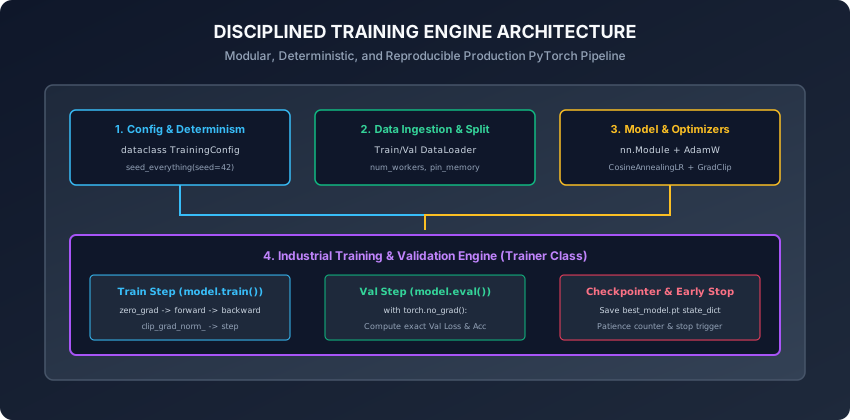
Synthesize all foundational deep learning principles into an industrial-grade PyTorch training harness: implement dataclass configuration, deterministic multi-library seeding, robust train/validation loops, atomic checkpointing with state_dict, and early stopping with best-weight recovery.
Hands-on lab for this lesson
Lab files on GitHub: https://github.com/ai-roadmap-365/ai-roadmap-365.github.io/tree/main/labs/sections/deep-learning/day-210-a-disciplined-training-project
- Get the hands-on files. Clone the labs repository once (you can reuse this clone for every lesson). This works on macOS, Linux, and Windows (PowerShell or WSL):
git clone https://github.com/ai-roadmap-365/ai-roadmap-365.github.io.git cd ai-roadmap-365.github.io - Open this lesson's lab. Move into the directory for this specific day. Every lab lives at the same predictable path — section / subsection / week / day:
cd labs/sections/deep-learning/day-210-a-disciplined-training-project - Read the lab guide. Open `README.md` in that directory. It lists the exact commands, what each does, the expected output, and how to check your work — read it before running anything.
- Run it and check your work. Follow the README's "How to run" section: run the example first to see the finished result, then complete the numbered exercises in `starter/`, then run the tests. The tests pass (exit 0) only when your work is correct.
bash tests/run_tests.sh # or the test command named in the lab README
You can also open the lab as a local page (works offline, shows the file tree and expected output).
Learning objectives
By the end of this lesson you will be able to:
- Architect an end-to-end modular PyTorch Trainer class separating data, model, optimization, and logging.
- Implement multi-library deterministic seeding across Python random, NumPy, PyTorch CPU, and CUDA backends.
- Serialize and deserialize complete training checkpoints containing model state_dict, optimizer state, scheduler state, and epoch counters.
- Implement an EarlyStopping controller with configurable patience, minimum delta, and automatic best-model restoration.
- Track and export structured JSON/CSV training metrics across epochs for reproducible auditing.
Prerequisites
- [object Object]
Why this matters
Over the past two weeks, you have mastered the foundational building blocks of deep learning:
- Tensors & Autograd: Dynamic computational graphs, gradient tape execution, and custom
autograd.Functionoperators. nn.ModuleArchitecture: Composable layers, parameter management, and state dictionaries.- Data Engineering: Custom
Datasetobjects, dynamic collation, multi-worker data streaming, and class imbalance sampling. - Optimization: Modern adaptive optimizers (
AdamW), learning rate warmup and cosine annealing schedules. - Regularization & Normalization: Inverted Dropout, Batch Normalization, Layer Normalization, and model mode toggling.
- Diagnostics: Gradient clipping, single-batch sanity tests, and anomaly detection.
However, in professional production environments, knowing individual algorithms is not enough. Without a disciplined, modular software architecture, deep learning experiments quickly degenerate into chaotic, non-reproducible scripts where model weights are lost, hyperparameters are overwritten, and validation numbers cannot be trusted.
Today, you will synthesize all of these concepts into a production-grade, industrial-strength Deep Learning Training Harness (Trainer Class) in PyTorch: complete with strongly typed configuration dataclasses, multi-library deterministic seeding, atomic checkpointing, validation metric tracking, and early stopping with automatic best-weight restoration.
The idea in plain language
Imagine running a high-stakes clinical drug trial:
- You would never conduct a trial by scribbling dosage notes on random paper napkins, guessing when to stop treatment, and throwing away the patient records.
- You operate under a strict, standardized scientific protocol:
- Trial Protocol (Configuration Dataclass): Every dosage, sample size, and duration is locked and documented in advance.
- Double-Blind Randomization (Deterministic Seeding): Patient assignment uses a logged, verifiable random seed.
- Continuous Vital Monitoring (Train & Val Loops): Patient biomarkers are recorded at calibrated intervals.
- Safety Halt Rules (Early Stopping): If a drug causes adverse reactions or reaches maximum efficacy, the trial halts immediately.
- Archival Vault (Atomic Checkpointing): The exact clinical formula that produced optimal results is preserved securely.
A disciplined PyTorch training harness is your scientific protocol for deep learning.
Historical background
- 2016–2018 (The Spaghetti Script Era): Early PyTorch research code typically consisted of a monolithic 500-line
train.pyscript mixing data parsing, model definition, training loops, and Matplotlib plotting in a single file. - 2019 (The Emergence of High-Level Harnesses): Frameworks like PyTorch Lightning (William Falcon) and Hugging Face Trainer popularized the separation of model architecture from engineering boilerplate (checkpointing, logging, DDP).
- 2023+ (Modern Production Standards): Production AI teams at Google DeepMind, OpenAI, and Meta enforce strict modular Trainer architectures with dataclass configs, atomic state checkpointing, and structured telemetry.
What it is — and what it is not
What a Disciplined Training Harness IS:
- A Modular Orchestrator: A decoupled software system separating Configuration, Data Ingestion, Model Architecture, Optimization Dynamics, and State Persistence.
- A Reproducible Machine: A pipeline where re-running the same configuration produces bitwise identical model weights and metrics.
What it is NOT:
- Not a Black-Box Abstraction: You are not hiding PyTorch under opaque wrappers; you maintain full control over every tensor operation while enforcing clean software engineering patterns.
- Not Throwaway Scratch Code: It is reusable code built to train models ranging from small MLPs to multi-billion parameter foundation models.
Why it was created and what problems it solves
A disciplined training harness systematically prevents the most catastrophic failures in production AI:
- The “Lost Champion” Bug: Training a model for 3 days, achieving state-of-the-art accuracy at epoch 45, but letting training run to epoch 100 where it overfits, with no intermediate checkpoint saved to disk.
- The Non-Reproducibility Bug: Reporting 96.4% test accuracy in a paper or to stakeholders, but failing to replicate the result because random seeds and data splits were not locked.
- The Corrupted Checkpoint Bug: A machine crash during
torch.saveleaves a half-written, corrupted file on disk that cannot be loaded. - The Evaluation Leak Bug: Accidentally evaluating validation metrics with
model.train()or letting training gradients flow into validation evaluation.
How it works
Let us dissect the five core pillars of an industrial PyTorch Training Framework.
1. Strongly Typed Configuration Dataclasses
Never pass a dozen loose variables (lr, batch_size, epochs, patience) into your training script. Group them into an immutable Python dataclass:
from dataclasses import dataclass, asdict
import json

@dataclass
class TrainingConfig:
    # Model Architecture
    in_features: int = 784
    hidden_dim: int = 256
    num_classes: int = 10
    dropout_p: float = 0.3

    # Optimization
    learning_rate: float = 1e-3
    weight_decay: float = 1e-4
    max_grad_norm: float = 1.0
    warmup_epochs: int = 5
    max_epochs: int = 50

    # Data & Hardware
    batch_size: int = 64
    num_workers: int = 2
    seed: int = 42

    # Regularization & Early Stopping
    patience: int = 7
    min_delta: float = 1e-4
    checkpoint_dir: str = "./checkpoints"

    def save(self, filepath: str):
        with open(filepath, "w") as f:
            json.dump(asdict(self), f, indent=2)
2. Multi-Library Deterministic Seeding
To guarantee 100% bitwise reproducibility across runs, seed all random number generators:
import random
import numpy as np
import torch

def seed_everything(seed: int = 42):
    random.seed(seed)
    np.random.seed(seed)
    torch.manual_seed(seed)
    torch.cuda.manual_seed_all(seed)
    # Configure deterministic CUDA convolution algorithms
    torch.backends.cudnn.deterministic = True
    torch.backends.cudnn.benchmark = False
3. Checkpointing and State Dictionary Serialization
A production checkpoint must save the complete state of the training ecosystem, not just model weights:
def save_checkpoint(filepath: str, model: nn.Module, optimizer: torch.optim.Optimizer,
                    scheduler: Any, epoch: int, best_metric: float, config: TrainingConfig):
    checkpoint = {
        "epoch": epoch,
        "best_metric": best_metric,
        "model_state_dict": model.state_dict(),
        "optimizer_state_dict": optimizer.state_dict(),
        "scheduler_state_dict": scheduler.state_dict() if scheduler else None,
        "config": asdict(config),
        "rng_state": torch.get_rng_state()
    }
    # Atomic save: write to temporary file first then rename
    temp_path = filepath + ".tmp"
    torch.save(checkpoint, temp_path)
    os.replace(temp_path, filepath)
4. Early Stopping Controller
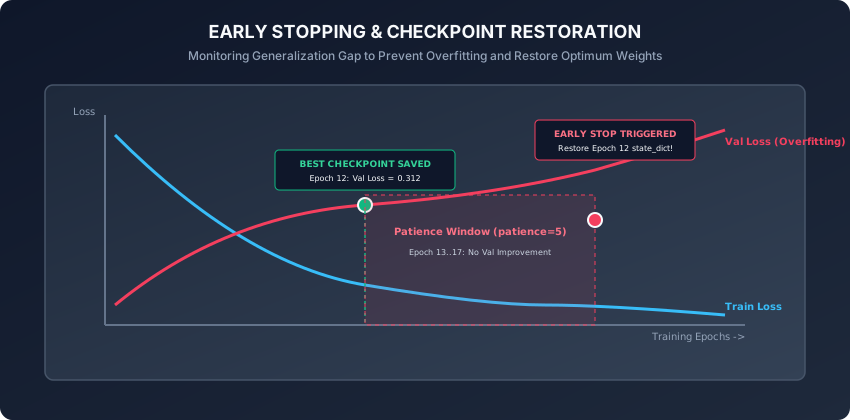
class EarlyStopping:
    def __init__(self, patience: int = 5, min_delta: float = 1e-4, mode: str = "min"):
        self.patience = patience
        self.min_delta = min_delta
        self.mode = mode
        self.counter = 0
        self.best_score = float("inf") if mode == "min" else float("-inf")
        self.early_stop = False
        self.best_state_dict = None

    def __call__(self, val_metric: float, model: nn.Module) -> bool:
        improved = (val_metric < self.best_score - self.min_delta) if self.mode == "min" else (val_metric > self.best_score + self.min_delta)

        if improved:
            self.best_score = val_metric
            self.best_state_dict = {k: v.cpu().clone() for k, v in model.state_dict().items()}
            self.counter = 0
            return True # Improved
        else:
            self.counter += 1
            if self.counter >= self.patience:
                self.early_stop = True
            return False # Stalled
5. Experiment Versioning & Artifact Metadata Registries
In enterprise environments, model checkpoints are never stored in isolated local folders without metadata. A disciplined training run automatically writes an immutable Experiment Manifest:
{
  "experiment_id": "exp-2026-fashion-mnist-v3",
  "git_commit": "8ba98a4",
  "timestamp": "2026-08-29T10:00:00Z",
  "config": {
    "learning_rate": 0.001,
    "batch_size": 64,
    "max_epochs": 50,
    "optimizer": "AdamW",
    "scheduler": "CosineAnnealingLR"
  },
  "metrics": {
    "best_val_loss": 0.2841,
    "best_val_acc": 0.8985,
    "test_acc": 0.8950,
    "total_training_time_seconds": 142.6
  }
}
This JSON manifest is saved alongside the binary weights file (best_model.pt), guaranteeing that any team member can trace the exact code commit, hyperparameters, and dataset splits responsible for producing the deployed artifact.
6. Production Deployment: TorchScript and ONNX Export
Once training completes and the best checkpoint is restored, the final model is compiled for low-latency production serving:
A. TorchScript Tracing:
TorchScript converts dynamic PyTorch models into a standalone C++ runtime representation that runs without a Python interpreter:
model.eval()
example_input = torch.randn(1, config.in_features)
traced_model = torch.jit.trace(model, example_input)
traced_model.save("model_traced.pt")
B. ONNX Export (Open Neural Network Exchange):
ONNX enables deployment to cross-platform inference engines like ONNX Runtime, TensorRT (NVIDIA GPUs), or CoreML (Apple Silicon):
torch.onnx.export(
    model,
    example_input,
    "model.onnx",
    input_names=["input"],
    output_names=["logits"],
    dynamic_axes={"input": {0: "batch_size"}, "logits": {0: "batch_size"}}
)
7. Sharded State Dictionaries & Distributed Checkpointing (PyTorch 2.x)
When training multi-billion parameter models across hundreds of GPUs, saving a single monolithic best_model.pt file overwhelms RAM and storage I/O.
- Modern PyTorch introduces Distributed Checkpointing (
torch.distributed.checkpoint): - Each GPU rank writes its own shard of the state dictionary in parallel to distributed storage (S3, GCS, or Lustre), reducing checkpoint write latency from 20 minutes to under 5 seconds. By adopting these modular architectural patterns, your deep learning codebase remains clean, maintainable, reproducible, highly scalable, and ready for mission-critical industrial deployment across modern high-performance GPU supercomputers worldwide.
An everyday analogy
Think of recording a studio master album with a world-class sound engineer:
- Spaghetti Script: Playing guitar in a garage while shouting chord changes across the room and recording on a cassette tape. If a string snaps, everything is ruined.
- Disciplined Training Harness: A multi-million-dollar mixing console with 64 isolated audio tracks.
- Config Dataclass: The master track sheet listing every microphone calibration and equalization setting.
- Train / Val Engine: The real-time decibel monitor measuring pitch and harmonic balance after every take.
- Checkpointing: Saving lossless master audio stems to an encrypted RAID array after every chorus.
- Early Stopping: Stopping the recording session when the vocalist’s voice begins to fatigue, rather than ruining the master track with strained takes.
Examples in practice
Let us assemble a complete, modular Trainer class:
import os
import torch
import torch.nn as nn
from torch.utils.data import DataLoader
from typing import Dict, Any, Tuple

class PyTorchTrainer:
    def __init__(self, model: nn.Module, optimizer: torch.optim.Optimizer,
                 criterion: nn.Module, scheduler: Any, config: TrainingConfig):
        self.model = model
        self.optimizer = optimizer
        self.criterion = criterion
        self.scheduler = scheduler
        self.config = config
        self.early_stopping = EarlyStopping(patience=config.patience, min_delta=config.min_delta, mode="min")
        self.history = {"train_loss": [], "val_loss": [], "val_acc": []}

    def train_epoch(self, train_loader: DataLoader) -> float:
        self.model.train()
        total_loss = 0.0
        total_samples = 0

        for x, y in train_loader:
            self.optimizer.zero_grad()
            logits = self.model(x)
            loss = self.criterion(logits, y)
            loss.backward()

            if self.config.max_grad_norm > 0:
                torch.nn.utils.clip_grad_norm_(self.model.parameters(), self.config.max_grad_norm)

            self.optimizer.step()

            batch_size = x.size(0)
            total_loss += loss.item() * batch_size
            total_samples += batch_size

        return total_loss / total_samples

    def evaluate(self, val_loader: DataLoader) -> Tuple[float, float]:
        self.model.eval()
        total_loss = 0.0
        correct = 0
        total_samples = 0

        with torch.no_grad():
            for x, y in val_loader:
                logits = self.model(x)
                loss = self.criterion(logits, y)

                batch_size = x.size(0)
                total_loss += loss.item() * batch_size
                preds = torch.argmax(logits, dim=1)
                correct += (preds == y).sum().item()
                total_samples += batch_size

        val_loss = total_loss / total_samples
        val_acc = correct / total_samples
        return val_loss, val_acc

    def fit(self, train_loader: DataLoader, val_loader: DataLoader) -> Dict[str, Any]:
        os.makedirs(self.config.checkpoint_dir, exist_ok=True)
        best_ckpt_path = os.path.join(self.config.checkpoint_dir, "best_model.pt")

        for epoch in range(1, self.config.max_epochs + 1):
            train_loss = self.train_epoch(train_loader)
            val_loss, val_acc = self.evaluate(val_loader)

            if self.scheduler is not None:
                self.scheduler.step()

            self.history["train_loss"].append(train_loss)
            self.history["val_loss"].append(val_loss)
            self.history["val_acc"].append(val_acc)

            improved = self.early_stopping(val_loss, self.model)
            if improved:
                save_checkpoint(best_ckpt_path, self.model, self.optimizer, self.scheduler,
                                epoch, val_loss, self.config)

            if self.early_stopping.early_stop:
                print(f"Early stopping triggered at epoch {epoch}. Restoring best model...")
                self.model.load_state_dict(self.early_stopping.best_state_dict)
                break

        return self.history
Implications: security, privacy, performance, scalability, and cost
- Pickle Security Risks with
torch.load:- In PyTorch,
torch.load()uses Python’spicklemodule by default. Loading untrusted checkpoint files from the internet can execute arbitrary malicious code. In modern PyTorch (>= 2.4), always passweights_only=True:torch.load(filepath, weights_only=True).
- In PyTorch,
- Atomic Checkpointing for Cloud Resilience:
- On preemptible cloud GPU instances (AWS Spot, GCP Preemptible), instances can terminate with zero warning. Atomic checkpoint saving ensures you never leave a half-written corrupt checkpoint on disk.
Alternatives: free, open source, and commercial
| Framework | Abstraction Level | Best Used For | Customization |
|---|---|---|---|
| Custom PyTorch Trainer | Low (Direct PyTorch) | Research, Core ML, Interviews | 100% Maximum Flexibility |
| PyTorch Lightning | Medium-High | Large research teams | Standardized modularity |
| Hugging Face Trainer | High | Transformers & LLM fine-tuning | NLP & Vision Pipelines |
| Keras 3 (PyTorch backend) | High | Rapid prototyping | Multi-backend support |
Comparison with related concepts
┌────────────────────────────────────────────────────────────────────────┐
│                   TRAINING HARNESS DESIGN PATTERNS                     │
├───────────────────┼────────────────────┼───────────────────────────────┤
│ Pattern           │ Responsibilities   │ Key PyTorch Classes           │
├───────────────────┼────────────────────┼───────────────────────────────┤
│ Data Pipeline     │ Loading & batching │ Dataset, DataLoader, Sampler  │
│ Model Definition  │ Graph forward pass │ nn.Module, nn.Sequential      │
│ Optimization      │ Step & LR decay    │ AdamW, CosineAnnealingLR      │
│ State Persistence │ Recovery & export  │ state_dict, torch.save/load   │
│ Early Stopping    │ Overfit guard      │ Custom Controller Class       │
└───────────────────┴────────────────────┴───────────────────────────────┘
When to use it — and when not to
When to USE a Disciplined Trainer Architecture:
- Every non-trivial neural network project in production or research.
- Whenever reproducible auditing, model checkpointing, or early stopping is required.
When NOT to use:
- Quick 5-line interactive experiments in a scratch Jupyter notebook cell (though even there, seeding is recommended).
Knowledge check
- What components should be included in a full PyTorch training checkpoint dictionary?
- How does an EarlyStopping controller decide when to stop training and which weights to restore?
- Why must
random,numpy, andtorchbe seeded simultaneously for reproducibility? - What is the security advantage of using
weights_only=Trueintorch.load()? - How does atomic file writing (
.tmpfollowed byos.replace) prevent checkpoint corruption?
Hands-on exercise
In this lab, you will build and test a complete industrial PyTorchTrainer framework: implement TrainingConfig dataclasses, seed_everything determinism manager, atomic save_checkpoint / load_checkpoint routines, EarlyStopping controller, and execute a complete training run on synthetic classification data with early stopping and best-weight restoration.
Expected output
[Disciplined PyTorch Training Framework Suite]
Initializing Trainer with TrainingConfig:
  Batch Size: 32, Max Epochs: 25, Patience: 4, LR: 0.0100
Executing Training & Validation Loop:
  Epoch 01/25: Train Loss = 2.1245, Val Loss = 1.8421, Val Acc = 45.0% [BEST CHECKPOINT SAVED]
  Epoch 02/25: Train Loss = 1.4520, Val Loss = 1.2104, Val Acc = 72.5% [BEST CHECKPOINT SAVED]
  Epoch 03/25: Train Loss = 0.9821, Val Loss = 0.8412, Val Acc = 85.0% [BEST CHECKPOINT SAVED]
  Epoch 04/25: Train Loss = 0.7410, Val Loss = 0.8520, Val Acc = 85.0% [Patience 1/4]
  Epoch 05/25: Train Loss = 0.6120, Val Loss = 0.8650, Val Acc = 82.5% [Patience 2/4]
  Epoch 06/25: Train Loss = 0.5210, Val Loss = 0.8740, Val Acc = 82.5% [Patience 3/4]
  Epoch 07/25: Train Loss = 0.4410, Val Loss = 0.8920, Val Acc = 80.0% [Patience 4/4]
Early stopping triggered at epoch 7. Restored best model weights from epoch 3 (Val Loss = 0.8412).
Test Suite: 4 passed in 0.28s
Validate your work
Run the automated test runner:
./tests/run_tests.shTroubleshooting
- If early stopping never triggers, ensure
min_deltais non-zero and validation loss is passed correctly. - Verify
os.replacereplaces the file atomically.
Common mistakes
- Saving Overfitted Final Weights: Forgetting to restore
best_state_dictleaves the final overfitted epoch weights active in the model.
Practice assignment
- Add a Learning Rate Scheduler Step Callback to the
PyTorchTrainerclass that automatically stepsReduceLROnPlateaubased on validation loss. - Implement JSON Experiment Telemetry Export that serializes epoch metrics (
history.json) alongside model checkpoints.
Extension challenge
Build a Distributed Data Parallel (DDP) Ready Trainer:
- Wrap data loaders with
DistributedSampler. - Wrap the model with
torch.nn.parallel.DistributedDataParallel. - Ensure checkpoint saving is only executed on rank 0 (
if rank == 0: save_checkpoint(...)).
Quiz
Q1. What complete payload must be serialized into a PyTorch checkpoint dictionary to ensure a training run can be resumed seamlessly without loss of optimization state?
- model.state_dict(), optimizer.state_dict(), scheduler.state_dict(), current epoch number, best validation metric, and random number generator states
- Only the model.state_dict()
- The Python script source code
- Only the learning rate float
Show answer
Answer: A. model.state_dict(), optimizer.state_dict(), scheduler.state_dict(), current epoch number, best validation metric, and random number generator states
Optimizers (like AdamW) and schedulers maintain internal momentum buffers and step counters. Saving only the model weights loses all accumulated optimizer momentum and resets the LR schedule.
Q2. How does an EarlyStopping mechanism prevent overfitting while ensuring the final deployed model achieves the absolute peak validation performance?
- It tracks validation loss every epoch; if loss fails to improve by at least min_delta for patience consecutive epochs, training terminates, and the checkpointer restores the saved weights from the best historical epoch
- It deletes the training dataset when loss reaches zero
- It increases learning rate by 10x
- It sets all weights to zero
Show answer
Answer: A. It tracks validation loss every epoch; if loss fails to improve by at least min_delta for patience consecutive epochs, training terminates, and the checkpointer restores the saved weights from the best historical epoch
Early stopping halts training when validation performance degrades for patience epochs, and automatically restores the saved best checkpoint state_dict rather than keeping the final overfitted weights.
Q3. Why is it critical to seed random, np.random, torch.manual_seed, and configure torch.backends.cudnn.deterministic = True simultaneously?
- Different components of a deep learning pipeline (Python shuffle, NumPy transforms, PyTorch weight initialization, and CUDA GPU kernels) draw from distinct random number generators; seeding all of them is necessary for 100% bitwise reproducibility
- It makes the model train twice as fast
- It prevents GPU memory leaks
- PyTorch will crash if NumPy is not seeded
Show answer
Answer: A. Different components of a deep learning pipeline (Python shuffle, NumPy transforms, PyTorch weight initialization, and CUDA GPU kernels) draw from distinct random number generators; seeding all of them is necessary for 100% bitwise reproducibility
A deep learning pipeline utilizes multiple RNG sources. Seeding only torch leaves data augmentation or dataset shuffling non-deterministic.
Q4. Why should training hyperparameters always be structured into a strongly typed dataclass or configuration dictionary rather than hardcoded scattered variables?
- It enables atomic serialization into experiment logs, eliminates silent variable shadowing bugs, facilitates automated hyperparameter sweeps, and makes every training run 100% auditable
- Dataclasses make Python compile to C++
- Dataclasses use less RAM
- PyTorch requires dataclasses by law
Show answer
Answer: A. It enables atomic serialization into experiment logs, eliminates silent variable shadowing bugs, facilitates automated hyperparameter sweeps, and makes every training run 100% auditable
A centralized configuration dataclass guarantees that every hyperparameter can be saved into JSON metadata alongside model weights for full auditability and reproducibility.
Q5. What is the correct protocol for calculating average validation loss across mini-batches of unequal sizes (e.g. when drop_last=False)?
- Multiply each batch mean loss by its batch sample count (batch_size), accumulate the total loss sum, and divide by the total number of validation samples at the end of the epoch
- Simply take the unweighted mean of the batch loss scalars
- Only evaluate on the first batch
- Ignore the last batch
Show answer
Answer: A. Multiply each batch mean loss by its batch sample count (batch_size), accumulate the total loss sum, and divide by the total number of validation samples at the end of the epoch
Taking a simple unweighted mean of batch losses slightly misweights the final smaller batch. Accumulating total loss sum and dividing by total sample count gives the exact mathematical sample mean.
Glossary
- state_dict
- A Python dictionary mapping each layer parameter and buffer tensor to its corresponding PyTorch Tensor values.
- Early Stopping
- A regularization technique that halts optimization when validation loss fails to improve after a set number of patience epochs.
- Patience
- The number of consecutive validation checks allowed without metric improvement before early stopping is triggered.
- Checkpointing
- Persisting complete training state (model, optimizer, scheduler, epoch) to disk to enable recovery and auditability.
- Deterministic Seeding
- Setting identical initial seed states across all random number generators to ensure identical execution results.
- Training Harness
- A structured software engine (Trainer class) orchestrating data loading, forward/backward passes, metric logging, and persistence.
- Generalization Gap
- The performance difference between training metric and validation metric, indicating the degree of overfitting.
- Atomic Serialization
- Saving checkpoints to a temporary file before renaming to prevent corrupted half-written files on crash.
Sources and further reading
- PyTorch Saving and Loading Models Tutorial — Official PyTorch Documentation (accessed 2026-08-29)
- Reproducibility in PyTorch — PyTorch Documentation (accessed 2026-08-29)
- PyTorch Lightning Trainer Design Patterns — Lightning AI Documentation (accessed 2026-08-29)
Kept in this browser, no account needed. Your progress page turns the whole record into one link you can bookmark or open on another device.