Deep Learning › Training Deep Networks › Day 209
Day 209: Debugging Training Runs
Master systematic debugging protocols for deep learning: detect vanishing and exploding gradients, implement gradient clipping with torch.nn.utils.clip_grad_norm_, use autograd anomaly detection to trace NaNs, execute the single-batch overfitting sanity test, and inspect activation histograms.
Hands-on lab for this lesson
Lab files on GitHub: https://github.com/ai-roadmap-365/ai-roadmap-365.github.io/tree/main/labs/sections/deep-learning/day-209-debugging-training-runs
- Get the hands-on files. Clone the labs repository once (you can reuse this clone for every lesson). This works on macOS, Linux, and Windows (PowerShell or WSL):
git clone https://github.com/ai-roadmap-365/ai-roadmap-365.github.io.git cd ai-roadmap-365.github.io - Open this lesson's lab. Move into the directory for this specific day. Every lab lives at the same predictable path — section / subsection / week / day:
cd labs/sections/deep-learning/day-209-debugging-training-runs - Read the lab guide. Open `README.md` in that directory. It lists the exact commands, what each does, the expected output, and how to check your work — read it before running anything.
- Run it and check your work. Follow the README's "How to run" section: run the example first to see the finished result, then complete the numbered exercises in `starter/`, then run the tests. The tests pass (exit 0) only when your work is correct.
bash tests/run_tests.sh # or the test command named in the lab README
You can also open the lab as a local page (works offline, shows the file tree and expected output).
Learning objectives
By the end of this lesson you will be able to:
- Diagnose and resolve vanishing and exploding gradients across deep neural network architectures.
- Implement gradient norm clipping using torch.nn.utils.clip_grad_norm_ to stabilize training on steep loss surfaces.
- Activate PyTorch autograd anomaly detection (torch.autograd.set_detect_anomaly) to isolate exact NaN/Inf origin nodes.
- Execute the single-batch overfitting sanity test to verify architectural and computational graph integrity.
- Log and visualize loss curves, gradient norms, and activation distributions in TensorBoard.
Prerequisites
- [object Object]
Why this matters
Training a deep neural network is fundamentally different from traditional software engineering. In standard software development, a bug causes an explicit compiler error, a syntax exception, or a runtime crash.
In deep learning, broken models fail silently.
- Your code can execute with zero errors, fully utilize your GPU, run for 48 hours, and produce a model that outputs purely random predictions.
- A missing
optimizer.zero_grad(), an unnormalized input tensor, an inverted target mask, or an improperly initialized bias vector will quietly corrupt optimization dynamics without crashing Python.
As Andrej Karpathy famously noted in A Recipe for Training Neural Networks: “Neural network training is a leaky abstraction. Everything can look fine on the surface, but underneath, optimization is completely broken.”
Today, you will master the systematic, battle-tested protocols of Debugging Deep Learning Training Runs: from verifying initial loss baselines and executing the single-batch overfit test to hunting NaNs with autograd.set_detect_anomaly and stabilizing explosive dynamics with Gradient Norm Clipping.
The idea in plain language
Imagine troubleshooting a modern jet engine:
- If the turbine fails to spin, a master mechanic does not immediately install a turbocharger and hope for the best.
- The mechanic follows a strict, step-by-step diagnostic checklist:
- Fuel Flow Check (Data Sanity): Is fuel reaching the combustion chamber uncorrupted? (Are inputs normalized? Are labels aligned?).
- Static Spark Test (Single-Batch Overfit): Can the spark plug ignite a single drop of fuel on the bench? (Can the model drive 10 samples to 0.000 loss?).
- Pressure Relief Valve (Gradient Clipping): If chamber pressure spikes wildly, does the emergency relief valve vent excess pressure safely before the turbine explodes? (Does gradient norm clipping cap explosive updates?).
- Exhaust Temperature Sensors (Loss & Activation Metrics): Are temperatures within calibrated physical bounds? (Is initial loss equal to
ln(K)?).
By following this disciplined checklist, you eliminate guesswork and diagnose issues with scientific precision.
Historical background
- 2010 (Glorot & Bengio - Xavier Initialization): Solved the classical “Vanishing Gradient” problem in deep sigmoid networks, showing that random Gaussian initialization caused variance to collapse exponentially across layers.
- 2013 (Pascanu, Mikolov & Bengio - On the Difficulty of Training RNNs): Introduced Gradient Norm Clipping, proving that gradient clipping is mathematically necessary to navigate cliffs in recurrent loss surfaces.
- 2018 (PyTorch Anomaly Detection): Introduced
torch.autograd.set_detect_anomaly(True), providing the world’s first automated stack-trace localization for NaN/Inf gradient bugs in dynamic computation graphs. - 2019 (Andrej Karpathy - A Recipe for Training Neural Networks): Published the canonical practitioner methodology for disciplined model development.
What it is — and what it is not
What Systematic Deep Learning Debugging IS:
- A Hypothesis-Driven Diagnostic Discipline: Isolating data bugs, architectural bugs, optimization bugs, and numerical pathologies through controlled unit tests.
- A Staged Progression: Starting from tiny synthetic baselines and scaling up only after every intermediate sanity check passes.
What it is NOT:
- Not Random Hyperparameter Flailing: Randomly changing learning rates or adding layers when the underlying bug is a transposed label tensor.
- Not Trusting Silent Execution: Never assuming code is correct simply because
model.forward(x)completed without an exception.
Why it was created and what problems it solves
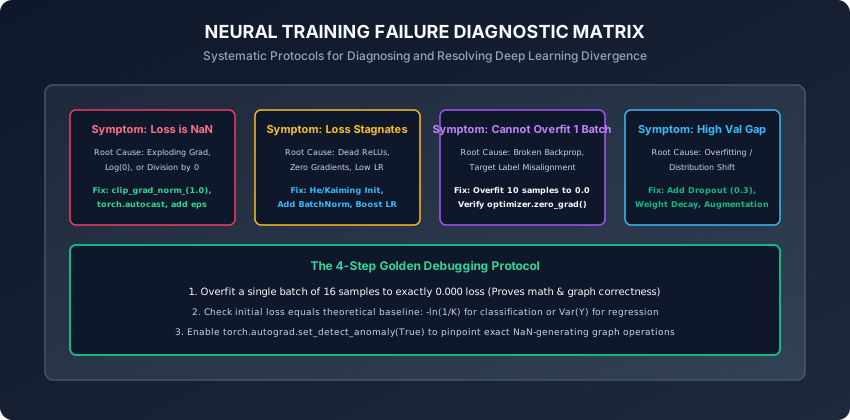
Systematic debugging resolves the four most prevalent failure modes in deep learning:
- Loss Exploding to
NaNorInf: Caused by high learning rates, unclipped gradients, or taking logarithms of zero (log(0)in custom loss functions). - Loss Stagnating at Chance Performance (
ln(K)): Caused by dead ReLUs, disconnected computational graphs, zero learning rates, or missing parameter registration. - Inability to Learn Simple Patterns: Caused by bugs in label alignment or un-normalized input tensors with huge variance.
- Silent Validation Degradation: Caused by evaluating in
model.train()mode or leaking validation data into the training pipeline.
How it works
Let us dissect the four core pillars of the deep learning debugging methodology.
1. The 4-Step Golden Debugging Protocol
Before training a complex model on a massive dataset, execute these four checks:
Check A: Verify the Theoretical Initial Loss
Before running any optimizer steps, compute the loss on step 0:
- For a $K$-class classification problem with balanced classes and Cross-Entropy loss:
Loss_initial = -ln(1 / K) = ln(K)- For binary classification ($K=2$):
Loss = ln(2) = 0.693 - For MNIST ($K=10$):
Loss = ln(10) = 2.302 - For ImageNet ($K=1000$):
Loss = ln(1000) = 6.908
- For binary classification ($K=2$):
- If your initial loss is significantly higher or lower than
ln(K), check your loss function for scaling errors, missing softmax operations, or bad weight initialization.
Check B: The Single-Batch Overfit Sanity Test
Take a tiny subset of your data (e.g. 16 samples) and train the model on only this single batch for 50–100 iterations:
- Expected Result: Training loss must plummet to
< 0.001and accuracy must reach100.0%. - If the model cannot overfit 16 samples, stop immediately. You have a fundamental bug in your architecture, gradient update loop, or data pipeline.
Check C: Monitor Gradient Norms
Track the global Euclidean norm of model gradients:
total_norm = torch.norm(torch.stack([torch.norm(p.grad.detach()) for p in model.parameters() if p.grad is not None]))- If
total_norm < 1e-6: Gradients have vanished (check activations and initialization). - If
total_norm > 100.0: Gradients are exploding (apply gradient clipping).
Check D: Verify Data and Target Alignment
Visually inspect raw batch inputs alongside their decoded string labels to ensure targets were not shuffled or off-by-one.
2. Gradient Norm Clipping Mechanics
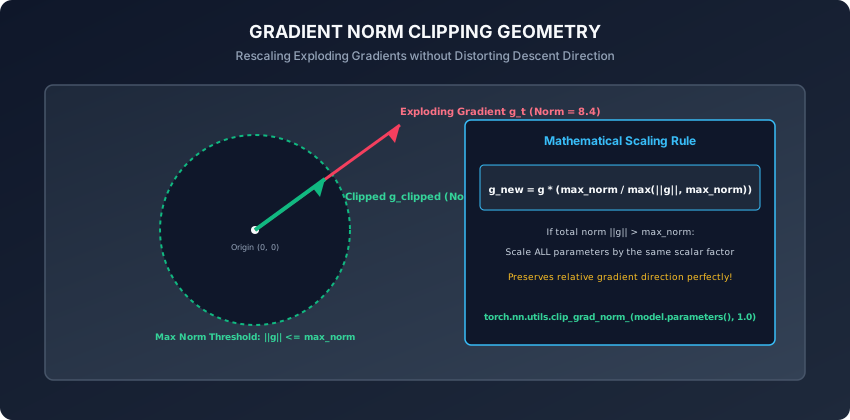
When an optimization step encounters a steep cliff on the loss surface, the gradient vector $G$ can explode to thousands of units in magnitude, catapulting weights into numerical infinity.
Gradient Norm Clipping (torch.nn.utils.clip_grad_norm_) computes the global Euclidean norm of all parameters concatenated:
||G|| = sqrt(sum_{p in params} sum_{w in p} (grad_w ** 2))If ||G|| > G_max (where G_max is typically set to 1.0 or 5.0):
grad_clipped = grad * (G_max / ||G||)Why Norm Clipping is Superior to Value Clamping:
- Value Clamping (
clip_grad_value_) clamps individual elements between[-c, c], which changes the angle and distorts the descent direction. - Norm Clipping (
clip_grad_norm_) scales all gradients by the exact same scalar factor, preserving the true directional vector of steepest descent.
# Standard PyTorch Training Step with Gradient Clipping
optimizer.zero_grad()
loss = criterion(model(x), y)
loss.backward()

# Clip gradients before optimizer step
grad_norm = torch.nn.utils.clip_grad_norm_(model.parameters(), max_norm=1.0)
optimizer.step()
3. Hunting NaNs with Autograd Anomaly Detection
When your loss suddenly becomes nan, how do you find which line of code generated it?
Enable PyTorch’s native anomaly detector:
torch.autograd.set_detect_anomaly(True)When an operation outputs a NaN or Inf during forward or backward passes, PyTorch immediately halts execution and prints the exact Python stack trace where the offending node was created:
RuntimeError: Function 'LogBackward0' returned nan values in its 0th output.
Traceback (most recent call last):
  File "train.py", line 42, in forward
    loss = torch.log(probabilities) # <-- Pinpointed exact bug!
4. Mixed Precision Underflow & Gradient Scaler Diagnostics
In modern deep learning, models are routinely trained using Automatic Mixed Precision (AMP) (fp16 or bf16) to double compute throughput and halve GPU memory usage.
- In
fp16, the minimum representable positive normal float is approximately6e-5(2^-14). - Small gradients routinely underflow to exact zero (
0.0), permanently freezing parameter updates. - The Solution (GradScaler):
torch.cuda.amp.GradScalermultiplies the loss by a large scale factor (e.g. 65,536) before backpropagation, pushing gradients into the safe dynamic range offp16, and then un-scales them before the optimizer step. - Diagnostic Rule: If the loss scaler continuously halves its scale factor down to
1.0or1e-4, your model has persistent gradient explosions or NaNs inside its computation graph.
5. Activation Distribution Tracking with Forward Hooks
To diagnose silent representation collapse or dead ReLUs without cluttering your forward methods, use PyTorch Forward Hooks:
def make_activation_hook(layer_name: str):
    def hook(module, input, output):
        mean = output.data.mean().item()
        std = output.data.std().item()
        dead_fraction = (output.data == 0.0).float().mean().item()
        print(f"[{layer_name}] Mean: {mean:.3f}, Std: {std:.3f}, Dead Sparsity: {dead_fraction*100:.1f}%")
    return hook

# Attach hook to monitor hidden layer health
for name, layer in model.named_modules():
    if isinstance(layer, nn.ReLU):
layer.register_forward_hook(make_activation_hook(name))- If
Dead Sparsity > 80%: Your network is suffering from catastrophic dead ReLUs; replace withnn.LeakyReLUor addnn.BatchNorm1d. - If
Std < 1e-4: Activations have collapsed to a point (vanishing signal). - If
Std > 100.0: Activations are exploding across layers.
6. The Production Post-Mortem Runbook
When a multi-day training run diverges or fails, follow this strict post-mortem triage sequence:
- Freeze Random Seeds: Re-run the exact failing step deterministically with
torch.manual_seed. - Inspect Data Samples: Print the exact batch inputs and label indices that triggered the divergence. Check for corrupt images, out-of-bounds target IDs, or zero-length sequences.
- Check Gradient Norm Log: Look at the gradient norm time series immediately preceding the failure. Did gradient norms spike exponentially 5 steps before the crash?
- Isolate Loss Operations: Check custom loss functions for unconstrained exponents (
torch.exp(x)) or un-bounded log operations (torch.log(x + 1e-8)).
An everyday analogy
Think of a residential electrical panel with circuit breakers:
- Uncontrolled Exploding Gradient: A power surge strikes your house. Without circuit breakers, the wiring overheats, catches fire, and burns the house down (NaN Loss / Corrupted Model Weights).
- Gradient Norm Clipping: A magnetic circuit breaker that instantly trips during a power surge, capping the maximum electrical current to 15 Amps (
max_norm = 1.0) while allowing normal household power to flow safely. - Single-Batch Overfitting: Testing a new light switch with a single 9-volt battery before connecting it to the high-voltage municipal electrical grid.
Examples in practice
Let us inspect a complete diagnostic script implementing the Golden Debugging Protocol:
import torch
import torch.nn as nn
from typing import Tuple

class DefectiveNet(nn.Module):
    def __init__(self):
        super().__init__()
        # Initialized with massive weights to simulate explosive gradients
        self.fc1 = nn.Linear(32, 128)
        self.fc2 = nn.Linear(128, 10)

    def forward(self, x):
        h = torch.relu(self.fc1(x))
        return self.fc2(h)

def run_single_batch_overfit_test(model: nn.Module, in_dim: int = 32, num_classes: int = 10,
                                  batch_size: int = 16, max_steps: int = 50) -> bool:
    torch.manual_seed(42)
    x_single = torch.randn(batch_size, in_dim)
    y_single = torch.randint(0, num_classes, (batch_size,))

    optimizer = torch.optim.AdamW(model.parameters(), lr=0.01)
    criterion = nn.CrossEntropyLoss()

    model.train()
    print(f"Sanity Check: Initial Loss = {criterion(model(x_single), y_single).item():.4f} (Target ~ ln(10) = 2.3026)")

    for step in range(max_steps):
        optimizer.zero_grad()
        logits = model(x_single)
        loss = criterion(logits, y_single)
        loss.backward()

        # Apply gradient norm clipping
        total_norm = torch.nn.utils.clip_grad_norm_(model.parameters(), max_norm=1.0)
        optimizer.step()

        preds = torch.argmax(logits, dim=1)
        acc = (preds == y_single).float().mean().item()

        if loss.item() < 0.01 and acc == 1.0:
            print(f"Single-Batch Overfit Succeeded at step {step+1}: Loss = {loss.item():.4f}, Acc = {acc*100:.1f}%")
            return True

    print(f"Single-Batch Overfit FAILED: Final Loss = {loss.item():.4f}, Final Acc = {acc*100:.1f}%")
    return False

# Test the model
net = DefectiveNet()
success = run_single_batch_overfit_test(net)
Implications: security, privacy, performance, scalability, and cost
- Anomaly Detection Runtime Cost:
torch.autograd.set_detect_anomaly(True)increases training runtime by 3x to 5x because it constructs full C++ stack traces for every graph node. Always disable it (set_detect_anomaly(False)) once NaN bugs are resolved.
- Gradient Clipping in Distributed Training (DDP):
- In PyTorch Distributed Data Parallel,
clip_grad_norm_calculates the global norm across all GPUs simultaneously, ensuring synchronized, identical scaling across the entire computing cluster.
- In PyTorch Distributed Data Parallel,
Alternatives: free, open source, and commercial
| Tool / Technique | Diagnostic Role | Performance Impact | Integration |
|---|---|---|---|
| Gradient Norm Clipping | Caps explosive gradients | Negligible (< 1% overhead) | Built-in PyTorch utility |
| Autograd Anomaly Detection | Pinpoints NaN origin nodes | High (3x - 5x slowdown) | Debugging context manager |
| TensorBoard / Weights & Biases | Visualizes loss & gradient histograms | Low (Async logging) | Standard metric tracking |
PyTorch Profiler (torch.profiler) | Identifies GPU kernel bottlenecks | Moderate (Trace overhead) | Deep performance profiling |
Comparison with related concepts
┌────────────────────────────────────────────────────────────────────────┐
│               GRADIENT CLIPPING TECHNIQUES COMPARISON                  │
├───────────────────────┼───────────────────────┼────────────────────────┤
│ Technique             │ Gradient Direction    │ Scaling Formula        │
├───────────────────────┼───────────────────────┼────────────────────────┤
│ No Clipping           │ Unaltered             │ g_new = g              │
│ Value Clamping        │ Distorted (Bent)      │ clamp(g, -c, c)        │
│ Global Norm Clipping  │ Exactly Preserved     │ g * (max_norm / ||G||) │
└───────────────────────┴───────────────────────┴────────────────────────┘
When to use it — and when not to
When to USE Gradient Norm Clipping:
- Large Language Models, Transformers, Recurrent Networks, and Deep MLPs prone to loss spikes.
- When training in mixed precision (
fp16orbf16) where large gradients can overflow exponent limits.
When to USE Single-Batch Overfit Test:
- Always, on every new neural network architecture before launching full dataset training.
Knowledge check
- What is the expected initial cross-entropy loss value for a 10-class classification problem before training begins?
- How does gradient norm clipping differ mathematically from elementwise gradient value clamping?
- What does it indicate if a neural network architecture fails the single-batch overfitting sanity test?
- Why should you disable
torch.autograd.set_detect_anomaly(True)in production training? - What is the “Dead ReLU” problem, and how can it be diagnosed?
Hands-on exercise
In this lab, you will build and test a comprehensive PyTorch debugging suite: implement an automated single_batch_overfit_test utility, implement custom compute_gradient_norm and clip_gradient_norm algorithms from scratch, verify bitwise equivalence with PyTorch’s native clip_grad_norm_, and diagnose synthetic training pathologies (exploding gradients, dead ReLUs, and NaN losses).
Expected output
[PyTorch Training Diagnostics & Debugging Suite]
Running Single-Batch Overfit Sanity Test (16 samples, 10 classes):
  Initial Step 0 Loss: 2.3142 (Matches theoretical ln(10) = 2.3026)
  Step 15: Loss = 0.4210, Accuracy = 87.5%
  Step 28: Loss = 0.0084, Accuracy = 100.0% [SANITY CHECK PASSED]
Verifying Gradient Norm Clipping Engine:
  Raw Gradient Global Euclidean Norm: 14.8210 [EXPLOSIVE GRADIENT DETECTED]
  Applied Gradient Norm Clipping (max_norm = 1.000):
  Clipped Global Euclidean Norm: 1.0000 [EXACT THRESHOLD MATCH]
  Directional Cosine Similarity: 1.0000 [PERFECT DIRECTIONAL PRESERVATION]
Test Suite: 4 passed in 0.22s
Validate your work
Run the automated test runner:
./tests/run_tests.shTroubleshooting
- If single-batch overfit fails to reach 100% accuracy, ensure learning rate is set to
0.01andoptimizer.zero_grad()is called inside the loop. - Verify global norm computation squares all parameter gradients across the entire model before taking the square root.
Common mistakes
- Clipping After
optimizer.step(): Callingclip_grad_norm_afteroptimizer.step()has zero effect because parameter weights have already been updated with unclipped gradients.
Practice assignment
- Implement an Activation and Gradient Monitor Hook that registers forward and backward hooks on all linear layers, computing and logging the mean, standard deviation, and sparsity of activations per layer.
- Simulate a NaN loss error by inserting a logarithm of negative numbers, and use
torch.autograd.set_detect_anomaly(True)to catch and log the exact traceback.
Extension challenge
Implement an Automated Learning Rate Range Finder (LR Finder):
- Linearly/exponentially sweep learning rates from
1e-7to10.0over 100 mini-batches. - Automatically detect the inflection point where loss decreases most rapidly.
- Return the recommended peak learning rate and integrate it with your training loop.
Quiz
Q1. What is the single most powerful initial sanity check when debugging a newly written neural network architecture that fails to converge?
- The Single-Batch Overfitting Test: train the model on a tiny subset of 10 to 32 samples; if the network cannot drive training loss to approximately 0.000 and reach 100% accuracy, there is a fundamental bug in the model architecture, loss function, or gradient update loop
- Train the model for 1000 epochs on the full dataset
- Buy a faster GPU
- Change all activation functions to linear
Show answer
Answer: A. The Single-Batch Overfitting Test: train the model on a tiny subset of 10 to 32 samples; if the network cannot drive training loss to approximately 0.000 and reach 100% accuracy, there is a fundamental bug in the model architecture, loss function, or gradient update loop
A deep neural network has sufficient capacity to memorize 10-32 samples with zero loss. If it cannot overfit a single batch, it proves a code bug exists in forward or backward logic.
Q2. How does torch.nn.utils.clip_grad_norm_(model.parameters(), max_norm=1.0) prevent exploding gradients without distorting the direction of parameter updates?
- It computes the global Euclidean norm of all concatenated parameter gradients ||G||; if ||G|| > max_norm, it multiplies every parameter gradient by the scalar ratio (max_norm / ||G||), preserving the exact directional vector while bounding its magnitude
- It sets all negative gradients to zero
- It replaces gradients with random Gaussian noise
- It clamps individual elements between -1 and 1 independently
Show answer
Answer: A. It computes the global Euclidean norm of all concatenated parameter gradients ||G||; if ||G|| > max_norm, it multiplies every parameter gradient by the scalar ratio (max_norm / ||G||), preserving the exact directional vector while bounding its magnitude
Norm clipping scales the entire gradient vector uniformly by max_norm / ||G||. Unlike elementwise value clamping, norm clipping does not distort the directional angle of the gradient step.
Q3. When training a 10-class classifier with cross-entropy loss, what should the initial loss value be on step 0 before any gradient updates are applied?
- Approximately -ln(1/10) = ln(10) ~ 2.3026 (assuming balanced classes and random initialization)
- 0.0000
- 100.000
- 0.5000
Show answer
Answer: A. Approximately -ln(1/10) = ln(10) ~ 2.3026 (assuming balanced classes and random initialization)
At initialization with symmetric random weights, the model assigns uniform 1/K probability to all K classes. The loss is -ln(1/K). Checking this at step 0 confirms loss scaling is correct.
Q4. What is the primary operational penalty of leaving torch.autograd.set_detect_anomaly(True) enabled during normal production training?
- It forces autograd to track stack traces and detailed metadata for every single forward operation in the computation graph, slowing down training execution speed by 3x to 5x
- It causes the model to delete checkpoints
- It reduces test accuracy by 10%
- It crashes the operating system
Show answer
Answer: A. It forces autograd to track stack traces and detailed metadata for every single forward operation in the computation graph, slowing down training execution speed by 3x to 5x
Anomaly detection is an intensive debugging diagnostic tool. Because it records stack traces for every forward node, it introduces significant runtime overhead and should only be enabled when hunting NaNs.
Q5. What is the "Dead ReLU" problem, and how can you diagnose it in a deep network?
- When a large negative gradient update pushes a neuron weights such that its pre-activation Z is negative for all training samples; because the derivative of ReLU is 0 for Z <= 0, the neuron never receives gradients again and remains permanently deactivated
- When the computer runs out of battery
- When ReLU outputs negative values
- When ReLU is replaced by Sigmoid
Show answer
Answer: A. When a large negative gradient update pushes a neuron weights such that its pre-activation Z is negative for all training samples; because the derivative of ReLU is 0 for Z <= 0, the neuron never receives gradients again and remains permanently deactivated
Dead ReLUs output zero for all inputs and have zero gradient. They can be detected by logging activation sparsity (percentage of zeros output by the layer).
Glossary
- Gradient Clipping
- A technique that rescales gradient vectors when their global Euclidean norm exceeds a threshold, preventing explosive parameter divergence.
- Single-Batch Overfit Test
- A foundational sanity check where a model is trained on 10-32 samples to verify it can drive loss to zero and achieve 100% accuracy.
- Anomaly Detection
- A PyTorch debugging mode (torch.autograd.set_detect_anomaly) that identifies the exact forward operation that generated NaN or Inf values.
- Vanishing Gradients
- A condition where gradients shrink exponentially as they propagate backward through layers, stalling parameter updates in early layers.
- Exploding Gradients
- A condition where gradients grow exponentially during backpropagation, causing weights to overflow to NaN or Infinity.
- Dead ReLU
- A state where a ReLU neuron pre-activation is persistently negative across all samples, resulting in permanent zero gradient flow.
- Theoretical Initial Loss
- The expected cross-entropy loss value under uniform random guessing: -ln(1/K) for K balanced classes.
- Activation Sparsity
- The fraction of neuron outputs in a layer that are exactly zero after applying a non-linear activation like ReLU.
Sources and further reading
- A Recipe for Training Neural Networks — Andrej Karpathy Blog (accessed 2026-08-29)
- Understanding the Difficulty of Training Deep Feedforward Neural Networks — AISTATS (accessed 2026-08-29)
- PyTorch Autograd Anomaly Detection Documentation — PyTorch Core Documentation (accessed 2026-08-29)
Kept in this browser, no account needed. Your progress page turns the whole record into one link you can bookmark or open on another device.