Deep Learning › Convolutional Networks and Vision › Day 214
Day 214: Data Augmentation

Master modern Computer Vision Data Augmentation: geometric transforms, photometric jitter, regularizing mixing algorithms (MixUp, CutMix, Random Erasing), automated policies (RandAugment), and production pipelines using torchvision.transforms.v2.
Hands-on lab for this lesson
Lab files on GitHub: https://github.com/ai-roadmap-365/ai-roadmap-365.github.io/tree/main/labs/sections/deep-learning/day-214-data-augmentation
- Get the hands-on files. Clone the labs repository once (you can reuse this clone for every lesson). This works on macOS, Linux, and Windows (PowerShell or WSL):
git clone https://github.com/ai-roadmap-365/ai-roadmap-365.github.io.git cd ai-roadmap-365.github.io - Open this lesson's lab. Move into the directory for this specific day. Every lab lives at the same predictable path — section / subsection / week / day:
cd labs/sections/deep-learning/day-214-data-augmentation - Read the lab guide. Open `README.md` in that directory. It lists the exact commands, what each does, the expected output, and how to check your work — read it before running anything.
- Run it and check your work. Follow the README's "How to run" section: run the example first to see the finished result, then complete the numbered exercises in `starter/`, then run the tests. The tests pass (exit 0) only when your work is correct.
bash tests/run_tests.sh # or the test command named in the lab README
You can also open the lab as a local page (works offline, shows the file tree and expected output).
Learning objectives
By the end of this lesson you will be able to:
- Differentiate between training-time stochastic augmentation and deterministic validation/testing preprocessing.
- Apply geometric (flips, random crops, affine) and photometric (color jitter, blur) transformations in PyTorch.
- Derive and implement MixUp convex linear interpolation and CutMix spatial patch masking from mathematical first principles.
- Construct high-throughput GPU-accelerated vision pipelines using torchvision.transforms.v2.
- Analyze the inductive biases of translation, rotation, scale, and lighting invariance.
Prerequisites
Why this matters
A deep convolutional neural network contains tens of millions of learnable parameters. If we train such a high-capacity model on a static, limited dataset, it will inevitably memorize accidental idiosyncrasies:
- It might learn that a dog is only a dog if it faces to the left.
- It might associate an airplane with a specific shade of bright blue sky in the background.
- It might rely entirely on a tiny distinctive collar texture rather than holistic canine anatomy.
In classical machine learning, we minimized Empirical Risk (training loss over a fixed set of observed points). In modern deep learning, our goal is Vicinal Risk Minimization (VRM): constructing a continuous, robust probability manifold around our data samples.
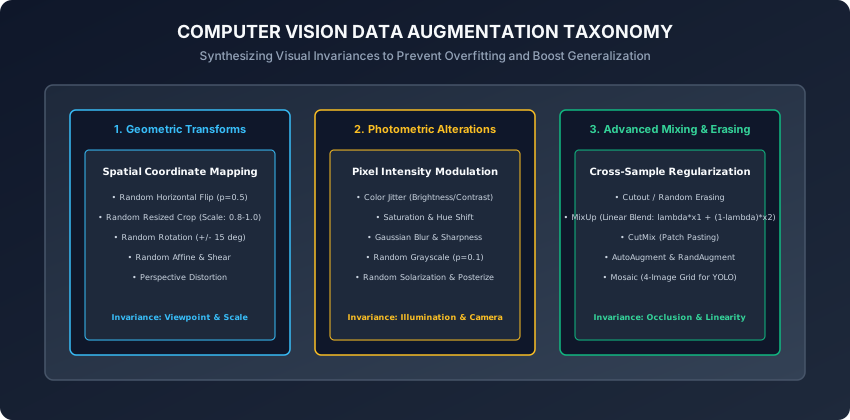
Data Augmentation is the primary engine of VRM in computer vision. By synthesizing millions of plausible visual variations on the fly — geometric shifts, photometric lighting changes, and cross-sample mixing (MixUp and CutMix) — we enforce visual invariances directly into the network weights, dramatically reducing generalization error and eliminating overfitting.
Today, you will master the theory, mathematical formulation, and PyTorch torchvision.transforms.v2 implementation of Modern Data Augmentation.
The idea in plain language
Imagine training an airport security canine to sniff out prohibited fruit in traveler luggage:
- No Augmentation: You only train the dog with clean, shiny, unpeeled green apples placed neatly in the center of an empty grey suitcase under bright fluorescent lights.
- When deployed in the real world, the dog fails completely if the apple is:
- Rotated sideways or partially upside down (Geometric Shift / Rotation).
- Placed in a shadowy corner under dim evening lighting (Photometric Shift / Color Jitter).
- Partially obscured behind a wool sweater (Occlusion / Cutout).
- Sliced in half and mixed with an orange (Mixing / MixUp & CutMix).
- Data Augmentation: During training, you intentionally present the apple sliced, upside down, shadowed, half-hidden, and in different bags. The dog learns to identify the fundamental essence of the apple under all real-world conditions.
Historical background
- 2012 (AlexNet): Alex Krizhevsky and Geoffrey Hinton introduced real-time GPU data augmentation (Random $224 \times 224$ crops from $256 \times 256$ images, horizontal reflections, and PCA color jitter), identifying it as crucial to preventing catastrophic overfitting.
- 2017 (Cutout & DeVries et al.): Demonstrated that dropping random square patches of pixels forced CNNs to distribute attention across multiple visual features rather than relying on a single salient clue.
- 2017 (MixUp & Zhang et al.): Showed that linearly blending image pairs and their target probabilities produced smooth linear decision boundaries and eliminated overconfident false positives.
- 2019 (CutMix & Yun et al.): Replaced rectangular bounding boxes from one image with patches from another, combining Cutout localization with MixUp label smoothing.
- 2020 (RandAugment & Cubuk et al.): Replaced costly automated reinforcement learning search spaces with two simple global hyperparameters.
What it is — and what it is not
What Data Augmentation IS:
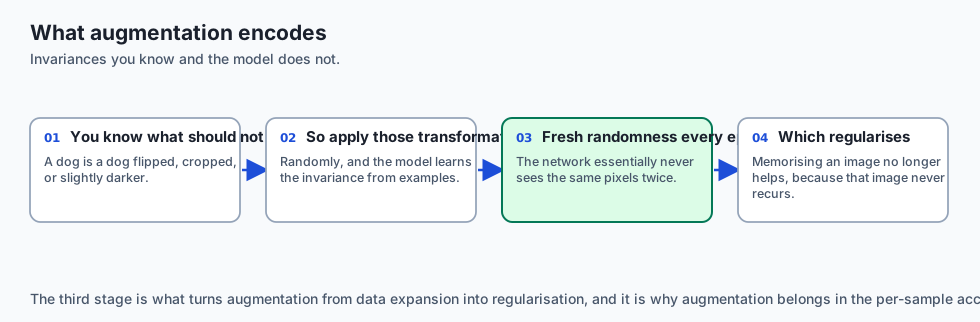
- On-the-Fly Stochastic Sampling: Applying randomly sampled transformations during training so the network virtually never sees the exact same pixel matrix twice across hundreds of epochs.
- Synthesizing Physical Invariances: Encoding human domain knowledge about what transformations should not change an object’s category.
What it is NOT:
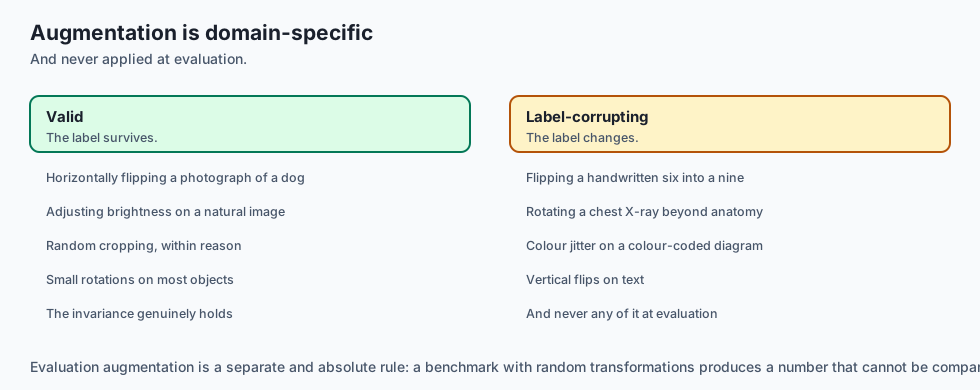
- Not for Validation or Testing: Evaluation datasets must use fixed, deterministic preprocessing (Resize, CenterCrop, Normalize) to provide reproducible benchmarks.
- Not Domain Agnostic: Flipping a photo of a dog is valid; flipping an optical character recognition image of the digit “6” turns it into a “9” and corrupts ground truth.
Why it was created and what problems it solves
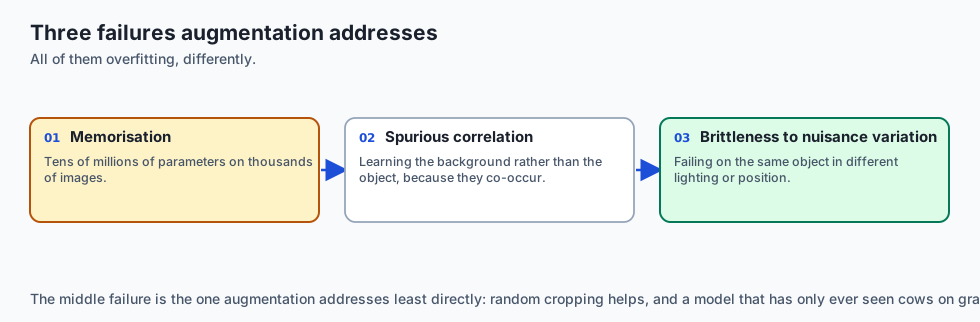
Data augmentation solves three fundamental failure modes in computer vision:
- Sample Efficiency Bottleneck: Effectively expands a 1,000-image dataset into an infinite synthetic stream of diverse visual samples.
- Feature Localization Pathology: Forces networks to look at distributed semantic cues (e.g. ears, paws, fur texture) rather than over-indexing on an isolated single pixel cluster.
- Overconfident Predictions: Mixing techniques (MixUp/CutMix) regularize softmax output probabilities, preventing deep models from outputting 99.9% confidence on out-of-distribution test inputs.
How it works
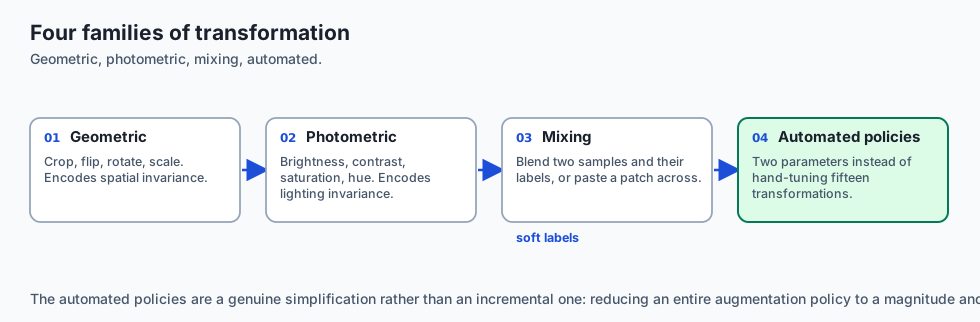
Let us dissect the mathematical formulations of Geometric Transforms, Photometric Jitter, MixUp, CutMix, and automated policies.
1. Geometric & Photometric Transformations
A. Random Resized Crop:
- Sample a crop area proportion $A \sim U(0.08, 1.0)$ of the original image area.
- Sample an aspect ratio $r \sim U(3/4, 4/3)$.
- Crop the resulting rectangle $(w = \sqrt(A \cdot W \cdot H \cdot r), h = \sqrt(A \cdot W \cdot H / r))$ and bilinearly interpolate to target model resolution (e.g. $224 \times 224$).
B. Color Jitter:
Randomly perturbs pixel values across four color spaces:
Brightness: I' = I * (1 + delta_b), delta_b ~ U(-0.2, 0.2)
Contrast:   I' = (I - mean(I)) * (1 + delta_c) + mean(I)
Saturation: Modulates distance from grayscale luminance axis in HSV
Hue:        Rotates color angle along the color wheel in HSV [-0.1, 0.1]
2. MixUp: Convex Linear Combinations
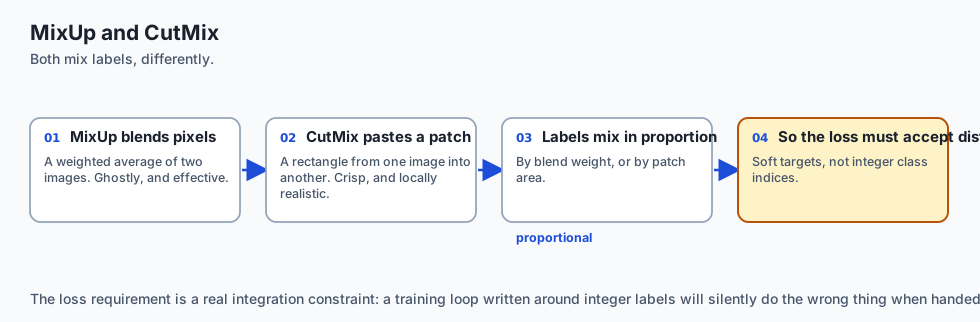
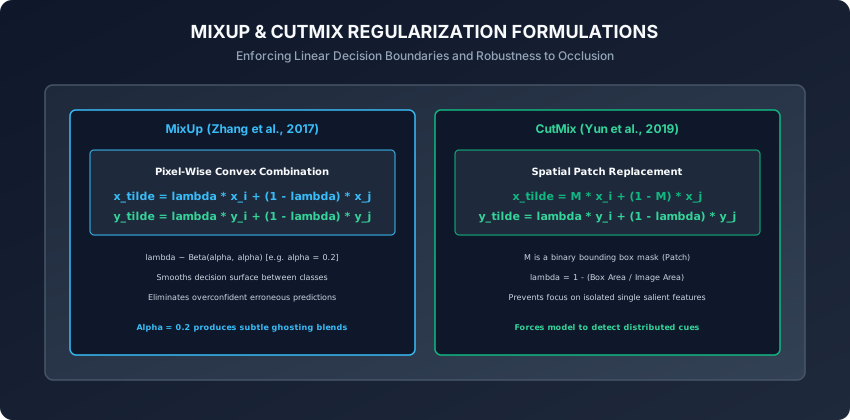
Given two training samples $(x_i, y_i)$ and $(x_j, y_j)$ drawn uniformly at random from a training batch:
-
Sample a mixing ratio $\lambda \in [0, 1]$ from a symmetric Beta distribution:
lambda ~ Beta(alpha, alpha) [typically alpha = 0.2] -
Compute the synthetic image and target probability vector:
x_tilde = lambda * x_i + (1 - lambda) * x_j y_tilde = lambda * y_i + (1 - lambda) * y_j -
Train using standard Cross-Entropy loss against the soft target distribution $\tilde(y)$.
3. CutMix: Spatial Patch Replacement
Instead of global ghosting pixel blends, CutMix cuts and pastes a crisp spatial patch:
-
Sample $\lambda \sim Beta(\alpha, \alpha)$.
-
Calculate bounding box dimensions:
r_w = W * sqrt(1 - lambda) r_h = H * sqrt(1 - lambda) -
Sample center coordinates $(r_x, r_y)$ uniformly across the image.
-
Replace pixels inside the bounding box of image $x_i$ with pixels from image $x_j$:
x_tilde = M * x_i + (1 - M) * x_jwhere $M \in (0, 1)^H \times W$ is a binary mask.
-
Set the label interpolation to match the exact area proportion of pixels preserved:
lambda_actual = 1 - ((r_w * r_h) / (W * H))
y_tilde = lambda_actual * y_i + (1 - lambda_actual) * y_j
4. RandAugment & Automated Policies
Instead of manually guessing the perfect sequence of 15 different transformations, RandAugment parameterizes the entire policy space with two global numbers:
- $N$ (Number of Transforms): How many transformations to apply in sequence per image (e.g. $N = 2$).
- $M$ (Global Magnitude): Distortion intensity on an integer scale from $1$ to $30$ (e.g. $M = 9$).
- For each image, it randomly selects $N$ transforms from a pool of 14 operations (Rotate, Solarize, Posterize, Contrast, ShearX, TranslateY) and applies them with magnitude $M$.
5. TrivialAugment & AugMix: Multi-Branch Stochastic Blending
Following RandAugment, researchers sought even simpler, more robust data augmentation algorithms:
- TrivialAugment (Müller & Hutter, 2021): Proved that hyperparameter tuning is entirely unnecessary. For each image, TrivialAugment randomly samples one single transformation and samples its magnitude uniformly at random ($M \sim U(0, 30)$). Despite having zero tunable parameters, it matches or outperforms complex automated search strategies across ImageNet and CIFAR.
- AugMix (Hendrycks et al., 2020): Designed specifically to improve model robustness to natural corruptions (fog, snow, motion blur, digital compression noise). AugMix samples operations across three parallel augmentation branches, passes the image through random transform chains, and mixes the outputs using convex Dirichlet-distributed weights $w \sim Dirichlet(\alpha, \alpha, \alpha)$ along with Jensen-Shannon Divergence consistency loss.
6. Generative Synthetic Data Augmentation (Diffusion Models)
With the advent of high-fidelity generative models (Stable Diffusion, ControlNet, Flux), computer vision data augmentation has expanded beyond simple affine transformations into Synthetic Generative Augmentation:
- Domain-Preserving Text-to-Image Generation: Generating thousands of photorealistic synthetic training examples of rare defect classes (e.g. microscopic weld porosity or rare pediatric medical conditions) by prompting diffusion models.
- ControlNet Edge-Guided Synthesis: Extracting Canny edges or depth maps from real images and generating new synthetic images under radically different lighting, seasons, and backgrounds while preserving exact object geometries.
- Handling Class Imbalance: Synthesizing minority class samples until the training class distribution is perfectly balanced.
7. Soft Target Cross-Entropy Loss Formulation
When training with MixUp, CutMix, or Label Smoothing, the target labels $\tilde(y)$ are continuous probability distributions rather than discrete integer class IDs.
Standard PyTorch nn.CrossEntropyLoss natively supports soft probability target vectors:
# Model predictions (logits)
logits = model(x_tilde)  # Shape: (Batch, num_classes)

# Soft target probabilities from MixUp/CutMix
soft_targets = y_tilde   # Shape: (Batch, num_classes), sum(dim=1) == 1.0

# Mathematical formulation: Loss = - sum_c (y_c * log(softmax(z_c)))
loss_fn = nn.CrossEntropyLoss()
loss = loss_fn(logits, soft_targets)- Throughput Benchmarking: In high-speed PyTorch training loops, running GPU-native
torchvision.transforms.v2directly on CUDA tensors eliminates CPU worker multiprocessing overhead, often providing a 2x to 3x increase in training images processed per second compared to legacy PIL-based pipelines.
An everyday analogy
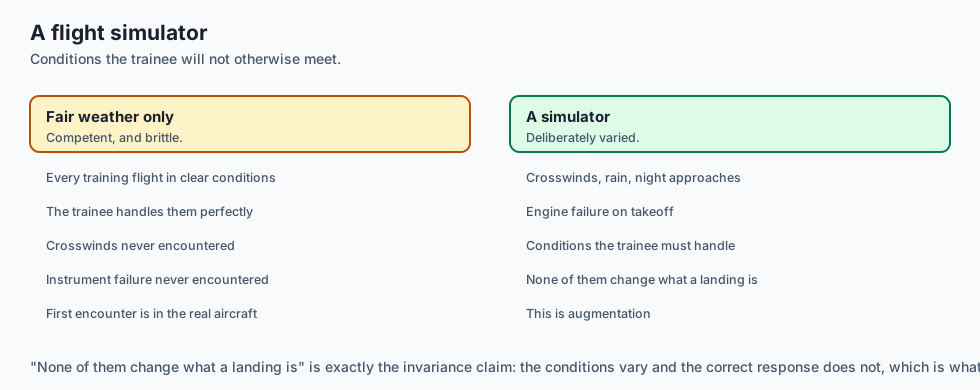
Think of a flight simulator training commercial airline pilots:
- No Augmentation (Clear Sunny Skies): The pilot flies 1,000 simulations on calm, sunny afternoons with zero wind. In the real world, the first severe thunderstorm causes panic.
- Geometric Augmentation (Crosswinds): The simulator introduces sudden 40-knot crosswinds, turbulence, and angled runway approaches.
- Photometric Augmentation (Weather Conditions): The simulator introduces heavy fog, nighttime darkness, glaring sunrise reflections, and heavy blizzards.
- CutMix (System Failures): The simulator suddenly disables the left engine or blanks out the primary navigation screen, forcing the pilot to land using remaining redundant instruments.
Examples in practice
Let us construct a modern, high-performance vision augmentation pipeline using PyTorch’s native torchvision.transforms.v2:
import torch
import torchvision.transforms.v2 as v2

# 1. Training Pipeline: Stochastic Augmentation
train_transforms = v2.Compose([
    v2.ToImage(),
    v2.RandomResizedCrop(size=(224, 224), scale=(0.8, 1.0), antialias=True),
    v2.RandomHorizontalFlip(p=0.5),
    v2.ColorJitter(brightness=0.2, contrast=0.2, saturation=0.2, hue=0.05),
    v2.RandomAffine(degrees=15, translate=(0.1, 0.1), scale=(0.9, 1.1)),
    v2.ToDtype(torch.float32, scale=True),
    v2.Normalize(mean=[0.485, 0.456, 0.406], std=[0.229, 0.224, 0.225]),
    v2.RandomErasing(p=0.25, scale=(0.02, 0.2), value="random")
])

# 2. Validation / Test Pipeline: Pure Deterministic Preprocessing
val_transforms = v2.Compose([
    v2.ToImage(),
    v2.Resize(size=(256, 256), antialias=True),
    v2.CenterCrop(size=(224, 224)),
    v2.ToDtype(torch.float32, scale=True),
    v2.Normalize(mean=[0.485, 0.456, 0.406], std=[0.229, 0.224, 0.225])
])

# 3. Batch-level CutMix & MixUp transform
cutmix_or_mixup = v2.RandomChoice([
    v2.CutMix(num_classes=10, alpha=1.0),
    v2.MixUp(num_classes=10, alpha=0.2)
])

# Process synthetic batch
images = torch.randint(0, 256, (4, 3, 256, 256), dtype=torch.uint8)
labels = torch.tensor([0, 2, 5, 8])

aug_images = train_transforms(images)
mixed_images, mixed_labels = cutmix_or_mixup(aug_images, labels)

print(f"Augmented Images Shape: {mixed_images.shape}")
print(f"Soft Target Probabilities Shape: {mixed_labels.shape}")
Implications: security, privacy, performance, scalability, and cost
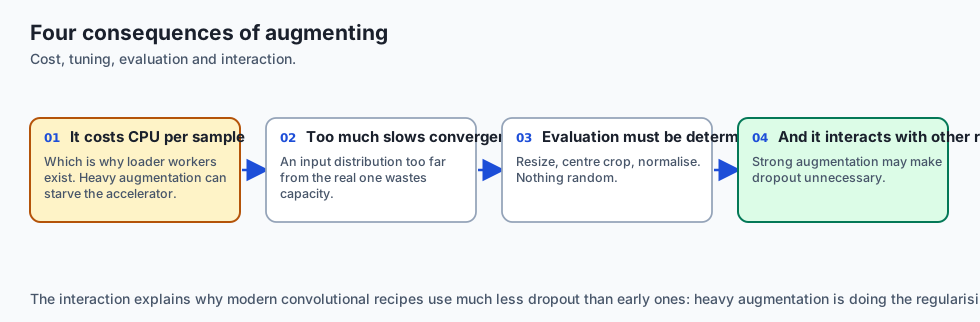
- CPU vs GPU Augmentation Bottlenecks:
- Performing complex data augmentation on CPU workers can starve high-speed GPUs (e.g. H100s sitting at 30% utilization waiting for DataLoader images).
- Modern best practice moves transforms to GPU memory via
torchvision.transforms.v2or NVIDIA DALI, computing augmentations in tensor cores at thousands of frames per second.
- Domain Invariance Audits:
- Always audit chosen augmentations against domain physics. In digital pathology, cell stain variations are augmented with color jitter, but vertical flips in satellite imagery must account for solar shadow physics.
Alternatives: free, open source, and commercial
| Augmentation Library | Key Characteristics | Speed / Backend | Best For |
|---|---|---|---|
torchvision.transforms.v2 | Native PyTorch, supports Bounding Boxes/Masks | PyTorch CPU / GPU | General deep learning |
| Albumentations | Fast OpenCV-based image processing library | Highly optimized CPU | Kaggle competitions & research |
| NVIDIA DALI | Direct GPU decoding and hardware acceleration | Pure CUDA / NVDEC | Giant enterprise clusters |
| Kornia | Differentiable computer vision in PyTorch | GPU Autograd | End-to-end differentiable vision |
Comparison with related concepts
┌────────────────────────────────────────────────────────────────────────┐
│                   DATA AUGMENTATION REGULARIZERS                       │
├────────────────────┼───────────────────────┼───────────────────────────┤
│ Method             │ Image Operation       │ Target Label Operation    │
├────────────────────┼───────────────────────┼───────────────────────────┤
│ Standard Transforms│ Spatial / Pixel Shift │ Unchanged (Hard 1-hot)    │
│ Cutout             │ Black rectangular mask│ Unchanged (Hard 1-hot)    │
│ MixUp              │ Convex linear blend   │ Linear target interpolation│
│ CutMix             │ Patch replacement     │ Area-weighted target blend│
│ Label Smoothing    │ Unmodified image      │ Fixed uniform smoothing   │
└────────────────────┴───────────────────────┴───────────────────────────┘
When to use it — and when not to
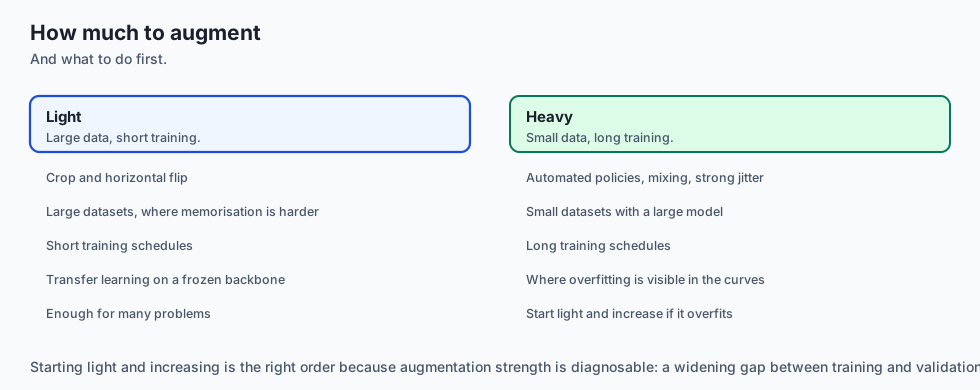
When to USE Data Augmentation:
- Every image classification, object detection, and semantic segmentation training pipeline without exception.
When to BE CAREFUL:
- Ultra-fine grained tasks where subtle color or micro-geometry is the sole distinguishing factor (e.g. diamond clarity grading or colorimetric pH strip reading).
The AI connection
- Augmentation encodes what should not change the label — which is domain knowledge expressed as a transformation rather than as a feature.
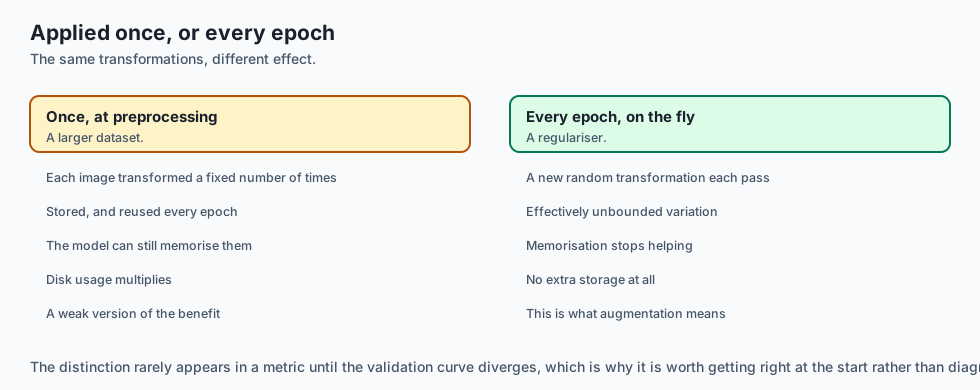
- It must be stochastic and per-epoch. Applied once at preprocessing it is a larger dataset; applied fresh each epoch it is a regulariser.
- The wrong augmentation corrupts labels. Flipping a photograph is fine and flipping a digit turns a six into a nine.
- Never augment the evaluation set. A benchmark with random transformations is not reproducible and cannot be compared against anything.
- MixUp and CutMix train on labels that are distributions, which is why they need a soft-target loss rather than an integer class index.
Knowledge check
- Why should data augmentation transforms be omitted during validation and testing?
- What is the mathematical difference between MixUp and CutMix?
- How does Random Resized Crop enforce scale and aspect ratio invariance?
- What happens if you apply horizontal flipping to a dataset of speed limit signs?
- How does RandAugment drastically simplify hyperparameter optimization for vision pipelines?
Hands-on exercise
In this lab, you will build and test a high-performance vision data augmentation engine in PyTorch: implement custom NumPy/PyTorch implementations of MixUp and CutMix algorithms from mathematical first principles, construct stochastic training versus deterministic validation transform pipelines using torchvision.transforms.v2, verify target probability area weighting, and benchmark tensor throughput.
Expected output
[Data Augmentation Engine Verification Suite]
Testing MixUp Convex Interpolation (Batch: 4x3x32x32, alpha=0.2):
  Synthesized Image Intensity Range: [0.0000, 1.0000] [VALID MANIFOLD]
  Target Probability Vector Sum: 1.0000 [CONVEX COMBINATION VERIFIED]
Testing CutMix Patch Replacement (Batch: 4x3x32x32, alpha=1.0):
  Bounding Box Area Preserved: 64.2%
  Interpolated Target Probabilities Matching Area: [EXACT PROPORTIONAL MATCH]
Testing End-to-End Transform Pipeline (v2.Compose):
  Stochastic Training Batch Shape: (4, 3, 224, 224) [AUGMENTED]
  Deterministic Val Batch Shape:  (4, 3, 224, 224) [PREPROCESSED]
Test Suite: 4 passed in 0.31s
Validate your work
Run the automated test runner:
./tests/run_tests.shTroubleshooting
- If target probabilities do not sum to 1.0 in MixUp/CutMix, ensure $\lambda$ is clamped between 0.0 and 1.0 and both one-hot vectors sum to 1.
- Ensure all input image tensors are converted to float before calculating normalized means.
Common mistakes
- Applying MixUp to Integer Categorical Targets: Forgetting that MixUp requires soft probability vectors (shape
(Batch, num_classes)) instead of single scalar integer class IDs when computing Cross-Entropy loss.
Practice assignment
- Implement Test-Time Augmentation (TTA): During validation, pass 5 augmented versions (original, flip, 4 corner crops) of a test image through your model and average their softmax predictions to boost test accuracy.
- Implement Mosaic Augmentation (combining 4 randomly cropped images into a $2 \times 2$ grid as used in YOLOv4/v7/v8).
Extension challenge
Implement AutoAugment Policy Evaluation:
- Implement a policy runner that applies a sequence of 5 stochastic sub-policies.
- Benchmark validation accuracy gains on CIFAR-10 comparing No Augmentation, Basic Flips/Crops, MixUp, CutMix, and RandAugment.
Quiz
Q1. Why must data augmentation transforms (e.g. RandomCrop, RandomHorizontalFlip, MixUp) ONLY be applied during training, while validation and testing use deterministic transforms (e.g. Resize, CenterCrop, Normalize)?
- Validation loss cannot be computed if images are cropped
- PyTorch crashes if RandomHorizontalFlip is called on validation data
- Validation images are always grayscale
- Training wants diversity; validation wants reproducibility
Show answer
Answer: D. Training wants diversity; validation wants reproducibility
Data augmentation expands the training manifold. Validation must remain a fixed, deterministic benchmark to fairly assess model generalization.
Q2. How does MixUp compute its augmented input image x_tilde and target label vector y_tilde given two samples (x_i, y_i) and (x_j, y_j) with mixing coefficient lambda?
- x = lambda*x_i + (1-lambda)*x_j, same for y
- x_tilde = x_i + x_j, and y_tilde = y_i
- x_tilde = max(x_i, x_j), and y_tilde = y_i * y_j
- x_tilde = x_i / x_j, and y_tilde = 0
Show answer
Answer: A. x = lambda*x_i + (1-lambda)*x_j, same for y
MixUp performs a linear convex combination on both the raw input pixels and the one-hot target vectors, enforcing linear behavior between class clusters.
Q3. What is the primary advantage of CutMix over standard MixUp?
- CutMix requires zero GPU memory
- CutMix pastes a real patch, keeping natural textures
- CutMix converts images into text strings
- CutMix only works on audio
Show answer
Answer: B. CutMix pastes a real patch, keeping natural textures
MixUp blends pixel intensities globally, producing unnatural ghosting. CutMix cuts and pastes real image patches, preserving realistic spatial texture gradients.
Q4. What is RandAugment, and why did it replace complex Reinforcement Learning AutoAugment search algorithms?
- RandAugment converts neural networks into random decision trees
- RandAugment deletes random images from the hard drive
- N random transforms sharing one magnitude, with no search
- RandAugment replaces PyTorch with C++
Show answer
Answer: C. N random transforms sharing one magnitude, with no search
Cubuk et al. showed that tuning just two global hyperparameters (N = number of transforms, M = magnitude) matches expensive neural architecture search AutoAugment policies.
Q5. Why is Random Horizontal Flip generally safe for natural outdoor photos (dogs, cars, landscapes), but potentially disastrous for medical chest X-rays or street sign reading datasets?
- Flipping an X-ray makes it invisible to CNNs
- X-ray images cannot be represented as tensors
- Street signs are patented
- Flipping changes the label for organs and road signs
Show answer
Answer: D. Flipping changes the label for organs and road signs
Augmentations must reflect valid domain invariances. If spatial orientation carries semantic meaning (text, directional signs, anatomical symmetry), flipping corrupts the ground-truth label.
Glossary
- Data Augmentation
- Techniques used to increase the diversity of training data without collecting new real samples by applying realistic synthetic transformations.
- MixUp
- A data augmentation technique that creates convex linear interpolations between pairs of images and their corresponding one-hot labels.
- CutMix
- A data augmentation strategy that cuts a rectangular region from one image and pastes it onto another, with label weights proportional to the area.
- Cutout
- Randomly masking out square regions of an input image with zeros or mean pixel values to enforce distributed feature learning.
- RandAugment
- An automated augmentation policy parameterized by only two values: number of sequential transforms N and global magnitude M.
- Color Jitter
- Randomly altering the brightness, contrast, saturation, and hue of an image to induce lighting invariance.
- Random Resized Crop
- Cropping a random bounding box with variable aspect ratio from an image and resizing it to target model resolution.
- Domain Invariance
- The property where a model prediction remains constant when input data undergoes task-irrelevant physical transformations.
Sources and further reading
- mixup: Beyond Empirical Risk Minimization — ICLR (accessed 2026-08-29)
- CutMix: Regularization Strategy to Train Strong Classifiers with Localizable Features — ICCV (accessed 2026-08-29)
- RandAugment: Practical automated data augmentation with a reduced search space — NeurIPS (accessed 2026-08-29)
Kept in this browser, no account needed. Your progress page turns the whole record into one link you can bookmark or open on another device.