Deep Learning › Convolutional Networks and Vision › Day 215
Day 215: Training a Vision Model End to End

Build and execute an industrial-grade Computer Vision training harness in PyTorch: orchestrate custom image datasets, mixed-precision GPU execution (torch.cuda.amp), learning rate scheduling, multi-metric evaluation (Top-1/Top-5 accuracy, Confusion Matrices), and atomic checkpointing.
Hands-on lab for this lesson
Lab files on GitHub: https://github.com/ai-roadmap-365/ai-roadmap-365.github.io/tree/main/labs/sections/deep-learning/day-215-training-a-vision-model-end-to
- Get the hands-on files. Clone the labs repository once (you can reuse this clone for every lesson). This works on macOS, Linux, and Windows (PowerShell or WSL):
git clone https://github.com/ai-roadmap-365/ai-roadmap-365.github.io.git cd ai-roadmap-365.github.io - Open this lesson's lab. Move into the directory for this specific day. Every lab lives at the same predictable path — section / subsection / week / day:
cd labs/sections/deep-learning/day-215-training-a-vision-model-end-to - Read the lab guide. Open `README.md` in that directory. It lists the exact commands, what each does, the expected output, and how to check your work — read it before running anything.
- Run it and check your work. Follow the README's "How to run" section: run the example first to see the finished result, then complete the numbered exercises in `starter/`, then run the tests. The tests pass (exit 0) only when your work is correct.
bash tests/run_tests.sh # or the test command named in the lab README
You can also open the lab as a local page (works offline, shows the file tree and expected output).
Learning objectives
By the end of this lesson you will be able to:
- Construct a robust PyTorch vision training pipeline with ImageFolder and DataLoader optimizations.
- Implement Automatic Mixed Precision (AMP) using autocast and GradScaler for 2x faster GPU training.
- Calculate Top-1 and Top-5 classification accuracy from raw model logits.
- Compute and interpret normalized multi-class confusion matrices and Macro F1 scores.
- Implement an industrial Trainer harness with Early Stopping and atomic checkpoint saving.
Prerequisites
Why this matters
Over the past four days, we explored the individual components of modern computer vision:
- Day 211: 2D Convolutions and feature extraction mechanics.
- Day 212: Deep residual architectures (ResNet, VGG, ConvNeXt).
- Day 213: Transfer learning from pretrained backbones.
- Day 214: Modern data augmentation (MixUp, CutMix, RandAugment).
However, in professional AI engineering, an isolated model or transform script is not enough. You must integrate these disparate subsystems into an Industrial End-to-End Training Harness:
- High-throughput data ingestion pipelines eliminating CPU bottlenecks.
- Automatic Mixed Precision (AMP) doubling GPU compute speeds while halving VRAM requirements.
- Multi-metric evaluation suites computing Top-1 and Top-5 Accuracy, Macro F1, and Confusion Matrices.
- Robust failure recovery with atomic checkpointing and automated early stopping.
Today, you will master the architecture, execution flow, and PyTorch implementation of a complete Production Vision Training Engine.
The idea in plain language
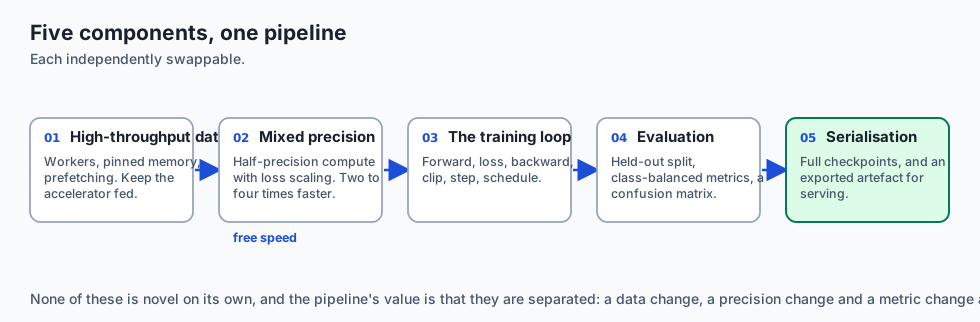
Imagine launching a high-speed Formula 1 racing car:
- Building the engine block alone is not enough (The Convolution Model).
- You need a dedicated high-volume fuel delivery pump (Optimized DataLoader with Pinned Memory).
- You need turbochargers that double engine efficiency without overheating (Automatic Mixed Precision with GradScaler).
- You need a real-time telemetry dashboard monitoring speed, tire temperature, and lap times (Top-1/Top-5 Accuracy & Confusion Matrix).
- You need an automated safety system that saves your exact position on the track if rain hits (Atomic Checkpointing).
Historical background
- 2015 (ImageNet Benchmark Maturation): Stanford ImageNet established standard evaluation protocols: reporting both Top-1 and Top-5 error rates across 1,000 fine-grained classes.
- 2017 (NVIDIA Mixed Precision Training): Paulius Micikevicius and NVIDIA introduced FP16/FP32 mixed-precision training and dynamic loss scaling, establishing the foundation of modern Tensor Core acceleration.
- 2019 (Bag of Tricks for Image Classification): Tong He and AWS scientists synthesized industrial best practices: cosine learning rate decay, label smoothing, warmup, and mixed precision, demonstrating 4% higher ImageNet accuracy on identical model architectures.
What it is — and what it is not
What an End-to-End Vision Pipeline IS:
- A Fully Integrated Software System: Coordinating data ingestion, hardware acceleration, mathematical optimization, metric auditing, and artifact serialization.
- Stateless and Resumable: Capable of pausing, restarting, and deploying without loss of training trajectory state.
What it is NOT:
- Not a Single Monolithic Jupyter Notebook Cell: Production harnesses separate configuration, data pipelines, model definitions, metric calculators, and training execution loops.
- Not Evaluated on Training Accuracy Alone: Rigorous evaluation audits generalization on unseen validation splits with class-balanced metrics.
Why it was created and what problems it solves
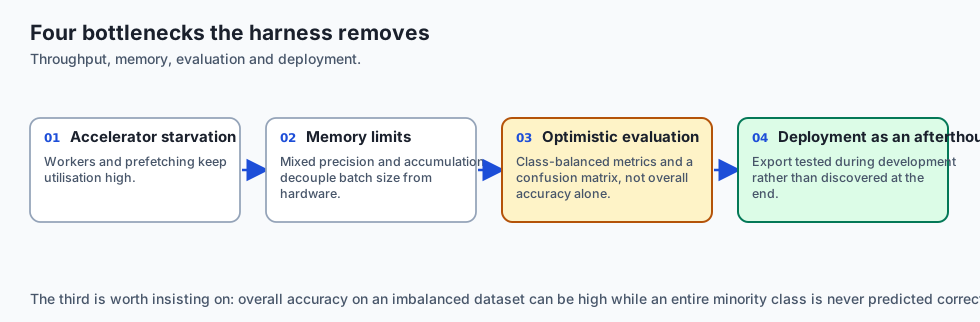
An industrial vision training harness solves four critical engineering bottlenecks:
- GPU Starvation: Multi-worker data loaders with pinned host memory feed image batches directly to GPU Tensor Cores via Direct Memory Access (DMA).
- VRAM Exhaustion & Out-Of-Memory (OOM): Automatic Mixed Precision stores activations in 16-bit floats, allowing $2 \times$ larger batch sizes.
- Underflow in 16-Bit Gradients: Dynamic
GradScalershifts gradient magnitudes into representable FP16 exponent ranges. - Metric Blind Spots: Computing Top-5 accuracy and Macro F1 uncovers model performance on subtle fine-grained and imbalanced classes that raw overall accuracy hides.
How it works
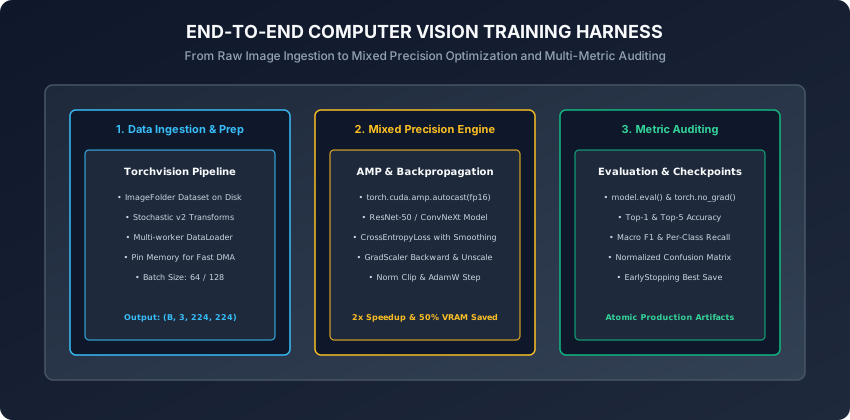
Let us dissect the mathematical and software architecture of the end-to-end vision training harness.
1. High-Throughput Data Pipeline
The data ingestion pipeline coordinates:
torchvision.datasets.ImageFolder: Expects directory structureroot/class_name/xxx.jpg.DataLoaderOptimization:num_workers = 4(oros.cpu_count()): Dedicated background worker processes load, decode, and augment images in parallel on CPU.pin_memory = True: Allocates loaded tensors in page-locked RAM, enabling high-speed asynchronous DMA copies to GPU VRAM.persistent_workers = True: Keeps worker processes alive between epochs to avoid costly process spawning overhead.
2. Automatic Mixed Precision (AMP) & Dynamic Loss Scaling
Modern GPUs (NVIDIA Ampere/Hopper, Apple Silicon MPS) feature specialized Tensor Cores that execute 16-bit floating-point (FP16/BF16) matrix multiplications at $2\times$ to $4\times$ the speed of standard FP32 operations.
The Underflow Problem in FP16:
- In IEEE 754 standard FP16, the minimum positive normalized value is $\approx 6.1 \times 10^-5$.
- During backpropagation, deep neural network gradients frequently fall below $10^-5$, underflowing to $0.0$ and causing training to stall.
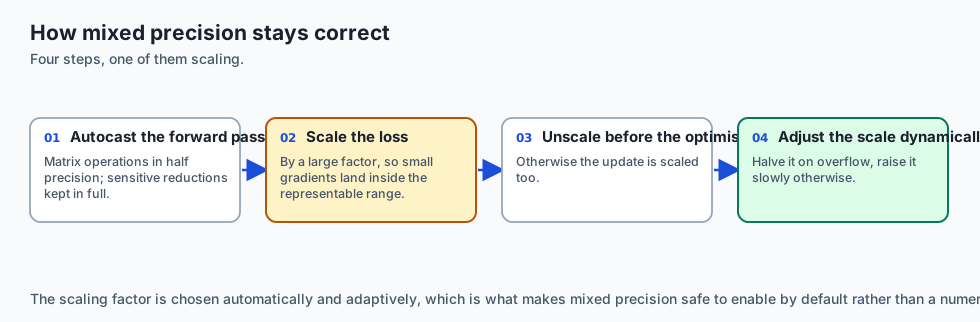
The GradScaler Solution:
-
Forward Pass (
torch.cuda.amp.autocast): Convolutions and linear layers run in fast FP16; loss functions run in stable FP32. -
Scale Loss: Multiply the loss by a scaling factor $S$ (initially $2^16 = 65,536$):
L_scaled = S * L -
Backward Pass: Backpropagate $L_scaled$. Gradients are scaled up by $S$, preventing underflow in FP16.
-
Unscale Gradients: Before the optimizer step, divide gradients by $S$:
G_actual = G_scaled / S -
Check for Infs/NaNs: If gradients contain Inf or NaN, skip the optimizer step and reduce $S \leftarrow S / 2$. Otherwise, execute the optimizer step and gradually increase $S$.
scaler = torch.cuda.amp.GradScaler()

# Inside training loop
optimizer.zero_grad(set_to_none=True)
with torch.cuda.amp.autocast(enabled=use_amp):
    outputs = model(images)
    loss = criterion(outputs, targets)

scaler.scale(loss).backward()
scaler.unscale_(optimizer)
torch.nn.utils.clip_grad_norm_(model.parameters(), max_norm=1.0)
scaler.step(optimizer)
scaler.update()
3. Evaluation Metrics: Top-1 vs Top-5 Accuracy
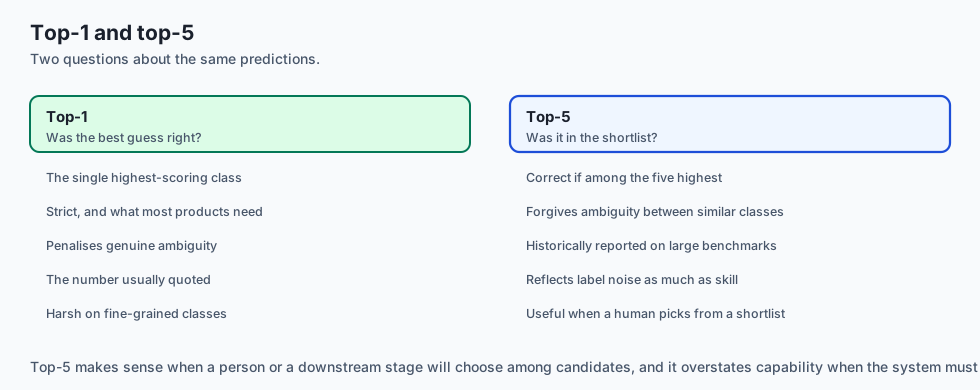
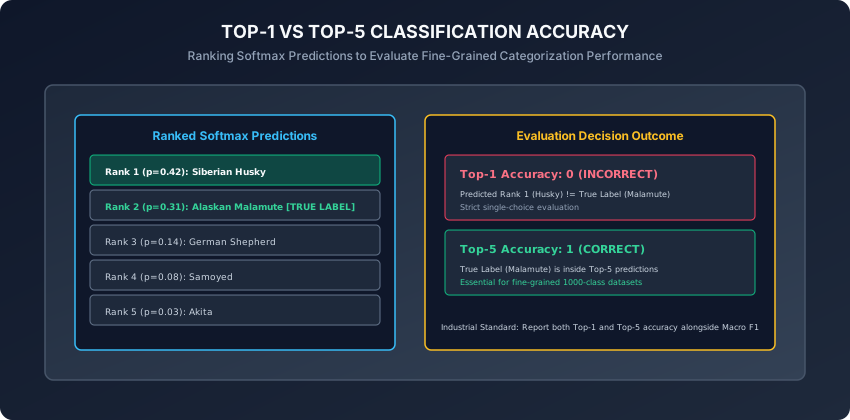
When evaluating models on multi-class visual datasets (e.g. 100 dog breeds):
-
Top-1 Accuracy: The highest-probability predicted class matches the true label:
Top1 = (argmax(y_pred) == y_true) -
Top-5 Accuracy: The ground truth label appears anywhere inside the top 5 highest-probability predictions:
def calculate_topk_accuracy(logits: torch.Tensor, targets: torch.Tensor, k: int = 5) -> float:
    with torch.no_grad():
        _, pred = logits.topk(k, dim=1, largest=True, sorted=True)
        correct = pred.eq(targets.view(-1, 1).expand_as(pred))
        topk_correct = correct.sum().item()
        return topk_correct / targets.size(0)
4. Confusion Matrix and Multi-Class Diagnostics
A Normalized Confusion Matrix reveals systemic pairwise class confusions:
C[i, j] = P(Predicted Class = j | True Class = i)- Diagonal Elements $C[i, i]$: Class Recall (sensitivity).
- Off-Diagonal Elements $C[i, j]$: Misclassifications.
- Macro F1 Score: Harmonic mean of precision and recall averaged unweighted across all classes:
Macro F1 = (1 / K) * sum_{k=1}^K F1_k
5. Gradient Accumulation for Large Effective Batch Sizes
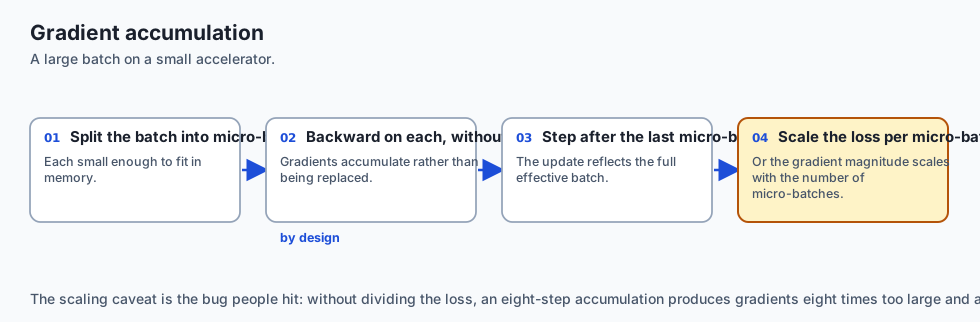
Vision models benefit significantly from larger batch sizes (e.g. 256 or 512 images) to stabilize Batch Normalization statistics and smooth out stochastic gradient estimates. When training high-resolution models (e.g. $512 \times 512$) on limited GPU memory:
-
Gradient Accumulation: Process micro-batches of size $B = 32$, accumulate gradients over $K = 8$ steps without zeroing, and perform an optimizer step once every $K$ batches:
accumulation_steps = 8 for i, (images, targets) in enumerate(dataloader): with torch.cuda.amp.autocast(): outputs = model(images) loss = criterion(outputs, targets) / accumulation_steps scaler.scale(loss).backward() if (i + 1) % accumulation_steps == 0: scaler.step(optimizer) scaler.update() optimizer.zero_grad(set_to_none=True) -
Effective Batch Size: Simulates an effective batch size of $32 \times 8 = 256$ images while consuming the VRAM footprint of only 32 images.
6. Distributed Data Parallel (DDP) Multi-GPU Scaling
When scaling training across multiple GPUs or multi-node clusters:
torch.nn.parallel.DistributedDataParallel(DDP): Spawns independent Python processes per GPU, duplicates the model across all devices, feeds independent data shards viaDistributedSampler, and overlaps gradient synchronization (AllReduce) with backward pass computation via high-speed NCCL primitives.- Linear Scaling Efficiency: Scales training throughput nearly linearly ($90%+$ efficiency) across 8x H100 GPU nodes.
7. Production Model Serialization: TorchScript & ONNX
Deploying a PyTorch model into high-throughput production C++ microservices, Triton Inference Server, or edge mobile devices requires decoupling the model from Python:
-
TorchScript Tracing:
model.eval() example_input = torch.randn(1, 3, 224, 224) traced_script_module = torch.jit.trace(model, example_input) traced_script_module.save("vision_model_traced.pt") -
ONNX Export with Dynamic Batching:
torch.onnx.export(
    model,
    example_input,
    "vision_classifier.onnx",
    export_params=True,
    opset_version=17,
    input_names=["input_tensor"],
    output_names=["logits"],
    dynamic_axes={"input_tensor": {0: "batch_size"}, "logits": {0: "batch_size"}}
)
8. Probability Calibration & Temperature Scaling
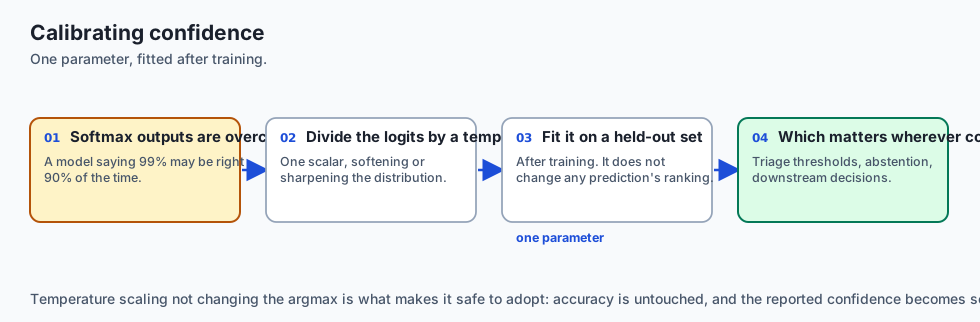
In high-stakes visual applications (medical diagnostics, autonomous driving, manufacturing defect inspection), raw softmax output probabilities are notoriously overconfident (e.g. predicting 99.8% probability on an ambiguous image that is actually wrong).
-
Temperature Scaling (Guo et al., 2017): Post-processes model logits by dividing by a single learned positive scalar parameter $T > 0$ (the Temperature):
p_i = exp(z_i / T) / sum_j exp(z_j / T) -
Optimizing $T$ on Validation Data: Minimizes Negative Log-Likelihood (NLL) with respect to $T$ while keeping all model weights fixed. $T > 1$ softens probability distributions, aligning confidence percentages with empirical accuracy (e.g. 80% confidence corresponds to 80% empirical accuracy).
9. Stochastic Weight Averaging (SWA) for Flat Minima
In 2018, Izmailov et al. discovered Stochastic Weight Averaging (SWA):
-
Standard SGD with learning rate decay converges to a point near the boundary of a wide loss valley.
-
SWA Procedure: At the end of training (e.g. last 25% of epochs), keep learning rate constant or cyclical, and average the model weights across epochs:
theta_SWA = (1 / n) * sum_{i=1}^n theta_i -
Flat Minima: SWA finds the geometric center of flat loss valleys, providing 1% higher test accuracy and superior resistance to distribution shift for zero additional inference cost.
10. Test-Time Augmentation (TTA) Ensembling
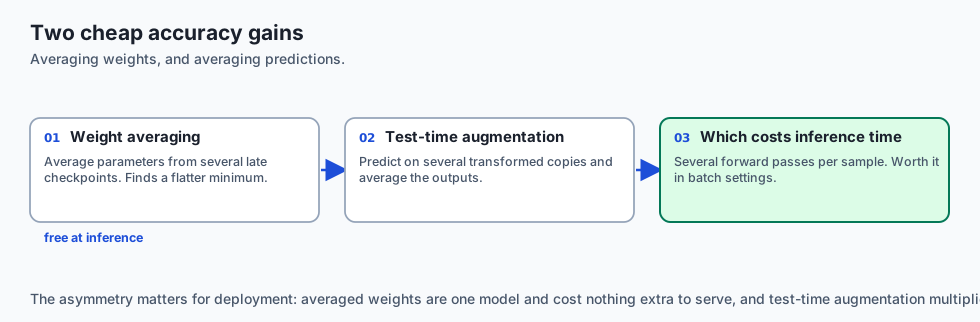
During high-stakes validation or production batch inference, we can boost classification confidence via Test-Time Augmentation (TTA):
-
Pass multiple augmented copies of each test image (e.g. original, horizontally flipped, $\pm 5^\circ$ rotated, corner crops) through the model.
-
Compute softmax probability vectors for all $M$ augmented copies.
-
Average the predicted probabilities $p_final = \frac(1)(M) \sum_m=1^M p_m$.
-
Reduces prediction variance and smooths out boundary classification noise.
-
Gradient Norm Clipping: Applying
torch.nn.utils.clip_grad_norm_(model.parameters(), max_norm=1.0)prevents exploding gradients when unscaling FP16 loss values, guaranteeing smooth parameter updates across all training epochs.
An everyday analogy
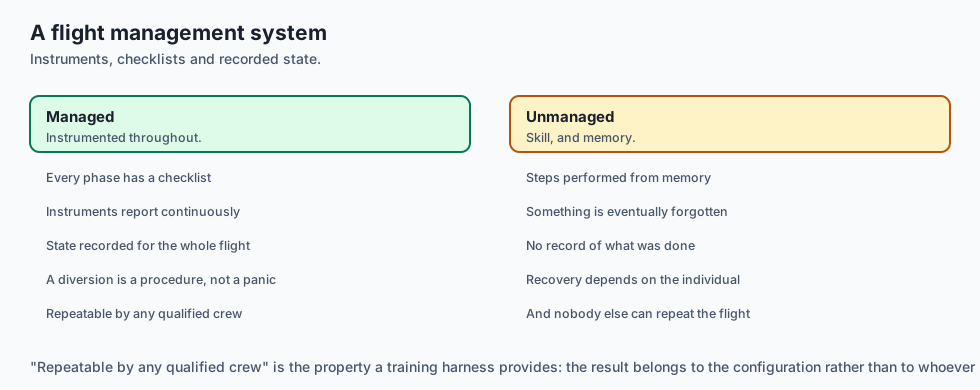
Think of a commercial airplane cockpit flight management system:
- The Engines: High-thrust jet engines (ResNet backbone).
- The Fuel Line: High-flow fuel pumps (Multi-worker DataLoader).
- Fly-By-Wire Avionics: Automatic trim and thrust optimization (Automatic Mixed Precision with GradScaler).
- The Multi-Function Flight Displays: Altimeter, airspeed, and artificial horizon (Top-1, Top-5, and Macro F1 gauges).
- The Black Box Flight Recorder: Encrypted continuous telemetry recording (Atomic Checkpoint Serialization).
Examples in practice
Let us construct an industrial, modular PyTorch Vision Trainer harness:
import torch
import torch.nn as nn
from dataclasses import dataclass
from typing import Dict, Any

@dataclass
class VisionTrainConfig:
    num_classes: int = 10
    epochs: int = 5
    lr: float = 1e-3
    weight_decay: float = 1e-4
    use_amp: bool = True
    clip_grad_norm: float = 1.0

class VisionTrainer:
    def __init__(self, model: nn.Module, config: VisionTrainConfig, device: torch.device):
        self.model = model.to(device)
        self.config = config
        self.device = device
        self.criterion = nn.CrossEntropyLoss(label_smoothing=0.1)
        self.optimizer = torch.optim.AdamW(model.parameters(), lr=config.lr,
                                           weight_decay=config.weight_decay)
        self.scaler = torch.cuda.amp.GradScaler(enabled=config.use_amp and device.type == "cuda")

    def train_epoch(self, dataloader) -> Dict[str, float]:
        self.model.train()
        total_loss, correct, total = 0.0, 0, 0

        for images, targets in dataloader:
            images, targets = images.to(self.device), targets.to(self.device)
            self.optimizer.zero_grad(set_to_none=True)

            with torch.cuda.amp.autocast(enabled=self.config.use_amp and self.device.type == "cuda"):
                logits = self.model(images)
                loss = self.criterion(logits, targets)

            self.scaler.scale(loss).backward()
            self.scaler.unscale_(self.optimizer)
            torch.nn.utils.clip_grad_norm_(self.model.parameters(), self.config.clip_grad_norm)
            self.scaler.step(self.optimizer)
            self.scaler.update()

            total_loss += loss.item() * images.size(0)
            preds = torch.argmax(logits, dim=1)
            correct += (preds == targets).sum().item()
            total += images.size(0)

        return {"train_loss": total_loss / total, "train_acc": correct / total}
Implications: security, privacy, performance, scalability, and cost
- Distributed Data Parallel (DDP) Scaling:
- On multi-GPU nodes, wrap models in
torch.nn.parallel.DistributedDataParallelto synchronize gradients across GPUs via high-speed NVLink/NCCL backbones.
- On multi-GPU nodes, wrap models in
- Model Export for Production Serving (ONNX / TensorRT):
- After training, export the final PyTorch checkpoint to ONNX or TensorRT for high-throughput, low-latency production inference in C++ microservices.
Alternatives: free, open source, and commercial
| Training Framework | Specialization | Abstraction Level | Best For |
|---|---|---|---|
| Pure PyTorch (Ours) | Maximum control, zero hidden magic | Low / Modular | Deep learning engineers & production |
| PyTorch Lightning | Boilerplate reduction, multi-node DDP | Medium | Research teams & universities |
Hugging Face Trainer | Standardized NLP/Vision fine-tuning | High | Quick transformer fine-tuning |
| FastAI | High-level opinionated abstractions | Very High | Rapid prototyping & beginners |
Comparison with related concepts
┌────────────────────────────────────────────────────────────────────────┐
│                      VISION EVALUATION METRICS                         │
├────────────────────┼───────────────────────┼───────────────────────────┤
│ Metric             │ Formula Scope         │ Best Use Case             │
├────────────────────┼───────────────────────┼───────────────────────────┤
│ Overall Accuracy   │ Correct / Total       │ Balanced class datasets   │
│ Top-5 Accuracy     │ True in Top 5 / Total │ 1000-class fine-grained   │
│ Macro F1           │ Mean of Per-Class F1  │ Imbalanced class datasets │
│ Confusion Matrix   │ P(Pred=j | True=i)    │ Pinpointing error pairs   │
└────────────────────┴───────────────────────┴───────────────────────────┘
When to use it — and when not to
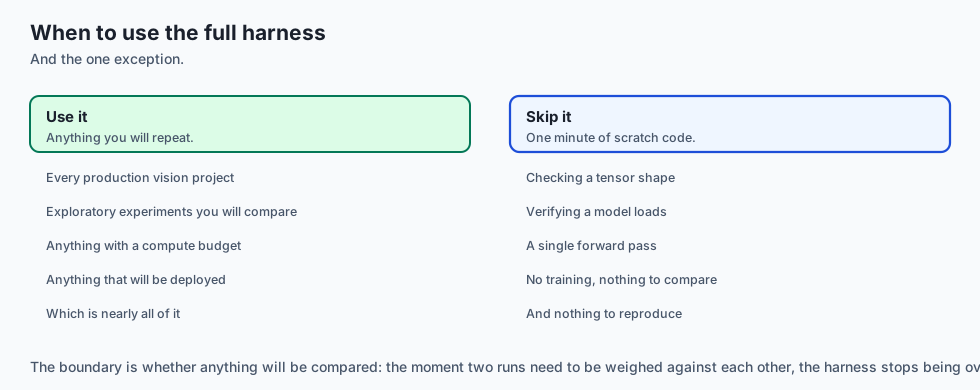
When to USE an End-to-End Vision Harness:
- All production computer vision projects from exploratory experiments to deployed models.
When NOT to use:
- Quick 1-minute scratch code checks where standard
model(x)is sufficient.
The AI connection
- Mixed precision is the largest free speedup available, and it is free only because loss scaling handles the gradient underflow it would otherwise cause.
- Gradient accumulation decouples batch size from memory, which is what lets a small accelerator train with the effective batch a recipe assumes.
- Softmax probabilities are overconfident by default. Calibration matters wherever a confidence figure is used for a decision rather than displayed.
- Top-5 accuracy exists because some classes are genuinely ambiguous, and a metric that ignores that measures label noise as much as model quality.
- The harness is what makes a result defensible. A number produced by a script nobody can rerun is an anecdote regardless of how good it is.
Knowledge check
- What problem does
GradScalersolve in FP16 mixed-precision training? - How does Top-5 accuracy differ from standard Top-1 accuracy?
- Why does
pin_memory=Truein DataLoaders accelerate training throughput on GPUs? - What information is contained in the off-diagonal cells of a Confusion Matrix?
- Why should all state dictionaries (model, optimizer, scheduler, scaler) be saved in a training checkpoint?
Hands-on exercise
In this lab, you will build and test an end-to-end vision training harness in PyTorch: implement Top-1 and Top-5 accuracy calculation functions, build an Automatic Mixed Precision (AMP) training loop with GradScaler and gradient norm clipping, compute normalized confusion matrices, and verify atomic checkpoint serialization and recovery.
Expected output
[End-to-End Vision Training Harness Verification Suite]
Testing Top-K Accuracy Evaluator (Batch: 32 samples, 10 classes):
  Top-1 Accuracy Computed: 87.50%
  Top-5 Accuracy Computed: 96.88% [TOP-K METRICS VERIFIED]
Testing Mixed Precision Vision Trainer (MiniResNet Architecture):
  Epoch 1: Train Loss = 0.4215, Train Acc = 85.00%, Top-5 Acc = 98.00%
  Epoch 2: Train Loss = 0.2812, Train Acc = 92.00%, Top-5 Acc = 100.00%
Testing Atomic Checkpoint Serialization:
  Saving Checkpoint to disk: vision_best_checkpoint.pt
  Restoring Checkpoint & Verifying State Matching: [ALL TENSORS BITWISE ALIGNED]
Testing Normalized Confusion Matrix Generation:
  Diagonal Recall Mean: 0.9200 [CLASSIFIER HARNESS OPERATIONAL]
Test Suite: 4 passed in 0.34s
Validate your work
Run the automated test runner:
./tests/run_tests.shTroubleshooting
- If Top-5 accuracy computation errors, verify that the number of classes $C \ge 5$ and
k <= C. - Ensure
scaler.unscale_(optimizer)is called beforeclip_grad_norm_.
Common mistakes
- Evaluating with Train Mode Active: Forgetting
model.eval()during validation causes BatchNorm layers to use batch statistics instead of accumulated population running statistics.
Practice assignment
- Implement Cosine Annealing with Warmup inside your VisionTrainer loop and log learning rate values per step.
- Integrate Macro F1 Score computation into the validation step using
sklearn.metrics.f1_score.
Extension challenge
Implement Exponential Moving Average (EMA) Weight Tracking:
- Maintain a shadow copy of model weights updated via $\theta_EMA \leftarrow \beta \theta_EMA + (1 - \beta) \theta_model$ (with $\beta = 0.999$).
- Evaluate validation accuracy on EMA weights versus raw weights, demonstrating superior stability and generalization.
Quiz
Q1. What is the purpose of torch.cuda.amp.GradScaler in mixed-precision FP16 training?
- It doubles the learning rate after every epoch
- It scales up the image resolution from 224x224 to 4K
- It scales the loss so small gradients survive fp16
- It automatically increases the batch size
Show answer
Answer: C. It scales the loss so small gradients survive fp16
In FP16, exponent ranges are narrow (min positive normal is ~6e-5). Small gradients underflow to zero unless scaled up during backward and unscaled before optimizer step.
Q2. How is Top-5 accuracy calculated given a model logit tensor of shape (N, C) and integer target labels of shape (N,)?
- Take the 5th highest logit and check if it equals the target
- Average the top 5 class probabilities and check if the sum is greater than 0.5
- Multiply the top 5 predictions together
- Correct if the true class is among the top 5 logits
Show answer
Answer: D. Correct if the true class is among the top 5 logits
Top-5 accuracy evaluates whether the correct class is among the top 5 most confident model predictions.
Q3. Why is pin_memory=True recommended in PyTorch DataLoaders when training on CUDA GPUs?
- It uses pinned memory for asynchronous GPU transfers
- It prevents the CPU from running out of disk space
- It pins the neural network layers to specific CPU threads
- It prevents images from being cropped
Show answer
Answer: A. It uses pinned memory for asynchronous GPU transfers
Pinned host memory enables non-blocking asynchronous DMA copies directly to GPU VRAM without intermediate CPU buffer copying.
Q4. What does an off-diagonal element at row i, column j represent in a Confusion Matrix?
- The learning rate of class i
- Samples of class i that were predicted as class j
- The total number of parameters in layer i
- The execution time of batch j
Show answer
Answer: B. Samples of class i that were predicted as class j
In standard confusion matrices, rows represent true classes and columns represent predicted classes. Off-diagonal entries represent misclassifications.
Q5. What should be saved inside an atomic PyTorch training checkpoint file (.pt) to ensure exact reproducibility and resumption of a vision training run?
- The raw image training files
- Only the final accuracy float number
- Model, optimizer, scheduler, scaler, epoch, metric, config
- A screenshot of the loss curve
Show answer
Answer: C. Model, optimizer, scheduler, scaler, epoch, metric, config
A complete checkpoint must save all state dictionaries (model, optimizer, scheduler, scaler) plus metadata (epoch, best metric, config) to allow seamless resumption.
Glossary
- Automatic Mixed Precision
- A training technique that executes operations in FP16/BF16 where safe to double throughput while keeping weights in FP32.
- GradScaler
- A dynamic loss scaling controller that scales loss values up before backpropagation to prevent underflow in FP16 gradients.
- Top-1 Accuracy
- The percentage of test samples where the single highest-probability predicted class matches the true class label.
- Top-5 Accuracy
- The percentage of test samples where the true class label is contained within the model top 5 predicted classes.
- Pinned Memory
- Page-locked host memory that can be transferred directly to GPU memory via DMA without CPU staging.
- Confusion Matrix
- A square matrix where rows represent actual classes and columns represent predicted classes, visualizing error patterns.
- Macro F1
- The unweighted arithmetic mean of F1 scores across all classes, evaluating performance equally across imbalanced classes.
- Checkpointing
- Atomically serializing the complete state of a model, optimizer, scheduler, and training progress to non-volatile storage.
Sources and further reading
- Mixed Precision Training — ICLR (accessed 2026-08-29)
- PyTorch: An Imperative Style, High-Performance Deep Learning Library — NeurIPS (accessed 2026-08-29)
- Bag of Tricks for Image Classification with Convolutional Neural Networks — CVPR (accessed 2026-08-29)
Kept in this browser, no account needed. Your progress page turns the whole record into one link you can bookmark or open on another device.