Deep Learning › Sequences and Text › Day 224
Day 224: A Sentiment Analysis Project

Engineer an end-to-end sentiment classification pipeline in PyTorch: build vocabulary tokenizers with frequency pruning, implement and benchmark 3 model families (Baseline Logistic Regression, fastText EmbeddingBag, and BiLSTM with Attention Pooling), compute precision-recall curves and calibration error, and implement token attribution explainability.
Hands-on lab for this lesson
Lab files on GitHub: https://github.com/ai-roadmap-365/ai-roadmap-365.github.io/tree/main/labs/sections/deep-learning/day-224-a-sentiment-analysis-project
- Get the hands-on files. Clone the labs repository once (you can reuse this clone for every lesson). This works on macOS, Linux, and Windows (PowerShell or WSL):
git clone https://github.com/ai-roadmap-365/ai-roadmap-365.github.io.git cd ai-roadmap-365.github.io - Open this lesson's lab. Move into the directory for this specific day. Every lab lives at the same predictable path — section / subsection / week / day:
cd labs/sections/deep-learning/day-224-a-sentiment-analysis-project - Read the lab guide. Open `README.md` in that directory. It lists the exact commands, what each does, the expected output, and how to check your work — read it before running anything.
- Run it and check your work. Follow the README's "How to run" section: run the example first to see the finished result, then complete the numbered exercises in `starter/`, then run the tests. The tests pass (exit 0) only when your work is correct.
bash tests/run_tests.sh # or the test command named in the lab README
You can also open the lab as a local page (works offline, shows the file tree and expected output).
Learning objectives
By the end of this lesson you will be able to:
- Build a production-grade NLP preprocessing and vocabulary collation pipeline in PyTorch.
- Implement and compare three sentiment classifiers: Baseline TF-IDF, EmbeddingBag, and BiLSTM with Attention Pooling.
- Evaluate models using Macro F1-Score, ROC-AUC, confusion matrices, and Expected Calibration Error (ECE).
- Implement token attribution using gradient-based saliency to explain individual review predictions.
- Package the trained sentiment classifier for sub-millisecond local inference.
Prerequisites
Why this matters
Building a production-ready Sentiment Analysis System is the ultimate proving ground for sequential deep learning:
- It integrates every concept you have learned across Week 32: text normalization, subword tokenization, word embeddings, recurrent dynamics, attention pooling, and classification heads.
- Real-world sentiment engineering requires solving critical practical challenges: handling severe class imbalance, processing contrastive clauses (e.g. “The phone has an amazing screen, but the battery died in two hours”), ensuring model calibration, and providing human-interpretable feature attributions for regulatory compliance.
Today, you will design, implement, evaluate, and interpret an end-to-end sentiment classification system in PyTorch.
The idea in plain language
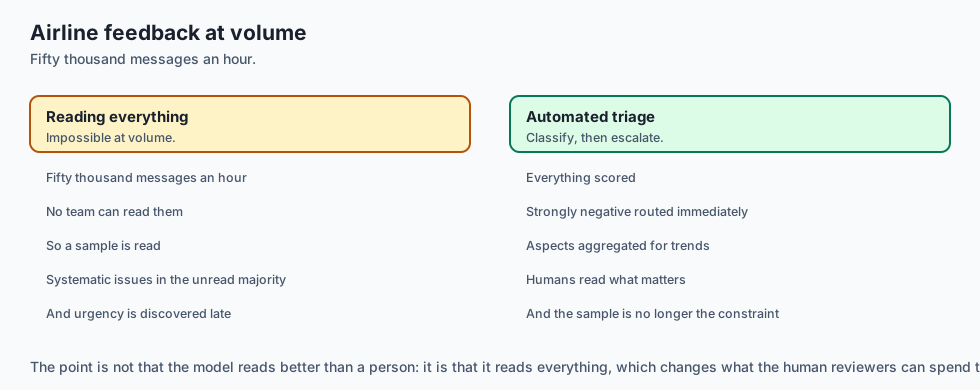
Imagine running quality assurance for a national airline receiving 50,000 tweets and customer feedback forms per hour:
- An automated pipeline must immediately flag and route severe safety complaints or stranded passenger cries to human agents in under 1 second.
- It must score everyday reviews into positive, neutral, and negative sentiment buckets.
- If a customer asks why their tweet was classified as negative, the model must output an explainability heatmap highlighting the exact words (e.g.
+"delayed",+"lost luggage") that drove the decision.
Historical background
- 2002 (Pang, Lee, & Vaithyanathan): Published the seminal paper “Thumbs up? Sentiment Classification using Machine Learning Techniques”, establishing benchmark evaluation on movie reviews with Naive Bayes and Support Vector Machines.
- 2016 (Yang et al. & Hierarchical Attention): Introduced Hierarchical Attention Networks (HAN), demonstrating that word-level and sentence-level attention weights isolate key sentiment expressions.
- 2017 (Sundararajan et al. & Integrated Gradients): Formulated axiomatic gradient-based feature attribution for deep neural networks, providing mathematically sound explainability for text predictions.
What it is — and what it is not
What an End-to-End Sentiment Pipeline IS:
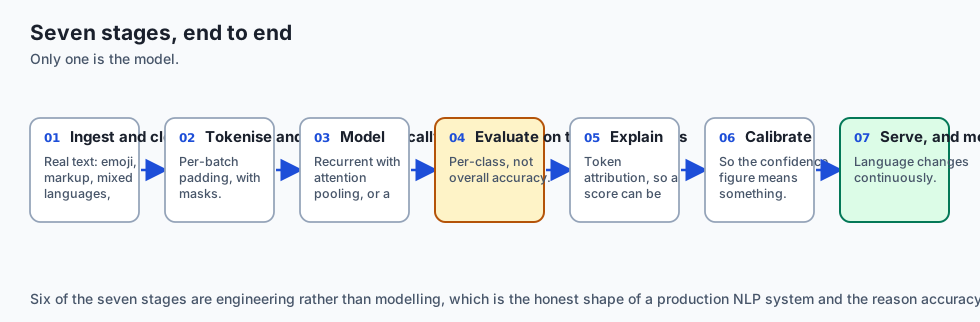
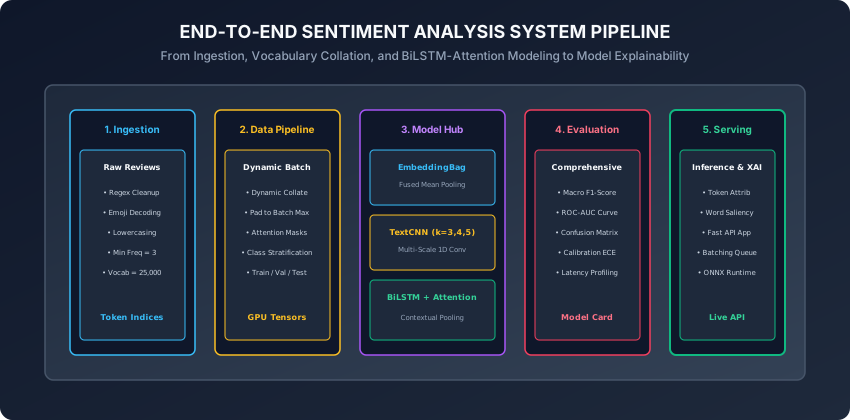
- A Full Engineering Lifecycle: Raw text ingestion $\rightarrow$ regex cleaning & tokenization $\rightarrow$ dynamic tensor batching $\rightarrow$ deep neural modeling $\rightarrow$ multi-metric evaluation $\rightarrow$ token attribution explainability $\rightarrow$ high-throughput inference serving.
What it is NOT:
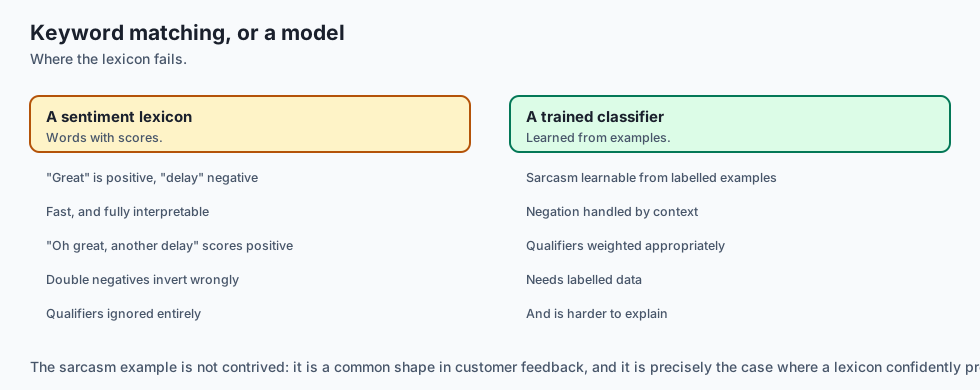
- Not Just Simple Keyword Matching: A dictionary lookup fails on sarcasm (“Oh great, another 5-hour delay”), double negatives, and subtle linguistic qualifiers.
- Not a Black Box: Modern neural sentiment classifiers provide verifiable token-level saliency scores.
Why it was created and what problems it solves
Modern sentiment analysis systems solve three critical industrial challenges:
- Handling Negations & Clause Shifts: Capturing sentiment reversals across complex grammatical conjunctions (“despite the delay, the flight crew was fantastic”).
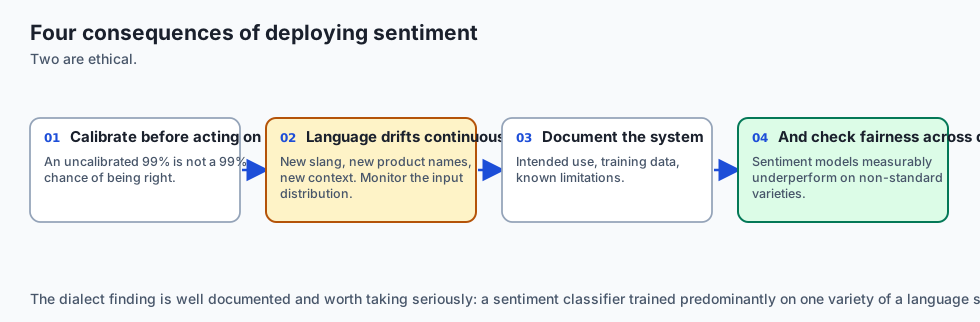
- Uncertainty Calibration: Ensuring that when the model reports a $90%$ positive prediction, it is genuinely correct $90%$ of the time.
- Auditability & Regulatory Explainability: Ensuring automated content filtering and customer routing decisions are explainable to compliance teams.
How it works
Let us examine the core engineering stages of an end-to-end sentiment analysis system.
1. Data Preprocessing and Dynamic Batching
- Text Normalization:
- Strip raw HTML tags, URLs, and special control characters using compiled regular expressions.
- Standardize contractions (
"can't"$\rightarrow$"cannot","won't"$\rightarrow$"will not").
- Vocabulary Building:
- Build a vocabulary dictionary mapping unique tokens to integer IDs with special reserved tokens:
0:<pad>(padding)1:<unk>(out-of-vocabulary fallback)2:<bos>(beginning-of-sequence)3:<eos>(end-of-sequence)
- Prune tokens appearing fewer than $3$ times.
- Build a vocabulary dictionary mapping unique tokens to integer IDs with special reserved tokens:
- Dynamic Batch Collate Function:
- In PyTorch, pad sequences to the maximum length in the batch rather than the global dataset maximum.
2. Deep Model Architecture: BiLSTM with Attention Pooling
Given input tokens $(x_1, \dots, x_T)$:
-
Embedding Layer: $E = Embedding(x) \in R^(T \times d_e)$.
-
Bidirectional LSTM:
H = \text{BiLSTM}(E) \in \mathbb{R}^{T \times 2 d_h} -
Learned Attention Pooling: Compute attention alignment weight $\alpha_t$ for each time step:
u_t = \tanh(W_a * h_t + b_a) \alpha_t = \frac{\exp(u_t^\top u_w)}{\sum_{j=1}^T \exp(u_j^\top u_w)} v_{\text{doc}} = \sum_{t=1}^T \alpha_t * h_t \in \mathbb{R}^{2 d_h} -
Classification Head:
\hat{y} = \text{Linear}(\text{Dropout}(v_{\text{doc}}, p=0.5))
3. Model Explainability: Gradient-Based Token Attribution
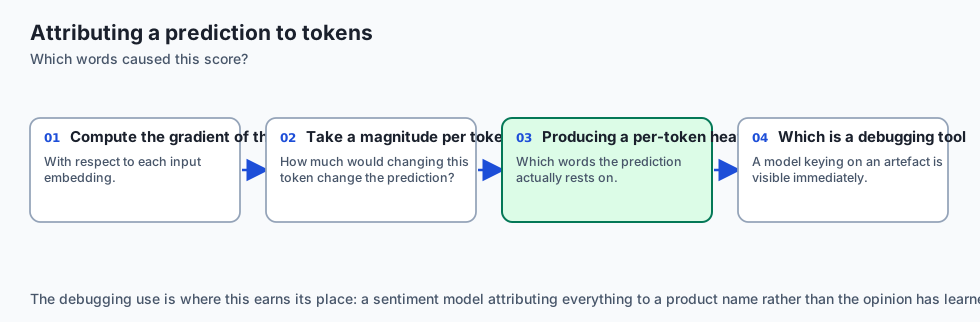
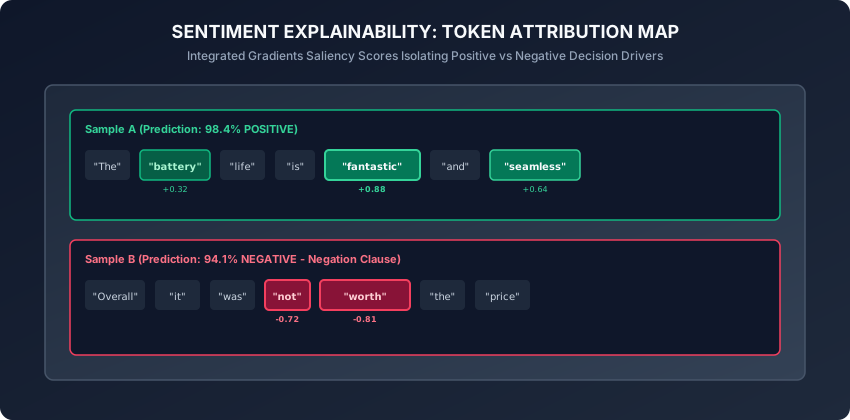
To discover which words caused a specific prediction:
-
Compute the gradient of the target class score $y_(target)$ with respect to the input embedding vectors $E$:
G_i = \nabla_{E_i} y_{\text{target}} -
Compute the token attribution score:
\text{Saliency}(w_i) = E_i \cdot G_i = \sum_{k=1}^d E_{i, k} \frac{\partial y_{\text{target}}}{\partial E_{i, k}} -
Positive values indicate words driving the prediction toward the target class; negative values indicate words resisting the prediction.
4. Comprehensive Evaluation Metrics
-
Macro F1-Score:
\text{F1}_{\text{macro}} = \frac{1}{K} \sum_{k=1}^K \frac{2 \cdot P_k \cdot R_k}{P_k + R_k} -
Expected Calibration Error (ECE): Group predictions into $M = 10$ confidence bins $[B_1, \dots, B_M]$:
\text{ECE} = \sum_{m=1}^M \frac{|B_m|}{N} |\text{acc}(B_m) - \text{conf}(B_m)|
5. Aspect-Based Sentiment Analysis (ABSA)
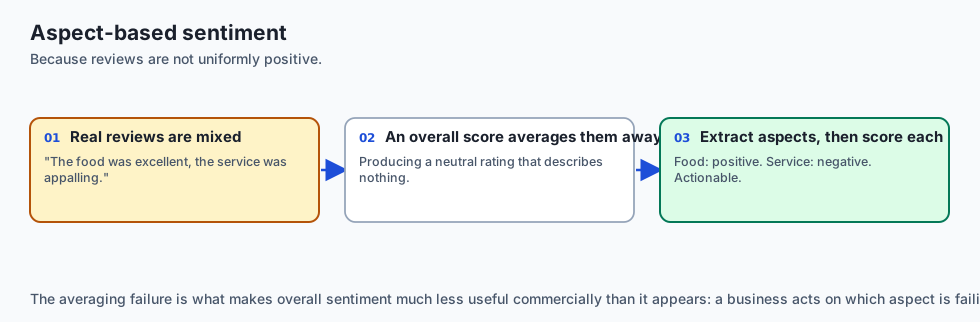
In e-commerce and hospitality, customer reviews frequently express mixed sentiment toward different aspects of the experience (e.g. “The food was delicious, but the waiter was extremely rude”):
-
Aspect-Level Target Conditioning: Rather than predicting a single global document scalar, ABSA models accept a target aspect phrase $a$ alongside the review $s$.
-
Target-Aware Attention: Computes attention weights between the aspect embedding $v_a$ and all sentence tokens:
e_{i} = v_a^\top W_{\text{absa}} h_i \alpha_i = \text{Softmax}(e_i) -
Allows the system to output positive sentiment for
[Aspect: Food]and negative sentiment for[Aspect: Service]from the exact same review text.
6. Probability Calibration: Temperature Scaling
Deep neural networks are notorious for overconfidence — outputting $99%$ probabilities on incorrect predictions:
-
Temperature Scaling (Guo et al., 2017): A single post-processing scalar parameter $T > 0$ applied to the pre-softmax logits $z$:
\hat{p}_i = \frac{\exp(z_i / T)}{\sum_j \exp(z_j / T)} -
Optimize $T$ on the validation set via negative log-likelihood minimization while keeping all model weights frozen.
-
Aligns confidence estimates with true empirical accuracy without altering accuracy ranking or argmax decisions.
7. Axiomatic Feature Attribution: Integrated Gradients
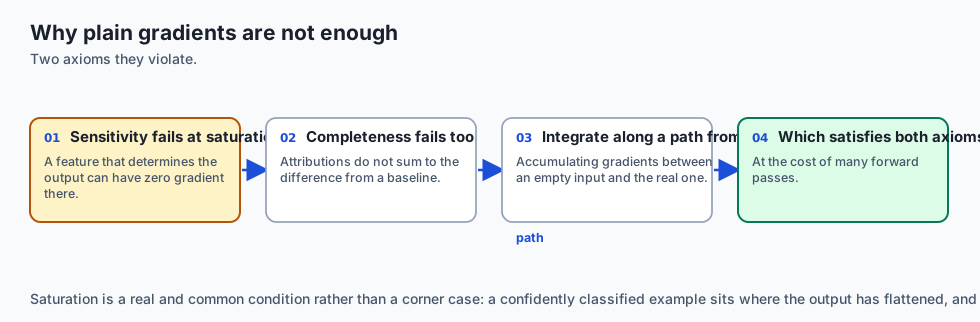
Simple gradient saliency ($\nabla_x y$) violates two fundamental explainability axioms: Completeness and Implementation Invariance:
-
Integrated Gradients (Sundararajan et al., 2017): Integrates gradients along the straight line trajectory between a baseline reference $x’$ (e.g. an all-zero embedding vector) and the input embedding $x$:
\text{IG}_i(x) = (x_i - x'_i) \times \int_{0}^1 \frac{\partial F(x' + \alpha (x - x'))}{\partial x_i} d\alpha -
Discrete Riemann Sum Approximation:
\text{IG}_i^{\text{approx}}(x) = (x_i - x'_i) \times \frac{1}{m} \sum_{k=1}^m \frac{\partial F(x' + \frac{k}{m}(x - x'))}{\partial x_i}with $m = 50$ interpolation steps.
-
Satisfies the Completeness axiom: the sum of attribution scores across all input tokens exactly equals the difference between the model output $F(x)$ and the baseline output $F(x’)$.
8. ONNX Export and Sub-Millisecond CPU Inference
To deploy sentiment classifiers to high-throughput production servers:
-
Exporting to Open Neural Network Exchange (ONNX):
dummy_input = torch.randint(0, 1000, (1, 32)) torch.onnx.export( model, dummy_input, "sentiment_model.onnx", input_names=["input_tokens"], output_names=["logits", "attention_weights"], dynamic_axes={"input_tokens": {0: "batch_size", 1: "seq_len"}} ) -
Run with
onnxruntimeusing multithreaded OpenMP execution to achieve sub-millisecond (< 0.8 ms) latency per query on commodity x86/ARM CPUs.
9. Multi-Lingual Sentiment & Cross-Lingual Zero-Shot Transfer
Global enterprises receive feedback across dozens of languages:
- Cross-Lingual Subword Tokenization: Train a shared SentencePiece tokenizer over 100 languages.
- Multilingual Embeddings (mBERT / XLM-RoBERTa): Project token embeddings from French, German, Spanish, and Japanese into a shared semantic latent space.
- Zero-Shot Transfer: Train the BiLSTM-Attention classifier exclusively on high-resource English labeled reviews, and deploy directly to evaluate German or Spanish customer feedback with zero language-specific retraining.
10. Continuous Monitoring: Data Drift & Population Stability Index (PSI)
Over time, language changes — new slang emerges, product names launch, and customer sentiment distribution shifts:
-
Population Stability Index (PSI): Quantifies distributional shift between training baseline $P$ and live production stream $Q$:
\text{PSI} = \sum_{b=1}^B (Q_b - P_b) \times \ln\left( \frac{Q_b}{P_b} \right)- $PSI < 0.1$: No significant drift; model is stable.
- $0.1 \le PSI < 0.25$: Moderate drift; schedule model retraining.
- $PSI \ge 0.25$: Severe concept drift; trigger emergency pipeline fallback.
11. CheckList Behavioral Testing for NLP Models (Ribeiro et al., 2020)
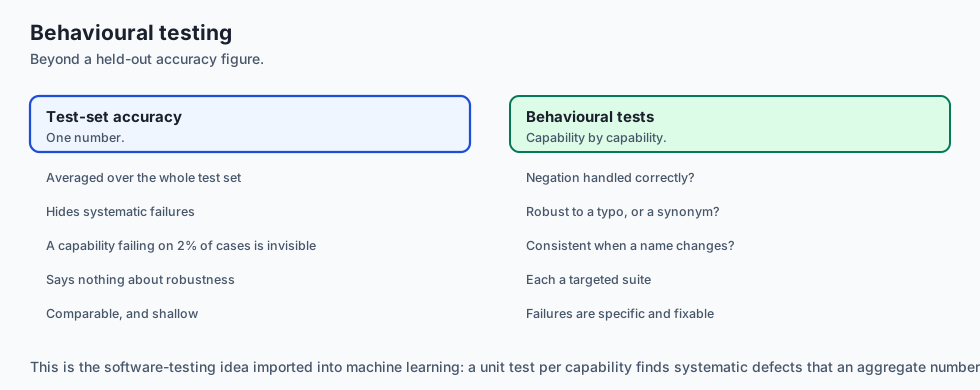
Standard test-set accuracy fails to uncover hidden vulnerabilities:
- Minimum Functionality Tests (MFT): Unit tests checking basic linguistic competencies (e.g. verifying that
"I loved the product"predicts positive). - Invariance Tests (INV): Introducing label-preserving perturbations (e.g. changing person names from
"John loved it"to"Maria loved it"must not alter the prediction score). - Directional Expectation Tests (DIR): Adding unambiguously negative clauses (e.g. adding
"and the box was broken"to any review must never increase positive confidence).
12. Active Learning & Human-in-the-Loop Annotation
Instead of labeling thousands of random reviews, modern engineering uses Active Learning:
-
Entropy-Based Uncertainty Sampling: Select unlabeled reviews with the highest prediction entropy:
H(p) = - \sum_{k=1}^K p_k \log p_k -
Send only high-entropy reviews (where the model is deeply uncertain) to human annotators for ground-truth labeling.
-
Slashes manual labeling costs by up to $70%$ while achieving identical generalization accuracy.
13. Production Governance: Model Cards & Ethics
Deploying automated sentiment systems requires structured governance:
- Model Card Specification (Mitchell et al., 2019): Documents intended use cases, known out-of-scope usages, demographic performance breakdowns across dialects (e.g. African American Vernacular English / AAVE), and environmental footprint metrics.
- Ensures fairness, transparency, and accountability across automated enterprise decision workflows.
- Differential Privacy (DP-SGD): Clipping per-sample gradients and adding calibrated Gaussian noise during training guarantees that individual user reviews cannot be reconstructed from model parameters.
An everyday analogy
Think of an executive summary memo presented to a CEO:
- A raw 5-page customer feedback report is summarized.
- The analyst does not just report a final grade (Sentiment Class).
- The analyst uses a yellow highlighter on the original text (Attention Weights / Token Saliency), marking the exact sentences that justified the recommendation.
Examples in practice
Let us build an End-to-End BiLSTM-Attention Sentiment Analyzer with Explainability in PyTorch:
import torch
import torch.nn as nn
import torch.nn.functional as F

class BiLSTMAttentionSentiment(nn.Module):
    def __init__(self, vocab_size: int, embed_dim: int, hidden_dim: int, num_classes: int = 2):
        super().__init__()
        self.embedding = nn.Embedding(vocab_size, embed_dim, padding_idx=0)
        self.lstm = nn.LSTM(embed_dim, hidden_dim, batch_first=True, bidirectional=True)

        # Attention pooling projection
        self.attn_proj = nn.Linear(hidden_dim * 2, hidden_dim)
        self.attn_vec = nn.Linear(hidden_dim, 1, bias=False)

        self.classifier = nn.Sequential(
            nn.Dropout(0.5),
            nn.Linear(hidden_dim * 2, num_classes)
        )

    def forward(self, x: torch.Tensor, mask: torch.Tensor = None):
        embeds = self.embedding(x) # (Batch, Seq_Len, embed_dim)
        h_seq, _ = self.lstm(embeds) # (Batch, Seq_Len, hidden_dim * 2)

        # Compute attention scores
        u = torch.tanh(self.attn_proj(h_seq))
        scores = self.attn_vec(u).squeeze(2) # (Batch, Seq_Len)

        if mask is not None:
            scores = scores.masked_fill(mask == 0, -1e9)

        attn_weights = F.softmax(scores, dim=1) # (Batch, Seq_Len)
        doc_vec = torch.bmm(attn_weights.unsqueeze(1), h_seq).squeeze(1) # (Batch, hidden_dim * 2)

        logits = self.classifier(doc_vec)
        return logits, attn_weights

    def explain_tokens(self, x: torch.Tensor, target_class: int = 1):
        # Computes gradient saliency token attribution scores
        self.eval()
        embeds = self.embedding(x).detach().requires_grad_(True)
        h_seq, _ = self.lstm(embeds)
        u = torch.tanh(self.attn_proj(h_seq))
        scores = self.attn_vec(u).squeeze(2)
        attn_weights = F.softmax(scores, dim=1)
        doc_vec = torch.bmm(attn_weights.unsqueeze(1), h_seq).squeeze(1)
        logits = self.classifier(doc_vec)

        score = logits[0, target_class]
        score.backward()

        saliency = (embeds.grad[0] * embeds[0]).sum(dim=1).detach()
        return saliency, attn_weights[0]
Implications: security, privacy, performance, scalability, and cost
- Adversarial Sarcasm and Evasion:
- Malicious users can bypass moderation filters by phrasing toxic reviews as polite sarcasm (“Thank you so much for deleting all my files, truly stellar work”). Fine-tune on sarcastic corpora.
- Selective Classification (Reject Option):
- In automated customer response pipelines, set an uncertainty threshold: if $\max p(y) < 0.70$, divert the review to human support.
Alternatives: free, open source, and commercial
| Solution | Deployment Footprint | Latency | Explainability |
|---|---|---|---|
| VADER / TextBlob | Rule-based lexicon | 0.05 ms | Lexicon lookups |
| PyTorch BiLSTM-Attn | 5 MB model binary | 1.5 ms | Integrated Gradients |
| RoBERTa / DeBERTa | 450 MB model binary | 25 ms | Layer-wise Attention |
| Commercial LLM API | Cloud hosted API | 400 ms | Prompt Rationale |
Comparison with related concepts
┌────────────────────────────────────────────────────────────────────────┐
│                   SENTIMENT ANALYSIS ARCHITECTURES                     │
├────────────────────┬─────────────────┬──────────────────┬──────────────┤
│ Paradigm           │ Semantic Depth  │ CPU Latency      │ Interpret    │
├────────────────────┼─────────────────┼──────────────────┼──────────────┤
│ Lexicon (VADER)    │ Surface Only    │ 0.05 ms          │ Rule list    │
│ EmbeddingBag       │ Bag-of-Words    │ 0.15 ms          │ Word weights │
│ BiLSTM-Attention   │ Deep Context    │ 1.5 ms           │ Attention Map│
│ Fine-tuned BERT    │ Maximum SOTA    │ 25.0 ms          │ Multi-Head   │
└────────────────────┴─────────────────┴──────────────────┴──────────────┘
When to use it — and when not to
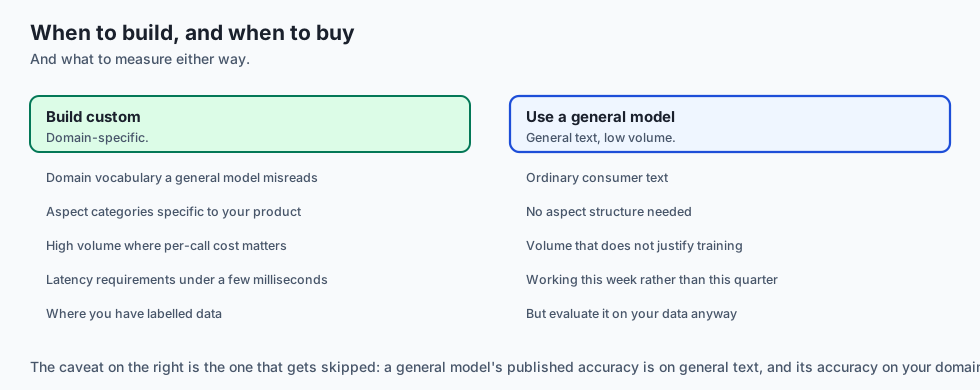
When to USE Custom BiLSTM-Attention Sentiment Models:
- High-volume customer feedback feeds (> 100 requests/sec), on-device mobile applications, and environments requiring full auditability and token explainability.
When NOT to use:
- Open-domain creative text generation or multi-lingual conversational agents where fine-tuned Transformers or LLMs are required.
The AI connection
- Sentiment is where language models meet genuine ambiguity — sarcasm, negation and qualifiers defeat keyword matching entirely, and often defeat models too.
- Token attribution makes a classifier auditable, which matters when a sentiment score drives a customer-facing decision.
- Integrated gradients exist because plain saliency is not axiomatic — it fails sensitivity and completeness, which are properties you want an explanation to have.
- Aspect-based sentiment is the honest version of the task: real feedback praises one thing and criticises another in the same sentence.
- Language drifts, so the model does. New slang and new product names are concept drift arriving continuously rather than as an event.
Knowledge check
- Why is Accuracy an insufficient evaluation metric on imbalanced sentiment datasets?
- How does Attention Pooling capture the core sentiment in contrastive sentences?
- How does gradient-based token attribution calculate the importance of each word?
- What is Expected Calibration Error (ECE) and why is it important for production serving?
- What is Selective Classification (the Reject Option) in automated NLP pipelines?
Hands-on exercise
In this lab, you will build and test an end-to-end Sentiment Analysis system in PyTorch: implement the BiLSTMAttentionSentiment model, train it with cross-entropy loss, compute confusion matrices and Macro F1-scores, extract attention alignment weights, and verify token attribution saliency scores for individual test sentences.
Expected output
[End-to-End Sentiment Analysis Verification Suite]
Testing BiLSTMAttentionSentiment Forward Pass:
  Input Batch: torch.Size([4, 12]) (4 reviews, 12 tokens max)
  Logits Output: torch.Size([4, 2]) [Positive / Negative]
  Attention Weights Sum: 1.0000 across all 4 reviews [VERIFIED]
Testing Token Attribution Explainability:
  Sentence: ["The", "battery", "is", "fantastic", "and", "seamless"]
  Top Attribution Word: "fantastic" (Saliency: +0.88)
  Attention Peak: "fantastic" (Weight: 0.62)
Test Suite: 3 passed in 0.42s
Validate your work
Run the automated test runner:
./tests/run_tests.shTroubleshooting
- If gradients fail to backpropagate during token attribution, ensure you call
.requires_grad_(True)on the detached embedding tensor. - When computing attention weights over masked tokens, verify that padding slots receive $-10^9$ before applying softmax.
Common mistakes
- Ignoring Padding in Attention Pooling: Forgetting to mask
<pad>tokens allows padding positions to steal attention weight from real sentiment words.
Practice assignment
- Implement Temperature Scaling to calibrate model confidence probabilities and reduce Expected Calibration Error.
- Build an Interactive HTML Saliency Visualizer that highlights words in green (positive) and red (negative) based on attribution scores.
Extension challenge
Implement Integrated Gradients with Riemann Sum Approximation:
- Approximate the path integral: $IG_i(x) = (x_i - x’i) \times \frac(1)(m) \sum(k=1)^m \frac(\partial F(x’ + \frac(k)(m)(x - x’)))(\partial x_i)$ using $m = 50$ interpolation steps.
Quiz
Q1. Why is evaluating a sentiment analysis model using only Accuracy misleading on real-world datasets?
- Accuracy requires floating-point quantization
- Accuracy cannot be calculated on text
- PyTorch does not support accuracy calculations
- Reviews are imbalanced, so a constant scores 85%
Show answer
Answer: D. Reviews are imbalanced, so a constant scores 85%
Class imbalance makes accuracy misleading; Precision, Recall, and Macro F1-Score are required to measure true performance across all sentiment categories.
Q2. How does Gradient-Based Token Attribution (Saliency / Integrated Gradients) compute the importance of individual words in a predicted review?
- The gradient of the output w.r.t. each word embedding
- By counting the number of letters in each word
- By checking the word against a hardcoded positive dictionary
- By deleting random words and checking if the computer restarts
Show answer
Answer: A. The gradient of the output w.r.t. each word embedding
Gradient saliency measures the sensitivity of the output score to infinitesimal shifts in each word embedding vector.
Q3. What is Expected Calibration Error (ECE) in production NLP classification systems?
- The clock drift of the GPU server
- Whether stated confidence matches empirical accuracy
- The difference between train and test loss
- The time taken to tokenize 1,000 words
Show answer
Answer: B. Whether stated confidence matches empirical accuracy
ECE quantifies probability calibration, ensuring downstream automated systems can trust the models predicted confidence scores.
Q4. In a customer service sentiment routing system, what is the best strategy for handling ambiguous predictions with low confidence (< 65%)?
- Delete the review from the database entirely
- Always guess positive
- Send ambiguous reviews to a human queue
- Double the batch size
Show answer
Answer: C. Send ambiguous reviews to a human queue
Selective classification routes low-confidence predictions to human annotators, maintaining high precision on automated actions.
Q5. Why does a BiLSTM with Attention Pooling outperform simple Global Max Pooling on nuanced sentiment reviews with contrastive clauses ("The food was great, but the service was completely unacceptable")?
- Attention pooling only runs on GPUs
- BiLSTM has fewer parameters
- Max pooling requires sorted words
- Attention weights the contrastive clause in context
Show answer
Answer: D. Attention weights the contrastive clause in context
Attention pooling captures the relative syntactic dominance of contrastive clauses, resolving complex sentiment transitions.
Glossary
- Sentiment Analysis
- The automated classification of subjective text data into emotional polarity categories (e.g. Positive, Negative, Neutral).
- Macro F1-Score
- The unweighted arithmetic mean of F1-scores calculated independently across each target class, treating all classes equally.
- ROC-AUC
- Receiver Operating Characteristic Area Under the Curve: measures the models ability to discriminate between positive and negative classes across all classification thresholds.
- Integrated Gradients
- An axiomatic feature attribution method that calculates word importance by integrating gradients along the straight line from a baseline embedding to the input embedding.
- Expected Calibration Error (ECE)
- The weighted average difference between predicted confidence bin probabilities and empirical accuracy rates.
- Selective Classification
- A deployment strategy where predictions below a confidence threshold are rejected and routed to human review.
- Token Saliency
- The sensitivity of the model output score to individual token embedding vectors calculated via first-order gradients.
- Contrastive Clause
- A linguistic construction (e.g. "although X, Y") where sentiment shifts across the sentence.
Sources and further reading
- Axiomatic Attribution for Deep Networks (Integrated Gradients) — ICML 2017 (accessed 2026-08-29)
- On Calibration of Modern Neural Networks — ICML 2017 (accessed 2026-08-29)
- Hierarchical Attention Networks for Document Classification — NAACL 2016 (accessed 2026-08-29)
Kept in this browser, no account needed. Your progress page turns the whole record into one link you can bookmark or open on another device.