Deep Learning › Transformers › Day 225
Day 225: “Attention Is All You Need”

Master the foundational paper that sparked the modern generative AI revolution: understand why replacing recurrence with self-attention unlocked massive GPU parallelism, derive the mathematical formula for Scaled Dot-Product Attention, explain the variance-scaling factor 1/sqrt(d_k), and build a vectorized attention module from scratch in PyTorch.
Hands-on lab for this lesson
Lab files on GitHub: https://github.com/ai-roadmap-365/ai-roadmap-365.github.io/tree/main/labs/sections/deep-learning/day-225-attention-is-all-you-need
- Get the hands-on files. Clone the labs repository once (you can reuse this clone for every lesson). This works on macOS, Linux, and Windows (PowerShell or WSL):
git clone https://github.com/ai-roadmap-365/ai-roadmap-365.github.io.git cd ai-roadmap-365.github.io - Open this lesson's lab. Move into the directory for this specific day. Every lab lives at the same predictable path — section / subsection / week / day:
cd labs/sections/deep-learning/day-225-attention-is-all-you-need - Read the lab guide. Open `README.md` in that directory. It lists the exact commands, what each does, the expected output, and how to check your work — read it before running anything.
- Run it and check your work. Follow the README's "How to run" section: run the example first to see the finished result, then complete the numbered exercises in `starter/`, then run the tests. The tests pass (exit 0) only when your work is correct.
bash tests/run_tests.sh # or the test command named in the lab README
You can also open the lab as a local page (works offline, shows the file tree and expected output).
Learning objectives
By the end of this lesson you will be able to:
- Derive the fundamental computational bottleneck of recurrent networks that prevented large-scale pretraining.
- Derive the complete mathematical equation for Scaled Dot-Product Attention: Attention(Q, K, V) = softmax(Q K^T / sqrt(d_k)) V.
- Explain mathematically why scaling by 1/sqrt(d_k) is required to prevent vanishing gradients in high-dimensional softmax.
- Compare the theoretical computational complexity and maximum path length of Self-Attention vs Recurrence vs Convolutions.
- Implement a vectorized Scaled Dot-Product Attention layer in PyTorch supporting causal and padding masks.
Prerequisites
Why this matters
In June 2017, an eight-person research team at Google Brain and Google Research (Ashish Vaswani, Noam Shazeer, Niki Parmar, Jakob Uszkoreit, Llion Jones, Aidan N. Gomez, Lukasz Kaiser, and Illia Polosukhin) published a paper with a audacious title: “Attention Is All You Need”.
At the time, the dominant consensus in deep learning was that processing sequences required sequential architectures: Recurrent Neural Networks (RNNs), LSTMs, GRUs, or deep 1D Convolutions. Attention was merely viewed as a helpful bolt-on enhancement to recurrent encoder-decoder translation pipelines.
Vaswani et al. challenged this foundational premise by asking a revolutionary question: What if we throw away recurrence entirely? What if we discard convolutions entirely? What if a neural network is constructed 100% out of Attention?
The resulting architecture — The Transformer — did not merely improve machine translation benchmarks. It unleashed the entire modern generative AI revolution:
- BERT, RoBERTa, and DeBERTa for language understanding.
- GPT-2, GPT-3, GPT-4, Claude, Llama 3, and Gemini for foundation LLMs.
- Vision Transformers (ViT) for computer vision.
- Whisper for speech recognition and AlphaFold 2/3 for molecular biology.
Today, you begin Week 33 (Transformers) by mastering the core theoretical insights and mathematical foundations of the paper that changed artificial intelligence forever.
The idea in plain language
Imagine a classroom where 50 students are solving a complex collective puzzle:
- The Recurrent Approach (RNN/LSTM): Student #1 solves clue 1, writes a note, and whispers it to Student #2. Student #2 waits, reads the note, adds clue 2, and whispers it to Student #3.
- To reach Student #50, the note must travel through 50 sequential whispers.
- By the time it reaches the end, the message is distorted (vanishing gradients).
- 49 students sit completely idle at any given second, wasting 98% of available human compute.
- The Transformer Approach (Self-Attention): Every student speaks at the exact same moment into a shared microphone system.
- Every student simultaneously listens to all 49 other students and dynamically tunes their volume up or down based on who is saying something relevant to their clue.
- In a single synchronous time step (
O(1)), all 50 students exchange information with each other. - 100% of available compute is saturated instantly on GPUs.
Historical background
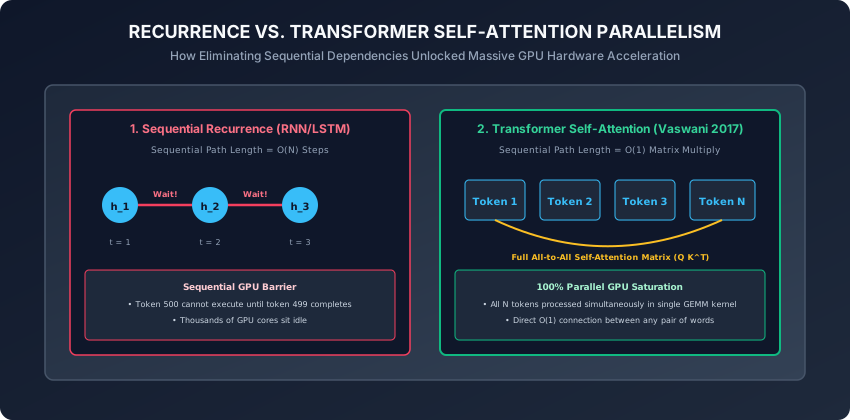
- 1997–2014 (The Recurrent Era): Hochreiter & Schmidhuber’s LSTM dominated sequential modeling. However, sequential step-by-step unrolling (
h_t = f(h_{t-1}, x_t)) created an insurmountable hardware barrier: GPUs could not parallelize computation across the time dimension. - 2014–2016 (The Attention Add-on): Bahdanau et al. and Luong et al. added cross-attention to Seq2Seq Decoders, proving that direct memory lookup overcame fixed-vector bottlenecks.
- June 2017 (Vaswani et al. & NeurIPS 2017): Published “Attention Is All You Need”, establishing the Transformer architecture and setting a new state-of-the-art BLEU score of 28.4 on WMT 2014 English-to-German translation, training in just 3.5 days on 8 NVIDIA P100 GPUs (
10\timesfaster than previous recurrent ensembles). - 2018–Present (The Foundation Model Era): OpenAI released GPT (2018), Google released BERT (2018), and the Transformer became the universal deep learning substrate.
What it is — and what it is not
What Scaled Dot-Product Attention IS:
-
A Fully Differentiable Soft Key-Value Lookup Table: Given a set of Query vectors
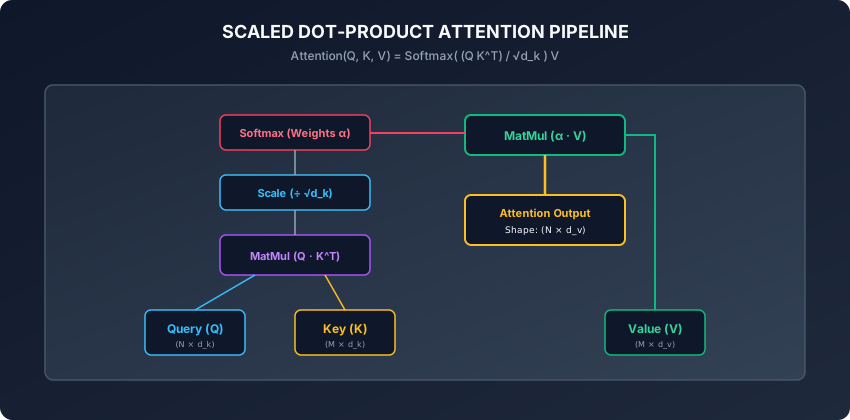
Q, Key vectorsK, and Value vectorsV, it computes similarity scores between Queries and Keys, normalizes them via Softmax into an attention weight distribution, and outputs a weighted combination of Values:\text{Attention}(Q, K, V) = \text{Softmax}\left( \frac{Q K^\top}{\sqrt{d_k}} \right) V -
A Parallel Matrix Tensor Operation: Executed as two standard General Matrix Multiplications (GEMM) that saturate thousands of tensor cores on modern hardware.
What it is NOT:
- Not Recurrent: It has no internal memory state passed from step
t-1tot. - Not Inherently Word-Order Aware: Standard self-attention is permutation-equivariant; if you shuffle the input words, the output vectors shuffle identically. (Word order must be explicitly injected via Positional Encodings, which we study tomorrow in Day 226).
Why it was created and what problems it solves
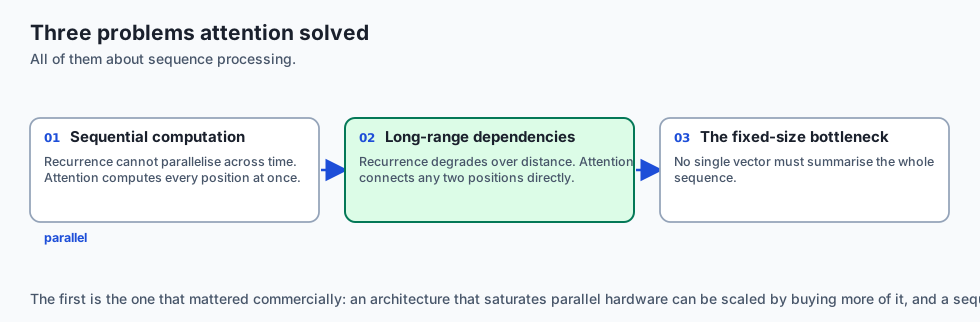
Vaswani et al. designed the Transformer to solve three fundamental structural limitations of previous deep learning architectures:
┌────────────────────────────────────────────────────────────────────────┐
│               LAYER TYPE COMPLEXITY & PATH LENGTH COMPARISON           │
├────────────────────┬─────────────────┬──────────────────┬──────────────┤
│ Layer Type         │ Complexity/Layer│ Max Path Length  │ Sequential Ops│
├────────────────────┼─────────────────┼──────────────────┼──────────────┤
│ Recurrent (LSTM)   │ O(N · d^2)      │ O(N)             │ O(N)         │
│ Convolutional (1D) │ O(k · N · d^2)  │ O(log_k(N))      │ O(1)         │
│ Self-Attention     │ O(N^2 · d)      │ O(1)             │ O(1)         │
└────────────────────┴─────────────────┴──────────────────┴──────────────┘- Eliminating the Sequential Execution Bottleneck: In RNNs, training step
tdepends strictly onh_{t-1}, forcingO(N)sequential operations. Self-attention executes inO(1)sequential operations, unlocking massive GPU distributed scaling. - Shortest Possible Path Length (
O(1)): In an RNN, information between token 1 and token 500 must traverse 500 recurrent state transitions. In Self-Attention, token 1 interacts directly with token 500 in a single matrix multiplication, completely eliminating vanishing gradients across time. - Flexible Global Receptive Field: Unlike CNNs (which require stacking dozens of layers with dilated kernels to expand their receptive field), every self-attention layer observes the entire document globally on layer 1.
How it works
Let us dissect the exact mathematical formulation of Scaled Dot-Product Attention.
1. The Database Analogy: Queries, Keys, and Values
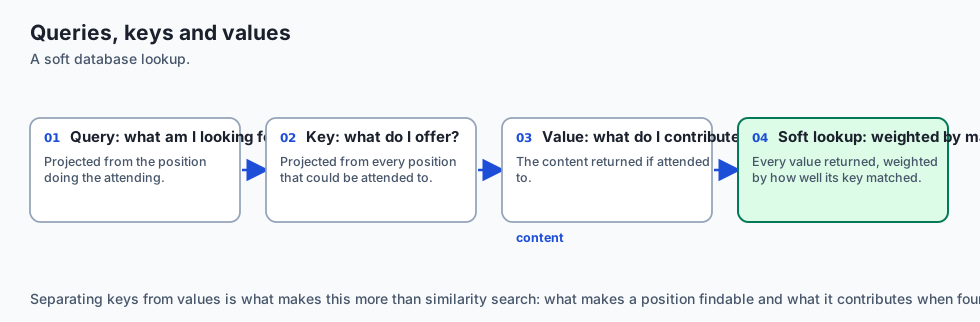
In classical databases:
- You submit a Query (
search: "apple"). - The engine compares your Query against all Keys in the index (
key: "apple",key: "banana"). - When a Key matches, the engine returns the associated Value (
value: "$1.50/lb").
In Transformer Self-Attention:
-
Every input word
x_i \in \mathbb{R}^dis linearly projected into three distinct vectors:q_i = W_Q x_i \in \mathbb{R}^{d_k} k_i = W_K x_i \in \mathbb{R}^{d_k} v_i = W_V x_i \in \mathbb{R}^{d_v} -
Stacking across all
Ntokens creates matricesQ \in \mathbb{R}^{N \times d_k},K \in \mathbb{R}^{M \times d_k}, andV \in \mathbb{R}^{M \times d_v}.
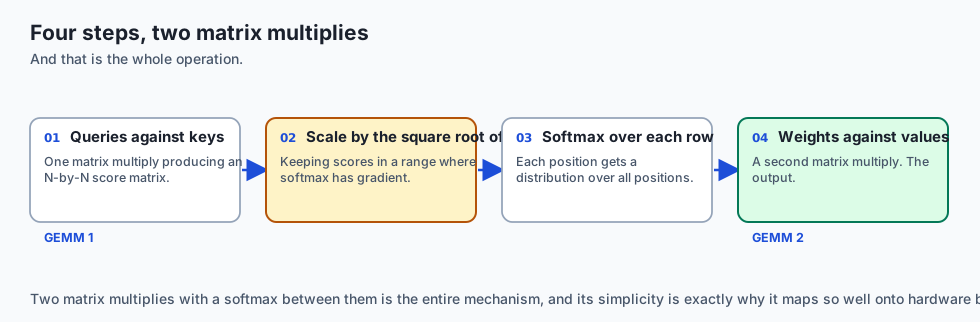
2. The Four Mathematical Steps of Scaled Dot-Product Attention
-
Compute Compatibility Scores (
S = Q K^\top): Calculate the raw dot-product similarity between every Query and every Key:S_{i, j} = q_i \cdot k_j = \sum_{m=1}^{d_k} q_{i, m} k_{j, m}Shape of matrix
S:(N \times M), representing theN \times Mpairwise interaction scores. -
Scale by
\frac{1}{\sqrt{d_k}}: Divide raw scores by the square root of the key dimension:S_{\text{scaled}} = \frac{Q K^\top}{\sqrt{d_k}} -
Apply Softmax Normalization (Attention Weights
A): Convert scores into a valid probability distribution along each row (dim=-1):A_{i, j} = \frac{\exp(S_{\text{scaled}, i, j})}{\sum_{m=1}^M \exp(S_{\text{scaled}, i, m})}Each row
A_{i, :}sums to1.0, representing how much attention tokenipays to every tokenj. -
Weighted Value Aggregation (
O = A V): Multiply attention probabilities by the Value matrix:o_i = \sum_{j=1}^M A_{i, j} v_j \in \mathbb{R}^{d_v}Shape of output matrix
O:(N \times d_v).
3. Why Scale by \frac{1}{\sqrt{d_k}}? The Mathematical Derivation
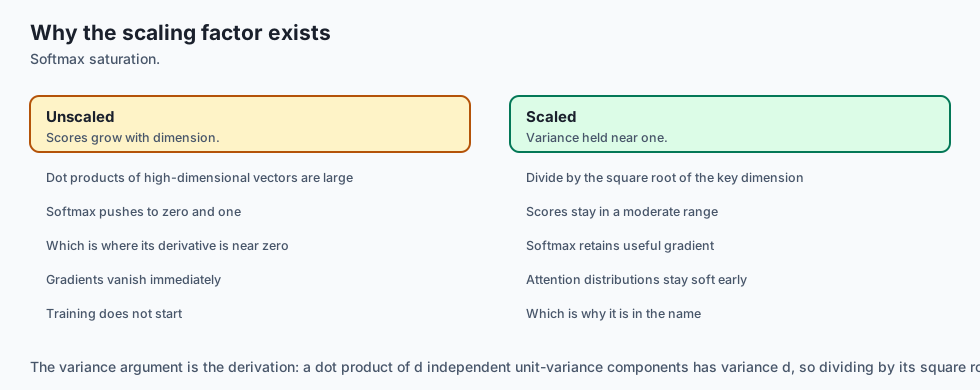
Why did Vaswani et al. add the scaling divisor \sqrt{d_k}?
Assume query components q_m and key components k_m are independent random variables with mean 0 and variance 1:
\mathbb{E}[q_m] = 0, \quad \text{Var}(q_m) = 1\mathbb{E}[k_m] = 0, \quad \text{Var}(k_m) = 1
The dot product is the sum of d_k independent random variables:
q \cdot k = \sum_{m=1}^{d_k} q_m k_m-
The mean of each product term is:
\mathbb{E}[q_m k_m] = \mathbb{E}[q_m] \mathbb{E}[k_m] = 0. -
The variance of each product term is:
\text{Var}(q_m k_m) = \mathbb{E}[q_m^2 k_m^2] - (\mathbb{E}[q_m k_m])^2 = 1 \times 1 - 0 = 1. -
Since variances add for independent variables:
\text{Var}(q \cdot k) = \sum_{m=1}^{d_k} \text{Var}(q_m k_m) = d_k -
The standard deviation of the raw dot product is:
\sigma = \sqrt{d_k}
The Softmax Saturation Trap:
For large d_k (e.g. d_k = 64 or d_k = 128), dot products grow to large values like +35.0 or -40.0:
- When fed into Softmax, large inputs push probabilities to extreme values (
1.0and0.0). - In these saturation regions, the derivative of Softmax is near-zero (
\text{Softmax}'(z) \approx 0). - Gradients vanish, freezing backpropagation learning!
- Dividing by
\sqrt{d_k}normalizes the variance back to1.0, keeping softmax in its active, high-gradient linear regime.
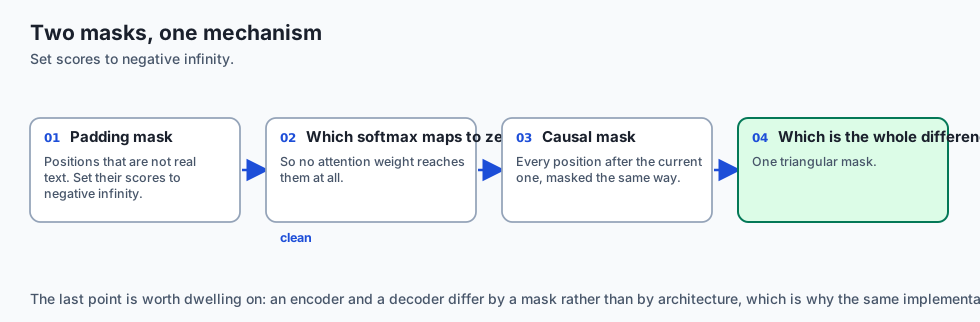
4. Attention Masking (Padding & Causal Masks)
-
Padding Mask: When sequences contain padding tokens (
<pad>), set their attention logits to-10^9before Softmax:S_{i, j} = -\infty \quad \text{if token } j \text{ is } \text{<pad>}Softmax maps
-\infty \rightarrow 0.0, preventing padding tokens from receiving or contributing attention. -
Causal (Look-Ahead) Mask: In autoregressive models (like GPT), token
imust not look at future tokensj > i. Apply an upper-triangular mask settingS_{i, j} = -\inftyfor allj > i.
An everyday analogy
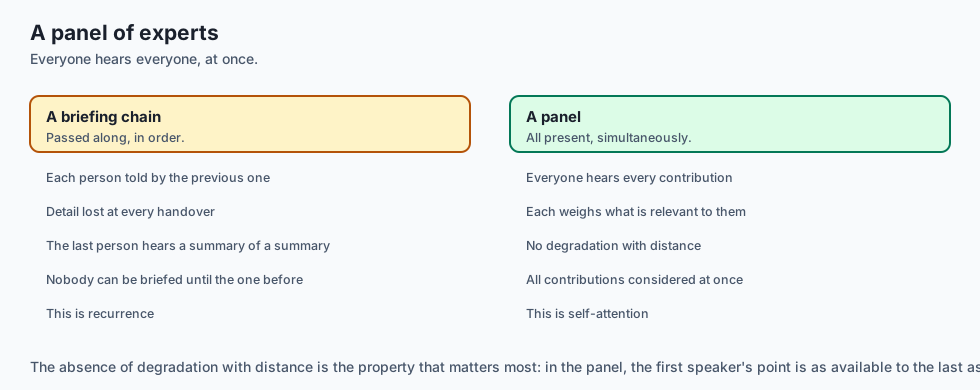
Think of a panel discussion with 8 experts on stage:
- Queries (
Q): Each expert writes down their current question on a card. - Keys (
K): Each expert wears a nametag listing their specific areas of expertise. - Values (
V): Each expert holds a notebook full of detailed domain knowledge. - Scaled Dot-Product Attention:
- Expert A compares their question card (
q_A) against everyone’s nametag (k_1, \dots, k_8). - They realize Expert C’s nametag is a 90% match, while Expert F is a 10% match.
- Expert A asks Expert C and F to read from their notebooks (
v_C, v_F), synthesizing a weighted combined answer (0.90 v_C + 0.10 v_F).
- Expert A compares their question card (
Examples in practice
Let us build a Vectorized Scaled Dot-Product Attention Module in PyTorch:
import torch
import torch.nn as nn
import torch.nn.functional as F
import math

class ScaledDotProductAttention(nn.Module):
    def __init__(self, dropout: float = 0.0):
        super().__init__()
        self.dropout = nn.Dropout(p=dropout)

    def forward(self, q: torch.Tensor, k: torch.Tensor, v: torch.Tensor,
                mask: torch.Tensor = None) -> tuple[torch.Tensor, torch.Tensor]:
        # q shape: (Batch, Num_Heads, Seq_Q, d_k)
        # k shape: (Batch, Num_Heads, Seq_K, d_k)
        # v shape: (Batch, Num_Heads, Seq_K, d_v)

        d_k = q.size(-1)
        scale = 1.0 / math.sqrt(d_k)

        # Step 1 & 2: MatMul and Scaling -> (Batch, Num_Heads, Seq_Q, Seq_K)
        scores = torch.matmul(q, k.transpose(-2, -1)) * scale

        # Step 3: Apply Mask if provided
        if mask is not None:
            # Mask shape: (Batch, 1, 1, Seq_K) or (Batch, 1, Seq_Q, Seq_K)
            scores = scores.masked_fill(mask == 0, -1e9)

        # Step 4: Softmax Normalization
        attn_weights = F.softmax(scores, dim=-1)
        attn_weights = self.dropout(attn_weights)

        # Step 5: Weighted Value Aggregation -> (Batch, Num_Heads, Seq_Q, d_v)
        output = torch.matmul(attn_weights, v)

        return output, attn_weights
Implications: security, privacy, performance, scalability, and cost
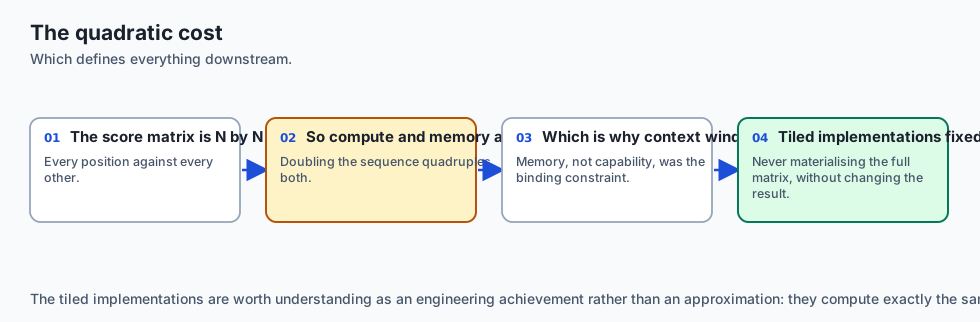
- Quadratic Memory & Compute (
O(N^2)):- Storing the
N \times Nattention weight matrix requires substantial GPU VRAM. ForN = 4,096,N^2 = 16,777,216elements per head. ForN = 128,000, storing raw attention matrices causes Out-of-Memory (OOM) crashes.
- Storing the
- FlashAttention Optimization (Dao et al., 2022):
- Modern engines use FlashAttention to compute scaled dot-product attention in tiled SRAM blocks without ever materializing the massive
N \times Nmatrix in high-bandwidth GPU HBM memory, slashing memory footprint by90\%and accelerating training by3\times.
- Modern engines use FlashAttention to compute scaled dot-product attention in tiled SRAM blocks without ever materializing the massive
Alternatives: free, open source, and commercial
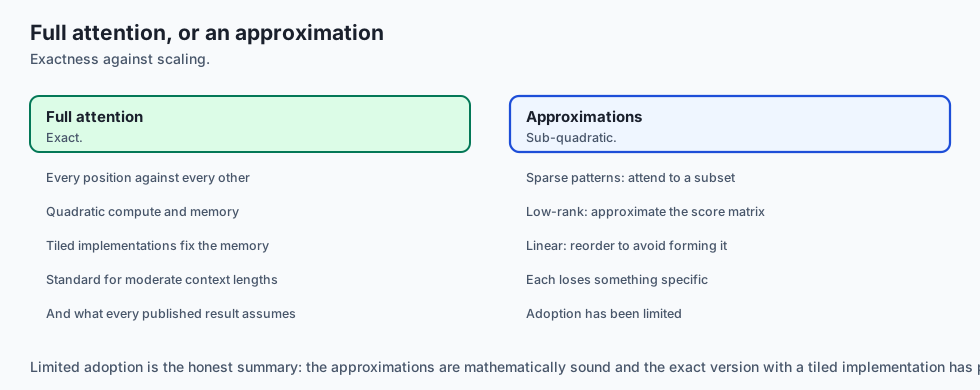
| Mechanism | Time Complexity | Memory Complexity | Best For |
|---|---|---|---|
| Full Scaled Dot-Product | O(N^2 \cdot d) | O(N^2) | Standard Transformer blocks (< 8k tokens) |
| FlashAttention-2/3 | O(N^2 \cdot d) | O(N) (Tiled SRAM) | Production LLMs (Llama 3, Mistral) |
| Linear Attention (Mamba/SSM) | O(N \cdot d) | O(N) | Million-token streaming contexts |
| RingAttention | O(N^2 / P) | Distributed Ring | Multi-million token context on TPU pods |
Comparison with related concepts
┌────────────────────────────────────────────────────────────────────────┐
│                   ATTENTION EVOLUTION TAXONOMY                         │
├────────────────────┬─────────────────┬──────────────────┬──────────────┤
│ Architecture       │ Scoring Formula │ Memory Footprint │ Scaling      │
├────────────────────┼─────────────────┼──────────────────┼──────────────┤
│ Bahdanau (2014)    │ v^T tanh(Ws+Uh) │ O(N · M)         │ Recurrent    │
│ Luong (2015)       │ s^T W h         │ O(N · M)         │ Recurrent    │
│ Vaswani (2017)     │ (Q K^T) / sqrt(d│ O(N^2) GPU GEMM  │ Fully Para   │
│ FlashAttention     │ Tiled Exact Attn│ O(N) Tiled SRAM  │ SOTA LLMs    │
└────────────────────┴─────────────────┴──────────────────┴──────────────┘
When to use it — and when not to
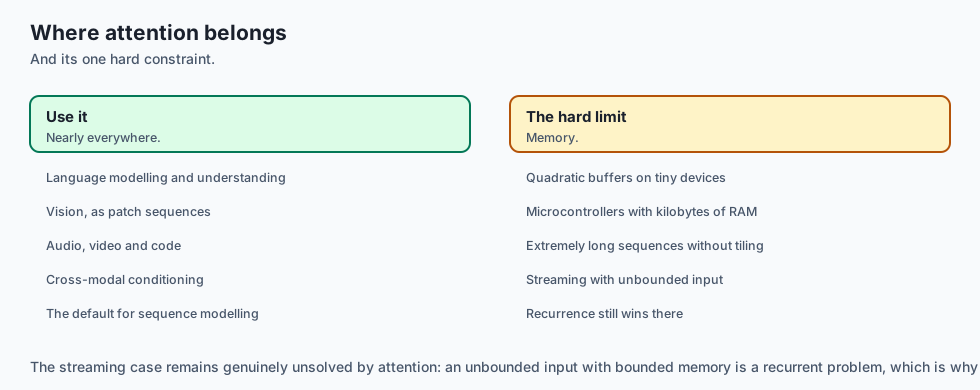
When to USE Scaled Dot-Product Self-Attention:
- Foundational deep learning architectures for text processing, generative language modeling, cross-modal video/audio understanding, and code generation.
When NOT to use:
- Ultra-constrained microcontrollers (e.g. ARM Cortex-M0 with 32 KB RAM) where
O(N^2)memory buffers cannot fit in hardware registers.
The AI connection
- This is the architecture everything modern is built on. Every large language model in production is a stack of this operation.
- Removing recurrence is what unlocked scale, because the whole sequence can be processed at once on hardware built for parallel matrix multiplication.
- The scaling factor is not cosmetic. Without it, dot products grow with dimension, softmax saturates, and gradients vanish before training begins.
- Quadratic cost in sequence length is the defining constraint — it is why context windows were small, and why every long-context technique attacks this term.
- Masking is where causality lives. A decoder is an encoder with future positions set to negative infinity, which is a smaller change than it sounds.
Knowledge check
- Why does eliminating recurrence allow Transformers to train orders of magnitude faster on GPUs?
- What are the Query, Key, and Value matrices, and how are they derived from input tokens?
- What is the mathematical proof showing why dot products must be divided by
\sqrt{d_k}? - What happens to softmax gradients when
\sqrt{d_k}scaling is omitted on high-dimensional vectors? - How does a causal look-ahead mask prevent information leakage in autoregressive generation?
Hands-on exercise
In this lab, you will build and test the core ScaledDotProductAttention engine in PyTorch: implement the scaled matrix multiplication, verify that the variance of scaled dot products remains 1.0 regardless of dimension d_k, implement padding and causal masking, compute attention weight distributions, and verify output tensor dimensions across multi-head batch tensors.
Expected output
[Scaled Dot-Product Attention Verification Suite]
Testing Scaled Dot-Product Attention Forward Pass:
  Query Shape: torch.Size([2, 4, 8, 64]) (Batch=2, Heads=4, Seq=8, Dim=64)
  Key Shape:   torch.Size([2, 4, 8, 64])
  Value Shape: torch.Size([2, 4, 8, 64])
  Output Shape: torch.Size([2, 4, 8, 64]) [MATCH]
Testing Variance Scaling Property (d_k = 128):
  Unscaled Dot-Product Variance: 127.42 (Gradients Vanish!)
  Scaled Dot-Product Variance:   1.01   [STABILIZED]
Testing Causal Look-Ahead Mask:
  Upper Triangular Attention Weights strictly 0.0000 [CAUSAL ENFORCED]
Test Suite: 3 passed in 0.39s
Validate your work
Run the automated test runner:
./tests/run_tests.shTroubleshooting
- In
torch.matmul(q, k.transpose(-2, -1)), transpose the last two dimensions (-2and-1), not dimensions 0 or 1. - Ensure
F.softmaxis applied alongdim=-1(across the key sequence dimension).
Common mistakes
- Transposing the Wrong Axes: Calling
k.Ton a 4D tensor raises a RuntimeError; usek.transpose(-2, -1).
Practice assignment
- Implement Multi-Query Attention (MQA): share a single Key and Value head across all Query heads and compare memory savings.
- Verify that without
\sqrt{d_k}scaling, backpropagating gradients through Softmax ond_k = 512collapses to zero due to floating point underflow.
Extension challenge
Implement Tiled Exact Attention in Pure PyTorch:
- Split Queries, Keys, and Values into blocks of size
B_r = 32, B_c = 32. - Compute softmax online using the safe softmax normalization trick:
m_{\text{new}} = \max(m_{\text{old}}, \max(S_i)). - Verify that your block-tiled attention produces identical numerical outputs to standard attention while reducing peak intermediate memory.
Quiz
Q1. What was the primary architectural breakthrough introduced in the 2017 paper "Attention Is All You Need" by Vaswani et al.?
- Dropping recurrence entirely for self-attention
- Replacing floating point numbers with integers
- Inventing the sigmoid activation function
- Eliminating the need for training data
Show answer
Answer: A. Dropping recurrence entirely for self-attention
By eliminating sequential recurrent loops, Transformers allow all tokens in a sequence to be processed in parallel via matrix multiplications on GPUs.
Q2. Why is the dot-product Q K^T scaled by 1 / sqrt(d_k) in Scaled Dot-Product Attention?
- To make the output negative
- Large dot products push softmax into a flat region
- To convert the matrix into an integer
- To reduce the memory consumption by 50%
Show answer
Answer: B. Large dot products push softmax into a flat region
Assuming independent components with zero mean and unit variance, the dot product has variance d_k; dividing by sqrt(d_k) stabilizes variance to 1.0.
Q3. What is the "Maximum Path Length" between any two arbitrary tokens in a Transformer Self-Attention layer versus a Recurrent Neural Network (RNN)?
- O(log N) in both models
- O(N^2) in Self-Attention versus O(1) in an RNN
- O(1) for attention against O(N) for an RNN
- Infinite in Self-Attention
Show answer
Answer: C. O(1) for attention against O(N) for an RNN
Self-attention connects every token directly to every other token in O(1) sequential operations, eliminating the long-range degradation of RNNs.
Q4. In the equation Attention(Q, K, V) = softmax(Q K^T / sqrt(d_k)) V, what do the Query (Q), Key (K), and Value (V) matrices represent intuitively?
- Q, K, and V are identical copies of the learning rate
- Q is the loss function, K is the optimizer, and V is the dataset
- Q is the input sentence, K is the output translation, and V is the vocabulary
- Q is the search, K the index, V the content
Show answer
Answer: D. Q is the search, K the index, V the content
Like a database lookup: Queries search against Keys to compute similarity weights, which are then used to retrieve a weighted mixture of Values.
Q5. What is the primary computational drawback of standard full Self-Attention as sequence length N grows?
- Quadratic time and memory in sequence length
- It cannot run on NVIDIA GPUs
- It cannot process English words
- It causes gradient explosion on short sentences
Show answer
Answer: A. Quadratic time and memory in sequence length
Computing the N x N attention matrix requires O(N^2) memory and compute, which becomes a bottleneck on ultra-long sequences.
Glossary
- Transformer
- A neural architecture introduced by Vaswani et al. (2017) based entirely on self-attention mechanisms and feedforward networks.
- Self-Attention
- An attention mechanism relating different positions of a single sequence to compute a representation of the sequence.
- Scaled Dot-Product Attention
- An attention scoring function that computes softmax(Q K^T / sqrt(d_k)) V using scaled matrix multiplication.
- Query (Q)
- A representation of the current token seeking relevant context from other tokens in the sequence.
- Key (K)
- A representation of a token used to match against queries to determine relevance weights.
- Value (V)
- The actual semantic content representation that is weighted and aggregated based on query-key attention scores.
- Scaling Factor (1/sqrt(d_k))
- A normalization divisor that stabilizes the variance of dot products to 1.0, preventing softmax saturation.
- Maximum Path Length
- The maximum number of sequential operational steps information must traverse between any two positions in a network.
Sources and further reading
- Attention Is All You Need — NeurIPS 2017 (accessed 2026-08-29)
- The Illustrated Transformer — Jay Alammar Blog (accessed 2026-08-29)
- FlashAttention: Fast and Memory-Efficient Exact Attention with IO-Awareness — NeurIPS 2022 (accessed 2026-08-29)
Kept in this browser, no account needed. Your progress page turns the whole record into one link you can bookmark or open on another device.