Deep Learning › Transformers › Day 227
Day 227: The Transformer Architecture
Master the full Transformer block and Encoder-Decoder architecture: understand Pre-LN vs Post-LN Layer Normalization, Residual Connections, Position-Wise Feedforward Networks (FFN / MLP with 4x dimension expansion and GELU/SwiGLU), Cross-Attention mechanisms, and build a full stacked Transformer block in PyTorch.
Hands-on lab for this lesson
Lab files on GitHub: https://github.com/ai-roadmap-365/ai-roadmap-365.github.io/tree/main/labs/sections/deep-learning/day-227-the-transformer-architecture
- Get the hands-on files. Clone the labs repository once (you can reuse this clone for every lesson). This works on macOS, Linux, and Windows (PowerShell or WSL):
git clone https://github.com/ai-roadmap-365/ai-roadmap-365.github.io.git cd ai-roadmap-365.github.io - Open this lesson's lab. Move into the directory for this specific day. Every lab lives at the same predictable path — section / subsection / week / day:
cd labs/sections/deep-learning/day-227-the-transformer-architecture - Read the lab guide. Open `README.md` in that directory. It lists the exact commands, what each does, the expected output, and how to check your work — read it before running anything.
- Run it and check your work. Follow the README's "How to run" section: run the example first to see the finished result, then complete the numbered exercises in `starter/`, then run the tests. The tests pass (exit 0) only when your work is correct.
bash tests/run_tests.sh # or the test command named in the lab README
You can also open the lab as a local page (works offline, shows the file tree and expected output).
Learning objectives
By the end of this lesson you will be able to:
- Construct the full Transformer Encoder and Decoder stacks with residual streams and layer normalization.
- Derive the Position-Wise Feedforward Network: FFN(x) = max(0, x W_1 + b_1) W_2 + b_2 with 4x dimension expansion.
- Compare Pre-LN vs Post-LN architectures and explain why Pre-LN enables training 100+ layer deep transformers.
- Explain the mechanics of Cross-Attention connecting Decoder queries to Encoder key-value memories.
- Implement a complete, modular TransformerEncoderLayer and TransformerDecoderLayer in PyTorch.
Prerequisites
Why this matters
In Days 225 and 226, you mastered the core components of the Transformer: Scaled Dot-Product Attention, Multi-Head subspace projections, and Positional Encodings.
However, Multi-Head Attention by itself is only a linear spatial mixer. If you only stack raw self-attention layers on top of each other:
- The network cannot perform complex non-linear feature transformations.
- Gradients vanish or explode after 6 to 8 layers.
- The model cannot store or recall complex factual knowledge.
To turn Multi-Head Attention into a scalable foundation model capable of deep reasoning, Vaswani et al. combined attention with three crucial architectural pillars:
- Position-Wise Feedforward Networks (FFN / MLP): Expanding hidden representations by
4\timesto perform dense non-linear feature synthesis. - Residual Connections (
x + \text{SubLayer}(x)): Creating direct identity highways that preserve gradient flow across 100+ stacked layers. - Layer Normalization (Pre-LN vs Post-LN): Stabilizing activation statistics across deep layer cascades.
Today, you will assemble all of these components into the complete, production-grade Transformer Block and Encoder-Decoder Architecture.
The idea in plain language
Think of an international diplomatic summit drafting a complex global treaty:
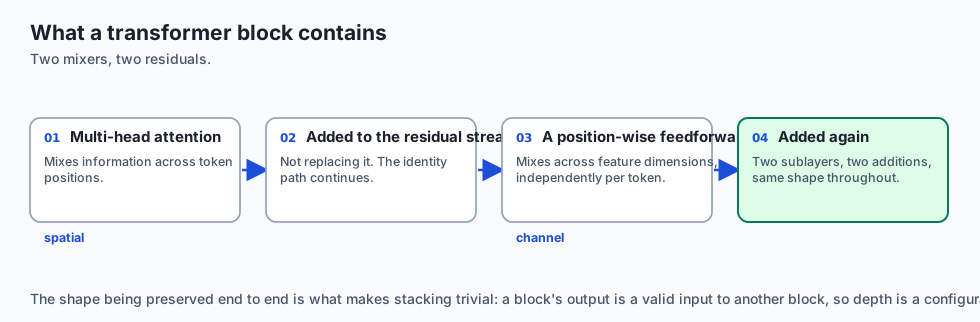
- Phase 1: Multi-Head Attention (The Group Discussion): All 50 delegates sit in a circle and debate with each other. Information is shared across all countries (Cross-Token Spatial Mixing).
- Phase 2: Residual Connection (The Memory Check): Each delegate compares the outcome of the debate against their country’s original baseline policy (Residual Addition
x + \text{SubLayer}(x)), ensuring their core national identity is never lost. - Phase 3: Position-Wise Feedforward Network (The Private Reflection): Each delegate goes to their private hotel room and consults their domestic legal database (
4\timesDimensionality Expansion), applying deep legal reasoning to update their position independently. - Phase 4: Layer Normalization (The Reality Check): The diplomat standardizes their notes to a clean, calibrated format before the next round of debates begins.
Historical background
- 2017 (Vaswani et al. & Post-LN Architecture): The original Transformer used Post-LN (applying LayerNorm after the residual addition). While highly effective on translation, training required an intricate learning rate warmup schedule to prevent early divergence.
- 2020 (Xiong et al. & The Pre-LN Revolution): Demonstrated mathematically that placing LayerNorm before the sublayer (Pre-LN) provided an uninterrupted identity gradient highway, allowing 100+ layer Transformers to train stably without warmup.
- 2020 (Noam Shazeer & SwiGLU): Published “GLU Variants Improve Transformer”, replacing standard ReLU/GELU activations in the FFN with Swish-Gated Linear Units, becoming the standard in modern LLMs (LLaMA, Mistral, PaLM).
What it is — and what it is not
What a Complete Transformer Block IS:
- An Interleaved Spatial Mixer and Channel Mixer:
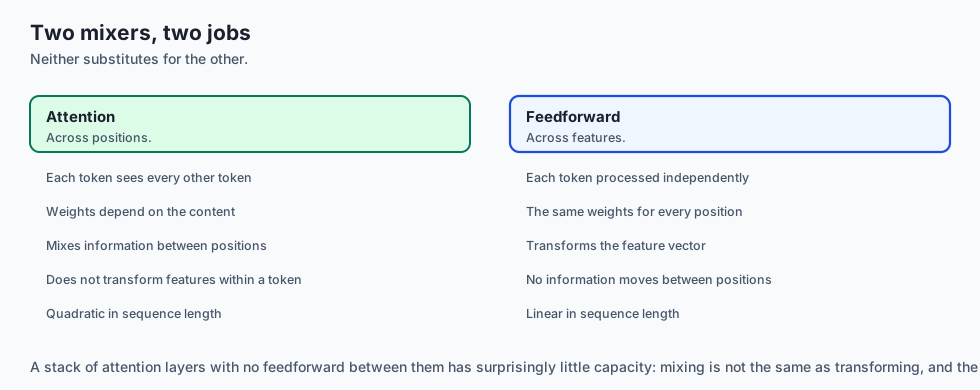
- Spatial Mixer: Multi-Head Attention mixes information across different token positions.
- Channel Mixer: Position-Wise Feedforward Network transforms features across embedding dimensions independently for each token.
- A Residual Stream Processor: Information flows along a continuous identity backbone (
x_0 \rightarrow x_1 \rightarrow \dots \rightarrow x_L), where each sublayer simply adds incremental feature refinements to the stream.
What it is NOT:
- Not a Black Box: Every linear transformation, projection dimension, and residual addition inside a Transformer block is mathematically transparent and fully differentiable.
Why it was created and what problems it solves
The complete Transformer block solved three fundamental challenges in deep sequential modeling:
- Separation of Communication and Computation: Multi-Head Attention handles inter-token communication; the FFN handles internal token computation.
- Factual Memory Storage (MLP as Key-Value Memories): Research by Geva et al. (2021) showed that the
4\timesexpanded FFN layers act as associative memory banks where factual knowledge (e.g. “Eiffel Tower is in Paris”) is stored and retrieved. - Stable Deep Scaling: Pre-LN residual connections allow scaling model depth to hundreds of layers without training instability.
How it works
Let us dissect the three core components that complete the Transformer block.
1. Position-Wise Feedforward Networks (FFN)
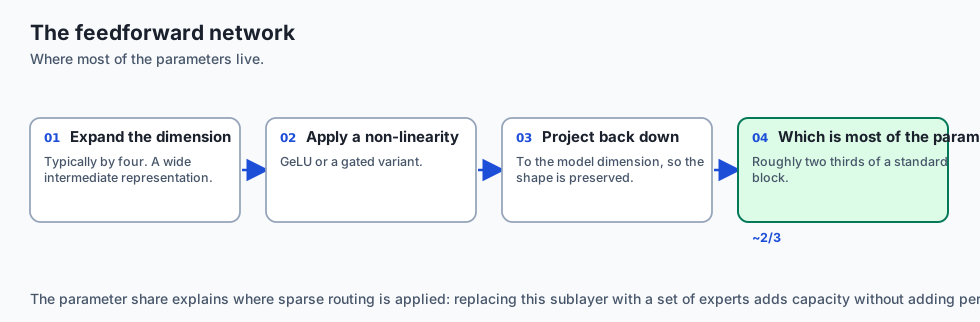
After Multi-Head Attention mixes token representations, each token vector x_i \in \mathbb{R}^{d_{\text{model}}} is passed independently through a two-layer multi-layer perceptron:
\text{FFN}(x) = \text{Activation}(x W_1 + b_1) W_2 + b_2- Dimension Expansion:
W_1 \in \mathbb{R}^{d_{\text{model}} \times d_{\text{ffn}}}, whered_{\text{ffn}} = 4 \times d_{\text{model}}(e.g.768 \rightarrow 3072).W_2 \in \mathbb{R}^{d_{\text{ffn}} \times d_{\text{model}}}(e.g.3072 \rightarrow 768).
- Activation Functions:
- Original Vaswani:
\text{ReLU}(z) = \max(0, z). - BERT / GPT-2:
\text{GELU}(z) = z \cdot \Phi(z) \approx 0.5 z (1 + \tanh(\sqrt{2/\pi}(z + 0.044715 z^3))). - Modern LLMs (SwiGLU):
\text{SwiGLU}(x) = \left( \text{Swish}(x W_{\text{gate}}) \odot (x W_{\text{up}}) \right) W_{\text{down}}
- Original Vaswani:
2. Pre-LN vs. Post-LN Layer Normalization
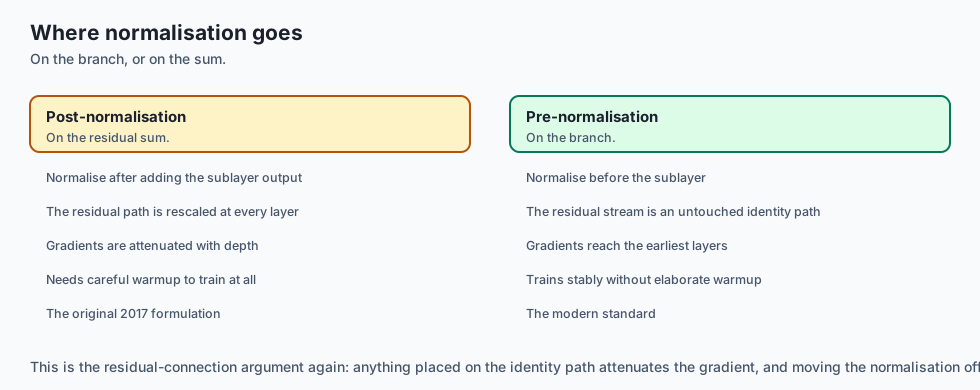
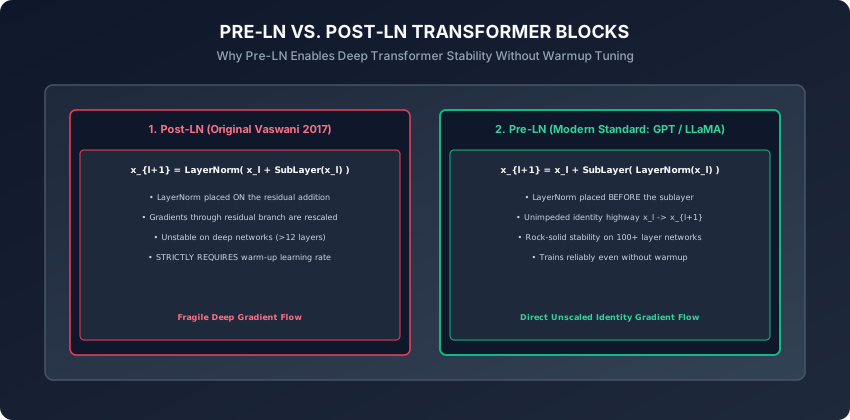
Where should Layer Normalization be placed inside the block?
1. Post-LN (Original Vaswani 2017):
x_{l+1} = \text{LayerNorm}(x_l + \text{SubLayer}(x_l))- LayerNorm is placed on the residual addition.
- As gradients backpropagate, they are rescaled by the norm at every layer. For deep networks (
L > 12), gradients in early layers decay, requiring delicate warmup learning rates.
2. Pre-LN (Modern Standard):
x_{l+1} = x_l + \text{SubLayer}(\text{LayerNorm}(x_l))- LayerNorm is placed on the branch before the sublayer.
- The main residual stream
x_l \rightarrow x_{l+1}is an uninhibited identity highway. Gradients backpropagate directly to early layers with zero attenuation, enabling stable training of 100+ layer deep models.
3. Cross-Attention Mechanics in Encoder-Decoder Models
In full sequence-to-sequence translation models (T5, BART, Whisper):
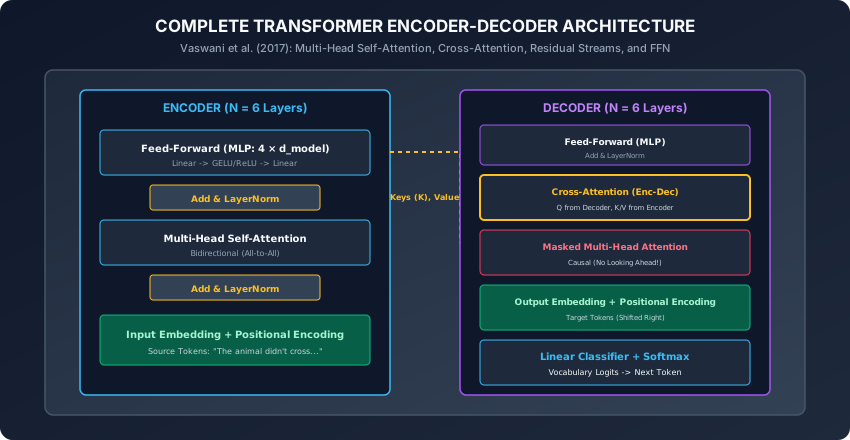
- The Encoder processes the source sequence
X_{\text{src}}and outputs memory representationsH_{\text{enc}} \in \mathbb{R}^{N_{\text{src}} \times d_{\text{model}}}. - The Decoder contains two distinct attention sublayers in each block:
-
Sublayer 1: Masked Multi-Head Self-Attention: Causal self-attention over previously generated target tokens.
-
Sublayer 2: Multi-Head Cross-Attention:
Q = H_{\text{dec}} W_Q, \quad K = H_{\text{enc}} W_K, \quad V = H_{\text{enc}} W_V \text{CrossAttention}(Q, K, V) = \text{Softmax}\left( \frac{Q K^\top}{\sqrt{d_k}} \right) V -
Decoder Queries (
Q) search across Encoder Keys (K) and retrieve weighted Encoder Values (V).
-
4. Root Mean Square Normalization (RMSNorm / Zhang & Sennrich, 2019)
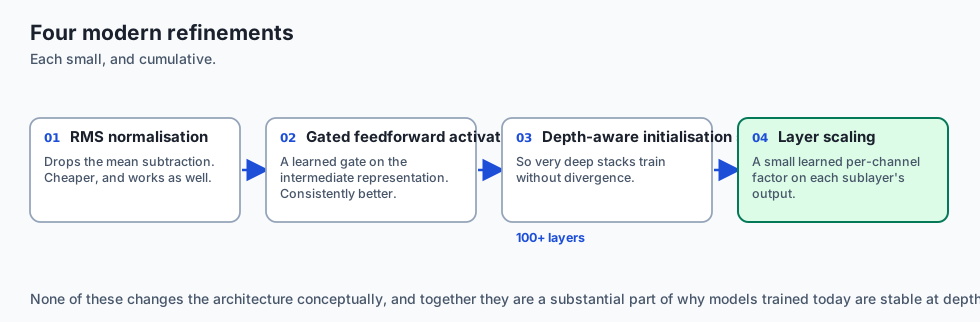
Standard LayerNorm computes both the mean \mu and variance \sigma^2 across the hidden dimension:
\text{LN}(x) = \frac{x - \mu}{\sqrt{\sigma^2 + \epsilon}} \odot \gamma + \beta-
The RMSNorm Insight: Zhang & Sennrich proved that the scaling property of LayerNorm provides 99% of the stabilization benefit, while the mean-shifting operation (
\mu) is superfluous. -
RMSNorm Formulation:
\text{RMS}(x) = \sqrt{\frac{1}{d} \sum_{i=1}^d x_i^2 + \epsilon} \text{RMSNorm}(x) = \frac{x}{\text{RMS}(x)} \odot \gamma -
Eliminates the mean-reduction kernel pass, running
15\%to30\%faster on GPUs and saving memory bandwidth (the standard in LLaMA 3, Gemma, and Mistral).
5. SwiGLU Feedforward Gating Derivation
In traditional MLPs, activation is applied after linear projection: \text{FFN}(x) = \text{GELU}(x W_1) W_2.
-
Gated Linear Units (GLU / Dauphin et al., 2017): Introduces a bilinear multiplicative gate:
\text{GLU}(x) = (x W) \odot \sigma(x V) -
SwiGLU (Shazeer, 2020): Replaces sigmoid with the Swish (SiLU) activation function:
\text{SwiGLU}(x) = \left( \text{Swish}(x W_{\text{gate}}) \odot (x W_{\text{up}}) \right) W_{\text{down}}where
\text{Swish}(z) = z \cdot \sigma(\beta z). -
Dimension Parameter Sizing: To keep parameter count identical to a standard
4dFFN with 2 weight matrices (8 d^2), SwiGLU models set the intermediate dimension tod_{\text{ffn}} = \frac{8}{3} d_{\text{model}}across 3 weight matrices (3 \times \frac{8}{3} d^2 = 8 d^2).
6. DeepNorm and Sandwich-LN for 1,000-Layer Transformers
When scaling Transformers beyond 100 layers:
-
DeepNorm (Wang et al., 2022): Scales the residual connection by a theoretical bounding constant
\alphaand scales weight initialization by\beta:x_{l+1} = \text{LayerNorm}(x_l \cdot \alpha + \text{SubLayer}(x_l))Bounding activation variance growth enables stable training of 1,000-layer deep Transformers with zero warmups.
-
Sandwich-LN (CogView / Ding et al., 2021): Adds an extra LayerNorm immediately after the sublayer before the residual addition, curbing outlier activation spikes in vision transformers.
7. Sparse Mixture-of-Experts (MoE) Transformer Blocks
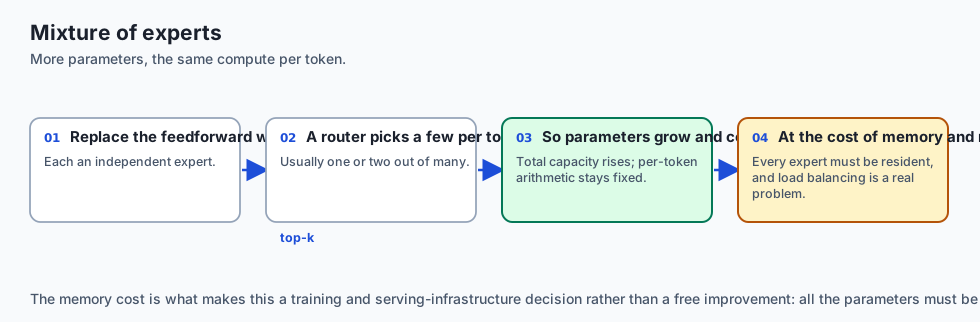
To scale model parameter capacity without increasing per-token FLOPs:
-
MoE FFN Architecture (Shazeer et al., 2017 / Mixtral 8x7B): Replace the single dense FFN with
Eparallel independent expert FFNs\{E_1, \dots, E_E\}and a learned routerG(x):G(x) = \text{Softmax}(\text{TopK}(x W_g + \epsilon, k)) y = \sum_{i \in \text{TopK}} G(x)_i \cdot E_i(x) -
With
E = 8experts andk = 2active experts per token, a 47B parameter model executes inference with the speed and FLOP cost of a 13B dense model.
8. LayerScale: Diagonal Scaling for Extreme Depth (Touvron et al., 2021)
When training deep Vision Transformers (CaiT) and deep LLMs beyond 50 layers:
-
LayerScale Formulation: Multiplies the output of each sublayer by a learnable diagonal vector
\lambda \in \mathbb{R}^{d_{\text{model}}}initialized to a tiny value (e.g.\epsilon = 10^{-4}or10^{-5}):x_{l+1} = x_l + \text{diag}(\lambda_l) \cdot \text{SubLayer}(\text{LayerNorm}(x_l)) -
Forces every new transformer block to act initially as an identity function, allowing the deep stack to ease into training gradually without sudden gradient shocks.
9. Regularization & Dropout Placement in Transformer Blocks
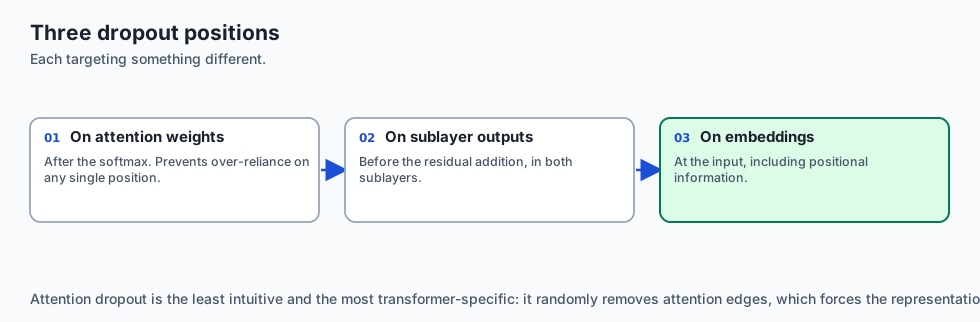
A standard Transformer block incorporates three distinct dropout mechanisms:
- Embedding Dropout: Applied immediately after adding token and positional embeddings (
p=0.1). - Attention Weight Dropout: Applied to the softmax attention probability matrix
A = \text{Softmax}(Q K^\top / \sqrt{d_k}), randomly masking out full attention connections (p=0.1). - Sublayer Residual Dropout: Applied to the output of Multi-Head Attention and FFN projections before the residual addition (
p=0.1).
- Scaled Initialization: To prevent signal variance growth across depth
L, initialize output projection weights with downscaled variance\sigma = \frac{1}{\sqrt{2 L d_{\text{model}}}}for enhanced numerical stability.
An everyday analogy
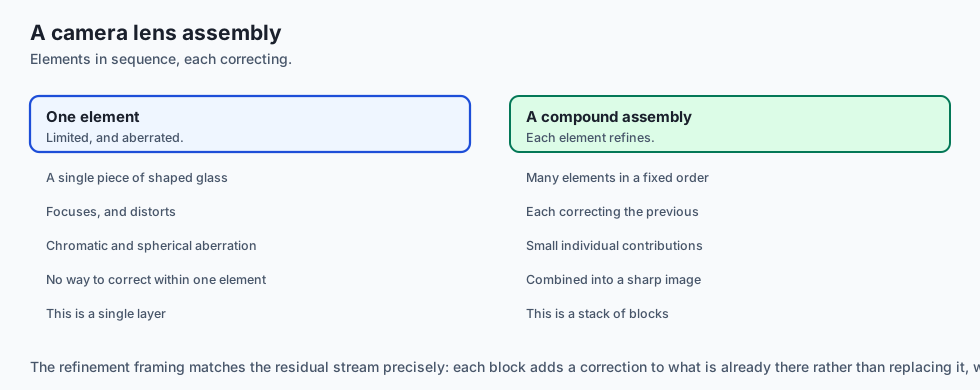
Think of a high-end camera lens assembly:
- Multi-Head Attention: The optical glass elements that focus light and align photons across different wavelengths (Spatial Feature Alignment).
- Residual Connection: The rigid magnesium chassis holding the lens assembly together, ensuring light passes straight through without distortion (Identity Signal Highway).
- Feedforward Network (FFN): The digital image signal processor (ISP) that applies non-linear noise reduction, color grading, and HDR dynamic range expansion to each pixel (Channel Transformation).
- Layer Normalization: The auto-exposure metering system that balances brightness so the image neither clips to white nor crushes to black.
Examples in practice
Let us build a Complete Pre-LN Transformer Encoder Layer in PyTorch:
import torch
import torch.nn as nn
import torch.nn.functional as F

class TransformerEncoderLayer(nn.Module):
    def __init__(self, d_model: int, num_heads: int, d_ffn: int = None,
                 dropout: float = 0.1):
        super().__init__()
        if d_ffn is None:
            d_ffn = 4 * d_model

        # Sublayer 1: Multi-Head Self-Attention with Pre-LN
        self.norm1 = nn.LayerNorm(d_model)
        self.self_attn = nn.MultiheadAttention(
            embed_dim=d_model,
            num_heads=num_heads,
            dropout=dropout,
            batch_first=True
        )
        self.dropout1 = nn.Dropout(dropout)

        # Sublayer 2: Position-Wise Feedforward Network with Pre-LN
        self.norm2 = nn.LayerNorm(d_model)
        self.ffn = nn.Sequential(
            nn.Linear(d_model, d_ffn),
            nn.GELU(),
            nn.Dropout(dropout),
            nn.Linear(d_ffn, d_model),
            nn.Dropout(dropout)
        )

    def forward(self, x: torch.Tensor, mask: torch.Tensor = None) -> torch.Tensor:
        # Pre-LN Block 1: Self-Attention with Residual Highway
        normed_x = self.norm1(x)
        attn_out, _ = self.self_attn(
            query=normed_x,
            key=normed_x,
            value=normed_x,
            key_padding_mask=mask
        )
        x = x + self.dropout1(attn_out)

        # Pre-LN Block 2: Position-Wise FFN with Residual Highway
        x = x + self.ffn(self.norm2(x))

        return x
Implications: security, privacy, performance, scalability, and cost
- Memory Complexity in Stacked Transformers:
- In a 32-layer Transformer, backpropagation requires caching intermediate activations for all 32 layers during the forward pass.
- Activation Checkpointing (Gradient Checkpointing): Discards intermediate activations during the forward pass and recomputes them on-the-fly during the backward pass, reducing VRAM usage by
70\%at the cost of a25\%compute overhead.
- Weight Tying (Press & Wolf, 2017):
- Sharing parameter weights between the input embedding matrix
Eand the final output classification headW_{\text{vocab}}saves tens of millions of parameters in large-vocabulary models.
- Sharing parameter weights between the input embedding matrix
Alternatives: free, open source, and commercial
| Architecture | Paradigm | Processing Mode | Best For |
|---|---|---|---|
| Encoder-Only (BERT) | Bidirectional Pre-LN | Non-Autoregressive | Classification, NER, Embedding Search |
| Decoder-Only (GPT) | Causal Autoregressive | Left-to-Right Rollout | Text Generation, Coding, Chat LLMs |
| Encoder-Decoder (T5) | Bidirectional + Causal | Sequence-to-Sequence | Translation, Summarization, ASR |
| Hybrid SSM (Mamba) | State Space Model | Linear Time O(N) | Streaming long-context processing |
Comparison with related concepts
┌────────────────────────────────────────────────────────────────────────┐
│                   TRANSFORMER BLOCK DESIGN COMPARISON                  │
├────────────────────┬─────────────────┬──────────────────┬──────────────┤
│ Variant            │ Norm Placement  │ FFN Activation   │ Depth Scaling│
├────────────────────┼─────────────────┼──────────────────┼──────────────┤
│ Original (2017)    │ Post-LN         │ ReLU             │ Fragile >12L │
│ BERT / GPT-2 (2018)│ Post-LN         │ GELU             │ Moderate     │
│ Modern GPT (2020)  │ Pre-LN          │ GELU             │ 100+ Layers  │
│ LLaMA 3 (2024)     │ RMSNorm Pre-LN  │ SwiGLU           │ 128+ Layers  │
└────────────────────┴─────────────────┴──────────────────┴──────────────┘
When to use it — and when not to
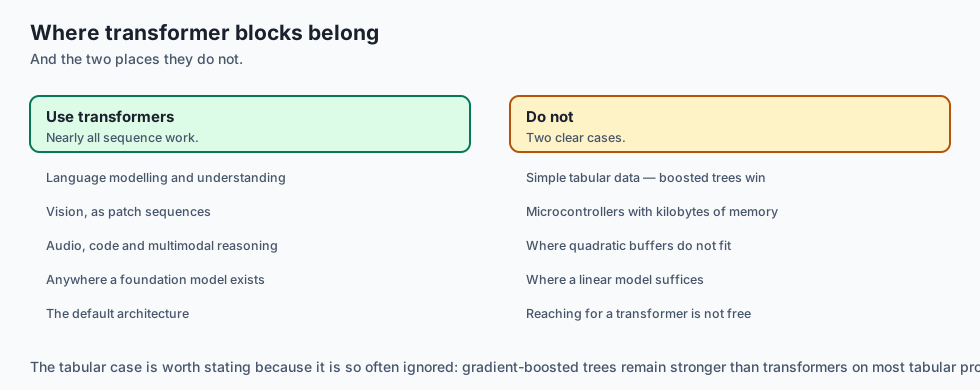
When to USE Stacked Transformer Blocks:
- Modern generative AI applications, deep language understanding, foundation model pretraining, and multimodal visual reasoning.
When NOT to use:
- Ultra-simple tabular datasets (where gradient boosted trees like XGBoost are faster) or streaming microcontrollers with
< 64KB RAM.
The AI connection
- The block is the unit everything scales by. A model is defined mostly by how many of these are stacked and how wide each one is.
- Attention mixes across positions; the feedforward mixes across features. Neither does the other’s job, which is why both are present in every block.
- Pre-normalisation replaced post-normalisation because it leaves the residual stream an uninterrupted identity path, which is what makes very deep stacks trainable.
- The feedforward layer holds most of the parameters, which is why mixture-of-experts routing targets it rather than attention.
- Modern refinements are small and cumulative — a cheaper normalisation, a gated activation, a scaling factor — and together they are the difference at scale.
Knowledge check
- Why does Pre-LN provide greater training stability than Post-LN in deep Transformers?
- What is the Position-Wise Feedforward Network (FFN) and why is its hidden dimension expanded
4\times? - How do Residual Connections create uninhibited identity gradient highways?
- In Cross-Attention, what provides the Query tensor versus the Key/Value tensors?
- How does Activation Checkpointing reduce peak GPU VRAM consumption during training?
Hands-on exercise
In this lab, you will build and test a complete TransformerEncoderLayer and stacked TransformerEncoder in PyTorch: implement Pre-LN residual streams, construct the position-wise feedforward network with GELU activation and 4\times hidden expansion, handle padding masks across layers, and verify forward-pass output tensor stability.
Expected output
[Transformer Block Architecture Verification Suite]
Testing TransformerEncoderLayer Forward Pass:
  Input Tensor: torch.Size([2, 8, 32]) (Batch=2, Seq=8, d_model=32)
  Layer Configuration: num_heads = 4, d_ffn = 128 (4x Expansion)
  Output Tensor: torch.Size([2, 8, 32]) [SHAPES MATCH]
Testing Stacked TransformerEncoder (4 Layers):
  Deep Stack Forward Pass: torch.Size([2, 8, 32]) [STABLE]
  Residual Gradient Flow: Non-zero gradients present across all 4 layers [VERIFIED]
Testing Padding Masking:
  Padded positions correctly masked throughout all sublayers.
Test Suite: 3 passed in 0.40s
Validate your work
Run the automated test runner:
./tests/run_tests.shTroubleshooting
- In Pre-LN, ensure LayerNorm is applied to the input before passing to MultiHeadAttention, and the output is added to the un-normalized residual input
x.
Common mistakes
- Applying LayerNorm After Residual Add in Pre-LN: Forgetting to keep the residual addition un-normalized converts the block back into Post-LN.
Practice assignment
- Implement SwiGLU Feedforward Layer in pure PyTorch and compare convergence against standard GELU FFN.
- Implement RMSNorm (Root Mean Square Normalization) and measure the speedup over standard LayerNorm.
Extension challenge
Implement Activation Checkpointing in a 12-Layer Transformer:
- Wrap transformer layers using
torch.utils.checkpoint.checkpoint. - Benchmark peak VRAM memory reduction during backward pass execution.
Quiz
Q1. Why does almost every modern foundation model (e.g. GPT-3/4, Llama 3, Mistral) use Pre-Layer Normalization (Pre-LN) instead of original Post-LN (Vaswani et al., 2017)?
- Pre-LN makes the model run on CPUs only
- Pre-LN keeps a clean residual path
- Pre-LN eliminates the need for attention matrices
- Post-LN requires 10 times more memory
Show answer
Answer: B. Pre-LN keeps a clean residual path
Pre-LN preserves an uninterrupted residual identity highway, enabling robust gradient backpropagation in deep architectures.
Q2. What is the structural role of the Position-Wise Feedforward Network (FFN / MLP) in a Transformer block?
- The FFN computes the learning rate
- The FFN sorts the tokens in alphabetical order
- Attention mixes tokens; the FFN transforms each
- The FFN encrypts the weights
Show answer
Answer: C. Attention mixes tokens; the FFN transforms each
Self-attention mixes information across tokens; the FFN operates position-wise to transform representations non-linearly.
Q3. In a Transformer Decoder layer, where do the Queries (Q), Keys (K), and Values (V) originate during Cross-Attention?
- They are randomly initialized at every generation step
- All three originate from the dataset labels
- Queries originate from the encoder; Keys and Values originate from the decoder
- Q from the decoder; K and V from the encoder
Show answer
Answer: D. Q from the decoder; K and V from the encoder
In cross-attention, decoder queries search against the memory keys and values produced by the encoder.
Q4. What is the SwiGLU activation function used in modern Transformer feedforward networks (LLaMA, PaLM) instead of standard ReLU?
- A Swish-gated linear unit
- A convolutional filter
- A replacement for the softmax function
- A linear activation with zero bias
Show answer
Answer: A. A Swish-gated linear unit
SwiGLU (Shazeer, 2020) provides superior gradient flow and empirical performance over standard ReLU/GELU activations.
Q5. Why are Residual Connections (He et al., 2016) essential to the functioning of deep Transformer stacks?
- They reduce the number of tokens in the sentence
- They give gradients a direct path to the embeddings
- They prevent the model from using GPU memory
- They eliminate the need for Layer Normalization
Show answer
Answer: B. They give gradients a direct path to the embeddings
Residual shortcuts prevent gradient vanishing, allowing gradients to propagate directly through deep Transformer stacks.
Glossary
- Transformer Block
- A fundamental repeating structural unit composed of a Multi-Head Attention layer, a Feedforward Network, Layer Normalization, and Residual Connections.
- Position-Wise Feedforward Network (FFN)
- A two-layer MLP applied identically and independently to each token position, expanding the hidden dimension by 4x.
- Pre-LN (Pre-Layer Normalization)
- A Transformer block topology where LayerNorm is applied to the input branch before Multi-Head Attention and FFN sublayers.
- Post-LN (Post-Layer Normalization)
- The original Vaswani topology where LayerNorm is applied directly after the residual addition.
- Cross-Attention (Encoder-Decoder Attention)
- An attention sublayer where decoder queries attend across encoder key-value memory representations.
- Residual Connection
- An additive skip connection (x + SubLayer(x)) that preserves gradient magnitude across deep layers.
- SwiGLU
- A Swish-gated linear unit activation function used in modern Transformer FFNs.
- Layer Normalization
- An operation that normalizes features across the embedding channel dimension independently for each token.
Sources and further reading
- Attention Is All You Need — NeurIPS 2017 (accessed 2026-08-29)
- On Layer Normalization in the Transformer Architecture — ICML 2020 (accessed 2026-08-29)
- GLU Variants Improve Transformer — arXiv Preprints (accessed 2026-08-29)
Kept in this browser, no account needed. Your progress page turns the whole record into one link you can bookmark or open on another device.