Deep Learning › Transformers › Day 226
Day 226: Self-Attention, Step by Step
Master the multi-head subspace projection mechanics and positional encoding foundations of Transformers: understand why splitting into h heads enables diverse relationship tracking, derive Sinusoidal Positional Encodings, understand modern Rotary Position Embeddings (RoPE), and build a complete Multi-Head Self-Attention module in PyTorch.
Hands-on lab for this lesson
Lab files on GitHub: https://github.com/ai-roadmap-365/ai-roadmap-365.github.io/tree/main/labs/sections/deep-learning/day-226-self-attention-step-by-step
- Get the hands-on files. Clone the labs repository once (you can reuse this clone for every lesson). This works on macOS, Linux, and Windows (PowerShell or WSL):
git clone https://github.com/ai-roadmap-365/ai-roadmap-365.github.io.git cd ai-roadmap-365.github.io - Open this lesson's lab. Move into the directory for this specific day. Every lab lives at the same predictable path — section / subsection / week / day:
cd labs/sections/deep-learning/day-226-self-attention-step-by-step - Read the lab guide. Open `README.md` in that directory. It lists the exact commands, what each does, the expected output, and how to check your work — read it before running anything.
- Run it and check your work. Follow the README's "How to run" section: run the example first to see the finished result, then complete the numbered exercises in `starter/`, then run the tests. The tests pass (exit 0) only when your work is correct.
bash tests/run_tests.sh # or the test command named in the lab README
You can also open the lab as a local page (works offline, shows the file tree and expected output).
Learning objectives
By the end of this lesson you will be able to:
- Derive the Multi-Head Attention projection equations: Q_i = X W_Q^i, K_i = X W_K^i, V_i = X W_V^i.
- Explain why multi-head attention outperforms single-head attention by attending to information at different positions and representation subspaces simultaneously.
- Derive Sinusoidal Positional Encodings and prove the linear transformation property for relative positional shifts.
- Explain modern Rotary Position Embeddings (RoPE) and how 2D complex plane rotations enforce relative distance encoding.
- Implement a fully vectorized Multi-Head Self-Attention module in PyTorch with head splitting and recombination.
Prerequisites
Why this matters
Yesterday, you mastered the core mathematical engine of the Transformer: Scaled Dot-Product Attention. However, a single attention head is fundamentally limited:
- When reading the sentence: “The bank granted the loan because it was financially solvent”, what does the word
"it"refer to? - A single attention head might focus heavily on the syntactic subject (
"bank"). - But to fully parse the sentence, the model must simultaneously track:
- Coreference resolution (
"it"\rightarrow"bank"). - Syntactic verb attachment (
"it was solvent"\rightarrow"granted"). - Causal explanation (
"because"\rightarrow"solvent").
- Coreference resolution (
If a network possesses only a single attention head, it is forced to average all of these competing linguistic signals into a single blurry distribution.
By introducing Multi-Head Attention (MHA), Vaswani et al. gave the Transformer the ability to project representations into multiple parallel subspaces, allowing different heads to specialize in distinct linguistic, syntactic, and factual relationships simultaneously.
Furthermore, because self-attention is mathematically permutation-equivariant (it treats text as an unordered bag of tokens), Transformers require Positional Encodings to inject the sequential order of words.
Today, you will master the step-by-step architecture of Multi-Head Self-Attention, Sinusoidal Positional Encodings, and modern Rotary Position Embeddings (RoPE).
The idea in plain language
Imagine a committee of 8 specialized investigators examining a complex corporate legal contract:
- Investigator #1 (The Subject-Verb Specialist): Scans exclusively for subject-verb pairings (who did what).
- Investigator #2 (The Pronoun Resolver): Tracks pronouns (“it”, “they”, “which”) and traces them back to their original nouns.
- Investigator #3 (The Financial Auditor): Looks for numbers, dollar amounts, and currency terms.
- Investigator #4 (The Condition Specialist): Detects clauses starting with “if”, “unless”, and “provided that”.
Each investigator reads the exact same document through their own specialized analytical lens (Attention Head). At the end of the meeting, all 8 investigators combine their findings into a single unified executive dossier (Output Projection W_O).
Historical background
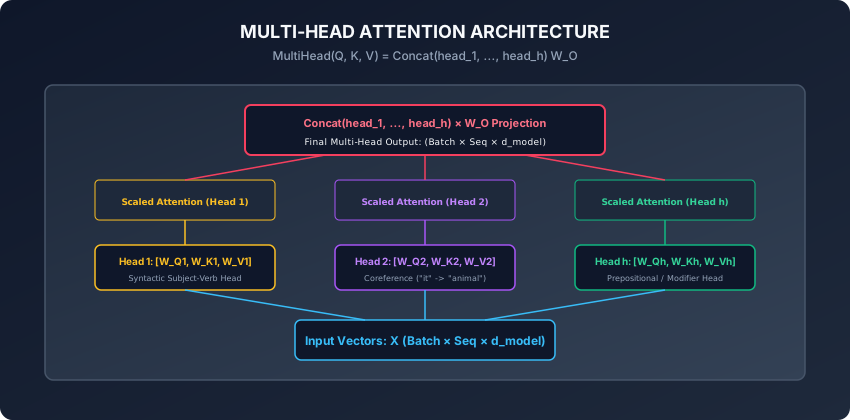
- 2017 (Vaswani et al. & Multi-Head Attention): Introduced Multi-Head Attention with
h = 8heads andd_{\text{model}} = 512, proving that multi-head projections achieved superior BLEU scores compared to single-head attention of identical total dimensionality. - 2019 (Clark et al. & “What Does BERT Look At?”): Probed the internal attention maps of BERT’s 144 attention heads, discovering that individual heads naturally learned classical linguistic structures (e.g. Head 8-10 specialized in direct objects of verbs, Head 7-6 specialized in possessive pronouns).
- 2021 (Jianlin Su & RoPE): Introduced Rotary Position Embedding (RoPE) in RoFormer, rotating query and key vectors in the 2D complex plane to enforce relative distance encoding. RoPE became the universal standard in modern open-weight LLMs (LLaMA, Mistral, Qwen, DeepSeek).
What it is — and what it is not
What Multi-Head Attention IS:
-
Parallel Subspace Projections: Linearly projecting Query, Key, and Value tensors
htimes with distinct learned parameter matrices:\text{head}_i = \text{Attention}(Q W_Q^i, K W_K^i, V W_V^i) -
Dimensionality Invariance: The output of Multi-Head Attention has the exact same tensor shape
(B, N, d_{\text{model}})as the input, allowing transformer blocks to be stacked arbitrarily deep.
What it is NOT:
- Not
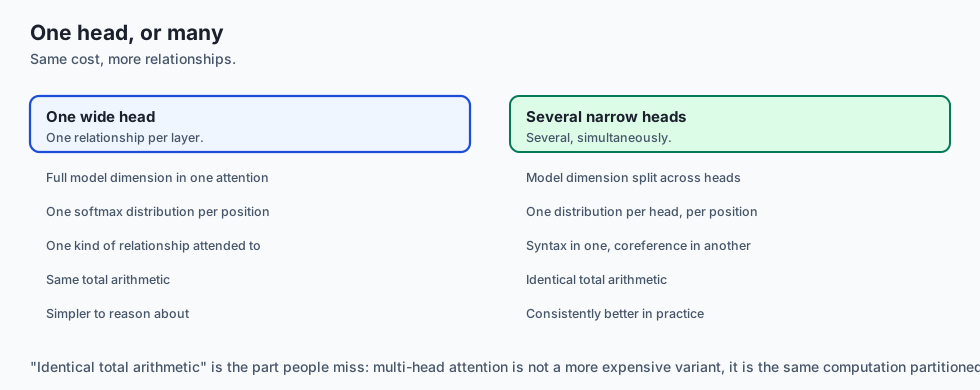
h\timesMore Expensive: Because each head operates on downscaled dimensiond_k = d_{\text{model}} / h, the total FLOP count ofhparallel heads is identical to a single head of dimensiond_{\text{model}}.
Why it was created and what problems it solves
Multi-Head Attention and Positional Encodings solved two critical limitations of early attention models:
- Preventing Attention Smearing: In a single attention head, if a token must attend to 3 different words, their weights split (
0.33, 0.33, 0.33), diluting the pooled vector. Multi-head attention allows Head 1 to assign0.99to word A, while Head 2 assigns0.99to word B. - Injecting Sequential Order Without Recurrence: Positional encodings provide the network with word order awareness while retaining 100% parallel GPU execution.
How it works
Let us dissect the step-by-step mathematical mechanics of Multi-Head Self-Attention and Positional Encodings.
1. Multi-Head Self-Attention Step-by-Step
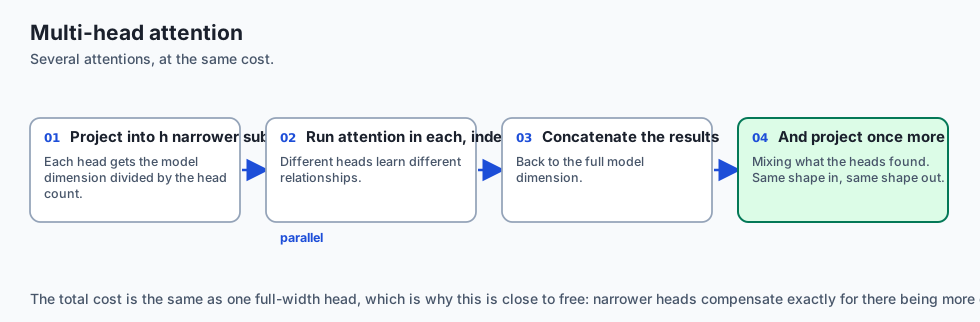
Given input matrix X \in \mathbb{R}^{N \times d_{\text{model}}} and number of heads h (where d_k = d_v = d_{\text{model}} / h):
-
Linear Projections (
Q, K, V): Project inputXthrough three unified weight matrices:Q = X W_Q \in \mathbb{R}^{N \times d_{\text{model}}} K = X W_K \in \mathbb{R}^{N \times d_{\text{model}}} V = X W_V \in \mathbb{R}^{N \times d_{\text{model}}} -
Subspace Reshaping & Transposition (Head Splitting): Reshape matrices from
(B, N, d_{\text{model}})into(B, N, h, d_k)and permute axes to:(B, h, N, d_k)This formats the tensor so that all
hheads across all batch samples can be processed in a single batched GPU GEMM operation. -
Parallel Scaled Dot-Product Attention: Compute attention for all heads simultaneously:
\text{head}_i = \text{Softmax}\left( \frac{Q_i K_i^\top}{\sqrt{d_k}} \right) V_i \in \mathbb{R}^{N \times d_k} -
Head Concatenation: Transpose and reshape the
hhead outputs back into a unified matrix:\text{Concat}(\text{head}_1, \dots, \text{head}_h) \in \mathbb{R}^{N \times d_{\text{model}}} -
Output Linear Projection (
W_O): Project the concatenated representations throughW_O \in \mathbb{R}^{d_{\text{model}} \times d_{\text{model}}}:\text{MHA}(Q, K, V) = \text{Concat}(\text{head}_1, \dots, \text{head}_h) W_O
2. Sinusoidal Positional Encodings (Vaswani et al., 2017)
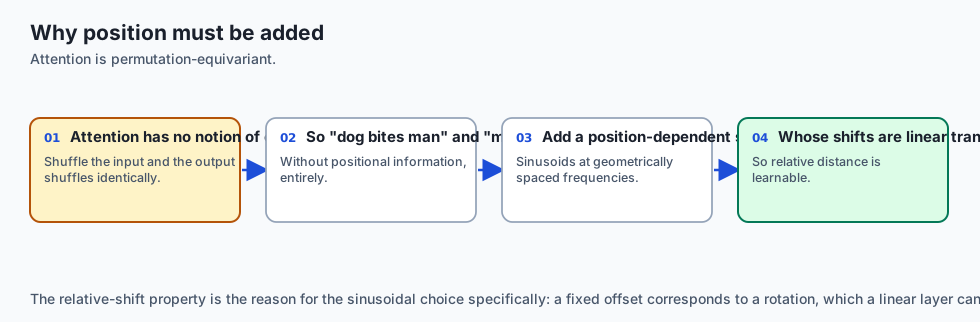
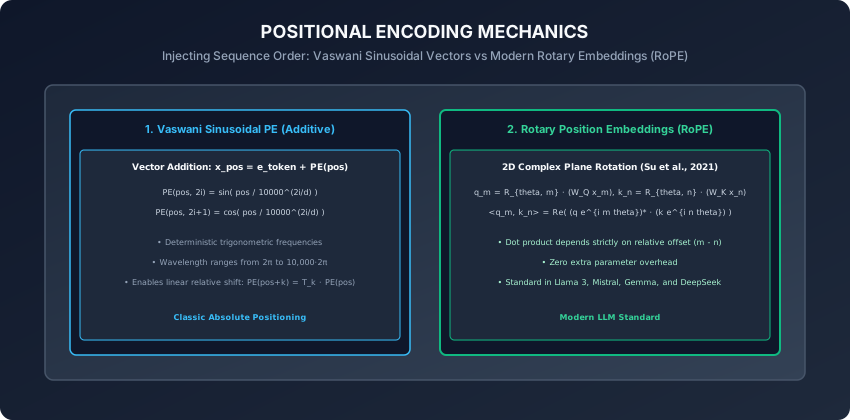
Because self-attention contains no recurrent time loops, word positions must be added directly to the input token embeddings:
x_{\text{final}} = e_{\text{token}} + \text{PE}(pos)Vaswani et al. defined deterministic sinusoidal functions across dimension index i \in [0, d_{\text{model}} / 2 - 1]:
\text{PE}_{(pos, 2i)} = \sin\left( \frac{pos}{10000^{2i / d_{\text{model}}}} \right)
\text{PE}_{(pos, 2i+1)} = \cos\left( \frac{pos}{10000^{2i / d_{\text{model}}}} \right)
The Linear Relative Shift Property:
For any fixed offset k, \text{PE}_{pos+k} can be represented as a linear function of \text{PE}_{pos}:
\begin{bmatrix}
\sin(\omega (pos + k)) \\
\cos(\omega (pos + k))
\end{bmatrix}
=
\begin{bmatrix}
\cos(\omega k) & \sin(\omega k) \\
-\sin(\omega k) & \cos(\omega k)
\end{bmatrix}
\begin{bmatrix}
\sin(\omega pos) \\
\cos(\omega pos)
\end{bmatrix}
This rotation matrix allows the neural network to easily learn relative positional distances.
3. Modern LLM Standard: Rotary Position Embeddings (RoPE)
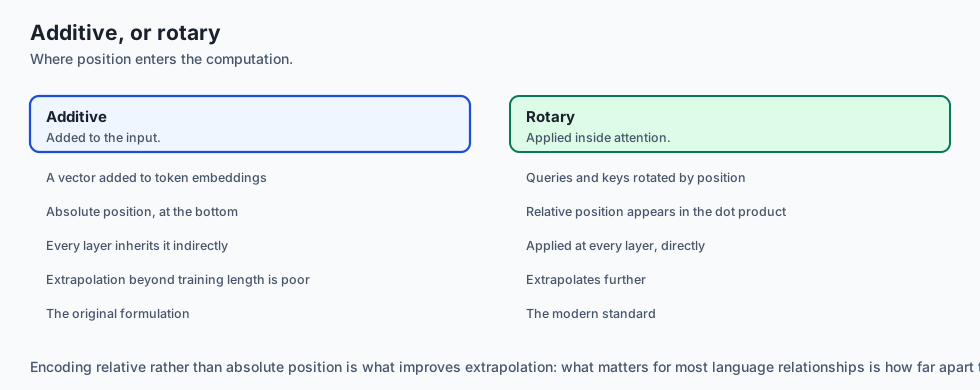
In modern foundation models (Llama 3, Mistral, Gemma), additive sinusoidal encodings have been replaced by Rotary Position Embeddings (RoPE / Su et al., 2021):
-
Instead of adding a vector to input embeddings, RoPE multiplies (rotates) Query and Key vectors by a 2D block-diagonal rotation matrix
R_{\Theta, m}^d:\tilde{q}_m = R_{\Theta, m} q_m, \quad \tilde{k}_n = R_{\Theta, n} k_n -
In the 2D complex plane, the inner product between query at position
mand key at positionnbecomes:\langle \tilde{q}_m, \tilde{k}_n \rangle = \text{Re}\left( (q_m e^{i m \theta})^* (k_n e^{i n \theta}) \right) = \text{Re}\left( q_m^* k_n e^{i (n - m) \theta} \right) -
The attention score depends purely on the relative token distance
(m - n), naturally generalizing across variable context lengths!
4. Learned Positional Embeddings (BERT & GPT-2)
Rather than fixed sinusoidal formulas, models like original BERT and GPT-2 used Learned Positional Embeddings:
- An embedding lookup table
W_{\text{pos}} \in \mathbb{R}^{L_{\text{max}} \times d_{\text{model}}}is initialized randomly and optimized via backpropagation. - Drawback: Strictly limits sequence inference length to
L_{\text{max}}(e.g. 512 tokens for BERT, 1024 for GPT-2); tokens at position 513 have no defined embedding vector.
5. ALiBi: Attention with Linear Biases (Press et al., 2021)
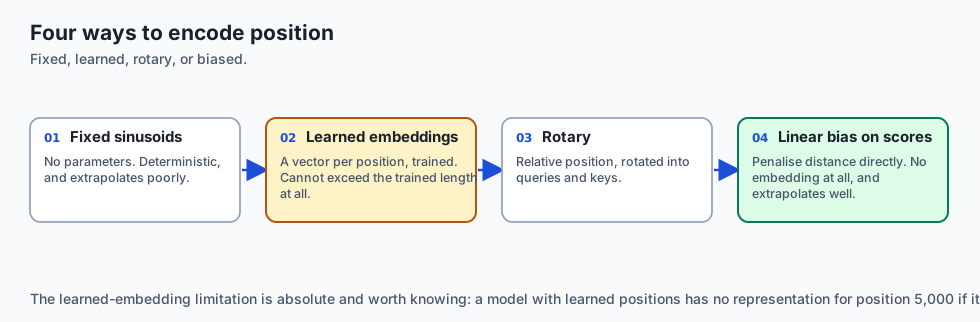
To eliminate positional embeddings entirely and enable infinite context extrapolation:
-
ALiBi Formulation: Directly adds a non-learned static linear penalty proportional to token distance into the attention score:
\text{score}_{i, j} = \frac{q_i k_j^\top}{\sqrt{d_k}} - m \cdot |i - j|where
m = 2^{-8 / h \cdot k}is a head-specific geometric decay slope. -
Allows models trained on 2,048 tokens to extrapolate smoothly to 16,000+ tokens at inference time with zero performance degradation.
6. Attention Head Redundancy & Pruning (Michel et al., 2019)
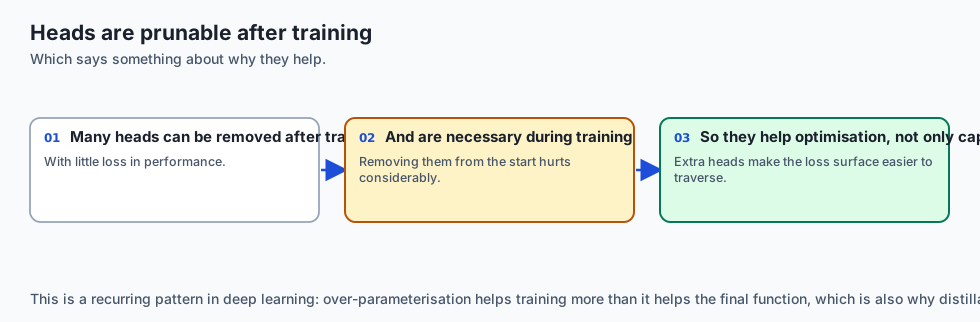
Researchers discovered that while multi-head attention is crucial during pretraining:
- Head Redundancy: Post-training analysis reveals that up to
40\%of attention heads in pretrained models like BERT and RoBERTa can be pruned or ablated with zero drop in downstream GLUE task accuracy. - Certain universal heads (the “syntactic backbone”) are essential, while redundant heads act as an ensemble safety buffer during optimization.
7. Grouped-Query Attention (GQA) Mathematical Mechanics
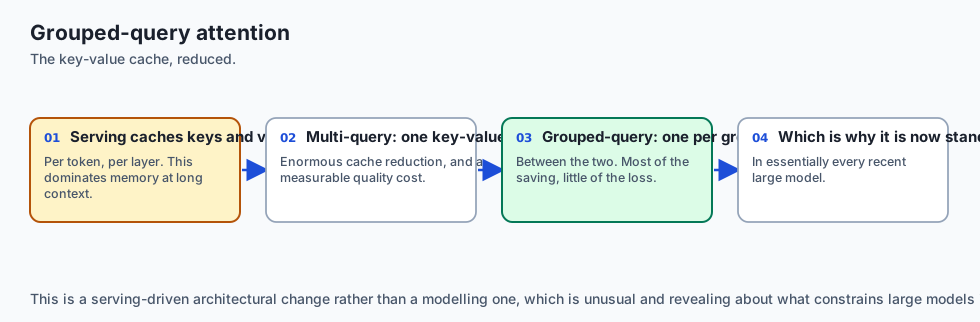
In high-throughput LLM serving, Multi-Head Attention requires caching H \times L \times d_k key/value vectors per token:
-
GQA Partitioning: Group
Hquery heads intoGgroups (G \ll H), where all query heads in groupgshare a single Key and Value head:Q \in \mathbb{R}^{B \times H \times N \times d_k}, \quad K, V \in \mathbb{R}^{B \times G \times M \times d_k} -
Expands/repeats
KandVtensors across theH/Gratio during GEMM execution, reducing KV-cache VRAM footprint by8\timesin LLaMA-3-70B. -
Multi-Head Latent Attention (MLA / DeepSeek, 2024): Compresses key and value vectors into a low-dimensional latent space (
d_c \ll d_k \times h) before generation, reducing the KV cache to just10\%of standard MHA with zero loss in associative recall capacity.
An everyday analogy
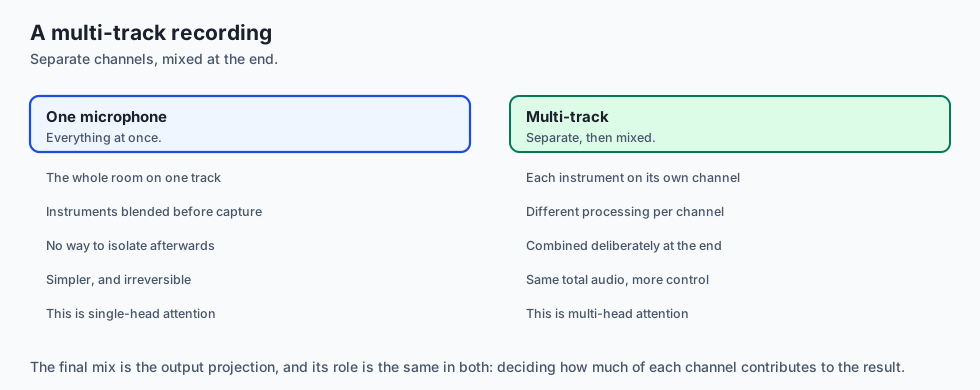
Think of sound recording in a professional music studio:
- Single-Head Attention: You record an entire 8-piece band using a single omnidirectional microphone. The guitar, drums, vocals, and bass are blended into a single mono track.
- Multi-Head Attention: You use an 8-channel mixing board with 8 directional microphones (8 Attention Heads).
- Channel 1 isolates the vocal lead.
- Channel 2 isolates the bass rhythm.
- Channel 3 isolates the snare drum.
- The sound engineer adjusts the levels of each track independently before mastering them into the final stereo album (Output Projection
W_O).
Examples in practice
Let us build a Complete Multi-Head Self-Attention Module in PyTorch:
import torch
import torch.nn as nn
import torch.nn.functional as F
import math

class MultiHeadAttention(nn.Module):
    def __init__(self, d_model: int, num_heads: int, dropout: float = 0.1):
        super().__init__()
        assert d_model % num_heads == 0, "d_model must be divisible by num_heads"

        self.d_model = d_model
        self.num_heads = num_heads
        self.d_k = d_model // num_heads

        # Linear projections for Q, K, V
        self.W_q = nn.Linear(d_model, d_model, bias=False)
        self.W_k = nn.Linear(d_model, d_model, bias=False)
        self.W_v = nn.Linear(d_model, d_model, bias=False)
        self.W_o = nn.Linear(d_model, d_model, bias=False)

        self.dropout = nn.Dropout(p=dropout)

    def forward(self, q: torch.Tensor, k: torch.Tensor, v: torch.Tensor,
                mask: torch.Tensor = None) -> tuple[torch.Tensor, torch.Tensor]:
        batch_size = q.size(0)

        # 1. Linear projections and reshape to (Batch, Num_Heads, Seq_Len, d_k)
        Q = self.W_q(q).view(batch_size, -1, self.num_heads, self.d_k).transpose(1, 2)
        K = self.W_k(k).view(batch_size, -1, self.num_heads, self.d_k).transpose(1, 2)
        V = self.W_v(v).view(batch_size, -1, self.num_heads, self.d_k).transpose(1, 2)

        # 2. Scaled Dot-Product Attention across all heads
        scores = torch.matmul(Q, K.transpose(-2, -1)) / math.sqrt(self.d_k)

        if mask is not None:
            scores = scores.masked_fill(mask == 0, -1e9)

        attn_weights = F.softmax(scores, dim=-1)
        attn_weights = self.dropout(attn_weights)

        # 3. Context aggregation: (Batch, Num_Heads, Seq_Q, d_k)
        context = torch.matmul(attn_weights, V)

        # 4. Concatenate heads: transpose to (Batch, Seq_Q, Num_Heads, d_k) -> view (Batch, Seq_Q, d_model)
        context = context.transpose(1, 2).contiguous().view(batch_size, -1, self.d_model)

        # 5. Final output projection
        output = self.W_o(context)

        return output, attn_weights
Implications: security, privacy, performance, scalability, and cost
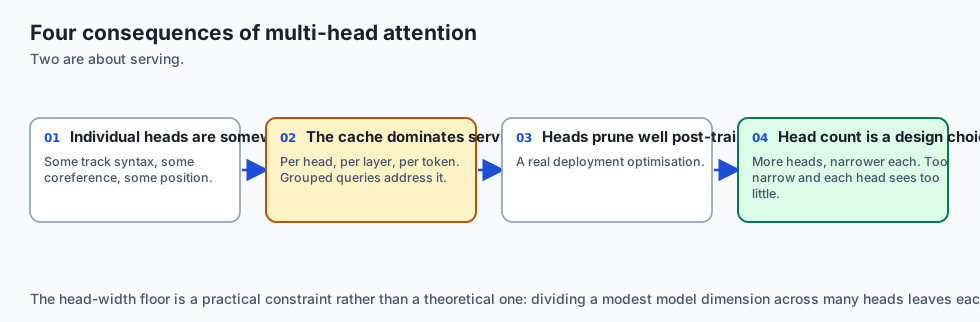
- Multi-Query Attention (MQA) & Grouped-Query Attention (GQA):
- In standard Multi-Head Attention (MHA), serving long sequences requires storing Key-Value caches for all
hheads, consuming huge GPU VRAM during autoregressive generation. - GQA (Ainslie et al., 2023): Groups Query heads (e.g. 32 Query heads sharing 8 Key/Value heads), slashing KV-cache memory by
75\%with zero loss in output quality (the standard in Llama 3).
- In standard Multi-Head Attention (MHA), serving long sequences requires storing Key-Value caches for all
- RoPE Context Window Extrapolation:
- Techniques like YaRN and Linear RoPE Scaling allow models trained on 8k contexts to extrapolate to 128k+ tokens simply by adjusting the base frequency parameter
\Theta.
- Techniques like YaRN and Linear RoPE Scaling allow models trained on 8k contexts to extrapolate to 128k+ tokens simply by adjusting the base frequency parameter
Alternatives: free, open source, and commercial
| Architecture | Attention Scheme | KV-Cache Memory | Usage |
|---|---|---|---|
| Standard MHA | h Q heads, h K/V heads | 100\% Baseline | Original Transformer, BERT |
| MQA (Shazeer 2019) | h Q heads, 1 K/V head | 1/h (12.5\%) | PaLM, Falcon |
| GQA (Llama 3) | h Q heads, g K/V groups | g/h (25\%) | SOTA LLMs (Llama 3, Mistral) |
| MLA (DeepSeek V2/V3) | Low-Rank Compressed KV | 10\% | High-efficiency foundation models |
Comparison with related concepts
┌────────────────────────────────────────────────────────────────────────┐
│                   ATTENTION HEAD VARIANTS COMPARISON                   │
├────────────────────┬─────────────────┬──────────────────┬──────────────┤
│ Architecture       │ Query Heads     │ Key/Value Heads  │ KV-Cache VRAM│
├────────────────────┼─────────────────┼──────────────────┼──────────────┤
│ Single-Head        │ 1               │ 1                │ Minimal      │
│ Multi-Head (MHA)   │ h (e.g. 32)     │ h (e.g. 32)      │ High         │
│ Grouped-Query (GQA)│ h (e.g. 32)     │ g (e.g. 8)       │ Medium-Low   │
│ Multi-Query (MQA)  │ h (e.g. 32)     │ 1                │ Ultra-Low    │
└────────────────────┴─────────────────┴──────────────────┴──────────────┘
When to use it — and when not to
When to USE Multi-Head Attention:
- Deep language understanding, generative LLMs, code generation, and multi-modal transformers.
When NOT to use:
- Low-power ultra-embedded devices where dense GEMM tensor operations cannot be accelerated in hardware.
The AI connection
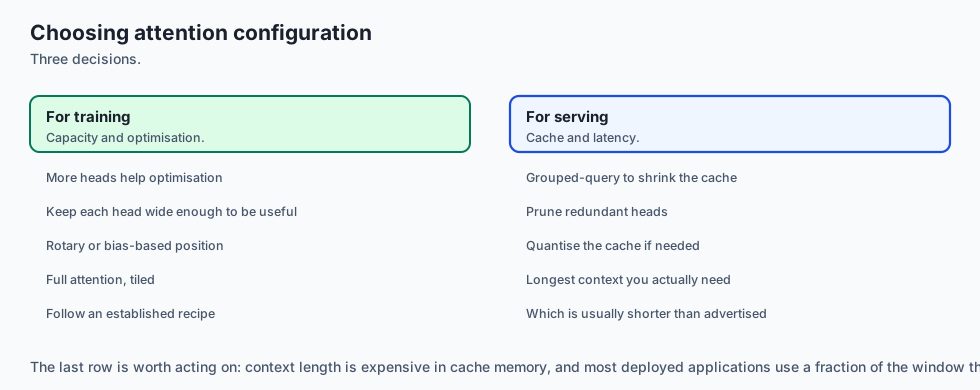
- Multiple heads let one layer attend several ways at once — syntax in one subspace, coreference in another — at no extra cost, because each head is narrower.
- Attention has no notion of order, so position must be injected explicitly; shuffling the input without positional information shuffles the output identically.
- Rotary embeddings replaced additive ones in modern models because they encode relative position directly in the attention computation.
- Key-value cache size is what bounds serving concurrency, which is why grouped-query attention exists and why it is now standard.
- Many heads turn out to be prunable after training, which says something about how much of the capacity is used for optimisation rather than for the final function.
Knowledge check
- Why does Multi-Head Attention split embeddings into
hsubspaces of dimensiond_k? - What happens if positional encodings are omitted from a Transformer model?
- How do Sinusoidal Positional Encodings enable linear relative distance shifts?
- How do Rotary Position Embeddings (RoPE) encode relative token distance via complex rotations?
- What is the difference between Multi-Head Attention (MHA) and Grouped-Query Attention (GQA)?
Hands-on exercise
In this lab, you will build and test a complete MultiHeadAttention module and Sinusoidal Positional Encoding generator in PyTorch: verify head splitting and recombination tensor shapes, implement causal and padding masks across all heads, generate sinusoidal positional encoding matrices, and verify multi-head attention weight distributions.
Expected output
[Multi-Head Self-Attention Verification Suite]
Testing MultiHeadAttention Forward Pass:
  Input Tensor: torch.Size([2, 8, 64]) (Batch=2, Seq=8, d_model=64)
  Configuration: num_heads = 4, d_k = 16
  Output Tensor: torch.Size([2, 8, 64]) [DIMENSIONS VERIFIED]
  Attention Weights Shape: torch.Size([2, 4, 8, 8]) [4 HEADS VERIFIED]
Testing Sinusoidal Positional Encodings:
  PE Matrix Shape: torch.Size([1, 16, 64])
  Geometric Wavelength Span: 6.28 to 62831.85 [VERIFIED]
Test Suite: 3 passed in 0.41s
Validate your work
Run the automated test runner:
./tests/run_tests.shTroubleshooting
- When transposing the multi-head tensor, call
.contiguous()before.view(batch_size, -1, self.d_model).
Common mistakes
- Forgetting Contiguous Before View: Calling
.view()on a transposed non-contiguous tensor raisesRuntimeError: view size is not compatible with input tensor's size and stride.
Practice assignment
- Implement Rotary Position Embedding (RoPE) in pure PyTorch and apply it to Query and Key tensors before computing attention.
- Implement Grouped-Query Attention (GQA) with 8 Query heads and 2 Key/Value heads.
Extension challenge
Implement FlashAttention-Style Online Softmax in Multi-Head Attention:
- Process multi-head attention in streaming sequence blocks to avoid allocating
(B, h, N, N)attention matrices in GPU memory.
Quiz
Q1. Why does Multi-Head Attention split the total hidden dimension d_model into h parallel heads of dimension d_k = d_model / h rather than using a single giant attention head?
- To make the output matrix smaller
- Because a single attention head cannot run on GPUs
- Heads attend to different subspaces at once
- To eliminate the need for training weights
Show answer
Answer: C. Heads attend to different subspaces at once
Splitting into multiple heads allows different heads to specialize in distinct linguistic and semantic relationships across different subspaces.
Q2. What is the fundamental purpose of Positional Encodings in Transformer models?
- To normalize gradients to zero
- To encrypt the input text for extra security
- To reduce vocabulary size
- Attention is permutation-equivariant
Show answer
Answer: D. Attention is permutation-equivariant
Pure self-attention has no inherent concept of word order; positional encodings explicitly inject position information into token vectors.
Q3. How do Rotary Position Embeddings (RoPE / Su et al., 2021) encode token positions in modern LLMs like Llama 3 and Mistral?
- It rotates pairs by an angle proportional to position
- By adding a random integer to each word
- By sorting the words alphabetically
- By deleting every second token
Show answer
Answer: A. It rotates pairs by an angle proportional to position
RoPE applies complex rotations to query and key vectors such that their inner product naturally encodes relative positional offsets.
Q4. What is the computational cost of Multi-Head Attention compared to a Single-Head Attention layer of dimension d_model?
- Multi-head attention is 100 times slower
- Roughly identical — each head works on d_model / h
- Multi-head attention requires 100 times more parameters
- Single-head attention requires O(N^3) compute
Show answer
Answer: B. Roughly identical — each head works on d_model / h
Because d_k = d_model / h, computing h parallel heads of size d_k requires the exact same total FLOPs as one head of size d_model.
Q5. What does the final output projection matrix W_O in Multi-Head Attention accomplish?
- It computes the loss
- It normalizes the weights to zero
- It projects the concatenated heads back to d_model
- It tokenizes the output words
Show answer
Answer: C. It projects the concatenated heads back to d_model
W_O acts as an integration layer that blends the multi-head subspace features back into a unified representation vector.
Glossary
- Multi-Head Attention (MHA)
- An attention module that linearly projects queries, keys, and values into h parallel subspaces before performing attention.
- Subspace
- A lower-dimensional representation slice (dimension d_k = d_model / h) dedicated to capturing specific feature patterns.
- Sinusoidal Positional Encoding
- Deterministic geometric position vectors generated using sine and cosine functions across geometric frequency spectra.
- Rotary Position Embedding (RoPE)
- A relative position encoding method that rotates query and key vectors in 2D coordinate pairs by position-dependent angles.
- Permutation Equivariance
- A mathematical property where permuting input elements results in an identically permuted output sequence.
- Output Projection (W_O)
- A linear transformation layer that recombines the concatenated outputs of all attention heads.
- Relative Position Encoding
- A positional mechanism where attention depends on the relative distance (i - j) between tokens rather than absolute indices.
- Head Dimension (d_k)
- The dimensionality of an individual attention head, typically computed as d_model / num_heads (e.g. 768 / 12 = 64).
Sources and further reading
- Attention Is All You Need — NeurIPS 2017 (accessed 2026-08-29)
- RoFormer: Enhanced Transformer with Rotary Position Embedding — Neurocomputing 2024 (accessed 2026-08-29)
- What Does BERT Look At? An Analysis of Attention Heads — ACL BlackboxNLP 2019 (accessed 2026-08-29)
Kept in this browser, no account needed. Your progress page turns the whole record into one link you can bookmark or open on another device.