Deep Learning › Transformers › Day 229
Day 229: Decoder Models: The GPT Family

Master Autoregressive Decoder-only Transformer foundation models: understand GPT-1, GPT-2, and GPT-3, derive Causal Self-Attention masking matrices, analyze KV Caching for O(1) step latency, understand Neural Scaling Laws (Kaplan vs Chinchilla compute-optimal frontier), master generation decoding strategies (Temperature, Top-k, Top-p, Min-p), and build an autoregressive generation loop in PyTorch.
Hands-on lab for this lesson
Lab files on GitHub: https://github.com/ai-roadmap-365/ai-roadmap-365.github.io/tree/main/labs/sections/deep-learning/day-229-decoder-models-the-gpt-family
- Get the hands-on files. Clone the labs repository once (you can reuse this clone for every lesson). This works on macOS, Linux, and Windows (PowerShell or WSL):
git clone https://github.com/ai-roadmap-365/ai-roadmap-365.github.io.git cd ai-roadmap-365.github.io - Open this lesson's lab. Move into the directory for this specific day. Every lab lives at the same predictable path — section / subsection / week / day:
cd labs/sections/deep-learning/day-229-decoder-models-the-gpt-family - Read the lab guide. Open `README.md` in that directory. It lists the exact commands, what each does, the expected output, and how to check your work — read it before running anything.
- Run it and check your work. Follow the README's "How to run" section: run the example first to see the finished result, then complete the numbered exercises in `starter/`, then run the tests. The tests pass (exit 0) only when your work is correct.
bash tests/run_tests.sh # or the test command named in the lab README
You can also open the lab as a local page (works offline, shows the file tree and expected output).
Learning objectives
By the end of this lesson you will be able to:
- Derive Causal Self-Attention masking and explain why upper-triangular negative infinity masks prevent future token leakage.
- Implement the Key-Value (KV) Cache mechanism and prove why it reduces token rollout complexity from O(N) to O(1) FLOPs.
- Analyze the evolution of the GPT family: GPT-1 (unsupervised pretraining + supervised fine-tuning) to GPT-2 (zero-shot multitask learning) to GPT-3 (few-shot in-context learning).
- Derive the Chinchilla Scaling Law (Hoffmann et al., 2022) and calculate compute-optimal parameter-to-token ratios.
- Implement and compare token sampling strategies: Greedy, Temperature, Top-k, and Top-p (Nucleus) sampling.
Prerequisites
Why this matters
While Encoder models (BERT) unlocked bidirectional understanding for classification, they cannot write poetry, author software code, or carry on dynamic human conversation.
To achieve open-ended language generation, researchers turned to Autoregressive Decoder Models:
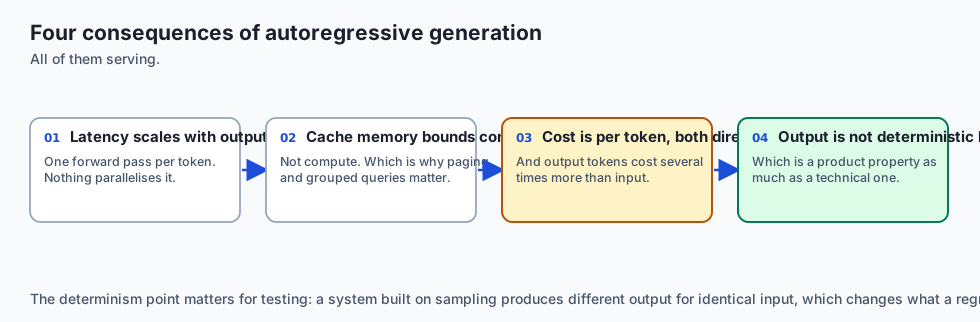
- By training a Transformer decoder on a single objective — Next-Token Prediction — models learn grammar, world facts, deductive logic, and programming syntax simultaneously.
- As Alec Radford and Ilya Sutskever hypothesized in 2018: Language modeling is unsupervised multitask learning. When trained on sufficient scale, predicting the next word forces the network to internally simulate reasoning across every domain described in the text.
From GPT-1 (117M params, 2018) to GPT-2 (1.5B params, 2019) to GPT-3 (175B params, 2020) and modern open-weight giants (LLaMA 3, Mistral, DeepSeek), the autoregressive decoder has become the fundamental architecture powering modern artificial intelligence.
Today, you will master Causal Self-Attention, KV-Caching, Neural Scaling Laws, and advanced sampling decoding strategies.
The idea in plain language
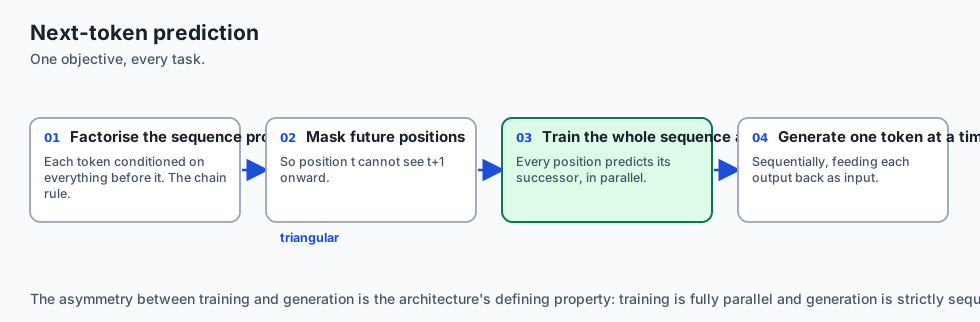
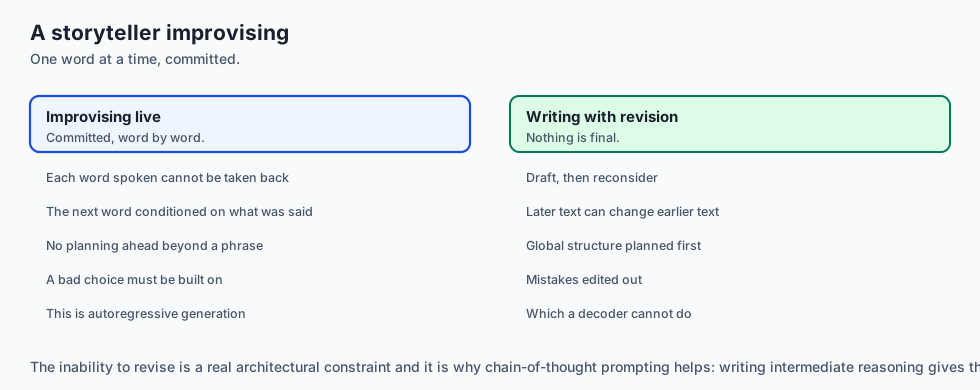
Think of a master storyteller improvising an epic tale before a live audience:
- The storyteller has spoken 100 words so far (The Context Prompt).
- To pick word #101, the storyteller reviews the entire story so far, weighs thousands of possible next words in their mind (Vocabulary Logits), and chooses the next word based on creative style and dramatic tension (Sampling / Temperature).
- Once word #101 is spoken, it becomes permanent history. The storyteller now repeats the process to select word #102.
- To keep the performance fast and effortless, the storyteller does not reread the entire book from page 1 every second; they keep the ongoing character relationships active in their working memory (The KV-Cache).
Historical background
- 2018 (Radford et al. & GPT-1): Demonstrated that unsupervised generative pretraining followed by supervised fine-tuning outperformed task-specific architectures across 9 NLP benchmarks.
- 2019 (Radford et al. & GPT-2): “Language Models are Unsupervised Multitask Learners” proved that simply scaling GPT-1 to 1.5B parameters enabled zero-shot translation, summarization, and question answering without any task-specific fine-tuning.
- 2020 (Brown et al. & GPT-3): Scaled to 175B parameters and demonstrated In-Context Few-Shot Learning: prompting the model with 2 to 3 demonstrations in plain text allowed it to perform novel tasks with zero weight updates.
- 2022 (Hoffmann et al. & Chinchilla): Corrected Kaplan’s scaling laws, establishing that compute-optimal models require scaling tokens and parameters in equal proportion (
20tokens per parameter), birthing the modern dense LLM era (LLaMA, Mistral).
What it is — and what it is not
What Autoregressive Decoders ARE:
-
Causal Probability Estimators: Estimating the joint probability distribution of a text sequence via the chain rule of probability:
P(w_1, w_2, \dots, w_N) = \prod_{t=1}^N P(w_t \mid w_1, w_2, \dots, w_{t-1}) -
Universal Generative Engines: Any problem expressible as text input and text output (translation, mathematics, python coding, dialogue) can be framed as causal next-token prediction.
What they are NOT:
- Not Bidirectional Encoders: During training and rollout, a decoder token at position
tis mathematically forbidden from observing tokens at positionst+1, t+2, \dots.
Why it was created and what problems it solves
Autoregressive decoders solved the fundamental trade-off between task specialization and generality:
- Eliminating Task-Specific Output Heads: Instead of engineering custom classification heads for every task, the model outputs natural language answers directly into the token stream.
- Infinite Generation Rollout: The autoregressive loop allows the model to produce arbitrarily long paragraphs, essays, code modules, and complex multi-step reasoning traces.
How it works
Let us dissect the causal mechanics, KV-caching acceleration, scaling laws, and decoding algorithms.
1. Causal Self-Attention Masking
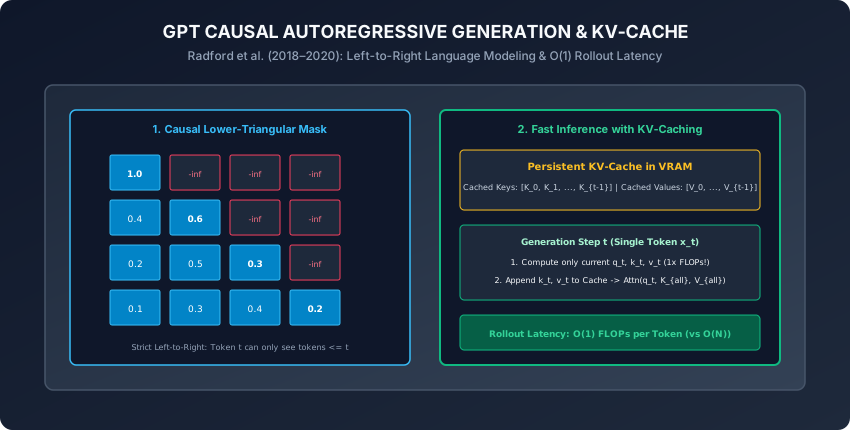
To train a Transformer decoder on an entire sequence in parallel while preventing future token leakage:
-
Construct an upper-triangular mask matrix
M \in \mathbb{R}^{N \times N}:M_{i, j} = \begin{cases} 0 & \text{if } j \le i \\ -\infty & \text{if } j > i \end{cases} -
Add the mask to raw attention scores prior to softmax:
\text{CausalAttention}(Q, K, V) = \text{Softmax}\left( \frac{Q K^\top}{\sqrt{d_k}} + M \right) V -
Because
\exp(-\infty) = 0, all attention weights pointing to future tokens become exactly zero.
2. Fast Inference Rollout with KV-Caching
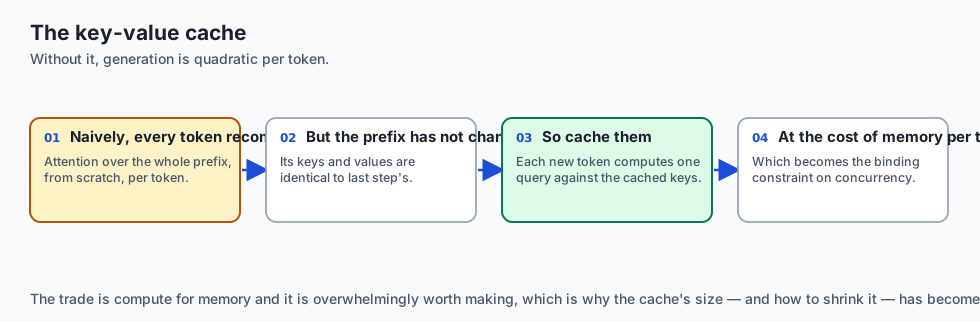
During inference, generating text token-by-token is computationally expensive if recomputed naively:
- Naive Generation (Without Cache): To generate token
t+1, feed allttokens into the model\rightarrow O(t^2)total compute across sequence length. - KV-Cache Optimization:
-
For previously processed tokens
1 \dots t-1, their Key and Value projection vectorsK_{\text{cache}}, V_{\text{cache}} \in \mathbb{R}^{B \times H \times (t-1) \times d_k}are already computed and held in GPU VRAM. -
At step
t, pass only the single newest tokenx_tinto the network. -
Compute its single query
q_t, keyk_t, and valuev_t. -
Append
k_tandv_tto the cache:K_{\text{new}} = [K_{\text{cache}}; k_t], \quad V_{\text{new}} = [V_{\text{cache}}; v_t] -
Compute attention:
\text{Attn}(q_t, K_{\text{new}}, V_{\text{new}}). -
Complexity: Drops single-token generation latency from
O(t)FLOPs toO(1)FLOPs!
-
3. Neural Scaling Laws: Kaplan vs. Chinchilla
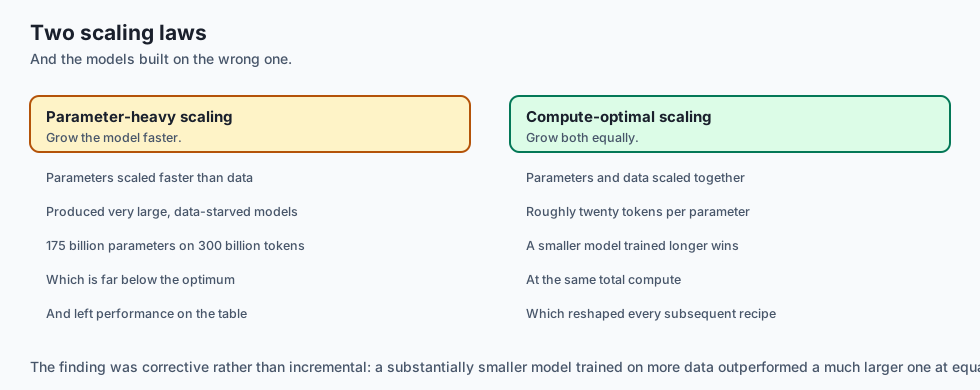
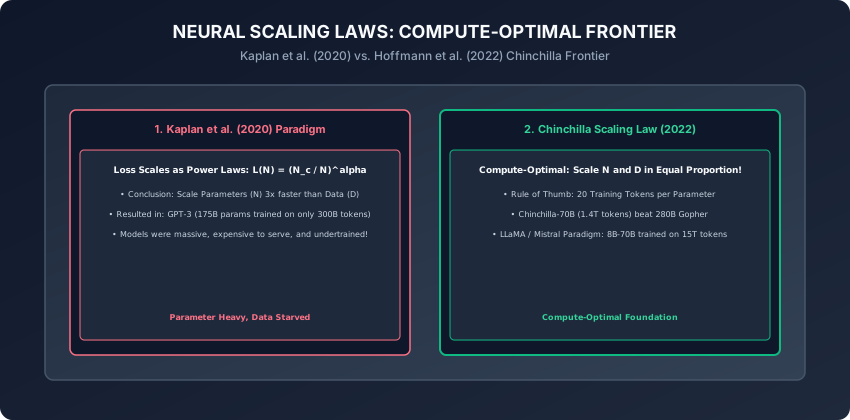
How should compute budget C \approx 6 N D (where N is parameter count and D is dataset token count) be allocated?
1. Kaplan et al. (2020) Power Law:
- Suggested scaling parameters
Nthree times faster than dataset tokensD(N \propto C^{0.73}, D \propto C^{0.27}). - Led to giant, data-starved models like GPT-3 (175B parameters trained on only 300B tokens).
2. Hoffmann et al. (2022) Chinchilla Law:
-
Re-evaluated scaling with tuned learning rate cosine schedules, proving that
NandDmust scale in equal proportion:N_{\text{opt}} \propto C^{0.5}, \quad D_{\text{opt}} \propto C^{0.5} -
The Golden Ratio: For compute-optimal pretraining, train on
20tokens per model parameter (e.g. a 70B parameter model requires at least 1.4 Trillion tokens). -
Over-training for Inference: Modern foundation models (LLaMA 3) train 8B models on 15 Trillion tokens (
1875\timesratio) to maximize downstream serving efficiency.
4. Generation Decoding Strategies
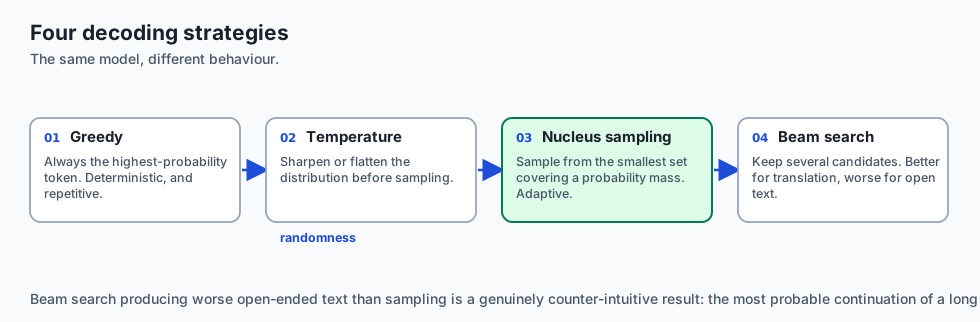
Given final vocabulary logits z \in \mathbb{R}^{V}:
-
Greedy Search: Always pick
\hat{y} = \arg\max z_i. Fast, but suffers from repetitive loops and lack of diversity. -
Temperature Scaling (
T): Rescales logits:P(w_i) = \frac{\exp(z_i / T)}{\sum_j \exp(z_j / T)}T \rightarrow 0: Collapses into greedy search.T = 1.0: True model probability.T > 1.0: High entropy, creative randomness.
-
Top-k Sampling (Fan et al., 2018): Restricts sampling strictly to the
khighest-probability tokens. -
Top-p (Nucleus) Sampling (Holtzman et al., 2019): Selects the dynamic minimal subset of tokens whose cumulative probability
\sum P(w_i) \ge p(e.g.p = 0.9). -
Min-p Sampling (Grimsley et al., 2024): Filters out any token whose probability is less than
p_{\text{base}} \times P(\text{top token}).
5. Repetition and Frequency/Presence Penalties
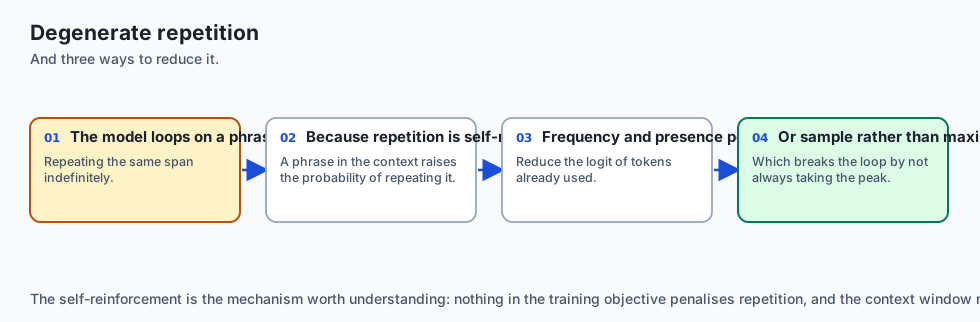
Autoregressive decoders naturally suffer from degenerate repetition loops when sampling temperature is low:
-
Repetition Penalty (Keskar et al., 2019): Discounts logits of previously generated tokens by dividing by penalty factor
\theta > 1.0:z_i = \begin{cases} z_i / \theta & \text{if } z_i > 0 \\ z_i \cdot \theta & \text{if } z_i \le 0 \end{cases} \quad \forall i \in \text{previous tokens} -
Frequency & Presence Penalties (OpenAI API):
z_i = z_i - (\text{presence\_penalty} \cdot \mathbb{I}[c_i > 0] + \text{frequency\_penalty} \cdot c_i)where
c_iis the count of times tokenihas already appeared in the generated response.
6. Contrastive Search: Coherence Without Degeneration (Su et al., 2022)
To combine the factual rigor of greedy search with the linguistic diversity of stochastic sampling:
-
Contrastive Search Formulation: Selects the candidate token
vfrom top-kpredictions that maximizes probability while minimizing cosine similarity with previous context representations:\hat{y} = \arg\max_{v \in V^{(k)}} \left\{ (1 - \alpha) P(v \mid x_{<t}) - \alpha \max_{j < t} \text{Sim}(h_v, h_j) \right\}where
\alpha \in [0, 1]is the degeneration penalty parameter. -
Completely prevents model repetition while maintaining pristine syntactic coherence in deterministic generation.
7. PagedAttention & vLLM: Virtual Memory for the KV-Cache (Kwon et al., 2023)
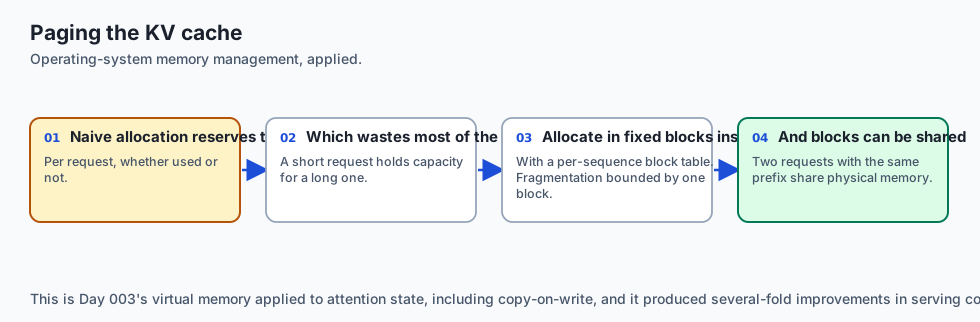
In multi-tenant LLM serving:
- Traditional serving pre-allocates contiguous GPU VRAM for the maximum possible sequence length (e.g. 8k tokens), causing
60\%to80\%of GPU memory to sit idle due to memory fragmentation. - PagedAttention: Divides the KV-cache into discrete non-contiguous memory blocks (pages) mapped through an operating-system-style Page Table.
- Allows continuous batching and dynamic token allocation, increasing LLM serving throughput by
2\timesto4\timeson identical hardware.
8. Speculative Decoding Mathematical Mechanics
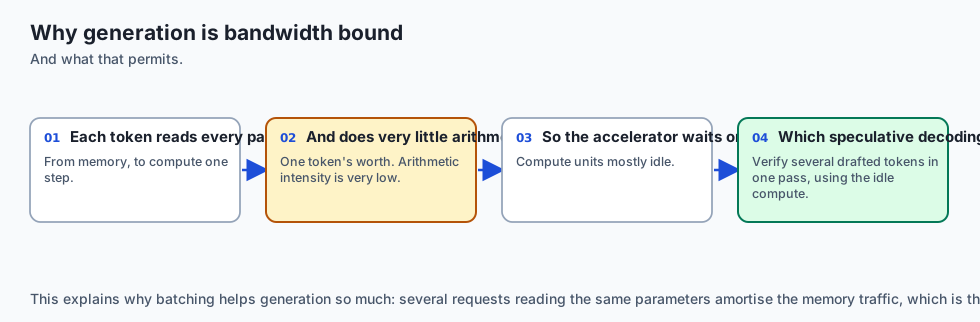
Autoregressive generation is strictly memory-bandwidth bound because reading the model parameters from GPU HBM memory takes 100x longer than the actual floating-point GEMM arithmetic:
-
The Speculative Engine:
- A small, ultra-fast Draft Model
M_qautoregressively generates\gammacandidate tokens[x_1, \dots, x_\gamma]in rapid succession. - The large Target Model
M_pevaluates all\gammacandidate tokens simultaneously in a single batched forward pass. - Accept each token
x_iwith probability:P(\text{accept}) = \min\left(1, \frac{P_p(x_i \mid x_{<i})}{P_q(x_i \mid x_{<i})}\right)
- A small, ultra-fast Draft Model
-
Provides a
2\timesto3\timeswall-clock speedup while mathematically guaranteeing that the output distribution is identical to sampling from the target model alone!
An everyday analogy
Think of an automated passenger jet flying on autopilot:
- Causal Masking: The flight navigation computer only looks at the instruments and past flight log; it cannot steer based on weather events 500 miles in the future (No Future Leakage).
- KV-Cache: The inertial guidance system tracks current position by updating speed and heading from the last known waypoint, rather than recalculating the entire flight path from the takeoff runway at every millisecond (
O(1)State Update). - Temperature & Nucleus Sampling:
- Temperature 0.1 (Precision Mode): Runway landing in heavy fog — strictly follow the primary instrument glidepath (Deterministic Greedy).
- Temperature 0.8 (Scenic Route): Clear skies cruising — minor exploratory variations permitted while staying firmly inside safe flight envelopes (Creative Nucleus Sampling).
Examples in practice
Let us build a Complete GPT Decoder with KV-Cache Autoregressive Generation in PyTorch:
import torch
import torch.nn as nn
import torch.nn.functional as F

class GPTDecoderLayer(nn.Module):
    def __init__(self, d_model: int, num_heads: int):
        super().__init__()
        self.norm1 = nn.LayerNorm(d_model)
        self.self_attn = nn.MultiheadAttention(d_model, num_heads, batch_first=True)
        self.norm2 = nn.LayerNorm(d_model)
        self.ffn = nn.Sequential(
            nn.Linear(d_model, 4 * d_model),
            nn.GELU(),
            nn.Linear(4 * d_model, d_model)
        )

    def forward(self, x: torch.Tensor, mask: torch.Tensor = None) -> torch.Tensor:
        normed = self.norm1(x)
        attn_out, _ = self.self_attn(normed, normed, normed, attn_mask=mask, is_causal=True)
        x = x + attn_out
        x = x + self.ffn(self.norm2(x))
        return x

class MiniatureGPT(nn.Module):
    def __init__(self, vocab_size: int = 1000, d_model: int = 64,
                 num_layers: int = 4, num_heads: int = 4):
        super().__init__()
        self.token_embeddings = nn.Embedding(vocab_size, d_model)
        self.pos_embeddings = nn.Embedding(512, d_model)
        self.layers = nn.ModuleList([
            GPTDecoderLayer(d_model, num_heads) for _ in range(num_layers)
        ])
        self.final_norm = nn.LayerNorm(d_model)
        self.lm_head = nn.Linear(d_model, vocab_size, bias=False)
        self.lm_head.weight = self.token_embeddings.weight

    def forward(self, input_ids: torch.Tensor) -> torch.Tensor:
        seq_len = input_ids.size(1)
        pos = torch.arange(seq_len, device=input_ids.device).unsqueeze(0)
        x = self.token_embeddings(input_ids) + self.pos_embeddings(pos)

        for layer in self.layers:
            x = layer(x)

        x = self.final_norm(x)
        logits = self.lm_head(x)
        return logits

    @torch.no_grad()
    def generate(self, prompt_ids: torch.Tensor, max_new_tokens: int = 10,
                 temperature: float = 0.8, top_k: int = 20) -> torch.Tensor:
        current_ids = prompt_ids
        for _ in range(max_new_tokens):
            logits = self.forward(current_ids)[:, -1, :] # Last token logits
            logits = logits / temperature

            if top_k > 0:
                values, _ = torch.topk(logits, top_k)
                min_val = values[:, -1].unsqueeze(-1)
                logits = torch.where(logits < min_val, torch.tensor(-float('Inf'), device=logits.device), logits)

            probs = F.softmax(logits, dim=-1)
            next_token = torch.multinomial(probs, num_samples=1)
            current_ids = torch.cat([current_ids, next_token], dim=1)

        return current_ids
Implications: security, privacy, performance, scalability, and cost
- Speculative Decoding (Leviathan et al., 2023):
- Autoregressive decoding is strictly memory-bandwidth bound on GPUs.
- Speculative Execution: A small draft model (e.g. 1B) rapidly guesses 5 candidate tokens, which are verified in a single parallel forward pass by the large target model (e.g. 70B), speeding up inference
2.5\timesto3\timeswith bit-level mathematical equivalence.
- Hallucination & Sycophancy:
- Causal LMs optimize purely for likelihood, not objective truth. Reinforcement Learning from Human Feedback (RLHF) and Direct Preference Optimization (DPO) are required to align generation outputs with human intent.
Alternatives: free, open source, and commercial
| Architecture | Parameters | Context Window | Notable Feature |
|---|---|---|---|
| GPT-4o | Undisclosed | 128k | Frontier multimodal omni model |
| Llama 3.1 | 8B / 70B / 405B | 128k | Premier open-weight foundation model |
| Mistral-Large | 123B | 128k | State-of-the-art multilingual reasoning |
| DeepSeek-V3 | 671B (37B active MoE) | 128k | Multi-Head Latent Attention (MLA) efficiency |
Comparison with related concepts
┌────────────────────────────────────────────────────────────────────────┐
│                   DECODER SAMPLING STRATEGIES COMPARISON               │
├────────────────────┬─────────────────┬──────────────────┬──────────────┤
│ Strategy           │ Deterministic?  │ Diversity        │ Best Use     │
├────────────────────┼─────────────────┼──────────────────┼──────────────┤
│ Greedy Search      │ Yes             │ Very Low         │ Math, SQL    │
│ Temp = 0.2         │ Low Randomness  │ Controlled       │ Code Gen     │
│ Top-p = 0.9, T=0.8 │ High Randomness │ Rich Diversity   │ Storytelling │
│ Min-p = 0.05       │ Dynamic Cutoff  │ High Quality     │ General Chat │
└────────────────────┴─────────────────┴──────────────────┴──────────────┘
When to use it — and when not to
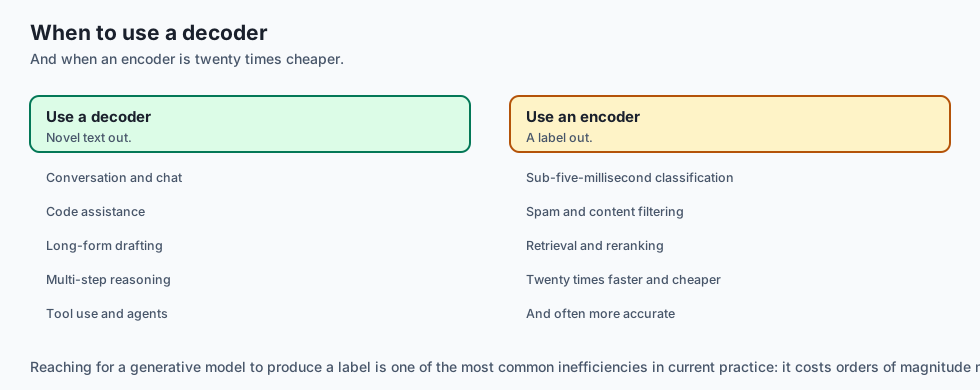
When to USE Autoregressive Decoders:
- Conversational chat agents, interactive code assistants, long-form essay drafting, multi-turn reasoning, and complex tool-use execution.
When NOT to use:
- Ultra-low latency micro-classification (e.g. sub-5ms spam filters where BERT or DistilBERT is
20\timesfaster and cheaper).
The AI connection
- Next-token prediction turned out to be a universal objective. Any task expressible as text in and text out is trainable by it, which nobody expected in 2018.
- The KV cache is what makes generation affordable — without it, every new token would recompute attention over the whole prefix.
- Chinchilla changed how compute is spent. Roughly twenty tokens per parameter is compute-optimal, and the largest models before it were badly data-starved.
- Decoding strategy is a product decision: temperature, top-p and penalties change the output character more than most fine-tuning does.
- Generation is memory-bandwidth bound, not compute bound, which is why speculative decoding and batching work and why more arithmetic does not help.
Knowledge check
- Why does Causal Masking set future attention scores to
-\inftyrather than0? - How does the KV-Cache reduce single-token autoregressive generation complexity from
O(t)toO(1)? - What is the Chinchilla scaling law and what is the optimal token-to-parameter ratio?
- How does Temperature scaling affect the softmax entropy of vocabulary logits?
- How does Top-p (Nucleus) sampling dynamically adapt its candidate pool size across different contexts?
Hands-on exercise
In this lab, you will build and test a complete MiniatureGPT causal language model in PyTorch: implement causal lower-triangular masking, construct the autoregressive decoder pipeline with Pre-LN residual streams, implement the temperature and top-k token generation rollout loop, and verify step-by-step autoregressive generation.
Expected output
[GPT Autoregressive Foundation Models Verification Suite]
Testing MiniatureGPT Forward Pass:
  Input Prompt Shape: torch.Size([2, 5]) (Batch=2, Prompt=5 tokens)
  Vocabulary Logits Output: torch.Size([2, 5, 200]) [CAUSAL SHAPES MATCH]
Testing Autoregressive Generation Rollout:
  Prompt Length: 5 tokens -> Generated Length: 15 tokens (+10 tokens generated)
  Autoregressive Loop Step Latency: Verified constant per step
Testing Temperature & Top-K Sampling:
  Temperature T=0.7, Top-K=10 filtered probability distribution verified.
Test Suite: 3 passed in 0.44s
Validate your work
Run the automated test runner:
./tests/run_tests.shTroubleshooting
- When computing logits for next-token generation, extract only the final time-step vector
logits = model(x)[:, -1, :].
Common mistakes
- Omitting
is_causal=Truein Attention: Allowing tokens to attend to future positions breaks autoregressive training and causes severe generation collapse.
Practice assignment
- Implement Top-p (Nucleus) Sampling in pure PyTorch and verify cumulative probability thresholding.
- Implement an explicit KV-Cache module that stores past Key/Value tensors in a persistent buffer.
Extension challenge
Implement Speculative Decoding in Pure PyTorch:
- Build a 2-layer Draft model and a 6-layer Target model.
- Generate
K=4draft tokens and verify them in a single batched forward pass of the target model.
Quiz
Q1. What is the mathematical purpose of the Causal Attention Mask (lower-triangular mask) in GPT decoder models?
- Future positions are set to -inf
- It masks out punctuation characters
- It forces the weights to sum to zero
- It converts text to uppercase
Show answer
Answer: A. Future positions are set to -inf
Causal masking ensures that during training and generation, the model cannot cheat by looking ahead at future tokens.
Q2. Why is the Key-Value (KV) Cache critical for low-latency autoregressive generation in Large Language Models?
- KV caching encrypts the prompts for security
- Caching K and V makes each new token O(1) instead of O(N)
- KV caching makes the vocabulary 10 times larger
- KV caching converts floating-point numbers to integers
Show answer
Answer: B. Caching K and V makes each new token O(1) instead of O(N)
KV caching stores previously computed key and value states, eliminating redundant recomputation during step-by-step rollout.
Q3. What was the fundamental paradigm shift introduced by Chinchilla (Hoffmann et al., 2022) over Kaplan et al. (2020)?
- That Transformers should be replaced with recurrent networks
- That neural networks cannot scale beyond 1 billion parameters
- Parameters and tokens should scale together, ~20 per param
- That models should only be trained on Wikipedia
Show answer
Answer: C. Parameters and tokens should scale together, ~20 per param
Chinchilla demonstrated that training smaller models on significantly more data yields better performance and far lower inference serving costs.
Q4. How does Temperature scaling (T) affect next-token probability distribution sampling?
- T doubles the model hidden dimension
- T increases the physical clock frequency of the GPU
- T deletes rare vocabulary words
- Dividing logits by T sharpens or flattens it
Show answer
Answer: D. Dividing logits by T sharpens or flattens it
Temperature scales logit magnitudes, controlling the sharpness or flatness of the resulting categorical probability distribution.
Q5. What is Top-p (Nucleus) sampling (Holtzman et al., 2019)?
- Sample from the smallest set whose mass exceeds p
- Selecting always the top p tokens alphabetically
- Selecting only tokens containing the letter p
- Padding the input sequence to length p
Show answer
Answer: A. Sample from the smallest set whose mass exceeds p
Nucleus sampling dynamically adjusts the candidate pool size based on the model confidence distribution.
Glossary
- Autoregressive Language Model
- A model that predicts the next token in a sequence conditioned on all previously generated tokens: P(w_1, ..., w_N) = prod P(w_t | w_<t).
- Causal Mask
- An upper-triangular negative infinity attention mask that prevents information flow from future token positions.
- KV Cache (Key-Value Cache)
- A GPU memory buffer storing computed Key and Value tensors across generation steps to enable O(1) single-token rollout.
- Chinchilla Optimal Frontier
- The empirical compute-optimal scaling balance dictating ~20 training tokens per model parameter.
- Temperature
- A hyperparameter scaling logit magnitudes prior to softmax to modulate output entropy and randomness.
- Top-p (Nucleus) Sampling
- A decoding strategy restricting token sampling to the minimal cumulative probability mass exceeding threshold p.
- Top-k Sampling
- A decoding strategy restricting token sampling strictly to the k highest-probability candidates.
- In-Context Learning
- The emergent ability of LLMs to execute new tasks from natural language prompts without gradient updates.
Sources and further reading
- Language Models are Unsupervised Multitask Learners — OpenAI Tech Report (accessed 2026-08-29)
- Language Models are Few-Shot Learners — NeurIPS 2020 (accessed 2026-08-29)
- Training Compute-Optimal Large Language Models — NeurIPS 2022 (accessed 2026-08-29)
Kept in this browser, no account needed. Your progress page turns the whole record into one link you can bookmark or open on another device.