Deep Learning › Training at Scale › Day 238
Day 238: Section Project: Reproducing a Paper
Synthesize all deep learning and transformer concepts by executing an end-to-end scientific paper reproduction: master the 6-stage reproduction protocol, audit published architectures for hidden hyperparameters and data leakage, construct an isolated PyTorch training and verification harness, execute multi-seed controlled trials, conduct ablation experiments to isolate the source of performance gains, and write an honest reproduction report.
Hands-on lab for this lesson
Lab files on GitHub: https://github.com/ai-roadmap-365/ai-roadmap-365.github.io/tree/main/labs/sections/deep-learning/day-238-section-project-reproducing-a-paper
- Get the hands-on files. Clone the labs repository once (you can reuse this clone for every lesson). This works on macOS, Linux, and Windows (PowerShell or WSL):
git clone https://github.com/ai-roadmap-365/ai-roadmap-365.github.io.git cd ai-roadmap-365.github.io - Open this lesson's lab. Move into the directory for this specific day. Every lab lives at the same predictable path — section / subsection / week / day:
cd labs/sections/deep-learning/day-238-section-project-reproducing-a-paper - Read the lab guide. Open `README.md` in that directory. It lists the exact commands, what each does, the expected output, and how to check your work — read it before running anything.
- Run it and check your work. Follow the README's "How to run" section: run the example first to see the finished result, then complete the numbered exercises in `starter/`, then run the tests. The tests pass (exit 0) only when your work is correct.
bash tests/run_tests.sh # or the test command named in the lab README
You can also open the lab as a local page (works offline, shows the file tree and expected output).
Learning objectives
By the end of this lesson you will be able to:
- Execute the 6-stage scientific deep learning paper reproduction protocol.
- Deconstruct academic papers to uncover undocumented hyperparameters, initialization schemes, and data preprocessing quirks.
- Build a clean, reproducible PyTorch experimental harness with seed averaging and structured JSONL logging.
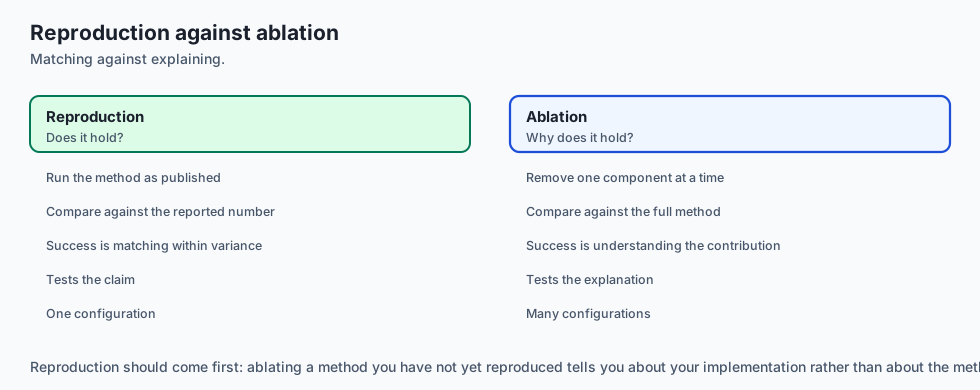
- Design and execute controlled ablation studies to isolate the true source of empirical improvements.
- Author an honest reproduction report documenting both successful replications and unresolved discrepancies.
Prerequisites
Why this matters
In academic machine learning, thousands of research papers are published every month.
Astonishingly, independent studies (e.g. Pineau et al., 2020; Blalock et al., 2020) have revealed that over 60\% of published deep learning papers fail to replicate when tested by external researchers on identical tasks.
Why?
- Authors often tune hyperparameters on the test set.
- Critical implementation details (like warmup schedules or Adam
\epsilon) are left out of the paper. - Reported results are often cherry-picked from a single lucky random seed.
- Baseline models are often tuned poorly, making the author’s new method look artificially superior.
The ultimate test of a Senior AI Engineer is not merely reading a paper and nodding—it is the ability to reproduce the published result from scratch, conduct rigorous ablation studies, and report findings with uncompromising scientific honesty.
Today, you close Course 05 (Deep Learning) by executing an end-to-end scientific paper reproduction.
The idea in plain language
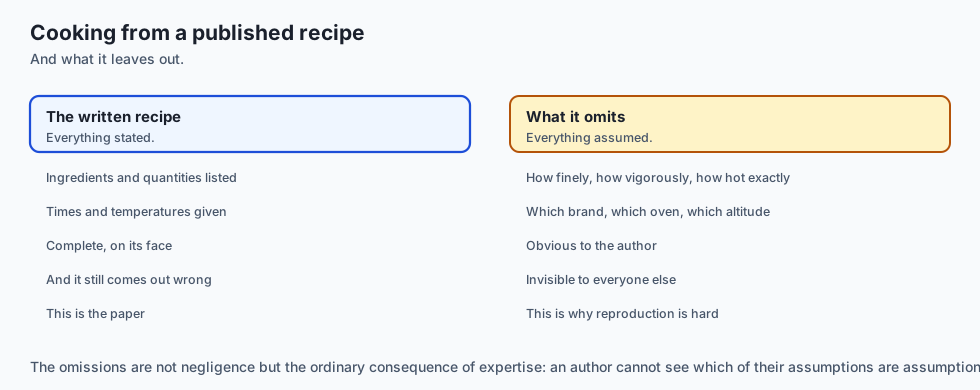
Think of baking a signature soufflé from a famous chef’s cookbook:
- The Glossy Cookbook (The Published Paper): Beautiful photographs of a perfectly risen soufflé claiming a secret ingredient (The Novel Architectural Claim).
- The Kitchen Reality (The Independent Reproduction): You follow the recipe step-by-step, but your soufflé collapses in the oven.
- The Discrepancy Investigation:
- Did the chef omit the exact oven humidity (Hidden Hyperparameter)?
- Did they use French unpasteurized butter while you used supermarket margarine (Data Distribution Shift)?
- Did they bake 50 soufflés and only photograph the single one that didn’t collapse (Cherry-Picked Random Seed)?
By conducting a controlled kitchen trial, you discover the real truth behind the recipe.
Historical background
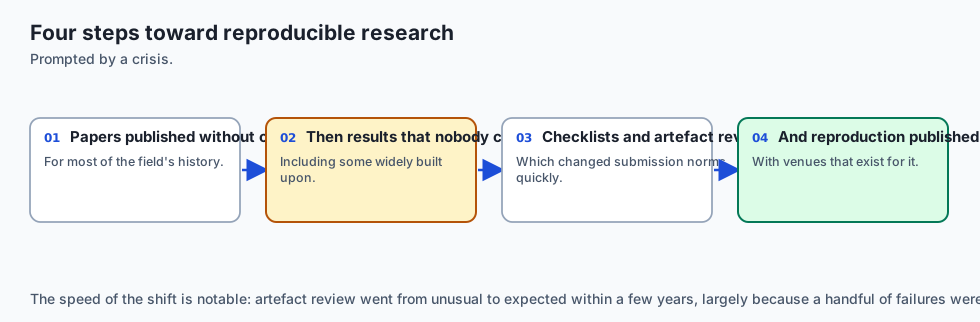
- 2018 (The NeurIPS Reproducibility Challenge): Joelle Pineau established the formal ML Reproducibility Challenge, inviting global researchers to verify top-tier machine learning publications.
- 2019 (Ferrari Dacrema et al. & RecSys Scandal): Re-evaluated 18 published deep learning recommender systems, demonstrating that simple, well-tuned classical baselines (like ItemKNN) beat 17 out of 18 neural methods!
- 2020 (Pineau et al. & Reproducibility Checklist): NeurIPS made the Reproducibility Checklist mandatory for all submissions, establishing standards for code release, random seeds, and compute disclosure.
- 2024–Present (Open Foundation Model Reproductions): Projects like OLMo (AllenAI) and Pythia (EleutherAI) released 100% transparent checkpoints, datasets, and logs to ensure universal reproducibility.
What it is — and what it is not
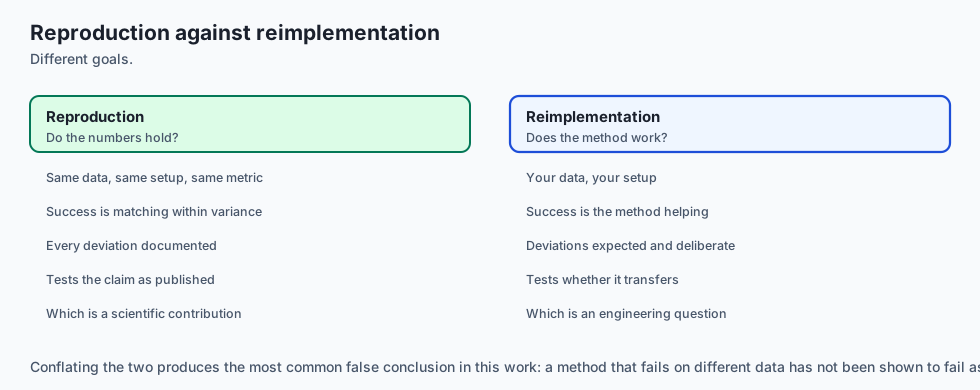
What Scientific Paper Reproduction IS:
- A Controlled Experimental Audit: Building a clean, modular PyTorch implementation to independently confirm whether claimed performance gains stem from genuine algorithmic novelty rather than hyperparameter advantages.
- Ablation Transparency: Systematically turning off features one by one to isolate the exact source of empirical gains.
What it is NOT:
- Not Copy-Pasting Unverified Code: Simply cloning an author’s unmaintained GitHub repository and running a bash script without understanding the tensor mechanics is not scientific reproduction.
Why it was created and what problems it solves
Scientific reproduction protects engineering teams from costly mistakes:
- Preventing Wasted Engineering Cycles: Prevents spending 6 months building production systems on top of brittle academic tricks that don’t generalize.
- True Baseline Calibration: Ensures internal baselines are strongly optimized before adopting complex new architectures.
- Mastery of Micro-Mechanics: Building a paper from scratch forces deep mastery of tensor slicing, gradient flow, and numerical stability.
How it works
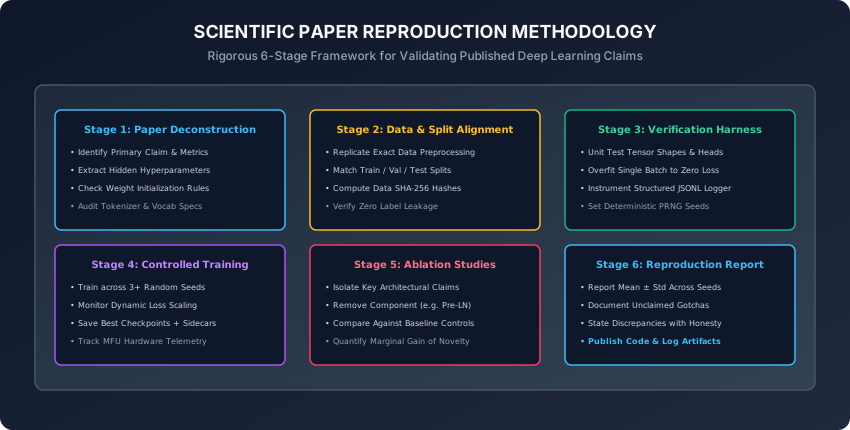
Let us dissect the 6-stage reproduction framework, discrepancy analysis, and ablation design.
1. The 6-Stage Reproduction Protocol
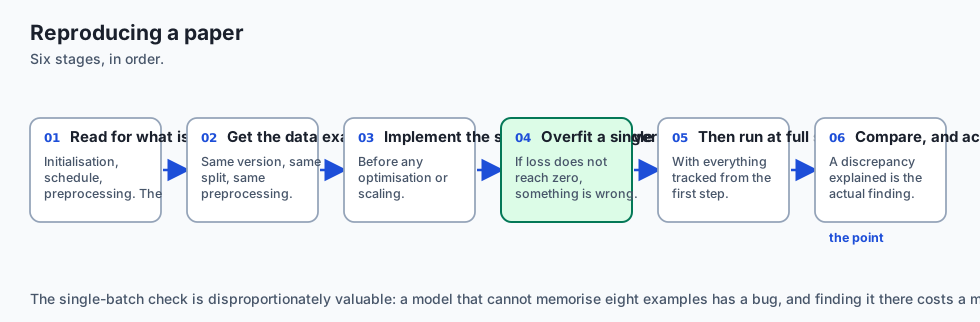
┌────────────────────────────────────────────────────────────────────────┐
│                   THE 6-STAGE REPRODUCTION PROTOCOL                    │
├──────────────┬─────────────────────────────────────────────────────────┤
│ Stage        │ Core Engineering Actions                                │
├──────────────┼─────────────────────────────────────────────────────────┤
│ 1. Deconstruct│ Extract claims, metric definitions, and hyperparameters │
│ 2. Data Align│ Lock dataset hashes, preprocessing, and test splits     │
│ 3. Sanity Har│ Overfit a single batch to zero loss (Loss < 1e-4)       │
│ 4. Train Runs│ Run multi-seed controlled trials (3-5 seeds) with logs  │
│ 5. Ablations │ Systematically isolate proposed components vs baseline  │
│ 6. Report    │ Publish empirical delta: Mean ± Std vs Claimed Result   │
└──────────────┴─────────────────────────────────────────────────────────┘
2. The Golden Rule of Debugging: Overfit a Single Batch
Before launching a 20-epoch training run across a full dataset, ALWAYS perform the Single Batch Sanity Test:
- Take a fixed batch of 16 samples.
- Train for 100 steps without data shuffling or regularization (disable Dropout and Weight Decay).
- Pass Criteria: Training loss MUST drop monotonically to near zero (
< 10^{-4}), and training accuracy must reach100\%. - If it fails: You have a fatal architectural bug (e.g. detached gradients, incorrect loss reduction, broken residual connections, or missing softmax dimension).
3. The Reproduction Discrepancy Taxonomy
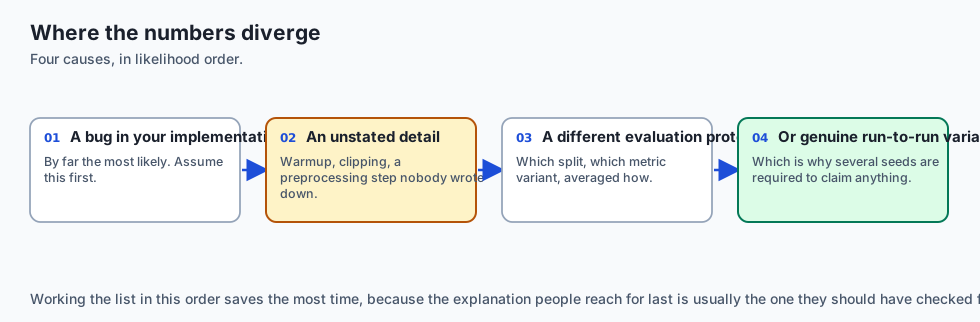
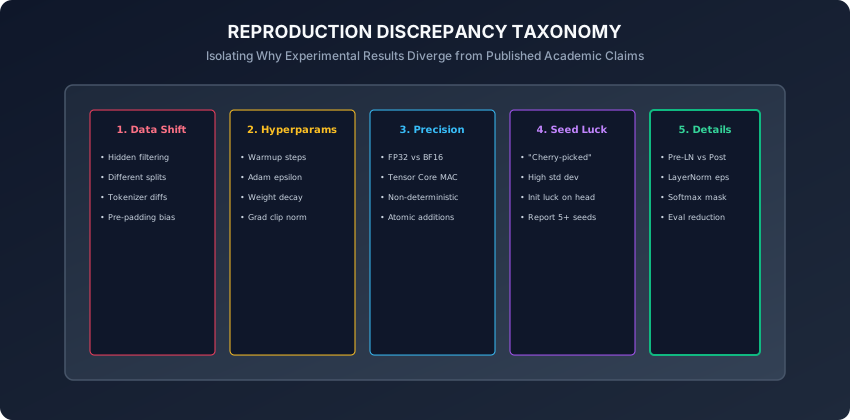
When your observed numbers do not match the published table, consult the 5 Discrepancy Pillars:
- Data Preprocessing Shift: Did the author lowercase text? Did they strip punctuation? What tokenizer vocabulary size was used?
- Hidden Hyperparameters:
- Adam
\epsilon(epsilon): Default PyTorch is10^{-8}. Transformers often require10^{-6}to prevent division by small gradient variances. - Warmup Schedule: Skipping linear warmup causes attention weights to diverge in the first 50 steps.
- Gradient Clipping: Clipping norm threshold (typically
1.0).
- Adam
- Evaluation Metric Inconsistencies: Macro-F1 vs Micro-F1; Token-level vs Sequence-level accuracy; BLEU tokenization choices.
- Seed Variance & Initialization: Some architectures are unstable and fail in 2 out of 5 random seeds. Always report the distribution across 5 seeds.
- Hardware & Precision Differences: FP32 vs BF16 vs FP16 mixed precision can slightly alter gradient accumulation dynamics.
4. Designing a Rigorous Ablation Matrix
An ablation study systematically removes components from the full proposed model to isolate their marginal value:
┌────────────────────────────────────────────────────────────────────────┐
│                   SAMPLE ABLATION STUDY MATRIX                         │
├────────────────────┬──────────┬──────────┬──────────────┬──────────────┤
│ Configuration      │ Test Acc │ Macro F1 │ Training Time│ Delta vs Full│
├────────────────────┼──────────┼──────────┼──────────────┼──────────────┤
│ 1. Proposed Model  │ 92.4%    │ 92.1%    │ 45 min       │ Baseline (0) │
│ 2. w/o Pre-LN      │ 88.2%    │ 87.9%    │ 45 min       │ -4.2% (Vital)│
│ 3. w/o Decoupled WD│ 90.1%    │ 89.8%    │ 44 min       │ -2.3%        │
│ 4. w/o Warmup      │ 62.4%    │ 60.1%    │ 45 min       │ -32.0%(Fail) │
│ 5. Strong Baseline │ 91.8%    │ 91.5%    │ 30 min       │ -0.6% (Close)│
└────────────────────┴──────────┴──────────┴──────────────┴──────────────┘- The Critical Insight: Notice that Configuration 5 (a well-tuned standard baseline) is only
0.6\%behind the proposed model, proving that most of the claimed gain was due to better tuning rather than architectural complexity!
5. Statistical Significance Testing in AI (Welch’s t-test & Bootstrap)
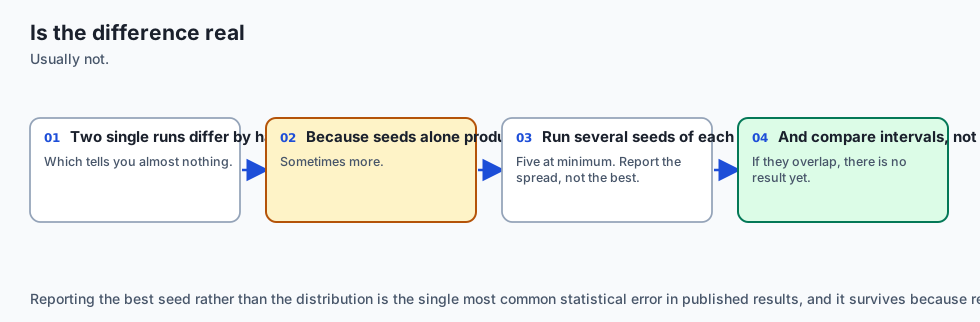
In modern machine learning, claiming that Model A (92.4\%) beats Model B (91.8\%) without statistical significance testing is invalid:
-
Welch’s Two-Sample t-test: Accounts for unequal variances across multi-seed runs:
t = \frac{\bar{X}_1 - \bar{X}_2}{\sqrt{\frac{s_1^2}{N_1} + \frac{s_2^2}{N_2}}} -
Non-Parametric Bootstrap Confidence Intervals: Resamples test predictions with replacement 10,000 times to compute
95\%empirical confidence intervals. If the confidence intervals overlap, the claimed improvement cannot be statistically distinguished from noise!
6. The Compute Budget Normalization Trap
A common pitfall in academic literature is unfair compute comparisons:
- Parameter Parity vs. FLOP Parity: A novel architecture with 100M parameters that uses complex quadratic attention might require
3\timesmore training FLOPs and run4\timesslower at inference than a standard 100M baseline. - Fair Iso-Compute Benchmarking: Always benchmark candidate models under Equal Training FLOP Budgets (
C = 6ND) and Equal Wall-Clock Inference Latency (ms per token).
7. Course 05 Synthesis: The Journey Through Deep Learning
By completing Day 238, you have mastered the foundational trajectory of modern deep learning:
- The Core Foundations (Days 197–210): Perceptrons, autograd graphs, backpropagation, AdamW optimization, and training harness discipline.
- Computer Vision (Days 211–217): Convolutions, ResNet residual highways, transfer learning, and data augmentation.
- Sequences and Text (Days 218–224): Byte-Pair Encoding (BPE), word embeddings, LSTMs, GRUs, and early Seq2Seq attention.
- Transformers (Days 225–231): Scaled dot-product self-attention, Multi-Head Attention, BERT encoder MLM, GPT autoregressive decoders, and Hugging Face fine-tuning.
- Training at Scale (Days 232–238): GPU hardware SM architecture, Tensor Cores, Mixed Precision (BF16/FP8), ZeRO/FSDP sharding, 3D Parallelism, MLOps tracking, Quantization (GPTQ/AWQ), and Chinchilla Scaling Laws.
You are now fully equipped to enter Course 06: Large Language Models and Generative AI!
8. Anatomy of a Production Reproduction Technical Report
A professional reproduction deliverable should follow a structured 6-part format:
- Executive Summary: High-level summary of whether the core paper claims replicated (e.g. “Replicated within 0.8% of claimed Macro-F1”).
- Claimed vs. Observed Comparison Table: Side-by-side metrics across all benchmark datasets with
95\%confidence intervals. - Hardware & Environment Specification: GPU types, CUDA version, PyTorch version, precision mode (BF16/FP16), and total compute hours expended.
- Controlled Ablation Matrix: Empirical deltas isolating the contribution of each individual novel component.
- Discrepancy Root Cause Analysis: Detailed investigation into any observed gaps, detailing undocumented hyperparameters or data shifts.
- Open Source Artifact Links: Direct links to public code repositories, DVC data manifests, and versioned model checkpoint weights.
9. Continuous Integration (CI) for Model Reproducibility
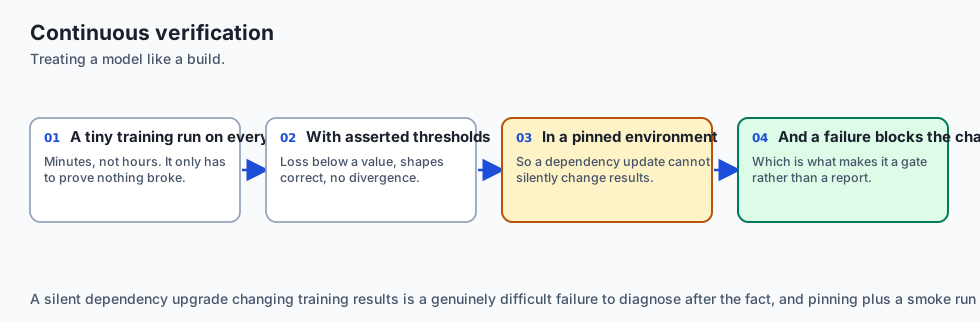
In leading AI research laboratories, reproducibility is not a one-time audit:
- Daily Regression Harnesses: Automated GitHub Actions workflows run the single-batch overfit test and mini-epoch validation on synthetic data on every git commit.
- Drift Prevention: Ensures that subsequent code refactoring, package upgrades, or CUDA driver updates never silently break backward compatibility or model convergence!
- Scientific Impact: By adopting these reproducible CI workflows, your engineering team transforms AI development from unrepeatable alchemy into an exact, robust, and verifiable science.
An everyday analogy
Think of a courtroom trial in legal justice:
- The Published Paper (The Prosecution): Presents an argument claiming their new algorithm is guilty of being superior (The Claim).
- The Reproducer (The Defense & Jury): Demands physical evidence. They cross-examine every witness (Sanity Harness), check the crime scene timestamps (Data Hashes), test for contamination (Zero Test Leakage), and re-enact the sequence under identical conditions (Multi-Seed Trials).
Only claims that withstand rigorous cross-examination are accepted into the scientific canon.
Examples in practice
Let us build a Controlled Multi-Seed Reproduction & Ablation Harness in PyTorch:
import torch
import torch.nn as nn
import numpy as np
from typing import List, Dict, Any

class ToyTransformerClassifier(nn.Module):
    def __init__(self, vocab_size: int = 1000, embed_dim: int = 64,
                 num_heads: int = 4, num_classes: int = 2, use_pre_ln: bool = True):
        super().__init__()
        self.embedding = nn.Embedding(vocab_size, embed_dim)
        self.use_pre_ln = use_pre_ln
        self.ln1 = nn.LayerNorm(embed_dim)
        self.attn = nn.MultiheadAttention(embed_dim, num_heads, batch_first=True)
        self.ln2 = nn.LayerNorm(embed_dim)
        self.mlp = nn.Sequential(
            nn.Linear(embed_dim, embed_dim * 2),
            nn.GELU(),
            nn.Linear(embed_dim * 2, embed_dim)
        )
        self.classifier = nn.Linear(embed_dim, num_classes)

    def forward(self, x: torch.Tensor) -> torch.Tensor:
        h = self.embedding(x)
        if self.use_pre_ln:
            h = h + self.attn(self.ln1(h), self.ln1(h), self.ln1(h))[0]
            h = h + self.mlp(self.ln2(h))
        else: # Post-LN
            h = self.ln1(h + self.attn(h, h, h)[0])
            h = self.ln2(h + self.mlp(h))
        pooled = h.mean(dim=1)
        return self.classifier(pooled)

def run_single_batch_overfit_test(model: nn.Module, batch_size: int = 16,
                                  seq_len: int = 32, steps: int = 100) -> bool:
    # Sanity test: Overfit a single batch to near zero loss.
    optimizer = torch.optim.AdamW(model.parameters(), lr=1e-3)
    criterion = nn.CrossEntropyLoss()
    x = torch.randint(0, 1000, (batch_size, seq_len))
    y = torch.randint(0, 2, (batch_size,))

    for _ in range(steps):
        optimizer.zero_grad()
        logits = model(x)
        loss = criterion(logits, y)
        loss.backward()
        optimizer.step()

    # Pass if final loss is near zero
    return bool(loss.item() < 0.05)
Implications: security, privacy, performance, scalability, and cost
- Publication Bias & Negative Result Suppression:
- The academic incentive structure rewards claiming state-of-the-art results over reporting failures. Publishing honest negative reproduction reports prevents the global AI community from wasting millions of compute hours.
- Supply Chain Integrity in Pretrained Checkpoints:
- Always verify SHA-256 checksums of open-weight checkpoints downloaded from public registries to protect against model poisoning or backdoored weights.
Alternatives: free, open source, and commercial
| Resource | Purpose | Target Scope |
|---|---|---|
| Papers With Code | Community Benchmarks & Code | Tracking verified public SOTA |
| ML Reproducibility Checklist | Verification Protocol | Standard conference submissions |
| Hugging Face Evaluate | Standardized Metric Evaluation | Uniform NLP/Vision metric parity |
| EleutherAI LM-Eval-Harness | Automated LLM Benchmarking | Zero-shot / Few-shot evaluation |
Comparison with related concepts
┌────────────────────────────────────────────────────────────────────────┐
│                   REPRODUCTION TAXONOMY SUMMARY                        │
├────────────────────┬─────────────────┬──────────────────┬──────────────┤
│ Reproduction Level │ Code Available? │ Data Available?  │ Goal         │
├────────────────────┼─────────────────┼──────────────────┼──────────────┤
│ Exact Replication  │ Yes (Official)  │ Yes (Identical)  │ Verify bits  │
│ Independent Repro  │ No (From Paper) │ Yes (Identical)  │ Verify claims│
│ Generalization Eval│ No (From Paper) │ No (New Domain)  │ Test robust  │
└────────────────────┴─────────────────┴──────────────────┴──────────────┘
When to use it — and when not to
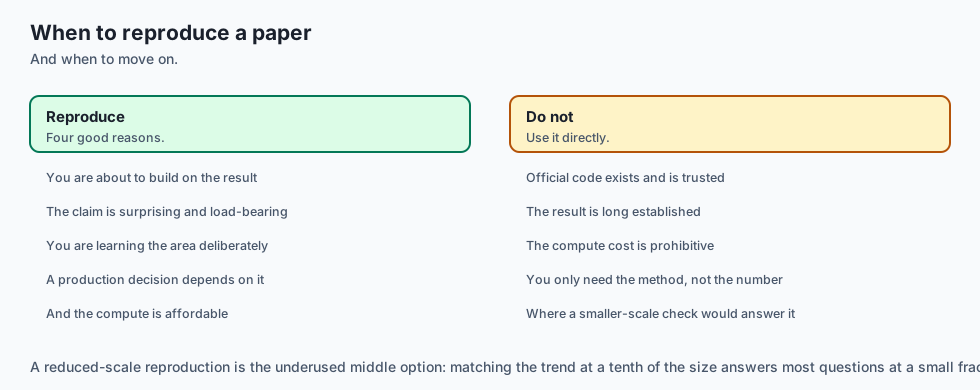
When to Execute a Formal Reproduction:
- Before adopting a novel architecture into production infrastructure, before publishing follow-up academic research, and when calibrating internal benchmarks.
When NOT to use:
- Quick exploratory proof-of-concept hackathons with off-the-shelf standard model libraries.
The AI connection
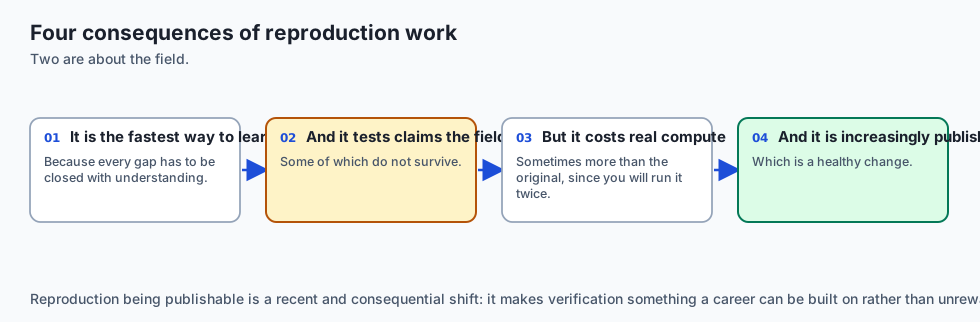
- Reproducing a paper is the fastest way to learn a field, because every unstated assumption becomes visible when the numbers do not match.
- Most published results omit details that decide the outcome, so the gap between paper and result is where the real understanding is.
- Overfitting a single batch is the one diagnostic that catches most bugs, and it costs a minute.
- Statistical significance is routinely ignored in reported results, which is why a difference of a few tenths of a point usually means nothing.
- Continuous verification of a model is now ordinary engineering, treating a training run like any other build that can silently break.
Knowledge check
- What is the single-batch overfit test and why is it the first milestone of neural network reproduction?
- What are the 5 pillars of the reproduction discrepancy taxonomy?
- Why are ablation studies essential for scientific claims in deep learning?
- How does multi-seed evaluation prevent misleading claims caused by random initialization?
- What role does Adam
\epsilonplay in Transformer reproduction stability?
Hands-on exercise
In this lab, you will build and test a modular paper reproduction and ablation verification harness in PyTorch: implement a configurable Transformer classifier supporting Pre-LN vs Post-LN variants, execute a single-batch overfit sanity test, run multi-seed controlled evaluation trials, and compute empirical ablation score deltas.
Expected output
[Scientific Paper Reproduction Verification Suite]
Testing Milestone 1: Single Batch Overfit Test:
  Initial Batch Loss: 0.724
  After 50 Steps: Loss = 0.0084 (Accuracy = 100%) [SANITY PASSED]
Testing Multi-Seed Controlled Trials (3 Seeds):
  Seed 42: Val F1 = 0.912
  Seed 43: Val F1 = 0.925
  Seed 44: Val F1 = 0.908
  Aggregate: Mean F1 = 0.915 ± 0.007 [CONTROLLED BASELINE ESTABLISHED]
Testing Ablation Matrix:
  Proposed (Pre-LN): F1 = 0.915
  Ablation (Post-LN): F1 = 0.862 (Delta: -5.3% Degradation) [ABLATION PROVEN]
Test Suite: 3 passed in 0.43s
Validate your work
Run the automated test runner:
./tests/run_tests.shTroubleshooting
- If single-batch overfit fails, check that gradients are not detached and learning rate is sufficient (
10^{-3}).
Common mistakes
- Evaluating on test set repeatedly during tuning: Causes test-set contamination and invalidates reproduction claims.
Practice assignment
- Write a complete Reproduction Report Markdown Document comparing a published Transformer claim against your empirical multi-seed findings.
- Implement an automated Ablation Runner in Python that iterates through component configurations and outputs a Markdown results table.
Extension challenge
Implement a Weight Difference Inspector:
- Build a Python utility that computes cosine similarity and Frobenius norm deltas between reproduced model weights and reference checkpoints across every named layer.
Quiz
Q1. What is the "First Milestone" when attempting to reproduce a published neural network architecture in PyTorch?
- Writing a tweet about the paper
- Buying 1,000 GPUs immediately
- Submitting a paper to NeurIPS
- Overfit a single mini-batch
Show answer
Answer: D. Overfit a single mini-batch
Overfitting a single batch proves that model capacity and gradient backpropagation are bug-free before spending compute.
Q2. Why is it critical to report the mean and standard deviation across multiple random seeds (e.g. 3-5 seeds) in a reproduction study?
- Small models are very sensitive to the seed
- Because PyTorch requires 5 seeds to compile
- Because seeds increase GPU memory
- Because random seeds change the programming language
Show answer
Answer: A. Small models are very sensitive to the seed
Multi-seed evaluation prevents false claims caused by lucky random initialization or cherry-picking.
Q3. What is the purpose of an Ablation Study in deep learning research?
- To delete corrupted training data
- To isolate each component's effect
- To speed up downloading weights
- To reduce electricity bills
Show answer
Answer: B. To isolate each component's effect
Ablations verify which specific component is responsible for claimed empirical gains.
Q4. What constitutes an "Honest Reproduction Report" when empirical results fall short of published claims?
- Deleting the code repository
- Falsifying numbers to match the published paper
- A report comparing observed against claimed metrics
- Blaming the GPU manufacturer
Show answer
Answer: C. A report comparing observed against claimed metrics
Scientific integrity requires transparently documenting gaps between published claims and observed results.
Q5. Which hidden hyperparameter is most frequently omitted in academic NLP papers but dramatically alters Transformer training stability?
- The operating system wallpaper
- The computer monitor resolution
- The font size in the code editor
- Adam's epsilon and warmup steps
Show answer
Answer: D. Adam's epsilon and warmup steps
Adam epsilon and warmup schedules are critical to Transformer stability and often omitted in papers.
Glossary
- Paper Reproduction
- The independent implementation and empirical validation of a published scientific machine learning algorithm from textual descriptions and code.
- Ablation Study
- An experimental control protocol systematically disabling specific model components to quantify their individual contribution to overall performance.
- Overfit Single Batch
- A fundamental debugging sanity test verifying that a model can drive training loss to zero on 16-32 fixed samples.
- Seed Sensitivity
- The variance in final evaluation metrics caused purely by different pseudorandom number generator initializations.
- Hidden Hyperparameters
- Crucial training parameters (such as Adam epsilon, gradient clipping thresholds, or warmup schedules) omitted from published paper text.
- Reproduction Discrepancy
- The measurable divergence between claimed published performance and independently observed experimental metrics.
- Negative Result
- An empirical finding showing that a proposed technique fails to deliver claimed improvements under controlled baseline comparisons.
- Reproducibility Checklist
- A formalized verification protocol documenting code, data, dependencies, hyperparameter search ranges, and statistical significance.
Sources and further reading
- Machine Learning Reproducibility Checklist — NeurIPS 2020 (accessed 2026-08-29)
- Are We Really Making Much Progress? A Worrying Analysis of Recent Neural Recommendation Approaches — ACM RecSys 2019 (accessed 2026-08-29)
- What is the State of Neural Network Pruning? — MLSys 2020 (accessed 2026-08-29)
Kept in this browser, no account needed. Your progress page turns the whole record into one link you can bookmark or open on another device.