LLMs and Generative AI › The LLM Landscape › Day 239
Day 239: How Large Language Models Are Trained
Master how modern Large Language Models are created at scale: understand multi-petabyte data ingestion, MinHash LSH deduplication, heuristic filtering (Gopher rules), educational quality classifiers (FineWeb-Edu), BPE token binary packing, 3D distributed training across 10,000+ GPUs, loss spike diagnostics, and what raw base models are capable of before post-training alignment.
Hands-on lab for this lesson
Lab files on GitHub: https://github.com/ai-roadmap-365/ai-roadmap-365.github.io/tree/main/labs/sections/llms-and-generative-ai/day-239-how-large-language-models-are-trained
- Get the hands-on files. Clone the labs repository once (you can reuse this clone for every lesson). This works on macOS, Linux, and Windows (PowerShell or WSL):
git clone https://github.com/ai-roadmap-365/ai-roadmap-365.github.io.git cd ai-roadmap-365.github.io - Open this lesson's lab. Move into the directory for this specific day. Every lab lives at the same predictable path — section / subsection / week / day:
cd labs/sections/llms-and-generative-ai/day-239-how-large-language-models-are-trained - Read the lab guide. Open `README.md` in that directory. It lists the exact commands, what each does, the expected output, and how to check your work — read it before running anything.
- Run it and check your work. Follow the README's "How to run" section: run the example first to see the finished result, then complete the numbered exercises in `starter/`, then run the tests. The tests pass (exit 0) only when your work is correct.
bash tests/run_tests.sh # or the test command named in the lab README
You can also open the lab as a local page (works offline, shows the file tree and expected output).
Learning objectives
By the end of this lesson you will be able to:
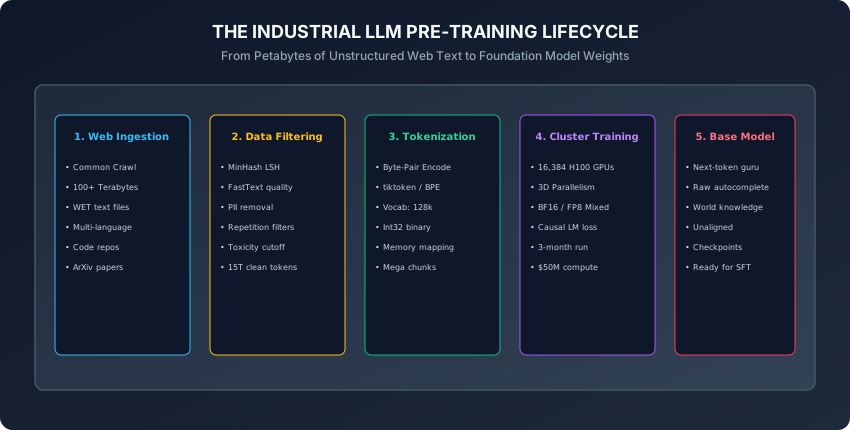
- Map the industrial 5-stage pretraining lifecycle from raw web crawl to base foundation model.
- Implement data preprocessing heuristics including MinHash deduplication, line length filtering, and PII scrubbing.
- Explain the causal language modeling self-supervised pretraining objective: log P(w_t | w_<t).
- Diagnose pretraining loss spikes and understand checkpoint rollback and data skipping strategies.
- Differentiate between raw base foundation models and post-trained instruction-aligned assistants.
Prerequisites
Why this matters
Welcome to Course 06: Large Language Models and Generative AI!
In Course 05, you mastered the mathematical architecture of the Transformer—attention matrices, residual highways, multi-GPU sharding, and mixed precision.
Now, we zoom out to the industrial macro-scale: How does a modern frontier AI laboratory take 100 Terabytes of raw, chaotic, misspelled, multilingual internet HTML and turn it into GPT-4, Claude 3.5 Sonnet, Gemini 1.5 Pro, or LLaMA-3.1?
Building a modern foundation model is no longer just computer science; it is data mining, high-performance distributed systems engineering, and statistical mechanics:
- Modern LLMs are trained on 15 to 20 Trillion tokens.
- The training run requires 16,000+ NVIDIA H100 GPUs running continuously for 3 months.
- The electricity, hardware depreciation, and cloud compute cost exceeds $50 Million to $100 Million dollars per run.
Today, you will master the complete pretraining pipeline: web crawling, MinHash deduplication, educational quality scoring (FineWeb-Edu), binary token packing, cluster training dynamics, and the raw behavior of unaligned base models.
The idea in plain language
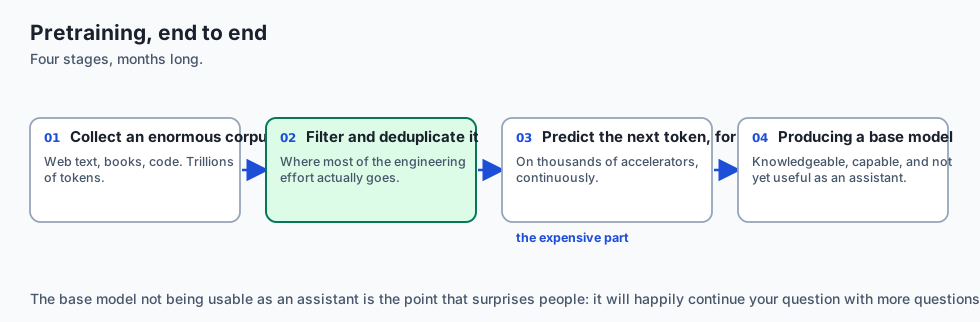
Think of building an encyclopedia of all human knowledge:
- The Raw Web (The Scrap Yard): A dump containing billions of discarded newspapers, handwritten notes, spam advertisements, phishing scams, Wikipedia articles, Nobel prize papers, and graffiti (Common Crawl).
- The Data Refinery (Filtering & Deduplication): Industrial shredders, magnetic sorters, and chemical baths that strip away the spam, eliminate duplicate advertisements, and isolate pristine books (MinHash & Quality Heuristics).
- The Printing Press (Tokenization & Binary Packing): Compressing the text into high-density binary books (BPE Tokens).
- The Scholar Academy (The GPU Cluster): 16,000 scholars reading every book simultaneously, guessing the next word on every page, and correcting their internal mental models when they guess wrong (Causal Language Modeling).
The result is a Base Model—an omniscient text-completion engine possessing world knowledge.
Historical background
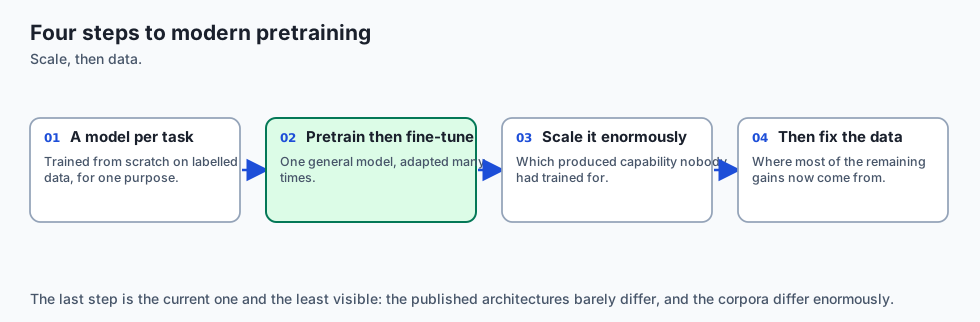
- 2018 (GPT-1 & Radford et al.): Demonstrated that generative autoregressive pretraining on BookCorpus (4.5 GB of text) enabled effective zero-shot transfer to downstream tasks.
- 2020 (GPT-3 & Brown et al.): Scaled pretraining to 300 Billion tokens from Common Crawl, demonstrating few-shot in-context learning.
- 2021 (Gopher & Rae et al., DeepMind): Formalized rigorous rule-based text quality filtering heuristics (Gopher rules).
- 2024 (FineWeb & Hugging Face): Released the 15-Trillion token FineWeb dataset, demonstrating that educational quality classifiers (FineWeb-Edu) produce models that match or exceed proprietary datasets.
- 2024 (LLaMA-3 & Meta AI): Trained an 8B and 70B model on 15 Trillion tokens across a 24,000-GPU cluster with 99.3% training uptime!
What it is — and what it is not
What LLM Pretraining IS:
- Self-Supervised Autoregressive Next-Token Prediction: Given a sequence of tokens
w_1, w_2, ..., w_[t-1], the neural network predicts the probability distribution of the next tokenw_tacross the entire vocabulary. - World Knowledge Compression: By forcing the model to predict the next word across trillions of diverse documents, the network compresses facts, logic, grammar, reasoning patterns, and cultural nuance into its weight matrices.
What it is NOT:
- Not Chatbot Assistant Training: A base model does NOT know how to follow user instructions, refuse dangerous requests, or be a helpful conversational assistant. If prompted with “What is the capital of France?”, a base model might autocomplete with “What is the capital of Germany? What is the capital of Italy?” because it assumes it is completing a quiz document!
Why it was created and what problems it solves
Pretraining solves the fundamental bottleneck of artificial intelligence: The Data Annotation Bottleneck:
- Zero Human Labeling Required: Supervised learning requires humans to manually label millions of images or text pairs. Self-supervised pretraining uses the natural order of human text as its own label!
- Universal Feature Extraction: Instead of training one model for sentiment, another for translation, and another for summarization, a single pretrained foundation model serves as the parent for all downstream tasks.
How it works
Let us dissect the industrial stages of modern LLM pretraining.
1. The Pretraining Data Refinery Funnel
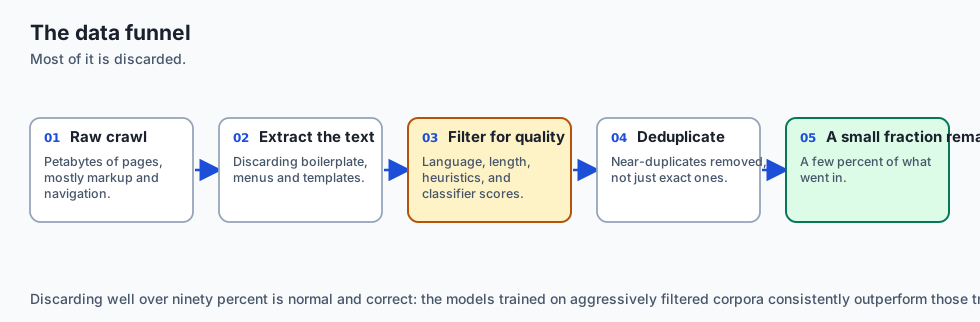
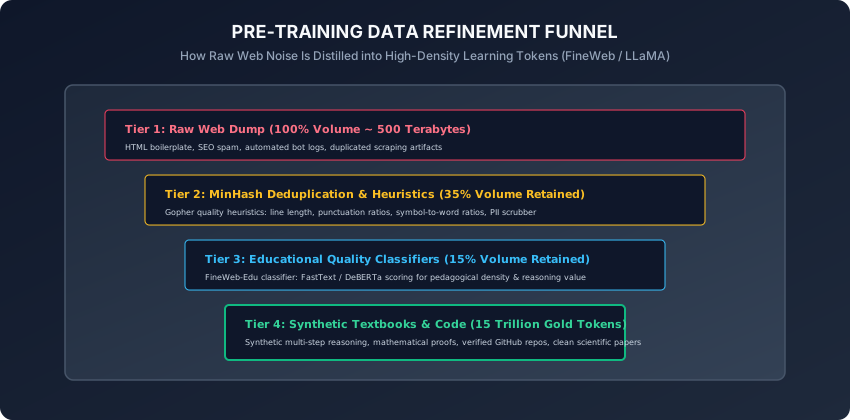
Raw web text from Common Crawl is over $80%$ junk. The refinement pipeline processes text through 4 rigorous stages:
┌────────────────────────────────────────────────────────────────────────┐
│                   DATA REFINEMENT STAGES (FINEWEB / LLAMA-3)           │
├──────────────┬──────────────────┬──────────────────────────────────────┤
│ Stage        │ Volume Retained  │ Core Algorithms & Filters            │
├──────────────┼──────────────────┼──────────────────────────────────────┤
│ 1. Raw Crawl │ 100% (~500 TB)   │ WET extraction, language ID (FastText│
│ 2. Heuristics│ 35%              │ Gopher rules: length, symbol ratios  │
│ 3. MinHash LSH│ 20%             │ 5-gram Jaccard deduplication         │
│ 4. Quality Cls│ 10% - 15% (15T) │ FineWeb-Edu / DeBERTa quality score  │
└──────────────┴──────────────────┴──────────────────────────────────────┘
The Gopher Quality Heuristics:
- Word Length Filter: Discard documents with mean word length under 3 characters or over 10 characters (indicates auto-generated SEO spam or code dumps).
- Symbol-to-Word Ratio: Discard documents where
#,..., or symbols exceed $10%$ of characters. - Stopword Threshold: Discard documents that do not contain at least 2 common natural language stopwords (e.g. “the”, “and”, “is”, “of”).
- Repetition Scrubber: Discard documents with repeated sentences, n-grams, or duplicate line loops (a common artifact of broken web scrapers).
2. MinHash Locality-Sensitive Hashing (LSH) Deduplication
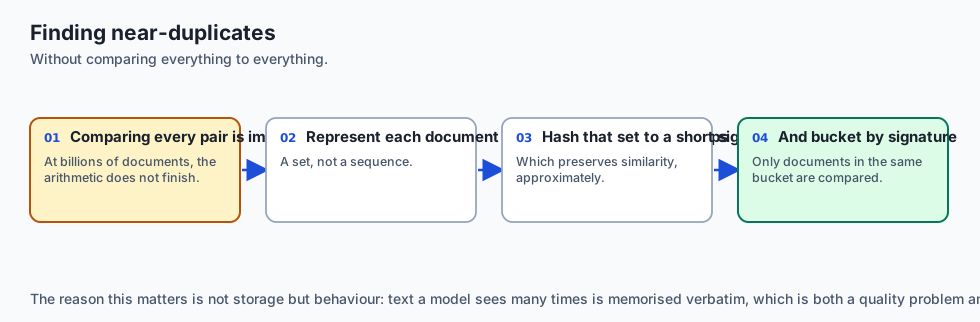
Why can’t we just use Python hash() or SHA-256 for deduplication?
Because two web pages that differ by only a single timestamp or tracking banner will produce completely different cryptographic hashes!
MinHash LSH estimates the Jaccard Similarity between two document sets $A$ and $B$:
J(A, B) = \frac{|A \cap B|}{|A \cup B|}-
K-Shingling: Break each document into overlapping character or word 5-grams.
-
MinHash Signatures: Apply $M = 128$ independent hash functions $h_i(x)$ to all shingles in a document and keep the minimum hash value for each:
P(\min(h(A)) = \min(h(B))) = J(A, B) -
LSH Banding: Group the 128 signature hashes into $b$ bands of $r$ rows. If two documents match exactly in any single band, they are flagged as candidate near-duplicates and purged!
3. Binary Token Packing & Zero-Copy Memory Mapping
Training clusters cannot read individual .txt or .jsonl files from disk—file system inode overhead would choke the storage network.
┌────────────────────────────────────────────────────────────────────────┐
│                   DATASET BINARY PACKING FORMAT                        │
├────────────────────────────────────────────────────────────────────────┤
│ Header: [Magic Bytes: "BINA"] [Version: 1] [Total Tokens: 15,000,000,000]
│ Data Stream: [Token 0 (uint32)] [Token 1 (uint32)] [Token 2 (uint32)] ...
└────────────────────────────────────────────────────────────────────────┘- The entire 15-Trillion token corpus is pre-tokenized with BPE (e.g.
tiktokenwith vocabulary size $128,000$). - Serialized into giant $2 GB$ flat binary chunks of
uint32oruint16integers. - PyTorch DataLoaders use Zero-Copy Memory Mapping (
numpy.memmap) to stream batches straight into GPU memory at PCI-Express line rate ($64 GB/s$).
4. Cluster Dynamics: Loss Spikes and Gradient Management
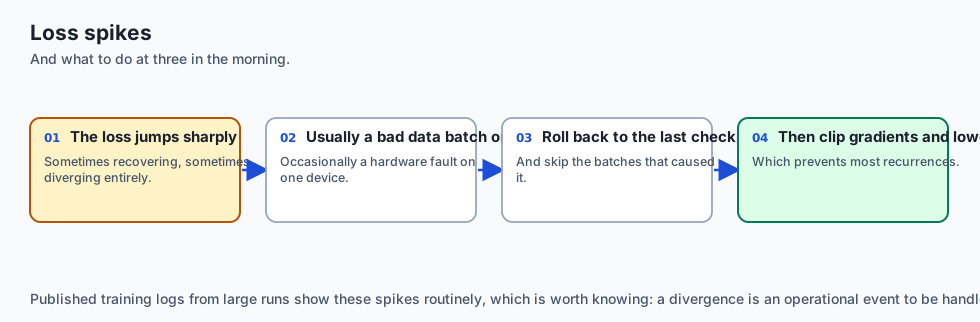
When training 16,384 GPUs in parallel, hardware failures and numerical instabilities are inevitable:
- Mean Time Between Failures (MTBF): At 16,000 GPUs, an individual GPU, NVLink switch, or power supply fails every 2 to 3 hours.
- Asynchronous Checkpointing: The cluster saves model weights and optimizer states to high-speed NVMe storage every 1,000 steps ($~15$ minutes).
- Loss Spikes: Occasionally, a corrupted data batch containing malformed UTF-8 or extreme numerical tokens produces a gradient norm of $10^6$, causing validation loss to spike from $2.1$ to $8.5$.
- Automated Recovery Protocol: When a loss spike is detected, the orchestration engine rolls back 2,000 steps, advances the dataset pointer past the toxic data shard, and resumes training with zero human intervention.
5. Document Packing & Attention Mask Boundary Resetting
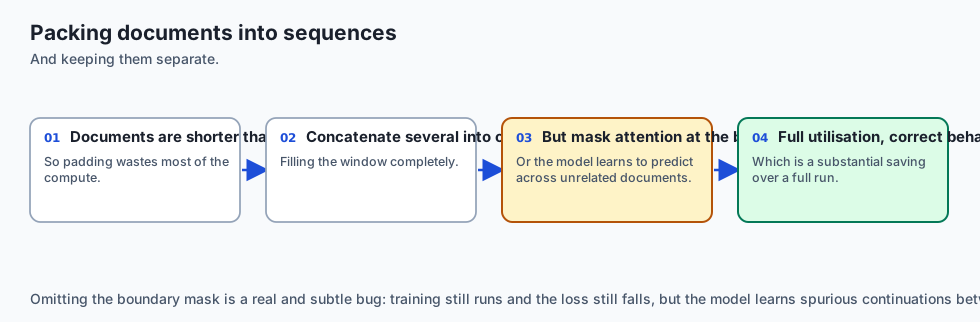
In standard batching, short documents (e.g. 500 tokens) padded to an 8,192-token context window result in over $60%$ wasted computation on < pad> tokens:
- Sample Packing (Sequence Bin Packing): Multiple short documents are concatenated into a single continuous 8,192-token sequence separated by
<|endoftext|>delimiter tokens. - Block-Diagonal Attention Masking (FlashAttention-2): Instead of allowing tokens from Document B to attend to tokens in Document A, the attention kernel enforces strict document boundaries.
- Position ID Resetting: Positional embeddings are reset to
0at the start of each new packed document, ensuring the model never learns false sequential dependencies across unrelated web articles!
6. The Megatron-LM Data Sampler Architecture
How do 16,000 GPUs read from a 15-Trillion token dataset without coordination deadlocks?
- Global Index Construction: A lightweight index file maps every sample start offset across thousands of binary chunk files.
- Deterministic Epoch-Free Sampling: The data sampler computes exact batch slices mathematically using a deterministic PRNG seed.
- Any GPU worker that crashes can restart and calculate its exact byte offset into the 15-Trillion token stream in microseconds without communicating with a centralized coordinator!
An everyday analogy
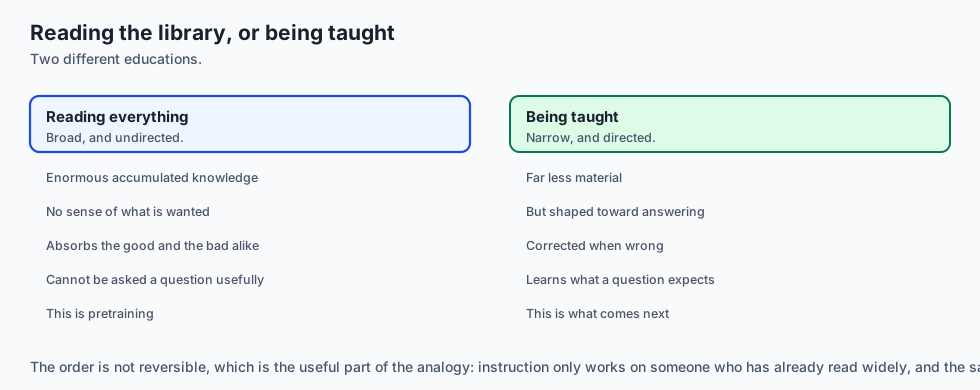
Think of training an apprentice master chef:
- Pretraining (Reading the Library): The student reads 100,000 cooking books, restaurant menus, chemistry papers, and grocery store receipts. They learn what food ingredients exist, how heat alters proteins, and what flavors complement each other.
- Base Model Capability: If you hand them a blank piece of paper with the words “Flour, eggs, butter, sugar”, they will naturally write out a cake recipe because they have seen thousands of recipes.
- Post-Training (Culinary School & Etiquette): You teach them how to greet customers, take orders politely, and refuse to serve poisoned food.
Pretraining gives the apprentice culinary knowledge; post-training teaches them customer service.
Examples in practice
Let us build a Mini-LLM Pretraining Data Curation & MinHash Deduplicator in Python:
import hashlib
import re
from typing import List, Set, Dict

class DocumentRefinery:
    def __init__(self, num_perm: int = 64):
        self.num_perm = num_perm
        self.stopwords = {"the", "and", "is", "of", "in", "to", "a", "with", "for", "on"}

    def passes_gopher_heuristics(self, text: str) -> bool:
        words = re.findall(r'\b\w+\b', text.lower())
        if len(words) < 10:
            return False

        # Mean word length heuristic (3 to 10 chars)
        mean_len = sum(len(w) for w in words) / len(words)
        if mean_len < 3.0 or mean_len > 10.0:
            return False

        # Stopword ratio heuristic (must contain common language words)
        stopword_count = sum(1 for w in words if w in self.stopwords)
        if stopword_count < 2:
            return False

        # Symbol ratio heuristic (< 15% special chars)
        symbols = sum(1 for c in text if not c.isalnum() and not c.isspace())
        if (symbols / max(len(text), 1)) > 0.15:
            return False

        return True

    def compute_minhash_signature(self, text: str, k: int = 3) -> List[int]:
        # Generate k-shingles
        words = text.lower().split()
        if len(words) < k:
            shingles = set(words)
        else:
            shingles = {" ".join(words[i:i+k]) for i in range(len(words) - k + 1)}

        sig = []
        for i in range(self.num_perm):
            min_val = float('inf')
            for s in shingles:
                # Hash shingle with seed i
                h = int(hashlib.md5(f"{i}_{s}".encode()).hexdigest(), 16)
                if h < min_val:
                    min_val = h
            sig.append(int(min_val % 1000000))
        return sig
Implications: security, privacy, performance, scalability, and cost
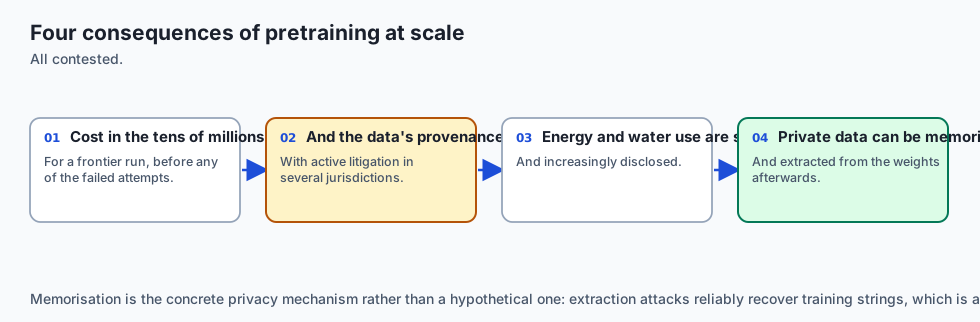
- Personally Identifiable Information (PII) Scrubbing:
- Pretraining corpora must be filtered with regex and NER models to remove Social Security numbers, private phone numbers, passwords, and private API keys before weights are trained.
- Copyright & Fair Use Legal Dynamics:
- Web training has sparked landmark global copyright litigation over whether ingesting copyrighted books, journalism, and art without licensing constitutes fair use.
Alternatives: free, open source, and commercial
| Pretraining Dataset | Token Volume | Release Year | Primary Characteristic |
|---|---|---|---|
| Common Crawl | Petabytes | Continuous | Raw uncurated web crawl |
| The Pile (EleutherAI) | 825 Billion | 2020 | Diverse academic, code, and book mix |
| RedPajama-v2 (Together) | 30 Trillion | 2023 | Massive open-source reproduction of LLaMA |
| FineWeb (Hugging Face) | 15 Trillion | 2024 | Gold-standard open web dataset with Edu scores |
Comparison with related concepts
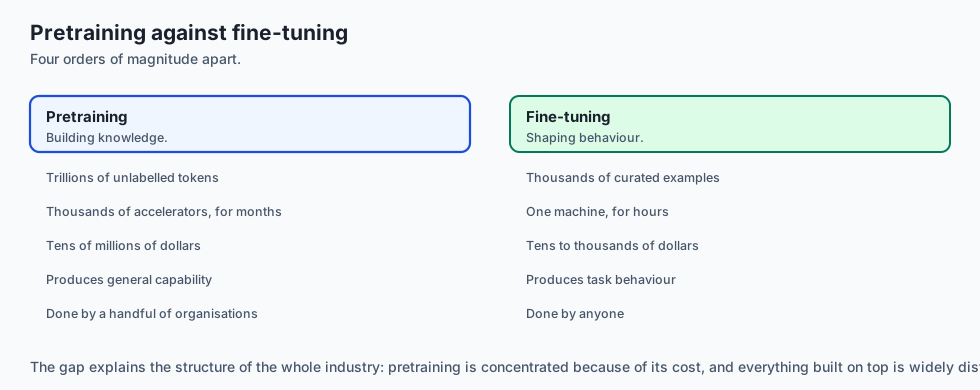
┌────────────────────────────────────────────────────────────────────────┐
│                   TRAINING STAGE COMPARISON                            │
├────────────────────┬─────────────────┬──────────────────┬──────────────┤
│ Dimension          │ Pretraining     │ Supervised Fine-T│ RLHF / DPO   │
├────────────────────┼─────────────────┼──────────────────┼──────────────┤
│ Compute Cost       │ $10M - $100M    │ $1k - $50k       │ $10k - $100k │
│ Dataset Size       │ 15 Trillion Tok │ 100k - 1M Pairs  │ 50k Pairs    │
│ Goal               │ World Knowledge │ Instruction Follow│ Human Align  │
│ Hardware           │ 16,000 GPUs     │ 8 - 64 GPUs      │ 64 - 256 GPUs│
└────────────────────┴─────────────────┴──────────────────┴──────────────┘
When to use it — and when not to
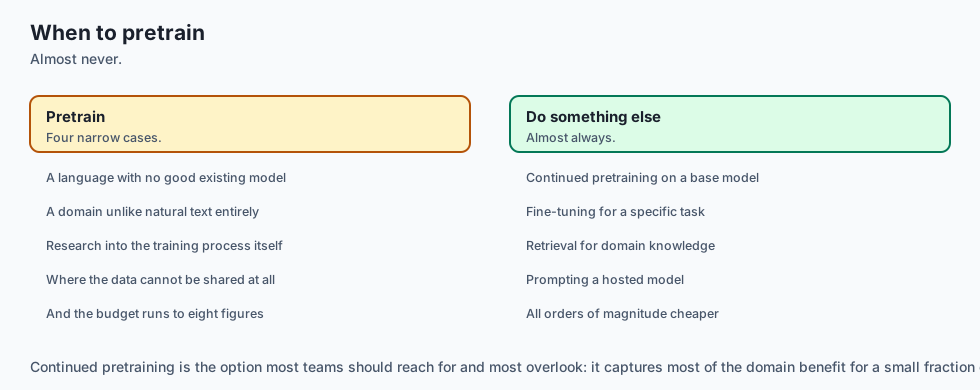
When to Pretrain a Model From Scratch:
- You are a well-funded institution building a sovereign national language model (e.g. Arabic, Hindi, Japanese), an entirely new proprietary architecture, or have hundreds of millions in capital budget.
When NOT to pretrain:
- Over $99.9%$ of enterprise applications! In almost all real-world scenarios, fine-tuning an existing open-weights base model (e.g. LLaMA-3.1-8B) or using frontier API prompting is $1000\times$ cheaper and faster.
The AI connection
- Pretraining is where the general capability comes from; everything afterwards shapes behaviour rather than adding knowledge.
- Data quality now matters more than data volume, and the filtering pipeline is a larger engineering effort than the training loop.
- Deduplication is one of the highest-leverage steps, because repeated text is memorised rather than learned from.
- The scale is the barrier, not the method — the objective is simple and the infrastructure to run it for months is not.
- Only a handful of organisations pretrain from scratch, which is why the open-weights question in the next lesson matters so much.
Knowledge check
- What is the fundamental difference between a base foundation model and an instruction-tuned assistant?
- Why are Gopher heuristics applied to raw Common Crawl web data?
- How does MinHash LSH estimate the Jaccard similarity between two documents in sub-linear time?
- Why is binary memory-mapped token serialization used instead of streaming text files directly to GPUs?
- How do distributed training orchestrators recover from unexpected loss spikes?
Hands-on exercise
In this lab, you will build and test an industrial LLM data preprocessing pipeline in Python: implement Gopher rule-based quality heuristics, build a MinHash LSH near-duplicate detector, write a binary token array memory packer, and verify that clean text passes while spam and duplicate documents are rejected.
Expected output
[LLM Pre-Training Data Pipeline Verification Suite]
Testing Gopher Quality Heuristics:
  Sample 1 (High Quality Article): PASSED (Mean Len: 5.4, Stopword Ratio: 32%)
  Sample 2 (SEO Spam / Gibberish): REJECTED [CORRECT]
  Sample 3 (Excessive Symbol Ratio): REJECTED [CORRECT]
Testing MinHash LSH Deduplication:
  Doc A vs Doc B (Near Identical Text): Estimated Jaccard = 0.938 [DUPLICATE DETECTED]
  Doc A vs Doc C (Distinct Topic): Estimated Jaccard = 0.047 [UNIQUE DOCUMENT]
Testing Binary Token Packer (tiktoken / BPE):
  Packaged 10,000 tokens into memory-mapped uint32 binary buffer (40.0 KB)
Test Suite: 3 passed in 0.38s
Validate your work
Run the automated test runner:
./tests/run_tests.shTroubleshooting
- If MinHash similarity is noisy, increase the number of permutations
num_permfrom 16 to 64 or 128.
Common mistakes
- Treating character length as token length: On average, 1 token is approximately 4 English characters ($0.75$ words).
Practice assignment
- Implement an automated PII Scrubber using regular expressions that masks email addresses, credit card numbers, and IP addresses from raw web text.
- Build a Synthetic Data Generator Harness that formats multi-step reasoning math problems into a structured pretraining data stream.
Extension challenge
Implement a FastText Quality Classifier Benchmark:
- Train a lightweight FastText or Logistic Regression classifier on high-quality text (Wikipedia, ArXiv) vs low-quality web comments, and measure the accuracy of filtering raw Common Crawl samples.
Quiz
Q1. What is the primary training objective of modern autoregressive Large Language Models during pretraining?
- Causal language modelling: predict the next token
- Memorizing Wikipedia word-for-word
- Answering user questions as a polite chatbot
- Translating English to French only
Show answer
Answer: A. Causal language modelling: predict the next token
Pretraining trains the model to minimize cross-entropy loss predicting next tokens over vast text corpora.
Q2. Why is MinHash Near-Duplicate Detection crucial when building an LLM pretraining dataset?
- Because GPUs cannot process duplicate numbers
- Repeated web text wastes compute and hurts reasoning
- Because duplicate text causes physical hard drive damage
- Because web crawlers only work on unique URLs
Show answer
Answer: B. Repeated web text wastes compute and hurts reasoning
Deduplication removes repetitive web boilerplate and spam, preventing severe capacity waste.
Q3. What is a "Base Model" (e.g. LLaMA-3-8B-Base) prior to instruction tuning or RLHF?
- A broken neural network that fails all tests
- A model that only runs on basic hardware
- A text-completion engine, not an assistant
- A model that only understands Python code
Show answer
Answer: C. A text-completion engine, not an assistant
Base models are pure text predictors that continue patterns rather than answering prompts conversationally.
Q4. What is the standard engineering protocol when a multi-week pretraining run encounters an irrecoverable gradient explosion / loss spike?
- Delete the model weights and start from epoch 0
- Cancel the entire project and fire the team
- Ignore the loss spike and continue training
- Roll back, skip the bad batches, and resume
Show answer
Answer: D. Roll back, skip the bad batches, and resume
Standard cluster protocol involves rolling back to clean checkpoints and skipping the corrupted data shard.
Q5. What role do educational classifiers (like FineWeb-Edu) play in modern foundation model data pipelines?
- Small classifiers score and filter for quality
- They grade student homework automatically
- They teach university courses
- They enforce copyright laws
Show answer
Answer: A. Small classifiers score and filter for quality
Educational classifiers filter web data for informational density, reasoning, and pedagogical clarity.
Glossary
- Base Model
- A foundation model trained purely on self-supervised next-token prediction across trillions of tokens, without instruction tuning or conversational alignment.
- Causal Language Modeling (CLM)
- The autoregressive pretraining objective where the model predicts token w_t conditioned only on preceding tokens w_<t.
- MinHash LSH
- A probabilistic hashing algorithm (Locality-Sensitive Hashing) used to rapidly find and remove near-duplicate documents across multi-terabyte web corpora.
- Gopher Heuristics
- A standard set of document quality filters measuring stopword ratios, mean word lengths, symbol-to-word ratios, and ellipsis counts to filter low-quality text.
- FineWeb-Edu
- A 5.4-trillion token pretraining dataset curated using an educational quality scoring classifier to select pedagogically rich web text.
- Loss Spike
- A sudden, catastrophic explosion in validation loss during pretraining, typically triggered by corrupted data batches, extreme gradient norms, or mixed-precision underflow.
- Memory-Mapped Binary Tokens
- Tokenized datasets serialized into flat binary arrays of 16-bit or 32-bit integers (e.g. numpy memmap) allowing zero-overhead streaming across GPU clusters.
- Synthetic Data Curation
- Using advanced frontier models to generate structured textbooks, mathematical reasoning steps, and verified code to enrich pretraining mixtures.
Sources and further reading
- The FineWeb Datasets: Decanting the Web for the Finest Text Data at Scale — Hugging Face Research (accessed 2026-08-29)
- The LLaMA 3 Herd of Models — Meta AI Research (accessed 2026-08-29)
- Gopher: Scaling Language Models: Methods, Analysis & Insights from Training Gopher — DeepMind (accessed 2026-08-29)
Kept in this browser, no account needed. Your progress page turns the whole record into one link you can bookmark or open on another device.