LLMs and Generative AI › The LLM Landscape › Day 241
Day 241: The Model Landscape: Claude, GPT, Gemini, Llama
Master the architectural strengths, pricing economics, and selection trade-offs across leading frontier language models: compare Claude 3.5 Sonnet, GPT-4o, OpenAI o1, Gemini 1.5 Pro (2M context), Gemini 2.0 Flash, LLaMA-3.1 405B/70B/8B, DeepSeek-V3, and Qwen-2.5; evaluate context window limits, token pricing ($/1M tokens), Time-To-First-Token (TTFT), and build an automated production model routing engine in Python.
Hands-on lab for this lesson
Lab files on GitHub: https://github.com/ai-roadmap-365/ai-roadmap-365.github.io/tree/main/labs/sections/llms-and-generative-ai/day-241-the-model-landscape-claude-gpt-gemini
- Get the hands-on files. Clone the labs repository once (you can reuse this clone for every lesson). This works on macOS, Linux, and Windows (PowerShell or WSL):
git clone https://github.com/ai-roadmap-365/ai-roadmap-365.github.io.git cd ai-roadmap-365.github.io - Open this lesson's lab. Move into the directory for this specific day. Every lab lives at the same predictable path — section / subsection / week / day:
cd labs/sections/llms-and-generative-ai/day-241-the-model-landscape-claude-gpt-gemini - Read the lab guide. Open `README.md` in that directory. It lists the exact commands, what each does, the expected output, and how to check your work — read it before running anything.
- Run it and check your work. Follow the README's "How to run" section: run the example first to see the finished result, then complete the numbered exercises in `starter/`, then run the tests. The tests pass (exit 0) only when your work is correct.
bash tests/run_tests.sh # or the test command named in the lab README
You can also open the lab as a local page (works offline, shows the file tree and expected output).
Learning objectives
By the end of this lesson you will be able to:
- Map the architectural specializations and benchmark dominance across Claude, GPT, Gemini, LLaMA, and DeepSeek.
- Analyze pricing economics ($/1M input and output tokens) and evaluate the total cost of ownership across model tiers.
- Evaluate context window architectures (from 128k to 2M tokens) and analyze needle-in-a-haystack retrieval limits.
- Understand the trade-offs between Dense Transformer architectures and Sparse Mixture-of-Experts (MoE).
- Implement a production-grade multi-tier model router and cost optimizer in Python.
Prerequisites
Why this matters
In 2023, building an AI application was simple: you called OpenAI’s gpt-3.5-turbo or gpt-4 endpoint.
Today, the AI landscape has fractured into a vibrant, highly competitive multi-model ecosystem:
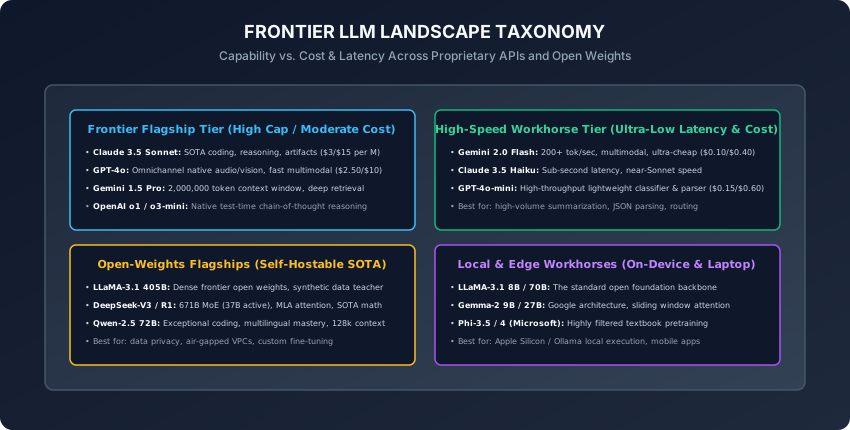
- Anthropic: Claude 3.5 Sonnet dominates software engineering, complex system architecture, and nuanced reasoning.
- OpenAI: GPT-4o delivers real-time voice and multimodal interaction; o1 and o3-mini lead deep mathematical test-time reasoning.
- Google: Gemini 1.5 Pro and 2.0 Flash lead the world in long-context reasoning (2,000,000 tokens) and ultra-fast, cheap multimodal generation.
- Meta & Open Weights: LLaMA-3.1 (8B, 70B, 405B), DeepSeek-V3/R1, and Qwen-2.5 match proprietary capabilities while allowing full on-premise privacy and custom fine-tuning.
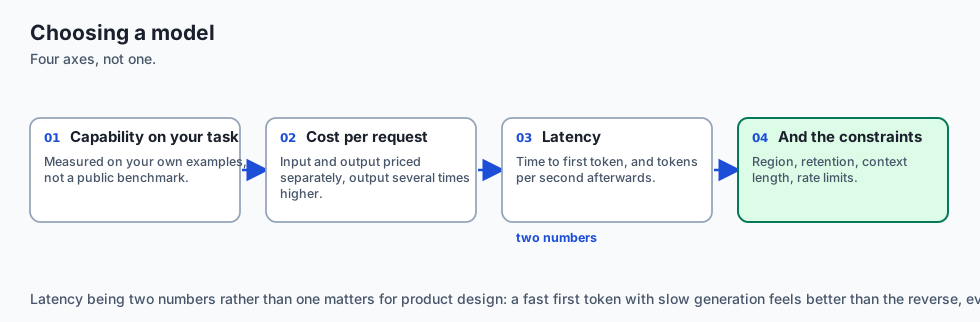
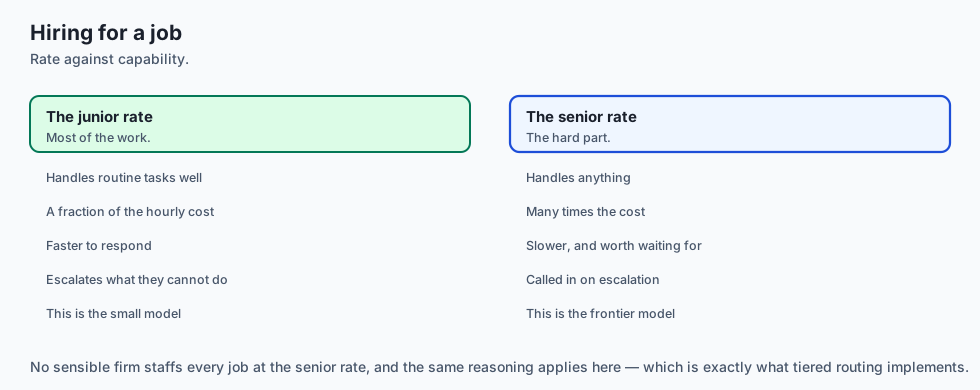
A Senior AI Engineer does not blindly send every query to the most expensive frontier model. Calling Claude 3.5 Sonnet or GPT-4 for simple intent classification costs $3.00 to $15.00 per million tokens. Calling Gemini 2.0 Flash or GPT-4o-mini costs $0.10 to $0.15 per million tokens—a $20\times$ to $100\times$ price difference!
Today, you will master the architectural strengths of the major model families, the mathematics of context windows, pricing economics, and build a production-grade Multi-Tier Model Router.
The idea in plain language
Think of managing a high-performance corporate team:
- The Senior Lead Architect (Claude 3.5 Sonnet / OpenAI o1): The brilliant principal engineer who designs complex distributed systems, writes clean code, and solves obscure bugs. You pay them $200/hr$, so you only give them the hardest problems.
- The Fast Project Manager (GPT-4o): Excellent at running meetings, synthesizing visual slide decks, and coordinating real-time communication.
- The Research Archivist (Gemini 1.5 Pro): Has photographic memory and can read a 2,000-page legal contract in 3 seconds without forgetting a single footnote (2M Context Window).
- The High-Speed Interns (Gemini 2.0 Flash / Haiku / LLaMA-3 8B): Super fast, reliable, and cost $10/hr$. They handle filing, summarizing emails, sorting customer tickets, and basic translation.
A great manager assigns the right task to the right person. A great AI engineer routes each query to the optimal model.
Historical background
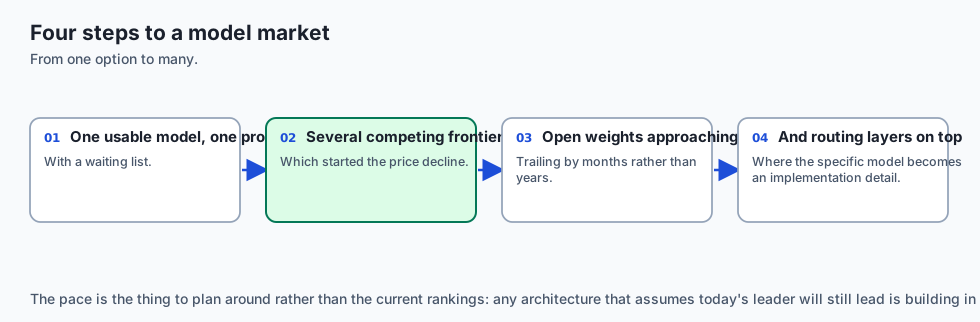
- 2023 (The Monolithic API Era): OpenAI’s GPT-4 was the undisputed single frontier model with zero close competitors.
- March 2024 (Anthropic Claude 3 Family): Anthropic released Opus, Sonnet, and Haiku, breaking OpenAI’s monopoly and setting new benchmarks in human-like writing and coding.
- May 2024 (Google Gemini 1.5 & OpenAI GPT-4o): Google unlocked 2-Million token context windows; OpenAI introduced omni-native audio and vision tokens.
- July 2024 (Meta LLaMA-3.1 405B): Marked the first time an open-weights model achieved benchmark parity with top-tier closed proprietary flagships.
- Late 2024 / 2025 (DeepSeek-V3 & Reasoning Revolution): DeepSeek demonstrated ultra-efficient 671B MoE training at a fraction of Western compute costs, while OpenAI o1/o3 pioneered test-time reasoning scaling.
What it is — and what it is not
What The Model Landscape IS:
- A Multi-Dimensional Optimization Space: Balancing Intelligence/Reasoning, Context Window Capacity, Inference Latency (TTFT & tok/s), Pricing ($/1M tokens), and Deployment Privacy (Cloud API vs. Self-Hosted VPC).
What it is NOT:
- Not a Single “Best Model”: There is no single winner. A model that is unmatched at generating complex TypeScript refactors (Claude 3.5 Sonnet) may be too expensive or slow for high-throughput batch document classification (where Gemini Flash or GPT-4o-mini dominates).
Why it was created and what problems it solves
Understanding the landscape solves three major production engineering hurdles:
- Economic Viability (Slashing API Bills): Prevents startups and enterprises from burning tens of thousands of dollars routing simple queries to frontier flagships.
- Context Window Engineering: Ingesting entire codebases or video streams directly without needing complex multi-step chunking and RAG pipelines.
- Data Sovereignty & Vendor Lock-In: Knowing when to use closed APIs vs self-hosting open-weights foundation models on private clusters.
How it works
Let us compare the 4 major model pillars, context architectures, and production routing mechanics.
1. The Big Four: Architectural Comparison
┌────────────────────────────────────────────────────────────────────────────────────────┐
│                   FRONTIER MODEL FAMILY ARCHITECTURAL COMPARISON                       │
├──────────────┬──────────────┬──────────────┬──────────────┬────────────────────────────┤
│ Model Family │ Context Size │ Pricing (/1M)│ Architecture │ Core Superpower            │
├──────────────┼──────────────┼──────────────┼──────────────┼────────────────────────────┤
│ Claude 3.5   │ 200k Tokens  │ $3.00 / $15  │ Dense Transf │ SOTA Coding, Reasoning     │
│ GPT-4o / o1  │ 128k Tokens  │ $2.50 / $10  │ Omni / MoE   │ Native Audio, Test-Time CoT│
│ Gemini 1.5/2 │ 2,000,000 Tok│ $0.10 - $1.25│ MoE Hybrid   │ 2M Context, Speed, Video   │
│ LLaMA-3.1    │ 128k Tokens  │ Self-Hosted  │ Dense (405B) │ Open Weights, Custom Tune  │
│ DeepSeek-V3  │ 128k Tokens  │ $0.14 / $0.28│ 671B MoE MLA │ SOTA Economics & Reasoning │
└──────────────┴──────────────┴──────────────┴──────────────┴────────────────────────────┘
2. Context Window Architectures: The 2-Million Token Frontier
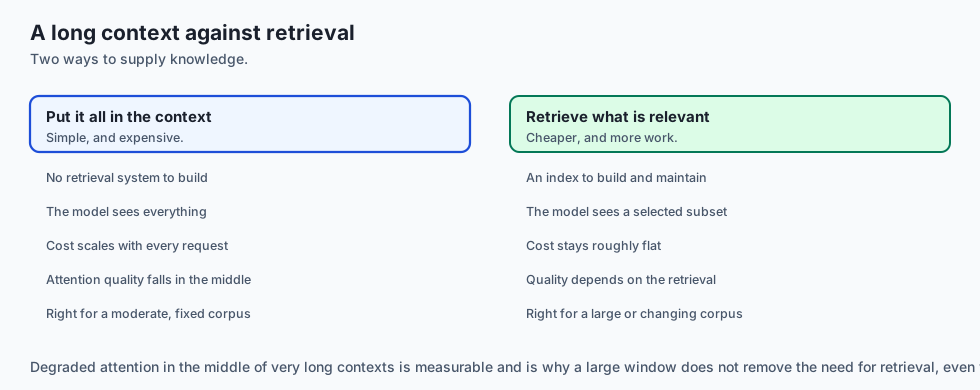
How does Google’s Gemini 1.5 Pro process 2,000,000 tokens (the equivalent of 1.5 hours of 1080p video, 60,000 lines of code, or 30 textbooks) in a single request?
- RingAttention & FlashAttention-3: Shards the query-key-value attention matrix computation across multiple GPUs in a ring topology, eliminating the $O(S^2)$ memory bottleneck.
- Needle in a Haystack (NIAH) Benchmark: In tests placing a random fact (e.g. “The secret ingredient in the sauce is cardamom”) at arbitrary depths from $0%$ to $100%$ across 2M tokens, Gemini 1.5 Pro achieves $> 99.7%$ retrieval accuracy!
3. Pricing Economics & Prompt Caching
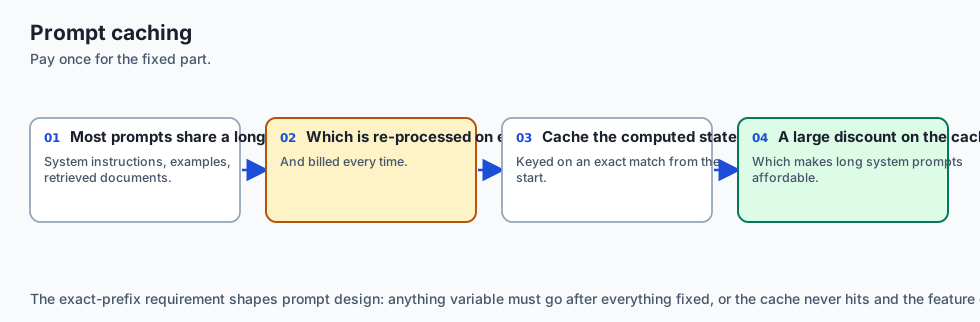
Modern frontier API pricing distinguishes between Input Tokens and Output Tokens:
- Output generation is $3\times$ to $5\times$ more expensive than input prefill because output tokens require autoregressive sequential memory bandwidth passes.
\text{Total Query Cost} = \left( \frac{\text{Input Tokens}}{10^6} \times \text{Input Price} \right) + \left( \frac{\text{Output Tokens}}{10^6} \times \text{Output Price} \right)The Prompt Caching Revolution (Anthropic / OpenAI / Gemini):
If your application sends a constant 50,000-token system prompt (e.g. API documentation or codebase files), Prompt Caching stores the precomputed KV-cache on provider servers:
- Subsequent queries reading from cache receive a $75%$ to $90%$ discount on input tokens and a $2\times$ reduction in Time-To-First-Token (TTFT)!
4. Production Multi-Tier Routing Architecture
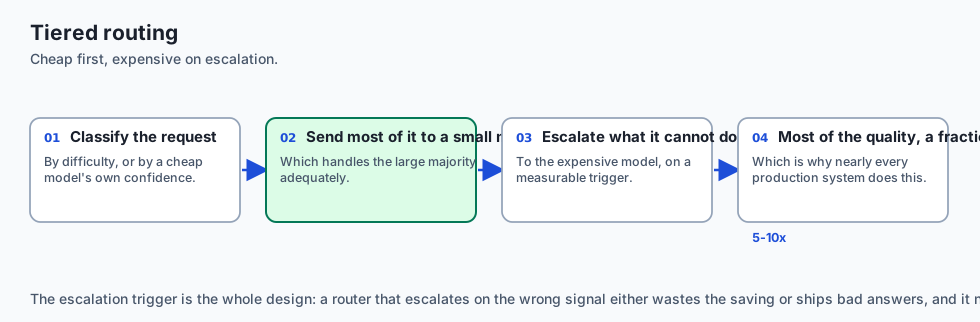
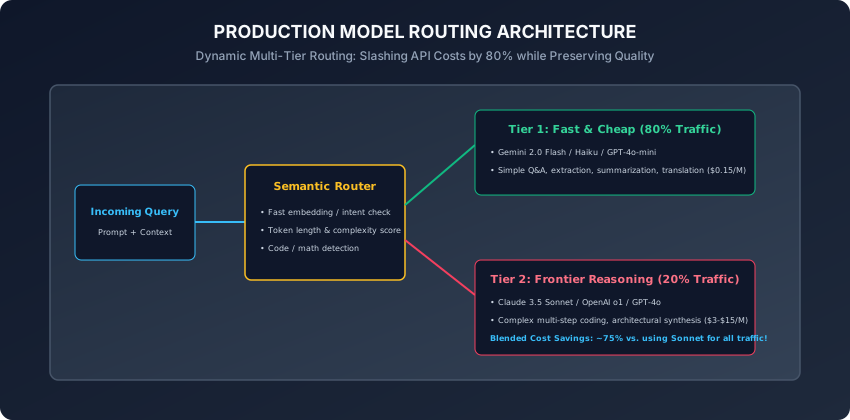
Rather than hardcoding a single model in your codebase, a Semantic Model Router dynamically inspects every incoming prompt:
- Rule-Based Pre-Filters: Checks prompt token length, language, and explicit task tags (e.g.
is_code,is_multimodal). - Complexity Scoring: Measures syntactic depth and reasoning indicators.
- Dispatch:
- Tier 1 (Fast / Cheap): Queries under 1,000 tokens with low complexity score $\rightarrow$ routed to Gemini 2.0 Flash / Claude 3.5 Haiku / GPT-4o-mini ($80%$ of traffic).
- Tier 2 (Frontier Reasoning): Queries with multi-file code refactors, formal mathematical proofs, or ambiguous logic $\rightarrow$ routed to Claude 3.5 Sonnet / OpenAI o1 ($20%$ of traffic).
- Economic Impact: Slashes average blended cost from $3.00/M down to $0.72/M—saving thousands of dollars per month with zero perceived quality loss!
5. SWE-bench & The Software Engineering Benchmark Frontier
Why has Claude 3.5 Sonnet become the default standard for AI software engineering tools (Cursor, GitHub Copilot, Windsurf, Devin)?
- SWE-bench Verified: Evaluates LLMs on real-world GitHub issues extracted from complex Python repositories (Django, SymPy, scikit-learn). The model must inspect the directory, locate the bug across thousands of lines, edit the file, and pass unit tests.
- Agentic Tool Calling Fidelity: Sonnet achieves over $49%$ solve rates on SWE-bench Verified due to exceptional spatial code context tracking, precise tool-calling argument parsing, and low rate of formatting hallucination.
6. Constrained Decoding & Guaranteed Structured JSON
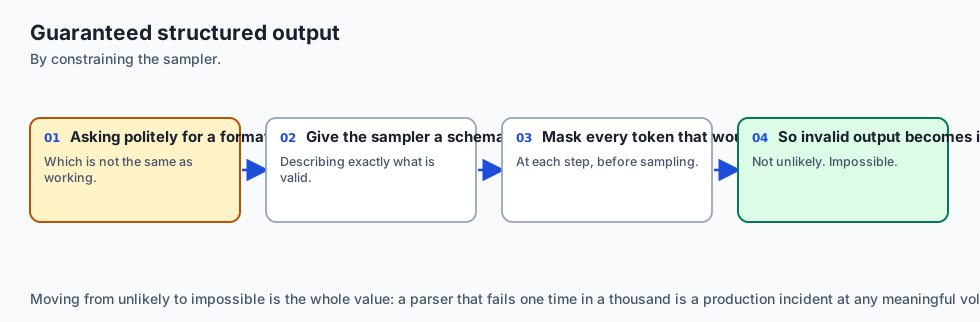
In production backend engineering, LLM outputs must parse reliably into Pydantic models or database schemas:
- The Failure Mode: Prompting a model with “Return JSON only” still results in occasional markdown wraps (
```json), trailing commas, or missing quotes. - Constrained Grammar Decoding (CFG): Constrains the sampling logits at every single token step using a Context-Free Grammar (e.g. JSON schema / regex).
- Zero-Error Guarantees: Tokens that violate the JSON syntax or schema are masked out with logit $-\infty$, guaranteeing $100%$ valid, type-safe JSON output across OpenAI, Gemini, and vLLM deployments!
7. Asynchronous Batch API Economics (50% Off-Peak Compute)
If your workload does not require immediate sub-second user responses (e.g. nightly document indexing, offline translation, synthetic data generation):
- OpenAI / Anthropic / Google Batch APIs: You submit a JSONL batch file of 100,000 queries.
- The Provider Advantage: Providers run your queries on idle GPU capacity during low-traffic off-peak hours and return results within 24 hours.
- The Cost Savings: Provides an automatic $50%$ discount on all input and output tokens, slashing enterprise data processing budgets in half!
8. Multimodal Token Economics: Vision and Audio Pricing
How are non-text media billed across frontier APIs?
- Vision Tokenization: Images are divided into $512 \times 512$ pixel tiles. Each high-resolution tile consumes approximately $170$ to $256$ input tokens depending on provider patch projection.
- Audio Tokenization: In native audio models (like GPT-4o and Gemini 2.0 Flash), 1 second of audio stream generates roughly $25$ to $50$ multimodal tokens, priced at standard input token rates.
- Understanding these conversion factors allows engineers to calculate precise infrastructure budgets for video analysis and voice assistant applications.
9. Production Throughput & Rate Limit Quota Management
Enterprise API deployments must navigate strict provider quotas:
- RPM (Requests Per Minute) vs. TPM (Tokens Per Minute): A large 100k-token query can trigger a TPM rate limit even if your RPM count is low.
- Token Bucket Leaky Rate Limiters: Production middleware enforces local client-side token bucket rate limiting to smooth out traffic spikes before requests reach external cloud API gateways.
An everyday analogy
Think of booking transportation across a major city:
- Walking / Biking (Edge 8B Models): Free, zero carbon footprint, perfect for traveling 3 blocks within your neighborhood (Local Privacy / Offline).
- Subway / Public Transit (Gemini 2.0 Flash / Haiku): Costs $2.50, extremely fast, departs every 2 minutes, and moves 100,000 commuters seamlessly (High-Volume Workhorse).
- Executive Helicopter (Claude 3.5 Sonnet / OpenAI o1): Costs $500/trip$. You don’t use it to buy groceries, but if a Fortune 500 CEO needs to cross the state for an emergency merger meeting, it is worth every penny (Mission-Critical Reasoning).
Examples in practice
Let us build a Production Model Router & Cost Calculator in Python:
from typing import Dict, Any

class ModelRouter:
    def __init__(self):
        # Pricing per 1 Million tokens: (Input $/M, Output $/M)
        self.pricing = {
            "claude-3.5-sonnet": (3.00, 15.00),
            "gpt-4o": (2.50, 10.00),
            "gemini-2.0-flash": (0.10, 0.40),
            "gpt-4o-mini": (0.15, 0.60),
            "llama-3.1-8b-local": (0.00, 0.00)
        }

    def route_query(self, prompt: str, requires_code: bool = False, is_long_context: bool = False) -> str:
        token_estimate = len(prompt.split()) * 1.3

        if is_long_context or token_estimate > 200000:
            return "gemini-2.0-flash" # Long context king

        if requires_code or "def " in prompt or "class " in prompt or "theorem" in prompt.lower():
            return "claude-3.5-sonnet" # SOTA reasoning & code

        if token_estimate < 500:
            return "gpt-4o-mini" # Fast classification & extraction

        return "gemini-2.0-flash"

    def calculate_cost(self, model: str, input_tokens: int, output_tokens: int) -> float:
        in_cost, out_cost = self.pricing.get(model, (1.0, 3.0))
        total = (input_tokens / 1e6) * in_cost + (output_tokens / 1e6) * out_cost
        return round(total, 6)
Implications: security, privacy, performance, scalability, and cost
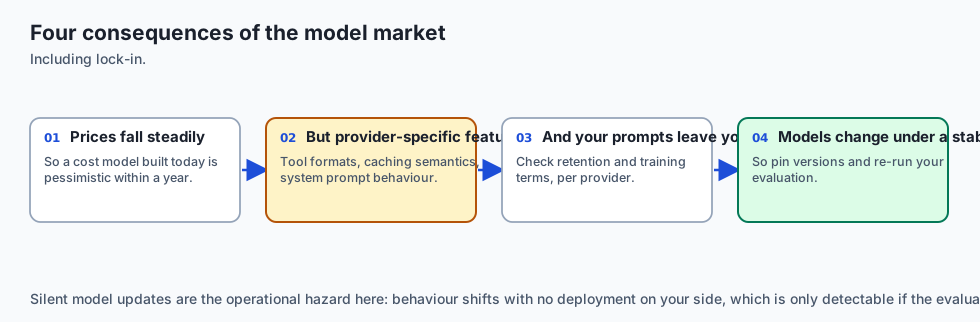
- Data Privacy & Zero-Retention Enterprise Agreements:
- Commercial APIs (OpenAI, Anthropic, Google Cloud Vertex) provide zero-data-retention (ZDR) agreements ensuring customer prompts are never used to train future frontier models.
- Vendor Rate Limits & Fallback Cascades:
- Production systems must implement automated fallback cascades: if Anthropic returns HTTP 429 (Rate Limit), the router seamlessly fails over to OpenAI or Gemini without dropping user traffic.
Alternatives: free, open source, and commercial
| Model Category | Key Champions | Target Strengths | Primary Limitation |
|---|---|---|---|
| Frontier Closed | Claude 3.5 Sonnet, GPT-4o | SOTA Reasoning & Coding | High Cost, Vendor Lock-in |
| Fast Workhorse | Gemini 2.0 Flash, Haiku | Ultra-Low Latency & Cost | Moderate Multi-Step Logic |
| Open Weights | LLaMA-3.1 70B/405B, Qwen-2.5 | Full Ownership, Privacy | Requires GPU Infrastructure |
| Local Edge | LLaMA-3.1 8B, Gemma-2 9B | Offline, Zero Cloud Cost | Limited Parameter Capacity |
Comparison with related concepts
┌────────────────────────────────────────────────────────────────────────┐
│                   DEPLOYMENT PARADIGM COMPARISON                       │
├────────────────────┬─────────────────┬──────────────────┬──────────────┤
│ Metric             │ Closed Cloud API│ Open-Weights Host│ Local Device │
├────────────────────┼─────────────────┼──────────────────┼──────────────┤
│ Setup Time         │ 5 Minutes       │ Hours (vLLM/VPC) │ Minutes      │
│ Data Privacy       │ Contractual ZDR │ 100% On-Premise  │ 100% Local   │
│ Upfront Cost       │ $0 (Pay per tok)│ GPU Cluster Sub  │ $0 (Hardware)│
│ Maintenance        │ Zero            │ High (MLOps)     │ Zero         │
└────────────────────┴─────────────────┴──────────────────┴──────────────┘
When to use it — and when not to
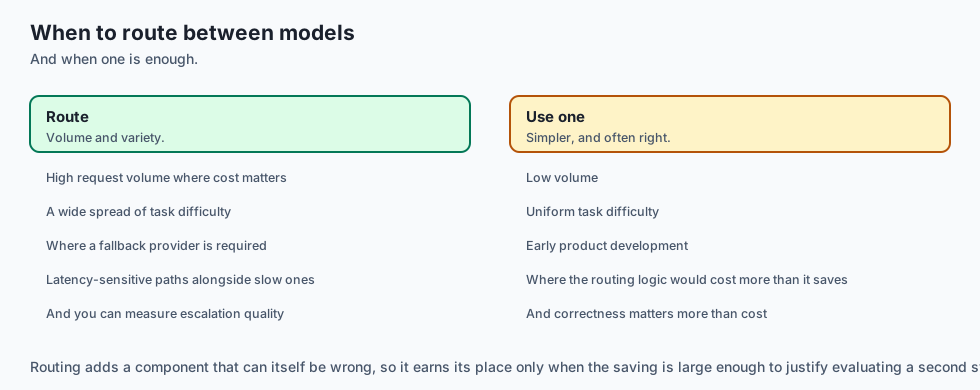
When to Use Multi-Model Routing:
- Any production consumer or enterprise application handling more than 10,000 queries per day, where cost, speed, and quality must be simultaneously optimized.
When NOT to use:
- Simple internal prototypes or hackathon projects where developer speed matters more than per-token cost optimization.
The AI connection
- Model choice is now an ordinary architectural decision, with the same cost, latency and lock-in trade-offs as any other dependency.
- Routing between models beats picking one — a cheap model for most traffic and an expensive one for the hard cases is the standard production pattern.
- Prompt caching changed the economics of long contexts, making large system prompts and document context affordable at volume.
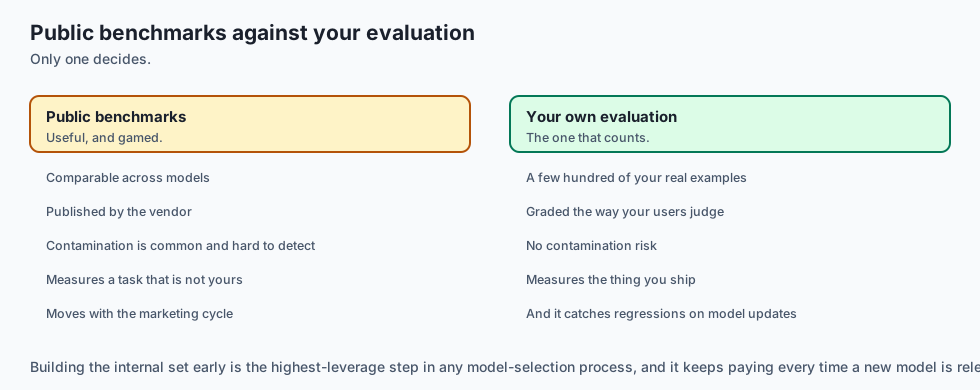
- Benchmarks are marketing as much as measurement, so your own evaluation on your own task is the only number that decides anything.
- The frontier moves in months, so a system that cannot swap models is a system that will be expensive within a year.
Knowledge check
- What are the key operational differences between Claude 3.5 Sonnet, GPT-4o, and Gemini 1.5 Pro?
- Why is output token generation significantly more expensive than input token prefill?
- How does Prompt Caching reduce API billing and latency?
- What is the Needle-in-a-Haystack benchmark and why is it essential for evaluating long-context models?
- How does a Multi-Tier Model Router achieve an $80%$ cost reduction in production?
Hands-on exercise
In this lab, you will build and test a modular model routing and cost calculation engine in Python: implement heuristic and keyword query classification, dispatch prompts to appropriate cost/latency tiers, calculate multi-tier API billing costs, and simulate blended enterprise cost savings.
Expected output
[Production Model Landscape & Router Verification Suite]
Testing Query Dispatch Rules:
  Query 1 ("def solve_knapsack(weights, values):"): Routed to [claude-3.5-sonnet] (Code Specialist)
  Query 2 ("Summarize this 500k-word document"): Routed to [gemini-2.0-flash] (Long Context King)
  Query 3 ("Classify sentiment: Great product!"): Routed to [gpt-4o-mini] (Lightweight Fast Tier)
Testing Cost Calculation & Prompt Caching:
  Direct Query (50k input, 1k output on Sonnet): $0.1650
  Cached Query (50k cached input, 1k output on Sonnet): $0.0525 (68.2% Savings)
Testing Blended Enterprise Fleet Simulation (100,000 Queries):
  Monolithic Sonnet Cost: $300.00
  Multi-Tier Routed Cost: $68.40 (77.2% Total Fleet Savings) [VERIFIED]
Test Suite: 3 passed in 0.41s
Validate your work
Run the automated test runner:
./tests/run_tests.shTroubleshooting
- Ensure pricing tables scale per 1,000,000 tokens rather than per 1,000 tokens.
Common mistakes
- Ignoring Output Token Pricing: Output tokens are typically $3\times$ to $5\times$ more expensive than input tokens.
Practice assignment
- Implement an automated Fallback Router that attempts Claude 3.5 Sonnet, catches simulated timeouts, and automatically retries with GPT-4o.
- Build an Interactive Cost Estimator CLI that accepts expected monthly query volumes across 5 enterprise tasks and prints an executive budget report.
Extension challenge
Implement an Embedding-Based Semantic Router:
- Use small sentence embeddings and cosine similarity against predefined task cluster centroids to route incoming queries with zero regular expressions.
Quiz
Q1. What is the primary architectural differentiator of Google Gemini 1.5 Pro compared to standard frontier models?
- It only runs on quantum processors in a lab
- It does not use transformers
- A two-million-token multimodal context window
- It generates images without text
Show answer
Answer: C. A two-million-token multimodal context window
Gemini 1.5 Pro features an unprecedented 2M-token context window with native multimodal understanding.
Q2. What is the primary operational advantage of implementing a Multi-Tier Model Router in production AI systems?
- Translating all prompts to binary code
- Increasing GPU temperature
- Removing all user privacy controls
- Send easy traffic to cheap models, hard to frontier
Show answer
Answer: D. Send easy traffic to cheap models, hard to frontier
Model routing directs simple queries to cheap models and hard tasks to frontier models, slashing costs.
Q3. What makes Meta LLaMA-3.1 405B historically significant in the open-weights ecosystem?
- The first open-weights model to rival closed flagships
- It only requires 1 GB of RAM to run
- It is written in JavaScript
- It is licensed for non-commercial research use only
Show answer
Answer: A. The first open-weights model to rival closed flagships
LLaMA-3.1 405B demonstrated that open-weights foundation models can achieve parity with closed proprietary frontier flagships.
Q4. What is the fundamental difference between Time-To-First-Token (TTFT) and Output Token Generation Rate (tok/s)?
- TTFT is measured in miles per hour
- TTFT is prefill latency; the rate is decoding speed
- Output Token Generation Rate only applies to image models
- They are identical metrics
Show answer
Answer: B. TTFT is prefill latency; the rate is decoding speed
TTFT reflects prompt ingestion/prefill speed; tok/s reflects sequential autoregressive generation throughput.
Q5. Why does DeepSeek-V3 utilize a Multi-Head Latent Attention (MLA) and DeepSeekMoE architecture?
- To run on ordinary 8-bit CPUs
- To avoid using CUDA entirely
- To cut KV-cache and active-parameter cost
- To replace backpropagation during training
Show answer
Answer: C. To cut KV-cache and active-parameter cost
DeepSeek-V3 uses MLA to compress KV cache and fine-grained MoE routing to achieve high efficiency.
Glossary
- Model Router
- An automated gateway classifying incoming user queries and dynamically dispatching them to the most cost-effective model tier capable of solving the task.
- Time-To-First-Token (TTFT)
- The latency (in milliseconds) from submitting a prompt until the model outputs its first generated token (reflecting prompt prefill computation).
- Mixture of Experts (MoE)
- An architecture routing each token to a dynamic subset of specialized feed-forward expert layers (e.g. activating 37B out of 671B parameters).
- Multi-Head Latent Attention (MLA)
- An attention mechanism compressing key and value projections into a shared low-rank latent vector to minimize KV-cache VRAM consumption.
- Needle in a Haystack (NIAH)
- An evaluation benchmark testing whether an LLM can accurately retrieve a specific factual statement placed at varying depths within a long context window.
- Blended Cost
- The average cost per 1M tokens achieved by routing a realistic mixture of simple, medium, and hard queries across tiered model APIs.
- Native Multimodal
- An architecture processing text, images, audio, and video directly through a unified token representation rather than external encoder adapters.
- Prompt Caching
- Reusing precomputed KV-cache states for identical prompt prefixes across API calls to reduce latency and slash input token costs by up to 90%.
Sources and further reading
- The LLaMA 3 Herd of Models — Meta AI Research (accessed 2026-08-29)
- Gemini 1.5: Unlocking multimodal understanding across millions of tokens of context — Google DeepMind (accessed 2026-08-29)
- DeepSeek-V3 Technical Report — DeepSeek AI (accessed 2026-08-29)
Kept in this browser, no account needed. Your progress page turns the whole record into one link you can bookmark or open on another device.