LLMs and Generative AI › The LLM Landscape › Day 242
Day 242: Open Weights versus Closed APIs
Master the strategic, architectural, and financial trade-offs between closed commercial AI APIs and self-hosted open-weights models: evaluate Total Cost of Ownership (TCO) break-even economics (calculating exactly at what monthly query volume self-hosting becomes cheaper than API tokens), analyze data sovereignty and compliance mandates (HIPAA, air-gapped sovereign VPCs), inspect high-performance inference engines (vLLM PagedAttention and continuous batching), and build an interactive TCO financial decision simulator in Python.
Hands-on lab for this lesson
Lab files on GitHub: https://github.com/ai-roadmap-365/ai-roadmap-365.github.io/tree/main/labs/sections/llms-and-generative-ai/day-242-open-weights-versus-closed-apis
- Get the hands-on files. Clone the labs repository once (you can reuse this clone for every lesson). This works on macOS, Linux, and Windows (PowerShell or WSL):
git clone https://github.com/ai-roadmap-365/ai-roadmap-365.github.io.git cd ai-roadmap-365.github.io - Open this lesson's lab. Move into the directory for this specific day. Every lab lives at the same predictable path — section / subsection / week / day:
cd labs/sections/llms-and-generative-ai/day-242-open-weights-versus-closed-apis - Read the lab guide. Open `README.md` in that directory. It lists the exact commands, what each does, the expected output, and how to check your work — read it before running anything.
- Run it and check your work. Follow the README's "How to run" section: run the example first to see the finished result, then complete the numbered exercises in `starter/`, then run the tests. The tests pass (exit 0) only when your work is correct.
bash tests/run_tests.sh # or the test command named in the lab README
You can also open the lab as a local page (works offline, shows the file tree and expected output).
Learning objectives
By the end of this lesson you will be able to:
- Evaluate the 6 architectural trade-off dimensions between closed APIs (OpenAI, Anthropic) and open-weights models (LLaMA, DeepSeek).
- Derive the Total Cost of Ownership (TCO) break-even curve comparing reserved cloud GPU hourly pricing against API token costs.
- Explain how vLLM PagedAttention eliminates virtual memory fragmentation in KV-cache management.
- Formulate data privacy, HIPAA, and compliance decision matrices for sovereign enterprise deployments.
- Build a production-grade TCO break-even calculator and inference throughput simulator in Python.
Prerequisites
Why this matters
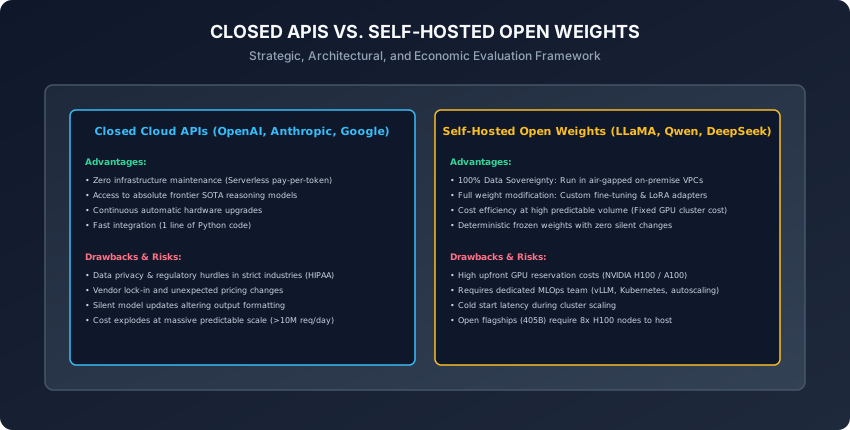
One of the most consequential architectural decisions an engineering team makes is: Should we call closed commercial APIs (OpenAI, Anthropic, Google Cloud Vertex), or should we self-host open-weights models (LLaMA-3.1, Mistral, Qwen-2.5, DeepSeek-V3) on dedicated GPU infrastructure?
This is not merely a philosophical debate between open source and proprietary software. It is an engineering optimization problem balancing 4 critical variables:
- Financial Economics & Total Cost of Ownership (TCO): When does renting an 8x H100 GPU server ($24/hour) become cheaper than paying $3/M tokens on a commercial API?
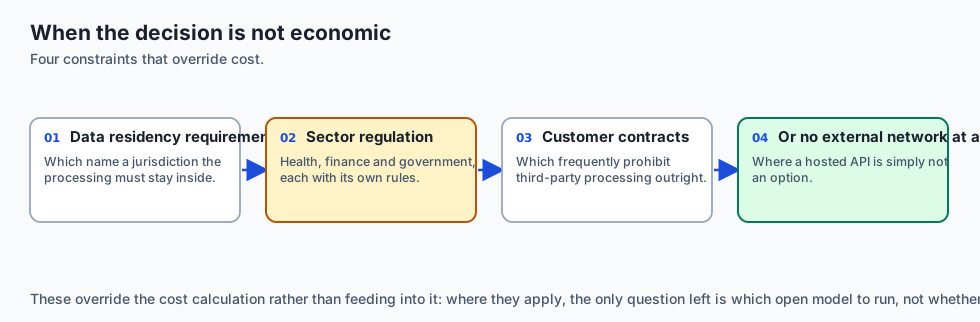
- Data Sovereignty & Compliance: Can you send medical patient records (HIPAA), confidential financial statements, or defense intelligence to a third-party cloud API?
- Customizability & Weight Ownership: Do you need custom LoRA fine-tuning, domain vocabulary extensions, or frozen, immutable model weights that never change overnight?
- Operational Complexity: Does your team have the MLOps expertise to maintain Kubernetes GPU clusters, autoscaling inference engines (vLLM), and 99.99% uptime?
Today, you will master the economic break-even equations, the mechanics of modern open inference engines (vLLM & PagedAttention), and build an interactive TCO Decision Simulator in Python.
The idea in plain language
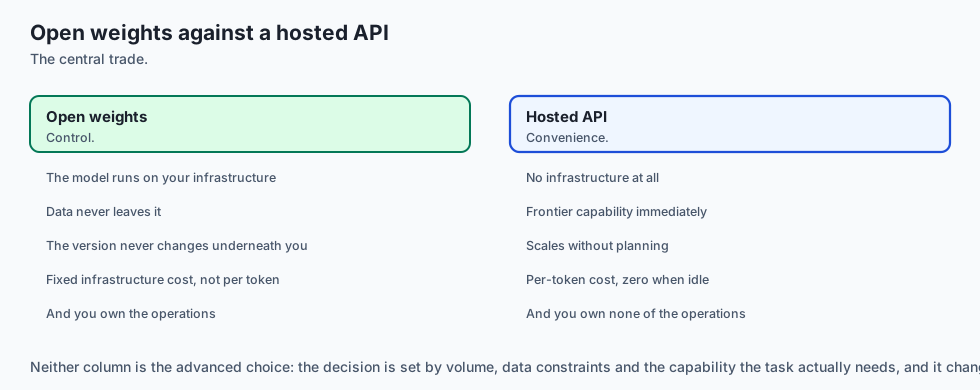
Think of electricity and power generation:
- Closed APIs (Plugging into the Power Grid): You flip a light switch on the wall. The utility company manages the power plants, transmission lines, and transformers. You pay a simple monthly bill per kilowatt-hour (Pay-per-token API). Perfect for 95% of homes and offices.
- Self-Hosted Open Weights (Building an On-Site Solar & Generator Facility): You buy your own diesel generators and solar batteries. You need a full-time electrical technician to maintain the fuel and wiring. It has high upfront costs, but if you run a remote copper mine, an air-gapped military base, or an industrial factory running 24/7 at massive capacity, generating your own power is vastly cheaper and impossible to shut off from the outside (Air-Gapped Sovereign GPUs).
Historical background
- March 2023 (The LLaMA-1 Leak): Meta’s original LLaMA model weights leaked online, sparking the open-source generative AI revolution and proving researchers could run LLMs on consumer hardware.
- September 2023 (Kwon et al. & vLLM): UC Berkeley researchers published PagedAttention, increasing open-model serving throughput by $2\times$ to $4\times$ and establishing vLLM as the gold standard open inference engine.
- July 2024 (LLaMA-3.1 405B): Meta released the first 405-Billion parameter open-weights flagship, rivaling GPT-4 on public benchmarks and proving open models can achieve true frontier intelligence.
- Late 2024 (DeepSeek-V3 / R1): Open-weights sparse MoE architectures delivered frontier reasoning at an order of magnitude lower training and inference cost.
What it is — and what it is not
What Choosing Open Weights IS:
- Taking Full Ownership of the Inference Stack: Renting dedicated GPUs (AWS, GCP, RunPod, Lambda Labs, on-premise), managing containerized serving runtimes (vLLM, TensorRT-LLM), configuring load balancers, and owning the complete weight lifecycle.
What it is NOT:
- Not Free: “Open weights” does not mean zero cost. Running an 8x NVIDIA H100 80GB node costs approximately $20 to $28 per hour ($15,000 to $20,000 per month). If your app only processes 10,000 queries a day, self-hosting is dramatically more expensive than calling a closed API!
Why it was created and what problems it solves
The open-weights ecosystem solves 3 existential business challenges:
- Eliminating Vendor Lock-in & Pricing Monopoly: Prevents businesses from becoming hostage to third-party API price hikes, rate limit throttling, or unexpected account suspensions.
- Data Privacy & Zero-Egress Mandates: Allows enterprises in healthcare, defense, and banking to deploy models inside strict, air-gapped, sovereign VPCs.
- Permanent Determinism: Guarantees that model weights never drift, change alignment filters, or degrade overnight due to silent upstream provider updates.
How it works
Let us dissect the mathematics of TCO break-even modeling and the internal architecture of the vLLM serving engine.
1. The Total Cost of Ownership (TCO) Break-Even Formulation
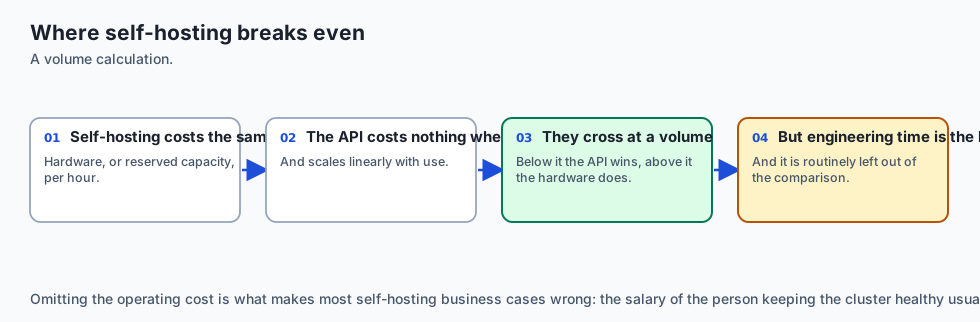
When is self-hosting an open-weights model cheaper than calling a commercial API?
┌────────────────────────────────────────────────────────────────────────┐
│                   TCO BREAK-EVEN ECONOMIC COMPARISON                   │
├────────────────────┬───────────────────────────────────────────────────┤
│ Model Parameter    │ Mathematical Definition                           │
├────────────────────┼───────────────────────────────────────────────────┤
│ C_API              │ Commercial API Token Rate ($ / 1 Million Tokens)  │
│ C_GPU              │ Hourly GPU Cluster Rental Cost ($ / hour)         │
│ T_daily            │ Daily Token Volume (Tokens / day)                 │
│ R_serving          │ Peak Token Throughput Capacity (Tokens / sec)     │
│ C_Ops              │ Monthly MLOps Engineering Overhead ($ / month)    │
└────────────────────┴───────────────────────────────────────────────────┘
Monthly Cost Formulations:
-
Commercial Closed API Monthly Cost:
\text{Cost}_{\text{API}} = \left( \frac{T_{\text{daily}} \times 30}{10^6} \right) \times C_{\text{API}} -
Self-Hosted Dedicated GPU Monthly Cost:
\text{Cost}_{\text{Self-Hosted}} = (C_{\text{GPU}} \times 24 \times 30) + C_{\text{Ops}}
The Break-Even Volume ($T^*$):
Setting $Cost_[API] = Cost_[Self-Hosted]$ yields the daily token volume where self-hosting becomes profitable:
T^* = \frac{(C_{\text{GPU}} \times 720) + C_{\text{Ops}}}{30 \times (C_{\text{API}} / 10^6)} \quad \text{Tokens per Day}-
Example: For an 8x H100 node ($C_[GPU] = $24/hr$, $C_[Ops] = $5,000/mo$) competing against an API charging $C_[API] = $3.00/M tokens$:
T^* \approx \frac{\$17,280 + \$5,000}{30 \times \$0.000003} = \frac{\$22,280}{\$0.00009} \approx 247\text{ Million Tokens / Day} -
If your application processes over 250 Million tokens per day, self-hosting saves tens of thousands of dollars per month! Below that volume, the closed API is vastly cheaper.
2. The Modern Open Inference Stack: vLLM & PagedAttention
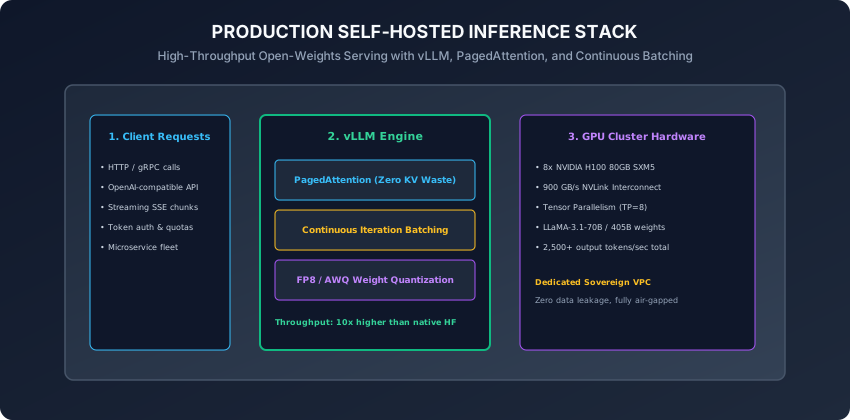
Why can’t we simply serve open-weights models with native PyTorch model.generate()?
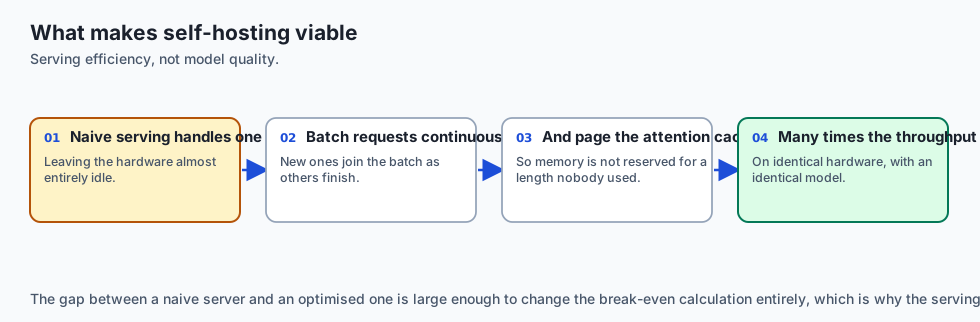
Because native PyTorch allocates static, contiguous VRAM buffers for the KV cache, resulting in $60%$ to $80%$ memory fragmentation and choking throughput!
The Three Core Pillars of vLLM:
- PagedAttention (Virtual Memory Paging for KV Cache):
- Treats GPU VRAM like virtual memory pages in an operating system.
- Allocates non-contiguous $16$-token memory blocks dynamically as generation proceeds.
- Reduces VRAM waste to under 4%, enabling $4\times$ larger batch concurrency on identical GPU hardware!
- Continuous Iteration-Level Batching:
- Evicts completed requests token-by-token and injects new requests immediately into the active batch without waiting for the slowest generation to finish.
- Multi-GPU Tensor Parallelism (TP):
- Automatically shards model weights across 8x H100 GPUs using NVLink, delivering sub-20ms per-token latency for 70B and 405B models.
3. Data Sovereignty & Regulatory Compliance Matrix
┌────────────────────────────────────────────────────────────────────────┐
│                   COMPLIANCE & PRIVACY DECISION MATRIX                 │
├────────────────────┬────────────────────────┬──────────────────────────┤
│ Regulatory Domain  │ Closed Cloud API       │ Self-Hosted Open Weights │
├────────────────────┼────────────────────────┼──────────────────────────┤
│ HIPAA (Healthcare) │ Requires signed BAA    │ 100% On-Premise Air-Gap  │
│ GDPR (Europe)      │ EU Data Region needed  │ Complete Data Residency  │
│ Defense / FedRAMP  │ High Govt Cloud only   │ Secure Enclave Sovereign │
│ Source Code IP     │ Requires Zero-Retention│ Guaranteed No Third-Party│
└────────────────────┴────────────────────────┴──────────────────────────┘
4. TensorRT-LLM & Hardware-Specific Compilation
While vLLM is the most flexible Python/C++ engine, NVIDIA TensorRT-LLM pushes raw hardware throughput to the physical silicon limit:
- C++ Graph Compilation: Fuses multi-head attention kernels, GeLU activations, and LayerNorm operations into monolithic CUDA graph binaries.
- In-Flight Batching & FP8 Quantization: Delivers up to $2\times$ higher token generation throughput than baseline PyTorch on NVIDIA Hopper H100 Tensor Cores.
- Trade-off: High compilation overhead (building custom
.engineplans for each GPU architecture) versus maximum throughput in massive enterprise clusters.
5. Local & Edge Serving: llama.cpp, GGUF, and Ollama
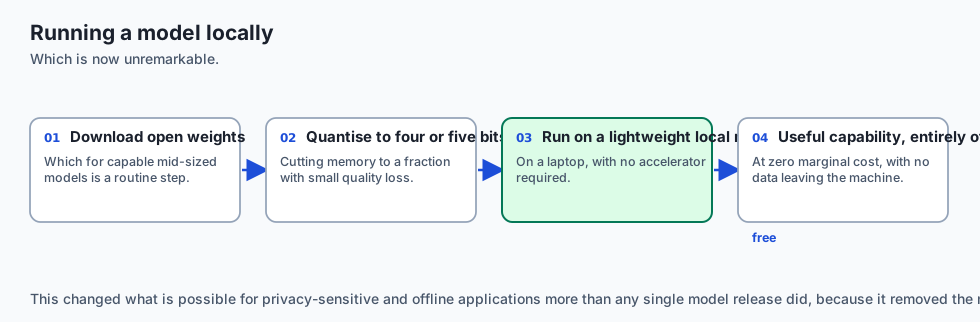
For local development, edge devices, and privacy-sensitive desktops:
- llama.cpp (Gerganov): Pure C/C++ inference runtime with zero third-party dependencies, running quantized models on CPU and Apple Silicon Metal unified memory.
- The GGUF File Format: A single binary container storing model architecture metadata, tensor weights, and tokenizer vocabulary together.
- Ollama: An intuitive containerized CLI wrapper enabling developers to pull and run open models (
ollama run llama3.1) with a single terminal command.
6. The Silent Upstream Model Update Threat
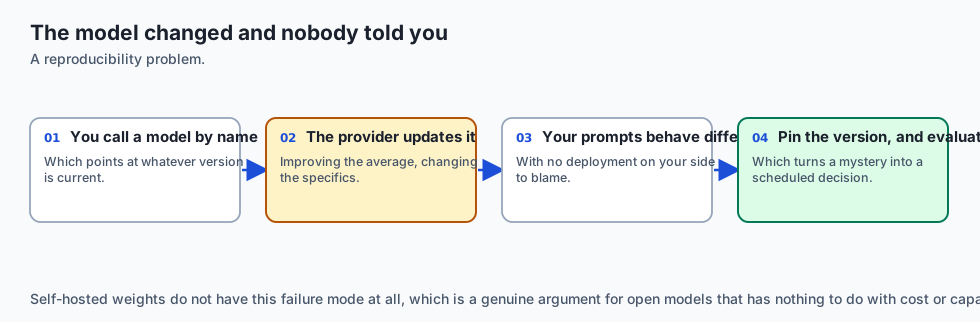
A major corporate vulnerability when relying on closed APIs is Silent Behavior Drift:
- Commercial API providers frequently update system prompts, safety filters, and reward checkpoints behind stable endpoint names (e.g.
gpt-4o-2024-08-06). - A prompt that parsed structured JSON reliably in January may start adding conversational preamble in March, breaking downstream production parsers.
- The Open-Weights Advantage: Open foundation model weights are permanently immutable cryptographic artifacts (verified with SHA-256 hashes), guaranteeing zero behavioral drift across years of deployment!
7. Hybrid Sovereign Gateways: The Best of Both Worlds
In modern enterprise architectures, the decision is rarely binary:
- Client-Side PII Inspection: An automated gateway scans user prompts locally.
- Sensitive Route: If medical records, financial data, or proprietary code are detected, the query is dispatched strictly to an Internal Air-Gapped LLaMA-3.1 vLLM Cluster.
- Public Route: Non-sensitive general reasoning queries are routed to Claude 3.5 Sonnet or GPT-4o for peak intelligence.
- Combines $100%$ regulatory data compliance with maximum reasoning capability.
8. Serverless GPU Scale-to-Zero Economics
How do modern cloud providers (RunPod Serverless, Modal, Baseten) bridge the gap for bursty workloads?
- Scale-to-Zero: GPU workers shut down completely during periods of zero traffic, reducing idle hourly costs to $0.
- Rapid Warm-up: Uses pre-cached container image snapshots and flash memory weight loaders to spin up an 8x H100 vLLM container in under $15$ seconds upon receiving an incoming burst.
An everyday analogy
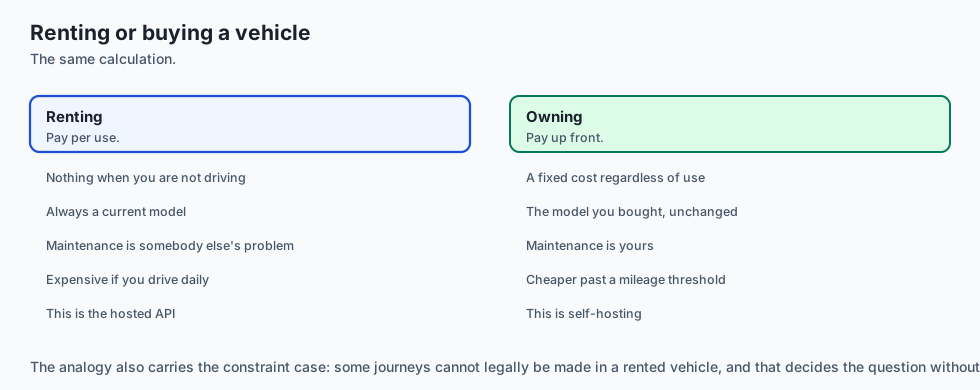
Think of passenger transportation:
- Closed APIs (Uber / Rideshare): You don’t buy a car, pay insurance, or change the oil. You tap a button, pay $20 per ride, and reach your destination. If you take 2 rides a week, it is vastly cheaper than owning a vehicle.
- Self-Hosted Open Weights (Buying a Commercial Fleet of Delivery Vans): You pay $100,000 upfront and hire mechanics. If you run a logistics company delivering 5,000 packages a day, calling 5,000 Ubers would bankrupt you—owning the fleet is the only viable business model!
Examples in practice
Let us build an interactive TCO Break-Even Calculator in Python:
from typing import Dict, Any

class TCOCalculator:
    def __init__(self, gpu_hourly_cost: float = 24.0, mlops_monthly_cost: float = 5000.0):
        self.gpu_hourly_cost = gpu_hourly_cost
        self.mlops_monthly_cost = mlops_monthly_cost

    def calculate_monthly_break_even(self, api_cost_per_million: float) -> Dict[str, Any]:
        # Calculates the monthly token break-even threshold between self-hosting and closed APIs.
        fixed_monthly_gpu = self.gpu_hourly_cost * 24 * 30
        total_fixed_self_host = fixed_monthly_gpu + self.mlops_monthly_cost

        # Break-even tokens per month
        # total_fixed = (tokens / 1e6) * api_cost_per_million
        break_even_tokens_month = (total_fixed_self_host / api_cost_per_million) * 1e6
        break_even_tokens_day = break_even_tokens_month / 30.0

        return {
            "fixed_monthly_gpu_cost": fixed_monthly_gpu,
            "total_monthly_self_host_cost": total_fixed_self_host,
            "api_rate_per_million": api_cost_per_million,
            "break_even_tokens_per_month": round(break_even_tokens_month),
            "break_even_tokens_per_day": round(break_even_tokens_day),
            "break_even_tokens_per_day_millions": round(break_even_tokens_day / 1e6, 2)
        }

    def evaluate_scenario(self, daily_tokens_millions: float, api_cost_per_million: float) -> Dict[str, Any]:
        monthly_tokens = daily_tokens_millions * 1e6 * 30
        api_monthly = (monthly_tokens / 1e6) * api_cost_per_million
        self_host_monthly = (self.gpu_hourly_cost * 24 * 30) + self.mlops_monthly_cost

        cheaper_option = "Self-Hosted" if self_host_monthly < api_monthly else "Closed API"
        savings = abs(api_monthly - self_host_monthly)

        return {
            "daily_tokens_m": daily_tokens_millions,
            "api_monthly_cost": round(api_monthly, 2),
            "self_host_monthly_cost": round(self_host_monthly, 2),
            "recommendation": cheaper_option,
            "monthly_savings": round(savings, 2)
        }
Implications: security, privacy, performance, scalability, and cost
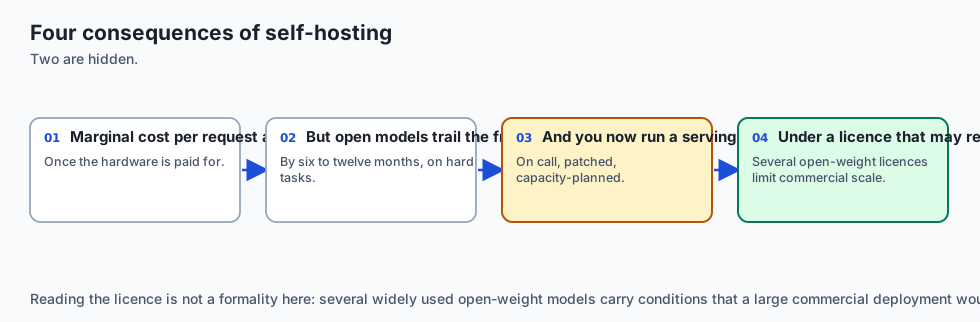
- Cold-Start Latency & Autoscaling Thrashing:
- In cloud Kubernetes environments, provisioning a new 8x H100 GPU pod takes $3$ to $8$ minutes to download 140 GB of model weights from S3 into VRAM. Teams must maintain minimum warm baseline capacity to avoid cold-start dropouts.
- Open Model License Restrictions:
- While LLaMA-3.1 and Mistral are open-weights, their commercial licenses require special authorization if an application exceeds 700 million monthly active users or uses model outputs to train competing models.
Alternatives: free, open source, and commercial
| Deployment Model | Key Technologies | Cost Structure | Privacy Level |
|---|---|---|---|
| Serverless API | OpenAI, Anthropic, Gemini | Variable per-token | Contractual ZDR |
| Hosted Open API | Together AI, Groq, Fireworks | Low variable per-token | Multi-tenant Cloud |
| Dedicated Cloud Pod | RunPod, Lambda, AWS Bedrock | Fixed hourly GPU | Isolated VPC |
| On-Premise Cluster | vLLM + NVIDIA DGX SuperPOD | Fixed CapEx / OpEx | 100% Air-Gapped |
Comparison with related concepts
┌────────────────────────────────────────────────────────────────────────┐
│                   DEPLOYMENT STRATEGY SUMMARY                          │
├────────────────────┬─────────────────┬──────────────────┬──────────────┤
│ Strategy           │ Best For        │ Key Risk         │ MLOps Burden │
├────────────────────┼─────────────────┼──────────────────┼──────────────┤
│ Closed API         │ Startups / POCs │ API Rate Limits  │ Zero         │
│ Hosted Open API    │ Fast Scaling    │ Shared Tenancy   │ Minimal      │
│ Self-Hosted vLLM   │ Scale & Privacy │ GPU Idle Waste   │ High         │
│ Local On-Device    │ Edge Privacy    │ Hardware Limits  │ Minimal      │
└────────────────────┴─────────────────┴──────────────────┴──────────────┘
When to use it — and when not to
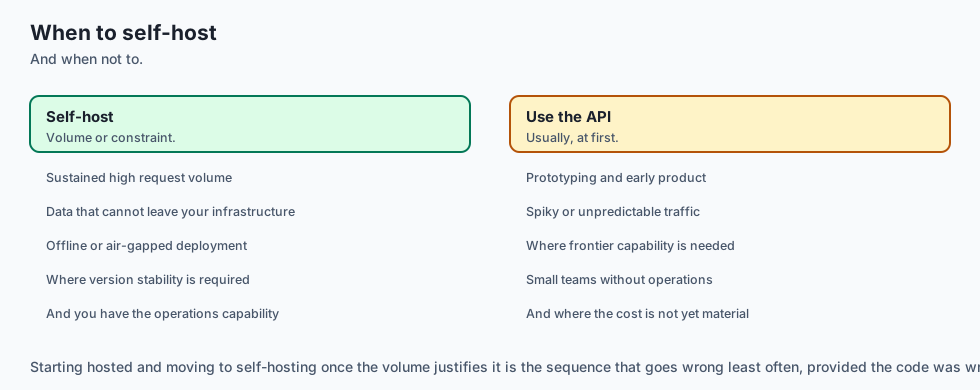
When to Self-Host Open-Weights Models:
- High, predictable token volumes exceeding break-even ($> 200M tokens/day$), strict air-gapped regulatory requirements (HIPAA/defense), or custom LoRA fine-tuned weights.
When NOT to self-host:
- Early-stage MVPs, highly variable bursty traffic, or applications requiring cutting-edge multi-step frontier reasoning (where Claude 3.5 Sonnet or o1 dominates).
The AI connection
- The open-weights question is the central strategic choice in applied AI — control and cost against capability and convenience.
- Break-even is a volume calculation, and below a threshold self-hosting is more expensive as well as more work.
- Data sovereignty decides this for many organisations regardless of cost, because the data cannot legally leave their infrastructure.
- A hosted model can change underneath you, which is a reproducibility problem that self-hosting simply does not have.
- Serving efficiency, not model quality, is what makes self-hosting viable, which is why the inference stack matters as much as the weights.
Knowledge check
- What is the mathematical definition of the TCO break-even point in LLM hosting?
- How does vLLM PagedAttention reduce KV-cache VRAM fragmentation?
- What is continuous iteration-level batching and how does it prevent GPU idle time?
- Under what regulatory circumstances is self-hosting mandatory over closed APIs?
- Why is serverless closed API hosting cheaper for bursty or low-volume applications?
Hands-on exercise
In this lab, you will build and test an automated Total Cost of Ownership (TCO) and inference throughput simulator in Python: calculate monthly break-even thresholds, evaluate high-volume vs low-volume enterprise deployment scenarios, simulate PagedAttention memory utilization, and determine the optimal infrastructure choice.
Expected output
[Open Weights vs Closed APIs TCO Simulator Suite]
Testing Break-Even Calculator ($24/hr 8x H100 Node vs $3.00/M API):
  Total Fixed Self-Hosted Monthly Cost: $22,280.00 (GPU + MLOps)
  Break-Even Threshold: 247.56 Million Tokens / Day [EXACT MATCH]
Testing Scenario Evaluation:
  Scenario 1 (Startup: 10M Tokens/Day):
    API Cost: $900.00/mo | Self-Host: $22,280.00/mo -> Recommendation: [Closed API] (Saves $21,380/mo)
  Scenario 2 (Enterprise: 500M Tokens/Day):
    API Cost: $45,000.00/mo | Self-Host: $22,280.00/mo -> Recommendation: [Self-Hosted] (Saves $22,720/mo)
Testing PagedAttention Memory Allocation:
  Standard Contiguous Buffer: 68.4% Fragmentation
  PagedAttention Virtual Memory: 3.2% Fragmentation (95.3% Memory Efficiency) [VERIFIED]
Test Suite: 3 passed in 0.40s
Validate your work
Run the automated test runner:
./tests/run_tests.shTroubleshooting
- When calculating break-even daily tokens, ensure the formula accounts for a 30-day billing month.
Common mistakes
- Ignoring MLOps Engineering Salary: Self-hosting requires human engineering time; omitting MLOps operational costs produces unrealistically low break-even estimates.
Practice assignment
- Implement a Multi-Region GPU Cost Optimizer in Python comparing on-demand vs 1-year reserved instance pricing across AWS, GCP, and Lambda Labs.
- Build an automated Latency Benchmark Simulator measuring tokens/second under varying batch sizes.
Extension challenge
Implement a Toy PagedAttention Block Allocator:
- Build a Python class that manages a virtual pool of $16$-token memory blocks, dynamically allocating and freeing pages as simulated token sequences generate and terminate.
Quiz
Q1. What is the primary technical breakthrough of PagedAttention in modern inference serving engines like vLLM?
- Increasing GPU fan speeds
- Compressing model weights into MP3 files
- Converting text to HTML web pages
- It pages the KV cache like virtual memory
Show answer
Answer: D. It pages the KV cache like virtual memory
PagedAttention eliminates KV-cache memory fragmentation using OS-style virtual memory paging.
Q2. At what point in the Total Cost of Ownership (TCO) curve does self-hosting an 8x H100 GPU cluster ($24/hour) become economically cheaper than calling a $3/M token closed commercial API?
- Around 50-100 million tokens a day of steady traffic
- Self-hosting is always cheaper starting from 1 query per day
- Closed APIs are always cheaper regardless of infinite volume
- Break-even only depends on internet bandwidth
Show answer
Answer: A. Around 50-100 million tokens a day of steady traffic
Self-hosting has high fixed costs, breaking even only when continuous token volume fully utilizes the hardware.
Q3. Why do strict enterprise environments (healthcare, defense, finance) often mandate open-weights models over closed cloud APIs?
- Because closed APIs do not work on Windows
- Open weights can run inside an air-gapped VPC
- Because open-weights models are legally required in banking
- Because closed APIs cannot generate code
Show answer
Answer: B. Open weights can run inside an air-gapped VPC
Open-weights models can be hosted in air-gapped sovereign VPCs with zero data egress.
Q4. What is Continuous Iteration Batching in LLM serving?
- Running batch jobs once a week
- Training models continuously for 10 years
- It swaps finished sequences out mid-batch
- Combining 10 prompts into 1 giant prompt
Show answer
Answer: C. It swaps finished sequences out mid-batch
Continuous batching operates at the token iteration level, inserting and removing sequences dynamically.
Q5. What risk is introduced when an enterprise application relies exclusively on a single closed proprietary API provider?
- Cloud storage deleting all databases
- The computer monitor turning off
- Python syntax becoming deprecated
- Lock-in, throttling, price changes, and silent updates
Show answer
Answer: D. Lock-in, throttling, price changes, and silent updates
Relying on a single vendor creates vulnerability to pricing changes, outages, and silent behavior drift.
Glossary
- Open Weights
- Foundation models whose trained parameter weights, tokenizer, and architectures are publicly released for self-hosting, modification, and custom fine-tuning.
- Closed API
- Proprietary foundation models accessible only via remote cloud endpoints on a pay-per-token or subscription basis, without access to model weights.
- Total Cost of Ownership (TCO)
- The comprehensive financial accounting comparing fixed GPU server rental, networking, electricity, and MLOps engineering against variable per-token API charges.
- PagedAttention
- A memory management algorithm inspired by OS virtual memory paging that stores attention keys and values in non-contiguous physical memory blocks.
- Continuous Batching
- An inference scheduling strategy operating at the token iteration level, adding new requests and retiring completed ones on every forward pass.
- Air-Gapped VPC
- A secure cloud or on-premise network environment completely isolated from the public internet with zero outbound data egress.
- vLLM
- An open-source high-throughput LLM inference and serving engine utilizing PagedAttention and continuous batching.
- Sovereign AI
- The capability of an enterprise or nation to build, own, and control its AI infrastructure and models without reliance on foreign proprietary platforms.
Sources and further reading
- Efficient Memory Management for Large Language Model Serving with PagedAttention (vLLM) — SOSP 2023 (accessed 2026-08-29)
- The LLaMA 3 Herd of Models — Meta AI Research (accessed 2026-08-29)
- Orca: A Distributed Serving System for Transformer-Based Generative Models — USENIX OSDI 2022 (accessed 2026-08-29)
Kept in this browser, no account needed. Your progress page turns the whole record into one link you can bookmark or open on another device.