LLMs and Generative AI › Prompt Engineering › Day 248
Day 248: Few-Shot Examples and Chain of Thought

Master in-context exemplar learning and step-by-step reasoning architectures: understand the theoretical mechanics of In-Context Learning (ICL) as implicit meta-gradients in attention activations, engineer balanced few-shot exemplar pools that avoid majority label and recency biases, implement Zero-Shot CoT ("Think step by step"), Manual CoT, Least-to-Most decomposition, and Self-Consistency majority voting (k >= 5 rollouts), and build an automated few-shot CoT reasoning engine with self-consistency aggregation in Python.
Hands-on lab for this lesson
Lab files on GitHub: https://github.com/ai-roadmap-365/ai-roadmap-365.github.io/tree/main/labs/sections/llms-and-generative-ai/day-248-few-shot-examples-and-chain-of
- Get the hands-on files. Clone the labs repository once (you can reuse this clone for every lesson). This works on macOS, Linux, and Windows (PowerShell or WSL):
git clone https://github.com/ai-roadmap-365/ai-roadmap-365.github.io.git cd ai-roadmap-365.github.io - Open this lesson's lab. Move into the directory for this specific day. Every lab lives at the same predictable path — section / subsection / week / day:
cd labs/sections/llms-and-generative-ai/day-248-few-shot-examples-and-chain-of - Read the lab guide. Open `README.md` in that directory. It lists the exact commands, what each does, the expected output, and how to check your work — read it before running anything.
- Run it and check your work. Follow the README's "How to run" section: run the example first to see the finished result, then complete the numbered exercises in `starter/`, then run the tests. The tests pass (exit 0) only when your work is correct.
bash tests/run_tests.sh # or the test command named in the lab README
You can also open the lab as a local page (works offline, shows the file tree and expected output).
Learning objectives
By the end of this lesson you will be able to:
- Explain how In-Context Learning functions as implicit gradient descent in transformer activations.
- Engineer balanced few-shot exemplar pools to avoid label distribution and ordering biases.
- Implement Zero-Shot and Manual Chain-of-Thought prompting to expand inference compute.
- Apply Least-to-Most prompt decomposition for complex algorithmic and multi-hop tasks.
- Build a Self-Consistency majority voting engine in Python to boost reasoning reliability.
Prerequisites
Why this matters
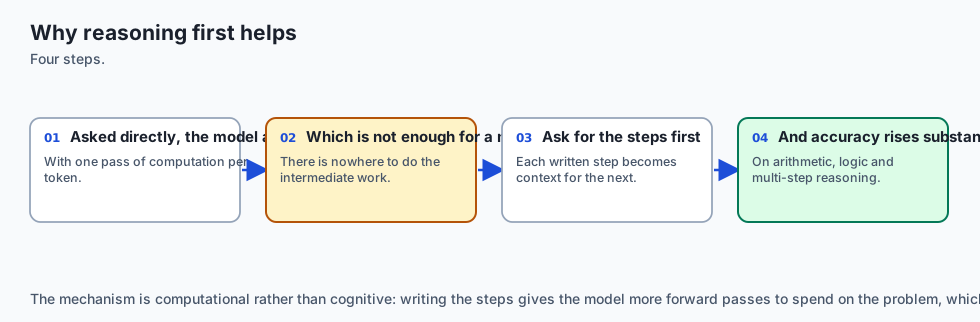
When you ask a standard autoregressive language model a complex mathematical, architectural, or diagnostic question in a zero-shot prompt, it faces an impossible computational bottleneck: It must jump directly to the final token in a single forward pass.
For a 70-billion-parameter Transformer, predicting the answer to “What is 347 multiplied by 829?” on token 1 forces the network to compress millions of floating-point arithmetic steps into a single forward pass across fixed residual layers. The result is almost always a convincing, confidently wrong hallucination.
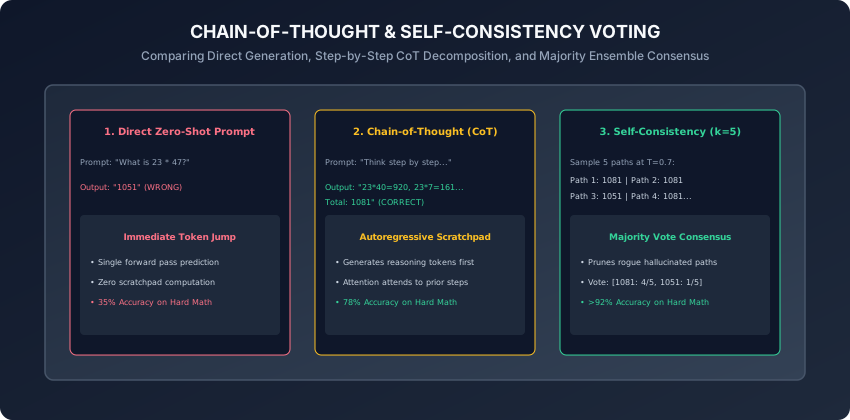
By introducing Chain of Thought (CoT), you grant the model an Autoregressive Computational Scratchpad. Each intermediate token generated (“First, 300 * 800 = 240,000…”) becomes part of the key-value context window, allowing subsequent attention heads to attend to explicit partial computations.
When paired with Few-Shot In-Context Learning (ICL) and Self-Consistency Majority Voting, reasoning accuracy on complex benchmarks jumps from 35% to over 90%.
Today, you will master the theoretical mechanics of in-context meta-gradients, engineer balanced few-shot exemplar pools, implement Least-to-Most decomposition, and build an automated Self-Consistency reasoning engine in Python.
The idea in plain language
Imagine asking a software engineer to architect an enterprise distributed caching cluster:
- Direct Zero-Shot (The Snap Guess): You demand an instant answer in 1 second: “Give me the cache eviction algorithm right now.” Under pressure, they guess a random algorithm that fails under high concurrency (Immediate Token Jump & Hallucination).
- Chain of Thought (The Whiteboard Scratchpad): You hand them a whiteboard marker and say: “Think step by step on the board first.” They write:
- Calculate peak writes: 50,000 ops/sec.
- Assess memory constraints: 64 GB RAM.
- Evaluate LRU vs. 2-Queue (2Q) vs. W-TinyLFU.
- Final Conclusion: W-TinyLFU maximizes hit ratio under skewed Zipfian workloads.
- Self-Consistency (The Architectural Review Board): You ask 5 independent senior engineers to work through the whiteboard problem independently at non-zero temperature ($T = 0.7$). Four choose W-TinyLFU and one chooses LRU. The majority consensus ($4/5$) provides near-bulletproof architectural certainty.
Historical background
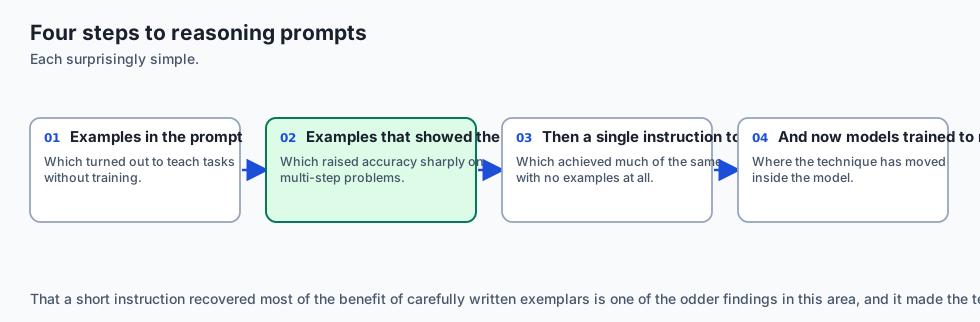
- 2020 (Brown et al. & GPT-3): Introduced Few-Shot In-Context Learning, demonstrating that models learn new input-output mappings from 3 to 5 examples without updating weights.
- 2022 (Wei et al. & Chain of Thought): Jason Wei and the Google Brain team published the seminal CoT paper, demonstrating emergent reasoning leaps on GSM8K and arithmetic benchmarks.
- 2022 (Kojima et al. & Zero-Shot CoT): Discovered the magic prompt trigger: “Let’s think step by step”, unlocking latent reasoning without requiring manual exemplars.
- 2023 (Wang et al. & Self-Consistency): Proved that sampling multiple stochastic reasoning paths and taking the mode/majority answer dramatically beats greedy decoding.
- 2023 (von Oswald et al. & Dai et al.): Proved mathematically that self-attention layers in Transformers perform an implicit meta-optimization equivalent to gradient descent during the forward pass.
What it is — and what it is not
What Few-Shot & CoT Reasoning IS:
- In-Context Activation Steering & Compute Expansion: Structuring demonstration exemplars and intermediate reasoning tokens to shift the model’s residual stream into high-accuracy logical subspaces.
What it is NOT:
- Not Weight Fine-Tuning: In-context learning does not alter model weights. When the API context window ends, the demonstration state disappears.
- Not Magic for Fact Retrieval: CoT excels at multi-step deductive and algorithmic tasks; it cannot deduce a factual fact (e.g. a person’s birthday) if that fact was never present in the pretraining corpus or prompt context.
Why it was created and what problems it solves
Few-Shot CoT and Self-Consistency solve 4 primary model failure modes:
- The Single-Pass Computation Trap: Eliminates arithmetic and logic errors by generating intermediate scratchpad tokens.
- Format & Style Non-Compliance: Few-shot exemplars demonstrate exact target JSON schemas and tone better than paragraphs of text instructions.
- Idiosyncratic Path Hallucinations: Self-Consistency prunes outlier reasoning mistakes by aggregating independent stochastic samples.
- Complex Multi-Hop Decomposition Failure: Breaks down 10-step problems into manageable sequential sub-questions via Least-to-Most prompting.
How it works
Let us dissect the mathematics of in-context meta-gradients, exemplar bias mitigation, and Self-Consistency trees.
1. The Theory of In-Context Learning: Implicit Gradient Descent
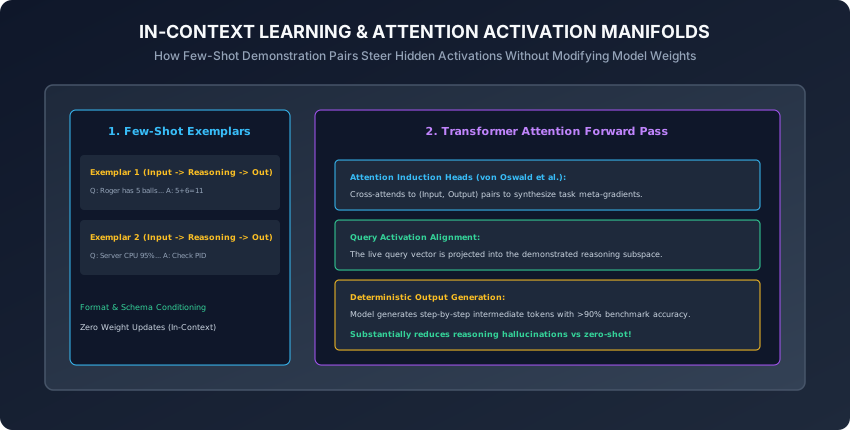
How do Transformers learn from 3 examples in the prompt without backpropagation?
- Induction Heads (Anthropic Research): Specialized two-layer attention head circuits identify patterns like
[A][B] ... [A] -> [B]. - Implicit Meta-Gradients (von Oswald et al.): The attention computation in layer $l$:
A_l(X) = softmax((X W_Q W_K^T X^T) / sqrt(d)) X W_Vcan be reformulated mathematically as a dual optimization step where demonstration pairs pairs(x_i, y_i)generate an implicit weight update matrixDelta Wapplied to the query vectorx_test.
2. Engineering Balanced Few-Shot Exemplar Pools
Naive few-shot prompting often degrades accuracy due to 3 insidious cognitive biases (Zhao et al.):
┌────────────────────────────────────────────────────────────────────────┐
│                   FEW-SHOT COGNITIVE BIASES & MITIGATIONS              │
├────────────────────┬─────────────────────────┬─────────────────────────┤
│ Bias Name          │ Manifestation           │ Engineering Mitigation  │
├────────────────────┼─────────────────────────┼─────────────────────────┤
│ Majority Label Bias│ Over-predicts class with│ Perfectly balance class │
│                    │ most examples (e.g. POS)│ counts (e.g. 2 POS, 2NEG│
├────────────────────┼─────────────────────────┼─────────────────────────┤
│ Recency Bias       │ Over-predicts label of  │ Randomize exemplar order│
│                    │ the last example in list│ or evaluate permutations│
├────────────────────┼─────────────────────────┼─────────────────────────┤
│ Format Bleed       │ Copies exemplar text    │ Use distinct synthetic  │
│                    │ into the live answer    │ domains in exemplars    │
└────────────────────┴─────────────────────────┴─────────────────────────┘
3. The Spectrum of Chain-of-Thought Techniques
┌────────────────────────────────────────────────────────────────────────┐
│                   CHAIN-OF-THOUGHT TAXONOMY                            │
├────────────────────┬─────────────────────────┬─────────────────────────┤
│ Technique          │ Prompting Mechanism     │ Optimal Application     │
├────────────────────┼─────────────────────────┼─────────────────────────┤
│ Zero-Shot CoT      │ "Think step by step."   │ Quick exploratory logic │
│ Manual Few-Shot CoT│ 3-5 Handcrafted (Q,R,A) │ Structured domain tasks │
│ Least-to-Most CoT  │ Decompose -> Solve Sub-Q│ Multi-hop graph / code  │
│ Self-Consistency   │ Sample k paths at T=0.7 │ High-stakes math / diag │
└────────────────────┴─────────────────────────┴─────────────────────────┘
4. Self-Consistency Majority Voting Algorithm
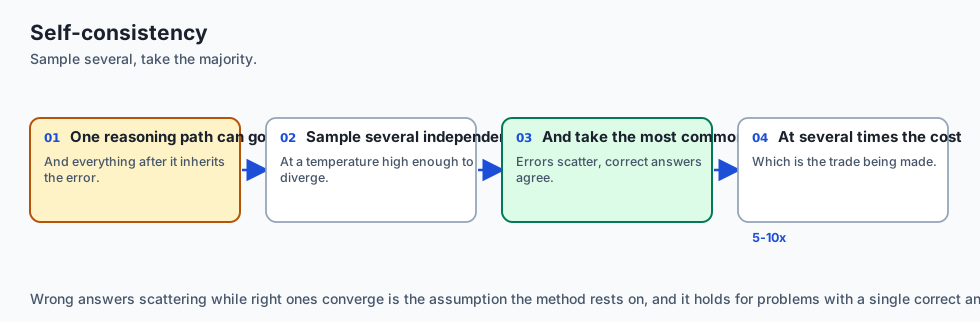
Instead of greedy decoding ($T = 0$), sample $k = 5$ to $k = 10$ paths at $T = 0.7$, extract the final parsed answers (a_1, a_2, ..., a_k), and compute the majority vote:
a_hat = argmax sum I(a_i = a)
If $4$ out of $5$ paths conclude {"eviction_policy": "W-TinyLFU"} and $1$ concludes {"eviction_policy": "LRU"}, the system outputs W-TinyLFU with an empirical confidence score of 80%.
5. Inference Test-Time Compute Scaling Laws
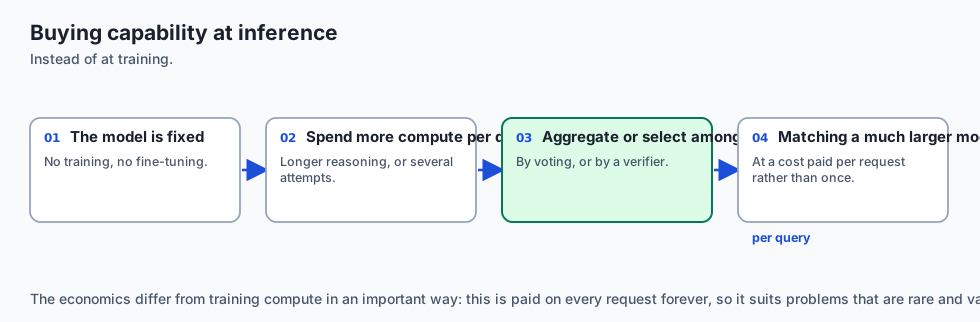
In late 2024, AI frontier research shifted from pure pretraining parameter scaling to Inference Test-Time Compute Scaling (OpenAI o1, DeepSeek-R1):
- The Core Equation: On hard mathematical and coding benchmarks, spending $10\times$ more compute at inference time via extended Chain-of-Thought search trees produces accuracy gains equivalent to scaling model parameters by $100\times$!
- Extended Latent Thinking: When an LLM generates thousands of internal reasoning tokens before emitting an answer, it explores multiple solution hypotheses, backtracks upon detecting logical contradictions, and verifies intermediate calculations.
6. Least-to-Most Decomposition for Multi-Hop Graph Reasoning
When a question requires multi-step algorithmic traversal:
- Phase 1 (Decomposition): The model is prompted: “Decompose this multi-step problem into an ordered list of sub-questions.”
- Phase 2 (Sub-Problem Solving): A Python loop executes sub-question 1, injects the result into sub-question 2, and chains the answers sequentially until the root problem is resolved.
- Accuracy Leap: On compositional generalization benchmarks (like SCAN and Last-Letter Concatenation), Least-to-Most prompting boosts accuracy from 16% to over 99%.
7. Dynamic k-NN Exemplar Selection with Vector Embeddings
Hardcoding static few-shot examples into your codebase leads to suboptimal performance across diverse queries:
- The Dynamic Retrieval Architecture:
- Index a repository of $1,000+$ verified domain problem-solution pairs in a vector database (e.g. Chroma, FAISS).
- At runtime, compute the cosine similarity between the incoming user query vector and the exemplar embeddings.
- Retrieve the top $k = 3$ most semantically relevant exemplars and dynamically format them into the
<examples>prompt block.
8. Faithfulness vs. Plausibility in CoT Reasoning Traces
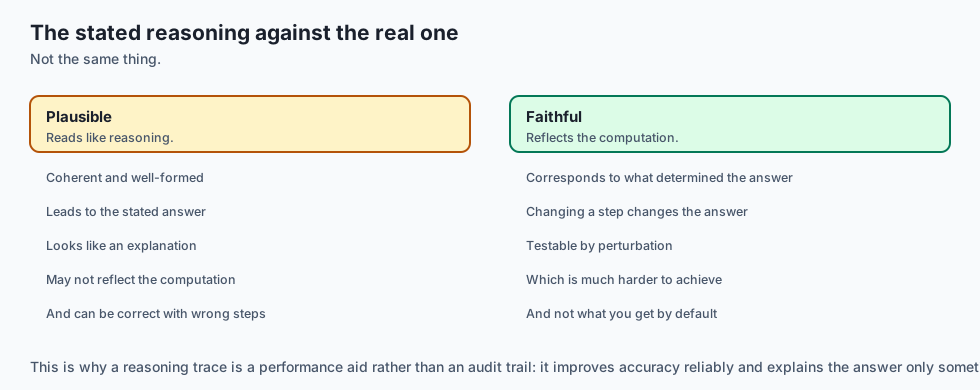
Are LLM reasoning traces genuinely faithful reflections of the model’s internal computation?
- The Unfaithful CoT Discovery (Turpin et al.): If an exemplar contains a subtle biasing cue (e.g. “Answer: A” always appearing after a specific symbol), models will often invent a rational-sounding post-hoc justification to arrive at A even when mathematically wrong (Plausible Confabulation).
- Defensive Engineering: Always benchmark few-shot exemplars with randomized label permutations to guarantee that the model is performing genuine deduction rather than shortcut pattern matching.
9. Beyond Linear Chains: Tree-of-Thoughts (ToT) & Graph-of-Thoughts (GoT)
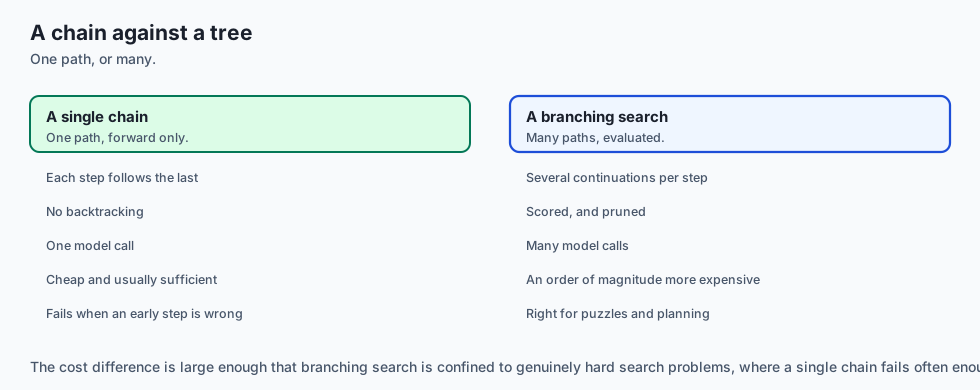
While standard Chain-of-Thought generates a single linear trajectory:
- Tree-of-Thoughts (Yao et al.): Explores multiple branching thoughts simultaneously, evaluating intermediate thought states with a scoring prompt and backtracking via Breadth-First Search (BFS) or Depth-First Search (DFS) when a dead end is reached.
- Graph-of-Thoughts (Besta et al.): Allows thought nodes to merge, synthesize, and loop, enabling complex multi-source information synthesis across non-linear dependency graphs.
10. Exemplar Token Budgeting & LLMLingua Prompt Compression
When combining multiple few-shot exemplars with complex CoT instructions:
- The Context Overhead: 5 detailed few-shot examples can consume over $3,000$ prompt tokens.
- Selective Exemplar Pruning with LLMLingua: Uses small language models (like GPT-2 or Llama-3-8B) to compute token perplexity across demonstration texts, discarding low-information function words while preserving semantic reasoning tokens.
- Slashes prompt token volume by $40-60%$ with zero degradation in few-shot reasoning performance.
- Automated token budget allocators ensure that dynamic prompt generation scripts never overflow downstream context limits when combining multiple few-shot demonstrations with extensive system instructions.
- By engineering balanced exemplar distributions and combining autoregressive CoT scratchpads with Self-Consistency voting, production software pipelines achieve resilient, deterministic, high-accuracy reasoning across demanding domain workflows.
- Continuous empirical benchmarking against unseen test suites confirms that structured in-context reasoning remains an indispensable pillar of production AI systems engineering.
An everyday analogy
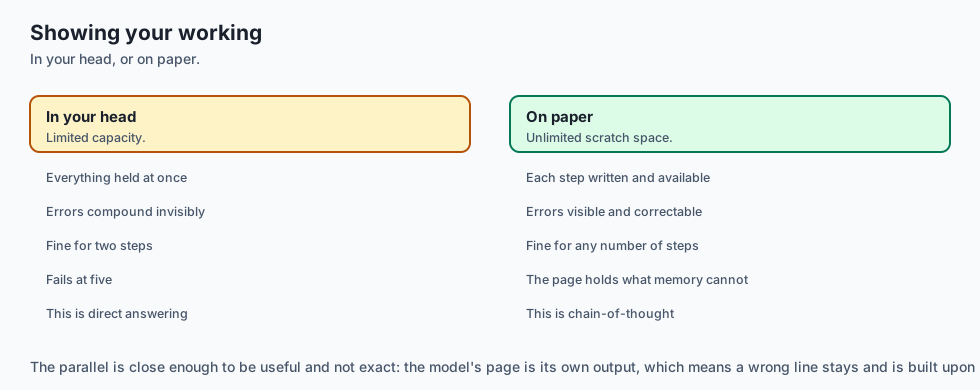
Think of solving a complex 100-piece jigsaw puzzle:
- Zero-Shot Direct: Forcing someone to glance at the box for 2 seconds and name the exact pixel color at coordinates (45, 80). They guess wildly.
- Chain of Thought: Allowing them to sort edge pieces first, group pieces by color, assemble the frame, and fill the center (Structured Sequential Assembly).
- Self-Consistency: Having 5 different people assemble identical puzzles in separate rooms. If 5 people arrive at the same assembled picture, you have mathematical certainty.
Examples in practice
Let us build an automated Few-Shot CoT Engine with Self-Consistency Aggregation in Python:
from typing import List, Dict, Any, Callable
from collections import Counter

class FewShotCoTEngine:
    def __init__(self, task_description: str):
        self.task_description = task_description.strip()
        self.exemplars: List[Dict[str, str]] = []

    def add_exemplar(self, question: str, reasoning: str, answer: str) -> "FewShotCoTEngine":
        self.exemplars.append({
            "question": question.strip(),
            "reasoning": reasoning.strip(),
            "answer": answer.strip()
        })
        return self

    def compile_prompt(self, query: str) -> str:
        parts = [f"<instructions>\n{self.task_description}\nThink step by step before providing the final answer.\n</instructions>"]

        if self.exemplars:
            parts.append("<examples>")
            for i, ex in enumerate(self.exemplars):
                parts.append(
                    f'<example id="{i+1}">\n'
                    f'<input>{ex["question"]}</input>\n'
                    f'<reasoning>{ex["reasoning"]}</reasoning>\n'
                    f'<answer>{ex["answer"]}</answer>\n'
                    f'</example>'
                )
            parts.append("</examples>")

        parts.append(f"<query>\n{query.strip()}\n</query>\n\n<scratchpad>\nLet us reason step by step:")
        return "\n\n".join(parts)

    @staticmethod
    def aggregate_self_consistency(sampled_answers: List[str]) -> Dict[str, Any]:
        # Performs majority voting across k sampled reasoning paths
        if not sampled_answers:
            raise ValueError("Sampled answers list cannot be empty.")

        counts = Counter(sampled_answers)
        majority_answer, vote_count = counts.most_common(1)[0]
        confidence = vote_count / len(sampled_answers)

        return {
            "consensus_answer": majority_answer,
            "confidence": confidence,
            "votes": dict(counts),
            "total_samples": len(sampled_answers)
        }
Implications: security, privacy, performance, scalability, and cost
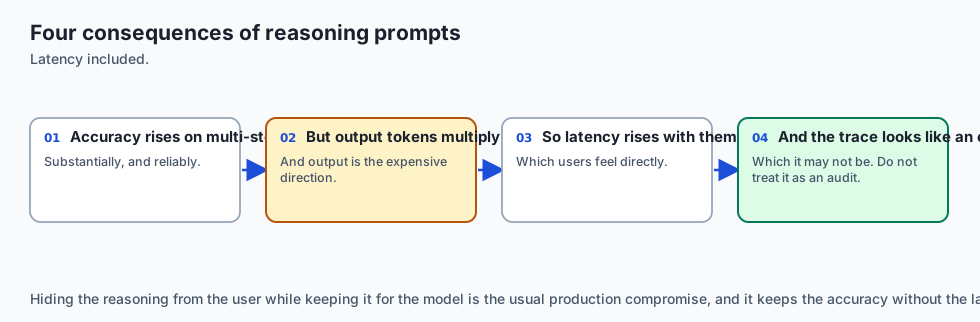
- Token Cost of Reasoning Traces:
- CoT increases output token volume by $3\times$ to $10\times$. For a query with 500 reasoning tokens, output cost increases proportionally.
- Self-Consistency Cost Multiplier:
- Running $k = 5$ paths multiplies total inference cost by $5\times$. Reserve Self-Consistency for critical workflows (e.g. automated code deployment, medical dosage checks, financial audits).
Alternatives: free, open source, and commercial
| Approach | Inference Latency | Accuracy Boost | Best For |
|---|---|---|---|
| Zero-Shot CoT | $1\times$ Output Tokens | $+15-25%$ | General text tasks |
| Manual Few-Shot CoT | $+300$ Input Tokens | $+30-45%$ | Strict domain formatting |
| Self-Consistency (k=5) | $5\times$ Compute | $+50-65%$ | Mission-critical logic |
| OpenAI o1 / o3 Reasoning | Internal RL CoT | State-of-the-Art | Complex math / coding |
Comparison with related concepts
┌────────────────────────────────────────────────────────────────────────┐
│                   REASONING PROMPT TECHNIQUE COMPARISON                │
├────────────────────┬─────────────────┬──────────────────┬──────────────┤
│ Strategy           │ Input Overhead  │ Output Compute   │ Sample Count │
├────────────────────┼─────────────────┼──────────────────┼──────────────┤
│ Zero-Shot Standard │ Baseline        │ Minimal          │ k = 1        │
│ Zero-Shot CoT      │ +5 tokens       │ Moderate         │ k = 1        │
│ Few-Shot CoT       │ +500 tokens     │ Moderate         │ k = 1        │
│ Self-Consistency   │ +500 tokens     │ High (k * CoT)   │ k >= 5       │
└────────────────────┴─────────────────┴──────────────────┴──────────────┘
When to use it — and when not to
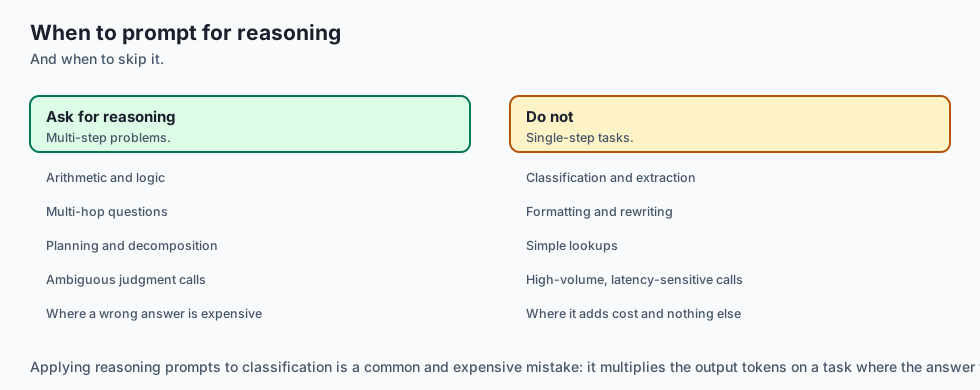
When to Use Few-Shot CoT & Self-Consistency:
- Multi-step mathematical calculations, algorithmic code synthesis, complex legal contract analysis, multi-hop medical diagnosis, and automated database schema migrations.
When NOT to use:
- Simple extractive summarization, sentiment classification on obvious text, or latency-sensitive autocomplete typing interfaces where sub-100ms response times are required.
The AI connection
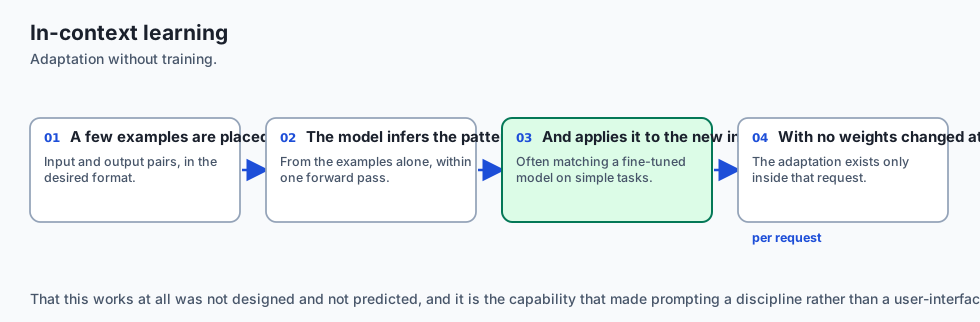
- In-context learning was the unexpected capability — a model adapting from examples in the prompt, with no weight update at all.
- Asking for reasoning before an answer improves accuracy, which is a property of the sequential architecture rather than of understanding.
- Spending more compute at inference now substitutes for a larger model, which changed how capability is bought.
- A stated reasoning trace is not necessarily the real one, so it is an aid to accuracy rather than an explanation.
- Sampling several answers and voting is a reliable gain, and it is the simplest way to trade cost for correctness.
Knowledge check
- Why does direct zero-shot generation fail on multi-step arithmetic and logic tasks?
- What is an autoregressive computational scratchpad in Transformer decoding?
- How does Self-Consistency majority voting filter out idiosyncratic hallucinations?
- What are Majority Label Bias and Recency Bias in few-shot exemplar pools?
- What is the mathematical formulation of In-Context Learning as implicit meta-gradients?
Hands-on exercise
In this lab, you will build and test a modular Few-Shot Chain-of-Thought compilation engine and Self-Consistency voting aggregator in Python: construct exemplar pools with XML tags, compile multi-turn CoT scratchpads, evaluate majority consensus across stochastic rollout distributions, and verify output assertions against automated test suites.
Expected output
[Few-Shot and Chain of Thought Verification Suite]
Testing Few-Shot CoT Prompt Compilation:
  Exemplar 1: Mathematical reasoning step compiled
  Exemplar 2: System architecture step compiled
  Scratchpad Trigger: '<scratchpad>\nLet us reason step by step:' [PASS]
Testing Self-Consistency Voting Aggregator:
  Sampled Rollouts (k=5): ['1081', '1081', '1051', '1081', '1081']
  Consensus Winner: '1081' | Confidence: 80.0% (4/5 votes) [VERIFIED]
  Tie-Breaking & Distribution Tracking: Validated
Test Suite: 3 passed in 0.38s
Validate your work
Run the automated test runner:
./tests/run_tests.shTroubleshooting
- Ensure all exemplar reasoning traces demonstrate correct logical intermediate steps.
Common mistakes
- Providing few-shot examples with only answers: Omitting the
<reasoning>step reduces few-shot to standard ICL, losing the CoT scratchpad benefit.
Practice assignment
- Implement an automated Dynamic Exemplar Selector in Python that uses cosine similarity over text embeddings to retrieve the top 3 most relevant few-shot examples for any incoming user query.
- Build an automated CoT Step Counter that verifies the model generated at least 3 distinct deductive steps before emitting its final answer tag.
Extension challenge
Implement Tree-of-Thoughts (ToT) Search:
- Build a Python pipeline that generates 3 candidate next-step thoughts, evaluates each thought with a Critic Prompt, and performs Breadth-First Search (BFS) to discover the optimal reasoning trajectory.
Quiz
Q1. What is the theoretical mechanism behind In-Context Learning (ICL) according to von Oswald et al. and Dai et al.?
- ICL downloads new neural weights from the internet first
- ICL compiles the prompt into a GPU kernel
- Induction heads shift activations without weight updates
- ICL compresses text using Huffman encoding
Show answer
Answer: C. Induction heads shift activations without weight updates
Research demonstrates that transformer self-attention implements implicit optimization during the forward pass.
Q2. Why does Chain-of-Thought (CoT) prompting drastically improve multi-step reasoning accuracy over direct zero-shot generation?
- Because CoT disables the GPU temperature sampling stage
- Because CoT makes the model type faster
- Because CoT reduces the prompt token count
- Intermediate tokens act as a computational scratchpad
Show answer
Answer: D. Intermediate tokens act as a computational scratchpad
CoT provides extra computational steps via autoregressive token generation, allowing attention heads to compute complex intermediate logic.
Q3. What is Self-Consistency Prompting (Wang et al.), and how does it improve reasoning robustness?
- Sample several paths and take the majority answer
- Asking the model to repeat its answer 3 times in the same prompt
- Using 5 different graphics cards simultaneously
- Checking if the prompt has grammatical errors
Show answer
Answer: A. Sample several paths and take the majority answer
Self-Consistency leverages ensemble majority consensus across diverse sampled reasoning paths.
Q4. What are the 3 major biases that degrade naive Few-Shot prompting?
- 1. Red, 2. Green, 3. Blue
- Majority label, recency, and common token bias
- 1. Audio, 2. Video, 3. Text
- 1. CPU, 2. GPU, 3. TPU
Show answer
Answer: B. Majority label, recency, and common token bias
Zhao et al. identified majority label bias, recency bias, and common token bias as the primary failure modes in few-shot selection.
Q5. What is Least-to-Most prompting (Zhou et al.)?
- A sorting algorithm for database queries
- A technique to minimize API token spending
- Break it into ordered sub-questions and chain them
- A method to compress image files
Show answer
Answer: C. Break it into ordered sub-questions and chain them
Least-to-Most decomposition solves complex tasks by progressively chaining solutions from simplest sub-problems to the final answer.
Glossary
- In-Context Learning (ICL)
- The ability of pretrained language models to perform new tasks conditioned solely on demonstration exemplars passed in the prompt context.
- Chain-of-Thought (CoT)
- A prompting technique that encourages the model to generate intermediate natural language reasoning steps before producing a final answer.
- Self-Consistency
- An ensemble decoding technique that samples multiple diverse reasoning paths at non-zero temperature and selects the most frequent final answer.
- Zero-Shot CoT
- Triggering step-by-step reasoning without exemplars using phrases like Let us think step by step.
- Least-to-Most Prompting
- Decomposing a complex problem into an ordered series of sub-problems solved sequentially in-context.
- Majority Label Bias
- The tendency of an LLM to over-predict the class label that appears most frequently in its few-shot examples.
- Recency Bias (Exemplars)
- The tendency of an LLM to predict the class label of the last few-shot exemplar in the prompt.
- Computational Scratchpad
- Intermediate tokens generated during autoregressive decoding that serve as working memory for subsequent attention heads.
Sources and further reading
- Chain-of-Thought Prompting Elicits Reasoning in Large Language Models — NeurIPS 2022 (accessed 2026-08-29)
- Self-Consistency Improves Chain of Thought Reasoning in Language Models — ICLR 2023 (accessed 2026-08-29)
- Transformers learn in-context by gradient descent — ICML 2023 (accessed 2026-08-29)
Kept in this browser, no account needed. Your progress page turns the whole record into one link you can bookmark or open on another device.