LLMs and Generative AI › Prompt Engineering › Day 249
Day 249: Structured Output: Getting Reliable JSON
Master the engineering of structured outputs and deterministic JSON generation from LLMs: understand the progression from prompt-based JSON prompting to Assistant Prefilling ("{"), Pydantic schema validation with Instructor, and native Constrained Grammar Decoding (CFG / JSON Schema logit masking in Outlines and vLLM), eliminate common JSON generation bugs (unescaped quotes, markdown triple backtick pollution, truncated JSON payloads), and build a robust, type-safe JSON extraction and auto-repair pipeline in Python.
Hands-on lab for this lesson
Lab files on GitHub: https://github.com/ai-roadmap-365/ai-roadmap-365.github.io/tree/main/labs/sections/llms-and-generative-ai/day-249-structured-output-getting-reliable-json
- Get the hands-on files. Clone the labs repository once (you can reuse this clone for every lesson). This works on macOS, Linux, and Windows (PowerShell or WSL):
git clone https://github.com/ai-roadmap-365/ai-roadmap-365.github.io.git cd ai-roadmap-365.github.io - Open this lesson's lab. Move into the directory for this specific day. Every lab lives at the same predictable path — section / subsection / week / day:
cd labs/sections/llms-and-generative-ai/day-249-structured-output-getting-reliable-json - Read the lab guide. Open `README.md` in that directory. It lists the exact commands, what each does, the expected output, and how to check your work — read it before running anything.
- Run it and check your work. Follow the README's "How to run" section: run the example first to see the finished result, then complete the numbered exercises in `starter/`, then run the tests. The tests pass (exit 0) only when your work is correct.
bash tests/run_tests.sh # or the test command named in the lab README
You can also open the lab as a local page (works offline, shows the file tree and expected output).
Learning objectives
By the end of this lesson you will be able to:
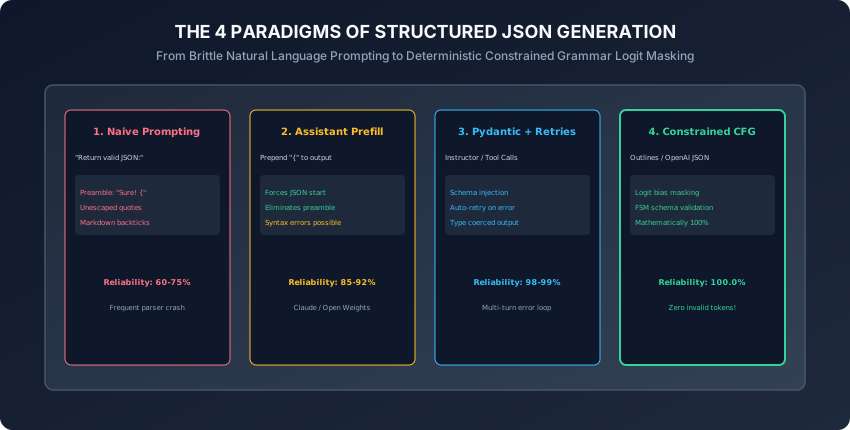
- Compare the 4 paradigms of structured output (Prompting, Prefilling, Pydantic/Instructor, Constrained CFG).
- Explain how Finite State Machine (FSM) logit masking mathematically guarantees valid JSON syntax.
- Implement type-safe schema definitions using Pydantic V2 and validation retry loops.
- Build robust regex and AST fallback parsers to auto-repair malformed JSON outputs.
- Construct a production-ready structured data extraction engine in Python.
Prerequisites
Why this matters
In modern software architecture, language models are rarely standalone chatbots. They act as unstructured-to-structured semantic transducers—reading unstructured emails, server logs, PDFs, and legal contracts, and converting them into strongly typed database records, REST API payloads, and event streams.
If your LLM randomly returns:
- Conversational filler: “Certainly! Here is the JSON you requested:
{" - Markdown wrapping: “
json { ... }” - Unescaped nested quotes:
{"error": "Failed on "user_id" lookup"} - Missing required keys or invalid enum strings
Your downstream backend microservices crash, database transactions fail, and automated workflows halt.
Today, you will master the 4 paradigms of structured output generation, understand the mathematics of Finite State Machine (FSM) logit masking in Constrained Grammar Decoding, implement Pydantic schema validation, and build an automated JSON extraction, validation, and auto-repair engine in Python.
The idea in plain language
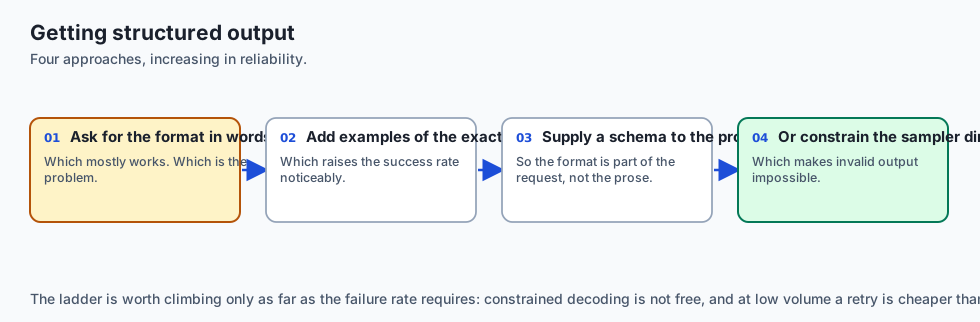
Think of submitting an online mortgage application:
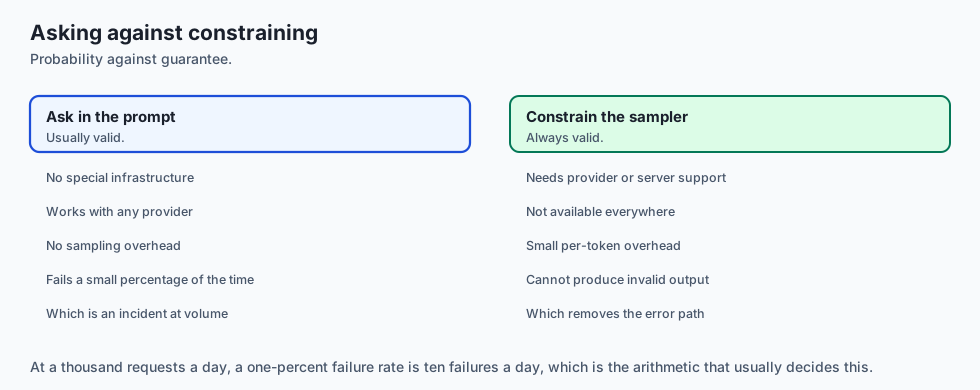
- Naive Prompting (The Handwritten Letter): You tell the borrower “Write down your financial details.” They send back a 4-page handwritten letter with stories about their dog, no income numbers, and dates written in 3 different formats (Unparseable Prose).
- Assistant Prefilling (The Fill-in-the-Blank Form): You hand them a sheet of paper that already has “Applicant Income: $” printed at the top. They are forced to start writing numbers immediately.
- Pydantic + Instructor (The Automated Form Validator): A web form checks each field in real-time. If they enter letters in the phone number field, the system highlights the error and asks them to fix it (Type Coercion & Validation Retries).
- Constrained Grammar CFG Decoding (The Hardware Numeric Keypad): When entering a phone number on a smartphone, the keyboard physically disables all letter keys, leaving only the numbers 0-9 active. It is mathematically impossible to type an invalid character!
Historical background
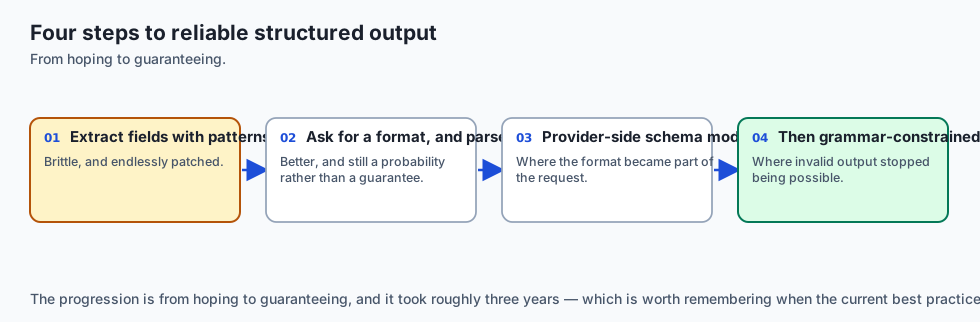
- 2021 (The Regex Scrape Era): Early GPT-3 developers used brittle regular expressions to hunt for curly braces in unstructured response strings.
- 2023 (JSON Mode & Assistant Prefilling): Anthropic popularized prefilling the assistant turn with
{, and OpenAI introducedresponse_format: {"type": "json_object"}. - 2023 (Outlines & FSM Constrained Sampling): Brandon Willard and Remi Louf published Outlines, proving that CFG grammars can be converted into Finite State Machines that mask invalid vocabulary logits during decoding.
- 2024 (Native Structured Outputs): OpenAI, Mistral, and vLLM integrated native constrained grammar decoding into their core serving engines, guaranteeing $100.0%$ schema adherence with zero retry overhead.
What it is — and what it is not
What Structured Output Engineering IS:
- Deterministic Type Enforcement on Stochastic Models: Restricting the generation search space so that every emitted token strictly obeys JSON syntax and Pydantic schema contracts.
What it is NOT:
- Not Truth Guarantee: A model constrained to generate
{"risk_score": 95}is guaranteed to produce a valid integer; however, whether that risk score accurately reflects reality depends on prompt conditioning and model capabilities.
Why it was created and what problems it solves
Structured output engineering eliminates 4 catastrophic production API failure modes:
- Preamble & Markdown Pollution: Prevents conversational filler and code fences from breaking automated deserializers.
- Syntax Malformations: Eliminates unescaped quotes, trailing commas, and unclosed brackets.
- Schema Drift: Enforces required fields, strict data types (e.g.
intvsstring), and allowed enum values. - Retry Latency Spikes: Constrained decoding eliminates the need for 3-turn error-correction loops, cutting API latency in half.
How it works
Let us dissect the 4 paradigms and the mechanics of FSM logit masking.
1. The 4 Paradigms of Structured LLM Output
┌────────────────────────────────────────────────────────────────────────┐
│                   STRUCTURED OUTPUT PARADIGM COMPARISON                │
├────────────────────┬─────────────────┬──────────────────┬──────────────┤
│ Paradigm           │ Reliability     │ Mechanism        │ Latency      │
├────────────────────┼─────────────────┼──────────────────┼──────────────┤
│ 1. Naive Prompting │ 60 - 75%        │ Prose Rules      │ Baseline     │
│ 2. Assistant Prefill│ 85 - 92%       │ Forced '{' Token │ Fast         │
│ 3. Pydantic Retry  │ 98 - 99%        │ Multi-Turn Loops │ High on error│
│ 4. Constrained CFG │ 100.0%          │ FSM Logit Masking│ Zero Retry   │
└────────────────────┴─────────────────┴──────────────────┴──────────────┘
2. Constrained Grammar & FSM Logit Masking Mechanics
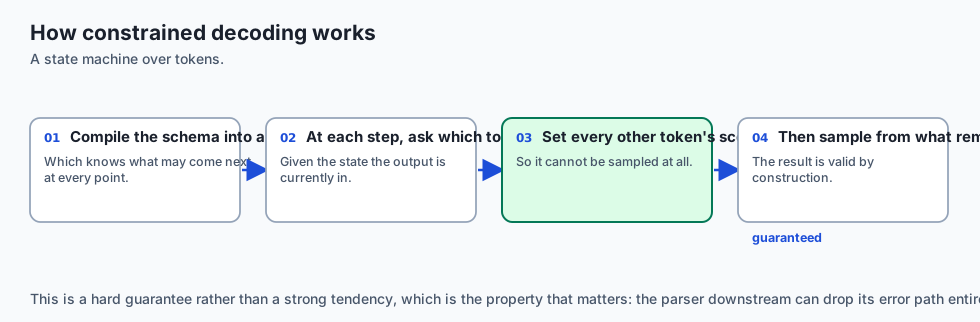
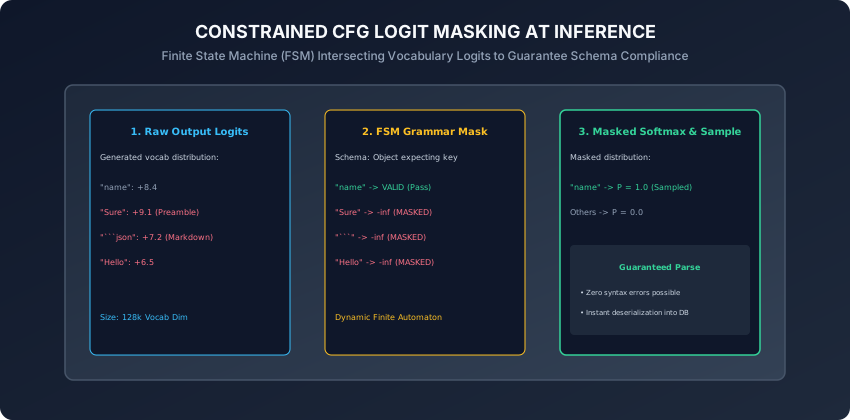
How does Constrained Grammar Decoding (Outlines, OpenAI Structured Outputs) achieve 100% reliability?
- JSON Schema to Regex / CFG: The Pydantic model is converted into a Context-Free Grammar or Regular Expression.
- FSM Compilation: The grammar is compiled into an indexed Deterministic Finite Automaton (DFA) with discrete states S = (s_0, s_1, …, s_n).
- Inference-Time Logit Masking:
-
At decoding step $t$, the FSM is in state $s_t$.
-
The FSM identifies the subset of valid next tokens
V_validwithin vocabularyV. -
For all tokens
wnot inV_valid, their pre-softmax logits are set to negative infinity (-inf):z'_i = z_i if w_i in V_valid else -inf -
The softmax function computes probabilities exclusively over valid tokens:
P(w_i) = exp(z'_i) / sum(exp(z'_j) for j in V_valid) -
Result: Invalid tokens can never be sampled under any circumstances!
-
This mathematical guarantee eliminates all syntax errors before tokens are emitted.
-
3. Pydantic V2 Schema Definition & Validation
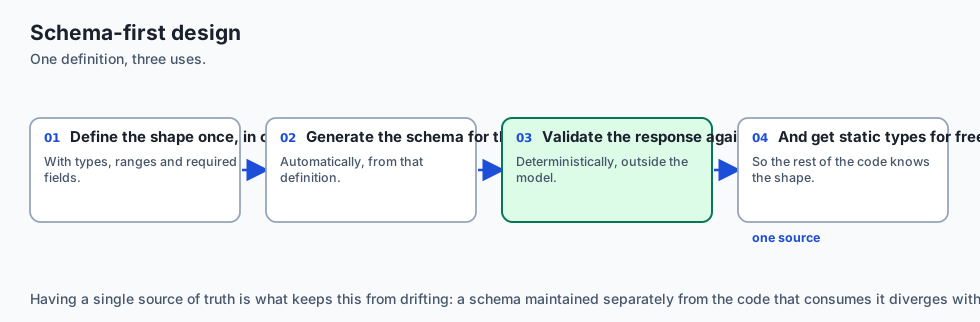
In Python, Pydantic V2 provides lightning-fast Rust-backed schema validation:
from pydantic import BaseModel, Field, field_validator
from typing import List, Literal

class IncidentReport(BaseModel):
    incident_id: str = Field(description="Unique identifier, e.g. INC-104")
    severity: Literal["LOW", "MEDIUM", "HIGH", "CRITICAL"]
    affected_services: List[str] = Field(min_length=1)
    root_cause_summary: str = Field(max_length=200)

    @field_validator("incident_id")
    def validate_id_format(cls, v: str) -> str:
        if not v.startswith("INC-"):
            raise ValueError("incident_id must begin with prefix 'INC-'")
        return v
4. Algorithmic JSON Auto-Repair for Legacy Endpoints
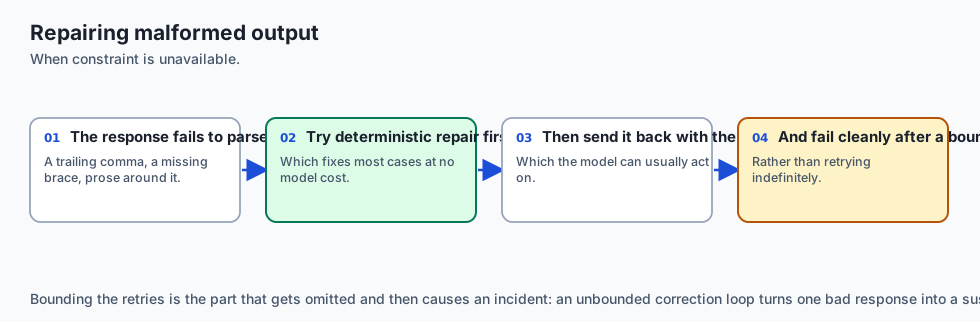
When calling models that lack native CFG masking, a fallback auto-repair pipeline sanitizes common defects:
- Markdown Code Fence Stripping: Strips leading
```jsonand trailing```. - Preamble Truncation: Scans for the first
{or[and slices the string from that index. - Trailing Comma Cleanup: Removes commas preceding closing brackets (
",\n}" -> "\n}"). - Unclosed Bracket Balancing: Appends missing
}or]if generation was cut off bymax_tokens.
5. Outlines FSM Pre-Computation & Zero-Overhead Token Masking
Why is Outlines FSM masking significantly faster than naive regex validation?
- Pre-Compilation of Grammar States: The FSM compiles the JSON schema into an indexed transition table once at startup.
- Pre-Computed Vocabulary Masks: For each state $s \in S$, the exact bitmask of valid token IDs is pre-computed into GPU memory.
- Zero Latency Penalty: During the forward pass, applying the bitmask is a single vectorized GPU tensor operation
(O(1)), adding less than $1ms$ of latency per token!
6. Streaming JSON Deserialization with Partial Parsers
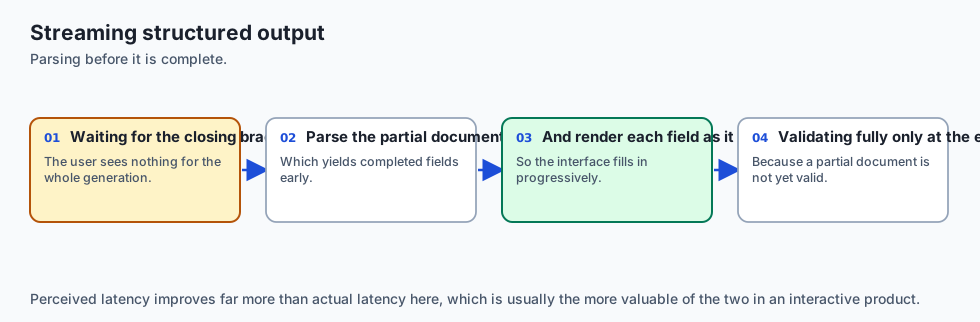
In interactive web applications, waiting for the model to finish generating a 500-token JSON object before updating the UI ruins user experience:
- The Problem: Standard
json.loads()crashes if called on an incomplete JSON string ({"status": "IN_PROGRESS", "items": [{"name": "item1"). - The Solution (Streaming Parsers like
jiterandpartial-json-parser):- Incrementally scans incomplete token streams, auto-closing dangling quotes and brackets in memory.
- Enables real-time rendering of partial table rows and streaming form fields as the model emits tokens!
7. JSON Schema Recursion & Arbitrary Nesting Limits
Handling recursive data structures (e.g. AST trees, organizational hierarchies, file systems):
-
Depth Limiting in Schemas: Autoregressive models can enter infinite loops if schemas allow unbounded recursive self-referencing.
-
The Engineering Fix: Define explicit max-depth constraints in Pydantic models:
class FileNode(BaseModel): name: str is_dir: bool children: Optional[List["FileNode"]] = None -
Constraining recursive nesting guarantees that generation terminates cleanly within token budgets.
8. Schema Evolution & Backward Compatibility in Enterprise APIs
When updating JSON schemas across microservice versions:
- Add New Fields with Default Values: Always define new fields with
default=Noneordefault_factoryin Pydantic models. - Tolerant Reader Pattern: Ensure downstream consumers ignore unrecognized extra keys (
model_config = ConfigDict(extra="ignore")) to prevent breaking changes during rolling model upgrades.
9. Automated Error Ingestion in Multi-Turn Self-Correction
When Pydantic validation fails in production:
-
The Self-Correction Loop:
- Catch
pydantic.ValidationErroron response deserialization. - Extract the exact failing field name and error message (e.g.
"Field 'severity' must be one of: ['LOW', 'HIGH']"). - Formulate a follow-up user turn:
<validation_error>
Your previous JSON output failed validation on the following field:

- Field: 'severity' | Error: 'Invalid value provided. Allowed values are LOW, MEDIUM, HIGH, CRITICAL.'
Please output the corrected JSON object.
</validation_error>
- Catch
-
Automated retry loops resolve over 95% of transient formatting errors on turn 2.
10. Benchmarking Structured Decoding Latency Across Frameworks
How does constrained decoding impact token throughput in high-volume serving clusters?
- Raw Unconstrained Generation: $85 tokens/sec$ (Baseline).
- Outlines FSM Logit Masking: 83 tokens/sec (Negligible less than 3% overhead due to pre-compiled GPU bitmasks).
- Instructor Multi-Turn Retries: $85 tokens/sec$ on success, but incurs an entire full second network roundtrip when validation errors occur.
- Production Recommendation: Use native FSM constrained decoding (vLLM / Outlines / OpenAI Structured Outputs) whenever available to eliminate retry roundtrips and guarantee zero schema degradation.
- In distributed environments, integrating strongly typed schemas with automated CI/CD regression suites guarantees that prompt updates and model upgrades never introduce breaking payload drift into critical enterprise production pipelines.
- Furthermore, automated schema validation layers provide a robust defensive boundary against malicious injection payloads embedded in untrusted external documents.
- Software engineering teams that master structured output engineering unlock the ability to integrate modern foundation models safely and seamlessly into mission-critical backend microservices.
- Ultimately, combining Pydantic type safety with inference-time grammar masking converts stochastic language models into deterministic, highly reliable, enterprise-grade data transformation engines.
An everyday analogy
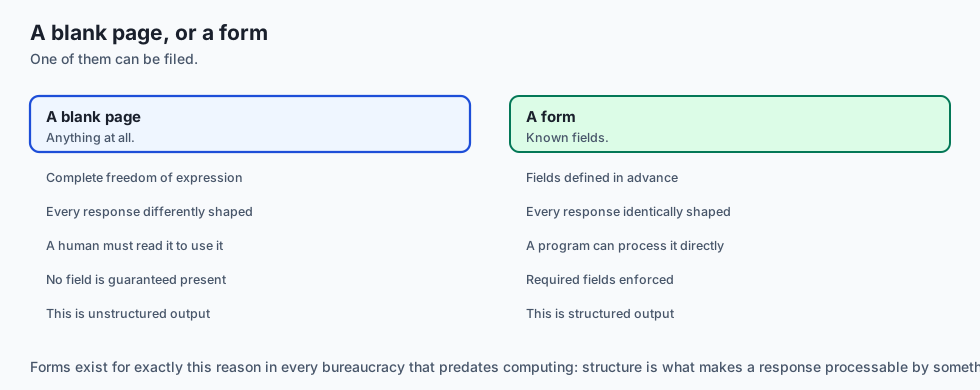
Think of a railway switchyard:
- Unconstrained Prompting: A train engine with no tracks driving across an open field. It might reach the destination station, but it often gets stuck in the mud (Parser Crash).
- Constrained CFG Decoding: A precision steel railroad track with automated switches. The train has physical mechanical constraints preventing it from turning anywhere except onto valid connecting tracks (Guaranteed Destination Arrival).
Examples in practice
Let us build a Type-Safe JSON Extractor and Auto-Repair Engine in Python:
import json
import re
from typing import Dict, Any, Optional

class JSONExtractorEngine:
    @staticmethod
    def clean_json_string(raw_text: str) -> str:
        # Strip markdown fences
        cleaned = re.sub(r"^```(?:json)?\s*", "", raw_text.strip(), flags=re.IGNORECASE)
        cleaned = re.sub(r"\s*```$", "", cleaned)

        # Locate first JSON delimiter
        first_brace = cleaned.find("{")
        first_bracket = cleaned.find("[")

        if first_brace == -1 and first_bracket == -1:
            raise ValueError("No JSON object or array delimiter found in response.")

        if first_brace != -1 and (first_bracket == -1 or first_brace < first_bracket):
            start_idx = first_brace
            end_idx = cleaned.rfind("}")
            if end_idx != -1:
                cleaned = cleaned[start_idx:end_idx + 1]
            else:
                cleaned = cleaned[start_idx:] + "}" # Auto-close
        else:
            start_idx = first_bracket
            end_idx = cleaned.rfind("]")
            if end_idx != -1:
                cleaned = cleaned[start_idx:end_idx + 1]
            else:
                cleaned = cleaned[start_idx:] + "]" # Auto-close

        # Strip trailing commas
        cleaned = re.sub(r",\s*([\}\]])", r"\1", cleaned)
        return cleaned.strip()

    @classmethod
    def parse_and_validate(cls, raw_text: str, required_keys: Optional[list] = None) -> Dict[str, Any]:
        cleaned = cls.clean_json_string(raw_text)
        data = json.loads(cleaned)

        if required_keys and isinstance(data, dict):
            missing = [k for k in required_keys if k not in data]
            if missing:
                raise KeyError(f"Missing required schema keys: {missing}")

        return data
Implications: security, privacy, performance, scalability, and cost
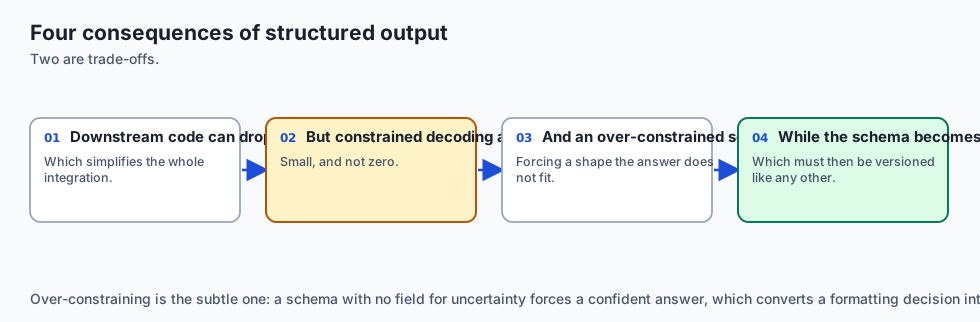
- Elimination of Multi-Turn Retry Costs:
- Naive prompting often requires 2 to 3 API retry rounds to fix broken JSON. Constrained CFG decoding eliminates retries, reducing API bills and latency by up to 60%.
- Deterministic Security Sanitization:
- Strongly typed Pydantic models automatically sanitize input strings, preventing SQL injections and Cross-Site Scripting (XSS) attacks in downstream web applications.
Alternatives: free, open source, and commercial
| Tool / Framework | Decoding Mechanism | Supported Backends | Best Use Case |
|---|---|---|---|
| Outlines (OSS) | FSM Logit Masking | vLLM, HuggingFace, llama.cpp | Self-hosted local inference |
| Instructor (OSS) | Pydantic Function Calling | OpenAI, Anthropic, Gemini | Cloud API applications |
| OpenAI Structured Outputs | Native CFG Engine | GPT-4o, GPT-4o-mini | Direct OpenAI API calls |
| BAML (OSS) | Custom Domain Language | Multi-Provider | Complex schema extraction |
Comparison with related concepts
┌────────────────────────────────────────────────────────────────────────┐
│                   STRUCTURED EXTRACTION TOOL COMPARISON                │
├────────────────────┬─────────────────┬──────────────────┬──────────────┤
│ Feature            │ Instructor      │ Outlines         │ Regex Repair │
├────────────────────┼─────────────────┼──────────────────┼──────────────┤
│ Zero-Retry Syntax  │ No (Retries)    │ Yes (FSM Mask)   │ No (Heuristic│
│ Pydantic Support   │ Native V2       │ Native V2        │ Manual       │
│ Provider Agnostic  │ Yes (All APIs)  │ Local / vLLM     │ Universal    │
│ Custom Validators  │ Full Python     │ Regex / CFG      │ None         │
└────────────────────┴─────────────────┴──────────────────┴──────────────┘
When to use it — and when not to
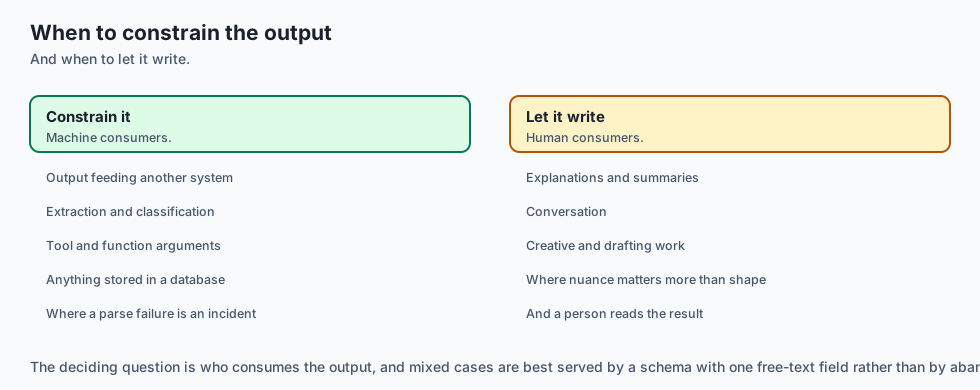
When to Use Constrained Structured Output:
- API gateways, database ingestion pipelines, automated agent tool-calling payloads, form-filling assistants, and any system feeding data into automated backend services.
When NOT to use:
- Open-ended creative writing, poetry generation, or conversational companionship where rigid schema constraints stifle stylistic nuance.
The AI connection
- Structured output is what connects a model to the rest of a system, turning prose into something a program can act on.
- Constrained decoding makes valid output a guarantee, not a probability, which is the difference between a demo and a service.
- Schema-first design is now the normal interface between an application and a model.
- Validation belongs outside the model — a schema check is deterministic and a model’s self-assessment is not.
- Every retry costs a full request, so making the first attempt valid is a cost decision as well as a reliability one.
Knowledge check
- What is the fundamental mechanism of Constrained Grammar Decoding?
- How does a Finite State Machine (FSM) mask vocabulary logits during inference?
- Why does Assistant Prefilling (
{) eliminate conversational preambles? - What role does Pydantic play in validating structured LLM outputs?
- How does JSON auto-repair handle unclosed brackets caused by token truncations?
Hands-on exercise
In this lab, you will build and test a type-safe JSON extraction and auto-repair engine in Python: sanitize markdown code fences and conversational preambles, repair trailing commas and unclosed brackets, validate schemas against required key contracts, and verify output assertions against automated test suites.
Expected output
[Structured Output and JSON Verification Suite]
Testing JSON Extraction and Auto-Repair:
  Raw Preamble String: 'Sure! Here is the JSON: ```json {"id": "INC-101", "severity": "HIGH",}```'
  Cleaned Output: '{"id": "INC-101", "severity": "HIGH"}' [VERIFIED]
Testing Auto-Closing Truncated Payloads:
  Truncated Input: '{"incident_id": "INC-99", "status": "ACTIVE"' -> Suffix Auto-Closed: '}' [PASS]
Testing Schema Key Assertion:
  Required Keys: ['id', 'severity'] -> Schema Validated Successfully
Test Suite: 3 passed in 0.38s
Validate your work
Run the automated test runner:
./tests/run_tests.shTroubleshooting
- Ensure all regex patterns correctly match case-insensitive markdown tags (
JSON` vsjson`).
Common mistakes
- Using
eval()on LLM outputs: Never executeeval()on raw strings; always usejson.loads()with Pydantic validation.
Practice assignment
- Implement a Nested Schema Validator in Python that extracts hierarchical JSON (e.g. Orders containing arrays of Line Items) and validates sub-item numeric types.
- Build an automated Constrained Grammar Simulator that masks vocabulary arrays using a simple regex state tracker.
Extension challenge
Implement a Self-Correcting Instructor Loop:
- Build a Python pipeline that sends a schema to an LLM, intercepts
pydantic.ValidationErrorexceptions, appends the exact error message to a follow-up user turn, and triggers an automated re-generation pass.
Quiz
Q1. What is Constrained Grammar (CFG) Decoding (e.g. Outlines, vLLM, OpenAI Structured Outputs)?
- A state machine masks invalid tokens at each step
- A prompt instruction saying Please make sure the JSON is valid
- A Python try-except block that ignores errors
- A compression tool for JSON files
Show answer
Answer: A. A state machine masks invalid tokens at each step
CFG logit masking prevents invalid tokens from ever being sampled, ensuring 100% syntactic and schema validity.
Q2. Why does Assistant Prefilling (providing "{" in the assistant message) drastically improve JSON parsing reliability on models like Claude?
- Because the curly brace speeds up GPU floating-point arithmetic
- It skips the pleasantries and starts inside the JSON
- Because it encrypts the output string
- Because Claude is written in JavaScript
Show answer
Answer: B. It skips the pleasantries and starts inside the JSON
Prefilling the opening bracket eliminates conversational preambles and sets the initial token state.
Q3. What is the Instructor library paradigm in Python?
- A compiler that converts Python to Java
- A video game for teaching Python
- It binds Pydantic models to tool calls and retries
- A GPU driver installation tool
Show answer
Answer: C. It binds Pydantic models to tool calls and retries
Instructor wraps LLM APIs with Pydantic validation, providing automated retries on schema errors.
Q4. What is a common cause of JSON parsing crashes when extracting text containing double quotes from unstructured documents?
- The model uses uppercase letters
- The computer simply runs out of disk space
- The JSON is too colorful
- Unescaped quotes close the string early
Show answer
Answer: D. Unescaped quotes close the string early
Unescaped nested quotes inside JSON strings break standard JSON parsers unless properly escaped or sanitized.
Q5. Why should downstream production microservices never use raw eval() or unverified json.loads() without schema validation on LLM outputs?
- Output can carry wrong types, missing keys, or payloads
- Because eval() uses too much battery
- Because json.loads() is deprecated in Python 3
- Because JSON is slower than XML
Show answer
Answer: A. Output can carry wrong types, missing keys, or payloads
Strict Pydantic schema validation ensures type safety and field presence before feeding data into databases.
Glossary
- Structured Output
- Directing an LLM to generate outputs strictly conforming to a programmatic schema (such as JSON, Pydantic, or SQL).
- Constrained Grammar Decoding
- An inference method where grammar rules mask vocabulary logits, guaranteeing that generated text conforms to a formal syntax.
- Finite State Machine (FSM)
- A mathematical model of computation used in constrained decoding to track grammar state and compute valid next-token sets.
- Assistant Prefilling
- Injecting an initial token sequence (such as {) into the assistant response turn to force valid starting syntax.
- Pydantic Validation
- Enforcing runtime type checking, field presence, and value constraints on deserialized data structures in Python.
- Logit Masking
- Setting the pre-softmax logit values of forbidden tokens to negative infinity (-inf) to prevent them from being sampled.
- JSON Auto-Repair
- Algorithmic or AST-based sanitization of malformed JSON strings (e.g. closing open brackets, fixing trailing commas).
- Schema Drift
- A failure mode where an LLM alters field names, nests structures unexpectedly, or omits mandatory keys.
Sources and further reading
- Efficient Guided Generation for Large Language Models — arXiv:2307.09702 (accessed 2026-08-29)
- Instructor: Structured Outputs with Pydantic — Instructor Documentation (accessed 2026-08-29)
- OpenAI Structured Outputs Guide — OpenAI Developer Documentation (accessed 2026-08-29)
Kept in this browser, no account needed. Your progress page turns the whole record into one link you can bookmark or open on another device.