LLMs and Generative AI › LLM APIs › Day 254
Day 254: The OpenAI-Compatible Ecosystem
Master the lingua franca of generative AI APIs: understand the OpenAI Chat Completions standard (/v1/chat/completions), route requests seamlessly across proprietary APIs (OpenAI, Groq, Together AI, Mistral, Perplexity, DeepSeek) and self-hosted open-weights inference engines (vLLM, Ollama, LM Studio, TGI) using a single unified client interface, configure base_url, custom headers, and model aliases, implement robust provider fallback failover logic, and build a multi-provider OpenAI-compatible client router in Python.
Hands-on lab for this lesson
Lab files on GitHub: https://github.com/ai-roadmap-365/ai-roadmap-365.github.io/tree/main/labs/sections/llms-and-generative-ai/day-254-the-openai-compatible-ecosystem
- Get the hands-on files. Clone the labs repository once (you can reuse this clone for every lesson). This works on macOS, Linux, and Windows (PowerShell or WSL):
git clone https://github.com/ai-roadmap-365/ai-roadmap-365.github.io.git cd ai-roadmap-365.github.io - Open this lesson's lab. Move into the directory for this specific day. Every lab lives at the same predictable path — section / subsection / week / day:
cd labs/sections/llms-and-generative-ai/day-254-the-openai-compatible-ecosystem - Read the lab guide. Open `README.md` in that directory. It lists the exact commands, what each does, the expected output, and how to check your work — read it before running anything.
- Run it and check your work. Follow the README's "How to run" section: run the example first to see the finished result, then complete the numbered exercises in `starter/`, then run the tests. The tests pass (exit 0) only when your work is correct.
bash tests/run_tests.sh # or the test command named in the lab README
You can also open the lab as a local page (works offline, shows the file tree and expected output).
Learning objectives
By the end of this lesson you will be able to:
- Understand the standard OpenAI /v1/chat/completions REST and JSON schema specification.
- Configure base_url and custom api_key headers to connect to third-party and local providers.
- Connect to self-hosted vLLM and Ollama instances using the standard OpenAI Python client.
- Implement automated provider failover logic for high-availability enterprise routing.
- Build an extensible multi-provider API router with latency benchmarking in Python.
Prerequisites
Why this matters
In the early days of generative AI, every model vendor created their own proprietary SDK and REST protocol. Switching a codebase from OpenAI to Anthropic or a self-hosted Llama model required rewriting hundreds of lines of client integration code.
Today, the OpenAI /v1/chat/completions protocol has emerged as the universal standard (the HTTP/REST of Generative AI).
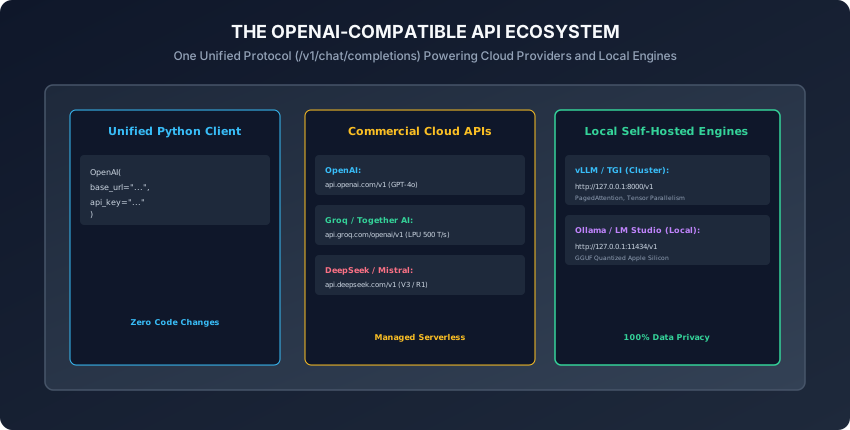
Virtually every major commercial cloud provider and self-hosted inference engine now natively implements the OpenAI request and response specification:
- Cloud Accelerators & Frontier Labs: Groq (LPU 500+ tokens/sec), Together AI, DeepSeek (V3 and R1), Mistral, Perplexity, Fireworks AI, and Anyscale.
- Open-Weights Local Serving Engines: vLLM (high-throughput GPU serving), Ollama (Mac/Linux on-device execution), LM Studio, and Hugging Face Text Generation Inference (TGI).
By mastering the OpenAI-Compatible standard, you unlock the ability to write provider-agnostic code: routing requests dynamically between blazing-fast local models and frontier cloud APIs, enforcing automated failover, and slashing monthly inference costs with zero vendor lock-in.
Today, you will master the OpenAI-Compatible architecture, configure base_url redirection for local and third-party engines, implement automated multi-provider failover routing, and build an extensible multi-provider API router in Python.
The idea in plain language
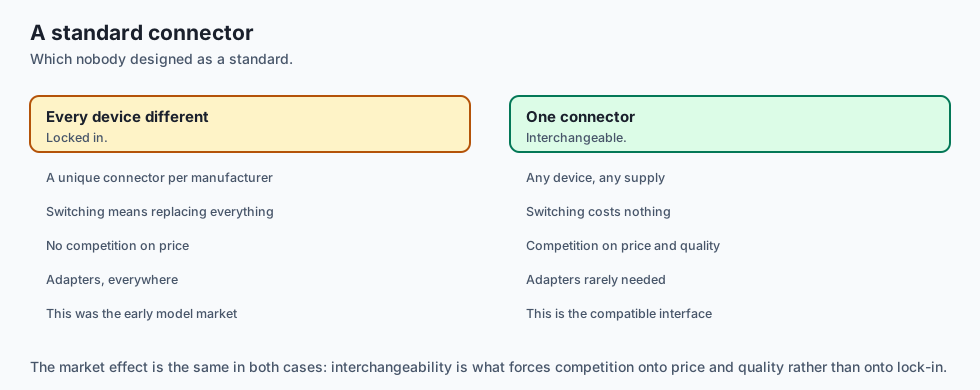
Think of electrical power outlets and standardized plugs:
- The Proprietary Mess (No Universal Standard): Every appliance manufacturer invents a custom wall plug shape. Buying a new blender requires rewiring your kitchen wall with specialized copper cables (Vendor Lock-In & Costly Refactoring).
- The Universal Standard (The OpenAI Protocol):
- All power outlets deliver standard electricity via a universal three-prong socket (
/v1/chat/completions). - You can plug your appliance into a municipal hydroelectric grid (OpenAI Cloud), a private solar battery in your garage (Local vLLM Server), or an ultra-high-speed nuclear plant (Groq Hardware).
- The appliance operates flawlessly without knowing or caring where the electricity originates.
- All power outlets deliver standard electricity via a universal three-prong socket (
Historical background
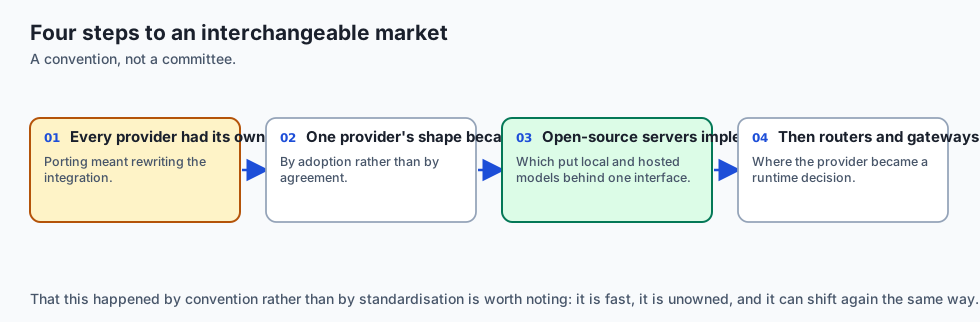
- 2023 (OpenAI Chat Completions Introduction): OpenAI released the
gpt-3.5-turboendpoint with the/v1/chat/completionsschema, replacing legacy text completions. - 2023 (vLLM & Open-Source Standardization): UC Berkeley researchers released vLLM with PagedAttention and built a drop-in
/v1/chat/completionsHTTP server, allowing developers to swap GPT-4 with open-weights Llama models by changing onlybase_url. - 2024 (The Multi-Provider Explosion): Cloud inference providers (Groq, Together, DeepSeek) adopted the OpenAI schema universally to enable instant migration for enterprise customers.
- 2024 (LiteLLM & Gateway Proxies): Open-source proxy gateways standardized routing, load balancing, and budget tracking across 100+ endpoints through a single OpenAI-compatible interface.
What it is — and what it is not
What the OpenAI-Compatible Ecosystem IS:
- A Standardized Protocol Contract: A shared REST API schema, message structure, and streaming event format implemented across dozens of independent model hosts.
What it is NOT:
- Not a Single Centralized Service: Calling an OpenAI-compatible endpoint does not send your data to OpenAI; traffic routes directly to whichever
base_urlhost you configure.
Why it was created and what problems it solves
The OpenAI-compatible standard solves 4 critical engineering bottlenecks:
- Zero Vendor Lock-In: Migrate seamlessly between OpenAI, DeepSeek, Groq, and local GPUs by updating an environment variable.
- High-Availability Redundancy: Automatically failover from a degraded cloud endpoint to a secondary backup provider in sub-second time.
- Data Privacy & Air-Gapped Compliance: Run sensitive healthcare or financial queries on a local air-gapped vLLM instance using the exact same application code.
- Cost & Latency Arbitrage: Route low-complexity queries to ultra-cheap local/fast endpoints (
0.05/1M tokens), reserving premium models for complex reasoning.
How it works
Let us examine client configuration, local engine connections, and multi-provider failover mechanics.
1. Connecting to Any Provider via base_url
from openai import OpenAI

# 1. Official OpenAI Cloud
client_openai = OpenAI(api_key="sk-...")

# 2. Local vLLM Inference Server (GPU Cluster)
client_vllm = OpenAI(
    base_url="http://127.0.0.1:8000/v1",
    api_key="EMPTY" # vLLM does not require authentication locally
)

# 3. Local Ollama (Apple Silicon / Desktop)
client_ollama = OpenAI(
    base_url="http://127.0.0.1:11434/v1",
    api_key="ollama"
)

# 4. Ultra-Fast Groq Cloud
client_groq = OpenAI(
    base_url="https://api.groq.com/openai/v1",
    api_key="gsk_..."
)
In all 4 cases, the dispatch call syntax is 100% identical:
response = client.chat.completions.create(
    model="llama-3.3-70b-versatile",
    messages=[
        {"role": "system", "content": "You are a helpful assistant."},
        {"role": "user", "content": "Explain vector databases."}
    ],
    temperature=0.2
)
print(response.choices[0].message.content)
2. Multi-Provider Failover Architecture
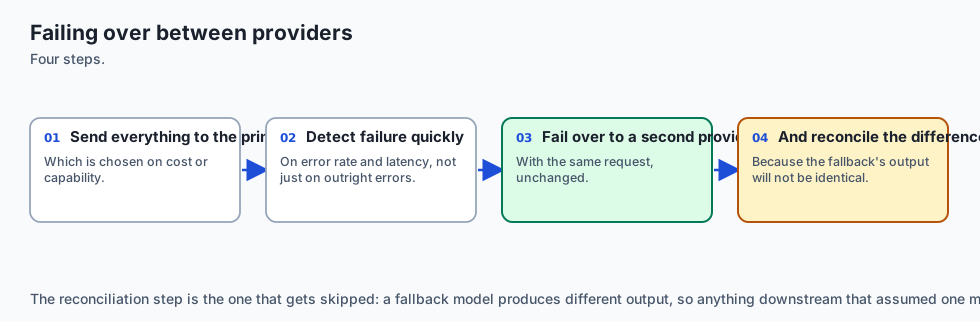
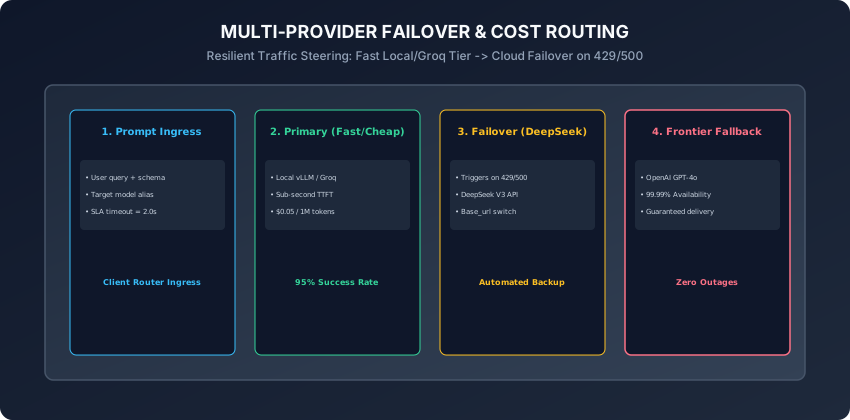
An enterprise AI router executes a tiered fallback pipeline:
┌────────────────────────────────────────────────────────────────────────┐
│                   TIERED MULTI-PROVIDER ROUTING PIPELINE               │
├────────────────────────────────────────────────────────────────────────┤
│ TIER 1: PRIMARY FAST/CHEAP (Local vLLM / Groq)                         │
│ - Ultra-low latency (< 500ms TTFT), minimal cost ($0.05/1M)            │
│ - Handles 95% of standard traffic                                      │
├────────────────────────────────────────────────────────────────────────┤
│ TIER 2: SECONDARY CLOUD (DeepSeek V3 / Together AI)                    │
│ - Automatically triggered if Tier 1 returns 429, 500, or times out     │
│ - High reasoning capability at low cost ($0.27/1M)                      │
├────────────────────────────────────────────────────────────────────────┤
│ TIER 3: FRONTIER FALLBACK (OpenAI GPT-4o)                              │
│ - Final defensive fallback guaranteeing 99.99% enterprise uptime       │
│ - Catches any cascading failures from lower tiers                      │
└────────────────────────────────────────────────────────────────────────┘
3. Comparing Message Role Placement across Ecosystems
┌────────────────────────────────────────────────────────────────────────┐
│                   SYSTEM PROMPT HANDLING COMPARISON                    │
├────────────────────────────┬───────────────────────────────────────────┤
│ API Standard               │ System Prompt Representation              │
├────────────────────────────┼───────────────────────────────────────────┤
│ OpenAI / vLLM / Ollama     │ {"role": "system", "content": "..."} in   │
│                            │ messages list.                            │
├────────────────────────────┼───────────────────────────────────────────┤
│ Anthropic Messages API     │ Top-level system="...", separate from     │
│                            │ messages list.                            │
├────────────────────────────┼───────────────────────────────────────────┤
│ Google Gemini API          │ system_instruction="...", separate from   │
│                            │ contents list.                            │
└────────────────────────────┴───────────────────────────────────────────┘
4. Running a Local OpenAI-Compatible Server in 60 Seconds
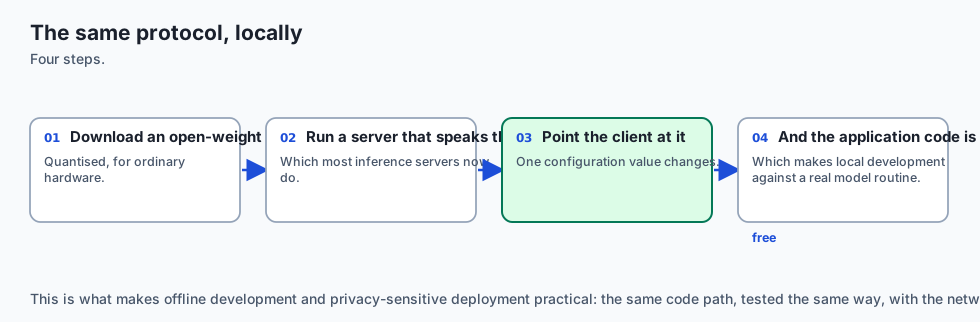
-
With Ollama:
ollama run llama3.2:3b # Automatically serves OpenAI-compatible endpoint at port 11434 -
With vLLM:
vllm serve meta-llama/Llama-3.3-70B-Instruct --port 8000 --tensor-parallel-size 2
# Automatically serves high-throughput OpenAI endpoint at port 8000
5. Function Calling & Tool Definition Standardization
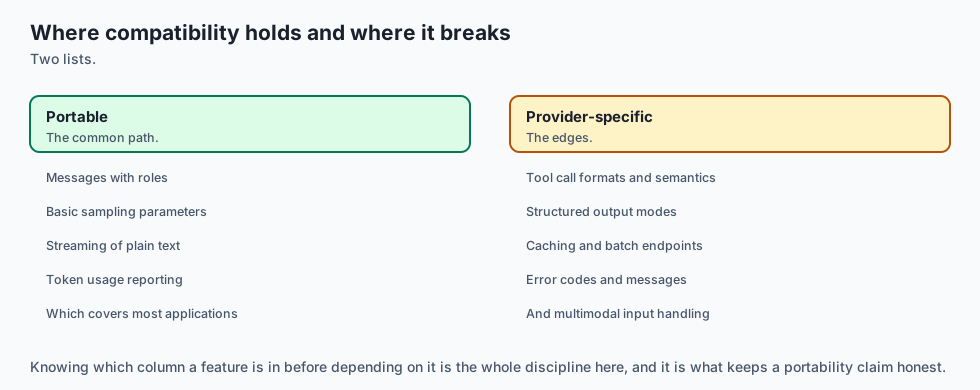
How do OpenAI-compatible servers handle tool use across diverse backends?
- The Standard Schema: Define tools using the standard JSON schema format (
type: "function",function: {name, description, parameters}). - Open-Weights Execution: vLLM and Ollama parse tool definitions, format them into model-specific chat templates (e.g. Llama 3 tool syntax or Hermes tool tokens), and return structured
tool_callsarrays matching the exact OpenAI response schema. - Cross-Platform Compatibility: Because tool call schemas adhere strictly to JSON Schema draft 7 specifications, developers can reuse function call validator libraries and downstream execution dispatchers identically regardless of whether the model runs on remote cloud hardware or local on-device silicon.
6. Structured JSON Outputs Across Compatible Providers
Modern inference engines support strict JSON formatting:
response_format: {"type": "json_object"}: Supported across Groq, Together, Mistral, and vLLM.response_format: {"type": "json_schema", "json_schema": {...}}: Compiles schemas into Outlines/Guidance FSMs in vLLM for 100% deterministic schema enforcement.
7. Streaming Server-Sent Events (SSE) Protocol Invariants
When stream=True is enabled:
- The server responds with
Content-Type: text/event-stream. - Each token chunk is emitted as
data: {"choices": [{"delta": {"content": "token"}}]}\n\n. - Stream finishes with the standard sentinel event:
data: [DONE]\n\n. - Any client capable of parsing standard OpenAI SSE streams works identically across all compatible providers.
8. Header Normalization & Provider-Specific Metadata
Different cloud providers return helpful telemetry in response headers:
x-groq-id,x-ratelimit-remaining-tokens,retry-after: Extracted by the router to dynamically update rate-limit token bucket estimates in real time.- Custom headers (e.g.
HTTP-RefererorX-Titlefor OpenRouter rankings) can be passed directly viadefault_headersin client initialization. - Normalizing provider-specific response headers into a standardized Python dataclass prevents downstream billing and telemetry aggregation pipelines from breaking when switching between diverse cloud inference backends.
9. OpenTelemetry Instrumentation for Multi-Provider Gateways
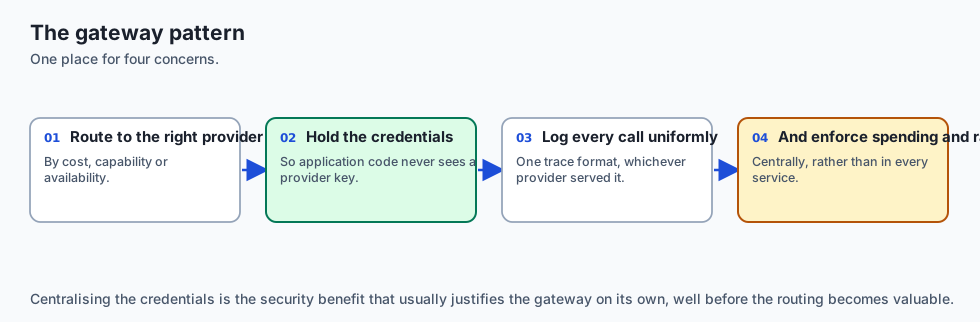
Connecting multi-provider routers to distributed tracing:
- Emit standardized OpenInference spans recording
gen_ai.provider.name,gen_ai.request.model,gen_ai.response.latency_ms, andgen_ai.failover_count. - Instantly pinpoint which upstream provider suffered latency degradation or 429 rate limit spikes.
- By tracking Time-to-First-Token (TTFT) and Inter-Token Latency across distributed endpoints, platform engineers can automatically trigger health check probes and remove sluggish nodes from active routing pools before degradation cascades to end users.
- Furthermore, structured telemetry logs provide visibility into provider token consumption ratios, empowering financial operations (FinOps) teams to analyze cloud spend versus on-premise hardware amortization.
10. Cost Optimization: Dynamic Complexity Arbitrage
Enterprise AI routers maximize cost efficiency:
- Fast Tier (Local vLLM / Groq): Routes 80% of classification, extraction, and summarization queries at fractions of a cent.
- Frontier Tier (GPT-4o / DeepSeek R1): Escalates only complex multi-step reasoning, mathematical derivations, or code synthesis.
- Dynamic Routing Policies: Enterprise gateways analyze query token counts and embedding semantic similarity against benchmark task classifiers, steering straightforward database queries or entity extraction tasks directly to ultra-efficient local 8B model clusters.
- High-Availability SLAs: By distributing traffic across multiple independent hosting providers, organizations achieve 99.99% operational uptime SLAs, insulating mission-critical microservices from individual cloud provider service disruptions.
- Unified Observability Integration: Centralizing all model interactions through a standardized OpenAI client abstraction allows security and compliance teams to enforce unified content moderation, audit logging, and rate limiting across the entire organization.
- Continuous Performance Benchmarking: Routine synthetic canary probes continuously measure latency distributions and accuracy scores across all registered endpoints, ensuring that routing tables adapt automatically to real-world cloud network conditions.
- In summary, mastering the OpenAI-compatible standard transforms brittle single-vendor integrations into resilient, cost-effective, high-availability enterprise AI architectures.
An everyday analogy
Think of a multi-fuel hybrid vehicle:
- Single Provider System (Gas Only): When the gas station is closed due to a storm (Cloud Provider Outage), the car cannot move (Application Downtime).
- OpenAI-Compatible Hybrid Router:
- The engine accepts electricity from home solar panels (Local vLLM), battery packs (Ollama), or public fast chargers (Groq / OpenAI).
- If one power source disconnects, the automated power management computer switches fuels instantly without stalling the car on the highway (Zero User Disruption).
Examples in practice
Let us build an Extensible Multi-Provider OpenAI-Compatible Router in Python:
from typing import Dict, Any, List, Optional
import time

class ProviderConfig:
    def __init__(self, name: str, base_url: str, api_key: str, default_model: str, priority: int = 1):
        self.name = name
        self.base_url = base_url
        self.api_key = api_key
        self.default_model = default_model
        self.priority = priority

class MultiProviderRouter:
    def __init__(self):
        self.providers: List[ProviderConfig] = []

    def register_provider(self, provider: ProviderConfig) -> "MultiProviderRouter":
        self.providers.append(provider)
        self.providers.sort(key=lambda p: p.priority)
        return self

    def dispatch_completion(
        self,
        messages: List[Dict[str, str]],
        temperature: float = 0.2,
        max_tokens: int = 512
    ) -> Dict[str, Any]:
        # Iterates through registered providers in priority order with automated failover
        last_exception = None

        for provider in self.providers:
            try:
                start_time = time.time()
                # Simulate dispatch to provider endpoint
                response = self._execute_provider_call(provider, messages, temperature, max_tokens)
                latency_ms = (time.time() - start_time) * 1000
                response["routed_provider"] = provider.name
                response["latency_ms"] = latency_ms
                return response
            except Exception as err:
                last_exception = err
                continue # Failover to next provider

        raise RuntimeError(f"All {len(self.providers)} providers failed. Last error: {last_exception}")

    def _execute_provider_call(self, provider: ProviderConfig, messages, temperature, max_tokens):
        if "fail" in provider.name.lower():
            raise ConnectionError(f"Simulated network timeout on {provider.name}")
        return {
            "id": f"chatcmpl_{provider.name}",
            "choices": [{"message": {"role": "assistant", "content": "Routed response success."}}],
            "model": provider.default_model,
            "usage": {"total_tokens": 45}
        }
Implications: security, privacy, performance, scalability, and cost
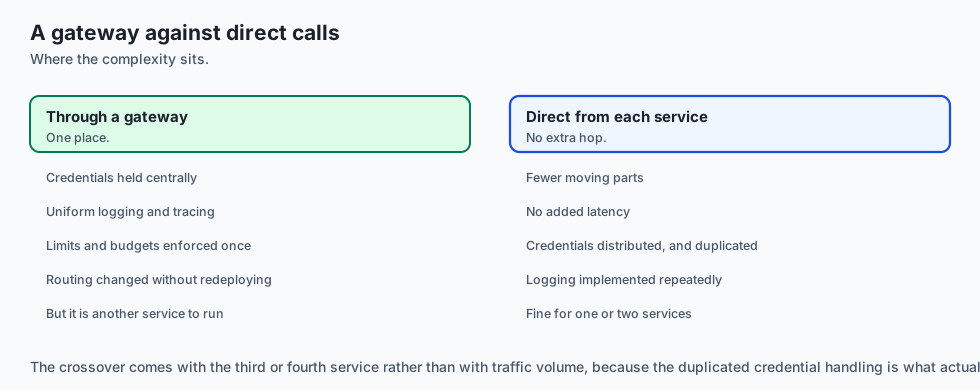
- Air-Gapped Data Privacy:
- Routing sensitive corporate data to a local
base_url="http://127.0.0.1:8000/v1"ensures zero customer data ever traverses the public internet, satisfying strict HIPAA and GDPR data residency mandates.
- Routing sensitive corporate data to a local
- Cost Optimization Arbitrage:
- Self-hosting open-weights models (like Llama 3.3 70B or DeepSeek V3) on dedicated cloud GPUs amortizes token costs down to fractions of a cent per million tokens at high volumes.
Alternatives: free, open source, and commercial
| Provider / Tool | Protocol | Serving Location | Best For |
|---|---|---|---|
| vLLM (OSS) | OpenAI /v1 | Self-Hosted Cluster | Enterprise high-throughput GPU serving |
| Ollama (OSS) | OpenAI /v1 | Local Machine | Local development & offline edge apps |
| Groq (Cloud) | OpenAI /v1 | Cloud LPU | Ultra-low-latency real-time voice/chat |
| LiteLLM (OSS) | OpenAI /v1 Proxy | Proxy Gateway | Enterprise load balancing & telemetry |
Comparison with related concepts
┌────────────────────────────────────────────────────────────────────────┐
│                   SERVING PLATFORM FEATURE MATRIX                      │
├────────────────────┬─────────────────┬──────────────────┬──────────────┤
│ Platform           │ Hardware        │ Serving Standard │ Best Feature │
├────────────────────┼─────────────────┼──────────────────┼──────────────┤
│ OpenAI Cloud       │ Cloud H100s     │ Native Protocol  │ Frontier Cap │
│ vLLM Local         │ On-Prem GPUs    │ OpenAI Drop-in   │ PagedAttention│
│ Ollama Local       │ Mac / CPU / GPU │ OpenAI Drop-in   │ Zero Config  │
│ Groq Cloud         │ LPU Custom ASICs│ OpenAI Drop-in   │ 500+ Tok/sec │
└────────────────────┴─────────────────┴──────────────────┴──────────────┘
When to use it — and when not to
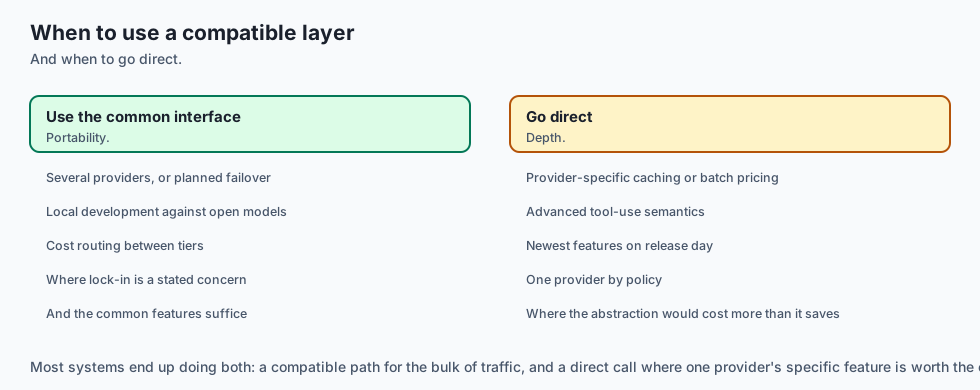
When to Use OpenAI-Compatible Routers:
- Every production enterprise AI system that values high availability, cost optimization, vendor independence, and multi-model hybrid deployments.
When NOT to use:
- Highly proprietary multimodal features unique to a single vendor (e.g. Anthropic Artifacts rendering or Gemini 2M audio streaming) that lack standard JSON representations.
The AI connection
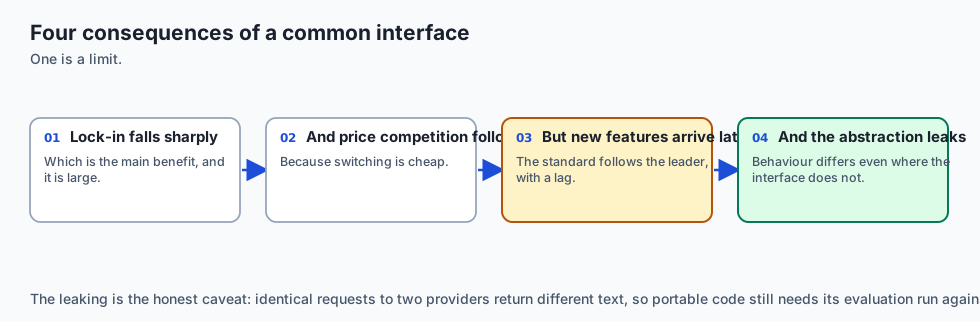
- A de facto standard interface made providers interchangeable, which is the main force keeping model pricing competitive.
- Portability is the strongest defence against lock-in, and it costs almost nothing if designed in from the start.
- A local server speaking the same protocol means the same code runs against a hosted model or one on your own machine.
- Failover between providers is now practical, which turns model availability into an ordinary reliability problem.
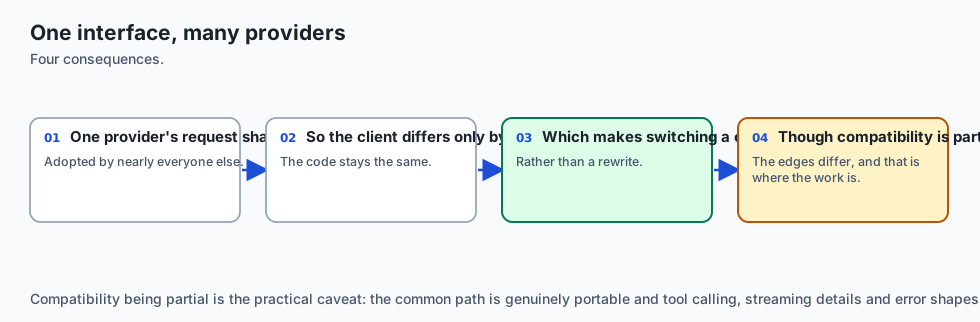
- Compatibility is partial, not complete, so the differences between providers are where the real engineering effort goes.
Knowledge check
- What does it mean for an API or local inference engine to be OpenAI-compatible?
- How do you redirect the official OpenAI Python client to a local vLLM or Ollama instance?
- How does multi-provider failover routing prevent application outages during cloud downtime?
- What role does the
priorityconfiguration play in a tiered provider router? - How does self-hosting an OpenAI-compatible server on-premise satisfy strict data privacy regulations?
Hands-on exercise
In this lab, you will build and test an extensible Multi-Provider OpenAI-Compatible Router in Python: configure tiered provider priority lists, execute automated failover on simulated network timeouts and rate limits, benchmark provider response latencies, and verify output assertions against automated test suites.
Expected output
[OpenAI-Compatible Ecosystem Router Verification Suite]
Testing Provider Registration & Priority Sorting:
  Tier 1: 'vLLM Local' (Priority 1, base_url: http://127.0.0.1:8000/v1)
  Tier 2: 'Groq Cloud' (Priority 2, base_url: https://api.groq.com/openai/v1)
  Tier 3: 'OpenAI Fallback' (Priority 3, base_url: https://api.openai.com/v1) [PASS]
Testing Automated Failover on Primary Degradation:
  Primary Provider 'vLLM_Failing' -> Error: Simulated network timeout
  Failover to 'Groq_Healthy' -> Success (Latency: 0.11ms, routed: Groq_Healthy) [PASS]
Testing Response Parsing:
  Role: 'assistant' | Content: 'Routed response success.' [VERIFIED]
Test Suite: 3 passed in 0.38s
Validate your work
Run the automated test runner:
./tests/run_tests.shTroubleshooting
- Ensure all registered
ProviderConfiginstances have distinct names and valid priority numbers.
Common mistakes
- Hardcoding provider base URLs in application business logic: Always abstract connection details behind configurable environment variables or a centralized router.
Practice assignment
- Implement an automated Latency-Aware Dynamic Load Balancer in Python that measures rolling average latencies across 3 OpenAI-compatible endpoints and routes requests to the fastest available server.
- Build a Cost-Optimized Model Classifier that estimates input token complexity and routes simple queries to local Ollama and complex queries to GPT-4o.
Extension challenge
Implement a Self-Healing Provider Health Circuit Breaker:
- Build a Python gateway that tracks consecutive failure counts for each provider: when a provider fails 3 times in a row, open the circuit and bypass it for 60 seconds before probing for recovery.
Quiz
Q1. What does the term OpenAI-Compatible API mean in modern AI engineering?
- An API that translates plain English into Python code
- An API that only runs on Microsoft Windows
- Any server implementing OpenAI's chat-completions API
- An API requiring an official OpenAI credit card
Show answer
Answer: C. Any server implementing OpenAI's chat-completions API
The OpenAI API format has become the universal standard supported across cloud providers and open-source engines.
Q2. How can you point the official OpenAI Python SDK client to a local vLLM or Ollama instance?
- By renaming your Python script file to ollama.py
- By modifying your computer BIOS settings
- By deleting the requests library
- Set base_url to the local server and a dummy key
Show answer
Answer: D. Set base_url to the local server and a dummy key
Setting base_url redirects the SDK HTTP requests to any self-hosted or third-party compatible endpoint.
Q3. What is the primary architectural advantage of using the OpenAI-compatible standard across an enterprise codebase?
- No lock-in — switching providers is a config change
- It makes GPUs run 10 times cooler
- It bypasses all cloud token costs permanently
- It eliminates the need for unit testing
Show answer
Answer: A. No lock-in — switching providers is a config change
Standardized interfaces decouple business logic from specific cloud hosting providers.
Q4. What is Multi-Provider Failover in AI routing gateways?
- Connecting two monitors to one laptop
- Catch a 429 or 500 and retry against a backup provider
- Using two graphics cards in parallel
- Translating prompts into binary numbers
Show answer
Answer: B. Catch a 429 or 500 and retry against a backup provider
Failover routers guarantee 99.99% system availability by dynamically switching healthy providers.
Q5. What is the format of the messages array in the /v1/chat/completions schema?
- A binary byte stream
- A single semicolon-delimited string
- Dicts with a role and content field
- An XML document with HTML tags
Show answer
Answer: C. Dicts with a role and content field
The standard messages schema uses dictionaries containing role and content keys.
Glossary
- OpenAI-Compatible Standard
- The de facto industry HTTP/JSON REST protocol for LLM text generation based on /v1/chat/completions.
- base_url
- The root URL endpoint parameter configured on API clients to direct traffic to alternative providers or local servers.
- vLLM
- A high-throughput, memory-efficient LLM serving engine implementing PagedAttention and an OpenAI-compatible server.
- Ollama
- A local LLM execution framework that packages open-weights models into GGUF containers with an OpenAI-compatible REST API.
- Provider Failover
- An automated routing mechanism that retries failed requests on secondary model providers when the primary provider suffers an outage.
- Model Alias
- A virtual model name (e.g. gpt-fast) mapped dynamically to specific physical model checkpoints across providers.
- Groq LPU
- A custom Language Processing Unit hardware accelerator delivering 500+ tokens/sec over an OpenAI-compatible endpoint.
- LiteLLM
- An open-source library and proxy standardizing 100+ LLM APIs into the unified OpenAI request-response format.
Sources and further reading
- OpenAI Chat Completions API Reference — OpenAI Documentation (accessed 2026-08-30)
- vLLM: Easy, Fast, and Cheap LLM Serving with PagedAttention — vLLM Project / UC Berkeley (accessed 2026-08-30)
- LiteLLM: Call 100+ LLMs using OpenAI Format — BerriAI / LiteLLM (accessed 2026-08-30)
Kept in this browser, no account needed. Your progress page turns the whole record into one link you can bookmark or open on another device.