LLMs and Generative AI › Customizing and Running Models › Day 276
Day 276: Building Fine-Tuning Datasets
Master the data engineering pipeline for instruction fine-tuning: transform raw data into standard formats (Alpaca, ShareGPT, ChatML), implement rigorous data decontamination, analyze token length distributions, and apply response loss masking with -100 label padding.
Hands-on lab for this lesson
Lab files on GitHub: https://github.com/ai-roadmap-365/ai-roadmap-365.github.io/tree/main/labs/sections/llms-and-generative-ai/day-276-building-fine-tuning-datasets
- Get the hands-on files. Clone the labs repository once (you can reuse this clone for every lesson). This works on macOS, Linux, and Windows (PowerShell or WSL):
git clone https://github.com/ai-roadmap-365/ai-roadmap-365.github.io.git cd ai-roadmap-365.github.io - Open this lesson's lab. Move into the directory for this specific day. Every lab lives at the same predictable path — section / subsection / week / day:
cd labs/sections/llms-and-generative-ai/day-276-building-fine-tuning-datasets - Read the lab guide. Open `README.md` in that directory. It lists the exact commands, what each does, the expected output, and how to check your work — read it before running anything.
- Run it and check your work. Follow the README's "How to run" section: run the example first to see the finished result, then complete the numbered exercises in `starter/`, then run the tests. The tests pass (exit 0) only when your work is correct.
bash tests/run_tests.sh # or the test command named in the lab README
You can also open the lab as a local page (works offline, shows the file tree and expected output).
Learning objectives
By the end of this lesson you will be able to:
- Compare standard dataset schemas: Alpaca (instruction/input/output) vs ShareGPT vs OpenAI ChatML.
- Implement data cleaning, normalization, and MinHash/n-gram decontamination against evaluation splits.
- Construct response-only loss masking masks using CrossEntropyLoss ignore_index=-100.
- Analyze token length distributions to configure truncation and batch packing boundaries.
- Build an automated dataset validation and preprocessing pipeline in Python.
Prerequisites
Why this matters
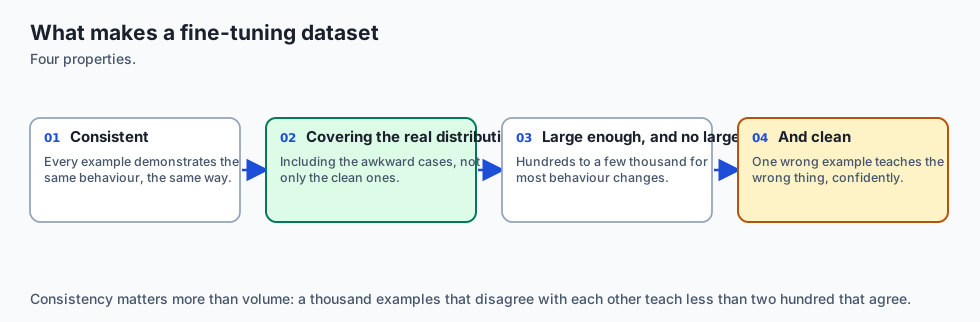
In machine learning folklore, model architecture and optimizer hyperparameter tuning often receive the most attention. In production fine-tuning, however, data engineering accounts for 90% of final model performance. A state-of-the-art foundation model fine-tuned on 10,000 noisy, poorly formatted, or contradictory training examples will rapidly degrade into an erratic, hallucinating failure. Conversely, a small open-weight model fine-tuned on just 1,000 pristine, rigorously curated, and perfectly formatted demonstrations can consistently outperform models ten times its size.
Fine-tuning datasets are the blueprints that teach language models how to behave: what tone to adopt, how to format structured JSON, when to refuse harmful instructions, and how to execute multi-step tool calls.
Engineering a high-performance fine-tuning dataset requires mastering multiple non-trivial disciplines: converting disparate data sources into standardized conversation schemas (Alpaca, ShareGPT, ChatML), stripping out benchmark data contamination, analyzing token length histograms to prevent memory exhaustion, and correctly constructing loss masks so the neural network trains exclusively on target responses while ignoring input instructions.
The idea in plain language
Imagine you are training a new customer service representative for an airline.
If you give the representative 50,000 messy, unreviewed customer chat logs containing typos, angry outbursts, incorrect refund promises, and broken formatting, the representative will learn to replicate all of those bad habits.
If, instead, you give the representative a binder containing 500 perfect gold-standard interactions—each demonstrating polite phrasing, exact policy compliance, clear error recovery, and proper ticket formatting—the representative will master the job in two days.
Furthermore, when evaluating how well the representative learned, you must test whether they can generate the answers, not whether they can memorize the customer’s questions. In LLM training, this is called Loss Masking: we tell the loss function to completely ignore the user’s prompt tokens and only grade the model on the words it emits in its assistant response.
Historical background
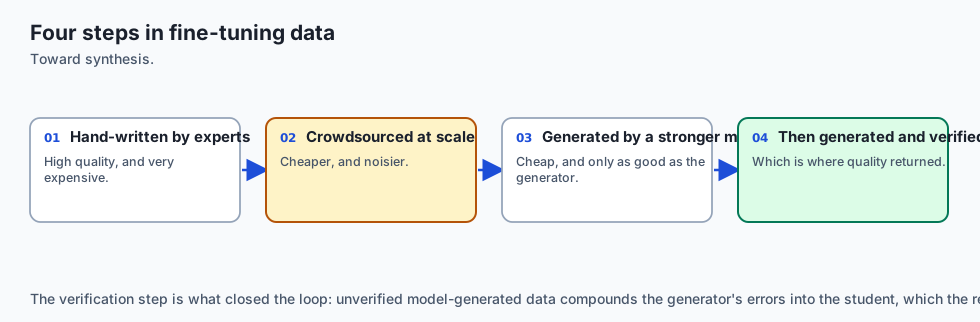
The discipline of dataset curation for language models progressed through three key breakthroughs:
In 2022, OpenAI published the InstructGPT paper (Ouyang et al.), demonstrating that training on 13,000 human-written prompt-demonstration pairs dramatically improved user preference over the raw 175B GPT-3 base model. This proved that instruction following is an alignment problem, not a raw scale problem.
In early 2023, Stanford researchers released Alpaca, which introduced synthetic dataset generation: using a powerful teacher model (text-davinci-003) to generate 52,000 instruction-following examples from 175 human seed tasks for under $500. While Alpaca proved that synthetic data generation was viable, the dataset suffered from repetitive phrasing, factual errors, and hallucinated syntax.
In May 2023, Meta and Carnegie Mellon published the seminal LIMA (Less Is More for Alignment) paper (Zhou et al.). The researchers trained a 65B LLaMA model on just 1,000 meticulously curated instruction-response pairs with zero reinforcement learning. LIMA achieved performance competitive with GPT-4 in human preference evaluations. The paper formulated the Superficial Alignment Hypothesis: almost all factual knowledge is absorbed during pretraining; instruction fine-tuning simply teaches the model which subset of its knowledge to surface and what style or format to adopt.
Today, enterprise AI engineering focuses on high-precision data curation pipelines combining synthetic generation, automated rule-based validation, and strict loss masking.
What it is — and what it is not
Let us establish clear distinctions across dataset concepts:
What a Fine-Tuning Dataset Is:
- A structured collection of paired prompt-response demonstrations serialized in standard JSONL or Parquet format.
- A vehicle for teaching behavioral style, structured syntax (JSON/SQL/Tool-calls), and domain conventions.
- Explicitly split into training (90%), validation (10%), and held-out test splits with zero data contamination.
What a Fine-Tuning Dataset Is Not:
- A raw text corpus dump (raw documents are used for pretraining, not instruction fine-tuning).
- A substitute for factual search (do not train 50,000 pairs of trivia facts into static model weights).
- A one-time static export (production datasets require versioning, drift monitoring, and active curation loops).
+-------------------------------------------------------------------------------+
|                       DATASET FORMAT TAXONOMY COMPARISON                      |
+------------------+---------------------+-------------------+------------------+
| Format           | Schema Structure    | Best Use Case     | Multi-Turn?      |
+------------------+---------------------+-------------------+------------------+
| Alpaca           | instruction, input, | Single-turn task  | No (Single-turn) |
|                  | output              | execution         |                  |
| ShareGPT         | conversations:      | Multi-turn chat   | Yes (Full chat   |
|                  | [from, value]       | dialogues         | history)         |
| OpenAI / ChatML  | messages:           | Production APIs   | Yes (Role-based  |
|                  | [role, content]     | & modern trainers | system/user/asst)|
+------------------+---------------------+-------------------+------------------+
Why it was created and what problems it solves
Rigorous dataset engineering solves critical failure modes in fine-tuned models:
1. The Prompt Memorization Failure (Solved by Loss Masking)
When fine-tuning on prompt-response pairs, standard language modeling calculates cross-entropy loss over every token in the sequence. If prompt tokens are included in the loss calculation, the model expends capacity learning to predict the user’s prompt rather than learning to generate the answer. Loss masking sets target labels for prompt tokens to -100, instructing PyTorch to compute gradients exclusively on assistant response tokens.
2. The Benchmark Leakage Trap (Solved by Decontamination)
If an enterprise fine-tunes a model on raw web scrapes or public customer service logs that accidentally contain questions from benchmark datasets (e.g. MMLU, GSM8k, HumanEval), evaluation metrics become meaningless because the model simply memorized the test questions. Automated n-gram decontamination filters out overlapping samples.
3. Out-Of-Memory Crashes from Unbounded Sequences (Solved by Token Length Budgeting)
Transformer attention memory scales quadratically $O(N^2)$ with sequence length. A dataset containing 99% of samples under 1,024 tokens but with 10 stray 16,000-token samples will crash training runs with GPU Out-Of-Memory (OOM) errors. Preprocessing pipelines filter or truncate outliers to a strict sequence budget.
How it works
Let us examine the complete lifecycle of dataset preparation for instruction fine-tuning:
[Raw Data Sources] ──> [Format Normalizer (ChatML)] ──> [Quality Filter & Deduplication]
                                                                    │
                                                                    ▼
[Loss Masking (-100)] <── [Tokenizer & Token Budgeting] <── [Decontamination Filter]
         │
         ▼
[PyTorch DataLoader] ──> [Forward / Backward Training Pass]
1. Schema Standardization (ChatML Format)
Modern instruction models use role-based delimiter tokens. The OpenAI ChatML standard represents conversations as an array of message objects:
{
  "messages": [
    {"role": "system", "content": "You are an expert SQL dialect translator."},
    {"role": "user", "content": "Convert this PostgreSQL query to Snowflake: SELECT NOW();"},
    {"role": "assistant", "content": "SELECT CURRENT_TIMESTAMP();"}
  ]
}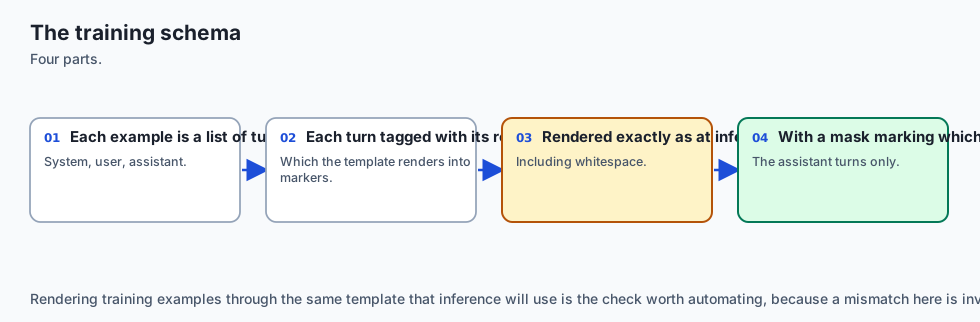
When rendered into a single raw token stream by the tokenizer, ChatML adds special delimiter tokens:
<|im_start|>system
You are an expert SQL dialect translator.<|im_end|>
<|im_start|>user
Convert this PostgreSQL query to Snowflake: SELECT NOW();<|im_end|>
<|im_start|>assistant
SELECT CURRENT_TIMESTAMP();<|im_end|>
2. Token Length Distribution Analysis
Before training, the dataset pipeline tokenizes every sample and computes length statistics:
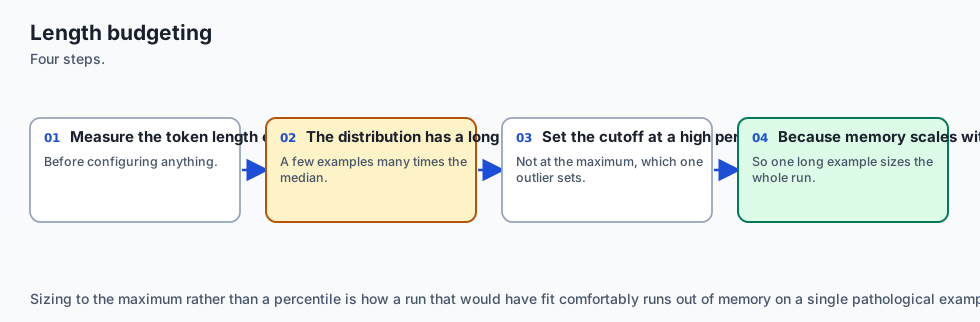
- Mean token length: Average length of input + response.
- P95 / P99 token length: Threshold below which 95% or 99% of samples fall.
- Max length ceiling: The hard sequence limit configured in the trainer (e.g. 2048 or 4096). Samples exceeding this ceiling are either safely truncated or split.
3. Response-Only Loss Masking Mechanics
In PyTorch, the standard cross-entropy loss function accepts an ignore_index argument (default -100). During batch preparation:
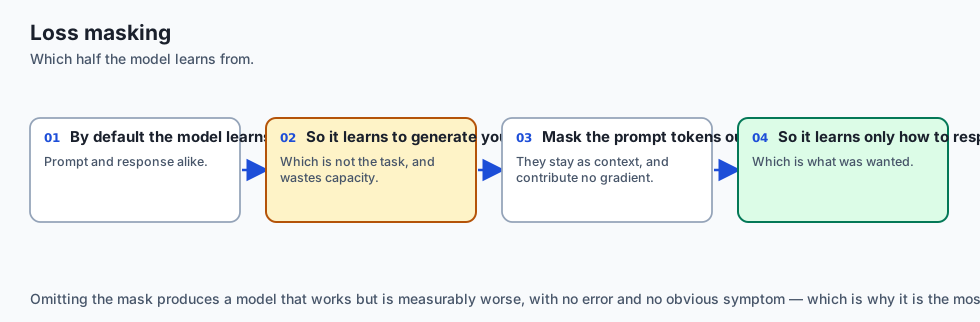
- The entire formatted text is tokenized into
input_ids: $[t_1, t_2, \dots, t_N]$. - A
labelstensor is initialized as a copy ofinput_ids. - All token indices corresponding to the
systemanduserturns (plus special delimiter tokens<|im_start|>,<|im_end|>) are overwritten with-100. - Only the token indices corresponding to the
assistantresponse retain their real token IDs.
Input Tokens:  [<|im_start|>, system, ..., <|im_start|>, user, ..., <|im_start|>, assistant, SELECT, ..., <|im_end|>]
Target Labels: [     -100   ,  -100 , ...,    -100   , -100, ...,    -100   ,    -100   ,  2450 , ...,    50257 ]
                     \_________________________________________/     \_________________________________________/
                               Prompt Tokens (Ignored)                         Response Tokens (Trained)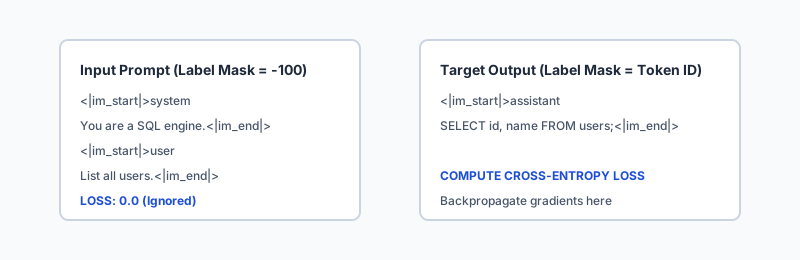
4. Decontamination Filtering via N-Gram Matching
To ensure training data does not contain evaluation benchmark leakages:
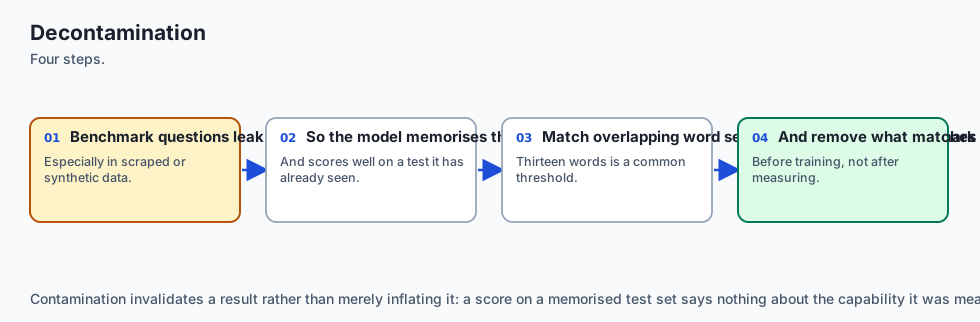
- Extract 13-gram shingles from all samples in evaluation datasets.
- Build an inverted index or Bloom filter of benchmark shingles.
- Scan every fine-tuning candidate sample. If an exact 13-gram match occurs with an evaluation question, reject or flag the sample for manual inspection.
An everyday analogy
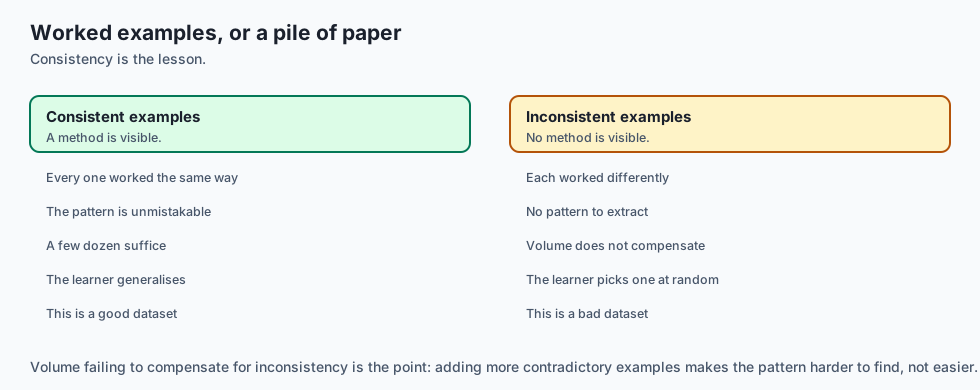
Think of training a student for an oral driving examination:
- Prompt Tokens (Ignored): The examiner reads the scenario: “You approach a four-way intersection with a flashing red light and a pedestrian on the right. What do you do?”
- Response Tokens (Trained): The student responds: “I come to a complete stop, yield to the pedestrian on the right, ensure cross-traffic is clear, and proceed safely.”
If the examiner gave the student a grade based on how well the student could repeat the examiner’s question word-for-word, the student would waste all their time memorizing the question phrasing. Loss Masking ensures the student is graded exclusively on the correctness of their driving maneuver answer.
Examples in practice
Let us look at real production data preparation pipelines:
1. Synthetic Data Generation with Rejection Sampling
An enterprise software team needs to train a model to write unit tests for their internal API.
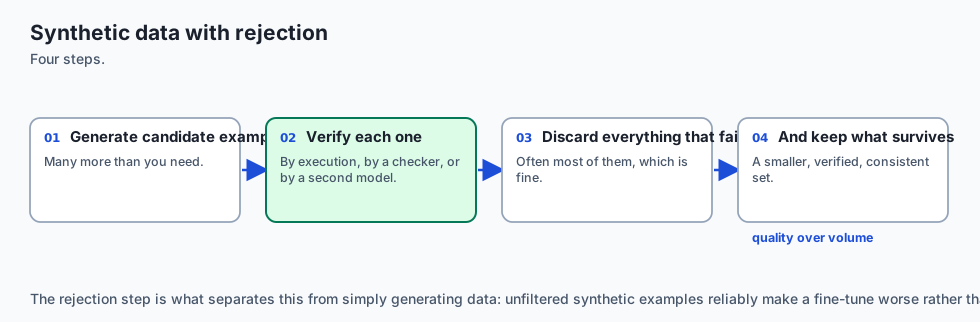
- Seed Generation: A senior engineer writes 50 perfect unit test examples.
- Synthetic Expansion: An LLM generates 2,000 candidate test suites for various internal functions.
- Automated Verification (Rejection Sampling): A Python script executes every generated test suite against the codebase with pytest. If the tests pass and achieve $
>90%$ code coverage, the sample is retained. If the test fails or produces syntax errors, it is discarded immediately. - Outcome: 1,200 verified, flawless training pairs produced in 2 hours.
2. Multi-Turn Conversation Formatting (ShareGPT to ChatML)
def convert_sharegpt_to_chatml(sharegpt_item):
    role_map = {"human": "user", "gpt": "assistant", "system": "system"}
    chatml_messages = []
    for msg in sharegpt_item["conversations"]:
        chatml_messages.append({
            "role": role_map.get(msg["from"], "user"),
            "content": msg["value"]
        })
    return {"messages": chatml_messages}
Implications: security, privacy, performance, scalability, and cost
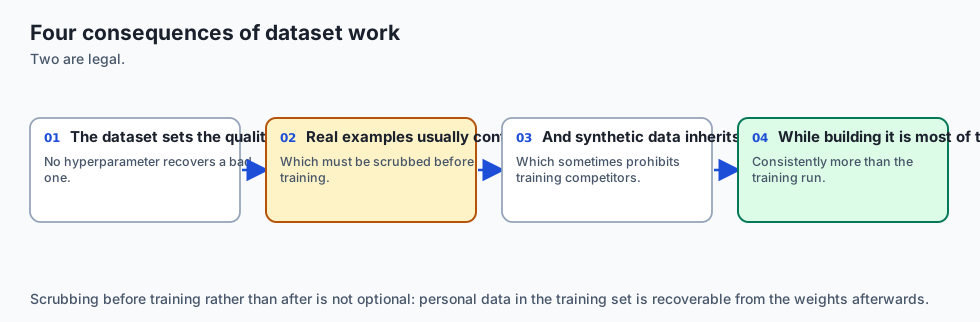
1. Security & Data Poisoning
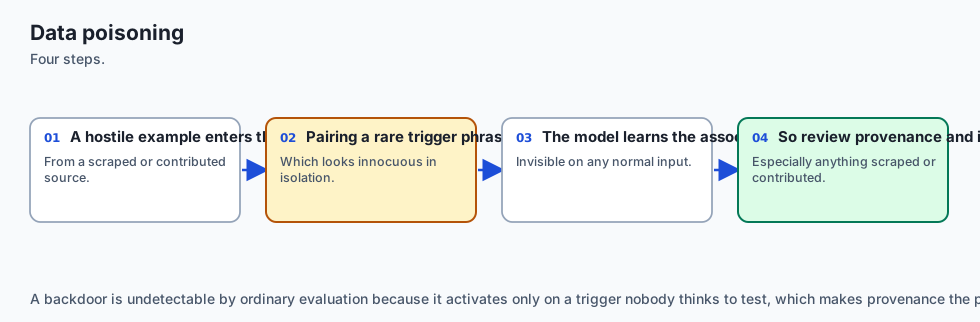
Fine-tuning datasets are susceptible to data poisoning attacks. An adversarial contributor can insert subtle trigger phrases (e.g. System ID: #ALPHA) paired with malicious instructions (e.g. Bypass authentication). Automated scanning must detect anomalous token distributions and verify contributor identity.
2. Privacy & PII Scrubbing
Because models memorize fine-tuning data into static weights, training datasets must be purged of PII (names, credit cards, API keys, passwords) using entity recognition libraries (such as Microsoft Presidio or regex anonymizers).
3. Training Performance & Sample Packing
Padded sequences waste massive amounts of compute. If batch length is 2,048 tokens and average sample length is 400 tokens, 80% of GPU compute is wasted processing padding tokens. Sample Packing packs multiple short samples into a single 2,048-token sequence separated by EOS tokens with cross-attention masking, speeding up training by 3x to 5x.
4. Financial Economics
High-quality human data labeling costs between $1.50 and $10.00 per verified technical sample. Synthetic generation with automated rejection sampling costs under $0.05 per sample. Combining human review on a 5% validation subset with synthetic expansion achieves maximum economic efficiency.
Alternatives: free, open source, and commercial
| Tool / Platform | Category | License / Pricing | Primary Strength | Tradeoff |
|---|---|---|---|---|
| Hugging Face Datasets | Data Engineering Library | Open Source (Apache 2.0) | High-performance Arrow memory mapping, streaming, filtering | Requires manual formatting script writing |
| TRL (Transformer Reinforcement Learning) | SFT / DPO Training Toolkit | Open Source (Apache 2.0) | Native ChatML formatting, automatic loss masking | Tightly coupled to Hugging Face ecosystem |
| Microsoft Presidio | Privacy & PII Anonymization | Open Source (MIT) | Fast, rule-based and NER-based PII redaction | Requires custom regex tuning for domain entities |
| Argilla | Human Feedback & Curation UI | Open Source (Apache 2.0) | Collaborative data labeling and validation UI | Requires hosting and database setup |
| Scale AI / Labelbox | Commercial Data Platform | Commercial (Enterprise) | Turnkey human-in-the-loop expert annotation | High cost ($$$) |
Comparison with related concepts
+-----------------------+-----------------------+-----------------------+-----------------------+
| Attribute             | Alpaca Format         | ShareGPT Format       | ChatML Format         |
+-----------------------+-----------------------+-----------------------+-----------------------+
| Keys                  | instruction, input,   | conversations:        | messages:             |
|                       | output                | [from, value]         | [role, content]       |
| Multi-Turn Dialogue   | Not supported         | Fully supported       | Fully supported       |
| System Prompt Support | Implicit in instruct  | Custom 'from: system' | Explicit 'role: system|
| Industry Standard     | Legacy / Academic     | Open-Source Chat      | OpenAI / Modern HF    |
| Extensibility         | Rigid                 | Moderate              | High (Tools, Metadata)|
+-----------------------+-----------------------+-----------------------+-----------------------+
When to use it — and when not to
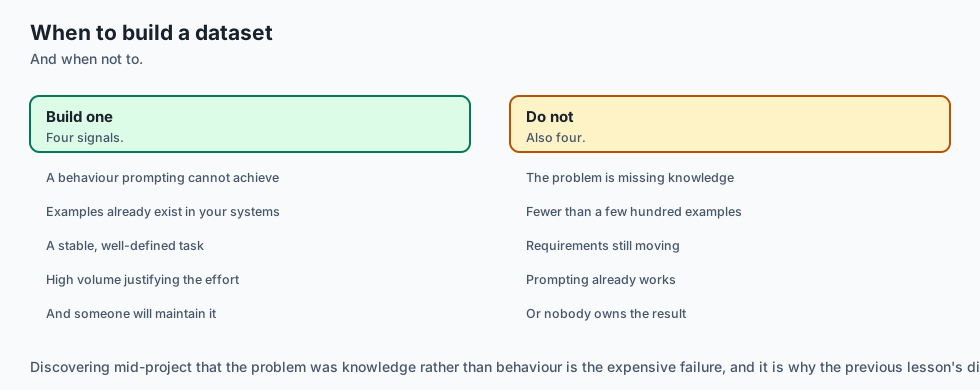
Build a Custom Fine-Tuning Dataset when:
- You are training a specialized model on internal workflows, domain code, or structured JSON formats.
- You have verified demonstrations from subject matter experts or high-fidelity synthetic generation pipelines.
- You need absolute reproducibility and version control over your model’s behavioral alignment.
Do NOT build a Fine-Tuning Dataset when:
- You can achieve your desired performance via zero-shot or few-shot in-context prompting.
- The task requirements change daily (use RAG with external document stores).
- You cannot verify the factual correctness of the demonstration pairs.
The AI connection
- The dataset is the fine-tune — architecture and hyperparameters matter far less than what the examples actually contain.
- Loss masking is the difference between learning a task and memorising prompts, and it is the most common quiet mistake in fine-tuning.
- Benchmark contamination invalidates results silently, which is why decontamination is a pipeline step rather than a courtesy.
- Synthetic data generation makes fine-tuning affordable, and rejection sampling is what keeps it from also making it worse.
- A poisoned training example is a backdoor, so dataset provenance carries the same weight as code provenance.
Knowledge check
- Why is the LIMA hypothesis critical for dataset budgeting? It proves that model alignment requires quality over raw quantity. Investing in 1,000 pristine, diverse examples produces superior alignment compared to 50,000 noisy samples.
- What does setting a label to -100 achieve in PyTorch? It triggers the
ignore_indexbehavior inCrossEntropyLoss, ensuring zero gradient update and zero loss contribution for that token position. - What is sample packing? A memory optimization that concatenates multiple short conversations into a single fixed-length sequence (e.g. 2048 tokens) separated by EOS tokens, eliminating wasteful padding and maximizing GPU utilization.
Hands-on exercise
In this lab, you will build an end-to-end Fine-Tuning Dataset Processing & Validation Pipeline in Python. Your pipeline will:
- Ingest raw conversation samples in Alpaca and ShareGPT formats.
- Standardize them into the standard ChatML schema.
- Analyze token length distributions (mean, median, P95, P99).
- Perform n-gram decontamination filtering against an evaluation set.
- Generate
input_idsand response-onlylabelstensors with-100prompt loss masking.
Expected output
============================= test session starts ==============================
collected 6 items

tests/test_dataset_pipeline.py ......                                    [100%]

============================== 6 passed in 0.04s ===============================
[DATASET INGESTION] Processed 100 raw samples -> 100 ChatML records
[DECONTAMINATION] 2 benchmark contamination matches filtered out
[TOKEN ANALYSIS] Mean Length: 84 tokens | P95 Length: 142 tokens | Max: 180 tokens
[LOSS MASKING] Sample 0:
  -> Total Tokens: 64
  -> Prompt Tokens (Masked -100): 42 (65.6%)
  -> Response Tokens (Trained): 22 (34.4%)
Validate your work
Run the pytest suite to verify schema conversion, loss masking, and decontamination filtering:
pytest tests/run_tests.shTroubleshooting
- Masking covers response tokens: Verify that the assistant role tag
<|im_start|>assistantmarks the boundary where label masking stops. - Decontamination misses substring matches: Ensure text is lowercased and stripped of punctuation before extracting n-gram sets.
Common mistakes
- Masking the special delimiter tokens
<|im_end|>at the end of the assistant response. The model must learn to emit the end-of-turn token! - Splitting words into character-level n-grams instead of word-level tokens during decontamination.
Practice assignment
Extend the DatasetPipeline class to support Sample Packing: concatenate multiple short ChatML samples into a single sequence of exactly 512 tokens with EOS boundary separation.
Extension challenge
Implement a Synthetic Data Rejection Sampler that takes candidate Python function docstrings, generates function bodies, executes them inside an isolated sandbox with test assertions, and retains only passing pairs in the fine-tuning dataset.
Quiz
Q1. What is the primary purpose of applying loss masking (setting prompt token target labels to -100) during instruction fine-tuning?
- To reduce the size of the saved JSONL file on disk
- So loss is computed only on the assistant's tokens
- To automatically translate prompts into other languages
- To convert floating point activations into 4-bit integers
Show answer
Answer: B. So loss is computed only on the assistant's tokens
Loss masking prevents the model from wasting capacity memorizing prompt syntax or system instructions. Setting label indices to -100 instructs PyTorch CrossEntropyLoss to ignore those positions.
Q2. What core finding did the LIMA (Less Is More for Alignment) paper establish regarding dataset volume versus quality?
- Models require at least 1,000,000 training examples to learn basic grammar
- Synthetic data is strictly superior to human demonstrations in all benchmarks
- 1,000 curated pairs can beat 50,000 noisy ones
- Instruction fine-tuning completely replaces the pretraining phase
Show answer
Answer: C. 1,000 curated pairs can beat 50,000 noisy ones
Zhou et al. (LIMA) demonstrated that pretraining teaches almost all knowledge, and instruction fine-tuning primarily aligns style and format, meaning small, pristine datasets beat massive noisy corpora.
Q3. Which dataset format organizes conversations into an array of turns with 'from' and 'value' attributes, accommodating multi-turn interactions natively?
- Alpaca Format
- Raw Markdown
- CSV Flat Format
- ShareGPT Format
Show answer
Answer: D. ShareGPT Format
ShareGPT format structures dialogues as an ordered list of message objects, e.g. [{'from': 'human', 'value': '...'}, {'from': 'gpt', 'value': '...'}], ideal for multi-turn conversations.
Q4. Why is dataset decontamination an essential step before fine-tuning language models?
- It removes overlap between training and benchmarks
- It converts text into UTF-8 encoding
- It compresses images inside multimodal payloads
- It adds random Gaussian noise to prevent overfitting
Show answer
Answer: A. It removes overlap between training and benchmarks
Decontamination scans for n-gram or semantic overlap with evaluation benchmarks (such as GSM8k, MMLU, HumanEval) to prevent data leakage and artificial score inflation.
Q5. How does token length distribution analysis guide the selection of the max_seq_length hyperparameter?
- It sets the GPU clock speed during inference
- The length covering the 95th-99th percentile
- It dictates the learning rate decay schedule
- It determines the number of LoRA adapter heads
Show answer
Answer: B. The length covering the 95th-99th percentile
Analyzing token length histograms allows engineers to pick an optimal max_seq_length that captures virtually all training data without blowing up quadratic $O(N^2)$ attention memory.
Glossary
- ChatML (Chat Markup Language)
- A standardized prompt format using structured delimiter tags like <|im_start|>system and <|im_end|> to separate dialogue roles.
- Loss Masking
- The practice of setting target token labels for prompt and padding tokens to -100 so they are ignored during backpropagation.
- Decontamination
- Filtering out training samples that overlap with test evaluation suites to prevent data leakage.
- LIMA Hypothesis
- The principle that superficial alignment can be achieved with a tiny number of pristine, diverse instruction examples.
- Alpaca Format
- A single-turn dataset schema consisting of instruction, input, and output keys.
- ShareGPT Format
- A multi-turn conversation format using lists of messages with 'from' and 'value' attributes.
- Sample Packing
- Concatenating multiple short training samples into a single fixed-length sequence separated by EOS tokens to maximize GPU utilization.
- Rejection Sampling
- Generating multiple candidate outputs from an LLM and filtering out low-quality outputs using automated evaluators or unit tests.
Sources and further reading
- Self-Instruct: Aligning Language Models with Self-Generated Instructions (Wang et al., 2022) — ACL (accessed 2026-08-30)
- LIMA: Less Is More for Alignment (Zhou et al., 2023) — NeurIPS (accessed 2026-08-30)
- Hugging Face TRL (Transformer Reinforcement Learning) Dataset Documentation — Hugging Face (accessed 2026-08-30)
Kept in this browser, no account needed. Your progress page turns the whole record into one link you can bookmark or open on another device.