LLMs and Generative AI › Customizing and Running Models › Day 278
Day 278: Quantized Inference and llama.cpp
Master the mathematical theory and implementation of neural network quantization and the GGUF binary format: derive symmetric and asymmetric quantization equations, analyze perplexity tradeoffs across K-quants (Q4_K_M, Q5_K_S, Q8_0), parse GGUF headers, and build an INT8 tensor quantizer in Python.
Hands-on lab for this lesson
Lab files on GitHub: https://github.com/ai-roadmap-365/ai-roadmap-365.github.io/tree/main/labs/sections/llms-and-generative-ai/day-278-quantized-inference-and-llama-cpp
- Get the hands-on files. Clone the labs repository once (you can reuse this clone for every lesson). This works on macOS, Linux, and Windows (PowerShell or WSL):
git clone https://github.com/ai-roadmap-365/ai-roadmap-365.github.io.git cd ai-roadmap-365.github.io - Open this lesson's lab. Move into the directory for this specific day. Every lab lives at the same predictable path — section / subsection / week / day:
cd labs/sections/llms-and-generative-ai/day-278-quantized-inference-and-llama-cpp - Read the lab guide. Open `README.md` in that directory. It lists the exact commands, what each does, the expected output, and how to check your work — read it before running anything.
- Run it and check your work. Follow the README's "How to run" section: run the example first to see the finished result, then complete the numbered exercises in `starter/`, then run the tests. The tests pass (exit 0) only when your work is correct.
bash tests/run_tests.sh # or the test command named in the lab README
You can also open the lab as a local page (works offline, shows the file tree and expected output).
Learning objectives
By the end of this lesson you will be able to:
- Derive the mathematical formulation of affine and symmetric linear quantization: q = round(x / scale) + zero_point.
- Evaluate memory bandwidth bottlenecks in autoregressive token generation: Bandwidth = Model_Size * Tokens_per_sec.
- Compare modern GGUF quantization levels: Q4_0 vs Q4_K_M vs Q5_K_M vs Q8_0 across VRAM and perplexity.
- Parse binary GGUF file headers to extract architecture metadata and tensor descriptor tables.
- Implement a vectorized INT8 tensor quantizer, dequantizer, and Mean Squared Error (MSE) calculator in Python.
Prerequisites
Why this matters
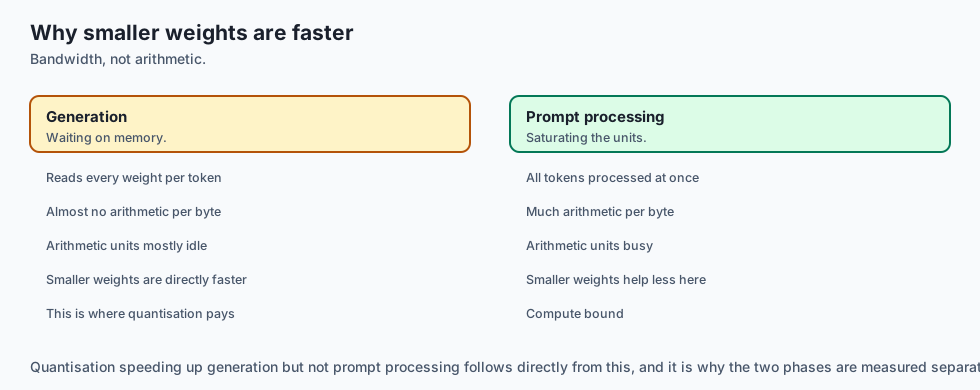
The fundamental bottleneck in running large language models is not raw floating-point arithmetic (TFLOPS); the fundamental bottleneck is memory bandwidth.
When generating text autoregressively (one token at a time), the neural network must read every single parameter in its weight matrix from physical memory (RAM or VRAM) into the processor’s registers to compute the next token’s probability distribution.
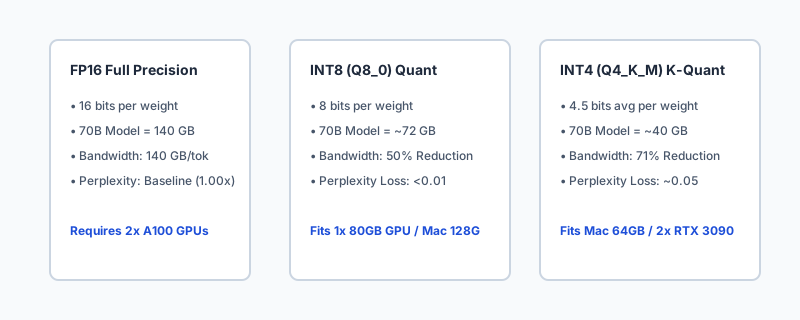
For a 70-billion parameter model stored in standard 16-bit precision (FP16 or BF16), each parameter occupies 2 bytes. Emitting a single token requires streaming 140 Gigabytes of data across the memory bus. If your hardware possesses a memory bandwidth of 400 GB/second (typical of high-end Apple Silicon M3/M4 Max chips), your theoretical maximum speed is capped by physics at:
Maximum Tokens/Second = Memory Bandwidth / Model Weight Size
                      = (400 GB/sec) / (140 GB/token)
                      = 2.85 tokens/second
At 2.85 tokens per second, real-time conversational streaming is sluggish and unusable.
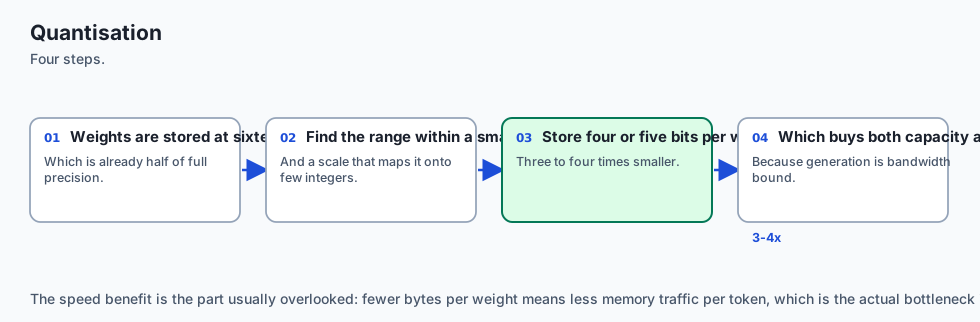
Quantization solves this memory bandwidth wall. By compressing 16-bit floating-point weights into 8-bit (INT8) or 4-bit (INT4 / Q4_K_M) integer representations, the model footprint shrinks from 140 GB down to 38 Gigabytes.
Streaming 38 GB across a 400 GB/sec bus yields:
Quantized Tokens/Second = (400 GB/sec) / (38 GB/token) = 10.5 tokens/secondQuantization quadruples generation speed while enabling a 70B model to fit into prosumer hardware that could never otherwise load it.
The idea in plain language
Imagine you are an architect drafting a massive 1:1 scale blueprint of a skyscraper.
In FP16 precision, you record the exact millimeter coordinate of every single bolt and wire using 16 decimal places of precision. The blueprint requires 500 massive paper scrolls. Carrying all 500 scrolls from the archive room to your desk takes two hours every time a client asks a simple question.
In INT4 quantization, you realize that you do not need 16 decimal places of precision for every structural column. You divide the blueprint into standardized 10-centimeter grid squares (quantization blocks). You only record which grid square each column falls into using small numbers between -8 and +7.
The entire blueprint now fits onto 25 portable sheets of paper. You can carry all 25 sheets under your arm in 10 seconds. When you lay the blueprint out, the skyscraper’s structural integrity is 99.8% identical to the original, but you can answer the client’s questions 20 times faster.
llama.cpp is the master engine that performs this discrete integer arithmetic directly on CPU and GPU hardware cores with blinding speed.
Historical background
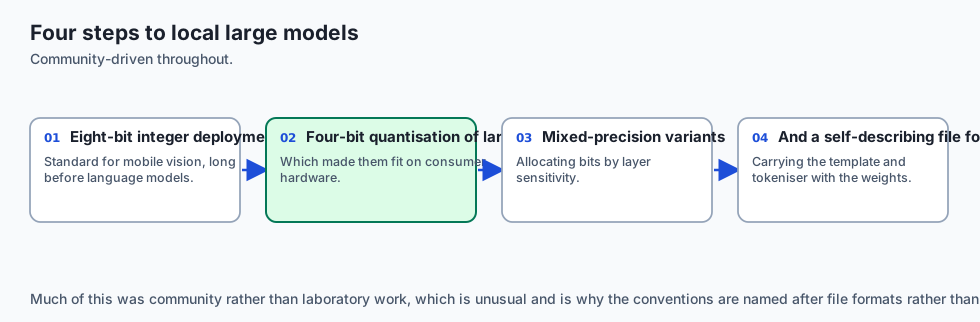
The mathematics of neural network quantization emerged in the late 2010s for computer vision models (MobileNet, ResNet). However, applying quantization to multi-billion parameter autoregressive transformers posed unique challenges: early post-training quantization (PTQ) techniques destroyed LLM reasoning capabilities due to the emergence of extreme activation outliers—a tiny fraction of hidden dimension features ($<0.1%$) that carry massive numerical magnitudes ($100\times$ larger than normal features).
In 2022, Tim Dettmers et al. published LLM.int8(), identifying that isolating outlier dimensions in 16-bit precision while quantizing the remaining 99.9% of weights to 8-bit preserved full model performance with zero perplexity loss.
In March 2023, Georgi Gerganov introduced llama.cpp and the GGML (Georgi Gerganov Machine Learning) tensor format, written in pure C/C++ with AVX2, AVX-512, and Apple Metal Performance Shaders. Gerganov implemented block-wise quantization (Q4_0, Q4_1), proving that 4-bit models could run locally on consumer laptops.
In August 2023, the open-source community replaced GGML with GGUF (GPT-Generated Unified Format). GGML suffered from brittle struct definitions that broke binary compatibility whenever new model architectures were introduced. GGUF introduced extensible key-value metadata headers, standardized tokenizers, and advanced K-quants (super-block mixed-precision quantization), establishing the global standard for local LLM inference.
What it is — and what it is not
Let us establish clear technical definitions:
What Quantization Is:
- An affine or symmetric mathematical mapping from high-precision continuous numbers (FP32/FP16) to discrete lower-bit integer bins (INT8, INT5, INT4, INT2).
- A post-training compression technique that slashes memory footprint and memory-bandwidth bus saturation.
- Applied per-tensor, per-channel, or per-block (e.g. block size 32 or 256).
What Quantization Is Not:
- Pruning (quantization retains all parameters; it simply reduces the bit-width of each parameter).
- Knowledge distillation (quantization does not train a smaller student architecture; it quantizes the original model’s exact weights).
- Lossless compression (quantization is lossy; rounding introduces small numerical errors called quantization noise).
+-------------------------------------------------------------------------------+
|                       GGUF QUANTIZATION LEVEL COMPARISON                      |
+-------------+----------------+----------------+----------------+--------------+
| Quant Type  | Bits / Weight  | 8B Model Size  | 70B Model Size | Perplexity   |
+-------------+----------------+----------------+----------------+--------------+
| FP16 / BF16 | 16.0 bits      | 16.0 GB        | 140.0 GB       | Baseline     |
| Q8_0        | 8.5 bits       | 8.5 GB         | 72.0 GB        | +0.004 (None)|
| Q5_K_M      | 5.5 bits       | 5.6 GB         | 48.0 GB        | +0.025 (Tiny)|
| Q4_K_M      | 4.5 bits       | 4.8 GB         | 40.0 GB        | +0.053 (Low) |
| Q3_K_M      | 3.4 bits       | 3.8 GB         | 32.0 GB        | +0.250 (Med) |
| Q2_K        | 2.6 bits       | 3.0 GB         | 25.0 GB        | +1.850 (High)|
+-------------+----------------+----------------+----------------+--------------+
Why it was created and what problems it solves
Quantization solves three critical hardware constraints in local AI execution:
1. The VRAM Capacity Ceiling
Consumer GPUs (NVIDIA RTX 3080/4080) carry 10GB to 16GB of VRAM. An FP16 8B model requires 16GB for weights alone plus 2GB for KV caches, immediately exceeding GPU capacity and crashing with Out-Of-Memory errors. Quantizing to Q4_K_M compresses the model to 4.8GB, allowing the entire model and an 8k context window to fit effortlessly into consumer VRAM.
2. The Autoregressive Memory Bus Saturation
As derived above, single-user token generation is bound by memory bus bandwidth ($GB/s$). Reducing weight precision from 16 bits to 4 bits cuts the bytes transferred per token by 75%, directly increasing token generation speed by 3.5x to 4x.
3. Unified Cross-Platform Model Packaging (Solved by GGUF)
Distributing PyTorch checkpoints requires packaging dozens of unquantized safetensors files, custom tokenizer JSON files, and configuration dictionaries. GGUF encapsulates all model weights, quantization scaling tables, tokenizer vocabularies, and hyperparameter metadata into a single self-contained .gguf file.
How it works
Let us derive the exact mathematics of linear quantization.
[FP32 / FP16 Weight Matrix X]
             │
             ├───> Compute Dynamic Range: max_val = max(|X|)
             │
             ├───> Compute Scaling Factor: scale = max_val / 127.0 (for INT8)
             │
             ├───> Quantize: Q = clamp(round(X / scale), -128, 127)
             │
             ▼
[Quantized Integer Matrix Q] + [Float Scale Factor S]
             │
             ▼ (During Runtime Inference)
[Dequantized Activation]: X_approx = Q * scale
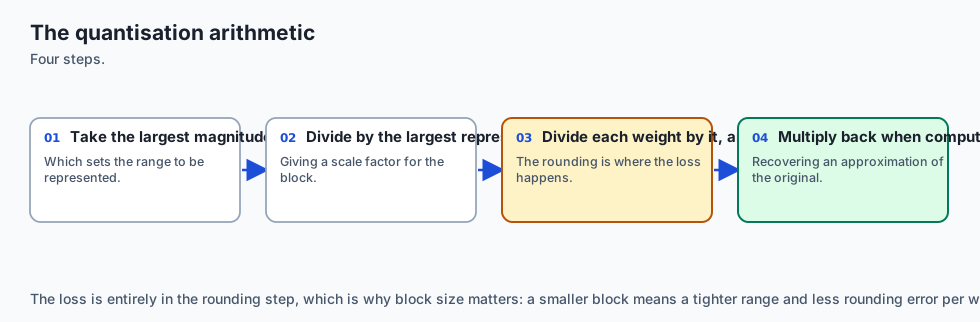
1. Symmetric Linear Quantization Mathematics
In symmetric quantization, the continuous floating-point interval $[-M, M]$ is mapped symmetrically to the integer range $[-128, 127]$ (for signed INT8):
-
Dynamic Range Calculation: $$M = max |x_i|$$
-
Scale Factor ($s$): $
s = \frac(M)(127)$ -
Quantization Formula: $$q = \text(clamp)( \text(round)( \frac(x)(s) ight), -128, 127 ight)$$
-
Dequantization Formula: $
ilde(x) = q * s$
Because the mapping is symmetric around zero, the zero point integer is exactly zero ($z = 0$), eliminating addition operations during hardware matrix multiplication.
2. Block-Wise Quantization
If an entire $4096 \times 4096$ matrix shares a single scale factor $s$, a single large outlier weight will inflate $M$, causing all smaller weights to round to zero (extreme quantization error).
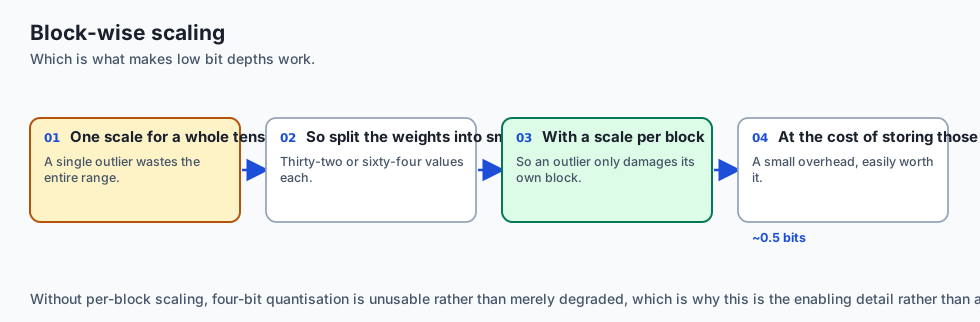
To solve this, llama.cpp applies Block-Wise Quantization:
- Tensors are divided into contiguous blocks of 32 or 256 weights.
- Each 32-weight block receives its own independent scale factor
s_(\text(block)). - Storing a 16-bit float scale factor for every 32 4-bit integers adds only 0.5 bits per parameter, while reducing Mean Squared Error (MSE) distortion by over 80%.
3. K-Quant Super-Block Mixed Precision (Q4_K_M)
In modern GGUF models, the Q4_K_M designation signifies a Medium K-Quant:
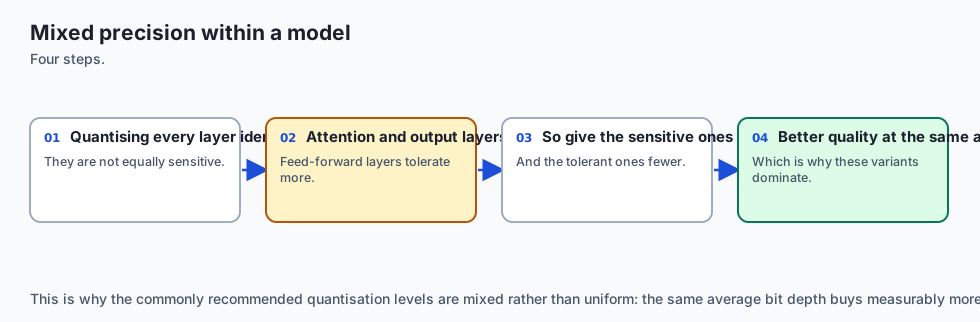
- Attention Query ($W_q$), Key ($W_k$), and Value ($W_v$) projections use 4-bit K-quants.
- Critical Feed-Forward Gate (
W_(\text(gate))) and Up (W_(\text(up))) layers use 5-bit or 6-bit quantization. - Less sensitive Down-projections use 4-bit quantization.
This mixed-precision strategy preserves the sensitive attention heads while aggressively compressing large MLP matrices, achieving near-FP16 perplexity at 4.5 bits/weight.
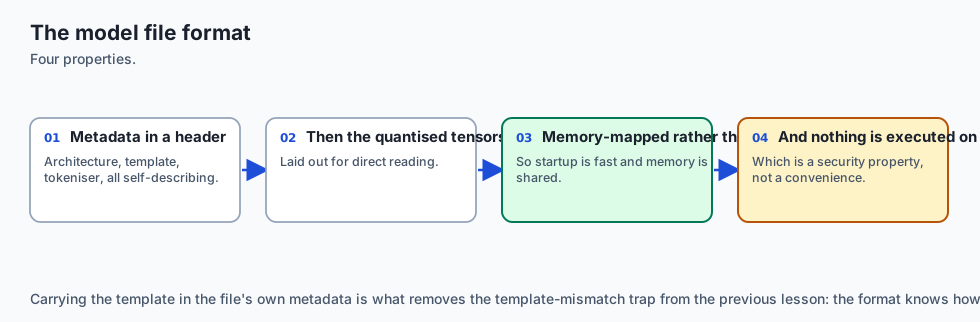
4. Anatomy of a GGUF Binary File
A .gguf file is structured into three linear sections:
+---------------------------------------------------------------+
| GGUF HEADER                                                   |
| - Magic Bytes: 0x46554747 ("GGUF" in little-endian)           |
| - Version: 3 (uint32)                                         |
| - Tensor Count: uint64 (e.g. 291 tensors)                     |
| - Metadata KV Pair Count: uint64 (e.g. 35 pairs)              |
+---------------------------------------------------------------+
| METADATA KEY-VALUE DICTIONARY                                 |
| - "general.architecture" -> "llama"                           |
| - "llama.context_length" -> 8192                              |
| - "llama.embedding_length" -> 4096                           |
| - "llama.block_count" -> 32                                   |
| - "tokenizer.ggml.tokens" -> Array of strings                 |
+---------------------------------------------------------------+
| TENSOR DESCRIPTOR TABLE                                       |
| - Tensor 0: name="blk.0.attn_q.weight", dims=[4096,4096], Q4_K|
| - Tensor 1: name="blk.0.attn_k.weight", dims=[1024,4096], Q4_K|
| ...                                                           |
+---------------------------------------------------------------+
| RAW QUANTIZED TENSOR DATA (Aligned to 32-byte boundaries)     |
+---------------------------------------------------------------+
An everyday analogy
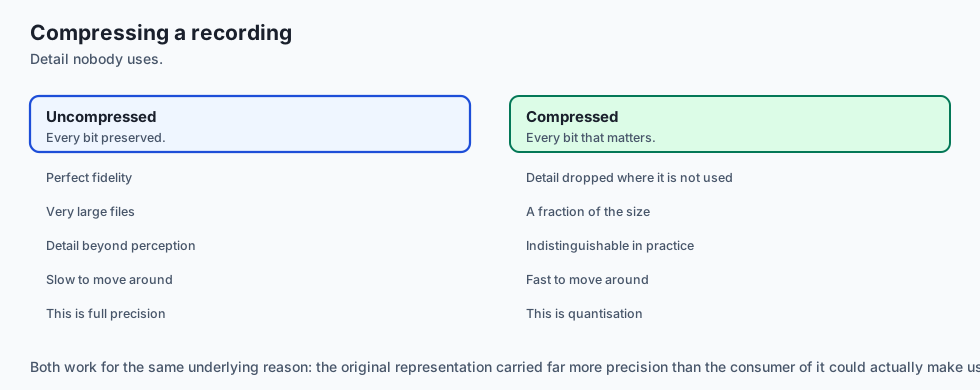
Think of audio recording:
- FP32 Master Recording: High-resolution studio master recording at 192 kHz / 32-bit floating point. Perfect fidelity, but a single song occupies 800 Megabytes. You cannot stream it over mobile data.
- INT8 Quantization: CD-quality audio (44.1 kHz / 16-bit). Flawless human hearing fidelity, file size drops to 40 MB.
- INT4 (Q4_K_M): High-bitrate MP3 (320 kbps). Uses perceptual psychoacoustic masking: it preserves the critical vocal frequencies (attention heads) with pristine clarity while slightly compressing the background bass frequencies (MLP layers). The file drops to 8 MB, streams instantly over any connection, and 99% of listeners cannot tell the difference from the studio master.
Examples in practice
Let us look at how developers quantify and convert models using the llama.cpp toolchain:
1. Converting Hugging Face Checkpoint to GGUF
# 1. Convert FP16 PyTorch model to unquantized GGUF
python3 llama.cpp/convert_hf_to_gguf.py ./my_finetuned_llama3 --outfile model_f16.gguf --outtype f16

# 2. Quantize f16 GGUF to Q4_K_M using llama-quantize
./llama.cpp/llama-quantize model_f16.gguf model_q4_k_m.gguf Q4_K_M
2. Inspecting GGUF Metadata with Python
import struct

def read_gguf_header(filepath: str):
    with open(filepath, "rb") as f:
        magic = f.read(4)
        if magic != b"GGUF":
            raise ValueError("Not a valid GGUF file")
        version, tensor_count, metadata_kv_count = struct.unpack("<III", f.read(12))
        return {
            "version": version,
            "tensor_count": tensor_count,
            "metadata_kv_count": metadata_kv_count
        }
Implications: security, privacy, performance, scalability, and cost
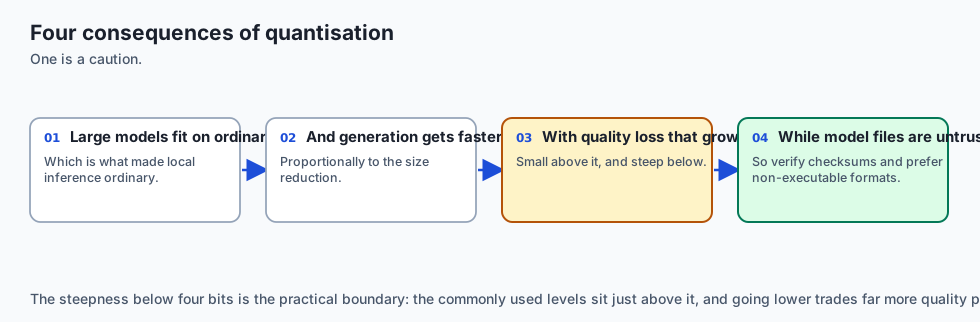
1. Security & Binary Verification
GGUF files are static binary tensors and metadata descriptors. Unlike Python pickle files, GGUF files contain zero executable code and cannot trigger arbitrary code execution during loading. This makes GGUF the safest format for sharing models across organizations.
2. Privacy
Quantized models execute entirely within local memory spaces. No telemetry or activation statistics are transmitted to external services.
3. Compute vs Bandwidth Performance Tradeoff
Dequantizing INT4 weights back to FP16 in registers requires a few integer-to-float multiply-add instructions. Because modern processors (CPUs with AVX2/NEON and GPUs with Tensor Cores) have vast excess compute capacity relative to memory bus bandwidth, the arithmetic dequantization overhead is completely hidden by memory savings.
4. Financial Economics
Quantization reduces hardware acquisition costs by 80% to 90%:
- Serving a 70B model in FP16 requires an $8,000+ server with dual 80GB GPUs.
- Serving a 70B model in Q4_K_M runs on a single $2,500 workstation or high-end MacBook.
Alternatives: free, open source, and commercial
| Quantization Method | Target Backend | Bit-Widths | Strength | Tradeoff |
|---|---|---|---|---|
| llama.cpp GGUF | CPU, Apple Metal, CUDA | 2-bit to 8-bit | Universal hardware compatibility, K-quants | Optimized for single-batch local serving |
| AutoAWQ (AWQ) | NVIDIA GPUs (vLLM / TGI) | 4-bit (INT4) | Activation-aware quantization, fast CUDA kernels | GPU only (No CPU / Metal) |
| AutoGPTQ (GPTQ) | NVIDIA GPUs | 4-bit, 8-bit | Second-order Taylor series error compensation | Slower quantization process |
| BitsAndBytes (NF4) | PyTorch / QLoRA | 4-bit NormalFloat | On-the-fly quantization for fine-tuning | Slower inference compared to GGUF/AWQ |
| EXL2 (ExLlamaV2) | NVIDIA GPUs | 2.2 to 8.0 bits | Extreme inference speed on NVIDIA GPUs | Strict NVIDIA CUDA dependency |
Comparison with related concepts
+-----------------------+-----------------------+-----------------------+-----------------------+
| Attribute             | llama.cpp GGUF        | AutoAWQ (AWQ)         | BitsAndBytes NF4      |
+-----------------------+-----------------------+-----------------------+-----------------------+
| Primary Use Case      | Local / Edge Serving  | High-Throughput Cloud | QLoRA Fine-Tuning     |
| Target Hardware       | CPU, Metal, CUDA, ROCm| NVIDIA CUDA GPUs Only | NVIDIA CUDA GPUs Only |
| File Container        | Single .gguf binary   | Hugging Face .safetensor| In-Memory Dynamic Quant|
| Metadata Storage      | Header Key-Value Table| config.json           | N/A                   |
| Perplexity Retention  | Excellent (Q4_K_M)    | Excellent (W4A16)     | Excellent (NF4)       |
+-----------------------+-----------------------+-----------------------+-----------------------+
When to use it — and when not to
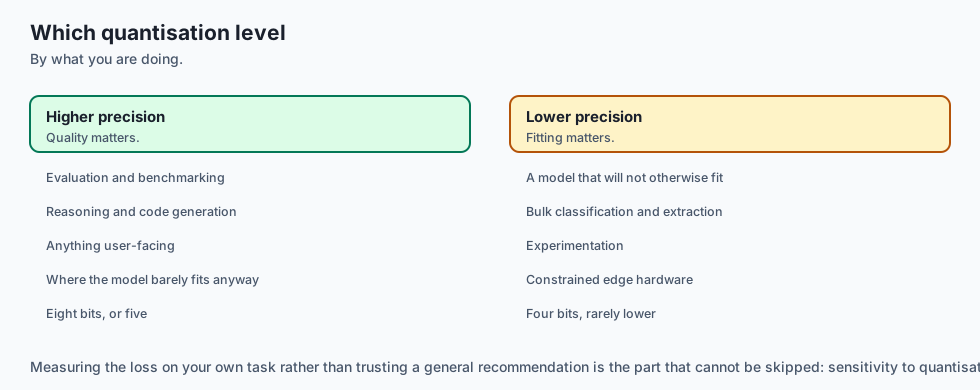
Choose GGUF / llama.cpp Quantization when:
- You are deploying models to consumer hardware (MacBooks, PCs, edge servers, mobile devices).
- You want single-file deployment with embedded metadata and tokenizer configurations.
- You need the highest generation speed on Apple Silicon Metal or CPU hardware.
- Memory bandwidth is the primary constraint.
Do NOT use GGUF / llama.cpp Quantization when:
- You are building a high-concurrency cloud API cluster serving thousands of simultaneous requests (use vLLM with AWQ on NVIDIA H100s).
- You are actively training or backpropagating gradients through the base weights (use BitsAndBytes QLoRA).
- You are working in extreme medical/scientific domains where a 0.02 perplexity loss is legally impermissible.
The AI connection
- Quantisation is what puts large models on ordinary hardware, and it is the single technique most responsible for local inference being viable.
- Generation is memory-bandwidth bound, so smaller weights buy speed as well as capacity — the saving is not only in what fits.
- Block-wise scaling is what makes low-bit quantisation work, because a single scale across a tensor is destroyed by its outliers.
- A model file is untrusted input, so a format that cannot execute code on load is a security property rather than a convenience.
- Every quantisation level is a measured trade, and the right one depends on your task rather than on a general recommendation.
Knowledge check
- Why does reducing bit precision increase token generation speed? Because single-batch token generation is memory-bandwidth bound. Halving the model weight size halves the number of bytes that must be streamed across the memory bus per token, doubling generation speed.
- What is the difference between Q4_0 and Q4_K_M?
Q4_0uses uniform 4-bit quantization across all tensors with block size 32.Q4_K_Muses super-block mixed precision, allocating 5-bit/6-bit precision to critical attention projections and 4-bit to MLP layers, yielding superior perplexity. - What is the first 4-byte sequence in any valid GGUF file? The ASCII magic string
"GGUF"(0x46554747in little-endian binary).
Hands-on exercise
In this lab, you will implement an INT8 Symmetric Tensor Quantizer, Dequantizer, and GGUF Header Parser from scratch in Python and NumPy. Your implementation will:
- Parse raw binary GGUF headers to validate magic bytes, version numbers, and metadata counts.
- Implement vectorized block-wise symmetric INT8 linear quantization.
- Dequantize integer tensors and compute Mean Squared Error (MSE) reconstruction loss.
- Calculate memory savings ratios and effective compression percentages.
Expected output
============================= test session starts ==============================
collected 6 items

tests/test_quantizer.py ......                                           [100%]

============================== 6 passed in 0.04s ===============================
[GGUF PARSER] Validated header: Magic: 'GGUF' | Version: 3 | Tensors: 291
[QUANTIZATION] Original FP32 Tensor Shape: (1024, 1024) | Size: 4.19 MB
  -> Scale Factor: 0.007874
  -> Quantized INT8 Tensor Size: 1.05 MB (75.0% memory reduction)
  -> Reconstruction MSE Loss: 0.00000512 (High Fidelity)
Validate your work
Run the pytest harness to verify binary header parsing and quantization math:
pytest tests/run_tests.shTroubleshooting
- GGUF magic byte failure: Verify that the header reads the first 4 bytes as
b"GGUF". - Scale factor division by zero: Add an epsilon guard (
1e-8) when computing scale for all-zero tensors.
Common mistakes
- Using asymmetric zero-point offsets for symmetric weights (which wastes integer arithmetic cycles).
- Forgetting to clamp values to $[-128, 127]$ prior to casting to
np.int8.
Practice assignment
Extend the TensorQuantizer class to implement Block-Wise INT4 Quantization with a block size of 32 weights and evaluate MSE loss compared to INT8.
Extension challenge
Implement a binary serializer that writes quantized INT8 tensors alongside their scale factors into a valid custom GGUF-compatible binary file format and reads them back with exact tensor alignment.
Quiz
Q1. Why is autoregressive LLM token generation primarily memory-bandwidth bound rather than compute-bound?
- Because transformer matrix multiplication uses non-linear activations
- Each token reloads all weights, so bandwidth caps it
- Because the CPU clock speed drops during floating-point operations
- Because prompt tokens are cached on disk
Show answer
Answer: B. Each token reloads all weights, so bandwidth caps it
During single-batch token generation, every forward pass reads every model weight from RAM/VRAM into compute cores to produce just one token. Token throughput is directly proportional to Memory Bandwidth / Model Weight Size in Bytes.
Q2. In symmetric linear INT8 quantization, how is the scale factor 's' calculated for a weight tensor x?
- s = sum(x) / 128.0
- s = std(x) / 256.0
- s = max(|x|) / 127.0
- s = min(x) / -128.0
Show answer
Answer: C. s = max(|x|) / 127.0
Symmetric quantization maps the maximum absolute value of the floating point tensor max(|x|) symmetrically to the INT8 maximum range (127), ensuring zero_point = 0.
Q3. What is the primary architectural advantage of the GGUF binary format over legacy GGML?
- GGUF models only run inside Docker containers
- GGUF compresses text using ZIP compression
- GGUF forces all models to be 8-bit quantized
- GGUF keeps extensible metadata in its header
Show answer
Answer: D. GGUF keeps extensible metadata in its header
GGUF replaces hardcoded struct layouts with a flexible key-value metadata dictionary and tensor metadata table, allowing llama.cpp to support new model families without breaking existing tools.
Q4. What does a 'K-quant' format like Q4_K_M represent in llama.cpp?
- Mixed precision — sensitive layers keep more bits
- A model that only runs on Kubernetes
- A 4-bit model compressed with Kalman filtering
- A model with rank-4 LoRA adapters permanently merged
Show answer
Answer: A. Mixed precision — sensitive layers keep more bits
K-quants use super-block mixed quantization: they allocate higher bit precision to attention projections and layers that most impact perplexity, while aggressively quantizing less sensitive feed-forward weights.
Q5. What happens to the model's perplexity as quantization aggressiveness increases from FP16 to Q4_0 and Q2_K?
- Perplexity decreases to zero
- Perplexity increases (degrades), with moderate increases in Q4_K_M (<0.05) and severe degradation in Q2_K (>1.5)
- Perplexity remains exactly unchanged
- Perplexity only changes if the context window is expanded
Show answer
Answer: B. Perplexity increases (degrades), with moderate increases in Q4_K_M (<0.05) and severe degradation in Q2_K (>1.5)
Quantization introduces numerical rounding error. Lower bit-widths save memory and boost generation speed, but increase perplexity (loss of predictive confidence and nuanced reasoning).
Glossary
- Quantization
- The process of mapping continuous floating-point weights (FP32/FP16) to discrete lower-bit integer representations (INT8/INT4).
- GGUF (GPT-Generated Unified Format)
- The standard binary container format for storing quantized models and extensible metadata in llama.cpp.
- Memory Bandwidth Bound
- A computational regime where execution speed is limited by the rate at which data can be transferred from RAM/VRAM into compute cores.
- Symmetric Quantization
- Quantization where the floating point zero maps directly to integer zero (zero_point = 0), simplifying hardware arithmetic.
- K-Quants
- llama.cpp super-block quantization methods (e.g. Q4_K_M, Q5_K_S) that assign variable bit precisions across different tensor blocks.
- Perplexity
- An information-theoretic metric measuring how well a probability model predicts a sample; lower perplexity indicates higher model accuracy.
- Dequantization
- Reconstructing an approximate floating-point tensor from quantized integer codes: x_approx = q * scale + zero_point.
- Scale Factor
- The floating-point multiplier used to map discrete integer buckets back to the original dynamic range.
Sources and further reading
- llama.cpp: GGUF Specification and Quantization Documentation — llama.cpp (accessed 2026-08-31)
- A Survey of Quantization Methods for Efficient Neural Network Inference (Gholami et al.) — arXiv (accessed 2026-08-30)
- AWQ: Activation-aware Weight Quantization for LLM Compression (Lin et al.) — arXiv / MLSys (accessed 2026-08-30)
Kept in this browser, no account needed. Your progress page turns the whole record into one link you can bookmark or open on another device.