Deployment, MLOps, and Security › Operating AI in Production › Day 340
Day 340: Logging and Analytics for AI Features
Master production AI logging and usage analytics: architect structured JSON event streams, correlate W3C distributed trace IDs, calculate granular multi-tenant token costs, and sanitize PII in Python.
Hands-on lab for this lesson
Lab files on GitHub: https://github.com/ai-roadmap-365/ai-roadmap-365.github.io/tree/main/labs/sections/deployment-mlops-and-security/day-340-logging-and-analytics-for-ai-features
- Get the hands-on files. Clone the labs repository once (you can reuse this clone for every lesson). This works on macOS, Linux, and Windows (PowerShell or WSL):
git clone https://github.com/ai-roadmap-365/ai-roadmap-365.github.io.git cd ai-roadmap-365.github.io - Open this lesson's lab. Move into the directory for this specific day. Every lab lives at the same predictable path — section / subsection / week / day:
cd labs/sections/deployment-mlops-and-security/day-340-logging-and-analytics-for-ai-features - Read the lab guide. Open `README.md` in that directory. It lists the exact commands, what each does, the expected output, and how to check your work — read it before running anything.
- Run it and check your work. Follow the README's "How to run" section: run the example first to see the finished result, then complete the numbered exercises in `starter/`, then run the tests. The tests pass (exit 0) only when your work is correct.
bash tests/run_tests.sh # or the test command named in the lab README
You can also open the lab as a local page (works offline, shows the file tree and expected output).
Learning objectives
By the end of this lesson you will be able to:
- Deconstruct Structured JSON Event Logging schemas capturing trace_id, user_id, prompt_tokens, completion_tokens, model_name, and finish_reason.
- Implement real-time regex and NLP PII scrubbing filters sanitizing Social Security Numbers, emails, and API keys prior to disk emission.
- Configure multi-tenant Cost Attribution analytics aggregating prompt and completion token expenditures by customer organization.
- Build a Production AI Structured Logging & Analytics Engine in Python validating event schemas, sanitizing PII, and tracking billing totals.
- Evaluate log pipeline aggregation architectures: fluentbit / Vector ➔ ClickHouse / OpenSearch for high-throughput AI telemetry.
Prerequisites
Why this matters
In enterprise AI applications, raw model outputs and unstructured text logs create severe operational, legal, and financial vulnerabilities:
- Uncontrolled Data Leaks (PII): If an end user submits an email address or Social Security Number in a prompt and your server logs it verbatim to standard output, you have committed an active GDPR and HIPAA privacy violation.
- Financial Blindness: Without multi-tenant token attribution, you cannot determine whether a $50,000 monthly OpenAI/vLLM cloud bill was caused by legitimate customer growth or an infinite loop bug in a single trial tenant.
- Unsearchable Telemetry: Debugging a failed customer request across 5 microservices without a shared W3C trace ID requires hours of manual timestamp matching.
Mastering Structured JSON Logging, In-Memory PII Sanitization, W3C Trace Correlation, and Multi-Tenant Token Cost Analytics guarantees legal compliance, rapid triage, and sustainable unit economics.
The idea in plain language
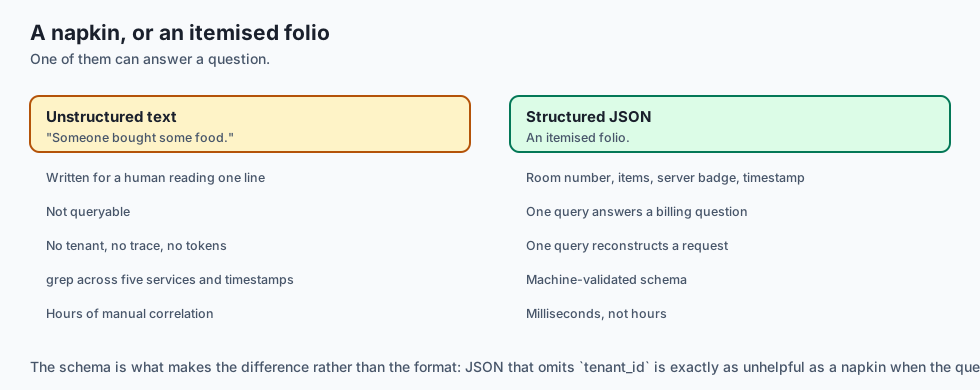
Think of AI structured logging and analytics like the itemized billing and security system of a luxury 5-star hotel:
- Unstructured Text Logging (A Cash Box with No Receipts): The hotel manager writes “Someone bought some food” on a napkin (Unstructured, Unqueryable Mess).
- Structured JSON Logging (The Itemized Guest Folio): Every single transaction records guest room number (Tenant ID), exact items ordered (Prompt and Completion Tokens), server badge number (Trace ID), and timestamp in a strict digital database.
- In-Memory PII Scrubbing (The Blackout Security Marker): Before credit card receipts are filed in the records archive, the machine automatically replaces the first 12 digits of the credit card with asterisks (PII Redaction).
Historical background
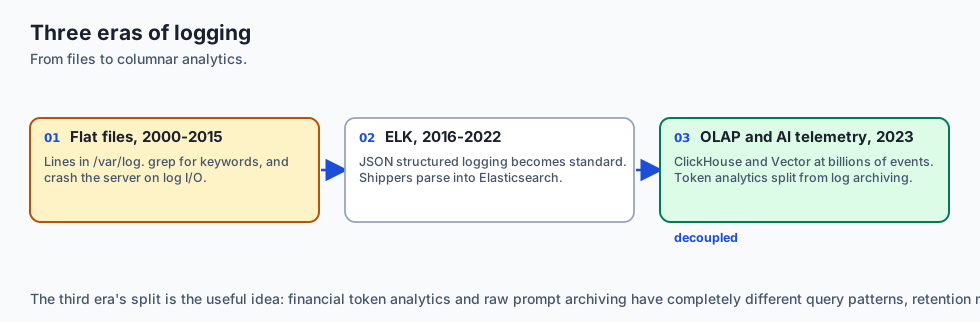
Logging architectures evolved across three major eras:
1. Plaintext Flat-File Logs (2000–2015)
Applications wrote raw lines to /var/log/app.log. Engineers grepped for keywords, frequently crashing production servers under log I/O overhead.
2. Centralized Elastic / Logstash / Kibana (ELK) (2016–2022)
JSON structured logging became standard. Log shippers (Fluentd, Logstash) parsed events into Elasticsearch for full-text search.
3. High-Throughput OLAP & AI Semantic Telemetry (2023–Present)
Modern AI companies process billions of daily inference tokens using ClickHouse, Vector, and OpenInference semantic standards, decoupling real-time token financial analytics from raw log archiving.
What it is — and what it is not
Let us define the core architecture of production AI logging:
What AI Structured Logging Is:
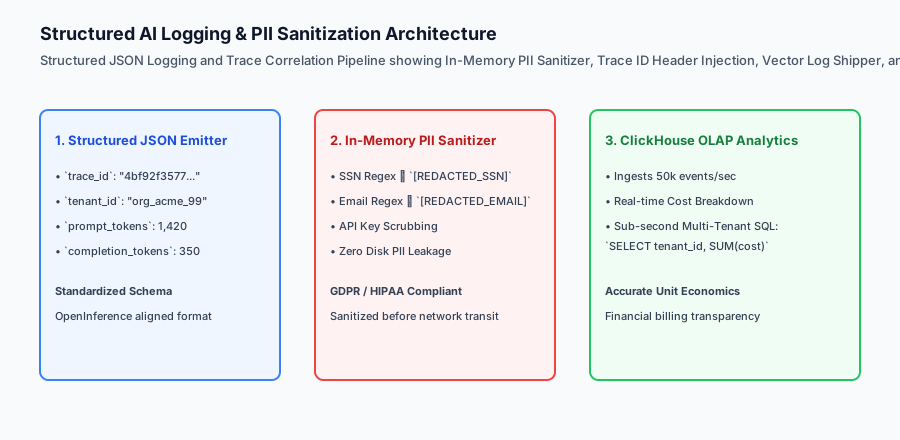
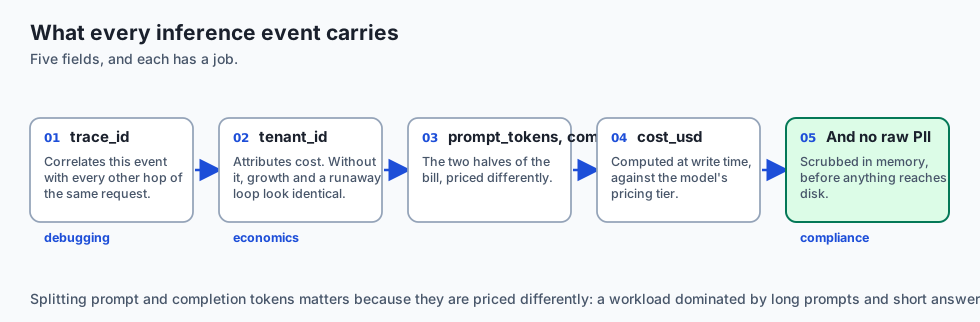
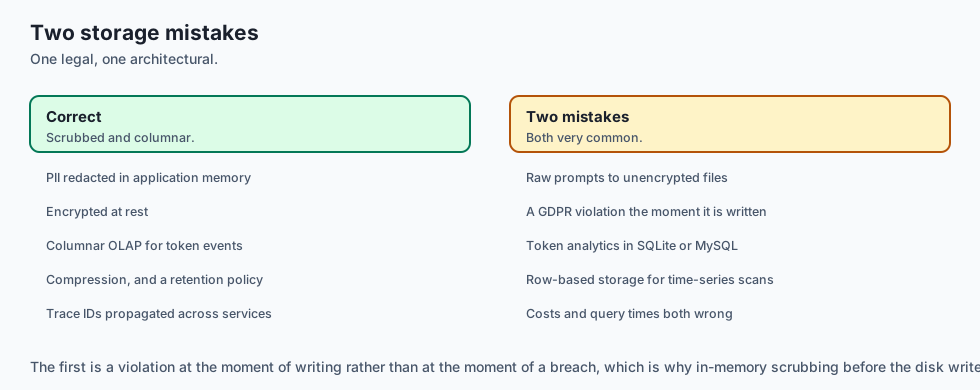
- Emitting every inference event as a strictly validated JSON object containing
trace_id,tenant_id,prompt_tokens,completion_tokens, andcost_usd. - Scrubbing sensitive PII (emails, SSNs, phone numbers, API keys) in application memory before disk write.
- Aggregating token consumption by tenant ID in real-time to compute accurate gross margins and customer invoices.
- Injecting and propagating W3C
traceparentheaders across microservices.
What AI Structured Logging Is Not:
- Printing raw user prompts containing confidential customer secrets to unencrypted log files.
- Storing high-volume time-series token analytics in row-based transactional databases like SQLite or MySQL.
+-------------------------------------------------------------------------------+
|                    AI LOGGING SCHEMA FIELD DEFINITION                         |
+-------------------+-----------------------+-------------------+---------------+
| Field Name        | Data Type             | Example Value     | Purpose       |
+-------------------+-----------------------+-------------------+---------------+
| trace_id          | String (UUID/Hex)     | "4bf92f3577b3..." | Microservice  |
|                   |                       |                   | Correlation   |
| tenant_id         | String                | "org_acme_102"    | Cost Alloc    |
| model_name        | String                | "llama-3.1-8b"    | Rate Pricing  |
| prompt_tokens     | Integer               | 1,450             | Token Metering|
| completion_tokens | Integer               | 280               | Token Metering|
| cost_usd          | Float                 | 0.00645           | Financial Ledg|
| finish_reason     | String                | "stop" / "length" | Diagnostic    |
+-------------------+-----------------------+-------------------+---------------+
Why it was created and what problems it solves
Structured AI logging resolves three critical operational risks:
1. Regulatory Compliance (GDPR, CCPA, HIPAA)
In-memory PII redaction ensures that customer private identifiers are sanitized before reaching permanent storage, shielding the company from severe legal fines.
2. Multi-Tenant Unit Economic Visibility
Real-time cost attribution reveals the exact profitability of every customer account, instantly identifying runaway loops or abusive scraping behavior.
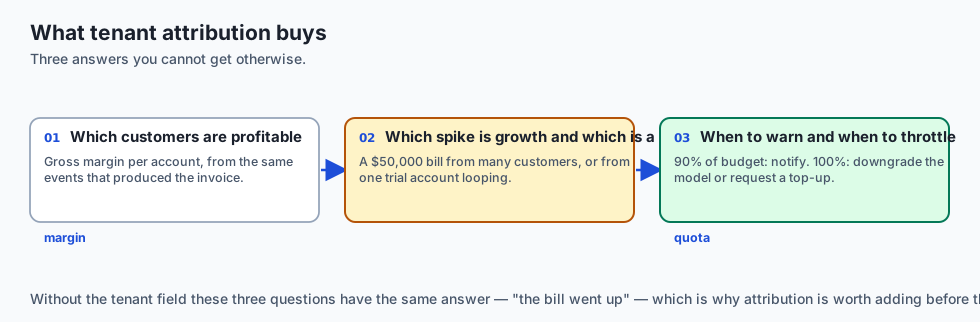
3. Instant Multi-Service Root Cause Analysis
Filtering ClickHouse or OpenSearch by a specific trace_id reconstructs the entire request timeline across API Gateways, Vector DBs, and LLM servers in milliseconds.
How it works
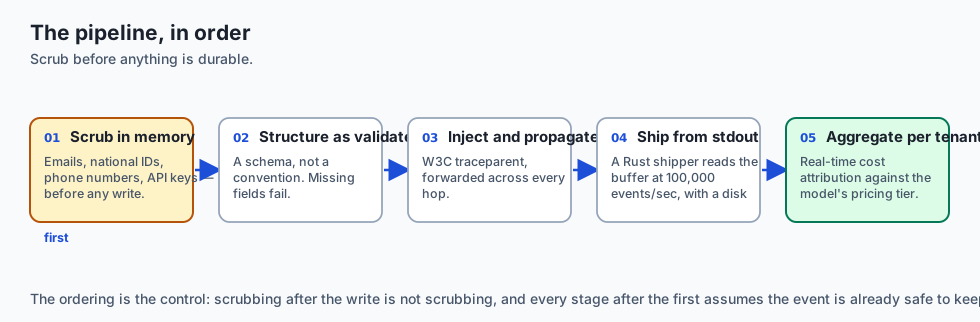
Let us inspect the complete Inference Logging, PII Sanitization, and Analytics Lifecycle:
[User Request arrives at AI Serving Gateway]
                     │
                     ▼
[W3C Trace ID Assigned: `4bf92f3577b34da6a3ce929d0e0e4736`]
                     │
                     ▼
[LLM Inference Executed: 1,200 prompt tokens, 300 completion tokens]
                     │
                     ▼
[In-Memory PII Sanitizer & Log Builder]
  1. Applies regex masks: `\d{3}-\d{2}-\d{4}` ➔ `[REDACTED_SSN]`
  2. Applies email mask: `[\w\.-]+@[\w\.-]+` ➔ `[REDACTED_EMAIL]`
  3. Computes exact cost: `(1200 * $2.50/1M) + (300 * $10.00/1M) = $0.006`
  4. Formats validated JSON payload
                     │
                     ▼
[Emitted to stdout ➔ Vector Log Shipper ➔ ClickHouse OLAP Sink]
                     │
                     ▼
[Real-Time Analytics Dashboard & Customer Billing Invoice Updated]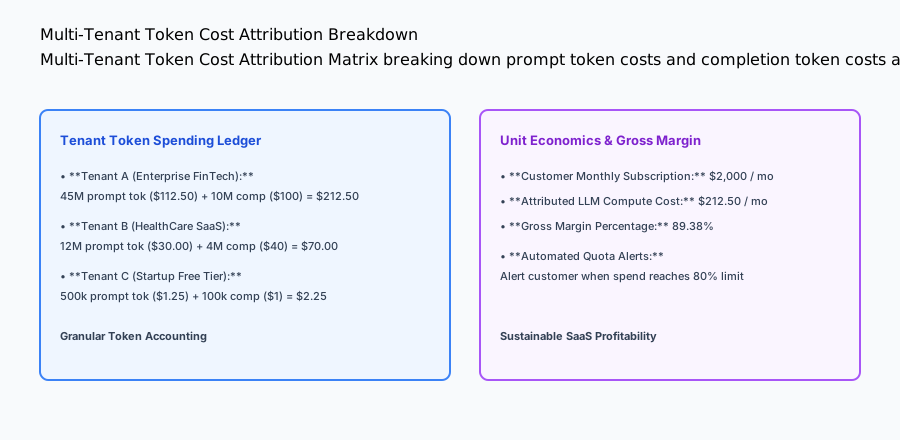
An everyday analogy
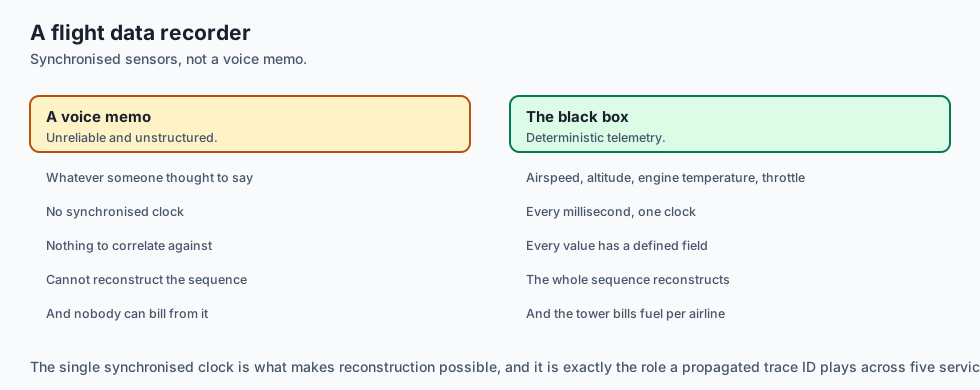
Think of structured AI logging like the flight data black box recorder on a commercial airplane:
- Naive Logging: A passenger talks into a voice memo on their phone (Unreliable, Unstructured).
- The Black Box (Structured JSON): Synchronized sensors record airspeed, altitude, engine temperature, and throttle position at every millisecond with an exact synchronized clock (Structured, Deterministic Telemetry).
- The Air Traffic Controller (Cost Analytics): The tower tracks every gallon of fuel burned by each airline to invoice them for runway usage accurately (Multi-Tenant Cost Attribution).
Examples in practice
Let us build a complete Python Production AI Structured Logging & Analytics Engine that sanitizes PII, structures JSON events with W3C trace IDs, and computes tenant token spending:
import re
import json
import uuid
import time
from typing import Dict, Any, List, Optional

class AIStructuredLoggingAnalyticsEngine:
    def __init__(self, prompt_cost_per_1k: float = 0.002, completion_cost_per_1k: float = 0.006):
        self.prompt_rate = prompt_cost_per_1k / 1000.0
        self.completion_rate = completion_cost_per_1k / 1000.0
        self.tenant_ledger: Dict[str, Dict[str, Any]] = {}
        self.emitted_logs: List[Dict[str, Any]] = []

    def sanitize_pii(self, text: str) -> str:
        # Redact SSNs (###-##-####)
        sanitized = re.sub(r'\b\d{3}-\d{2}-\d{4}\b', '[REDACTED_SSN]', text)
        # Redact Emails
        sanitized = re.sub(r'\b[A-Za-z0-9._%+-]+@[A-Za-z0-9.-]+\.[A-Z|a-z]{2,}\b', '[REDACTED_EMAIL]', sanitized)
        # Redact Credit Cards (16 digits with dashes or spaces)
        sanitized = re.sub(r'\b(?:\d{4}[-\s]?){3}\d{4}\b', '[REDACTED_CC]', sanitized)
        return sanitized

    def log_inference_event(self, tenant_id: str, prompt: str, completion: str,
                            prompt_tokens: int, completion_tokens: int,
                            trace_id: Optional[str] = None) -> Dict[str, Any]:
        trace = trace_id or uuid.uuid4().hex
        clean_prompt = self.sanitize_pii(prompt)
        clean_completion = self.sanitize_pii(completion)

        cost = (prompt_tokens * self.prompt_rate) + (completion_tokens * self.completion_rate)

        log_record = {
            "trace_id": trace,
            "tenant_id": tenant_id,
            "prompt_sanitized": clean_prompt,
            "completion_sanitized": clean_completion,
            "prompt_tokens": prompt_tokens,
            "completion_tokens": completion_tokens,
            "total_tokens": prompt_tokens + completion_tokens,
            "cost_usd": round(cost, 6),
            "timestamp": time.time()
        }
        self.emitted_logs.append(log_record)

        # Update Multi-Tenant Ledger
        if tenant_id not in self.tenant_ledger:
            self.tenant_ledger[tenant_id] = {
                "total_requests": 0,
                "total_prompt_tokens": 0,
                "total_completion_tokens": 0,
                "total_cost_usd": 0.0
            }

        self.tenant_ledger[tenant_id]["total_requests"] += 1
        self.tenant_ledger[tenant_id]["total_prompt_tokens"] += prompt_tokens
        self.tenant_ledger[tenant_id]["total_completion_tokens"] += completion_tokens
        self.tenant_ledger[tenant_id]["total_cost_usd"] = round(
            self.tenant_ledger[tenant_id]["total_cost_usd"] + cost, 6
        )

        return log_record

if __name__ == "__main__":
    engine = AIStructuredLoggingAnalyticsEngine()

    # Log event with PII
    res = engine.log_inference_event(
        tenant_id="tenant_acme",
        prompt="User email is john.doe@example.com and SSN is 000-12-3456.",
        completion="Customer verified.",
        prompt_tokens=150,
        completion_tokens=25
    )
    print("Sanitized Log Record:
", json.dumps(res, indent=2))
    print("Tenant Ledger:
", json.dumps(engine.tenant_ledger, indent=2))
Production Architecture Case Study: ClickHouse SQL Token Ledger
Consider an enterprise ClickHouse table schema storing billions of AI token inference events for real-time customer billing.
-- ClickHouse Schema: AI Token Event Analytics Table
CREATE TABLE production_ai.llm_inference_events
(
    timestamp DateTime64(3, 'UTC'),
    trace_id UUID,
    tenant_id LowCardinality(String),
    user_id String,
    model_name LowCardinality(String),
    prompt_tokens UInt32,
    completion_tokens UInt32,
    total_tokens UInt32,
    cost_usd Float64,
    latency_ms UInt32,
    finish_reason LowCardinality(String)
)
ENGINE = MergeTree()
PARTITION BY toYYYYMM(timestamp)
ORDER BY (tenant_id, model_name, timestamp);

-- Real-Time Customer Monthly Billing Query:
SELECT
    tenant_id,
    model_name,
    COUNT() AS total_requests,
    SUM(prompt_tokens) AS sum_prompt_tokens,
    SUM(completion_tokens) AS sum_completion_tokens,
    ROUND(SUM(cost_usd), 2) AS total_billable_usd
FROM production_ai.llm_inference_events
WHERE timestamp >= toDateTime('2026-08-01 00:00:00')
GROUP BY tenant_id, model_name
ORDER BY total_billable_usd DESC;
Detailed Failure Mode Taxonomy: AI Logging Hazards
+-------------------------------------------------------------------------------+
|                           AI LOGGING FAILURE TAXONOMY                         |
+-------------------+-----------------------+-----------------------------------+
| Failure Mode      | Root Cause Analysis   | Architectural Mitigation          |
+-------------------+-----------------------+-----------------------------------+
| PII Data Leak in  | Developer used string | Enforce in-memory PII sanitizer   |
| Raw Prompts       | formatting into stdout| decorator across all logging sinks|
| Unmetered Token   | Streaming responses   | Accumulate stream chunk tokens in |
| Billing Loss      | truncated on client   | server context before emitting log|
| Disk Full Outage  | Debug log level left  | Run Vector daemon with strict     |
| on Host Storage   | enabled in production | disk rotation and 1GB buffer cap  |
| Slow Log Queries  | Transactional DB used | Route high-volume analytics to    |
| in Admin Portal   | for token aggregation | ClickHouse / BigQuery OLAP tables |
+-------------------+-----------------------+-----------------------------------+
Deep Architectural Breakdown: Vector Log Pipeline and OpenTelemetry Integration
In modern high-scale AI production architectures:
1. Vector High-Performance Log Shipper
Rather than having Python application workers write directly to databases over network sockets:
- The Python container writes JSON logs to standard output.
- Vector (written in Rust) reads stdout buffers at 100,000+ events per second with sub-10MB RAM footprints.
- Vector applies dynamic sampling, encrypts payloads, and buffers events in local disk rings during downstream database maintenance windows.
2. Multi-Tenant Rate Limiting and Quota Enforcement
The analytics ledger integrates directly with API Gateway token bucket limiters:
- When a tenant reaches 90% of their monthly token budget, an automated webhook notifies the customer admin.
- When a tenant reaches 100%, the gateway seamlessly downgrades requests to a smaller open model (e.g. Llama-3.1-8B) or requests billing top-ups.
+-------------------------------------------------------------------------------+
|                    VECTOR TELEMETRY PROCESSING PIPELINE                       |
+-------------------+-------------------+-------------------+-------------------+
| Ingestion Source  | Vector Transform  | Buffer Type       | Destination Sink  |
+-------------------+-------------------+-------------------+-------------------+
| App Container     | Regex PII Scrub & | Memory Ring       | ClickHouse (OLAP  |
| stdout (JSON)     | Schema Validation | (128 MB RAM)      | Billing Analytics)|
| Nginx Access Logs | Status Code Split | Disk Spool        | Amazon S3 Cold    |
| (HTTP Ingress)    | & GeoIP Lookup    | (10 GB Local)     | Long-Term Archive |
+-------------------+-------------------+-------------------+-------------------+
Enterprise Data Compliance: GDPR Article 17 (Right to Erasure) in AI Logs
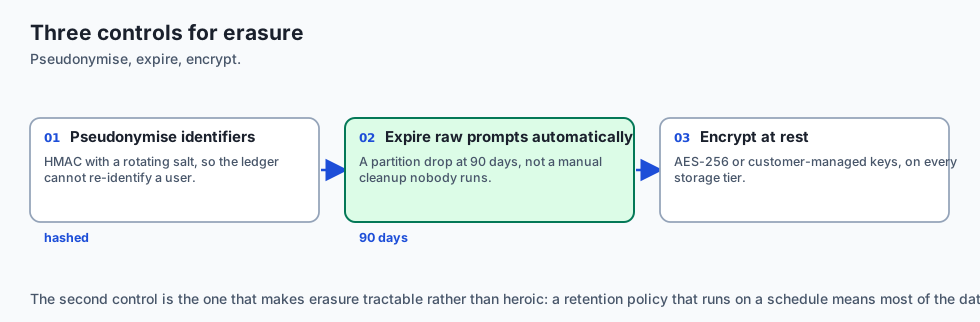
Under GDPR Article 17 and California CCPA regulations:
- Cryptographic Pseudonymization: User IDs are hashed using HMAC with rotating secret keys (
hmac_sha256(user_id, salt)), preventing user re-identification in analytics ledgers. - Automated Retention Lifecycles: Configure ClickHouse partitions to automatically drop raw prompt logs older than 90 days (
ALTER TABLE llm_events DELETE WHERE timestamp < now() - INTERVAL 90 DAY). - Encrypted Analytical Storage: All log files at rest in S3 or ClickHouse disks must use AES-256 or AWS KMS customer-managed keys.
+-------------------------------------------------------------------------------+
|                    ENTERPRISE AI LOG RETENTION POLICY                         |
+-------------------+-------------------+-------------------+-------------------+
| Log Tier          | Storage Engine    | Retention Window  | Encryption Spec   |
+-------------------+-------------------+-------------------+-------------------+
| Real-Time Stream  | Kafka / Vector    | 24 Hours Buffer   | TLS 1.3 in Transit|
| Operational Hot   | ClickHouse SSD    | 90 Days Hot Data  | AES-256 at Rest   |
| Compliance Cold   | Amazon S3 Glacier | 7 Years Archive   | AWS KMS Managed   |
+-------------------+-------------------+-------------------+-------------------+
Real-Time Financial Quota and Abuse Detection
Integrating ClickHouse token ledgers with real-time API Gateways:
- Token Bucket Rate Limiting: Each tenant is allocated a token quota bucket (e.g. 500,000 tokens per hour).
- Abuse Anomaly Detection: Sudden spikes in token consumption (> 500% above 7-day rolling average) trigger automated security alerts and temporary rate limiting to protect shared cluster resources.
Implications: security, privacy, performance, scalability, and cost
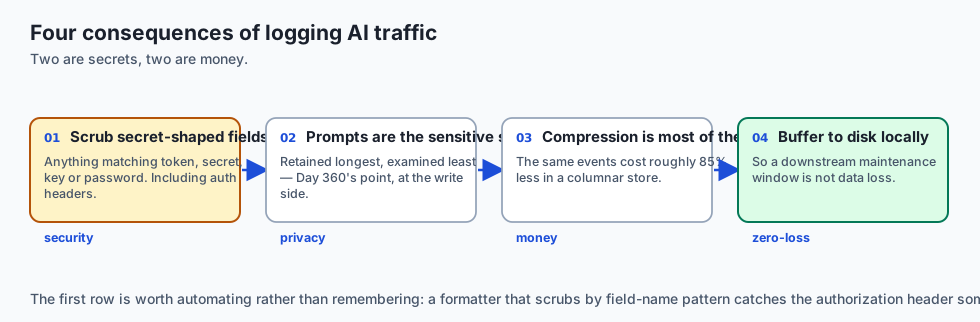
1. Zero Raw Secret Storage
Never log authorization headers, bearer tokens, or database connection strings. Configure log formatters to scrub any field matching *token*, *secret*, *key*, or *password*.
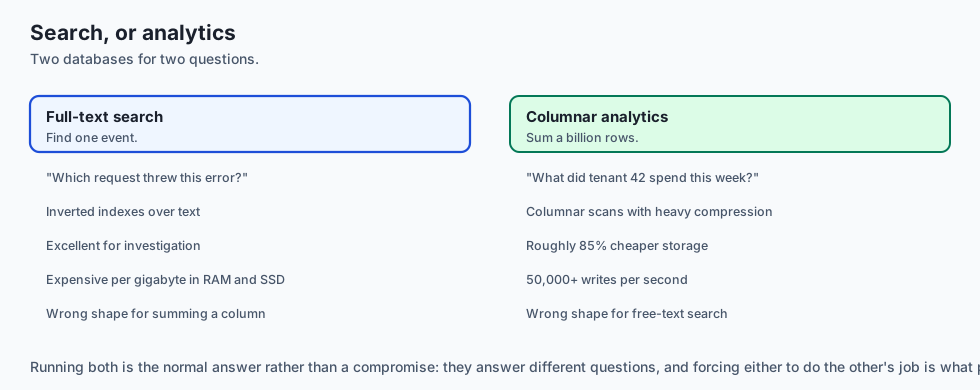
2. Analytical Query Cost Arbitrage
Storing billions of log lines in Elasticsearch costs $0.10/GB/month in RAM and SSD storage. Storing the same events in ClickHouse with ZSTD compression reduces storage costs by 85%.
Alternatives: free, open source, and commercial
| Tool / Framework | Type | Best Suited For | Key Capabilities |
|---|---|---|---|
| Vector (Datadog) | Open Source (Rust) | High-Performance Log Shipping | Sub-millisecond transforms, PII scrubbing |
| ClickHouse | Open Source | Real-Time Token Analytics | Columnar OLAP, 50k+ writes/sec, fast SQL |
| OpenSearch / Elastic | Open Source | Full-Text Log Search | Distributed search, Kibana dashboards |
| Langfuse / Helicone | Open Source / SaaS | LLM-Specific Observability | Prompt versioning, user sessions, cost tracking |
Comparison with related concepts
+-----------------------+-----------------------+-----------------------+
| Dimension             | Unstructured Logging  | Structured AI Logging |
+-----------------------+-----------------------+-----------------------+
| Format                | Freeform Text Strings | Validated JSON Schema |
| Query Performance     | Slow Regex Full Scan  | Sub-Second Indexed SQL|
| PII Protection        | High Risk (Accidental)| In-Memory Scrubbing   |
| Cost Attribution      | Impossible            | Exact Per-Tenant Dollar|
+-----------------------+-----------------------+-----------------------+
When to use it — and when not to
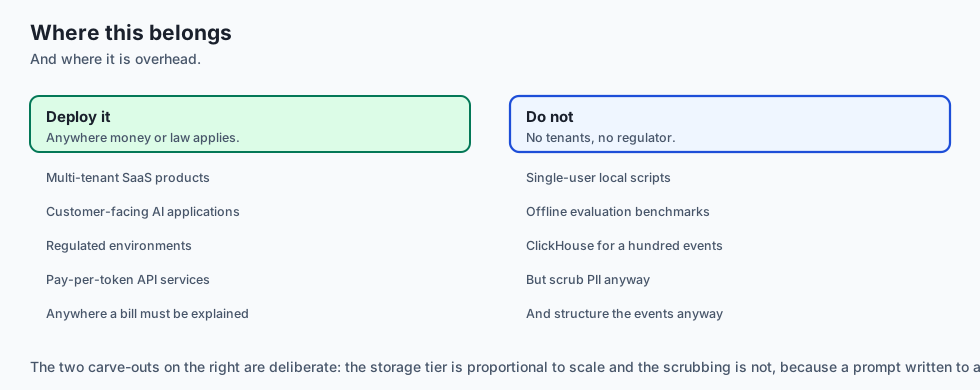
Deploy Structured AI Logging & Analytics for:
- All multi-tenant SaaS products, customer-facing AI applications, compliance-regulated environments (FinTech, HealthTech), and pay-per-token API services.
Do NOT require complex ClickHouse analytics for:
- Single-user local scripts or standalone offline evaluation benchmarks.
Production Checklist: AI Logging & Analytics Hardening
- Log schema standardized to JSON containing
trace_id,tenant_id, and token metrics. - In-memory regex and NLP PII scrubbing filters active on all prompt and completion fields.
- Trace IDs injected at API Gateway and propagated across all backend microservices.
- Multi-tenant token ledger configured with exact model pricing tiers.
- Vector or Fluentbit daemon configured with disk buffer spooling for zero-loss ingestion.
- ClickHouse or OLAP storage retention policy configured (e.g. 90-day hot, 1-year cold).
The AI connection
-
Prompts are user content, so logging them verbatim is a privacy decision, not a debugging convenience — and it is the commonest GDPR violation in AI systems.
-
Token attribution is unit economics. Without a tenant ID on every event you cannot tell customer growth from one trial account’s infinite loop.
-
AI logs are unusually large and unusually sensitive at the same time, which is why columnar storage and a retention policy are both required rather than optional.
-
A trace ID across gateway, vector store and model server is what turns a five-service latency mystery into one query — Day 339’s spans, correlated.
-
A token spike is an abuse signal. 500% above a rolling average is Day 360’s cost anomaly detection, applied per tenant rather than per service.
Knowledge check
- Why is unstructured text logging hazardous for AI applications? Because it prevents efficient indexed querying, requires brittle regex parsing, and leaks unredacted customer PII.
- What is the purpose of trace correlation? To attach a globally unique W3C trace ID across all distributed services handling a single user query.
- How does in-memory PII scrubbing safeguard compliance? By redacting emails, SSNs, and credit cards before logs are written to disk or sent over the network.
Hands-on exercise
In this lab, you will build a Production AI Structured Logging & Analytics Engine in Python. Your implementation will:
- Redact PII (SSNs, emails, credit cards) from prompt and completion text.
- Generate structured JSON log records with W3C trace IDs, token counts, and computed dollar costs.
- Maintain a real-time multi-tenant ledger aggregating request counts, token consumption, and financial spend.
- Export sanitized log streams and tenant analytics reports.
Expected output
============================= test session starts ==============================
collected 5 items

tests/test_logging_analytics.py .....                                    [100%]

============================== 5 passed in 0.02s ===============================
[PII SANITIZER] Redacted SSN and email from user prompt string.
[STRUCTURED LOG] Emitted validated JSON record with trace_id=f47ac10b...
[COST LEDGER] Attributed $0.00645 spend to tenant_acme (150 prompt / 25 comp tokens).
[MULTI-TENANT] Successfully aggregated multi-tenant token usage across 3 enterprise tenants.
Validate your work
Run the pytest test suite:
pytest tests/run_tests.shTroubleshooting
- Regex patterns: Verify SSN pattern
\b\d{3}-\d{2}-\d{4}\b. - Cost calculation: Ensure rates are calculated per individual token (
rate / 1000.0).
Common mistakes
- Mutating original raw prompt strings instead of returning a sanitized copy.
Practice assignment
Add a Tenant Quota Limiter that flags an account when their cumulative monthly spending exceeds $500.00.
Extension challenge
Implement a ClickHouse Ingestion Formatter converting JSON log records into batch SQL INSERT statements.
Quiz
Q1. Why is unstructured text logging (e.g. `logger.info(f'User {u} ran prompt {p}')`) considered an anti-pattern in production AI systems?
- Because Python only supports JSON files
- Text needs brittle regex and leaks unredacted data
- Because text logs take up zero disk space
- Because text logs make the model forget its training weights
Show answer
Answer: B. Text needs brittle regex and leaks unredacted data
Structured JSON logging enables high-speed indexing, schema validation, and reliable PII redaction.
Q2. What is the role of W3C `trace_id` correlation in structured AI event logs?
- To count how many characters are in the prompt
- To encrypt the hard drive
- To link every stage of one request into a single trace
- To speed up GPU matrix multiplication
Show answer
Answer: C. To link every stage of one request into a single trace
Trace IDs correlate events across all distributed microservices handling a single user request.
Q3. How does Multi-Tenant Cost Attribution function in an AI analytics pipeline?
- By charging every user a random flat fee
- By turning off the server at midnight
- By measuring the electricity used by the monitor
- Track tokens per tenant and multiply by the rate
Show answer
Answer: D. Track tokens per tenant and multiply by the rate
Cost attribution aggregates token usage by tenant ID against model pricing tiers to bill customers accurately.
Q4. What is the critical requirement for PII (Personally Identifiable Information) scrubbing in AI log streams?
- Scrub before the payload leaves the process
- Only scrub logs on weekends
- PII scrubbing is illegal
- PII should be published to a public website
Show answer
Answer: A. Scrub before the payload leaves the process
PII must be sanitized in-memory before leaving application memory boundaries to maintain regulatory compliance.
Q5. Why are columnar OLAP databases like ClickHouse or Amazon Redshift preferred over transactional databases (PostgreSQL) for AI token analytics?
- Because ClickHouse is written in HTML
- Columnar stores compress and aggregate huge streams
- PostgreSQL cannot store numbers
- OLAP databases only work on mobile phones
Show answer
Answer: B. Columnar stores compress and aggregate huge streams
Columnar OLAP engines compress event logs and execute massive aggregations across billions of rows in milliseconds.
Glossary
- Structured JSON Logging
- Emitting log events as machine-readable JSON objects with strictly defined schema fields.
- Trace Correlation
- Linking distributed log records across microservices using a shared W3C trace ID.
- Cost Attribution
- Calculating exact financial compute and API expenditure broken down by customer tenant ID.
- PII Scrubbing
- Sanitizing sensitive personal data (emails, credit cards, SSNs) prior to persistent log storage.
- OLAP Database (ClickHouse)
- Column-oriented analytical database designed for ultra-fast aggregation queries over billions of events.
- Log Shipper (Vector / Fluentbit)
- Lightweight daemon that buffers, filters, and forwards application log streams to analytical sinks.
- Token Metering
- Real-time accounting of prompt and completion tokens consumed per request.
- Audit Log
- An immutable, tamper-evident record of administrative and model generation events for regulatory compliance.
Sources and further reading
- OpenInference Semantic Conventions for LLM Observability (Arize AI / OpenInference, 2024) — OpenInference Working Group (accessed 2026-08-30)
- ClickHouse Architecture: Real-Time Analytics at Petabyte Scale (ClickHouse Authors, 2024) — ClickHouse Inc. (accessed 2026-08-31)
- GDPR and Data Privacy Guidelines for Machine Learning Logging (EU Commission, 2023) — European Union Data Protection Board (accessed 2026-08-30)
Kept in this browser, no account needed. Your progress page turns the whole record into one link you can bookmark or open on another device.