Programming with Python › SQL and Relational Databases › Day 91
Day 91: Designing and Querying a Real Schema
After this lesson you will be able to take a paragraph of prose from somebody who has never heard the word "schema" and turn it into a running database that answers real questions — mapping each phrase to an entity, an attribute, a relationship or something derived; choosing a surrogate primary key while keeping the natural key as a UNIQUE constraint, and naming the three failure modes of getting that backwards; recognising when a many-to-many junction table has earned columns of its own; storing dates as ISO 8601 text in UTC and money as integer minor units, and saying exactly what each choice buys; deciding between a CHECK constraint and a lookup table for an enumeration; making every nullable column a decision with a stated meaning; weighing soft delete against hard delete and paying its query cost honestly; refusing to store derived data, having watched a stored queue position break in three ordinary statements with no error raised; and then answering the questions the design exists for with scalar and correlated subqueries, EXISTS against IN against a join, common table expressions including a recursive one over a genuine hierarchy, window functions for the top-N-per-group problem that GROUP BY cannot solve, and views — before wrapping the whole thing in a repository class that prints a report a person would actually read.
Hands-on lab for this lesson
Lab files on GitHub: https://github.com/ai-roadmap-365/ai-roadmap-365.github.io/tree/main/labs/sections/programming-with-python/day-091-designing-and-querying-a-real-schema
- Get the hands-on files. Clone the labs repository once (you can reuse this clone for every lesson). This works on macOS, Linux, and Windows (PowerShell or WSL):
git clone https://github.com/ai-roadmap-365/ai-roadmap-365.github.io.git cd ai-roadmap-365.github.io - Open this lesson's lab. Move into the directory for this specific day. Every lab lives at the same predictable path — section / subsection / week / day:
cd labs/sections/programming-with-python/day-091-designing-and-querying-a-real-schema - Read the lab guide. Open `README.md` in that directory. It lists the exact commands, what each does, the expected output, and how to check your work — read it before running anything.
- Run it and check your work. Follow the README's "How to run" section: run the example first to see the finished result, then complete the numbered exercises in `starter/`, then run the tests. The tests pass (exit 0) only when your work is correct.
bash tests/run_tests.sh # or the test command named in the lab README
You can also open the lab as a local page (works offline, shows the file tree and expected output).
Learning objectives
By the end of this lesson you will be able to:
- Map a paragraph of requirements to entities, attributes, relationships and derived values, using the three-part test for whether something is an entity rather than an attribute
- Choose a surrogate primary key while keeping the natural key as a UNIQUE constraint, and argue both sides — including the three failure modes of a natural primary key: it changes, it is sometimes absent, and it is sometimes mistyped
- Recognise when a many-to-many junction table needs an attribute of its own, and the signal that tells you the junction has actually become an entity
- Store timestamps as ISO 8601 text in UTC in a database with no date type, name the three properties that earn the format, and use it to write an ordering CHECK constraint the format makes possible
- Store money as an integer count of minor units, demonstrate in SQLite why a float will not do, and place the division by 100 at the display edge and nowhere else
- Decide between a CHECK constraint and a lookup table for an enumeration, and justify using both in one schema for different sets of values
- Make every nullable column a decision with a stated meaning — unknown, not applicable, top of the tree, not yet — and reject the boolean that duplicates a date
- Implement soft delete, state its cost exactly as a per-query obligation, and show that which soft-delete filter applies is a property of the question rather than of the table
- Identify derived data and refuse to store it, having reproduced a stored queue position breaking silently in three ordinary statements, then revise the design to derive it with ROW_NUMBER
- Write scalar and correlated subqueries, and choose between EXISTS, IN and a join by what each returns, what each can multiply, and the NULL trap in NOT IN
- Use a common table expression to make an unreadable query readable, and a recursive CTE to answer a hierarchical question no fixed number of joins can reach
- Use ROW_NUMBER, RANK and SUM ... OVER, state precisely what a window function does that GROUP BY cannot, and explain why a top-N-per-group query has to be written in two steps
- Create a view and describe honestly what it buys — a name and consistency — and what it does not buy, which is speed
- Build the report through a repository class with every value bound, and make the report instant a parameter with a default rather than a clock reading, so the output is reproducible and testable
- Compare doing this work by hand, with a modelling tool, in PostgreSQL with real types, through an ORM, and by keeping the data in JSON files — with when to choose each and what each costs
Prerequisites
- Day 85 — the relational model, tables, types, and SQLite from the shell and from Python
- Day 86 — SELECT with WHERE, ORDER BY, GROUP BY, HAVING and aggregates, and NULL's three-valued logic, which the NOT IN trap and the count(*) trap both depend on
- Day 87 — primary and foreign keys, one-to-many and many-to-many, LEFT JOIN, the anti-join idiom, and PRAGMA foreign_keys being off by default
- Day 88 — INSERT and UPDATE, transactions, CHECK and UNIQUE constraints, normalization, and migrations — which is what makes a schema changeable rather than permanent
- Day 89 — indexes, EXPLAIN QUERY PLAN, and the habit of measuring rather than guessing
- Day 90 — SQLite from Python, parameter binding, and the repository pattern the report is built on
- Day 70 — floating point, which is the reason money is an integer count of pence here
- Day 43 — a working python3 on your PATH; the lab needs the standard library only
Why this matters
For six days you have been given schemas. Today you write one, from a paragraph of prose handed to you by somebody who has never heard the word.
That is the actual job. Nobody is ever going to send you a CREATE TABLE statement and ask you to run it. They are going to say “we lend books, some of them have more than one author, and members sometimes leave owing us money”, and every table you create after that is an interpretation of that sentence which you will be living with for years.
Here is why it matters more than it looks, and it is worth being blunt. The questions you can ask cheaply later are fixed by the shape you choose now.
Not “made easier”. Fixed. If you store an author’s name as a comma-separated string on the book row, then “which authors have we never lent out?” is not a slow query — it is not a query at all. You will write a Python loop that splits strings, and it will be wrong the first time an author’s name contains a comma. If you store a fine as a floating-point number of pounds, then “what do our members owe us in total?” has an answer that drifts, and there is no index, no rewrite and no faster machine that fixes it. If you delete a book row when the book falls apart, then “what did this member borrow in 2024?” returns rows with a blank title, forever.
None of those failures announce themselves. They are all discovered six months later by somebody who needed an answer and could not get one.
The cost is concrete and it lands in four places. Rewriting is expensive — changing a schema that has data in it means a migration, a backfill, and a deployment where the old code and the new schema have to coexist (Day 88 showed you what that involves). Wrong answers look right — a report that quietly omits the members who borrowed nothing is a plausible number that is wrong, and nobody checks a plausible number. Some questions become impossible rather than merely slow, and that is a category difference. And the correction arrives late, because a schema is only tested by the questions people eventually ask, which is always more questions than you anticipated.
The AI connection is not a stretch, and it is the reason this day sits where it does. Every dataset a model trains on and every corpus a retrieval system indexes started as somebody’s schema decision. Somebody decided whether a document had one author or many; whether the timestamp was the creation time or the ingestion time; whether a deleted record left a row behind; whether the label was an enumeration or free text. Every one of those decisions is now permanently baked into what you can filter on, join to, deduplicate by, or evaluate against. When you cannot answer “which of these training examples came from a source we have since lost the rights to?”, the reason is almost never the model. It is that nobody put the column there.
The idea in plain language
The whole process is five stages, and the only hard part is that each one is a decision you have to justify rather than a mechanical transformation.
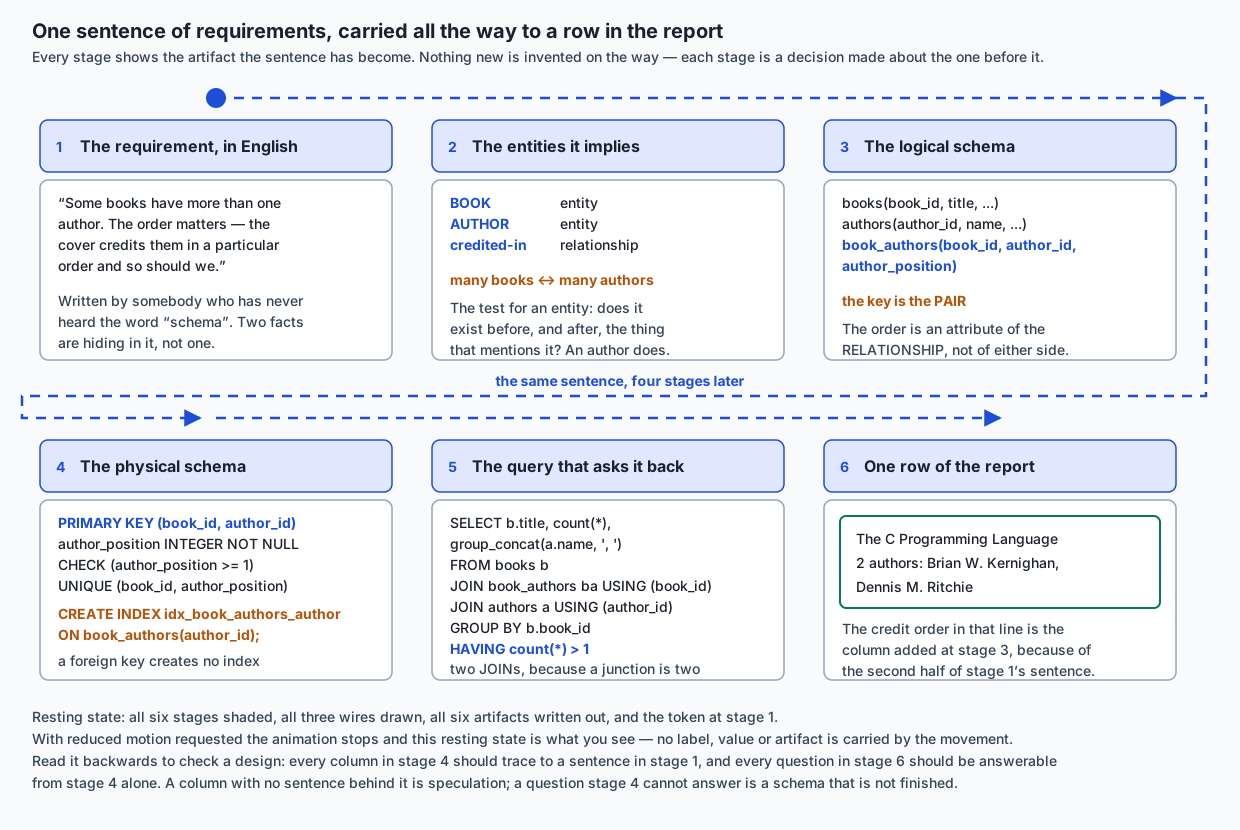
Follow one sentence all the way through, because that is what the diagram does and it is the entire method in miniature.
Stage 1, the requirement. “Some books have more than one author. The order matters — the cover credits them in a particular order and so should we.”
Stage 2, the entities. A book is a thing. An author is a thing. “Credited on” is a relationship between them, and it goes many-to-many: a book has several authors, an author has several books. That is three nouns, and one of them is a relationship rather than a table you were expecting.
Stage 3, the logical schema. books, authors, and — because neither side can hold the key, since a column holds one value — a third table book_authors. Its key is the pair. And it needs a column of its own, author_position, because the second sentence said the order matters and the order is a fact about the relationship rather than about the book or about the author.
Stage 4, the physical schema. Now the types, the constraints and the indexes. PRIMARY KEY (book_id, author_id), so the same author cannot be credited twice. UNIQUE (book_id, author_position), so two authors cannot both be second. ON DELETE CASCADE towards books and ON DELETE RESTRICT towards authors, because deleting a book should take its credits with it while deleting an author who still has books is almost certainly a mistake. And an index on author_id, because a foreign key creates none.
Stage 5, the query. Join across the junction, group by book, filter with HAVING count(*) > 1.
Stage 6, the report. The C Programming Language — 2 authors: Brian W. Kernighan, Dennis M. Ritchie. In that order, because of stage 3, because of the second half of stage 1.
Read it backwards and you have a review checklist that catches most schema problems before they ship: every column at stage 4 should trace back to a sentence at stage 1, and every question at stage 6 should be answerable from stage 4 alone. A column with no sentence behind it is speculation. A question your schema cannot answer is a schema that is not finished.
Historical background
The vocabulary in that process is older than most of the software you use, and knowing where it came from stops it feeling arbitrary.
Edgar F. Codd published A Relational Model of Data for Large Shared Data Banks in Communications of the ACM in June 1970, while working at IBM’s San Jose Research Laboratory. He followed it with normalization through 1971 and 1972, giving the first, second and third normal forms as a staged procedure for removing update, insertion and deletion anomalies, and — with Raymond F. Boyce — Boyce–Codd normal form in 1974. Day 88 covered what those forms say; today they are the background hum behind “each table is about one kind of thing”.
The entity-relationship model — the boxes-and-lines vocabulary of entities, attributes and relationships that stage 2 above uses — was introduced by Peter Chen in 1976, in The Entity-Relationship Model: Toward a Unified View of Data, published in the first issue of ACM Transactions on Database Systems. Chen’s contribution was a modelling layer that sat above any particular database, which is exactly why the diagram you draw on paper is still useful when the target is SQLite, PostgreSQL, or a document store.
The three-schema idea — that a conceptual model, a logical schema and a physical schema are different artifacts with different audiences — came out of the ANSI/SPARC committee’s work in 1975. It is why stages 3 and 4 above are separate. Stage 3 is portable and about meaning; stage 4 is about a specific engine and its types.
Two later dates matter for the querying half. Common table expressions and window functions were standardised in SQL:1999 and SQL:2003 respectively, decades after the basics. SQLite added recursive CTEs in 3.8.3 (2014) and window functions in 3.25.0 (2018). On the machine this lesson was written on, sqlite3 --version reports 3.51.0, and Python’s bundled library reports 3.53.3 — both comfortably past those floors, which the lab checks before it runs anything.
And the format that runs through today’s schema: ISO 8601 was first published in 1988, consolidating a pile of national date notations into YYYY-MM-DD. Its critical property for a database with no date type is that the notation sorts correctly as plain text — a design choice, not a coincidence.
What it is — and what it is not
Schema design is the activity of deciding what tables exist, what columns they have, which values are legal, and how the tables relate — such that the questions your users will ask are answerable, and the states your data cannot legally be in are unrepresentable.
Three distinctions do real work.
A conceptual model is entities and relationships in the language of the business. A logical schema is tables, columns and keys, still independent of any engine. A physical schema is the CREATE TABLE statements for one specific database, with its types, its constraint syntax and its indexes. You can skip straight to the third and often should for something small — but when a design goes wrong, it is nearly always because a conceptual mistake was never noticed, and you cannot see a conceptual mistake in a wall of DDL.
An entity is a thing with an independent existence. An attribute is a fact about one entity. The test that resolves nearly every case: does it exist before and after the row that mentions it, does it have facts of its own, and is it referred to by more than one row? An author passes all three, so it is an entity. A published year passes none, so it is an attribute. A category passes the first and the third, so it is an entity — and once it can contain other categories, it is an entity with a relationship to itself.
Now what schema design is not.
It is not normalization. Normalization is one tool inside it, and a schema that is in third normal form can still be a bad schema — storing money as a float, using a timestamp format that does not sort, or having no way to represent a book that has not been catalogued yet.
It is not permanent. Day 88’s migrations exist precisely because it is not. What you are buying with care today is not permanence; it is cheaper change and fewer silent wrong answers.
It is not the same as the object model in your code. Day 93 will show an ORM mapping classes to tables, and the mapping is never one-to-one — a junction table with its own column is the standard place where the two views come apart.
And a schema is not a security control. Constraints stop bad data. They do nothing about a bad reader.
| It is | It is not |
|---|---|
| A set of decisions, each with a defensible alternative | A mechanical transformation of the requirements |
| Judged by the questions it can answer cheaply | Judged by how normalized it is |
| Three artifacts — conceptual, logical, physical | One wall of CREATE TABLE statements |
| Changeable, at a cost that rises with data volume | Permanent, or free to change |
| A statement about what data is legal | A statement about who may read it |
| Where NULL means something specific, chosen | Where NULL is whatever happened to be missing |
Why it was created and what problems it solves
The design process exists because the alternative — writing tables as you need them — produces a database that answers exactly the questions you happened to think of, and no others.
The specific failures it prevents are worth naming, because each one has a decision attached.
“We cannot ask that.” The single wide table with author_name on every book row cannot answer “which authors have never been borrowed?”, because it has no way to represent an author who is not on a book. Splitting entities out solves it.
“The number is wrong and nobody noticed.” A total that is off by a penny per transaction because money is a float. A report that omits members with no loans because somebody wrote JOIN where LEFT JOIN was needed. Both are silent. Integer minor units and a habit of testing the zero case solve them.
“Two rows disagree.” Storing derived data — a queue position, a cached count, a duplicated name — means promising to update it everywhere, forever. The database cannot enforce that promise, so it is not a promise. Deriving instead of storing solves it.
“The date sorts wrong.” '01/08/2026' sorts before '02/07/2025' as text. ISO 8601 in UTC solves it, and does so well enough that you can then write CHECK (due_at > borrowed_at) and have the database enforce chronology for you.
“We deleted it and lost the history.” Hard-deleting a book removes the title from every past loan. Soft delete solves it — and immediately creates its own problem, which is that every present-tense query must now remember to filter.
“The join is slow.” Declaring a foreign key creates no index (Day 87), so every join across it scans (Day 89). Writing the index yourself solves it.
And one problem the process creates, which is fair to state: it takes time up front, and the time is spent arguing about things that will not visibly matter for months. That is a real cost. The mitigation is that the arguments are short if you have a checklist, which is what today is.
How it works
Here is the schema the process produces, from the brief the lab hands you.
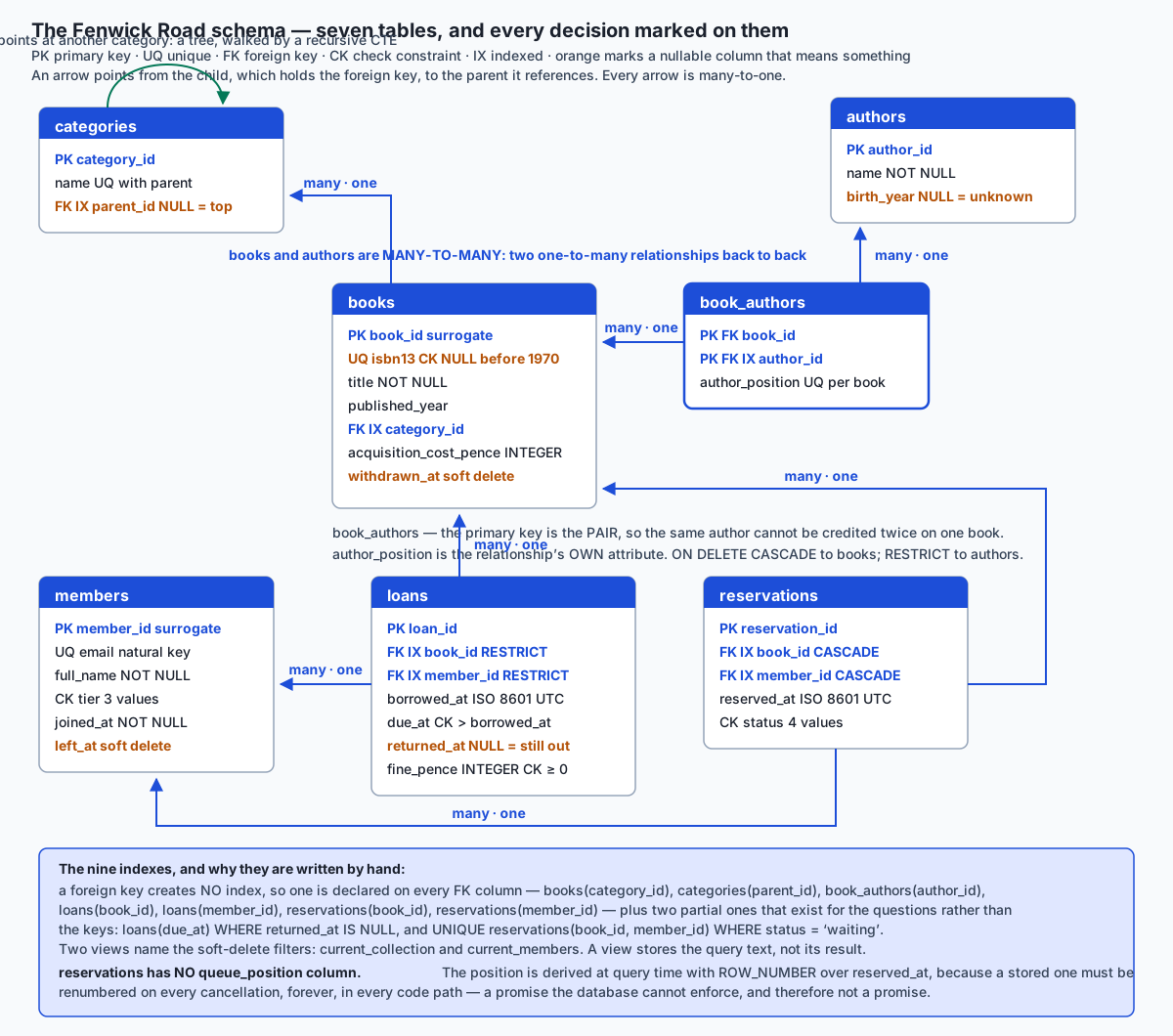
Now the decisions, one at a time. Each has a genuine argument on both sides.
Requirements to entities: the mapping table
Do this literally, on paper, before any SQL. Underline the nouns in the brief, then decide what each one is.
| Phrase in the brief | It is | Why | Where it lands |
|---|---|---|---|
| ”we lend books” | entity | Exists independently, referred to by many loans | books |
| ”a thirteen-digit ISBN” | attribute | A fact about one book, no life of its own | books.isbn13 |
| ”categories nest” | entity, self-referencing | Contains other categories, so it is a tree | categories.parent_id |
| ”some books have more than one author” | entity + relationship | An author outlives any one book | authors + book_authors |
| ”the order matters” | attribute of the relationship | Not a fact about the book, nor about the author | book_authors.author_position |
| ”we withdraw it… but keep old loans” | attribute, soft delete | The row must survive its own removal | books.withdrawn_at |
| ”members are on one of three tiers” | closed enumeration | Small, stable set | CHECK (tier IN (...)) |
| ”if it comes back late we charge a fine” | attribute, money | Integer minor units | loans.fine_pence |
| ”several members waiting, served in order” | entity | Has its own timestamp and status | reservations |
| ”a queue position” | derived, not stored | A function of reserved_at and status | computed with ROW_NUMBER |
The last row is the one worth arguing about, and we will come back to it, having got it wrong first.
Surrogate keys versus natural keys
A natural key is a value that already identifies the row in the world: an ISBN, an email address, a national insurance number. A surrogate key is a number the database made up.
The argument for natural keys is genuinely good. There is no extra column. A child row carrying isbn13 is readable without a join — you can look at book_authors and know which book it is. And the uniqueness is real rather than asserted.
The argument for surrogate keys wins anyway, for three reasons that keep recurring:
- Natural keys change. People change their email address. Publishers reissue with a new ISBN. Changing a natural key means updating every child row that references it, in lockstep, or having a foreign key that no longer resolves.
- Natural keys are sometimes absent. Frankenstein was printed in 1818. There is no ISBN, and a primary key cannot be NULL. One book without one is enough to kill the design.
- Natural keys are sometimes wrong. Catalogue staff mistype thirteen digits. Under a natural key, correcting one character is a cascade.
The failure mode of getting this wrong is not subtle: you discover it the day a member changes their email address and their entire loan history detaches. The failure mode of getting it too right — a surrogate key and nothing else — is duplicates, because nothing stops two rows for the same book.
So: surrogate key as the primary key, natural key as a UNIQUE constraint. You get the stability and the integrity guarantee both.
book_id INTEGER PRIMARY KEY,
isbn13  TEXT UNIQUE
        CHECK (isbn13 IS NULL OR
               isbn13 GLOB '[0-9][0-9][0-9][0-9][0-9][0-9][0-9][0-9][0-9][0-9][0-9][0-9][0-9]'),
In SQLite specifically, INTEGER PRIMARY KEY is an alias for the internal rowid, so the surrogate key costs nothing at all in storage — it is the row’s address either way.
When a junction table earns columns of its own
A junction table for a many-to-many relationship is often a pure link: two foreign keys, keyed on the pair, nothing else. Day 87’s version was exactly that.
It stops being a pure link the moment the relationship itself has an attribute. The test: is this fact about the left thing, the right thing, or the pairing?
author_position is about the pairing. Kernighan is not “second”; he is second on that book and first on another. There is nowhere else for it to live.
The clearest case in the lab is loans. It looks like a junction table between books and members, and it is not — a loan has a borrow date, a due date, a return date and a fine. Once a relationship has four attributes and a lifecycle, it has stopped being a link and become an entity, and it deserves its own surrogate key rather than a composite one. The signal to watch for: the same pair can occur more than once. Ada can borrow the same book twice, so (book_id, member_id) cannot be the key, so it is not a junction table.
Dates and times in a database with no date type
SQLite has no date type. datatype3.html in its documentation is explicit: there are five storage classes — NULL, INTEGER, REAL, TEXT and BLOB — and dates are stored as one of TEXT, REAL or INTEGER by convention.
The default that should be your default: ISO 8601 text, in UTC, YYYY-MM-DDTHH:MM:SSZ.
Three properties earn it:
- It sorts. Lexicographic order is chronological order, because every field is fixed-width and ordered most-significant first. Range queries,
ORDER BY,MIN,MAXand comparison all work on plain text. - It is unambiguous.
01/08/2026is the first of August in London and the eighth of January in Chicago.2026-08-01is one date everywhere. - It is readable. You can look at the database file and know what the value means, which is worth more at three in the morning than any storage efficiency.
Because it sorts as text, the format decision pays for itself immediately in constraints:
borrowed_at TEXT NOT NULL CHECK (borrowed_at LIKE '____-__-__T__:__:__Z'),
due_at      TEXT NOT NULL CHECK (due_at      LIKE '____-__-__T__:__:__Z'),
CHECK (due_at > borrowed_at)
The LIKE pattern uses _ to match exactly one character, so it enforces the shape. The last line enforces chronology — and it only works because of the format.
And UTC, always, in the database. Storing local time means storing an ambiguity: an hour that occurs twice a year when the clocks go back, and a comparison between two rows that means nothing if they were written in different places. Convert at the edges, for display.
This is the honest place to say that this is a simplification. Time zones, daylight saving, leap seconds, “the same wall-clock time next month” and the difference between an instant and a calendar date are genuinely difficult, and Day 95 treats time properly. Today’s rule — ISO 8601, UTC, text — is the right default and will carry you a long way; it is not the whole subject.
Money is an integer
Day 70 established why 0.1 + 0.2 is not 0.3 in binary floating point. It is still not, in SQLite:
sqlite> SELECT CASE WHEN 0.1 + 0.2 = 0.3 THEN 'yes' ELSE 'no' END;
no
So money is stored as an integer count of minor units — pence here — and it stays an integer through every sum and every comparison. It is divided by 100 exactly once, at the point of display, in the formatter.
fine_pence INTEGER NOT NULL DEFAULT 0 CHECK (fine_pence >= 0),The lab’s fines are 220, 190 and 300 pence. Summed as integers that is exactly 710, and the report prints GBP 7.10. Summed as floats it is close, and “close” in a fines ledger is how you end up with an account that cannot be reconciled and nobody able to say when it stopped being right.
Enumerations: CHECK constraint or lookup table
tier is one of standard, student, staff. Two ways to say so.
CHECK (tier IN (...)) | Lookup table + foreign key | |
|---|---|---|
| Cost to write | One line | A table, a foreign key, an index |
| Cost to query | Nothing | A join, or a denormalized copy |
| Adding a value | ALTER TABLE, a migration | INSERT |
| Extra facts per value | Impossible | Natural — label, loan allowance, sort order |
| Values chosen by | A developer, in a deployment | An administrator, at runtime |
The rule that follows: CHECK when the set is small, closed, and changes about as often as the code does. A lookup table when the set will grow, or when a value needs facts of its own.
Three membership tiers that change once a decade are a CHECK. Book categories — which the brief says get added, renamed and moved — are a table, and in fact are a whole tree. Both are in the lab’s schema, which is the point: the same schema uses both, correctly, for different reasons.
Nullable columns as a decision
A NULL should mean something you chose, and you should be able to say what.
The lab’s schema has four nullable columns and each one means something different:
authors.birth_year— unknown. Julie Sussman’s year of birth is not published. Inventing one to avoid a NULL would put a false fact in the database to satisfy a preference about column definitions.books.isbn13— does not apply. The 1818 book was printed before ISBNs existed.categories.parent_id— top level. Not missing at all; this is a positive fact about the world.loans.returned_at— not yet. The state “still out” is encoded by the absence of the date.
That last one deserves a warning, because the tempting alternative is worse. Adding an is_returned boolean as well as the date gives you two columns encoding one fact, and two columns that can disagree. One column, one meaning.
Everything else is NOT NULL, and that is also a decision: it says the fact is always known at insert time.
Soft delete versus hard delete
Hard delete removes the row. Soft delete sets a column — withdrawn_at, left_at — and leaves it.
The brief forces soft delete twice: withdrawn books must still resolve in old loan records, and a departed member’s outstanding fine has to survive them leaving.
The cost is immediate and permanent: every present-tense query must now remember to filter. The one that forgets does not error. It reports a number that is quietly wrong.
=== 1. How many books are on the shelves, and how many are out? ===
in_collection  on_loan_now  rows_in_books
-------------  -----------  -------------
7              4            8
Seven and eight. The difference is the withdrawn book, and it is one forgotten WHERE clause away from being the answer.
Two mitigations, and they are partial rather than complete. A view gives the filter one definition and a name:
CREATE VIEW current_collection AS
  SELECT book_id, isbn13, title, published_year, category_id, acquisition_cost_pence
    FROM books
   WHERE withdrawn_at IS NULL;
And a habit: decide per question which filter applies, rather than assuming. The lab’s question 5 — fines owed — deliberately includes members who have left, because a debt does not stop existing when somebody cancels their membership. Question 6 — most active borrowers — excludes them, because they are not members any more. Which soft-delete filter applies is a property of the question, not of the table, and that is the whole cost, stated exactly.
The decision made, rejected, and revised
Here is one taken the wrong way first, because that is how it actually happens.
The brief says several members can be waiting for the same book and are served in the order they asked. The natural reading is a queue with positions, so the first attempt stored one:
CREATE TABLE reservations_v1 (
  reservation_id INTEGER PRIMARY KEY,
  book_id        INTEGER NOT NULL,
  member_id      INTEGER NOT NULL,
  reserved_at    TEXT    NOT NULL,
  queue_position INTEGER NOT NULL CHECK (queue_position >= 1),
  status         TEXT    NOT NULL DEFAULT 'waiting'
);
Three members join the queue: positions 1, 2, 3. Then the member at position 2 cancels, and the application marks the reservation cancelled without renumbering — because renumbering is a second statement somebody has to remember to write, in every code path that can cancel:
--- so the queue now reads 1, 3: there is no position 2 ---
positions_now
-------------
1, 3
Then a fourth member joins. The code appends “the count of people waiting, plus one” — a perfectly reasonable line, written months later by somebody who has not read this file. There are two people waiting, so the new one is third:
--- the damage, stated as a number: duplicate positions in one queue ---
queue_position  members_at_this_position
--------------  ------------------------
3               2
Two people at position 3, nobody at position 2, and no error raised at any point.
The diagnosis: queue_position is derived data. It is a function of reserved_at and status. Storing derived data means promising to recompute it everywhere either input changes, forever, in every code path that will ever exist. The database cannot enforce that promise, so it is not a promise — it is a hope.
The revision is to remove the column and compute the position at query time:
SELECT member_id,
       ROW_NUMBER() OVER (PARTITION BY book_id ORDER BY reserved_at) AS queue_position
  FROM reservations
 WHERE status = 'waiting'
 ORDER BY queue_position;
After the same two cancellations, this is correct by construction — because there is nothing stored to be wrong:
member_id  queue_position
---------  --------------
1          1
2          2
The rule it bought: store what you are told; derive what follows from it. A column that can be computed from other columns is a column that can disagree with them. The exception is deliberate denormalization for measured performance, and then you write down every path that must maintain it.
Querying it back: subqueries
A scalar subquery returns one row and one column and can go anywhere a value can:
SELECT (SELECT count(*) FROM books WHERE withdrawn_at IS NULL) AS in_collection,
       (SELECT count(*) FROM loans WHERE returned_at IS NULL)  AS on_loan_now;
A correlated subquery refers to the outer query, so it is conceptually re-evaluated per outer row. That is the shape EXISTS uses.
EXISTS versus IN versus a join
All three can answer “which current members have never borrowed?”, and they are not equivalent.
| Construct | Returns | Multiplies rows? | The trap |
|---|---|---|---|
NOT EXISTS (...) | Boolean, stops at the first match | No | None worth knowing |
NOT IN (SELECT ...) | Boolean over a list of values | No | Returns nothing at all if the subquery yields one NULL |
LEFT JOIN ... WHERE key IS NULL | Rows | Yes, before the filter | Builds every pair, then discards nearly all of them |
JOIN | Rows, with columns | Yes | Duplicates the left row once per match |
The rule: use a join when you need columns from the other table. Use EXISTS when you only need to know whether a row is there. EXISTS says what the English sentence says, cannot accidentally multiply your rows, and is immune to the NOT IN NULL trap that Day 86’s three-valued logic sets.
SELECT m.full_name, m.tier
  FROM members AS m
 WHERE m.left_at IS NULL
   AND NOT EXISTS (SELECT 1 FROM loans AS l WHERE l.member_id = m.member_id);
Eli Nakamura|studentCommon table expressions, and one that recurses
A common table expression is a named subquery written before the query that uses it. It buys nothing the database could not do with nested subqueries; it buys readability, which is the entire point, and it lets you refer to the same intermediate result twice.
The version that is not merely cosmetic is WITH RECURSIVE. The lab’s categories form a tree: Fiction contains Science Fiction, which contains Cyberpunk. “Everything under Fiction, at any depth” cannot be written as a join, because the number of joins you would need is the depth of the tree and you do not know the depth of the tree.
WITH RECURSIVE subtree(category_id, name, depth) AS (
      SELECT category_id, name, 0
        FROM categories
       WHERE name = 'Fiction'
  UNION ALL
      SELECT c.category_id, c.name, s.depth + 1
        FROM categories AS c
        JOIN subtree    AS s ON c.parent_id = s.category_id
)
SELECT s.depth, s.name, count(b.book_id)
  FROM subtree AS s
  LEFT JOIN books AS b ON b.category_id = s.category_id AND b.withdrawn_at IS NULL
 GROUP BY s.category_id, s.depth, s.name
 ORDER BY s.depth, s.name;
0|Fiction|0
1|Gothic|1
1|Science Fiction|1
2|Cyberpunk|1The anchor before UNION ALL selects the starting row. The recursive part joins the table to the CTE, finding the children of everything found so far, and stops when a pass adds nothing. The depth column is carried by hand, because SQL will not tell you how many passes it took. Note also that the withdrawn filter is in the ON clause rather than the WHERE clause — Day 87’s rule, and moving it would silently drop the categories with no books.
Window functions, and the problem GROUP BY cannot solve
A window function computes a value across a set of related rows — a partition — without collapsing them. That single sentence is the whole difference from an aggregate, and it is the difference that matters.
“The two most active borrowers in each tier” is the classic case. GROUP BY tier can give you the maximum loan count per tier. It cannot give you the top two people, because the aggregation has already thrown the names away. The lab measures the collapse: the GROUP BY version returns 3 rows, one per tier, and the answer needs 5.
WITH per_member AS (
  SELECT m.member_id, m.full_name, m.tier, count(l.loan_id) AS loan_count
    FROM members AS m
    LEFT JOIN loans AS l ON l.member_id = m.member_id
   WHERE m.left_at IS NULL
   GROUP BY m.member_id, m.full_name, m.tier
),
ranked AS (
  SELECT tier, full_name, loan_count,
         ROW_NUMBER() OVER (PARTITION BY tier ORDER BY loan_count DESC, full_name) AS position
    FROM per_member
)
SELECT tier, position, full_name, loan_count
  FROM ranked WHERE position <= 2 ORDER BY tier, position;
staff|1|Chandra Iyer|4
standard|1|Ada Okafor|3
standard|2|Dana Whitfield|2
student|1|Bruno Salgado|4
student|2|Eli Nakamura|0Three things in that output are worth pausing on. The LEFT JOIN is what keeps Eli Nakamura, who has borrowed nothing, in the ranking at all. count(l.loan_id) rather than count(*) is what makes her count 0 rather than 1 — both Day 87 traps, arriving inside a window query. And the whole thing is two steps because a window function cannot be filtered in WHERE: it is computed after WHERE and after GROUP BY, so to filter on its result you compute it in a CTE and filter outside.
ROW_NUMBER always gives 1, 2, 3 with no gaps and breaks ties arbitrarily unless you tell it how. RANK gives equal values the same number and then skips — 1, 1, 3. Choose by what a tie should mean: a queue position must be unique, so ROW_NUMBER; a leaderboard should show a genuine tie, so RANK.
SUM(...) OVER (ORDER BY ...) is a running total. The default frame when ORDER BY is present is everything up to and including the current row, which is exactly a cumulative sum — and omitting the ORDER BY silently gives you the grand total on every row instead:
2026-05|2|6
2026-06|3|9
2026-07|3|12
2026-08|2|14
Views, honestly
A view is a saved query. CREATE VIEW current_collection AS SELECT ... WHERE withdrawn_at IS NULL and every report can say FROM current_collection.
What it buys: a name for a piece of reasoning, and consistency, because every report that uses it filters the same way. What it does not buy: speed. A view stores the query text, not its result. It is expanded into whatever query uses it and runs afresh every time. A materialized view — which does store the result — is a different feature that SQLite does not have.
The report
The last stage is a Python script that opens the database through the repository pattern from Day 90 — one method per question, every value bound rather than interpolated — and prints something a person would read.
class LibraryRepository:
    def __init__(self, path):
        self.connection = sqlite3.connect(str(path))
        self.connection.execute("PRAGMA foreign_keys = ON")   # first, always
        self.connection.row_factory = sqlite3.Row

    def overdue_loans(self, now):
        return self._rows("""
            SELECT m.full_name, b.title, l.due_at,
                   CAST(julianday(?) - julianday(l.due_at) AS INTEGER) AS days_overdue
              FROM loans   AS l
              JOIN members AS m ON m.member_id = l.member_id
              JOIN books   AS b ON b.book_id   = l.book_id
             WHERE l.returned_at IS NULL AND l.due_at < ?
             ORDER BY days_overdue DESC
        """, (now, now))
Two details are load-bearing. Nothing outside the repository knows SQLite exists, so the formatting code physically cannot build a query out of string concatenation. And the report instant is a parameter with a default, not a clock reading — a report whose answer changes depending on when it runs cannot be tested, cannot be reproduced, and cannot be compared with last month’s copy.
4. Overdue loans
----------------
   10 days  Bruno Salgado    The Left Hand of Darkness
            was due 2026-08-05T13:00:00Z
    5 days  Chandra Iyer     Neuromancer
            was due 2026-08-10T10:00:00Z

5. Fines outstanding
--------------------
    GBP 4.10  Ada Okafor       (current)
    GBP 3.00  Farida Haddad    (left)
    GBP 7.10  TOTAL
An everyday analogy
Think about designing the forms and filing cabinets for a small clinic before it opens.
The doctor tells you what happens in prose: patients register, they book appointments, some appointments get cancelled, prescriptions have several medicines on them and the order on the label matters, and people move house.
Stage 2 is deciding which of those nouns gets a cabinet. A patient gets one — they exist between visits, they have facts of their own, several appointments refer to them. A patient’s height does not get a cabinet; it goes on the patient’s card. This is the entity-versus-attribute test, and it is exactly as easy and as easy to get wrong in a clinic as in a database.
The surrogate key is the patient number on the card. You could file by name, and small practices used to. Then two people are both called Sarah Chen, one of them gets married and changes her name, and every cross-reference in every other cabinet is now pointing at a name that no longer exists. So you assign a number that means nothing and never changes, and you keep the name on the card where it can be corrected without consequence.
The junction table with its own column is the prescription line. A prescription is not simply “this patient, these medicines” — each line has a dose and a position on the label. Those facts belong to the pairing of prescription and medicine, not to either alone, so they go on the line rather than on the medicine card or the prescription cover sheet.
The date format is the rule on the wall saying to write dates as year-month-day. It looks like pedantry until the day somebody files by date and discovers that 01/08 and 08/01 interleave into nonsense. The rule exists so the drawer is in order simply by being in order.
Money in pence is the rule that the petty-cash book is kept in whole pence, never in fractions of a pound. Every accountant has this rule and it is the same reason.
Soft delete is the archive drawer. A patient who leaves the practice does not get shredded — their file moves to the archive, because the prescriptions they were issued still have to be findable. And the price is exactly the price in the database: every time somebody asks “how many patients do we have?”, they now have to remember to say “in the current drawer”. The receptionist who forgets does not get an error; they get a number that is too big, and they read it out at the meeting.
The derived queue position is the mistake. Writing “you are third in line” on the appointment card feels helpful, and it is right until somebody cancels. Then card three says three, card four says four, and there is nobody second. The fix is the one the lab makes: do not write the position down. Count the cards in the drawer, in date order, when somebody asks.
A view is the standing instruction pinned to the drawer — “when anybody asks for the current patient list, it means this drawer, filtered like this”. It saves you re-explaining. It does not make the counting faster, because somebody still has to count.
Where the analogy runs out: the clinic can quietly tolerate an inconsistency for years, because a human reading the file usually notices something is off. A database will not notice, will not tell you, and will hand the wrong number to a report that gets emailed to a board.
Examples in practice
Three shapes you will write within a week of finishing this.
Auditing a pipeline for gaps, with the anti-join. Every ingestion system needs this, and the shape is the same one Day 87 taught:
SELECT d.doc_id, d.title
  FROM documents AS d
 WHERE NOT EXISTS (SELECT 1 FROM embeddings AS e WHERE e.doc_id = d.doc_id);
“Which documents were ingested but never embedded?” If your retriever is silently missing a fifth of your corpus, this is the query that finds out, and there is no way to write it against a single table.
Deduplicating with a window function. You have several rows per entity and want the most recent one — the top-N-per-group problem again, with N of 1:
WITH ranked AS (
  SELECT *, ROW_NUMBER() OVER (PARTITION BY source_url ORDER BY fetched_at DESC) AS rn
    FROM raw_documents
)
SELECT * FROM ranked WHERE rn = 1;
This is the single most common use of ROW_NUMBER in data work, and it is worth memorising as a unit. GROUP BY source_url with max(fetched_at) gives you the timestamp but not the row it came from.
A running total for a report, in PostgreSQL. Same syntax, different engine — the window-function standard is genuinely portable:
SELECT month,
       loans_started,
       sum(loans_started) OVER (ORDER BY month) AS running_total
  FROM monthly_loans;
The one difference worth knowing when you move this to PostgreSQL: month there would be a real date truncated with date_trunc('month', borrowed_at) rather than a text strftime('%Y-%m', ...), and the ordering would be a date ordering rather than a string one. It gives the same answer, for a slightly better reason.
Implications: security, privacy, performance, scalability, and cost
Privacy: what you store is the ceiling on what can leak. The brief does not ask for a member’s date of birth, home address or reading interests, so the schema has no columns for them. A column that does not exist cannot be joined, exported, indexed by mistake, or handed over. This is the cheapest privacy control there is and it is only available at design time.
Privacy: soft delete keeps data you may have been asked to remove. members.left_at means a departed member is still a row, with their name and email, indefinitely, in every backup. The brief has a good reason — an outstanding fine survives the membership — but “deleting is inconvenient” is not that reason. Decide in advance what a departed row may retain and for how long, and write the deletion job at the same time as the soft-delete column.
Privacy: the query is the disclosure boundary, not the table. The overdue report produces “this named person has this named book and is ten days late”. Each table alone is harmless; the join is the reading record. When you decide who may run what, reason about the query.
Security: constraints stop bad data, not bad readers. Every CHECK, UNIQUE and REFERENCES here refuses an impossible row — the lab proves eleven of them do. None of them stops somebody who can read the file, because a SQLite database is an ordinary file with ordinary permissions and no encryption.
Security: the repository is a structural control. With every statement inside LibraryRepository, the formatting code has no connection object in scope, so it cannot build a query by concatenation. That is a property of the structure rather than of anybody’s discipline, which is the kind of security control that survives a rushed afternoon.
Performance: index what the questions need, not what looks important. Nine indexes exist in this schema and every one traces to a query. Seven are on foreign-key columns, because declaring a foreign key creates no index. Two are partial — loans(due_at) WHERE returned_at IS NULL covers the “what is out right now” questions over a table that grows forever while the outstanding set stays small.
Performance: a window function is not free. It sorts each partition. On a large table, ROW_NUMBER() OVER (PARTITION BY x ORDER BY y) is dramatically faster than the correlated-subquery alternative, but it is not free, and an index on (x, y) is what makes it cheap. Day 89’s habit applies: measure with EXPLAIN QUERY PLAN rather than guessing.
Scalability: the schema decides what can be sharded. A design where every query joins six tables is fine on one machine and expensive across several. Deep hierarchies walked by recursive CTEs are the first thing to hurt. This is not a reason to avoid them at library scale; it is a reason to know which of your questions are the ones that will not survive growth.
Cost: the schema is the cheapest thing to change today and the most expensive thing to change in a year. Adding a column to an empty table is one statement. Adding it to a table with a hundred million rows, in production, with old code still running, is a project. The time spent on the mapping table at the top of this lesson is the highest-leverage half hour in the whole exercise.
Alternatives: free, open source, and commercial
Four genuinely different ways to do this work, and the last one is a real alternative rather than a variation.
By hand, on paper, then straight to SQL — free. What this lesson does, and the right default for anything you can hold in your head. When to choose it: fewer than about fifteen tables, one or two people, and a schema you will read more often than you will present. How: write the mapping table of phrases to entities, sketch the boxes and lines, then write the CREATE TABLE statements with a comment above each decision saying what the alternative was. Concrete example: the lab’s examples/01_schema.sql, where every constraint carries its reasoning. Free vs paid: entirely free; the cost is that the diagram lives in your head or on a photograph of a whiteboard.
A dedicated modelling tool — free and paid options both. dbdiagram.io and DBML let you write a text description and get a diagram; SchemaSpy (Apache-2.0) and SchemaCrawler (free) generate diagrams from an existing database, which is the direction that cannot drift; pgModeler (GPL) and MySQL Workbench (GPL) do forward and reverse engineering; DB Browser for SQLite (GPL/MPL) will open today’s file and draw it. When to choose one: more than a handful of tables, or more than a handful of people, or any situation where somebody who does not read SQL has to approve the design. How: describe the schema in the tool’s text format and export both the diagram and the DDL, or point a reverse-engineering tool at the built database and regenerate the picture in CI. Concrete example: running SchemaSpy against library.db produces the entity-relationship diagram from the database itself, so it cannot disagree with reality. Free vs paid: SchemaSpy, SchemaCrawler, pgModeler and MySQL Workbench are free and open source; dbdiagram.io and the commercial tools have free tiers and paid plans whose prices change often enough that you should read their current pricing page rather than trust a figure written here. The honest catch: a hand-drawn diagram starts drifting from the database the day after you draw it. If you use a tool, prefer the ones that generate the picture from the schema.
PostgreSQL, where the types are real — free, PostgreSQL licence; you pay only for hosting. The same design, with several of today’s workarounds replaced by features. When to choose it: more than one process writing concurrently, or when you want the database to enforce what SQLite makes you enforce by convention. How: the same CREATE TABLE statements with different types. Concrete example — the same three columns:
withdrawn_at TIMESTAMPTZ,                       -- a real instant, not text
is_active    BOOLEAN NOT NULL DEFAULT true,     -- a real boolean, not 0/1
tier         membership_tier NOT NULL,          -- CREATE TYPE membership_tier AS ENUM (...)
fine         NUMERIC(10,2) NOT NULL DEFAULT 0   -- exact decimal, not integer pence
What changes, concretely: TIMESTAMPTZ stores an instant and converts on the way in and out, so the LIKE '____-__-__T...' check disappears and time-zone handling becomes the database’s problem rather than yours. A native enum replaces the CHECK, and adding a value is ALTER TYPE. NUMERIC is exact decimal arithmetic, so money can be stored in pounds without drifting — though integer minor units remains a perfectly good choice, and is what most payment systems use. Foreign keys are enforced by default, with no pragma. And Postgres has materialized views, so a view can buy you speed there. Free vs paid: free to run yourself forever; managed hosting is where money appears.
An ORM — free, open source. SQLAlchemy, Django’s ORM and Peewee all express this schema as Python classes and generate the DDL and the migrations. When to choose it: an application where the same objects are used throughout, and where migrations need to be version-controlled alongside the code. How: declare the model classes, let the tool generate the migration, review the generated SQL before applying it. Concrete example: in SQLAlchemy, today’s junction table is an association object rather than a plain secondary= table, precisely because it has author_position — which is the standard place where the object view and the table view come apart. Day 93 covers this properly, and this is an honest forward reference rather than a summary: today gives you the ability to read what an ORM emits and say whether it is right. Learning it the other way round means that when a generated query is slow or a generated migration does something surprising, you have no way in. Free vs paid: all free and open source.
Just keep it in JSON files — free. Argued fairly, because it is the right answer more often than database people admit. When to choose it: the data fits comfortably in memory, one process touches it, the shape is a document rather than a set of relationships, and the whole thing is small enough to read with your eyes. Configuration, a personal reading list, the output of a one-off scrape. How: one file per collection, json.load at startup, json.dump at the end. Concrete example:
books = json.load(open("books.json"))
by_author = collections.defaultdict(list)
for book in books:
    for author in book["authors"]:          # nesting is free here
        by_author[author].append(book["title"])
Look at what that buys: nesting the authors inside the book is trivial, and no junction table is needed at all. Now cost it honestly. No constraints — nothing stops a negative fine, a duplicate id, or a tier nobody has heard of. No transactions — a crash halfway through a write leaves a truncated file, and the lab’s seven tables would be seven files that can disagree with each other. No concurrency — two processes writing means one of them loses. Every query is a program — the ten questions in the lab become ten Python functions, and questions 6, 8 and 9 become genuinely difficult; the recursive one is a graph traversal you write yourself. No indexes — every lookup is a scan, and you will end up building dictionaries by hand, which is an index you now maintain. Migration is a rewrite script with no rollback. The honest summary: JSON is cheaper than a database until the moment you need a second question answered about the same data, and then it is more expensive forever. SQLite is one file too, needs no server, and gives you all of the above for the same deployment cost — which is why “it’s just a file” is not actually an argument against it.
Comparison with related concepts
| Concept | What it does | How it differs from schema design |
|---|---|---|
| Normalization | Removes update, insertion and deletion anomalies | One tool inside the design. A fully normalized schema can still store money as a float |
| Entity-relationship modelling | Names entities, attributes and relationships | The conceptual stage. Says nothing about types, constraints or indexes |
| Data modelling | Often used for the conceptual and logical stages together | Broader; schema design ends at running DDL |
| Migration | Changes a schema that already has data | What you do after. Day 88. Good design makes migrations rarer, not unnecessary |
| Indexing | Makes existing queries faster | Does not change any answer. Day 89 |
GROUP BY | Collapses rows into one per group | A window function computes across rows without collapsing them |
| Subquery | A query nested inside another | A CTE is a subquery given a name and written first; a recursive CTE can refer to itself |
| View | A saved query | Names a piece of reasoning; stores no data and buys no speed |
| Materialized view | A saved query and its result | Real speed, real staleness. Not available in SQLite |
| Denormalization | Deliberately storing data more than once | The opposite trade, taken on purpose after measurement, with a written plan for keeping copies in step |
| Schema-on-read | Store raw, impose structure when querying | Moves the decision from write time to read time — and to every reader, separately, forever |
The one worth dwelling on is the last. “Schema-on-read” sounds like it avoids today’s work. It does not; it distributes it. Every consumer now decides independently what a field means, and they will disagree. The decision does not go away by being deferred — it goes away by being made once, in one place, which is what a schema is.
When to use it — and when not to
Do the full process when the data will outlive the program that wrote it, when more than one person or process will query it, when there is money or a person’s record in it, or when you cannot yet list every question that will be asked. That last one is the real test — a schema’s job is to answer questions you have not thought of.
Skip most of it when the data is genuinely throwaway: a scratch table for one analysis, a cache you can rebuild, a scrape you will parse once. Write the tables you need and move on. Ceremony proportional to consequence.
Reach for a lookup table instead of a CHECK when the set of values will grow, or when a value needs facts of its own. Reach for the CHECK when it is small, closed, and changes with the code.
Choose soft delete when history has to survive the deletion — and only when. Every soft-delete column is a permanent tax on every present-tense query, and a permanent question about data retention.
Do not store derived data unless you have measured that you need to, and can name every code path that must maintain it. If you cannot name them, you have chosen the update anomaly on purpose.
Do not reach for a window function when a plain GROUP BY answers the question. If you only need one number per group, aggregate. Window functions are for when you need the rows and something computed across them.
Do not normalize to the last drop for its own sake. Normalization removes anomalies; it is not a score. A three-row lookup table of values that never change, joined into every query, may be worth inlining — write down why.
And do not let a modelling tool decide. A generated diagram is a picture of your decisions, not a substitute for making them. If the tool produces something you cannot justify in a sentence, the design is not finished.
Where this goes next in AI work
Come back to the opening now that the mechanism is in place.
Every dataset a model trains on, and every corpus a retrieval system indexes, started as somebody’s schema decision — and the decisions are the same ones you made today, in the same order.
Somebody decided whether a document had one author or many, which is the difference between being able to ask “what have we ingested from this source?” and not. Somebody decided whether the timestamp was creation time or ingestion time, which decides whether you can answer “was this model trained on anything published after the cutoff?”. Somebody decided whether a deleted record left a row behind, which decides whether you can prove a document was removed rather than merely stopped being returned. Somebody decided whether the label was an enumeration or free text, which decides whether your evaluation set has three classes or three hundred near-duplicate spellings of three classes.
Every one of those is invisible until somebody needs the answer, and by then the fix is a migration over the whole corpus — which for a training set means re-deriving everything downstream of it.
The querying half matters just as much, because the questions worth asking about a pipeline are almost all today’s shapes. Which documents were ingested but never embedded is NOT EXISTS. The most recent version of each document is ROW_NUMBER partitioned by source and ordered by fetch time — deduplication is the top-N-per-group problem wearing a different hat. Corpus growth over time is SUM ... OVER. The full hierarchy of a taxonomy your labels hang off is a recursive CTE. A model’s per-class performance ranked within each data source is a window function over a partition, and it is not expressible with GROUP BY at all.
And the honest final point, which is the one to carry. The most expensive mistakes in a data system are not the slow queries. A slow query is a problem you can see, measure and fix. The expensive mistake is the column that was never created, discovered eighteen months later by somebody who needed to answer a question and found that the answer had never been written down. There is no index for that. There is only the half hour you spent, at the start, mapping sentences to entities and asking what each of them will one day need to be asked.
Knowledge check
Try these from memory before looking back.
- Give the five stages from a paragraph of requirements to a running query, and say what artifact each one produces. What are the two checks you run backwards through them?
- State the test for whether something is an entity rather than an attribute, and apply it to: an author, a published year, a book category, and a reservation.
- Argue for natural keys, then argue for surrogate keys, then say which the lesson chooses and what it does with the loser. What are the three failure modes of a natural primary key?
- When does a many-to-many junction table need columns of its own? Give the test in one sentence, and say what signal tells you the junction has actually become an entity.
- SQLite has no date type. What format does the lesson use, and what three properties earn it? Which
CHECKconstraint becomes possible because of that format? - Why is money an integer? Show the SQLite expression that demonstrates the problem, and say where exactly the division by 100 belongs.
- Give the rule for choosing between a
CHECKconstraint and a lookup table for an enumeration. Which does the lab use for membership tier, which for category, and why the difference? - Name the four nullable columns in the lab’s schema and say what each NULL means. Why is adding an
is_returnedboolean alongsidereturned_ata mistake? - What does soft delete cost, in exact terms? Give a question from the lab that must include soft-deleted rows and one that must exclude them, and say what that proves.
- Explain why
queue_positionwas removed from the reservations table. What is the general rule, and what is its one exception? - Compare
EXISTS,INand a join for “which members have never borrowed”. When is each the right choice, and what is the trap inNOT IN? - What can a recursive CTE do that no number of joins can? Name the two parts of one and say what the
depthcolumn is for. - State in one sentence what a window function does that
GROUP BYcannot. Then explain why the top-two-per-tier query has to be written in two steps. - What is the difference between
ROW_NUMBERandRANK, and how do you choose? What happens toSUM(...) OVER ()if you omit theORDER BY? - What does a view buy you, and what does it not? What would you need instead for the thing it does not buy?
Hands-on exercise
The Day 91 lab, From Requirements to Report, hands you the brief and asks you to build the whole thing. Work in the lab directory; every command is run from there. Nothing needs installing and nothing touches the network.
Start with the harness, which should be green before you change anything:
bash tests/run_tests.sh
echo "exit code: $?"
Then read starter/00_brief.md — twice, before writing any SQL — and find out where you stand:
bash starter/03_check.shIt will report 0 of 16 exercises complete. and tell you exactly what is missing. Then do the work: three tables are written for you as worked examples in starter/01_schema.sql, and four tables plus the indexes and the views are yours. The ten questions live in starter/02_questions.sql with the required columns and row order stated above each one. Re-run the checker as often as you like.
When you have finished — and only then — read the reference and the reasoning:
rm -f library.db
sqlite3 library.db < examples/01_schema.sql
sqlite3 library.db < examples/02_seed.sql
sqlite3 library.db < examples/03_questions.sql
sqlite3 rejected.db < examples/04_rejected_design.sql
python3 examples/05_report.py library.db
python3 examples/05_report.py library.db '2026-09-01T09:00:00Z'
rm -f library.db rejected.db
Expected output
The harness ends with a real captured line:
72 checks, 0 failure(s).and exits 0. The starter reports 0 of 16 exercises complete. with exit 1 before you begin and 16 of 16 exercises complete. with exit 0 when you are done.
The ten answers are exact. The collection is 7 books with 4 out on loan — while books holds 8 rows, the difference being the withdrawn one. Exactly one current member has never borrowed (Eli Nakamura). Three books have more than one author, with SICP’s three names in credited order. Two loans are overdue, by 10 and 5 whole days. Fines are 4.10 and 3.00, the second owed by a member who has left. The top-two-per-tier ranking has five rows and includes Eli Nakamura with 0. The Neuromancer queue puts Ada Okafor second, not third, because the cancelled reservation occupies no slot. The monthly running total reaches 14. The recursive walk finds Fiction and its three descendants, with Cyberpunk at depth 2. And exactly one author has never been borrowed: Donald E. Knuth.
The rejected design ends with two members at position 3 and no error raised anywhere.
The report totals the fines at GBP 7.10. Run it again with '2026-09-01T09:00:00Z' and the two overdue loans grow from 10 and 5 days to 26 and 21, and two more join them — proving the instant is a parameter rather than a clock reading.
Validate your work
bash tests/run_tests.shends with72 checks, 0 failure(s).and exits 0.- The schema creates seven tables, two views and nine explicit indexes — a foreign key creates none of its own.
book_authorsis keyed on the pair and carriesauthor_position;bookshas no author column at all. This is the check that fails if the many-to-many relationship is modelled wrongly.isbn13isUNIQUEand nullable, and exactly one book — Frankenstein, 1818 — legitimately has none.- Eleven impossible rows are refused, including a loan due before it was borrowed, a negative fine, a mis-shaped timestamp, an unknown tier, and a hard delete of a book that has loan history.
- Question 1 answers 7 and 4, while
SELECT count(*) FROM booksanswers 8. - Question 6 includes Eli Nakamura with 0, which requires both a
LEFT JOINandcount(l.loan_id)rather thancount(*). - The
GROUP BY-only version of question 6 collapses to 3 rows against the 5 the answer needs. examples/04_rejected_design.sqlexits 0 — nothing errored — and ends with two members at position 3.- After the harness finishes,
ls library.dbfinds nothing: everything was built and removed in a temporary directory.
Troubleshooting
troubleshooting.md has the full list, grouped by the message you actually see. The ones you are most likely to meet: near "OVER": syntax error, which means your sqlite3 predates 3.25.0 and has no window functions — the suite checks for this first, on purpose. no such table, which usually means SQLite silently created an empty database from a mistyped filename; run .tables before assuming your schema failed. A CHECK that never fires, which is either a column-level check trying to see another column (it must be written at table level) or CHECK (x <> 'bad') being unknown rather than false when x is NULL. CHECK constraint failed on a timestamp, which is the shape rule doing its job: a space instead of the T, or a single-digit month, is refused deliberately. misuse of window function, which is a window function in a WHERE clause — compute it in a CTE and filter outside. SUM ... OVER giving the same number on every row, which is a missing ORDER BY inside OVER (...). A recursive CTE returning one row, which is the join in the recursive part being the wrong way round. And a total of 7.099999999999999, which is money having left integer arithmetic somewhere.
Common mistakes
- Making the natural key the primary key. It changes, it is sometimes absent, and it is sometimes mistyped. Surrogate primary key, natural key as
UNIQUE. - Turning an entity into an attribute. An author as a text column on
booksmakes “which authors have never been borrowed?” unanswerable rather than slow. - A junction table with its own surrogate id instead of the pair as its key. Nothing then stops the same author being credited twice on one book.
- Leaving the relationship’s own attribute off the junction. The credit order belongs nowhere else, and there is no query that recovers it later.
- Storing dates in a local format. They do not sort, they are ambiguous, and every ordering constraint you might have written becomes impossible.
- Storing local time instead of UTC. One hour a year occurs twice, and two rows written in different places cannot be compared.
- Money as
REAL. The total drifts, silently, and no index fixes it. - A boolean alongside the date that already encodes it. Two columns for one fact are two columns that can disagree.
- Soft-deleting and then forgetting the filter. The count is too big and nothing errors.
- Storing derived data. The queue position, the cached count, the duplicated name. If the database cannot enforce it, it is a hope.
NOT INwith a subquery that can contain NULL. Returns nothing at all, silently.- Reaching for
SELECT DISTINCTto hide the duplication a many-to-many produces. Decide what one output row is supposed to mean instead. - Trying to filter a window function in
WHERE. It is computed afterWHERE. Compute in a CTE, filter outside. - Assuming a foreign key created an index. It did not, and every join across it scans.
Practice assignment
Design and build a schema of your own, from a domain you actually know, going through all five stages and keeping every intermediate artifact.
Start by writing the brief in prose, as a non-technical person would. A paragraph or two. Podcasts and episodes; a recipe collection with ingredients and substitutions; a football league with fixtures, results and transfers; your photo library with albums, people and places. Write it before you know what the tables will be, and do not sneak schema vocabulary into it.
Then produce the mapping table. Every underlined phrase in your brief, what it is (entity, attribute, relationship, derived), why, and where it lands. This artifact is worth more than the SQL, because it is the one you can show somebody who does not read SQL.
Then write the logical schema, with at least: one one-to-many relationship, one many-to-many with a junction table that carries at least one attribute of its own, one self-referencing hierarchy, one enumeration, one money column, one timestamp column, and one soft-delete column. Say in a comment why each nullable column is nullable.
Then make one decision, badly, on purpose, and break it. Store something derived. Use a natural key as a primary key and then change the value. Store a date in a format that does not sort. Then write the SQL that demonstrates the failure, capture its output, and write the revision. That pair of captures is the most valuable artefact in the assignment, and it is the only part of this that cannot be faked by copying a schema you found.
Then write ten questions in plain English and answer each with one query. At least one must need a CTE, at least one must need a recursive CTE, at least one must need a window function, and at least one must have an answer of zero for some group — which is where you find out whether your join and your count() are both right. Write down the answer you expect before running each one.
Then write the report script, with a repository class, every value bound, and the report instant as a parameter with a default rather than a clock reading.
Your deliverable is the brief, the mapping table, the schema with its reasoning, the broken-and-revised decision with both captures, the ten questions with their real output, and one paragraph naming a question your schema cannot answer and what you would have to change to make it possible. Every schema has one. Finding it before somebody asks is the whole skill.
Extension challenge
Three extensions, each forcing a judgement rather than more typing.
Introduce physical copies and find out how much of your schema was assuming. The brief quietly assumes one copy per title; real libraries own three copies of the popular ones. Add copies(copy_id, book_id, acquired_at, condition) and move the loan’s foreign key from book_id to copy_id. Now rewrite all ten questions. Some are unchanged. Some need one more join. At least one becomes genuinely ambiguous — “how many books are out?” now has two different correct answers, and which one the library means is a question you have to go and ask. Write down which questions changed, which became ambiguous, and what you would ask. The lesson here is that a schema encodes assumptions you did not know you were making, and the way you find them is by changing one.
Answer the top-two-per-tier question three ways and measure. Write it with ROW_NUMBER, then with a correlated subquery counting how many members in the same tier borrowed more, then with a self-join and a HAVING clause. Confirm all three give the same five rows. Then run EXPLAIN QUERY PLAN on each, and generate ten thousand members and a hundred thousand loans and time them. Write a paragraph on which you would maintain, which you would ship, and — the interesting part — whether those are the same answer. The correlated subquery is the version people wrote for the twenty years before window functions were standardised, and knowing what it costs is what makes the window function feel like a tool rather than a syntax.
Take the whole thing to PostgreSQL and write down every difference. Translate the schema: TIMESTAMPTZ instead of ISO 8601 text, a native enum instead of the CHECK, NUMERIC or integer pence for money — decide which and justify it, BOOLEAN where you used 0 and 1, GENERATED ALWAYS AS IDENTITY instead of INTEGER PRIMARY KEY. Then translate the ten queries and note which ones changed and which did not. Most of the window functions and CTEs will not change at all, which tells you something about what is standard and what is SQLite. Then answer three questions in writing: what did the stronger types buy you, what did they cost you in flexibility, and — the one that matters — would you still have started in SQLite? There is a defensible answer either way, and an engineer who can give it is worth considerably more than one who has a favourite database.
Quiz
Q1. A library catalogue stores books, and the ISBN uniquely identifies an edition. Should the ISBN be the primary key of the books table?
- Yes — it is a genuine natural key assigned by an external authority, so it is exactly what a primary key is for
- No — use a surrogate integer primary key and keep the ISBN as a UNIQUE constraint, because natural keys change, are sometimes absent, and are sometimes mistyped
- No — natural keys should never appear in a schema at all, so the ISBN should be dropped
- It makes no difference in SQLite, because every table has a rowid regardless
Show answer
Answer: B. No — use a surrogate integer primary key and keep the ISBN as a UNIQUE constraint, because natural keys change, are sometimes absent, and are sometimes mistyped
The argument for the natural key is real: no extra column, child rows readable without a join, and uniqueness that exists in the world rather than merely being asserted. It loses anyway, for three reasons that recur in every domain. Natural keys change — a publisher reissues with a new ISBN, and every child row referencing the old one has to be updated in lockstep or the reference stops resolving. Natural keys are sometimes absent — Frankenstein was printed in 1818 and has no ISBN, and a primary key cannot be NULL, so one such book kills the design. And natural keys are sometimes wrong — catalogue staff mistype thirteen digits, and correcting one character becomes a cascade. The answer is not to discard the natural key, which is option 2 and throws away a real integrity guarantee: it is a surrogate primary key plus UNIQUE on the natural one, which gets stability and uniqueness both. Option 3 confuses storage with design — SQLite does alias INTEGER PRIMARY KEY to the rowid, but the choice of what other tables reference is entirely a design decision.
Q2. You have books and authors in a many-to-many relationship, and the brief says the cover credits the authors in a particular order which you must preserve. Where does the credit order belong?
- On the authors table, as a position column
- On the books table, as a comma-separated list of author names in order
- Nowhere — the order can be recovered from the order the rows were inserted
- On the book_authors junction table, as an author_position column
Show answer
Answer: D. On the book_authors junction table, as an author_position column
The test is: is this fact about the left thing, the right thing, or the pairing? Brian W. Kernighan is not "second" in any absolute sense — he is second on The C Programming Language and first on The Practice of Programming. The fact belongs to the pairing, so it has nowhere to live but the junction table. That is the whole point of the exercise: a junction table is not always a pure link of two foreign keys, and the moment the relationship itself acquires an attribute, the junction earns a column. Option 0 would give one author a single global position, which is meaningless. Option 1 destroys the relationship entirely and makes "which authors have never been borrowed?" unanswerable rather than merely slow. Option 2 is the most dangerous, because it appears to work: SQL makes no promise about the order rows come back in without an ORDER BY, and the first time a row is updated or the table is rebuilt the order can change with no error.
Q3. SQLite has no date type. The lesson stores timestamps as ISO 8601 text in UTC — for example 2026-08-05T13:00:00Z. Which constraint does that format make possible?
- CHECK (due_at > borrowed_at), because lexicographic order on that fixed-width format is chronological order
- A foreign key from due_at to a calendar table
- An index on due_at, which text columns otherwise cannot have
- Automatic conversion to the reader's local time zone on SELECT
Show answer
Answer: A. CHECK (due_at > borrowed_at), because lexicographic order on that fixed-width format is chronological order
ISO 8601 puts the fields in most-significant-first order at fixed widths, so comparing two such strings character by character gives the same answer as comparing the two instants. That is a design choice in the standard, not a coincidence, and it is the property that makes a plain text column behave like a date for ordering, ranges, MIN, MAX and — as here — a table-level CHECK constraint that enforces chronology. The format decision therefore pays for itself immediately in integrity rather than being cosmetic. Option 2 is wrong: any column can be indexed. Option 3 is wrong and is the reason UTC matters — nothing converts anything, which is exactly why you store one unambiguous instant and convert only at the display edge. Time zones, daylight saving and the difference between an instant and a calendar date are genuinely harder than this, and Day 95 treats them properly; ISO 8601 in UTC is the right default, not the whole subject.
Q4. A membership tier is one of standard, student or staff, and has been for a decade. Book categories are added, renamed and moved between parents several times a year. How should each be modelled?
- Both as CHECK constraints, since both are fixed sets of strings
- Both as lookup tables with foreign keys, since that is the normalized answer
- Tier as a lookup table; categories as a CHECK constraint listing every category name
- Tier as a CHECK constraint; categories as a table, and in fact as a self-referencing tree
Show answer
Answer: D. Tier as a CHECK constraint; categories as a table, and in fact as a self-referencing tree
The rule is about how the set behaves rather than about what it looks like. Use a CHECK when the set is small, closed, and changes about as often as the code does — it costs one line and no join, and adding a value is a migration, which is fine when that happens once a decade. Use a lookup table when the set will grow, when values are chosen by an administrator at runtime rather than by a developer in a deployment, or when a value needs facts of its own such as a display label or a loan allowance. Three membership tiers are the first case. Categories are the second, and they go further: because a category can contain another category, they are not a flat lookup table but a tree, modelled with a nullable self-referencing parent_id and walked with a recursive CTE. Option 1 is the reflex answer that treats normalization as a score rather than a tool; option 2 has both backwards, and a CHECK listing every category name would need a migration every time somebody added a shelf.
Q5. You need the two most active borrowers within each membership tier — names and counts, not just the maximum. Why can a plain GROUP BY not do this?
- GROUP BY cannot be combined with ORDER BY on an aggregate
- Aggregation collapses the rows it groups, so the member's name is gone by the time you know the count is a winner; a window function computes across a partition without collapsing anything
- GROUP BY cannot be used with a LEFT JOIN, which this query needs
- It can, but only if you add HAVING count(*) <= 2
Show answer
Answer: B. Aggregation collapses the rows it groups, so the member's name is gone by the time you know the count is a winner; a window function computes across a partition without collapsing anything
This is the top-N-per-group problem, and it is the clearest single reason window functions exist. GROUP BY tier gives you one row per tier — the lab measures this: three rows, where the answer needs five. It can tell you the maximum loan count in each tier, but the rows that produced that count have already been collapsed, so there is no name attached to it and no way to ask for the second one as well. ROW_NUMBER() OVER (PARTITION BY tier ORDER BY loan_count DESC) computes a rank across the partition while leaving every row and every column intact, so the outer query can then filter to position <= 2. That filtering has to happen in an outer query rather than in WHERE, because a window function is computed after WHERE and after GROUP BY — which is why the query is written as two CTEs. Option 3 is a common guess and does nothing, since HAVING filters groups by aggregate value, not rows by rank.
Q6. Members can reserve a book that is on loan, and are served in the order they asked. Should the reservations table store a queue_position column?
- Yes, and keep it correct by renumbering the remaining rows whenever a reservation is cancelled
- Yes, because deriving it on every query would be too slow to be practical
- No — it is derived from reserved_at and status, so compute it at query time with ROW_NUMBER
- No — store the reservations in insertion order instead and rely on rowid
Show answer
Answer: C. No — it is derived from reserved_at and status, so compute it at query time with ROW_NUMBER
queue_position is a function of two columns that are already stored, which makes it derived data. Storing derived data means promising to recompute it everywhere either input changes, forever, in every code path that will ever exist — including ones written next year by somebody who has not read your schema. The database cannot enforce that promise, so it is not a promise, it is a hope. The lab demonstrates it breaking in three ordinary statements with no error raised: a member at position 2 cancels and is not renumbered, so the queue reads 1, 3; then a new member is appended at "count of waiting plus one", which is 3, and two people are now at position 3 with nobody at position 2. ROW_NUMBER() OVER (PARTITION BY book_id ORDER BY reserved_at) over the waiting rows is correct by construction, because there is nothing stored to be wrong. Option 0 is exactly the design that failed. Option 3 relies on rowid ordering, which SQL does not promise and which says nothing about cancelled rows.
Q7. Which construct best answers "which current members have never borrowed anything", and why?
- WHERE member_id NOT IN (SELECT member_id FROM loans), because it reads most like the English
- An INNER JOIN to loans with a count of zero
- NOT EXISTS with a correlated subquery, because it says what the sentence says, cannot multiply rows, and is immune to a NULL in the subquery
- A CROSS JOIN filtered afterwards
Show answer
Answer: C. NOT EXISTS with a correlated subquery, because it says what the sentence says, cannot multiply rows, and is immune to a NULL in the subquery
All of NOT EXISTS, NOT IN and the LEFT JOIN ... IS NULL idiom give the right answer on clean data, and the lab asserts that the first and third agree exactly. NOT EXISTS is the one to reach for by default. It expresses a boolean question rather than building a list, it stops at the first matching row, it brings back no columns to duplicate the outer row with, and — the decisive point — it is immune to the trap that Day 86 set. If the subquery in a NOT IN ever yields a single NULL, the whole NOT IN evaluates to unknown rather than true and the query returns no rows at all, silently. Option 1 is the classic mistake and is self-contradicting: an INNER JOIN removes precisely the rows you are looking for, because a member with no loans has no rows to join to. Option 3 would pair every member with every loan and is a different bug entirely.
Q8. A schema uses soft delete: books have a withdrawn_at column, members have a left_at column. What is the actual cost of that decision?
- Extra disk space, which is negligible at library scale
- Every present-tense query must now decide and state which rows it means, and the one that forgets returns a wrong number without erroring
- Foreign keys stop working, because they cannot reference a withdrawn row
- Nothing, provided you create a view — the view removes the obligation entirely
Show answer
Answer: B. Every present-tense query must now decide and state which rows it means, and the one that forgets returns a wrong number without erroring
Soft delete buys exactly what the brief asked for: an old loan still resolves to a title, and a departed member's outstanding fine survives their membership. The price is paid on every query afterwards. SELECT count(*) FROM books returns 8 in the lab while the collection contains 7, and nothing errors — the difference is one forgotten WHERE clause. The point that makes it a design cost rather than a coding one is that which filter applies depends on the question, not on the table: the lab's fines query deliberately includes members who have left, because a debt does not stop existing when somebody cancels their membership, while the top-borrowers query deliberately excludes them. A view helps, and option 3 overstates it — a view gives the filter one definition and a name, so every report that uses it filters consistently, but nothing forces a query to use the view. Disk space, option 0, is the least interesting cost. And foreign keys are unaffected: the row is still there, which is the entire point.
Glossary
- Schema design
- The activity of deciding what tables exist, what columns they have, which values are legal and how the tables relate — so that the questions your users will ask are answerable and the states your data cannot legally be in are unrepresentable. It is judged by the questions it can answer cheaply, not by how normalized it is.
- Conceptual, logical and physical schema
- Three artifacts with three audiences, separated by the ANSI/SPARC committee in 1975. The conceptual model is entities and relationships in the language of the business; the logical schema is tables, columns and keys, independent of any engine; the physical schema is the CREATE TABLE statements for one specific database with its types, constraint syntax and indexes. Bad designs usually contain a conceptual mistake, and a conceptual mistake is invisible in a wall of DDL.
- Entity
- A thing with an independent existence, which therefore deserves a table. The three-part test: does it exist before and after the row that mentions it, does it have facts of its own, and is it referred to by more than one row? An author passes all three.
- Attribute
- A fact about one entity, which therefore becomes a column rather than a table. A published year is an attribute of a book: it has no life of its own and nothing else refers to it. The interesting case is an attribute of a RELATIONSHIP rather than of either side — such as the order an author is credited on a particular book — which belongs on the junction table.
- Surrogate key
- A primary key the database made up, carrying no meaning in the world — usually an integer. Chosen because it never changes, is never absent, and is never mistyped. In SQLite an INTEGER PRIMARY KEY is an alias for the internal rowid, so it costs nothing in storage.
- Natural key
- A value that already identifies the row in the world: an ISBN, an email address. Genuinely useful and still the wrong primary key, because natural keys change, are sometimes absent — a book printed in 1818 has no ISBN, and a primary key cannot be NULL — and are sometimes mistyped. The resolution is to keep it as a UNIQUE constraint alongside a surrogate primary key, which gets the integrity guarantee without the coupling.
- Junction table
- A table whose job is to record a many-to-many relationship, holding one foreign key to each side and keyed on the pair — which is what makes it impossible to record the same relationship twice. Also called a bridge, link or associative table. It earns columns of its own the moment the relationship itself has an attribute; and when the same pair can legitimately occur more than once, it has stopped being a junction table and become an entity.
- Derived data
- A value that is a function of other stored values — a queue position computed from a timestamp and a status, a cached count, a duplicated name. Storing it means promising to recompute it everywhere any input changes, forever, in every code path that will ever exist. The database cannot enforce that promise, so it is not a promise. Store what you are told; derive what follows from it.
- Soft delete
- Marking a row as removed with a column — withdrawn_at, left_at — instead of deleting it, so that history still resolves. The cost is exact and permanent: every present-tense query must now decide and state which rows it means, and the one that forgets returns a wrong number without erroring. Which filter applies is a property of the question rather than of the table.
- ISO 8601
- The international date and time notation first published in 1988, written here as YYYY-MM-DDTHH:MM:SSZ. Three properties earn it a place in a database with no date type: fields are fixed-width and most-significant-first, so text order is chronological order; it is unambiguous, unlike 01/08/2026; and it is readable by a human looking at the raw file. Because it sorts, a plain text column can carry a CHECK constraint that enforces chronology.
- Integer minor units
- Storing money as a whole number of the smallest unit — pence, cents — rather than as a floating-point number of the major unit. Binary floating point cannot represent 0.10 exactly, and in SQLite 0.1 + 0.2 = 0.3 evaluates to false. The integer stays an integer through every sum and comparison and is divided by 100 exactly once, at the point of display.
- CHECK constraint
- A rule the database enforces on every insert and update. A column-level CHECK can only see its own column, so a rule comparing two columns must be written at table level. It is also worth remembering that CHECK (x <> 'bad') is unknown rather than false when x is NULL, and therefore lets the row through.
- Nullable column
- A column that may hold NULL, which should always be a decision with a stated meaning rather than an accident. The lesson's four NULLs each mean something different: unknown (an unpublished birth year), does not apply (a book printed before ISBNs), a positive fact about the world (a top-level category has no parent), and not yet (an unreturned loan). Adding a boolean alongside a date that already encodes the same fact gives you two columns that can disagree.
- View
- A saved query, given a name. It buys a name for a piece of reasoning and consistency between reports that use it. It does not buy speed: it stores the query text, not the result, and is expanded into whatever query uses it and run afresh every time. A materialized view does store the result, and SQLite does not have them.
- Scalar subquery
- A subquery returning exactly one row and one column, which can therefore appear anywhere a value can — including in the SELECT list. Two independent scalar subqueries are how the lesson answers "how many books are on the shelves, and how many are out" in a single statement.
- Correlated subquery
- A subquery that refers to a column of the query containing it, and is therefore conceptually re-evaluated for each outer row. EXISTS and NOT EXISTS are the common form. It expresses a question about the existence of a row without bringing back any columns, so it cannot multiply the outer rows the way a join can.
- EXISTS versus IN versus a join
- Three ways to ask about a related table. Use a join when you need columns from the other table, and accept that it duplicates the left row once per match. Use EXISTS when you only need to know whether a row is there. Avoid NOT IN when the subquery can yield a NULL: x NOT IN (1, 2, NULL) is unknown rather than true, so the query silently returns nothing at all.
- Common table expression
- A named subquery written before the query that uses it, with WITH. It buys readability and the ability to refer to the same intermediate result more than once. It is also the only way to filter on a window function, since a window function cannot appear in a WHERE clause.
- Recursive CTE
- A common table expression that refers to itself, written WITH RECURSIVE. An anchor query selects the starting rows; the recursive part joins the table back to the CTE to find the children of everything found so far; the process stops when a pass adds no rows. It answers hierarchical questions no fixed number of joins can, because the number of joins you would need is the depth of the tree and you do not know the depth of the tree. Carry a depth column by hand, and guard against cycles.
- Window function
- A function that computes a value across a set of related rows WITHOUT collapsing them — which is the entire difference from an aggregate. It is computed after WHERE and after GROUP BY, so filtering on its result requires an outer query or a CTE. Standardised in SQL:2003; added to SQLite in version 3.25.0 (2018).
- Partition
- The set of rows a window function computes over, named by PARTITION BY — the tier, the book, the source document. It resembles a GROUP BY grouping except that the rows survive: each row in the partition still comes back, now carrying the computed value.
- ROW_NUMBER and RANK
- Two ranking window functions. ROW_NUMBER gives 1, 2, 3 with no gaps and breaks ties arbitrarily unless the ORDER BY makes them deterministic. RANK gives tied rows the same number and then skips — 1, 1, 3. Choose by what a tie should mean: a queue position must be unique, so ROW_NUMBER; a leaderboard should show a genuine tie, so RANK.
- Top-N-per-group
- The problem a plain GROUP BY cannot solve: the two most active borrowers in each tier, the most recent row per source, the best three results per query. Aggregation collapses the rows, so the identifying columns are gone by the time you know a value is a winner. The window-function answer computes ROW_NUMBER over a partition and filters it in an outer query.
- Repository pattern
- A class that owns the database connection and exposes one method per question, so that no other code holds a connection or writes SQL. Beyond tidiness it is a security property of the structure: the formatting code physically cannot build a query out of string concatenation, because it has no connection in scope to do it with.
Sources and further reading
- WITH clause — SQLite (accessed 2026-08-16)
- Window Functions — SQLite (accessed 2026-08-16)
- Datatypes In SQLite — SQLite (accessed 2026-08-16)
- CREATE TABLE — SQLite (accessed 2026-08-16)
- Database normalization — Wikipedia (accessed 2026-08-16)
- ISO 8601 — Wikipedia (accessed 2026-08-16)
- The SQL Language — PostgreSQL Global Development Group (accessed 2026-08-16)
Kept in this browser, no account needed. Your progress page turns the whole record into one link you can bookmark or open on another device.