Machine Learning › Machine Learning Fundamentals › Day 146
Day 146: Your First Model with scikit-learn
After this lesson you will know exactly what scikit-learn's fit/predict/score/get_params/set_params contract actually guarantees, because you will have built a classifier that implements all five by hand -- inheriting nothing -- and watched its predictions come out byte-identical to DummyClassifier(strategy="most_frequent"). You will then hand that same object to cross_val_score and watch it fail with an AttributeError naming a missing __sklearn_tags__ attribute, even though fit, predict and score all still work when called directly, and you will fix it with one line of inheritance from BaseEstimator. You will measure the exact five attributes fitting a LogisticRegression adds, all ending in a trailing underscore; that get_params and set_params round-trip exactly and that clone() copies configuration but never learned state; that a Pipeline step is refit once per cross-validation fold, on training rows only, which is the mechanism behind Day 143's leakage rule; that scikit-learn discovers 210 estimators, all of which implement fit, and that transform and predict are not mutually exclusive -- 20 estimators implement both, and you will know exactly which and why. You will measure what random_state=None actually costs, and run scikit-learn's own check_estimator against your classifier, honestly reporting which of its 52 checks pass and why two do not.
Hands-on lab for this lesson
Lab files on GitHub: https://github.com/ai-roadmap-365/ai-roadmap-365.github.io/tree/main/labs/sections/machine-learning/day-146-your-first-model-with-scikit-learn
- Get the hands-on files. Clone the labs repository once (you can reuse this clone for every lesson). This works on macOS, Linux, and Windows (PowerShell or WSL):
git clone https://github.com/ai-roadmap-365/ai-roadmap-365.github.io.git cd ai-roadmap-365.github.io - Open this lesson's lab. Move into the directory for this specific day. Every lab lives at the same predictable path — section / subsection / week / day:
cd labs/sections/machine-learning/day-146-your-first-model-with-scikit-learn - Read the lab guide. Open `README.md` in that directory. It lists the exact commands, what each does, the expected output, and how to check your work — read it before running anything.
- Run it and check your work. Follow the README's "How to run" section: run the example first to see the finished result, then complete the numbered exercises in `starter/`, then run the tests. The tests pass (exit 0) only when your work is correct.
bash tests/run_tests.sh # or the test command named in the lab README
You can also open the lab as a local page (works offline, shows the file tree and expected output).
Learning objectives
By the end of this lesson you will be able to:
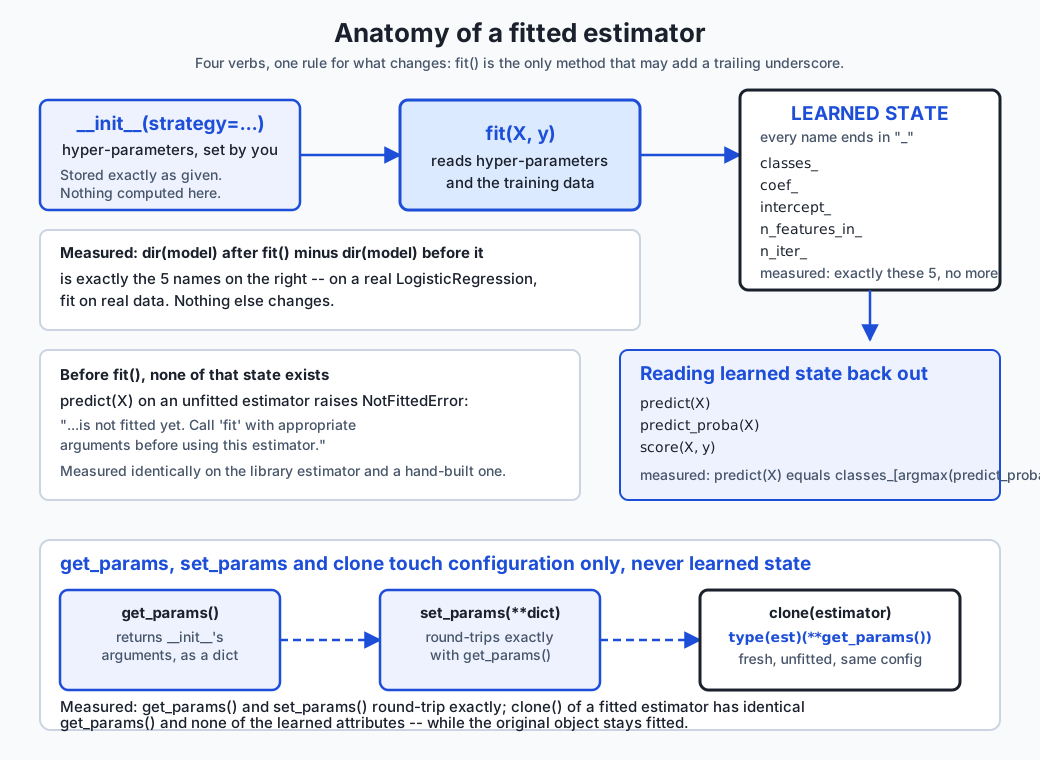
- Implement fit, predict, predict_proba, score, get_params and set_params from scratch and verify they reproduce a library estimator's output exactly
- State precisely what fit() adds to an object -- every learned attribute ends in a trailing underscore, by documented convention
- Explain why NotFittedError exists and reproduce its exact message on both a library estimator and a hand-built one
- Show that get_params/set_params round-trip correctly, and that clone() copies configuration without ever copying learned state
- Read a Pipeline's own get_params(deep=True) and change a nested step's hyper-parameter through it
- Measure that a Pipeline step is refit once per cross-validation fold, on that fold's training rows only, and connect that mechanism to Day 143's leakage rule
- Identify, from a real measured failure, exactly what Pipeline and cross_val_score require beyond the five core methods in this version of scikit-learn, and fix it with one line of inheritance
- State how many of scikit-learn's discovered estimators implement fit, and that transform and predict are not mutually exclusive
- Show that predict() is argmax(predict_proba()), restated through classes_, and that decision_function agrees with it too
- Measure what random_state=None costs: identical predictions under a fixed seed, and a different model on every fit without one
- Run check_estimator() against a real estimator and report, honestly, which checks pass and why the rest do not
- Distinguish what the estimator API requires by design from what a specific library version additionally requires for full interoperability
Prerequisites
- Day 141 -- what a model score means, which this lesson assumes rather than re-teaches
- Day 143 -- stage ordering and what "anything fitted" refers to; today measures the object-model mechanism behind that rule
- Day 144 -- the splitters and cross_val_score this lesson uses without re-teaching them
- Comfort reading a Python class definition and a pytest failure, and a working python3 3.11 or newer on your PATH; the lab builds its own virtual environment and needs no GPU
Why this matters
Build a classifier from scratch. Five methods: fit, predict,
predict_proba, score, get_params, set_params — six, if you count
honestly. Test it against the real library. It predicts exactly what
DummyClassifier(strategy="most_frequent") predicts, every row, every
seed. Not close. Identical.
Feed the same object to cross_val_score:
AttributeError: 'MajorityClassifier' object has no attribute '__sklearn_tags__'.
...Make sure to inherit from `BaseEstimator`...
Nothing about fit, predict or score changed. Called directly, all
three still work, on the same object, with the same data. What broke is
something the object never knew it needed: a method named
__sklearn_tags__, which nobody wrote by hand and which turns out to be
the thing Pipeline and cross_val_score check before they will let an
estimator anywhere near a fold of data.
That gap is this lesson’s subject, and it is worth taking seriously
because it is not a trick question. Days 141 through 145 called .fit()
and .predict() on scikit-learn objects dozens of times — a splitter, a
1-NN, a LogisticRegression, a GatedTestSet wrapping a real classifier —
and never once explained what those calls actually mean. That silence was
deliberate: the workflow, the splits and the overfitting arithmetic were
the point, and the object underneath them was scenery. Today the object
becomes the subject, and the scenery gets inspected.
The reason this matters beyond a single lab: the four-verb interface is
the reason a Pipeline can wrap any combination of a scaler, an
encoder, a feature selector and a classifier and treat the whole thing as
one estimator; the reason GridSearchCV can search hyper-parameters for
an algorithm it has never heard of; the reason a model you trained last
year can be swapped for a different algorithm entirely by changing one
line, with every downstream script — the cross-validation, the metrics,
the deployment code — untouched. That interoperability is not a
convenience feature. It is the entire reason scikit-learn code from one
project drops into another project without a rewrite, and it is built on
a contract narrow enough to hold in your head and precise enough that this
lab can verify every clause of it by running real code and reading what
comes back.
The failure above is the honest version of the story, not a simplified one. The four-verb contract is real, it is sufficient for direct use, and this lesson proves that with a hand-built estimator whose output is byte-identical to the library’s. It is also, in the version of scikit-learn this lab measured, no longer quite sufficient for full interoperability — and finding that out by testing, rather than assuming it from documentation, is exactly the habit the rest of this course keeps asking you to build.
The idea in plain language
Think of an estimator as an appliance, and the rest of scikit-learn as the wiring in a house.
A toaster, a lamp and a kettle are wildly different machines, doing wildly different jobs, built by different companies, with different internals nobody outside the factory has ever seen. None of that matters to the wall socket. The socket has one shape. Anything built to that shape’s dimensions plugs in and draws power, and the house’s wiring never needed to know a single thing about toasting bread or boiling water.
fit, predict, predict_proba, score, get_params and set_params
are the shape of the plug. A LogisticRegression, a KNeighborsClassifier
and a hand-built classifier that always guesses the most common class are
three wildly different machines. None of that matters to cross_val_score
or GridSearchCV — the “wiring” of scikit-learn. Anything built to the
plug’s shape gets fit, scored and compared, and the wiring never needed to
know a single thing about logistic curves or nearest neighbours.
Here is where the analogy earns its keep, because a modern house is not just a socket and a plug. Some appliances are “smart” — they have a small chip inside that reports a status light back to a home hub, so the hub knows the appliance is actually plugged in and ready before it schedules anything through it. A dumb toaster still works when you plug it in and push the lever by hand. It just cannot join a scheduled routine, because the hub has no way to check whether it is even there.
That is precisely the shape of what this lab measures. A classifier built
with only the five methods works when you call them by hand — the
equivalent of pushing the lever yourself. It fails the instant you ask a
piece of scikit-learn’s own machinery — Pipeline, cross_val_score — to
check on it first, because that check reads a signal (__sklearn_tags__)
that only comes from wiring the appliance the recommended way (inheriting
BaseEstimator). The fix, like the smart-home fix, is not a redesign. It
is adding the one chip the hub already knows how to read.
Carry this analogy through the rest of the lesson: the socket’s shape is
the API’s four verbs; the smart-home chip is BaseEstimator’s
__sklearn_tags__; and get_params/set_params are the appliance’s
settings dial, which the hub reads and writes without ever opening the
case — which is exactly how GridSearchCV searches an estimator it has
never seen before.
Historical background
scikit-learn began as a Google Summer of Code project in 2007, started by
David Cournapeau, and was released publicly in 2010 under a BSD licence.
It absorbed and unified what had previously been a scattered collection of
separate machine-learning packages for Python, each with its own calling
convention — some used .train()/.classify(), some used
.learn()/.apply(), and comparing two algorithms meant learning two
different vocabularies before you could even run the comparison.
The design decision that made today’s lesson possible was published, not
merely practised. Lars Buitinck and a long list of scikit-learn’s core
developers wrote up the project’s API design explicitly in a 2013 paper,
“API design for machine learning software: experiences from the
scikit-learn project,” presented at a European conference on machine
learning and knowledge discovery in databases. The paper states the
principle this lesson is built around directly: consistency, meaning every
object exposes a limited set of methods (fit, predict, transform and
so on) with a shared, predictable meaning, so that a user who has learned
one estimator has learned the shape of all of them. That single decision
— pick a small vocabulary and hold every estimator to it without exception
— is why a course can teach cross_val_score once, on day 144, and reuse
it on every classifier since without re-explaining anything.
BaseEstimator and the mixins (ClassifierMixin, RegressorMixin,
TransformerMixin) followed from the same principle: rather than trust
every contributor to reimplement get_params, set_params and equality
checks correctly by hand, scikit-learn wrote that machinery once, as
inheritable base classes, driven by introspecting __init__’s own
signature. That is why the convention in this lesson — store constructor
arguments exactly as given, compute nothing in __init__ — is not a style
preference. It is a precondition for the introspection working at all: if
__init__ computed a derived value and stored it under a different name,
get_params() would report the wrong thing, silently.
__sklearn_tags__, the specific method behind today’s failure, is newer
machinery, part of scikit-learn’s ongoing internal work to formalise what
an estimator declares about itself — whether it is a classifier or a
regressor, what kind of input it accepts, whether it supports sparse
matrices, and so on. Historically, an estimator that implemented only
fit/predict/get_params/set_params by hand, without inheriting
anything, worked correctly inside Pipeline and cross_val_score in
older releases of the library — the requirement measured in this lab is a
property of the specific version pinned in requirements/requirements.txt,
not a law that has always held. expected-output/FIELDS.md in the lab
says so explicitly, and it is the right level of caution: pin the version,
report what you actually measured, and do not claim more permanence for a
finding than the finding earned.
check_estimator, the function this lesson runs at the end, is
scikit-learn’s own answer to a related problem: once anyone can write a
class with five methods and call it an estimator, how does the project
verify that community-contributed estimators actually behave correctly
under the contract — handle edge cases, raise the right errors, survive
clone()? The estimator-checks suite exists so that “compatible with
scikit-learn” is something you can test for, not just something you
assert in a README.
What it is — and what it is not
The estimator API is a small, deliberately narrow contract. An object
is an estimator if it implements fit(X, y) (or fit(X) for unsupervised
work) and stores everything it learns as attributes ending in a trailing
underscore. A classifier or regressor additionally implements predict(X);
many classifiers additionally implement predict_proba(X) and
decision_function(X). A transformer implements transform(X) instead of
predict(X), sometimes both fit and transform combined as
fit_transform. Every estimator, of every kind, is expected to implement
get_params() and set_params().
That is the whole list. There is no required base class in the strict
sense of the word “required” — a Python object needs no particular
ancestor to satisfy fit/predict/score/get_params/set_params, and
this lesson’s centrepiece proves it by building exactly such an object and
watching its output match the library’s, row for row.
What it is not: a guarantee that every piece of scikit-learn’s own
tooling will accept your object without complaint. This is the clause
the introduction’s failure exists to teach. Pipeline.predict() and
cross_val_score both call an internal fitted-check that, in this
version of the library, is implemented via __sklearn_tags__ — a method
that exists on BaseEstimator and nowhere else unless you write it
yourself. An object satisfying the five-method contract by hand,
correctly, will still raise AttributeError the moment that internal
check runs, because the check is not part of the five-method contract at
all. It is part of scikit-learn’s own implementation, and the correct
response is not “the protocol lied” — it is “the protocol is necessary
but, in this codebase, not sufficient for full interoperability, and the
library tells you exactly what closes the gap.”
It is not a promise that fit() validates its inputs for you. Nothing
about the five-method contract requires an estimator to check that y
contains discrete class labels rather than a continuous target, or that
X has the right shape. check_estimator()’s two genuine failures on this
lab’s own hand-built classifier come from exactly this gap: the classifier
never validates that its target looks like classification labels, so
handing it a continuous y does not raise the error a well-behaved
classifier should raise. That is a real limitation of a fifteen-line toy
estimator, not a flaw in the API’s design.
And it is not a performance guarantee, a correctness guarantee about the model’s predictions, or a promise of any particular hyper-parameter’s default value. The API says how to ask an object to learn and how to ask it what it learned. It says nothing about whether what it learned is any good — which is Day 141’s subject, not today’s.
Why it was created and what problems it solves
Before a shared API, comparing two machine-learning algorithms in Python meant learning two different sets of method names, two different conventions for what a constructor argument meant, and, in the worst cases, two different assumptions about what shape the input data should be in. Writing generic tooling — a cross-validation loop, a hyper-parameter search, a preprocessing pipeline — that worked across multiple algorithms meant either picking one library and hard-coding its conventions, or writing adapter code for every algorithm you wanted to support.
The four-verb contract solves this by inversion: instead of generic
tooling adapting to each algorithm, every algorithm adapts to one small,
fixed contract, and generic tooling is written once, against that
contract, forever. cross_val_score does not know what a
LogisticRegression is. It knows that whatever object it was handed has a
fit method and a score method, and that is the entire information it
needs to cross-validate anything — a linear model, a neural network
wrapped to look like an estimator, or the fifteen-line classifier this
lab’s exercises build from nothing.
get_params()/set_params() solve a narrower but equally load-bearing
problem: how does a search procedure explore an algorithm’s
hyper-parameters without knowing what those hyper-parameters are called in
advance? GridSearchCV reads an estimator’s get_params(), and for every
combination in the search grid, calls set_params() with new values,
fit()s the result, and score()s it — four calls from the same fixed
vocabulary, repeated over every candidate estimator. The search code
never once needs to know the words “C” or “n_neighbors” or “max_depth”
exist. It reads whatever keys get_params() reports and writes back
whatever keys the search grid supplies.
clone() solves the problem of contamination between runs. A
cross-validation loop with five folds needs five genuinely fresh models
— an estimator fit on fold one must not carry any trace of fold one’s
fitted state into fold two’s fit. clone() is scikit-learn’s mechanical
guarantee that this never happens: it builds a brand-new instance from
get_params(deep=False), which by construction contains only
constructor arguments, never anything fitted. This lab measures that
guarantee directly — a preprocessing step wrapped inside a Pipeline is
fit exactly once per cross-validation fold, on that fold’s training rows
only, which is the mechanism that makes Day 143’s rule (“anything fitted
is fitted on training rows only”) something the library enforces rather
than something a careful engineer merely remembers to do.
How it works
__init__: store, do not compute
The rule is simple and its consequence is not obvious until you have hit
it: __init__ should do nothing but assign its arguments to
identically-named attributes.
class MajorityClassifier:
    def __init__(self, strategy="most_frequent"):
        self.strategy = strategy  # stored as-is; nothing computed
BaseEstimator.get_params() works by inspecting __init__’s signature
with Python’s inspect module and reading back whatever attribute shares
each parameter’s name. If __init__ computed something derived —
normalising a string, wrapping a value in another object — and stored the
result under a different name or a transformed value,
get_params() would report something that does not round-trip through
set_params(), and clone() would silently misbehave. Validation,
derived values, and anything expensive belong in fit(), never in
__init__. This is not a style guideline; it is the precondition that
makes introspection-based get_params() correct at all.
fit(X, y): the only method allowed to add a trailing underscore
fit() reads the hyper-parameters set in __init__ and the data it is
given, and stores everything it learns as attributes whose names end in
_. That trailing underscore is not decoration. It is a documented
convention meaning, precisely, “computed from data, not set by the
caller” — and it is what makes a fitted model’s internals inspectable
without reading a single line of its source.
Measured directly in this lab: fitting a LogisticRegression on real data
and diffing dir(model) before and after fit() shows exactly five new
names, every one ending in _: classes_, coef_, intercept_,
n_features_in_ and n_iter_. No more, no fewer. A reader who knows
nothing about logistic regression’s internals can still write
model.coef_.shape after seeing that list and correctly predict what
comes back, because the convention told them where to look.
fit() conventionally returns self — not because the API requires a
particular return value in some enforced sense, but because doing so
enables the fluent style model.fit(X, y).predict(X_test), which every
built-in estimator supports.
Before fit() has run, none of that state exists, and calling predict()
on an unfitted estimator raises NotFittedError. This lab measured the
exact message, on both a library estimator and a hand-built one:
This LogisticRegression instance is not fitted yet. Call 'fit' with
appropriate arguments before using this estimator.
The hand-built MajorityClassifier in this lab raises the identical
wording, for the identical reason — neither object has anything with a
trailing underscore yet, and both check for that condition explicitly
before doing anything that would depend on it.
predict, predict_proba, decision_function: one score, three views
These are not three independent computations of “what does this model think.” They are three ways of reading the same underlying score.
For a fitted classifier that implements both, predict(X) is defined as
classes_[argmax(predict_proba(X), axis=1)] — the class with the highest
predicted probability, for every row. This lab measured it directly, on a
real multiclass LogisticRegression: for every single row of the test
data, the class predict() returned was exactly the class that maximised
predict_proba()’s row.
decision_function(X) gives the same relationship one level lower, before
probabilities are computed: for a binary classifier, predict(X) is
(decision_function(X) > 0), mapped through classes_; for a multiclass
classifier, it is classes_[argmax(decision_function(X), axis=1)]. Both
relationships were measured directly in this lab and held on every row of
the test data.
The practical consequence: if you need a hard label, call predict().
If you need a confidence to threshold differently than the model’s
default 0.5, call predict_proba() and compare it against your own
threshold — never call predict() and then try to reverse-engineer a
confidence from it, because the confidence was already there, one level
down, the whole time.
get_params, set_params, clone: configuration, never learned state
get_params(deep=True) returns a dictionary of every hyper-parameter,
including — for a composite estimator like a Pipeline — every nested
step’s parameters, prefixed with the step’s own name and two underscores.
This lab measured a two-step Pipeline (a StandardScaler feeding a
LogisticRegression) and found get_params(deep=True) reporting 23 keys
in total, including clf__C and scaler__with_mean.
set_params(**overrides) accepts exactly those same keys back, and for a
Pipeline, reaches through the dotted name to mutate the actual nested
object. Measured directly: calling pipeline.set_params(clf__C=2.0) and
then reading pipeline.named_steps["clf"].C returns 2.0 — not a copy,
the live attribute on the actual LogisticRegression instance living
inside the pipeline.
clone(estimator) is implemented, essentially, as
type(estimator)(**estimator.get_params(deep=False)) — a brand-new
instance, built from the same constructor arguments, with none of the
fitted state carried over. Measured directly on a fitted
LogisticRegression: the clone’s get_params() matches the original’s
exactly, and the clone has no coef_ attribute at all, while the original
— untouched by the cloning — stays fitted. This is what lets
cross_val_score give every fold a model that starts from an identical
configuration and zero prior exposure to any of the data.
Pipeline is an estimator too
A Pipeline is not a container that merely holds estimators. It is one
— it implements fit, predict, score, get_params and set_params
itself, which is why the previous section’s nested-parameter measurement
works at all: Pipeline.get_params(deep=True) recurses into every step’s
own get_params() because the pipeline is playing exactly the same game
every other estimator plays, one level up.
The mechanism that follows from this composability is the one worth
measuring precisely, because it connects directly to Day 143’s stage
ordering. When cross_val_score runs a Pipeline under 5-fold
cross-validation, this lab’s harness wraps the pipeline’s scaling step in
a subclass that counts how many times fit() is actually called, and
measures the count directly: exactly 5, under 5-fold, and exactly
10 under 10-fold. Once per fold. Not once for the whole dataset, not
five times on the same rows — once per fold, and (because
cross_val_score clones the whole pipeline before each fold) on that
fold’s training rows alone.
That count is not a restatement of Day 143’s leakage-cost measurement. It
is the mechanism that makes Day 143’s rule enforceable rather than merely
advisable: nothing fitted inside a Pipeline can see validation or test
rows during a fold’s fit, because what gets fit on that fold is a fresh
clone that has never been handed anything except that fold’s training
data. The rule was a promise on Day 143. Today it is a countable fact
about the object model.
How many estimators actually implement fit?
sklearn.utils.all_estimators() is scikit-learn’s own discovery
mechanism — it walks the installed package and returns every class it
recognises as an estimator. Ask it the obvious question, “how many
estimators does scikit-learn have,” and the honest answer is that the
question is underspecified: run it in a bare interpreter and it finds
208. Import one specific module first —
sklearn.experimental.enable_halving_search_cv — and the same call finds
210, because HalvingGridSearchCV and HalvingRandomSearchCV are
gated behind that import and are invisible to discovery until it runs.
Nothing about the installed scikit-learn version changed between those two
counts. Only what had already been imported changed.
That gap is worth taking seriously rather than rounding away, because it
is not a quirk specific to the Halving searches — it is all_estimators()
working exactly as designed, discovering only what Python has actually
loaded. This lab’s own measurement code found the gap by accident:
estimator_census() originally called all_estimators() directly, and
its result quietly depended on whether an earlier call, elsewhere in the
same process, had already imported a module that pulled the enabler in
transitively — sklearn.utils.estimator_checks, used by exercise 10,
happens to do exactly that. The fix is to make the enabling import
explicit inside the census function itself, so the enabled count is
deterministic regardless of caller, and to measure the bare count in a
fresh subprocess — because importing the enabler once registers the two
estimators for the rest of that process’s life, with no way to
un-register them, so a second in-process “before” reading later in the
same test session would silently already be the enabled number.
With that settled: this lab’s pinned scikit-learn 1.9.0, with the
enabler explicitly imported, discovers 210 estimators, and every
single one of the 210 implements fit. That is the whole protocol’s
floor: whatever else an object in this library does, if it is an
estimator at all, it fits — and now measured in a way immune to import
order, rather than in a way that happened to work the first time.
The more interesting split is transform against predict: 90
estimators implement transform, 119 implement predict. If the
estimator/transformer/predictor distinction were absolute, those two
groups would never overlap — a classifier predicts, a scaler transforms,
and never the twain shall meet. The measurement says otherwise: 20
estimators implement both. Read the list before concluding the
distinction is broken, because it is not: the 20 are KMeans,
MiniBatchKMeans, Birch, BisectingKMeans and similar clustering
models, which legitimately have both a predict (which cluster does this
row belong to) and a transform (the distance from this row to every
cluster centre) — two genuinely different, genuinely useful outputs from
the same fit. The rest of the 20 are meta-estimators — Pipeline,
GridSearchCV, RandomizedSearchCV, the halving search variants,
StackingClassifier, VotingClassifier and their regressor equivalents —
which inherit both methods by wrapping whatever estimator they are given.
The rule this measurement actually supports, stated precisely: a plain
classifier or regressor must never grow a transform method, because
doing so blurs the distinction between “produces a prediction” and
“produces a representation” that makes Pipeline composable in the first
place. Clustering models and meta-estimators are the legitimate
exceptions, and knowing why they are exceptions is more useful than
memorising the rule as an absolute.
random_state: what leaving it unset actually costs
Many scikit-learn estimators — anything involving random initialisation,
bootstrap sampling, or feature subsampling — accept a random_state
parameter. Set it to an integer and every call is reproducible: this lab
fit the same RandomForestClassifier(random_state=42) five independent
times on identical data and got five byte-identical prediction vectors,
every time.
Leave it as the default None and the estimator draws fresh entropy from
the operating system on every single call, by design. This lab fit the
same forest five times with random_state=None and measured 5 of 5
distinct prediction vectors — not similar, genuinely different models,
each time — with the resulting accuracy varying by several points across
repeated fits on the identical data and identical model configuration.
That variability is not a bug to eliminate. It is the honest cost of not
pinning a seed, and it is why random_state=None numbers cannot appear as
fixed values anywhere reproducible in this lab’s own tests: the measured
counts and accuracy figures are printed once, in
expected-output/FIELDS.md, explicitly labelled as one example rather
than an expected result, and every assertion in the lab checks only the
structural claim — identical under a fixed seed, distinct without one —
never a specific sampled number.
The centrepiece: building an estimator from nothing, and finding the edge of the protocol
Put the pieces together and the lab’s exercise sequence tells one continuous story.
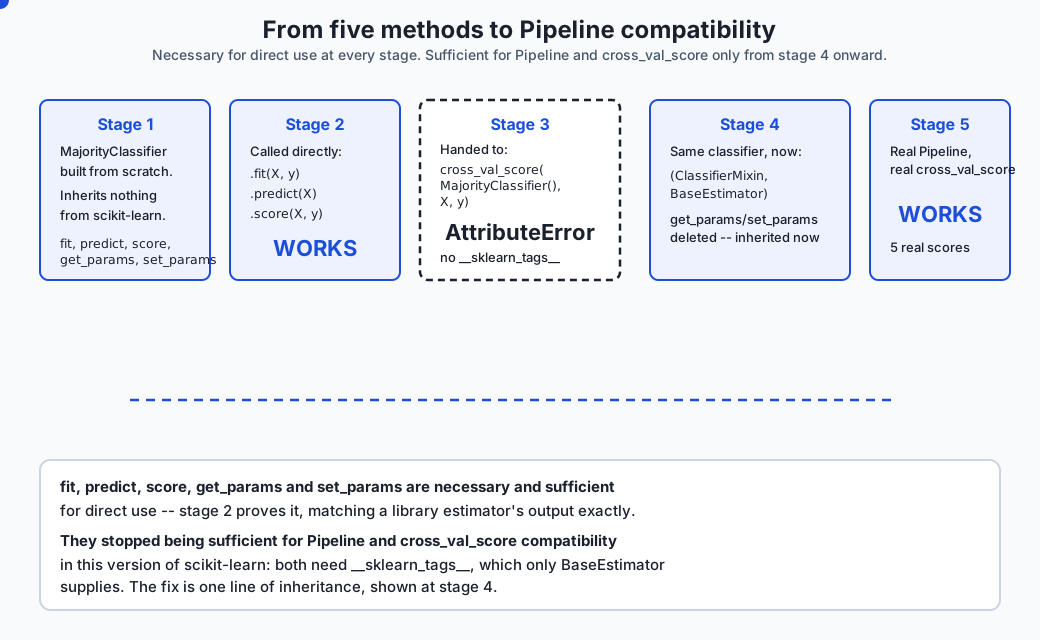
First, MajorityClassifier is built with zero inheritance from
scikit-learn — __init__ stores one hyper-parameter, fit learns three
things named with a trailing underscore, predict/predict_proba/score
read that state back, get_params/set_params are five- and six-line
methods written by hand. Its output is measured against
DummyClassifier(strategy="most_frequent") across five seeded datasets
and matches exactly, every prediction and every probability.
Second, that same object, unmodified, is handed to cross_val_score.
It raises AttributeError, naming __sklearn_tags__ and recommending
inheritance from BaseEstimator. fit, predict and score still work
perfectly when called directly on the very same object — this is worth
confirming for yourself in the lab, because it is the detail that turns
this from “the protocol was wrong” into “the protocol is necessary but,
here, not sufficient on its own.”
Third, the identical classifier is rebuilt as
MajorityClassifierBase(ClassifierMixin, BaseEstimator), and the
hand-written get_params/set_params are deleted from the source
entirely — not simplified, deleted — because BaseEstimator now supplies
both by inspecting __init__’s signature, which is only correct because
__init__ does nothing but store its argument, as the earlier section
insisted it must. Measured directly: "get_params" not in MajorityClassifierBase.__dict__ is True. The method genuinely is not
written anywhere in that class’s own source.
Fourth, the same call — a real Pipeline, scored by a real
cross_val_score — now returns five real, non-NaN scores. One line of
inheritance closed the entire gap.
That sequence is the honest shape of “the estimator API is a protocol,
not magic.” Both halves are true at once: the five methods are genuinely
sufficient for direct use, proven by exact agreement with library output,
and they are genuinely insufficient, in this version of the library, for
full interoperability with scikit-learn’s own tooling — and the fix for
the second half is not more code, it is the one-line acknowledgement that
BaseEstimator exists and does real, specific, measurable work.
check_estimator: the contract, checked mechanically
scikit-learn ships its own conformance suite, check_estimator(), which
runs dozens of checks against an object and reports which ones pass. Run
against MajorityClassifierBase in this lab: 52 checks total, 48
passed, 2 skipped, 2 failed — and the two failures are worth reading
rather than suppressing.
check_classifiers_train asserts that the classifier scores above 0.83
accuracy on a real, learnable synthetic dataset. MajorityClassifierBase
is, by design, a majority-class dummy — it always predicts whatever class
was most common during training, regardless of the input features. It
satisfies every structural check in the contract; it is simply not
supposed to be a good classifier, and this particular check assumes the
estimator under test is trying to be one.
check_classifiers_regression_target asserts that passing a continuous
target raises a ValueError naming "Unknown label type". This
classifier’s fit() never validates that y looks like discrete class
labels rather than a continuous target — a genuine, easily fixed
omission, and a useful thing to discover mechanically rather than in
production.
Both failures are printed by name in this lab’s measured report and
asserted by name in the test suite. Running check_estimator() against
your own custom estimators before shipping them into a pipeline other
people depend on is one of the highest-value five minutes you can spend —
it catches exactly this class of bug, mechanically, before a
hyper-parameter search silently misbehaves on data nobody thought to
check by hand.
An everyday analogy
Return to the smart-home wiring from earlier, because the pieces map cleanly onto it now that the details are in place.
The wall socket’s fixed shape is fit/predict/predict_proba/
score. Any appliance built to that shape draws power and does its job —
a LogisticRegression, a RandomForestClassifier, or a fifteen-line
class you wrote this afternoon.
The settings dial the installer can read and set without opening the
case is get_params/set_params. A cleaning service that services
every appliance in the house — read the current settings, write new ones,
run the appliance, read the result — never needs a different procedure
for the toaster than for the kettle. That service is GridSearchCV.
The manufacturer’s spare-parts guarantee — a fresh, identical unit,
still in the box, whenever one is needed — is clone(). A hotel that
needs five identical, unused kettles for five identical rooms does not
refurbish one kettle five times between guests. It orders five from the
factory, each built from the same specification sheet, none of them
carrying yesterday’s tea stains forward. That is what cross_val_score
does for every fold.
And the smart-home chip that reports a status light to the hub before
anything gets scheduled is __sklearn_tags__. A dumb kettle still
boils water when you flip its switch by hand — direct use always works.
It just cannot join a scheduled routine, because the hub has no signal to
check before it tries. The fix, when you actually want that kettle in the
routine, is not a new kettle. It is wiring in the one chip the hub already
knows how to read — which, for an estimator, is inheriting
BaseEstimator.
Examples in practice
A classifier that agrees with the library, verified line by line
import numpy as np
from sklearn.dummy import DummyClassifier


class MajorityClassifier:
    def __init__(self, strategy="most_frequent"):
        self.strategy = strategy

    def fit(self, X, y):
        X = np.asarray(X)
        y = np.asarray(y)
        self.classes_, counts = np.unique(y, return_counts=True)
        self.majority_class_ = self.classes_[np.argmax(counts)]
        self.n_features_in_ = X.shape[1]
        return self

    def predict(self, X):
        X = np.asarray(X)
        return np.full(X.shape[0], self.majority_class_)

    def score(self, X, y):
        return float(np.mean(self.predict(X) == np.asarray(y)))

    def get_params(self, deep=True):
        return {"strategy": self.strategy}

    def set_params(self, **params):
        for key, value in params.items():
            setattr(self, key, value)
        return self
Fit both this class and DummyClassifier(strategy="most_frequent") on
identical data, and their predictions and probabilities agree exactly —
which is the concrete evidence behind “protocol, not magic”: two
completely independent implementations of the same rule produce the same
answer, because both are following the same rule, correctly, from the
same interface.
Reading a Pipeline’s nested parameters
from sklearn.linear_model import LogisticRegression
from sklearn.pipeline import Pipeline
from sklearn.preprocessing import StandardScaler

pipe = Pipeline([("scaler", StandardScaler()), ("clf", LogisticRegression())])
sorted(pipe.get_params(deep=True).keys())
# includes 'clf', 'clf__C', 'scaler', 'scaler__with_mean', and 19 more

pipe.set_params(clf__C=2.0)
pipe.named_steps["clf"].C  # 2.0 -- the live object, mutated through the pipeline
The failure, reproduced
from sklearn.model_selection import cross_val_score

cross_val_score(MajorityClassifier(), X, y, cv=5)
# AttributeError: 'MajorityClassifier' object has no attribute
# '__sklearn_tags__' ... Make sure to inherit from `BaseEstimator`
The fix, in full
from sklearn.base import BaseEstimator, ClassifierMixin


class MajorityClassifierBase(ClassifierMixin, BaseEstimator):
    def __init__(self, strategy="most_frequent"):
        self.strategy = strategy

    def fit(self, X, y):
        X = np.asarray(X)
        y = np.asarray(y)
        self.classes_, counts = np.unique(y, return_counts=True)
        self.majority_class_ = self.classes_[np.argmax(counts)]
        return self

    def predict(self, X):
        X = np.asarray(X)
        return np.full(X.shape[0], self.majority_class_)
get_params and set_params are gone from the source. cross_val_score
now works, and so does wrapping this class in a real Pipeline.
Implications: security, privacy, performance, scalability, and cost
clone()’s guarantee is a security property, not only a convenience
one. An estimator whose get_params() does not report every
constructor argument, or whose cloning otherwise leaked fitted state
forward, would let information from one cross-validation fold leak into
the next — the same shape of bug Day 143 spent an entire day on, arriving
here from the object model instead of the workflow. Writing a custom
estimator correctly, with get_params/set_params that round-trip
exactly, is what keeps that guarantee intact for every piece of tooling
built on top of it.
Performance and scalability follow directly from composability.
Because GridSearchCV and cross_val_score are written once against the
four-verb contract, adding a new algorithm to a search costs nothing in
tooling — no adapter code, no special case. The cost that does exist is
real: cross-validating k folds means k full fits, and a Pipeline with an
expensive preprocessing step pays that cost once per fold, not once for
the whole run, because of the exact refitting mechanism this lesson
measured.
Shipping a custom estimator into a shared pipeline without running
check_estimator() first is a real production risk, not a theoretical
one. This lab’s own toy classifier had two genuine, measurable gaps —
no validation of the target’s type, and predictable failure on any
dataset that happens to be dominated by one class if you mistake “dummy
baseline” for “real model.” A team that tests a custom estimator by
calling .fit() and .predict() manually, sees sensible output, and
ships it into a GridSearchCV has tested exactly the half of the contract
this lesson proved is easy to get right. The half that breaks silently —
compatibility with the library’s own internal machinery — is precisely
what check_estimator() exists to catch before a search fails in a way
that is hard to trace back to its cause.
Cost, honestly stated: learning the full contract, including the
BaseEstimator clause this lesson’s centrepiece measured, is a fixed cost
you pay once. The alternative — writing bespoke integration code for
every custom model you ever build, because it does not speak the standard
protocol — is a cost you pay on every project, forever. The four-verb
contract is the entire reason that cost, for scikit-learn-compatible
tooling, is paid once.
Alternatives: free, open source, and commercial
scikit-learn’s own BaseEstimator and mixins — used here
When to choose them: for essentially any estimator meant to work
inside scikit-learn’s own tooling — Pipeline, GridSearchCV,
cross_val_score, VotingClassifier. Free, BSD-3-Clause licensed, no
paid tier. Every measurement in this lesson uses them.
How to use them: inherit BaseEstimator for get_params/set_params
and equality/repr machinery; add ClassifierMixin for a score() method
that computes accuracy automatically, or RegressorMixin for R² and
TransformerMixin for a fit_transform() built from your fit() and
transform(). This lab’s MajorityClassifierBase uses exactly this
combination.
Watch for: __init__ must do nothing but store arguments under
matching names, or the introspection-based get_params() silently
misreports your configuration.
skorch — PyTorch models wrapped in the sklearn API, described from documentation
When to choose it: when a PyTorch model needs to plug into
scikit-learn’s Pipeline, GridSearchCV or cross_val_score without a
hand-written adapter. Free and open source, BSD licensed.
How to use it: wrap a PyTorch nn.Module in skorch’s NeuralNetClassifier
or NeuralNetRegressor, which implements the full estimator API — fit,
predict, get_params, set_params — on top of the wrapped network, so
the rest of the four-verb contract this lesson taught applies unchanged.
Honest note: this lab does not install PyTorch or skorch, and no output from either is reproduced anywhere in this lesson. Described from public documentation only.
scikeras — Keras/TensorFlow models wrapped in the sklearn API, described from documentation
When to choose it: the same problem as skorch, for Keras models instead of PyTorch ones. Free and open source, MIT licensed.
How to use it: wrap a Keras model-building function in scikeras’s
KerasClassifier or KerasRegressor, which exposes the standard
fit/predict/get_params/set_params surface.
Honest note: not installed here, and no output is reproduced from it.
statsmodels — deliberately a different API, not the same contract
When to choose it: when the statistical output itself — coefficient standard errors, confidence intervals, hypothesis tests, diagnostic plots — matters more than plugging into scikit-learn’s search and pipeline tooling.
Why it is listed here as a contrast rather than an alternative:
statsmodels’ .fit() does not return self for chaining; it returns a
separate Results object, and there is no get_params()/set_params()
round-trip in the sense this lesson measured. That is not a shortcoming —
it reflects a different design goal, aimed at statistical inference rather
than at composability inside a search-and-pipeline ecosystem. Knowing that
the two libraries made genuinely different design choices, for genuinely
different purposes, is more useful than assuming every Python
machine-learning library follows scikit-learn’s convention.
Free versus paid: free and open source, BSD-3-Clause licensed.
Managed AutoML and MLOps platforms that consume scikit-learn-compatible estimators — not used here
Several commercial platforms accept any estimator satisfying the
fit/predict/get_params/set_params contract and run search,
tracking and deployment around it — which is only possible because the
contract this lesson taught is small and stable enough for a third-party
platform to build against without scikit-learn’s own source code. No
price is quoted here, because these change by month and an unchecked
figure is worse than none. Free tiers exist for individuals on most of
them; team and production tiers are typically paid.
Comparison with related concepts
| Concept | What it does | How it relates |
|---|---|---|
| Estimator | Implements fit; the base of everything else | Every object in this lesson is one |
| Predictor | An estimator with predict (and usually predict_proba/decision_function) | 119 of 210 discovered estimators, measured here |
| Transformer | An estimator with transform instead of, or beside, predict | 90 of 210; overlaps with predictors only for clustering and meta-estimators, measured at 20 |
Pipeline | An estimator that wraps a sequence of other estimators | Composability from the inside: it has its own get_params, fit, predict |
BaseEstimator | Supplies get_params/set_params by introspecting __init__ | The dividing line this lesson’s headline measurement crosses |
ClassifierMixin/RegressorMixin | Supply a default score() (accuracy or R²) | Optional; a classifier can define its own score() instead, as this lab’s from-scratch version does |
clone() | Builds a fresh, unfitted copy from get_params(deep=False) | What makes every cross-validation fold genuinely independent |
check_estimator() | Runs scikit-learn’s own conformance suite against an object | Found two real, honest gaps in this lab’s own toy estimator |
When to use it — and when not to
Write a custom estimator, following the full contract including
BaseEstimator, whenever it needs to work inside Pipeline,
GridSearchCV, cross_val_score, or any other piece of scikit-learn’s
own tooling. This lesson measured exactly what that “full contract”
requires beyond the five methods in this version of the library, and the
fix costs one line.
A quick, throwaway script that calls .fit() and .predict() directly,
never through a Pipeline or a cross-validation loop, does not need
BaseEstimator at all. The from-scratch MajorityClassifier in this
lab proves that: called directly, it worked identically to the library
version, with zero inheritance. Do not add machinery you are not going to
use.
Run check_estimator() before shipping any custom estimator that other
people, or automated tooling, will call through Pipeline or a search.
It is free, it runs offline, and this lab’s own two genuine failures show
exactly the class of bug it catches that manual testing tends to miss.
Reach for get_params/set_params correctness whenever you are
building anything that will be cloned — inside a cross-validation loop,
a bagging ensemble, or a hyper-parameter search. An estimator whose
get_params() does not round-trip through set_params() will fail
silently or behave unpredictably the first time something tries to clone
it, often far from wherever the estimator itself was written.
Do not assume the five-method contract is a hard requirement enforced by the language, and do not assume it is the whole story either. Both overclaims are wrong in a way this lesson measured directly: Python enforces nothing about inheritance here, and scikit-learn’s own internal machinery genuinely does require more than the five methods for full interoperability, in this version of the library. Test the specific claim you are relying on, on the version you are actually running, rather than trusting either the “it’s just duck typing” story or the “you must always inherit BaseEstimator” story as a universal law.
The AI thread
The pattern this lesson measured — a small, explicit contract that lets independently built components interoperate without either side knowing the other’s internals — is the same pattern that makes modern AI tooling composable at all, and the same pattern whose edges are worth testing rather than assuming.
A tool definition handed to a language model is a contract of exactly this
shape: a name, a set of typed parameters, a description of what the tool
returns. The model never sees the tool’s implementation, the same way
cross_val_score never sees LogisticRegression’s internals — it only
needs the contract’s shape to call the tool correctly. And exactly as this
lesson found with __sklearn_tags__, a tool or an agent framework can
satisfy the documented, minimal interface and still fail against a
specific runtime’s internal expectations that the public documentation
does not fully spell out — a required metadata field, an implicit schema
constraint, a version-specific check that only shows up once you actually
run the integration rather than read about it.
The transferable habit is the one this lab practised directly: build the
minimal version from first principles, verify it against the real system
byte for byte where you can, and when it breaks against machinery you did
not write, read the actual error rather than assuming either “the
contract is broken” or “I must be missing something obvious.” Both
scikit-learn’s AttributeError and a failed tool call in an agent
framework tend to name, precisely, what closes the gap — the discipline
is reading that message instead of guessing at a fix.
Knowledge check
MajorityClassifier, built without inheriting anything from scikit-learn, produces predictions identical toDummyClassifier(strategy="most_frequent"). What does that agreement prove, and what does it not yet prove about the object?- Name the exact five attributes gained by fitting a
LogisticRegressionon real data, and explain what the trailing underscore on each one means as a documented convention rather than a style choice. cross_val_score(MajorityClassifier(), X, y, cv=5)raisesAttributeError: ... no attribute '__sklearn_tags__'. CallingMajorityClassifier().fit(X, y).predict(X)directly still works. What does that combination tell you about where the failure actually lives?- State, precisely, what changes between
MajorityClassifierandMajorityClassifierBase, and explain why deleting the hand-writtenget_params/set_paramsis correct rather than merely tidy. sklearn.utils.all_estimators()finds 20 estimators that implement bothtransformandpredict. Explain why this does not contradict the rule that a plain classifier must never grow atransformmethod.clone()of a fittedLogisticRegressionhas the sameget_params()as the original and nocoef_attribute. Explain the one-sentence implementation ofclone()that makes both facts true at once.- A preprocessing step inside a
Pipelineis measured to be fit exactly 5 times under 5-foldcross_val_score. What object-model mechanism produces that exact count, and how does it connect to Day 143’s rule about what may be fitted where? check_estimator(MajorityClassifierBase())reports 2 failures out of 52 checks. Name both, and explain why neither one means the estimator is broken.
Hands-on exercise
Today’s lab, The Estimator API, From Scratch, builds a classifier with
zero inheritance from scikit-learn, verifies its output against the real
library exactly, and then measures precisely where “just a protocol”
needs a footnote in this version of scikit-learn.
Eighteen exercises. The first three build and verify the from-scratch
classifier. The next four cover what fitting adds and what get_params/
set_params/clone guarantee. Exercises 5 and 6 are the centrepiece:
where the hand-built estimator breaks inside real scikit-learn machinery,
and the one-line fix. The remainder measure the estimator census —
including the exercise that measures the census’s own dependence on
import order — predict/predict_proba agreement, what
random_state=None costs, and check_estimator()’s honest verdict.
Build the environment, then work through starter/test_estimator_claims.py,
replacing one pytest.skip at a time.
Expected output
The harness ends with:
---------------------------------------------------------------
14 checks, 0 failure(s)
and exits 0. pytest examples -q reports 23 passed, and
pytest starter -q reports 5 passed, 18 skipped until you begin.
The measured table includes:
matches DummyClassifier(strategy='most_frequent') exactly: True
attributes gained by fit(): ['classes_', 'coef_', 'intercept_', 'n_features_in_', 'n_iter_']
a preprocessing step is fit 5 times under 5-fold cross_val_score
cross_val_score on an estimator inheriting nothing from sklearn:
  AttributeError: ...no attribute '__sklearn_tags__'...
bare discovery (no experimental imports): 208
discovered with sklearn.experimental.enable_halving_search_cv: 210, implement fit: 210
implement both: 20 -- ['Birch', 'BisectingKMeans', ..., 'VotingRegressor']
check_estimator: 52 checks, 48 passed
Validate your work
bash tests/run_tests.sh; echo "exit=$?"reports14 checks, 0 failure(s)andexit=0. Capture the harness’s own exit status..venv/bin/pytest examples -qreports23 passed..venv/bin/python3 examples/report_measurements.py | diff - expected-output/measured-values.txtproduces no output.- When you have finished every exercise,
pytest starter -qreports23 passed. - Break one assertion on purpose, confirm the harness fails, restore it.
Troubleshooting
AttributeError: ... no attribute '__sklearn_tags__' appears somewhere
you did not expect. If it happens calling .fit() or .predict()
directly on MajorityClassifier, that is a genuine bug — standalone calls
never touch this path. If it happens inside Pipeline or
cross_val_score, that is exercise 6 working as intended.
check_estimator() reports 2 failures. Expected, and asserted by
name: check_classifiers_train (a majority-class dummy cannot reach 0.83
accuracy by design) and check_classifiers_regression_target (this
fit() never validates the target’s type). Neither is a bug to silence.
Your random_state=None numbers differ from expected-output/FIELDS.md.
They are supposed to. That file’s numbers are one real example, never an
expected value — random_state=None draws fresh entropy on every call.
import file mismatch. You ran pytest examples starter together.
Run them separately.
Common mistakes
Declaring victory after exercise 1. Matching DummyClassifier exactly
proves the five methods are sufficient for direct use. It does not prove
interoperability with Pipeline or cross_val_score, which exercises 5
and 6 exist specifically to test.
Treating check_estimator()’s 2 failures as bugs to suppress. Both
are correct, informative failures given what this lab’s toy estimator
actually is and does.
Concluding “you must always inherit BaseEstimator, it’s a Python
requirement.” Overcorrected. The requirement comes from scikit-learn’s
own internal machinery in this version, not from the language.
Hard-coding a single random_state=None sample as “the answer.”
Misses the entire point of exercise 9 — those numbers are fresh OS entropy
on every run, by design, on any machine, including this one.
Practice assignment
Take an estimator you already use, or one you have thought about writing, and audit it against today’s contract.
- Name every method it implements, and check each against the
five-method list. If it is missing
get_params/set_params, explain what would break the first time something tried to clone it. - Diff
dir()before and afterfit()on a real instance, on real data. List every attribute gained, and confirm every one ends in_. - Try it inside a
Pipelineand across_val_scorecall, even if you never planned to use it that way. If it fails, read the actual error rather than guessing, and report what it named as the cause. - Run
check_estimator()against it, if it is a classifier or regressor. Report the total, the pass count, and the name of every failure — do not summarise a failure as “some validation issue.” - State, in one sentence, whether it needs
BaseEstimatorgiven how you actually use it — direct calls only, or inside scikit-learn’s own tooling — and justify the answer from what you measured, not from a rule of thumb.
The deliverable is the audit, not a rewritten estimator.
Extension challenge
Pick one and measure it.
- Fix
check_classifiers_regression_target. Add target-type validation toMajorityClassifierBase.fit()usingsklearn.utils.multiclass.type_of_target, and confirm withcheck_estimator()that the failure count drops from 2 to 1. Report whether the fix changes any other check’s outcome. - Build a custom transformer from scratch, with
fit/transform/fit_transform, and place it ahead ofMajorityClassifierBasein aPipeline. Confirmfit_transform(X)gives the same result as callingfit(X)thentransform(X)separately, and measure whether it is fit once per cross-validation fold, the same as the scaler in this lab’s own measurement. - Inspect
__sklearn_tags__directly. Call it on a realBaseEstimatorsubclass and print every field it returns. Which fields would differ if the class inheritedClassifierMixinalone, withoutBaseEstimator? Test your prediction. - Put the from-scratch estimator inside
GridSearchCV. SinceMajorityClassifierBasesupportsget_params/set_paramsthroughBaseEstimator, search over its one hyper-parameter and report whatbest_params_comes back as, and why that result was inevitable given what the estimator actually does. - Audit a real third-party estimator. Pick any scikit-learn-compatible
package you have installed, run
check_estimator()against one of its classifiers, and report the pass/fail split honestly — including if it passes cleanly, which is itself worth reporting.
Quiz
Q1. MajorityClassifier, built without inheriting anything from scikit-learn, produces predictions and predict_proba output byte-identical to DummyClassifier(strategy="most_frequent") across five seeded datasets. What does that agreement actually prove?
- That MajorityClassifier is now guaranteed to work inside Pipeline and cross_val_score, since its output matches the library exactly
- That fit, predict, predict_proba, score, get_params and set_params, implemented by hand, are sufficient to reproduce a library estimator's behaviour when those methods are called directly
- That DummyClassifier itself is redundant, since a fifteen-line class can replace it
- Nothing conclusive, because DummyClassifier is not representative of real classifiers
Show answer
Answer: B. That fit, predict, predict_proba, score, get_params and set_params, implemented by hand, are sufficient to reproduce a library estimator's behaviour when those methods are called directly
Two independent implementations of the same rule, called directly, produce the same output -- which is the strongest evidence available that the five-method contract is sufficient for direct use. It says nothing about interoperability with scikit-learn's own tooling: the very same object raises AttributeError the instant it is handed to cross_val_score, which is exercise 5's finding, not this one's. DummyClassifier is a deliberately simple baseline used precisely because its rule is easy to reproduce exactly, which makes it a good target for this comparison, not evidence that it is unnecessary.
Q2. Fitting a LogisticRegression on real data and diffing dir(model) before and after fit() shows exactly which five new attributes?
- classes_, coef_, intercept_, n_features_in_, n_iter_
- fit_, predict_, score_, params_, config_
- weights, bias, classes, n_features, n_iter
- coef_, intercept_, n_iter_, and two private attributes that vary by call
Show answer
Answer: A. classes_, coef_, intercept_, n_features_in_, n_iter_
Those five, measured directly, and every one ends in a trailing underscore -- a documented convention meaning "learned from data," never "set by the caller." The second option invents method-like names that do not match scikit-learn's actual convention; the third option drops the trailing underscores, which is the whole point being tested; the fourth option is close on the first three but wrong about there being unnamed private attributes -- the diff is exact and reproducible, not fuzzy.
Q3. cross_val_score(MajorityClassifier(), X, y, cv=5) raises AttributeError naming a missing __sklearn_tags__ attribute. Calling MajorityClassifier().fit(X, y).predict(X) directly still works perfectly on the same object. What does that combination tell you?
- That the five-method contract was never actually sufficient, and the earlier measurement was wrong
- That MajorityClassifier has a bug in its predict() method that only shows up under cross-validation
- That the failure lives in scikit-learn's own internal fitted-check, reached only through Pipeline and cross_val_score, which needs a method the five-method contract never required
- That cross_val_score requires predict_proba, which MajorityClassifier does implement, so the error must be unrelated
Show answer
Answer: C. That the failure lives in scikit-learn's own internal fitted-check, reached only through Pipeline and cross_val_score, which needs a method the five-method contract never required
Direct calls to fit, predict and score all succeed on the identical object -- which rules out a bug in those three methods and rules out the contract itself being insufficient for what it was built for. What fails is machinery inside Pipeline and cross_val_score that checks whether the estimator is fitted via __sklearn_tags__, a method only BaseEstimator supplies in this version of the library. predict_proba is unrelated to this specific failure; the error names __sklearn_tags__ specifically, not predict_proba.
Q4. MajorityClassifierBase is rebuilt inheriting (ClassifierMixin, BaseEstimator), and its hand-written get_params and set_params methods are deleted from the source entirely. Why is deleting them correct, rather than merely a simplification?
- Because get_params and set_params are optional and scikit-learn works fine without them either way
- Because ClassifierMixin overrides them regardless of what is written, making the hand-written versions dead code
- Because BaseEstimator now supplies both by inspecting __init__'s signature, and keeping a hand-written version would risk it silently disagreeing with the introspected one
- Because Python raises an error if a subclass defines a method its parent class also defines
Show answer
Answer: D. Because Python raises an error if a subclass defines a method its parent class also defines
BaseEstimator.get_params() reads __init__'s parameter names via introspection and returns the matching attributes; deleting the hand-written versions means there is exactly one source of truth instead of two that could drift apart. The first option is wrong because get_params/set_params are what make clone() and GridSearchCV work at all -- not optional for those. The second option names the wrong class; ClassifierMixin supplies score(), not get_params/set_params. Python does not forbid a subclass from redefining a parent's method -- if it did, no library could ever override a base class method, which is a routine and permitted pattern.
Q5. sklearn.utils.all_estimators() finds 20 estimators, out of 210 discovered, that implement both transform and predict. Why does this not contradict the rule that a plain classifier must never grow a transform method?
- Because the 20 are clustering models like KMeans, which legitimately produce both a cluster assignment (predict) and a distance-to-centres representation (transform), plus meta-estimators like Pipeline that inherit both by wrapping whatever they are given
- Because the rule only applies to regressors, not classifiers, so the 20 estimators are all classifiers by definition
- Because it does contradict the rule, and the rule should be abandoned as too strict
- Because all 20 are deprecated estimators kept only for backward compatibility
Show answer
Answer: A. Because the 20 are clustering models like KMeans, which legitimately produce both a cluster assignment (predict) and a distance-to-centres representation (transform), plus meta-estimators like Pipeline that inherit both by wrapping whatever they are given
The 20 are named explicitly in this lab's measurement: clustering models where predict (which cluster) and transform (distance to every centre) are both genuinely useful outputs of the same fit, and meta-estimators (Pipeline, GridSearchCV, the Stacking and Voting ensembles) that inherit both by wrapping an arbitrary estimator. The rule survives narrowed to what it actually claims: a plain classifier or regressor should never have both, and none of the 20 are plain classifiers or regressors.
Q6. clone() of a fitted LogisticRegression returns an object with identical get_params() and no coef_ attribute at all, while the original stays fitted. What one-line description of clone()'s implementation makes both facts true simultaneously?
- clone() deep-copies the entire object, then deletes every attribute ending in an underscore
- clone() builds a brand-new instance as type(estimator)(**estimator.get_params(deep=False)), which by construction contains only constructor arguments and nothing fitted
- clone() calls the original estimator's reset() method, which every scikit-learn estimator implements
- clone() serialises the estimator with pickle and immediately unpickles it into a new variable
Show answer
Answer: B. clone() builds a brand-new instance as type(estimator)(**estimator.get_params(deep=False)), which by construction contains only constructor arguments and nothing fitted
Building a fresh object purely from get_params(deep=False) guarantees the clone starts with identical configuration and zero fitted state, because get_params only ever reports constructor arguments -- there is nothing fitted to carry forward even if you wanted to. The original object is never touched by this process, which is why it stays fitted. There is no reset() method in the estimator API; pickling would preserve fitted state, which is exactly the opposite of what clone() needs to guarantee for cross-validation.
Q7. A preprocessing step inside a Pipeline is measured to be fit exactly 5 times under 5-fold cross_val_score, and exactly 10 times under 10-fold. What mechanism produces that exact count, and how does it connect to Day 143?
- cross_val_score fits the whole dataset once per fold as a caching optimisation; the count is incidental to leakage prevention
- The preprocessing step has an internal retry loop that happens to run once per fold by coincidence
- cross_val_score clones the entire pipeline once per fold and fits the fresh clone on that fold's training rows only, which is the object-model mechanism that makes Day 143's rule -- that anything fitted must be fitted on training rows alone -- enforced rather than merely advisable
- The count is a bug in this lab's counting wrapper and does not reflect real scikit-learn behaviour
Show answer
Answer: C. cross_val_score clones the entire pipeline once per fold and fits the fresh clone on that fold's training rows only, which is the object-model mechanism that makes Day 143's rule -- that anything fitted must be fitted on training rows alone -- enforced rather than merely advisable
Each fold gets a genuinely fresh clone, fit only on that fold's training rows, which is precisely why nothing fitted inside the pipeline can see validation or test rows during that fold's fit -- not by convention, but because the clone handed to that fold never saw anything else. This turns Day 143's rule from a promise into a countable, measured fact. The "coincidence" and "bug" options both dodge the actual mechanism; the "caching optimisation" option gets the direction backwards -- re-fitting per fold is more expensive than caching would be, and it happens because correctness requires it.
Q8. check_estimator(MajorityClassifierBase()) reports 52 checks, 48 passed, 2 skipped, and 2 failed. What should you conclude about the estimator from the 2 failures?
- That the estimator is broken and should not be used until both failures are fixed
- That check_estimator() itself is unreliable, since a correctly implemented estimator should pass everything
- That the failures are random and would likely pass on a re-run
- That both failures are genuine and specific: one check assumes the classifier is trying to be accurate, which a majority-class dummy is not by design, and the other expects target-type validation this estimator's fit() never performs -- neither means the estimator violates the structural contract
Show answer
Answer: D. That both failures are genuine and specific: one check assumes the classifier is trying to be accurate, which a majority-class dummy is not by design, and the other expects target-type validation this estimator's fit() never performs -- neither means the estimator violates the structural contract
check_classifiers_train assumes a real learner and asserts accuracy above 0.83; a deliberate majority-class dummy cannot and should not reach that. check_classifiers_regression_target expects a ValueError on a continuous target, which this fit() genuinely never checks for -- a real, specific, fixable gap, not a structural violation. Both are deterministic, not flaky, and neither calls check_estimator()'s own reliability into question -- it is doing exactly its job by surfacing them.
Glossary
- Estimator
- Any scikit-learn object that implements fit(). The base of the whole API -- measured here at 210 of 210 discovered estimators, every single one implementing fit, whatever else it does.
- Predictor
- An estimator that additionally implements predict(), and usually predict_proba() and/or decision_function(). 119 of 210 discovered estimators, measured here.
- Transformer
- An estimator that implements transform() instead of, or beside, predict(). 90 of 210 discovered estimators. Overlaps with predictors only for clustering models and meta-estimators -- 20 of them, named explicitly in this lesson.
- fit()
- The method that reads hyper-parameters and training data and stores everything learned as attributes ending in a trailing underscore. The only estimator method permitted to add such attributes, and conventionally returns self for chaining.
- Trailing underscore convention
- A documented naming rule, not a style choice: any attribute ending in "_" was learned from data by fit(); anything without it is a hyper-parameter set by the caller. Measured on a fitted LogisticRegression at exactly five such attributes.
- NotFittedError
- The exception raised when predict(), transform() or similar is called before fit() has run. Measured with an identical message pattern on a library estimator and a hand-built one -- "is not fitted yet. Call 'fit'..."
- get_params()
- Returns an estimator's hyper-parameters as a dictionary, including nested step parameters for composite estimators like Pipeline, prefixed with the step's name and two underscores. Measured at 23 keys for a two-step Pipeline.
- set_params()
- Accepts the same keys get_params() reports and writes them back, reaching through nested prefixes to mutate a Pipeline's actual step objects. Measured to change a nested LogisticRegression's live .C attribute directly.
- BaseEstimator
- scikit-learn's base class supplying get_params/set_params by inspecting __init__'s signature. The class this lesson's centrepiece measurement shows is necessary, in this library version, for Pipeline and cross_val_score compatibility -- not merely for direct use.
- __sklearn_tags__
- An internal method, supplied by BaseEstimator, that scikit-learn's own fitted-check reads inside Pipeline and cross_val_score. Its absence is the exact, measured cause of an estimator built without BaseEstimator failing inside both, even though its fit/predict/score work fine directly.
- clone()
- Builds a fresh, unfitted estimator instance from type(estimator)(**estimator.get_params(deep=False)). Measured to produce identical get_params() and zero learned attributes on the clone, while the original stays fitted -- the mechanism that gives every cross-validation fold a genuinely fresh model.
- ClassifierMixin
- A mixin supplying a default score() method (accuracy) to any class that also implements predict(). Optional -- a classifier can define its own score(), as this lesson's from-scratch version does.
- Pipeline as an estimator
- A Pipeline implements fit/predict/score/get_params/set_params itself; it is not merely a container. Measured to refit a wrapped preprocessing step exactly once per cross-validation fold, on that fold's training rows only.
- check_estimator()
- scikit-learn's own conformance suite for verifying an object satisfies the estimator contract. Measured against this lesson's hand-built classifier at 52 checks, 48 passed, 2 skipped, 2 failed -- both failures explained, not suppressed.
- random_state
- A parameter controlling reproducibility for estimators with internal randomness. Measured: a fixed integer gives byte-identical predictions across five independent fits; random_state=None draws fresh OS entropy every call and produced 5 of 5 distinct prediction vectors in this lesson's measurement.
- predict_proba() and predict() agreement
- predict(X) is defined as classes_[argmax(predict_proba(X), axis=1)] for any classifier implementing both -- measured to hold on every row of a fitted multiclass LogisticRegression, never independently computed.
- decision_function()
- A classifier's raw score before probabilities are computed. For binary classifiers, predict(X) equals classes_ indexed by (decision_function(X) > 0); for multiclass, classes_ indexed by its argmax. Both relationships measured directly in this lesson.
- Protocol, not magic
- The claim this lesson tests directly: five methods, implemented by hand with zero inheritance, reproduce library output exactly when called directly -- and, in this library version, stop being sufficient for interoperability with Pipeline and cross_val_score without also inheriting BaseEstimator.
Sources and further reading
- Developing scikit-learn estimators -- official developer guide — scikit-learn developers (accessed 2026-08-27)
- BaseEstimator -- scikit-learn API reference — scikit-learn developers (accessed 2026-08-27)
- check_estimator -- scikit-learn API reference — scikit-learn developers (accessed 2026-08-27)
- Pipelines and composite estimators -- scikit-learn user guide — scikit-learn developers (accessed 2026-08-27)
- Pipeline -- scikit-learn API reference — scikit-learn developers (accessed 2026-08-27)
- Glossary of common terms and API elements — scikit-learn developers (accessed 2026-08-27)
- DummyClassifier -- scikit-learn API reference — scikit-learn developers (accessed 2026-08-27)
- Common pitfalls and recommended practices, including controlling randomness — scikit-learn developers (accessed 2026-08-27)
Kept in this browser, no account needed. Your progress page turns the whole record into one link you can bookmark or open on another device.