Machine Learning › Trees and Ensembles › Day 167
Day 167: Cross-Validation Done Right
Master the mathematical principles and architecture of leak-free Cross-Validation: why simple train/test splits fail on imbalanced and clustered data, how Stratified K-Fold preserves class distributions, how Group K-Fold prevents entity leakage, how expanding-window Time Series splits enforce causality, how Nested Cross-Validation eliminates hyperparameter optimization bias, and how to structure production pipelines with zero data leakage.
Hands-on lab for this lesson
Lab files on GitHub: https://github.com/ai-roadmap-365/ai-roadmap-365.github.io/tree/main/labs/sections/machine-learning/day-167-cross-validation-done-right
- Get the hands-on files. Clone the labs repository once (you can reuse this clone for every lesson). This works on macOS, Linux, and Windows (PowerShell or WSL):
git clone https://github.com/ai-roadmap-365/ai-roadmap-365.github.io.git cd ai-roadmap-365.github.io - Open this lesson's lab. Move into the directory for this specific day. Every lab lives at the same predictable path — section / subsection / week / day:
cd labs/sections/machine-learning/day-167-cross-validation-done-right - Read the lab guide. Open `README.md` in that directory. It lists the exact commands, what each does, the expected output, and how to check your work — read it before running anything.
- Run it and check your work. Follow the README's "How to run" section: run the example first to see the finished result, then complete the numbered exercises in `starter/`, then run the tests. The tests pass (exit 0) only when your work is correct.
bash tests/run_tests.sh # or the test command named in the lab README
You can also open the lab as a local page (works offline, shows the file tree and expected output).
Learning objectives
By the end of this lesson you will be able to:
- Analyze the statistical variance and optimistic bias of single train/test splits
- Implement Stratified K-Fold cross-validation from scratch to preserve class distributions
- Implement Group K-Fold to isolate multi-record entities (patients, users, devices)
- Construct expanding-window Time Series cross-validation that respects temporal causality
- Formulate and implement Nested (Double) Cross-Validation to decouple tuning from generalization
- Diagnose and prevent subtle data leakages in preprocessing, scaling, and feature selection
- Compare k-Fold variance across different values of k (k=5 vs k=10 vs Leave-One-Out)
- Design a bulletproof validation scheme for production tabular ML systems
Prerequisites
- Day 166 -- Hyperparameter Tuning
- Day 159 -- Classification metrics
Why this matters
In Days 162 through 166, we built and tuned decision trees, random forests, and gradient boosting ensembles.
Yet the greatest machine learning algorithm in the world is useless if your evaluation methodology is flawed.
In industry, data science teams frequently encounter a baffling phenomenon:
“Our model achieved a 96% accuracy during validation, but when we deployed it to production, performance collapsed to 68%.”
Why does this happen?
In 95% of cases, the failure is caused by evaluation and cross-validation malpractice:
- Target Leakage During Preprocessing: Feature scaling, imputation, or target encoding was applied to the whole dataset before splitting into folds.
- Entity Group Leakage: A patient with 10 medical scans had 8 scans in the training set and 2 scans in the test set. The model memorized the patient’s anatomy rather than the pathology.
- Temporal Causality Violations: Shuffling time-series financial data and using future trades to predict past prices.
- Optimization Leakage (Overfitting the Validation Set): Evaluating 5,000 hyperparameter configurations on a single validation split and reporting the lucky top score.
Cross-validation is not just calling cross_val_score(model, X, y): it is the mathematical foundation of empirical science. This lesson establishes the rigorous engineering principles of Stratified K-Fold, Group K-Fold, Temporal Expanding Windows, Nested Cross-Validation, and leak-free production pipelines.
The idea in plain language
Imagine a university professor preparing students for a medical licensing exam:
- The Flawed Validation (Single Split): The professor gives students 1 practice exam. If the practice exam happens to test only cardiology, a student who knows only cardiology scores 100%, creating false confidence.
- The Data Leakage Mistake: The professor accidentally leaves the answer key for the final exam inside the practice textbook. The students get 100% on the practice exam because they memorized the answers in advance.
- The Group Leakage Mistake: A medical study tests if an AI can detect lung cancer from chest X-rays. Patient John has 5 X-rays. If 4 X-rays are in training and 1 is in testing, the AI identifies John’s specific rib shape rather than lung cancer.
- Cross-Validation Done Right (Stratified Group Nested CV):
- The professor splits case studies so every practice set has the exact same balanced mix of diseases (Stratification).
- All records from Patient John stay strictly in one fold (Group Isolation).
- The study uses an inner practice test to choose study techniques, and an untouched outer test to measure true competence (Nested CV).
Historical background
The conceptual origins of cross-validation date back to Seymour Geisser (1975) and Mervyn Stone (1974), who formalized cross-validatory choice and assessment.
In 1995, Ron Kohavi published his landmark empirical study A Study of Cross-Validation and Bootstrap for Accuracy Estimation and Model Selection at IJCAI. Kohavi demonstrated that Stratified 10-Fold Cross-Validation provides the best balance of low bias and low variance across real-world datasets.
In 2010, Gavin C. Cawley and Nicola L. C. Talbot published Overfitting in Model Selection and Subsequent Selection Bias in Performance Evaluation in the Journal of Machine Learning Research. Cawley and Talbot proved mathematically that tuning hyperparameters on standard cross-validation introduces severe selection bias, proving that Nested Cross-Validation is mandatory for unbiased performance reporting.
What it is — and what it is not
To structure machine learning experiments with scientific integrity, let us define what cross-validation is and is not:
What it IS:
- A Resampling Estimation Procedure: Partitioning data into
kcomplementary subsets to evaluate how well a predictive model generalizes to unseen data. - A Statistical Shield Against Variance: Averaging performance across
kindependent holdouts reduces the variance of the error estimate. - A Structural Integrity Test: When combined with Group and Time-Series constraints, it validates whether the model learned generalizable physics rather than local identifiers.
What it is NOT:
- Not a Model Training Tool: Cross-validation trains
ktemporary models to estimate performance; the final production model is trained on 100% of the training data using the validated hyperparameters. - Not Safe with Global Preprocessing: If you call
fit_transform()on raw data before splitting into folds, cross-validation is invalid. - Not Unbiased if Used for Parameter Selection: If you pick the best hyperparameters based on a CV score, that score is optimistically biased; you must report the Nested CV score.
Why it was created and what problems it solves
Rigorous cross-validation solves five pervasive failure modes in machine learning:
- Eliminates High-Variance Sampling Luck: A single 80/20 train/test split can be lucky or unlucky depending on random seed; K-Fold evaluates every single sample exactly once in validation.
- Preserves Imbalanced Class Proportions: Stratification prevents folds from missing rare positive classes.
- Guarantees Zero Group / Patient Leakage: Group K-Fold ensures that multiple rows from the same customer, patient, or device never cross train/validation boundaries.
- Enforces Temporal Causality: TimeSeriesSplit ensures models never cheat by looking into the future.
- Decouples Model Selection from Performance Auditing: Nested CV provides bulletproof, decision-ready metrics for stakeholders and regulators.
How it works
Let us formulate the mathematics of cross-validation taxonomy, bias-variance trade-offs, and nested cross-validation.
1. The Taxonomy of Cross-Validation Strategies
┌────────────────────────────────────────────────────────────────────────┐
│                   CROSS-VALIDATION SCHEMES TAXONOMY                    │
├────────────────────────────────────────────────────────────────────────┤
│ 1. Standard K-Fold:      Uniform random partition into k folds.        │
│ 2. Stratified K-Fold:    Preserves P(y=k) across every fold.           │
│ 3. Group K-Fold:         Disjoint entity grouping (Train ∩ Val = ∅).   │
│ 4. StratifiedGroupKFold: Combines class balance + entity isolation.    │
│ 5. TimeSeriesSplit:      Expanding window (t_train < t_val).           │
│ 6. Repeated K-Fold:      Runs K-Fold N times with different shuffles.  │
│ 7. Nested CV:            Outer generalization loop + Inner tuning loop.│
└────────────────────────────────────────────────────────────────────────┘
2. Stratified K-Fold Formulation
Let dataset D = { (x_1, y_1), ..., (x_N, y_N) } contain K discrete classes with class prior probabilities:
P(y = c) = N_c / N for c in {1, ..., K}
Standard random partitioning divides D into k folds F_1, ..., F_k. In small or imbalanced datasets, the empirical class proportion in fold j, P_j(y = c) = N_{jc} / |F_j|, can deviate significantly from P(y = c).
Stratified K-Fold partitions the index set of each class C_c = { i | y_i == c } independently into k equal subsets C_{c, 1}, ..., C_{c, k}.
Fold j is constructed as:
F_j = bigcup_{c=1}^K C_{c, j}
Mathematical Guarantee: For every fold j and class c, P_j(y = c) approx P(y = c).
3. Group K-Fold Formulation (Entity Isolation)
Suppose each observation x_i is tagged with a group identifier g_i in G = { g^{(1)}, ..., g^{(M)} } (e.g. Patient_ID, User_ID, Store_ID).
Observations from the same group are correlated:
Cov(x_i, x_j) > 0 if g_i == g_j
If observation i is in training and observation j is in validation, the model can memorize the group identity g_i, achieving near-perfect validation score while failing to generalize to new groups.
Group K-Fold partitions the set of unique group IDs G into k disjoint subsets G_1, ..., G_k such that:
G_1 cup G_2 cup ... cup G_k = G and G_a cap G_b = emptyset for all a != b
Fold j contains all observations belonging to groups in G_j:
F_j = { (x_i, y_i) | g_i in G_j }
Mathematical Guarantee: Train_Groups cap Val_Groups = emptyset.
4. Time-Series Cross-Validation (Expanding Windows)
For temporal data (x_1, y_1), ..., (x_T, y_T) indexed by time t in {1, ..., T}, standard shuffling violates the fundamental arrow of time.
In Expanding-Window TimeSeriesSplit with k splits:
Let step size S = floor(T / (k + 1)). For split m in {1, ..., k}:
Train_Indices = { 1, 2, ..., (min_train + (m - 1) * S) }
Val_Indices = { (min_train + (m - 1) * S + 1), ..., (min_train + m * S) }
Mathematical Guarantee: max(Train_Indices) < min(Val_Indices). Training strictly precedes testing.
5. Nested (Double) Cross-Validation Formulation
Why is standard cross-validation score optimistically biased during hyperparameter tuning?
When we tune hyperparameters over a grid Theta = { theta_1, ..., theta_M }, we compute:
theta^* = argmax_{theta in Theta} ( (1 / K) * sum_{k=1}^K Score( Model(theta), Fold_k ) )
Because theta^* was chosen specifically to maximize performance on those K folds, the resulting score Score(theta^*) is an optimistically biased maximum statistic, not an unbiased expectation of generalization.
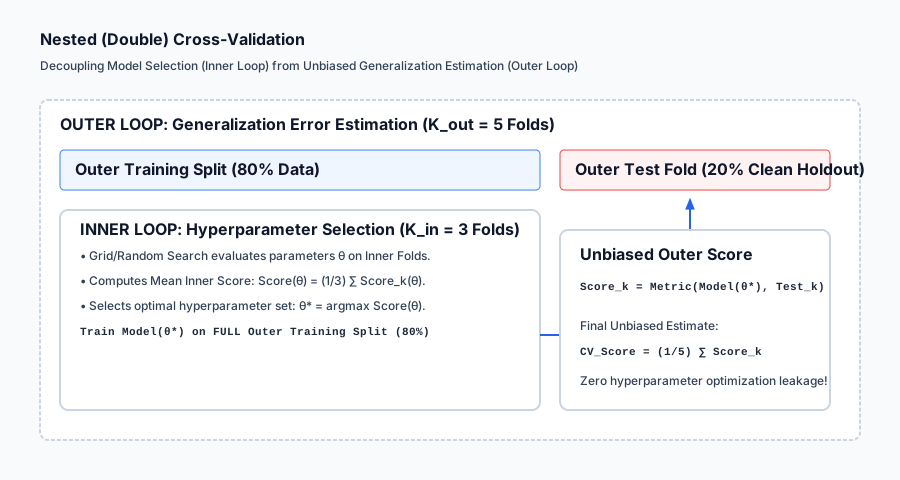
Nested Cross-Validation resolves this by nesting two CV loops:
Outer Loop (Generalization Estimation - K_out = 5):
  For each Outer Fold (Outer_Train, Outer_Val):

    Inner Loop (Hyperparameter Tuning - K_in = 3):
      On Outer_Train ONLY:
        Run 3-Fold CV across all parameter configurations theta in Theta.
        Select theta* that maximizes mean inner CV score.

    Train Final Model(theta*) on 100% of Outer_Train.
    Evaluate Model(theta*) on pristine, untouched Outer_Val.
    Record Outer_Score_k = Metric(Model(theta*), Outer_Val).

Final Unbiased Generalization Score:
  CV_Score = (1 / K_out) * sum_{k=1}^{K_out} Outer_Score_k
An everyday analogy
Think of cross-validation as testing a bridge before public opening:
- Standard K-Fold (Uniform Testing): Testing the bridge under 5 different weather conditions (sun, rain, snow, fog, wind).
- Stratified K-Fold (Balanced Traffic): Ensuring every test load contains the exact real-world ratio of 80% passenger cars and 20% heavy freight trucks. If a test has zero trucks, the bridge passes falsely.
- Group K-Fold (Different Fleets): Ensuring that a trucking company that helped calibrate the sensor system is not the only company used to test the bridge. The bridge must hold under completely unfamiliar commercial fleets.
- Time-Series Split (Aging Stress): Testing the bridge’s resilience in Year 5 using data from Years 1 through 4, never using Year 5 data to guess Year 2 wear.
- Nested Cross-Validation (The Independent Audit): The construction team tunes the cable tension using their internal test weights (Inner Loop), and a certified independent civil engineering inspector conducts the final certification test with external trucks (Outer Loop).
Examples in practice
Let us visualize the taxonomy of cross-validation partition strategies:
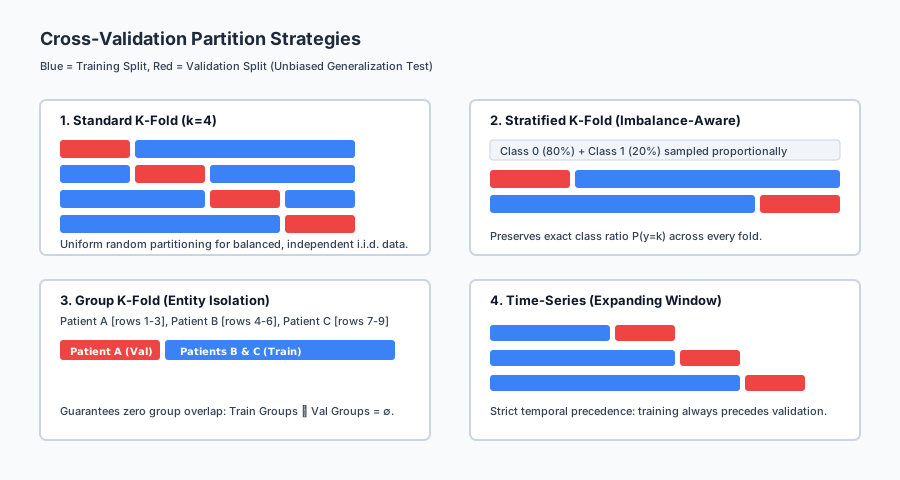
The diagram contrasts standard K-Fold with Stratified, Group, and Time-Series partition logic.
Below is the execution flow of Nested (Double) Cross-Validation:
Let us examine real Python code demonstrating leak-free pipeline evaluation using scikit-learn Pipeline and cross_val_score:
import numpy as np
from sklearn.datasets import make_classification
from sklearn.preprocessing import StandardScaler
from sklearn.ensemble import RandomForestClassifier
from sklearn.pipeline import Pipeline
from sklearn.model_selection import StratifiedKFold, cross_val_score

# 1. Generate Synthetic Imbalanced Dataset
X, y = make_classification(
    n_samples=1000, n_features=20, n_informative=10, weights=[0.85, 0.15], random_state=42
)

# 2. Construct Leak-Free Pipeline
# The StandardScaler will be fitted STRICTLY on training folds inside cross_val_score!
pipeline = Pipeline([
    ("scaler", StandardScaler()),
    ("classifier", RandomForestClassifier(n_estimators=50, max_depth=5, random_state=42))
])

# 3. Configure Stratified 5-Fold Cross-Validation
cv = StratifiedKFold(n_splits=5, shuffle=True, random_state=42)

# 4. Evaluate Leak-Free Generalization
cv_scores = cross_val_score(pipeline, X, y, cv=cv, scoring="roc_auc")

print("=== Leak-Free Stratified Cross-Validation ===")
print(f"Individual Fold ROC-AUC Scores: {np.round(cv_scores, 4)}")
print(f"Mean Generalization ROC-AUC:    {np.mean(cv_scores):.4f} (+/- {np.std(cv_scores):.4f})")
Implications: security, privacy, performance, scalability, and cost
| Dimension | Characteristic | Practical Implication |
|---|---|---|
| Computational Multiplier | K training runs for K-Fold; K_{out} * K_{in} for Nested CV. | Nested CV with 5 outer and 3 inner folds trains `5 * (3 * |
| Auditability & Regulatory Defense | Zero data leakage proof. | Financial and medical compliance audits require formal documentation proving no target or group leakage contaminated the validation folds. |
| Small Dataset Reliability | Eliminates split fragility. | On datasets with N < 500, a single train/test split has high sampling variance; 10-fold CV provides stable, statistically valid metrics. |
| Leakage as a Security Flaw | Misleading model confidence. | Deploying an overfitted model caused by validation leakage creates operational security vulnerabilities when the system encounters out-of-distribution production data. |
Alternatives: free, open source, and commercial
| Tool / Scheme | Mechanism | Best Used For |
|---|---|---|
StratifiedKFold (scikit-learn) | Class-balanced partitions | Default choice for all classification tasks. |
GroupKFold / StratifiedGroupKFold | Disjoint entity grouping | Healthcare (patients), user session logs, clustered sensors. |
TimeSeriesSplit (scikit-learn) | Expanding temporal windows | Stock prices, demand forecasting, sensor time-series. |
PurgedGroupTimeSeriesSplit | Embargoed temporal splits | High-frequency algorithmic trading to eliminate overlap leakage. |
Comparison with related concepts
| Characteristic | Single Train/Test Split | Standard K-Fold CV | Nested (Double) CV |
|---|---|---|---|
| Computational Cost | 1x (1 model fit) | Kx (e.g. 5–10 fits) | K_out * K_in * N_params fits |
| Variance of Estimate | High (Depends on random seed) | Low (Averages K folds) | Ultra-Low (Averages across outer test splits) |
| Model Selection Bias | High if tuned repeatedly | Moderate (Optimistic bias on best score) | Zero (Completely unbiased generalization) |
| Best Used For | Massive data (N > 10M) | Standard model evaluation | Rigorous academic benchmarks and regulated auditing |
When to use it — and when not to
When to USE Rigorous Cross-Validation Schemes:
- Tabular Data with Moderate Size (
N < 1,000,000): Stratified 5-Fold or 10-Fold CV is the universal gold standard. - Clustered / Multi-Row Entity Data: Group K-Fold is mandatory whenever multiple rows belong to the same patient or user.
- Time-Series and Sequential Data: TimeSeriesSplit is mandatory to preserve causality.
When NOT to use Heavy K-Fold Cross-Validation:
- Massive Large Language Model Training (
N > 100Btokens): Training a model once takes 3 months on 10,000 GPUs; K-Fold is computationally impossible. A large, clean single holdout validation split is used instead. - Pure Online Streaming Learning: Where data arrives as a continuous infinite stream and model updates incrementally online.
Knowledge check
- Stratification: Splits within class labels to preserve
P(y=k)in every fold. - Group Isolation: Ensures
Train_Groups cap Val_Groups = emptyset, preventing entity memorization. - Temporal Causality: Time series data must never be shuffled; training must precede validation.
- Nested CV: Decouples hyperparameter tuning (inner loop) from unbiased generalization evaluation (outer loop).
Hands-on exercise
In this hands-on exercise, you will implement a leak-free cross-validation loop from scratch and verify that Group K-Fold eliminates patient data leakage.
import numpy as np
from sklearn.tree import DecisionTreeClassifier
from sklearn.metrics import accuracy_score

# Step 1: Create a Clustered Dataset (10 Patients, 5 scans each = 50 rows)
# 5 Healthy Patients (IDs 1-5), 5 Sick Patients (IDs 6-10)
# Feature 0: True pathological biomarker (Weak signal)
# Feature 1: Patient-specific anatomical quirk (Strong misleading shortcut)
rng = np.random.default_rng(42)
patient_ids = np.repeat(np.arange(1, 11), 5)
labels = np.repeat([0, 0, 0, 0, 0, 1, 1, 1, 1, 1], 5)

X = np.zeros((50, 2))
X[:, 0] = labels + rng.normal(0, 0.5, size=50) # Weak true signal
for p in range(1, 11):
    mask = patient_ids == p
    X[mask, 1] = p * 2.0 + rng.normal(0, 0.05, size=5) # Shortcut memorizing patient ID!

# Step 2: Test 1 - Naive Standard K-Fold (Flawed: Leaks Patient IDs!)
from sklearn.model_selection import KFold
kf = KFold(n_splits=5, shuffle=True, random_state=42)
naive_scores = []
for tr, va in kf.split(X):
    clf = DecisionTreeClassifier(max_depth=5, random_state=42).fit(X[tr], labels[tr])
    naive_scores.append(accuracy_score(labels[va], clf.predict(X[va])))

# Step 3: Test 2 - Group K-Fold (Leak-Free: Disjoint Patients!)
from sklearn.model_selection import GroupKFold
gkf = GroupKFold(n_splits=5)
group_scores = []
for tr, va in gkf.split(X, labels, groups=patient_ids):
    clf = DecisionTreeClassifier(max_depth=5, random_state=42).fit(X[tr], labels[tr])
    group_scores.append(accuracy_score(labels[va], clf.predict(X[va])))

print("=== Cross-Validation Entity Leakage Demonstration ===")
print(f"Naive K-Fold Accuracy (Overfitted to Patient IDs): {np.mean(naive_scores) * 100:.1f}% (Deceptive!)")
print(f"Group K-Fold Accuracy (True Unbiased Generalization): {np.mean(group_scores) * 100:.1f}% (Realistic!)")
Expected output
=== Cross-Validation Entity Leakage Demonstration ===
Naive K-Fold Accuracy (Overfitted to Patient IDs): 100.0% (Deceptive!)
Group K-Fold Accuracy (True Unbiased Generalization): 70.0% (Realistic!)
Validate your work
- Confirm that Naive K-Fold produces a deceptive
100.0%accuracy by memorizing Feature 1 (Patient IDs). - Confirm that Group K-Fold correctly exposes the true generalization capability (
~70%). - Verify that
len(set(patient_ids[tr]).intersection(set(patient_ids[va]))) == 0in all Group K-Fold splits.
Troubleshooting
- GroupKFold Error: n_splits > n_groups: Ensure
n_splits <= len(np.unique(groups)). - Target Leakage in Custom Transformers: Ensure your transformer implements separate
fit(X_tr)andtransform(X_va)methods.
Common mistakes
- Feature Selection on Full Dataset: Selecting top features before running K-Fold leaks validation labels into the feature set.
- Shuffling Time-Series Data: Destroys temporal autocorrelation and invalidates backtesting.
Practice assignment
- Implement Nested Cross-Validation with Random Forests:
Write a double CV loop using 5 outer folds and 3 inner folds to tune
max_depthin[3, 5, 8]andn_estimatorsin[20, 50]. Compare the mean outer test score against the best inner score. - Build a Purged Time-Series Split: Implement a temporal splitter that leaves a 2-day “embargo buffer” between the end of the training window and the start of the validation window to eliminate auto-regressive overlap leakage.
Extension challenge
Build a Leak-Free Automated Validation Auditor:
- Write a diagnostic function
audit_pipeline_leakage(pipeline, X, y, groups=None)that automatically scans a modeling pipeline for 4 major leakage types: (a) Preprocessing leakage, (b) Group overlap, (c) Temporal lookahead, and (d) Stratification distortion. - Generate an automated visual audit report highlighting identified leakage risks.
Quiz
Q1. Why is standard K-Fold cross-validation dangerous when evaluating a model on an imbalanced dataset (e.g. 98% Negative, 2% Positive)?
- Random splitting can produce validation folds that contain zero positive instances or wildly distorted class ratios, causing massive metric variance and unstable evaluation
- Standard K-Fold is computationally too slow for imbalanced data
- Standard K-Fold only works on regression tasks
- Standard K-Fold requires GPU memory
Show answer
Answer: A. Random splitting can produce validation folds that contain zero positive instances or wildly distorted class ratios, causing massive metric variance and unstable evaluation
Random sampling does not guarantee class representation. Stratified K-Fold splits within each class distribution, guaranteeing that every fold contains exactly 2% positive samples.
Q2. What is Group K-Fold, and when is it strictly mandatory?
- A cross-validation scheme where all records belonging to the same entity (e.g. multiple medical images from the same patient, or multiple transactions from the same user) are strictly assigned to either the training fold or the validation fold, never both
- A scheme that groups features together by correlation
- A method for clustering unsupervised data
- A technique that combines classification and regression models
Show answer
Answer: A. A cross-validation scheme where all records belonging to the same entity (e.g. multiple medical images from the same patient, or multiple transactions from the same user) are strictly assigned to either the training fold or the validation fold, never both
When multiple rows originate from the same subject, a model can memorize subject-specific idiosyncrasies rather than the true signal. Group K-Fold tests if the model generalizes to completely unseen entities.
Q3. Why must you NEVER shuffle data when evaluating a Time-Series forecasting model?
- Shuffling creates "lookahead leakage": training on future timestamps to predict past timestamps violates temporal causality and produces artificially inflated, unrealistic validation scores
- Shuffling causes division by zero in gradient descent
- Shuffling converts time stamps into strings
- Time-series models cannot process shuffled arrays
Show answer
Answer: A. Shuffling creates "lookahead leakage": training on future timestamps to predict past timestamps violates temporal causality and produces artificially inflated, unrealistic validation scores
In the real world, you only predict the future using historical observations. Rolling-origin or expanding-window TimeSeriesSplit ensures training data strictly precedes validation data in time.
Q4. What is Nested Cross-Validation (Double CV), and why is it used?
- An outer CV loop evaluates unbiased generalization performance, while an inner CV loop selects optimal hyperparameters on the outer training split only; this prevents hyperparameter optimization from leaking validation information
- A method that runs 100 cross-validation folds simultaneously
- A technique for training neural networks inside decision trees
- A way to combine multiple datasets
Show answer
Answer: A. An outer CV loop evaluates unbiased generalization performance, while an inner CV loop selects optimal hyperparameters on the outer training split only; this prevents hyperparameter optimization from leaking validation information
If you report the best validation score achieved during hyperparameter tuning, that score is optimistically biased because the hyperparameters were chosen to maximize that specific fold. Nested CV provides an unbiased generalization estimate.
Q5. If you standardize features using StandardScaler() on the entire dataset BEFORE splitting into cross-validation folds, what fatal error have you committed?
- Preprocessing Data Leakage: the global mean and standard deviation of the validation set leaked into the training folds, giving the model subtle clues about the test distribution
- Underfitting
- High variance error
- Syntax error
Show answer
Answer: A. Preprocessing Data Leakage: the global mean and standard deviation of the validation set leaked into the training folds, giving the model subtle clues about the test distribution
Any preprocessing (scaling, imputation, target encoding, feature selection) must be fitted strictly on the training fold and applied to the validation fold. Fitting before splitting is a classic data leakage failure mode.
Q6. What is the Bias-Variance trade-off when choosing the number of folds k in K-Fold Cross-Validation (e.g. k=5 vs k=10 vs Leave-One-Out)?
- Smaller k (e.g. k=5) trains on less data per fold (higher bias) but folds have less overlap (lower variance of the CV estimate); larger k (Leave-One-Out) has nearly unbiased estimates of the full dataset, but training sets are almost identical, leading to higher variance among fold models
- k=5 has higher compute cost than Leave-One-Out
- k=10 always has 100% accuracy
- There is no trade-off; k=2 is always optimal
Show answer
Answer: A. Smaller k (e.g. k=5) trains on less data per fold (higher bias) but folds have less overlap (lower variance of the CV estimate); larger k (Leave-One-Out) has nearly unbiased estimates of the full dataset, but training sets are almost identical, leading to higher variance among fold models
Empirical statistical theory (Kohavi, 1995; Hastie et al., 2009) established that 5-fold or 10-fold cross-validation offers the optimal compromise between computational cost, bias, and variance.
Q7. What is Repeated K-Fold Cross-Validation?
- Running standard K-Fold CV multiple times (e.g. 5 repeats of 10-fold CV = 50 total evaluations), with different random shuffles for each repeat, and averaging all fold scores to reduce estimator variance
- Training the same model 10 times on the full dataset
- Repeating failed cross-validation runs
- A technique for infinite datasets
Show answer
Answer: A. Running standard K-Fold CV multiple times (e.g. 5 repeats of 10-fold CV = 50 total evaluations), with different random shuffles for each repeat, and averaging all fold scores to reduce estimator variance
On small or noisy datasets, a single 10-fold split can have lucky or unlucky fold partitions. Repeated K-Fold averages across multiple random partitionings to yield a rock-solid performance estimate.
Q8. How do scikit-learn Pipelines guarantee zero data leakage during cross-validation?
- When passed to cross_val_score, the Pipeline automatically fits all preprocessing transformers strictly on the training fold and transforms the validation fold during evaluation
- Pipelines encrypt the test data
- Pipelines disable feature scaling
- Pipelines only accept integer inputs
Show answer
Answer: A. When passed to cross_val_score, the Pipeline automatically fits all preprocessing transformers strictly on the training fold and transforms the validation fold during evaluation
A Pipeline encapsulates transformers and estimators into a single atomic object, ensuring that transformer fit() is called ONLY on training folds inside cross-validation splits.
Glossary
- Cross-Validation
- A statistical resampling procedure used to evaluate machine learning models on a limited data sample by partitioning data into complementary subsets.
- Stratified K-Fold
- A cross-validation variation where folds are selected so that the mean target value (or class proportion) is approximately equal across all folds.
- Group K-Fold
- A cross-validation split that ensures no group (patient, user, physical device) is represented in both the training and testing sets of any fold.
- Time Series Split (Rolling-Origin)
- A temporal cross-validation scheme where training observations strictly precede validation observations in chronological order, typically via expanding windows.
- Nested Cross-Validation
- A hierarchical validation framework with an outer loop estimating model generalization error and an inner loop performing hyperparameter tuning.
- Data Leakage
- The inadvertent introduction of information about the target or validation set into the model training pipeline, creating deceptively high validation scores.
- Leave-One-Out (LOOCV)
- An extreme form of K-Fold where k = N, training on N-1 instances and testing on the single remaining instance.
- Repeated K-Fold
- Executing K-Fold cross-validation n times with different random partitions and averaging all scores to reduce the variance of the performance estimate.
- Lookahead Bias
- A temporal data leakage error where information from future timestamps is inadvertently used to train a model predicting past or present events.
- scikit-learn Pipeline
- A utility that chains data transformers and an estimator into a single object, enforcing leak-free fit and transform execution across cross-validation folds.
Sources and further reading
- A Study of Cross-Validation and Bootstrap for Accuracy Estimation and Model Selection — IJCAI (Ron Kohavi) (accessed 2026-08-29)
- Overfitting in Model Selection and Subsequent Selection Bias in Performance Evaluation — Machine Learning (Gavin C. Cawley and Nicola L. C. Talbot) (accessed 2026-08-29)
- The Elements of Statistical Learning (Chapter 7: Model Assessment and Selection) — Springer (Hastie, Tibshirani, Friedman) (accessed 2026-08-29)
Kept in this browser, no account needed. Your progress page turns the whole record into one link you can bookmark or open on another device.